Saturday, August 22, 2020

Cab Ride to Liverpool

I came across the video above on YouTube this week.  It was taken on Thursday, 30th May, 1985, and records the view from the cab of a class 86 locomotive (86257 ‘Snowdon’) hauling a morning express from London Euston station to Liverpool Lime Street.  It is a nice opportunity to see the West Coast Main Line before the modernisation of 2004–2008, and also the ‘old’ (1902) Crewe station only days before most of it was levelled for complete remodelling, not to mention the electrified catenary whose installation my grandfather had a hand in overseeing in the 1960s.  I was a little taken aback by the blasé attitude to safety on the part of the permanent-way gangs, ambling around in the four-foot, right in the path of trains bearing down on them from various directions — see for instance the departure from Watford Junction! — but it is otherwise rather a relaxing way to spend the best part of three hours. 

It is enjoyable to see so much of the old British Rail traction out and about that is almost all now long withdrawn and scrapped, though I believe a few class 86s survive on freights.  It is good, too, to see the line so busy with trains and the stations with passengers, for in many ways the railways were in the doldrums in the mid-1980s.  The Beeching Axe had dealt its mortal blows to a third of the network only twenty years before, the motor-car’s supremacy was uncontested, and British Rail, being a nationalised industry, was scraping by on grudging Government subsidies.  The revival of the new millennium was still a good way off.

As well as the view ahead, I also found the conversation of the three men in the cab thoroughly absorbing — especially the running commentary provided by Traction Inspector Peter Crawley with the sort of articulate, measured voice that is seldom heard these days.  As well as being able to explain the ingenious solutions to the intricate puzzle of running a railway, he clearly knows and loves the line itself, the southern half especially, and is able to point out many interesting sights — everything from the Norman castle at Berkhamsted to the M25 motorway under construction at Kings Langley, from the reputed hauntedness of the slow lines’ tunnel at Watford to the factory of Armitage Shanks, renowned manufacturer of bathroom fittings!  There are the three spires of Lichfield Cathedral, Izaak Walton’s cottage just north of Stafford, the majestic crossing of the Mersey at Runcorn, and the dramatic final descent through the hewn tunnels into Lime Street.  We even encounter the Royal Train near Hartford in Cheshire.  On the approach to Crewe, Inspector Crawley points out how alarmingly near the station the Coronation Scot had got when it reached its record speed of 114mph in 1938, and therefore just how late the driver left it to slam on the brakes (too late, in fact, for the crockery in the dining car).

These days YouTube abounds with oodles of excellent modern-day cab-ride videos, many with highly informative captions: some of the best for British routes are supplied by Don Coffey, Ben Elias, ‘emmo999’ and Richard Griffin, who is one of the group maintaining the preserved ‘Hastings Diesel’ multiple unit.  But there is also something highly satisfying about this older, comparatively rudimentary film and the spontaneity and immediacy of the commentary.  It is almost as if Peter Crawley is reciting an old, familiar tale: for him the railway is no mere ‘transport artery’, but a corridor of associations and memories and jokes, with lore lying around every curve.  The film would be simply a non-stop miscellany of facts and trivia, if it were not held together by the thin bright narrative threads of the twin steel rails.

Railways are romantic because they tell stories as they go; they cannot help turning the landscape into the setting for a grand epic poem.  Whereas a motorway tramples amply wherever it will, railways are mindful of their surroundings as they weave their way ahead — regardless of their respective engineers’ intentions, good or ill, this is how it seems to be.  This is why, on long rail journeys, I often find myself putting my book aside in favour of the other, wordless narrative unfolding outside the window.  I find myself watching it all unfold, trying to learn England, so that it will become for me, as for Peter Crawley, a known and beloved land, full of fond sights; a gift to be passed on to others.

Friday, July 31, 2020

Poem in July 2020

Entered for a poetry competition organised by my parish.

  And we were once again the Israelites,
  Lost in the desert, driven with our tents
  Into lean lives for forty days and nights,

  With fear for foe.  But from that lengthiest Lent’s
  Bright soundless skies
  There fell strange manna, semi-sacraments:

  Unsullied sunlight, bolder birdsong, the surprise
  Of spring’s long-hoped-for leaf-burst jubilee;
  New green, new gilding, seen with clearer eyes.

  And more: the Gospel-truths shown differently,
  How we are all one body, and how light
  In shadow only shines more radiantly.

  Let quiet thanks, although there is in sight
  No end of troubles in the years ahead,
  Be given for the easing of our plight,

  And for our brethren, all whose souls were led
  Out of this world of mingled grace and vice,
  Let Requiems be said,

  That by the Lord’s love, and His sacrifice,
  They may see Paradise.

Vaulting above One Island Pond, 29th May, 2020.

Saturday, July 25, 2020

Ruth Gipps: new recording of Clarinet Concerto

Yet more good news concerning the music of Ruth Gipps!  A recording of her Clarinet Concerto (op. 9, 1940), whose world première in London last November I so thoroughly enjoyed, was released on a new disc last Friday.  The record is called ‘Reawakened’ and is catalogue number CHRCD160 on Champs Hill Records.  It features several other neglected clarinet concerti by Iain Hamilton and Richard Walthew, as well as John Ireland’s Fantasy Sonata.  Robert Plane is the soloist, and he is accompanied by the BBC Scottish Symphony Orchestra under Martyn Brabbins.

The slow movement was broadcast this morning on BBC Radio 3’s ‘Record Review’, and can be heard here for a month from now, about 1 hour 39 minutes into the programme.  It is a beautiful rendition.

Friday, June 12, 2020

‘Jednego Serca Jednego Ducha’: online edition

The feast of Corpus Christi, which was celebrated in Poland yesterday, is usually the occasion for the great ‘Jednego Serca Jednego Ducha’ hymn-singing concerts (about which I have written here and here).  This year’s, however, has gone the way of all large public gatherings: yet another casualty of the Coronavirus pandemic.  

The organisers did not admit complete defeat, however!  They put together an edition of the concert to stream over the Internet so that, although the Sybiraków park in the city of Rzeszów lay empty, where it should have been full of tens of thousands of people, the music at least could carry on.  It’s not the same as the real thing, but definitely something to cheer us all up.  See below to watch it, or click here: <https://www.youtube.com/watch?v=8f9V3DJ_9gU>.  

Sunday, June 07, 2020

Trinity Sunday

Lord, who hast form’d me out of mud,
 And hast redeem’d me through thy blood,
 And sanctifi’d me to do good; 
Purge all my sins done heretofore:
 For I confess my heavy score,
 And I will strive to sin no more. 
Enrich my heart, mouth, hands in me,
 With faith, with hope, with charity;
 That I may run, rise, rest with thee.
       George Herbert (1593–1633)
Happy Trinity Sunday!  This jewel-like lyric makes its meaning perfectly plain on the first reading, but then — a revelation to which I owe John Drury in ‘Music at Midnight’, his unforgettable biography of Herbert (London: Penguin, 2013) — notice all the threes wrapped up so tightly in it.  Three stanzas of three lines each; the first giving one line each to the Father, the Son and the Holy Spirit, the second to the past, the present and the future, and the last having three elements in each line, thrice three.

Fr. Mark Langham preached another wonderful homily this morning from Fisher House, the Catholic Chaplaincy of the University of Cambridge.  The Mass can be seen and heard here; Fr. Mark’s sermon begins 18 minutes and 23 seconds into the video.

Saturday, June 06, 2020

Lincolnshire Towers: St. Wulfram’s, Grantham

The steeple of St. Wulfram’s church first caught my eye, as it must many people’s, at about 105 miles per hour, the speed at which non-stop express trains hammer through the Lincolnshire town of Grantham, shooting out onto the high embankment across the town, leaning into the curve — and there, soaring above the chimneys and rooftops flashing jaggedly by in the foreground, there is Wulfram’s tower, with the same serenity with which it has weathered the seven centuries of its age; and the spirit soars with it.  The vision hangs and swivels, lingering for perhaps fifteen seconds, and is gone, and the train is pressing on towards Lincolnshire’s borders and London, or Yorkshire, or Scotland.

There are those who call the East Coast Main Line dull and boring, mainly because, south of County Durham at least, it runs relatively straightforwardly through England’s flatter counties.  But there are more than mountains to be seen from the window of a train.  For this line, as much as any other, I am sure, is proof of the poetry conjured up by that conspiracy if churches and railways.  Four medieval cathedrals — Durham, York, Peterborough and Lincoln — can be spotted to varying degrees at various points along its length, and plenty of other fine churches greet the eye as well, from the fifteenth-century spire of St. Mary Magdalene at Newark-on-Trent to Doncaster Minster’s Victorian Gothic, or handsome St. Peter’s at Offord D’Arcy.  But of all these, save perhaps only Durham, the sight of St. Wulfram’s at Grantham is surely the most thrilling.  Here the line speed (105mph beats ninety at Durham!), the eye-level view from the embankment, the church’s proximity to the railway, and, above all, the sheer beauty of the steeple, all conspire to lend those few seconds of the journey a meaningful, harmonious, unforgettable form, that of a theatrical scene, revolving like a snow-globe.  In other words, they turn Grantham into a poem.
St. Wulfram’s spire from a passing London train, 6th June 2017
Other travellers have noticed this before me.  For the writer Peter Hitchens, who ‘normally make[s] a point’ of looking out of the window whenever he comes this way, this is ‘one of the loveliest steeples in all England’.  And, according to the BBC programme Songs of Praise, which came to Grantham in 1980, ‘a certain Fr. Stanton’ would apparently stand up in the middle of the compartment to raise his hat in honour of the spire and its builders, and request his fellow passengers to do the same.  For myself, I resolved one day to visit Grantham properly, and to savour the poem more slowly, more closely, and from within.

That resolution was to be fulfilled one brisk autumn day in 2018. The train had pelted headlong from London, so it was barely mid-morning when my sister and I alighted half-way up England, under shredded bands of cloud scudding intermittently across the face of a kindly sun.  Off we set, through a pleasing warren of terraced houses immediately east of the station, down to where the Great North Road swoops in.  Even now it is not difficult to imagine the stage-coach days, with the inswooping mail trailing its column of dust, all wheels and thumping hooves and harnesses ajangle.  Not far along the road we found the majestic Victorian Guildhall, a building worthy of a major town on the Great North Road, with a statue of Isaac Newton outside, and a bustling local writers’ fair inside.  I was warming to Grantham already, sensing a certain self-respect that did not need to give itself airs (or maybe a down-to-earth-ness, appropriately enough for Newton’s home patch).  But there was no time to linger, for there was business to attend to.  Our plan was not to head straight for the church, but to hare up Hall’s Hill, the rise bounding the town to the east, in order to admire the great steeple from afar.  Hindered only by a bush full of angry wasps, which we doubled back to avoid, we climbed up high enough to be able to look back down on the town, and watch the sunlight and shadow cascading over it, and the fast trains hurtling through in the middle distance.
The view westwards from Hall’s Hill, 3rd November, 2018.
There in the autumn noon stood the tower that has been the glory of this broad, shallow valley of the young Witham since about the year 1320.  We were looking at a sight instantly recognisable, by this one essential feature, to twenty generations before us.  Briefly this was England’s highest steeple, until within ten years Salisbury Cathedral’s spire overtook it.  The two projects were not in fact unconnected, as Julian Flannery explains in his peerless Fifty English Steeples (Thames & Hudson, 2016), because Grantham actually belonged to Salisbury diocese: clearly one spire was not enough!  In any case, according to Flannery’s comprehensive theodolite surveys, St. Wulfram’s remains England’s fifth highest surviving medieval steeple after Salisbury and Norwich Cathedrals, the fellow Lincolnshire steeple of St. James’ in Louth, and St. Michael’s in Coventry (that is, the ‘old’ Coventry Cathedral).  It is worth mentioning in passing that three of the four highest medieval steeples of English parish churches are to be found in Lincolnshire: Louth amid the dreaming Wolds (287 feet), Grantham in south-western Kesteven (274 feet), and fen-defying Boston (266 feet).  This is to say nothing of Lincoln cathedral, once the tallest building in the world by virtue of its 520-foot central spire.  (Even after this spire collapsed in 1549, and the two others at the west end were taken down in the eighteenth century, Flannery believes that what remains of the central tower ‘may just exceed’ St. Botolph’s at Boston.)

The spire seen from Park Road.
But I am day-dreaming.  St. Wulfram can be put off no longer; it is time to go down the hill, threading through the suburban houses and the park — all almost conspicuously unpretentious, as if the town thinks the tower is showing off enough! —  to see the great church at closer quarters.
The west front.
So this is the steeple before which Ruskin swooned.  Here, as well as anywhere, it is possible to see the glory of the Gothic: the sheer verticality of everything, every little detail doing its bit to add to the upthrust of the whole.  The whole structure is straining towards Heaven, and the wide traceried windows let in Heaven’s light.  Flannery pointed out the one major mistake made by the builders in the staircase at the south-west corner, which was built too far out at the bottom, and which unfortunately, by becoming more pronounced as the tower tapers with height, throws the whole slightly off its symmetry.  Yet this lesson was learned here once and for all; the error was not repeated in any of the later great English towers.

Looking west from the chancel.  The tower stands right over the west door.
Considering the steeple’s emphasis on verticality, there is an interesting contrast waiting inside the church: the enormous and spacious width of its interior.  The two side-aisles are each almost as broad as the nave: John Betjeman even declares that the ‘power of the grand interior is horizontal rather than vertical’ (Best British Churches, Collins, 2011 edition, p. 400).  The church impresses us first by its height, then by its breadth.  In the north wall an alcove is visible where St. Wulfram’s relics are likely to have been displayed.  I wonder what grand processions there have been through this church over the years.  One spectacle that has been recorded for posterity is the visit of the BBC programme ‘Songs of Praise’ in 1980, which, for all sorts of reasons, in texture, language and content, seems caught at a curious, fascinating position, between the old Britain and the new.


We were, I think, about the only visitors at that point on the Saturday afternoon, but there were quite a few townsfolk pottering around.  Chairs and parts of a dismantled stage were being cleared away and loaded into a van after a secular awards ceremony the previous night, and a youngster no more than ten years old was being given a lesson on the mightly organ.  (I hope he will one day support a mighty surge of singing, as in Songs of Praise above!)  I bought a tea-towel showing the great spire (it has to be a particularly large tea-towel to fit the tower in) and we took our leave.

From the south-west.
This being a non-party-political blog, no party-political allegiance should be read into the detour we then made to see the building where, on October 13, 1925, Margaret Thatcher, Prime Minister from 1979 to 1990, was born.  This red-brick corner shop is, I think, revealing about her character, even though it is no longer Roberts the greengrocer but a chiropractic clinic.  This must have been, as has often been pointed out, and which seems in common with Grantham in general, an unpretentious but decent place to grow up; plain and unvarnished but dignified and unbowed (and is even raised slightly above the level of the road).  The Methodist church where the Roberts family worshipped is only a few doors down.

Margaret Thatcher’s birthplace, North Parade, Grantham.
It seems arguable that this building goes some way to explain both Margaret Thatcher’s sympathy as a politician for those who worked hard to earn their living, which aided her electoral success, and her apparent lack of sympathy with those who were not capable of doing so, which is generally acknowledged to have precipitated the end of her premiership.  I was also struck by the shop’s position actually right on the old Great North Road, and not far at all from the railway either; she must, as she was growing up, have felt London and the wide world beckoning to her the moment she stepped outside the front door.

Almost directly opposite Margaret Thatcher’s birthplace is one of the most curious Catholic churches I have ever seen.  From outside, St. Mary the Immaculate is a solemn, sober early nineteenth-century neo-classical edifice.  Inside, however, it is completely different: the church seems to have been altogether transformed in the 1960s, so that the altar now faces north, not east, along what must once have been the length of the church, rather than its breadth.  I don’t think I have ever seen a church with an interior differing so dramatically from the exterior.  This surprise certainly competes with the contrast between horizontal and vertical in St. Wulfram’s!
Inside the church of St. Mary the Immaculate, looking north
Daylight began to fade as we drank hot chocolate in Cafe Leo along Westgate, and so the time came to take our leave of this reserved, unshowy town with its ardent steeple, and of the unsung, wide-skied county in which it is set.  But not for long, for another tower further east, that of St. Botolph in Boston, was soon to beckon me back to Lincolnshire.

Postscript: Writing this at Whitsuntide, I am reminded of Philip Larkin’s famous poem ‘The Whitsun Weddings’.  Poetically at least, this week is the sixty-fifth anniversary of the journey it records.  It was down this line that Larkin’s train came that ‘sunlit Saturday’.  He would have passed through Grantham, and one of those weddings may well have been solemnised in St. Wulfram’s church.  Truly England is a poem.

Friday, May 29, 2020

Happy Oak Apple Day!

I have been reminded (by the blog ‘Once I was a Clever Boy’, via the British Catholic Blogs list) that today, 29th May, is Oak Apple Day.  (I shouldn’t have forgotten, but all the days are running into each other)…  A happy celebration of Charles II’s Restoration to all readers!

(An Oak Apple, by the way, is a gall, from one particular kind of which iron gall ink was once made).

Under the boughs of a local oak, 29 May 2020.

Friday, May 22, 2020

Three Childhoods

  On whose account, then, of these hundreds
  Ashrill in this playground of anguish,
  Under the yellowish, suburb-smothering noon,
  Of these hundreds at sixes and sevens at ten and eleven,
  Should Heaven be loudest appealed to?

  Luke Salt’s, for example?  Wild-hearted and gleeful of limb,
  Eager to get stuck in
  To some challenge in which to triumph
  And bring out the best in his allies and rivals alike,
  But a boisterous-elbowed boy,
  Blind to his own wayward roughness, so can’t think why
  Teachers all pick on him.
  And what he might do without meaning, though done on purpose,
  Others do back, so he does back back —
  To be punished with shunning and shame.
  And trouble at home he carries in secret to school
  In goblets of anger that always, eventually, spill
  Awfully over, costing him comrades,
  Marring his soul with a dark and deepening stain,
  And laying to waste the Luke Salt who might yet be,
  But whom, if lost, shall we ever regain?

  Or Connie-May Bushell, alight
  With gregarious giggles, and bright with wit,
  A brilliant play-mate aflash with ideas,
  Lively and bookish, but apt to be led astray,
  Whose innocence, if undefended,
  Will soon be ended?
  For what will prevent her, some day not far hence,
  Seeing the world’s ways,
  From trashing her own constitution
  And wholly dismantling her soul,
  Abolishing all the old ways with all her might,
  Shuttering, barring, veiling,
  Uprooting and ridding her whole
  Self of her former self?
  The passionate games will die,
  Sullenness cloud her eye,
  The voice that should sweeten will harden,
  And only a shadow will loiter
  Where light should have lightened the lives of all around.

  Or perhaps Peter Palmer,
  Standing out under the branches still,
  Imagining friendship under the dust-brown leaves,
  Friendship and conversation;
  Given to sniffiness, true, towards most of the rest,
  Vexed by their posturings, irked by their noise
  (The bossy and fussy girls and the mindless boys) —
  But heart set firm on a distant bearing:
  Transcendent good, and to do what is just
  Will endure what he must.

  O Lord, save thy people, and bless thine heritage.
  Govern them, and lift them up for ever.
  O Lord, in thee have they trusted.
  Let them never be confounded.

Thursday, May 21, 2020

Happy Ascension Day!

Wishing a very happy feast of the Ascension to all readers!


O clap your hands, all ye people; shout unto God with the voice of triumph.
For the LORD most high is terrible; he is a great King over all the earth.
God is gone up with a shout, the LORD with the sound of a trumpet.
Sing praises to God, sing praises: sing praises unto our King, sing praises.
For God is the King of all the earth: sing ye praises with understanding.
God reigneth over the heathen: God sitteth upon the throne of his holiness.

Psalm 46 (47): 1-2, 5-8, set to stirring music by Ralph Vaughan Williams.

Friday, May 08, 2020

VE Day


Some local decorations


Quite a few houses round about have been impressively decorated with flags and bunting for the seventy-fifth anniversary of VE Day.  In general, this is not the Victory Day we had envisaged, as we find ourselves engaged in a different kind of war with a new and different enemy.  But now is as good a time as any to recall with gratitude the qualities and sacrifices that won the Second World War for peace and justice against fetters and tyranny.

Here is the address made to the nation by King George VI at 9 p.m. on the 8th May, 1945.  (The full transcript can be read here: <https://www.royal.uk/king-george-vis-ve-day-broadcast>

Now that the murderers are put away
(At cost of the world’s hope), a moment comes,
Not feverish with war-cries, flags and drums,
Not terrible with terror and dismay,
Not beautiful (the lovely hope being dead),
Not hopeful, therefore, but… the time arrives…
[…] 
Man must not make less beauty than the flower.
Youth, given back from slaughter, has an hour.
Lighten us, Life: shine, planet in our east. 
—from ‘A Moment Comes’, by John Masefield (then Poet Laureate): The Times, 8 May 1945, p.7.

Saturday, April 25, 2020

Spring, Regardless

When last did silence lie over South London as it has in the past few weeks?  The Seventies?  The Sixties?  The Fifties?  Only the brief ‘stillness of the solemn air’ after heavy snowfall, as in February 2009, seems comparable, but even then I am not sure there was ever a hush so thick as that which now descends on London at night, not just in the street outside, but in all the roads around, and the roads beyond them, for miles and miles and miles.  The slick, insufferable, incessant, suburb-saturating, sempiternal seething of traffic has vanished.  Some reports suggest that the number of cars on the road has gone down by two thirds to its lowest level for sixty years; I could well believe this.  Now, four weeks into the national quarantine, I am noticing the volume of traffic creeping up again, but it is still bearable for now.  Any relief is welcome.

Council notice on the Common.
I am well aware of the suffering wrought by the pandemic, and that I write from well behind the front lines of the great battle against it, and indeed that I am relying largely on others to do the fighting.  All the same, I think it is not unfair to observe the silver linings I described a few weeks ago.  The quietening of London’s madness is one; another is the community spirit that has been the paradoxical fruit of enforced isolation.  Even having to keep our distance from each other has brought about a kind of solidarity: it is sometimes awkward to leap into the road or brambles when meeting someone coming the other way, but most people see the point and even, sometimes, humour in it (“Don’t get yourself stung!” a lady told me when she saw that I had leapt off the path into some shallow brambles to let her pass).  Children have decorated windows and pavements with innocent rainbows, and on my daily constitutionals I am exchanging friendly greetings with strangers in a manner completely at odds with London’s usual way of doing things.  

Then there is the weekly eight o’clock round of applause for doctors and nurses, which has been kept up vigorously in our street.  A friend reports that the clapping in his village at the fringes of London is lessening every week, but round near me (much further in) I am sure it is growing, if anything.  The neighbours add to the clamour by hammering on pots and pans, or by thumping their wheelie bins, while passing cars sound their horns.  Then after a minute or so, we down tools, wave to each other or call in greeting across the street, and withdraw.  Some might scoff at this, but I feel this is just the sort of custom that many parts of Britain, mine included, have long lacked.

It occurs to me that this pandemic may well cement the National Health Service into place as the established religion of Britain.  This is entirely understandable: our debt to doctors and nurses is now partly due in a currency other than that in which we pay our taxes.  But it may cause problems in the future if, as tends to happen with any large institution, the NHS comes to need reform of some sort, and public feeling produces misplaced resistance, legitimate changes being mistaken for undue interference.  On the other hand, the strength of public faith in the NHS will also serve as protection against any short-sighted erosion or thinning out of its services by its overseers.  Maybe, though, we will soon have worse to worry about than either of these problems.  (And I would also observe quietly that there are some needs which even the NHS cannot be expected to answer.)
Local pavement decoration
Daily walks over the now-well-worn paths of the Common have also given me the chance to see spring’s great leafburst in far more detail than usual.  In previous years, I put its seeming to happen overnight down to my lack of observation.  But now, regular visits in quick succession have shown me the remarkable proliferation that really does take place over only a two or three days, as if all that life is kept pent up in the earth until it can be contained no longer.

I have not altogether forgotten about the world outside my parish, though.  One gloomy piece of news that has almost been lost amid the coronavirus coverage is the continued collapse of marriage in Britain: the number registered in 2017 was a new record low, and of these the proportion of ceremonies with any religious dimension was also the lowest ever recorded: 22%.  It may sound blunt to say this, but this is the sign of a civilisation that scarcely believes in the future at all, let alone in lasting love.

But there has been cause for good cheer, such as the birthdays of Benedict XVI (ninety-three) and H.M. the Queen (ninety-four).  And Pope Francis has also given an interview here — https://www.thetablet.co.uk/features/2/17845/pope-francis-says-pandemic-can-be-a-place-of-conversion- — with something to hearten and challenge everyone, as is characteristic. For example:
It’s true, a number of governments have taken exemplary measures to defend the population on the basis of clear priorities. But we’re realising that all our thinking, like it or not, has been shaped around the economy. In the world of finance it has seemed normal to sacrifice [people], to practise a politics of the throwaway culture, from the beginning to the end of life. I’m thinking, for example, of pre-natal selection. It’s very unusual these days to meet Down’s Syndrome people on the street; when the tomograph [scan] detects them, they are binned. It’s a culture of euthanasia, either legal or covert, in which the elderly are given medication but only up to a point.
And —
Yet the elderly continue to be our roots. And they must speak to the young. This tension between young and old must always be resolved in the encounter with each other. Because the young person is bud and foliage, but without roots they cannot bear fruit. The elderly are the roots. I would say to them, today: I know you feel death is close, and you are afraid, but look elsewhere, remember your children, and do not stop dreaming. This is what God asks of you: to dream (Joel 3:1). 
What would I say to the young people? Have the courage to look ahead, and to be prophetic.  May the dreams of the old correspond to your prophecies.
 I hope all readers, and their friends and families, are safe and well.

IMG_3880
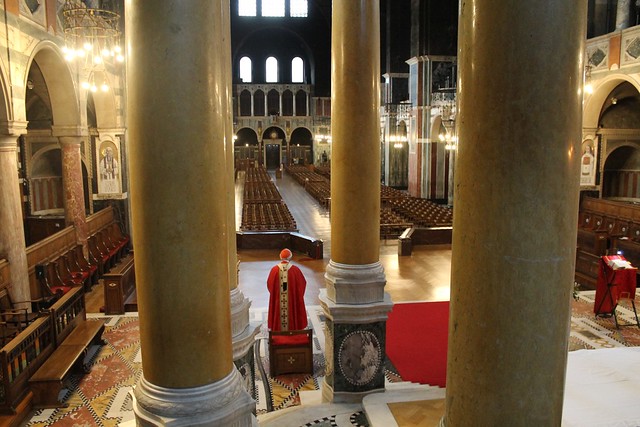
Cardinal Vincent Nichols (Archbishop of Westminster) celebrates Mass for National Health Service workers, carers, the sick and their families, in Westminster Cathedral.  
Photo from https://www.flickr.com/photos/catholicwestminster/49812472648/ (IMG_3880, 23rd April 2020).

Wednesday, April 22, 2020

Lincolnshire Towers

St. Wulfram’s church, Grantham, 3rd November, 2018.
Of all our counties I suspect few more strongly than Lincolnshire of keeping hidden, somewhere, the last remaining corner of Deep England.  For a start, there is so much of it in which to hide: after North Yorkshire it is the second-largest of the ceremonial counties, while the density of its population is the seventh lowest overall (ranking forty-second of forty-eight).  All that undisturbed, unmotorwayed acreage, almost as wide as mid-Wales, largely spared by industry and development, and unblemished by any major conurbation, in which Deep England might yet linger.  The river Trent, the Humber estuary, the Fens and the Wash, once its arteries of commerce, have come to serve as buffers against the cutting edges of modernity; and even its western, inlandmost parts are only incidentally served by the Great North Road and the East Coast Main Line (which latter never comes within thirty miles of that coast while Lincolnshire has anything to do with it).  It is true that the county has a grittier side — Scunthorpe steelworks, the port of Grimsby with its face set like flint against the North Sea, or the austerely dead-flat southern Fens — but its heart, the landscape of the Wolds or south Kesteven, has an otherworldly softness, even a tameness, about it.  That homeliness is matched by the place-names, among which even those of Danish derivation retain only a slight angularity: Willoughby… Hagworthingham… Scamblesby… Then there are all the old railway stations whose names appear in Flanders and Swann’s song ‘The Slow Train’, hinting at the heavy blow struck here by the Beeching Axe: Mumby Road, Dogdyke, Tumby Woodhouse.  Even the name of the county, with its buttery consonants, has a welcoming warmth to it.  And consider Bag Enderby in the light of Bag End, the name of Bilbo Baggins’ home in Tolkien’s Middle Earth.  If in these parts the mythical Shire can shimmer just beneath the surface, then why not very Deep England itself?

It is worth noting, too, that many Yellow-Bellies themselves — as Lincolnshire people are called — can fairly be said to be in sympathy with the ideals of Deep England. One of the most famous, indeed the son of a rector of Bag Enderby, and born nearby at Somersby, was Alfred, Lord Tennyson, whose verses tell of Arthur and the Knights of the Round Table, and vanished Lyonesse, and of many things loved and lost.  Or there is the late Roger Scruton, arguably the most articulate defender of Deep England in the past forty years, who began life in the tiny hamlet of Buslingthorpe near Market Rasen.  I concede, however, that Isaac Newton (Woolsthorpe) and Margaret Thatcher (Grantham) are harder to square with this list…


In any case, Lincolnshire has form where the preservation of Deep England is concerned.  The March of Progress always seems to be missing Lincs: is it too much to hope to find something that it has left alone altogether?  Not necessarily, is Lincolnshire’s murmured answer.  I think of Ruddock’s, the old-fashioned stationers and bookshop in Lincoln’s High Street, to which I paid tribute here at the time of its sad demise in 2017.  Or the quirky Bubble Car Museum near Boston.  And Lincolnshire sausages of course, the glorious centrepiece of any Full Deep English Breakfast.  Then there is another, less tangible but momentous example: whereas, in more urbanised parts of the country, who knows how many traditional folk-songs had been forgotten by the end of the nineteenth century, in Lincolnshire some were still remembered.  Here the last folk-singers lived just late enough to coincide with the earliest recording equipment and the Edwardian folk-song revival which saved so many tunes from extinction.  It was in the north of the county that the composer Percy Grainger discovered, and duly recorded and transcribed, such beautiful melodies as ‘Brigg Fair’ or ‘Rufford Park Poachers’.  That we can hear the voice of Joseph Taylor of Saxby-All-Saints, a man born in 1832, singing the songs of his youth, is cause to be thankful not only for Grainger and the singers who sang for him, but for the county which had preserved that folk-memory for so long.  Those songs are not only artefacts of the past, but to many ears some of its profoundest and most vivid evocations: this is borne out by the misty and chromatic arrangements that many composers made of them, Grainger’s own ‘Lincolnshire Posy’ being an example.*  Things linger in Lincolnshire: the old is slow to fade, and the new takes time to set in.  As I was once told by the guide on a rooftop tour of Lincoln Cathedral: "When the cranes go up in Lincoln, you know there’s a recession on the way."

This is not simply happenstance, either.  The county has a definite streak of rebelliousness, and its people stick by their principles.  I count very much in their favour the Lincolnshire Rising of 1536 against the Dissolution of the Monasteries, which in turn sparked off the Pilgrimage of Grace, the most serious popular opposition to confront Henry VIII; also the Lincolnshire Martyrs, who include two canonised saints.  The knowledge that Henry VIII hated Lincolnshire, declaring it ‘one of the most brute and beastly of the whole realm’, only makes me fonder of it still.  Less clear-cut morally is the tradition (if that’s the word) of poaching, which does, it must be said, have in its defence the injustice of the eighteenth-century enclosures of common land by wealthy land-owners.  The song ‘Rufford Park Poachers’, as sung by Joseph Taylor, with its pleasingly defiant declaration —
A buck or doe, believe it so,
A pheasant or an hare,
Were put on earth for everyone
Quite equal for to share […]
— captures the spirit, as does the more famous ditty ‘The Lincolnshire Poacher’ (apparently a favourite of George IV; presumably it was not his hares that were being filched!).  Those landowners had come to see the land merely as an asset or a useful resource, whereas for the poachers and ordinary folk it was simply home, and home for their minds and spirits as much as for their empty stomachs.  To this day, it is not Lincolnshire’s way to follow the herd or pay heed to fashion overmuch, and this tendency to dig in heels, combined with the fondness for old things, creates conditions highly favourable, I would say, to the secret abiding of Deep England.

For it is not altogether unthinkingly that Deep England drowses green and gold in the haze of the afternoon.  I like to believe that those who dwell in that lost land are awake and alive to truth and beauty, pondering great thoughts and bold deeds over another hearty round of ale.  The proof that such folk did once live in Lincolnshire —  if they do not live there still — is plain to see in the heirlooms they left us, which stand amid the low rises and shallow hollows of this gentle county, startling us with their beauty: I mean the towers, the great audacious medieval church towers, with their youthful exuberance, their sheer verticality, which everywhere point heavenwards.
The crossing tower of Lincoln Cathedral, 20 March 2014.  With its original spire, it once stood at 520 feet; without, it is now 271 feet high.
There is of course Lincoln Cathedral — in John Ruskin’s estimation ‘out and out the most precious piece of architecture in the British Isles and roughly speaking worth any two other cathedrals we have’ — which, when it still had its spires, was the tallest building in the world from 1311 to 1548.  The highest spire, 520 feet tall, crowned a county that never naturally rises higher than 551 feet above sea level.  But these are not Lincolnshire’s only towers.  The relative prosperity of this region in the Middle Ages, as well as its ready access to the raw material of the Great Limestone Belt (which stretches south-west from Lincolnshire’s Kesteven through Rutland, Northamptonshire and the Cotswolds, all the way to Somerset), provided conditions favourable to the building of great towers by any self-respecting town.  So it is that Lincolnshire came to possess some of England’s greatest treasures.  At Louth it boasts the tallest medieval parish church tower in England, St James’s, whose spire stands at 287 feet.  St. Botolph’s at Boston (the ‘Boston Stump’) has the tallest church tower to its roof: instead of tapering to a spire, the masonry shoots straight upwards to a height of 266 feet.  The spire of Grantham’s church of St. Wulfram, 274 feet high, sweeps into sight at 105mph when beheld, sudden, serene, from express trains on the East Coast Main line.  And hundreds of other towers, less lofty but all distinctive, all dignified, lay claim to their segment of the wide Lincolnshire sky, each raised up in intercession for its parish and all souls there dwelling.**  That is because the folk of these parts in the Middle Ages committed their wool-wealth to the dressing of their homeland for Heaven, ornamenting this lowest-lying of counties with ardent upliftings of passionate stone.

As Julian Flannery says so movingly in ‘Fifty English Steeples’, an epic volume of detailed architectural surveys of medieval church towers, and one of the most treasured books on my shelves, 
England was never more beautiful than in the two brief decades between the completion of Louth [church tower in September 1515] and the arrival of the English Reformation.  The pre-industrial landscape was dominated by the steeples of 17 cathedrals, 900 monasteries and 9,000 churches.  The spire of Lincoln Cathedral was the highest man-made structure the world had ever seen, and the construction of the great chapels at Westminster, Windsor and Cambridge had reached its magnificent conclusion.  Within a generation the monasteries had been dissolved, church-building had ceased, Lincoln spire had fallen, and medieval England had passed into history.  [p. 9]
Yet, for all the reasons above described, I have my suspicions that it is in Lincolnshire that the lost beauty he describes has lingered longest, and in particular in Lincolnshire’s towers that it survives most fiercely.  In a series of articles to come, I hope to describe what I found when I went to see some of them for myself.

St. Botolph’s church, Boston (the ‘Boston Stump’), under scaffolding on the 2nd February, 2019.  The tower is 266 feet high.
* Grainger’s Lincolnshire Posy was used as the incidental music for John Betjeman’s 1964 BBC film Branch Line.
** One other Lincolnshire tower, that of the parish church of Deeping St Nicholas, photographed from the Peterborough-Spalding line on the 20th March 2014, illustrates the title banner of this blog.

Tuesday, April 21, 2020

Happy Birthday to H. M. the Queen

Wishing a very happy ninety-fourth birthday to Her Majesty the Queen.

Here is ‘Dusk’ — a short orchestral number by Cecil Armstrong Gibbs — which Princess Elizabeth asked to hear played on her eighteenth birthday.

Saturday, April 11, 2020

‘Dazzling is the night for me, and full of gladness’

If we had not descended into the darkness of the Passion, into the depths of Good Friday and the dread of the tomb; if we were not living, too, through the shadow cast by the pandemic, then we would not have heard the Exsultet, the exultant Easter poem-prayer, in quite the same way: sung unforgettably by Fr. Mark, joy filling the chapel of Fisher House, the Catholic student chaplaincy of the University of Cambridge, and, through the speakers, filling the room where I sat in south London.

Joy, paradoxical joy for this sorrowful world: the tomb does not have the last word!  Death has no dominion!
This is the night
of which it is written:
The night shall be as bright as day,
dazzling is the night for me, and full of gladness. 
The sanctifying power of this night
dispels wickedness, washes faults away,
restores innocence to the fallen, and joy to mourners,
drives out hatred, fosters concord, and brings down the mighty.
 
[…]  
O truly blessed night, 
when things of heaven are wed to those of earth,
and divine to the human. 
Therefore, O Lord,
we pray you that this candle,
hallowed to the honour of your name,
may persevere undimmed,
to overcome the darkness of this night.
Receive it as a pleasing fragrance,
and let it mingle with the lights of heaven.
May this flame be found still burning
by the Morning Star:
the one Morning Star who never sets,
Christ your Son,
who, coming back from death’s domain,
has shed his peaceful light on humanity,
and lives and reigns for ever and ever.  Amen.
Wishing all readers, and any who happen upon this blog, a very happy Easter.

P. S.  The Easter Vigil Mass from Fisher House can be watched here.  The Exsultet begins about ten minutes into the video.

Friday, April 10, 2020

Good Friday

Now this austerest of Lents descends to its bitter nadir, and without any end in sight, either, of the Long Lent in which we are living.  (It is an irony that this is the sunniest Good Friday we have had in England for some time.)  All we know is that, however low we sink into despair or sin, the Son of God has come down with us, and that no anguish or suffering is beyond the knowledge or compassion of his Mother —

Cuius animam gementem,
Contristatam et dolentem
Pertransivit gladius.

O quam tristis et afflicta
Fuit illa benedicta,
Mater Unigeniti!

Quae mœrebat et dolebat,
Et tremebat, dum videbat
Nati pœnas inclyti.

([…] Whose anguished soul, sorrowed and grieving, a sword has pierced.
O how sorrowful and afflicted was that blessed Mother of the Only-Begotten!
Who, seeing the torment of her glorious Son, mourned and grieved and trembled.)


Here are these words of the Stabat Mater set to music by Herbert Howells (1892–1983).  With Catherine Wyn-Rogers (mezzo), John Daszak (tenor), the Philharmonia Chorus and the BBC Concert Orchestra, conducted by the late Stephen Cleobury, and broadcast live in the Chapel of King’s College, Cambridge on the 7th April, 2013.  Howells never recovered from the death in 1935 of his own son, aged nine.

Sunday, April 05, 2020

‘Better Days Will Return’

From the message of Her Majesty the Queen to the United Kingdom and the Commonwealth, broadcast this evening at 8 p.m. (B.S.T.):
I hope in the years to come everyone will be able to take pride in how they responded to this challenge. And those who come after us will say that the Britons of this generation were as strong as any.  That the attributes of self-discipline, of quiet good-humoured resolve and of fellow-feeling still characterise this country.  The pride in who we are is not a part of our past, it defines our present and our future.  […]
While we have faced challenges before, this one is different.  This time we join with all nations across the globe in a common endeavour, using the great advances of science and our instinctive compassion to heal. We will succeed — and that success will belong to every one of us.
We should take comfort that while we may have more still to endure, better days will return: we will be with our friends again; we will be with our families again; we will meet again.
But for now, I send my thanks and warmest good wishes to you all. 
Her Majesty’s message can be read in full here.

Saturday, March 28, 2020

Light against Shadow

It is an awe-striking thing to see our self-assured, hyper-ingenious civilisation brought so completely to a standstill.  An old peril has returned to stalk the world, and has swept over us with breathtaking speed.  Maybe January’s floods distracted me, but it was not really until the Coronavirus reached Lombardy that I started paying it close attention — and this was on the advice of a friend with whom I had been hoping to make my first visit to Italy in April, and who, having lived through the SARS epidemic in Singapore in 2003, had some idea of the approaching danger.  His early alertness has been completely vindicated.  (On the other hand, the pandemic really has erupted with extraordinary speed, and I don’t think that we need blame ourselves if we were taken by surprise.)  All in all, it was not until perhaps two and a half weeks ago that the scale of the crisis dawned on me, and I realised that it was only a matter of time before it engulfed us in Britain too.

Since then, an uneasy stillness has grown gradually heavier and heavier over our lives.  Even a fortnight ago, central London was perceptibly emptying out, which means I suppose that it was merely very busy rather than, as under normal conditions, pandemonium.  Road traffic subsided noticeably: one evening, on my way back home from the station, peals of church bells came to me in a street where I have never before heard them over the noise, and a blackbird’s song sounded with startling clarity from a branch high above me in the dusk.  Long before the streets fell silent, though, the atmosphere had changed: all was sober, muted, as if we were all marking some joyless anti-Christmas.  Before we were sent home from work a week ago last Tuesday, the air in the office was ionised with anxiety, and however hard we tried, we could hardly talk of anything but the virus.  We knew the wave was coming, and we were waiting for it to break over us.  Now it is upon us, and suddenly, I think still to our disbelief, we are all stuck.  Nothing can happen; nothing can move.  We find ourselves (in the Clerk of Oxford’s words) in the ‘longest Lent of our lives’.

Now the skies are empty of aeroplanes, and the torrents of traffic that usually come stampeding down my road have abated, most strikingly at night.  The new hush is slightly disconcerting, but to one who finds London’s noise immensely wearing, not unwelcome at all.  Being cut off from work, the pub, the rest of the country and from church is still taking some getting used to, though, and what an odd sight it was to see the Prime Minister leaning over his desk on Monday (23rd) to grab our lapels and tell us all to keep to our houses.  His instructions on how to wash our hands a few weeks ago was a strange enough sight… the only other public leader I can think of with such a strong opinion on this subject was Pontius Pilate.

The coronavirus had set me thinking about light and shadow even before I heard the words of last Sunday’s second reading ringing around the walls of Fisher House, the Catholic chaplaincy of the University of Cambridge, over the Internet and out through speakers into our living room.  "Be like children of light," read Fr. Chase, Lent-robed in pixellated purple, and the words of St. Paul as fiery as ever. "Try to discover what the Lord wants of you, having nothing to do with the futile works of darkness but exposing them by contrast… Anything exposed to the light will be illuminated, and anything illuminated turns into light".  Without a doubt, a new darkness has entered the world, but what happens when it meets the light is, as ever, far from straightforward: it is a mystery, one that we in our day are not the first to notice.  Already we can see that its effect is not simply to cast a shadow over things, but to embolden the light where it shines, or to show where it is thrown at different angles, in rays we would never normally see.  What the shadow brings is causing us great suffering: the unexpected and hastened deaths, the pain of the stricken, the fear of the vulnerable (and ours on their behalf), the anxiety of doctors and nurses before the unknown, the ruin of businesses and commerce, the evaporation of holidays and weddings and grand projects, and the load added to the existing troubles of so many (for example, are there people in Worcestershire, Shropshire, Yorkshire and the valleys of South Wales now confined to homes still damaged by flood?).  The shadow is real enough, and may be as grave a menace as we fear.  But it does not go unanswered.

I can see many silver linings being fanned into brilliance.  One is that we have just had an opportunity to prove to ourselves how much we value human life, and I think we have acquitted ourselves pretty well.  Are we prepared to bring the economy to a grinding halt in order to save life, even fragile life?  Yes, we are.  This is worth knowing, it seems to me.

Secondly, we are building new solidarity.  The virus is everybody’s common foe, so our common purpose is to defeat it: we are all on the same side.  What is more, it is a silly little cell with knobbly bits which has no feelings.  There is no other side to the argument; we have no need to consider its point of view: it must be vanquished.  So there is a strange relief with which we can throw ourselves wholeheartedly into that one uniting purpose, even if the noblest pinnacle of our sacrifice is to sit in a chair at home.  In tight corners we find out moral choices sharpened and starkened.  They are not always made easier, but sometimes the right course of action at least becomes clearer, and I think that is happening here.  Once or twice in the past week a rare feeling has caught me, one which I remember once shivering surprisingly down my spine when I came across a photograph of a gigantic, catastrophic pall of smoke over London after a Blitz bombing raid: the East End burning.  Even at a remove of seventy-five years, a cold intoxicating thrill swept over me, the beautiful clarity of war that an enemy brings about by placing himself wholly in the wrong, and us, together, gloriously, in the right.  This can be, of course, a highly dangerous feeling, and one which can be transmuted in seconds into fire-blooded vengefulness.  But as long as we limit our vengeance to the virus, maybe this new just war will do us good, and unify us, straighten our priorities, and remind us of our common humanity.  So it is that, paradoxically, even in this grave situation, there is a sense in which I feel more at home in Britain now than I usually do.

The East End of London in flames, 7th September, 1940. 
From www.ghmartinez.blogspot.com.
But we are forging new and valuable bonds in quieter ways as well.  The Internet is being used with tremendous energy and imagination in order to help the vulnerable and overcome our collective isolation.  (I would include the Church in this, which I think has responded commendably to this crisis, as I rather suspected it would).  There have been the email circulars that various firms have sent to ‘customers and colleagues’ alike, so that civilians like me overhear their thanks to their staff.  (The cynical might scoff, but I am willing to give them the benefit of the doubt and presume that the message is sincere.)  A colleague at work told me that in the hour and a half she had spent queuing in Morrison’s the previous Sunday (15th March), she spoke to more of her neighbours than in all the fifteen years she has lived in that part of London.  And then there was the extraordinary occurrence in my street on Thursday evening: the audible and visible observance of a national round of applause in support of the National Health Service.  Normally, this sort of thing simply doesn’t happen on our road, in which, one way and another, neighbourhood sentiment is on the patchy side.  Jubilees, Royal Weddings and Remembrancetide had all passed by unmarked, but now applause rang out from the front gardens and windows of neighbours who do not really know each other that well, but had found a common cause.  It helped that we were all bound to be at home anyway, and of course there was no traffic to compete with, but it was still a moving and heartening occasion.  For the first time I have ever seen, there was a general exchange of ‘Good night’ across the street.

I think a time of enforced monasticism will do us no harm, either, and maybe we will all emerge from this strange time a little wiser than before.  There are those of us whose lives only a world-wide pandemic could slow down!  Perhaps we will find new aspects of life to notice.  For instance, we might observe the strange paradox that, even as this virus reminds us of our physical, incarnated nature — that we really are one body — those of us not actually struck down by it are experiencing it as a malevolent spiritual force, invisible and silent.  The material and the spiritual are not so easily distinguished as we think.

In passing, I think I will note some other miscellaneous aspects of this crisis that have struck me.  For instance, that China has sent doctors to Italy and medical testing kits to Spain.  Also, that it is interesting how many prominent people have gone down with the illness: politicians, public figures, and even the Prince of Wales.  And is this the moment at which the phrase ‘to stay home’ (American, surely?) will supplant the British ‘to stay at home’ in our speech on this side of the Atlantic?  Finally, one more reason to hope: it has occurred to me that the pandemic will spark ambitions in scores of youngsters to become pathologists or doctors.  So, although a time of fear and uncertainty like this ‘has the capacity to bring out both the best and the worst of our human nature’, as our Archbishop John Wilson has said, I think we can have every hope that this darkness too will be ‘exposed by contrast’ with the light, and driven away.

I hope and pray that all readers, and those dear to them, are safe and well and as cheerful as we can be in these times.

In the original version of this article I stated mistakenly that the words of St. Paul, ‘Be like children of light…’, the Second Reading for Sunday 22nd March, had been read by Fr. Mark Langham; actually they were read by Fr. Chase Pepper, who was con-celebrating.

Monday, March 09, 2020

The View from Leith Hill

Approaching the top of Leith Hill from the east, as I did once again with an old friend the other Saturday, there is always a curious, pleasant sensation of having come round the back by a secret way.  We had met almost nobody among the hollows and meadows of the Hill’s lower slopes, so to find the summit quite busy — converged on by other visitors along more orthodox routes, and with the invariable cluster for refreshments around the National Trust servery at the foot of the Gothic tower — made us feel as if we had sneaked up by unknown paths across undiscovered country.

I doubt that any hill exists that is not worth climbing, but Leith Hill, the crown of Surrey, is one I particularly know and treasure.  Its summit on the Greensand Ridge is the highest point in south-east England (some say second-highest, defining south-east England differently — but I know where my loyalties lie!) and, looking northwards on a clear day, it is possible to see right over the top of the North Downs and Box Hill, themselves six miles distant, and to make out the wide grey clutter of London on the horizon.  To the south, the generous quilted Wealden country spreads all the way to the South Downs — and sometimes, through the Shoreham Gap, there can even be glimpsed a hazy glimmer of sea.  This is a good place to come for a bit of perspective on things.
Looking southwards from the top of Leith Hill Tower, 8th February 2020.
We have the eighteenth-century landowner, Richard Hull, to thank for the existence of the tower, which of course we paid our £3 to climb.  He had it built partly for an even better view over the counties below, and partly out of a fundamental dissatisfaction with the hill’s geomorphology.  That the natural summit stood 965 feet above sea level was for Hull ranklingly, frustratingly short of a thousand.  By the addition of the tower, he determined, the magic figure could be reached and surpassed.  (Did ever Enlightenment rationalism lead so directly to Romantic folly — never mind the building of an actual romantic folly?)  The modern displays in the tower’s first-floor chamber tell of later episodes in the tower’s history: the rowdy eighteenth-century fairs, or the longevity of Mrs Skilton (for over thirty years proprietrix of the tea-servery and ‘highest lady in the county’).  They tell of the near-collision of a passenger plane in 1948, averted by only thirty feet.  It was impossible not to notice, either, a photograph of a firework display held in 1993 to celebrate the entry of the United Kingdom to the European Union in its then-new formation.  (The week before our walk, Britain had formally reversed this very event, unaccompanied by any fireworks, as far as I know: I suppose Parliament has already given us our fill of pyrotechnics over the past few years…)

What do I see, looking down from the top of Leith Hill?  Almost unmitigated England in all directions, ancient with ghosts, curious with old tales, tender with things remembered.  It is known country I am looking down on, though I will never learn all there is to know about it: mile upon mile of palimpsest, all overlain by associations, details, particularities of the ages: Stane Street, the Roman road that we had crossed on the way from the station; the Iron Age hill fort of Anstiebury that we were to skirt on the way back — everyone from Richard Hull and Mrs Skilton and the fairgoers all the way down to ourselves and our fellow visitors this February Saturday.  I think of others who have loved this landscape: the poet George Meredith, he of the Mole Valley under Box Hill, and the composer Ralph Vaughan Williams, whose famous tone poem ‘The Lark Ascending’ took its name from one of  Meredith’s poems.  Vaughan Williams’ childhood home, Leith Hill Place, lies hard under Leith Hill’s southern slopes.

To put it more simply, from the top of Leith Hill I am looking at home.  Home not by title or deed, but by a character and spirit that dwells under my skin and in my soul.  Landscapes, like houses or streets, are sanctified by being lived in and loved: of the landscape below me I can say that I am at home when I walk in it, when I look on it and even when I think of it.  It is home, too, because, in its semi-sacramental beauty, it seems to stand for a certain ideal of the whole of England; to love this landscape is somehow to love the whole.  So today I, up here on the Hill, largely lifted away from England’s sorrow and sin, seeing it resolved into its proper image, into a sunlit heirloom on a crisp midwinter day, do not find it hard to love.  I remember that in fact it is very dear to me indeed.
Looking slightly south-eastwards from the slopes of Leith Hill near Coldharbour.  Gatwick Airport in the distance.

Love of home is for me as old as thought.  It is mostly a gentle thing, but it is also deep and dogged and immovable.  These days it is the fashion to scorn such sentiments, perhaps because of the extremes to which versions of it have been taken in the past.  But fashion, for all its force, holds little sway at the top of Leith Hill.  Up here, I can say boldly that I am blessed by the home we have been given to live in.  I can say that it is a good and natural thing to be grateful for that home, and that it is right and just to regard it as an inheritance, which, however indirectly, we must preserve for those who come after us.  Love of home need not, should not be jealous or selfish.  There is no reason why it should ever be either, not least since when it is authentic it is often actually accompanied by an urge to share it with others.  Nor is it necessarily a false idol: love of England may go very deep without overbalancing into outright worship — though I can sense the fierce flame to which some threat or peril could fan this instinct.


For look: it is indeed in peril.  Not this time by outright war or foreign conquest, but by something less tangible and more insidious, though similarly potent with worldly might.  The homely England I have praised may seem from up here to stretch out timelessly and unendingly, but it is always being threatened and encroached on by another England: that bland, bloated, blemishing England of which Betjeman warned, and Orwell, and Priestley, and Vaughan Williams himself in his later music.  I mean the England of the M23 corridor, just visible in the south-east, all motels and warehouses and commuters’ flats and dual carriageways and business parks.  I mean the pale angular mass of Gatwick Airport (even as I acknowledge the poetry in that airliner drifting dreamily up away from it — bound for Orlando, as my friend informs me).  I mean the scarring noise of traffic from which I have had to travel so far to escape, and the permeating threat of mass development (‘No to 480 homes here,’ a banner near the station had pleaded).  And look, now you can scarcely see, as you could before, the dome of St Paul’s Cathedral, drowned by its boasting and secular skyline.  It is not change in itself that dismays me, but change made blindly, seemingly for its own sake, or for merely economic or pragmatic reasons, on a brutishly massive scale, approved by Larkin’s ‘bespectacled grins’, by immense, distant forces that neither see nor care what they destroy. 


Yet… Leith Hill is a good place for some perspective.   Here it remains, serene above the strife of the world, lifted up from the hurly-burly and the madding crowd.  Now I see how remarkably persistent, how surprisingly tough, is the softness of this south country.  Here all those colours — the green meadows, the blue shadows, that Wealden amethyst, the flood of gold from the low sun — do not merely survive, but triumph, quietly as they may, and, it seems, might well till Doomsday.  For this reason I resolve to remember this part of England when in exile in surroundings quite unlike it — to think of the sun shining down unperturbed, and to give thanks with a grateful heart.
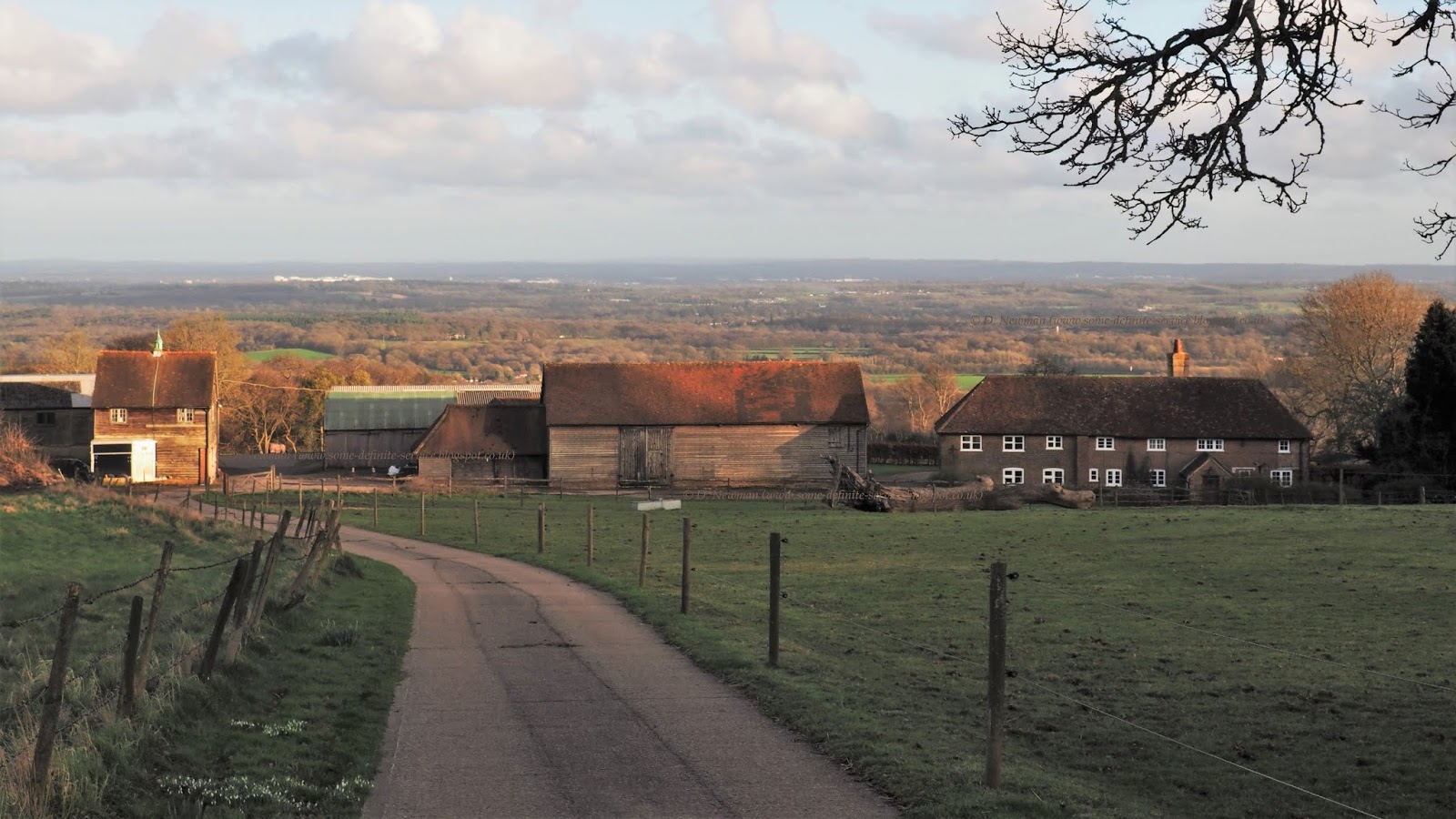
On Moorhurst Lane near Beare Green