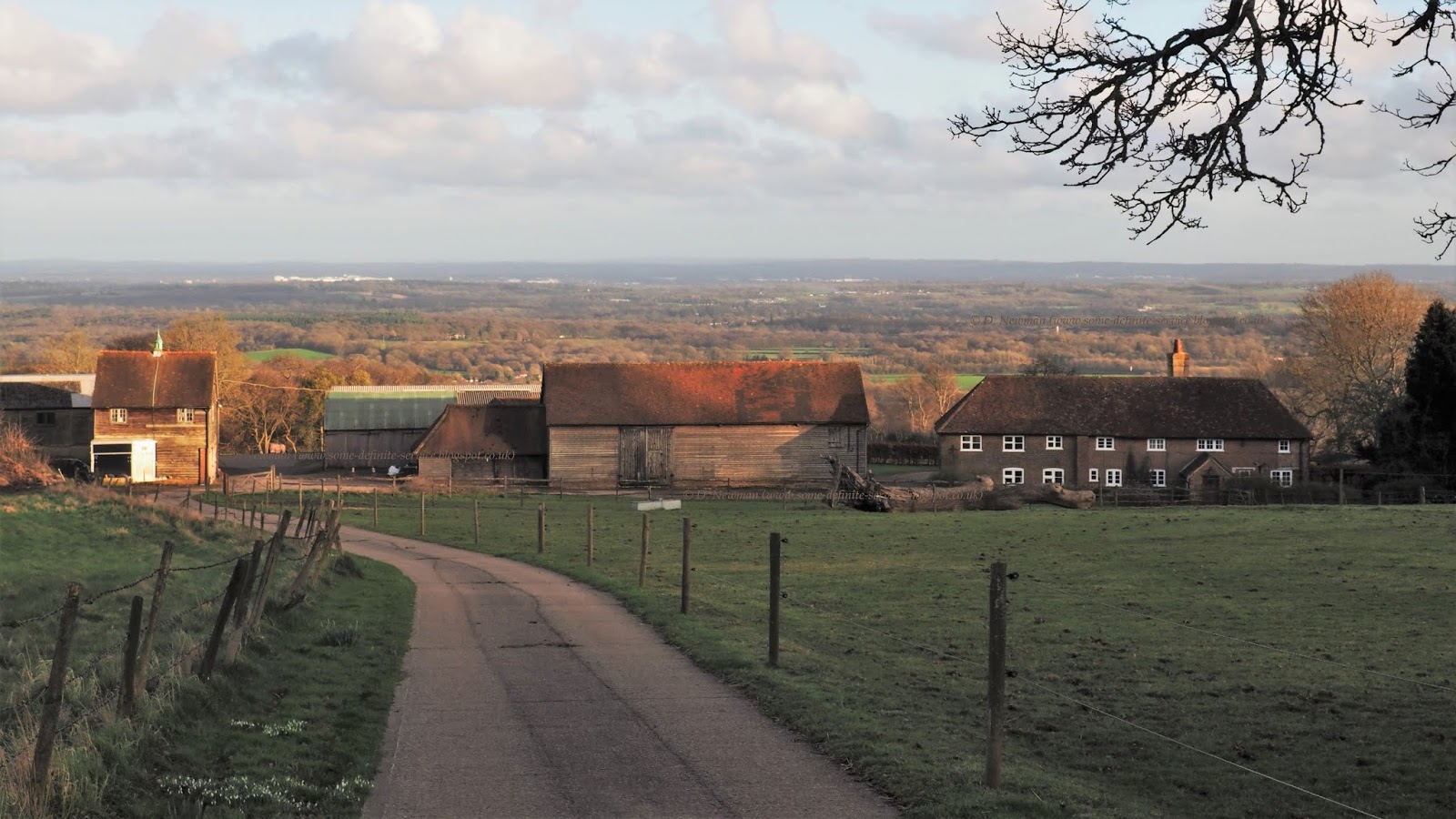
For years now and in countless emails my old friend Maolsheachlann (alias the Irish Papist) and I have been lamenting the state of poetry in the English-speaking world, or at least in Britain and Ireland. Our main complaint has been simply that almost nobody is writing the sort of poetry that we want to read — musical poetry, poetry that rhymes and scans or which at least does not scorn tradition, which appeals as strongly to the heart as to the intellect, which essentially affirms human dignity, and from which the ordinary person can glean an intelligible meaning.
Bentley Rise, near Doncaster
The first edition of John Masefield’s Collected Poems sold 80,000 copies and his poems were read in pubs; who can say that today? The nearest anyone comes to that sort of appeal is the priest-poet Rev. Malcolm Guite, whose 28,000 newsletter subscribers and sold-out readings are testament to his justly-celebrated poems — but he feels like an honourable exception. It is not just about numbers, of course, but most modern poets seem actively to be striving to shrink their readership, not to widen it.
Dawn over Dulwich, south London
And yet, as Ralph Vaughan Williams once declared, ‘the composer must not shut himself up and think about art; he must live with his fellows and make his art an expression of the whole community.’ Surely this is as true of poetry as it is of music. Wherever there are human beings there must be a hunger for verse and song, because, whatever else has changed utterly in our world since Masefield’s heyday, the hearts of human beings are still made of the same raw material, and remain the same vessels of joy and sorrow aching for correspondence and resonance. The calling of today’s poets is the same as ever — to write what will answer that longing. But too few seem to realise this.
Mitcham, south London
Maolsheachlann has done more than most to try to redress this situation, namely by living out his own vocation as a poet and sharing his work on his ever-readable blog. But in submitting his poems to various magazines and journals he has run up against a second obstacle: the reluctance of publishers and editors to publish poetry. Even magazines which ought to be sympathetic both to Maolsheachlann’s work and his themes have turned down poem after poem with pat answer after pat answer. He reports a shyness, or an embarrassment about it — as if even they are unsure what it is actually for.
Coulsdon, Surrey
What can we do about all this? Well, one of the great advantages of poetry is that it can speak for itself; when it is recognised and loved, it needs no other justification. But poets themselves may need inspiration to get there, and their readers encouragement. At past moments of poetic decadence or despondency, new movements have arisen to revitalise things and give a clear, though not constraining, new direction. Maolsheachlann and I think this is such a moment.
The Suburban Romantics favour all the poetic conventions that were the poet’s stock-in-trade up to the day before yesterday, especially rhyme and metre.
The Suburban Romantics believe that traditional poetic forms (such as blank verse, the sonnet, the ode, the villanelle etc.) are just as valid in the twenty-first century as they were in the seventeenth, eighteenth or nineteenth centuries.
The Suburban Romantics do not agree with Thoreau that “the mass of men live lives of quiet desperation”, or with Wilde that “most people exist, that is all”. We celebrate the routine, the ordinary, the workaday, the familiar.
The Suburban Romantics are not afraid of sentimentality or nostalgia, nor are we afraid of challenging or subverting sentimentality or nostalgia.
The Suburban Romantics do not genuflect before any transitory socio-political orthodoxies.
The Suburban Romantics want to evoke mystery, not practice mystification.
The Suburban Romantics are nourished at the wells of myth, legend, archetype, the sacred, the proverbial, the folkloric, the sacramental, and so on.
The Suburban Romantics do not disdain the topical, the ephemeral, the colloquial, the commercial, and so on.
The Suburban Romantics accept that the great majority of people (and perhaps an ever-increasing majority) are destined to live in suburbs, conurbations, commuter towns, housing estates, and so on. We insist that these can be the subject and setting of poetry; not just the poetry of satire and protest, but the poetry of affirmation and celebration as well. We seek the re-enchantment of the world, the transfiguration of the commonplace.
The Suburban Romantics have a special respect for Philip Larkin and John Betjeman, who demonstrated beyond all doubt that traditional forms can be used to explore contemporary life.
The Suburban Romantics are quite willing to use irony, but not to live in it as our natural element.
Suburban Romanticism is not a straitjacket. We do not preclude forays into free verse, rural themes, bleakness, misanthropy, obscurity, or any of the things against which this manifesto is a riposte. But they should be the exception, not the rule.
Wimbledon
I ought to be clear: the idea is not that all Suburban Romantic poems have to take suburbs as their theme or setting; ‘Suburban’ in this case conveys more of a disposition, or a sense of scale. ‘Provincial’ — which is perhaps a precise term for Philip Larkin’s outlook — might be an equally valid term, I think. Likewise, a Suburban Romantic poem may strike a major or a minor key, praise or mourn, and sing of places or people alike.
Worcester
What it all look like in practice? Here are some poems I would retrospectively claim for the Suburban Romantics.
These hearts were woven of human joys and cares, Washed marvellously with sorrow, swift to mirth. The years had given them kindness. Dawn was theirs, And sunset, and the colours of the earth. These had seen movement, and heard music; known Slumber and waking; loved; gone proudly friended; Felt the quick stir of wonder; sat alone; Touched flowers and furs and cheeks. All this is ended.
‘And I saw a new heaven and a new earth…’. From Sancta Civitas (1928), the composer’s favourite of his own choral works.
Today, 12th October 2022, is the hundred-and-fiftieth anniversary of the birth of Ralph Vaughan Williams (1872–1958). Was he England’s greatest composer? He has plenty of strong competition of course, and perhaps half the fun is never quite to settle the question — but as far as I am concerned, if anyone is to match Vaughan Williams, then they too will have to draw me, irresistibly, again and again, yet in a different way every time, into a distinctive, great-hearted, masterfully-crafted musical world that is all its own. He is in first place in my book.
Vaughan Williams photographed at home (The White Gates, Dorking, Surrey) in January, 1949.
His was a life that, in many ways, took place in reverse. He emerged as a composer relatively late — not completing his first symphony until he was thirty-five — but from then on never diminished in his output, even intensifying as he aged. Those who might have perceived in his fifth symphony (premièred in 1942, his seventieth year) a mellowing in age, or a mood of valediction, would hardly have suspected that this was actually the half-way mark, and that there were four more symphonies to follow. Throughout his last decade — well into his eighties — he seemed unstoppable, completing his three final symphonies, the opera The Pilgrim’s Progress (a lifetime’s work), concertos for harmonica and tuba and much more, all the while maintaining an energetic social life, both conducting and attending concerts. And it was not only musically that he was thriving: after the death of his wife Adeline in 1951 after decades of illness, he was rejuvenated by a second marriage to the poet and playwright Ursula Wood (whose poetry he set to music). So he seems almost to have been cut off in his prime, though he lived to eighty-five.
Music for the film 49th Parallel.
I admire Vaughan Williams in the first place for the most straightforward reason: because the sound of so much of his music appeals to me so directly. Time and again he wove melodies, harmonies, textures and cadences masterfully together in the service of beauty, beauty for its own sake. This beauty often seems so self-evident that I would struggle to explain it. Yet that first appeal, having drawn me in, makes me all the more willing to listen again more carefully for details I have missed, or to brave the composer’s more challenging works. In that way he has taught me a great deal about the more intellectual side of ‘serious music’: its forms, its structures, and the depth of expression that they make possible. So, for example, I have found my life enriched both by the tuneful English Folk-song Suite, which I have loved since I was small, and by the Fourth and Sixth Symphonies, which I discovered in my twenties. Yet in all his works the same personality is discernible: a companion and a teacher and a seer, who may challenge but never disregards the listener.
The third movement (Scherzo) of the London Symphony, played by the Spanish Radio and Television Orchestra and conducted by Carlos Kalmar.
This capacity for both simplicity and complexity is only part of another remarkable aspect of Vaughan Williams: his sheer versatility, or his ‘tremendous range’, as Vernon Handley put it. He wrote music of so many flavours, for so many purposes, and all so convincingly, that it is sometimes hard to believe that they flowed from a single pen. Is the same man really responsible for the tranquil Greensleeves Fantasia and the enthralling anguish of the fourth symphony; for the diabolical chortling of Satan’s Dance of Triumph (from his ballet Job) and the tiny jewel of an anthem, O Taste and See? He went off searching for ideas in all sorts of directions, but always came back to his own distinctive drawing-board: his work always bears, somewhere or other, the hall-mark of one and the same personality. There is Vaughan Williams the collector of folk songs, Vaughan Williams the scorer of films, Vaughan Williams the compiler of the English Hymnal. His music might be sacred or secular, it might last for four minutes or four movements, it might summon full chorus and orchestra or call simply for a solo violin and piano. For his harmonies he drew on everything from Tudor polyphony to thirties dance-band music; he also experimented with sonority, including a wind machine in his Seventh Symphony, a flügelhorn in his Ninth and ‘all the ’phones and ’spiels known to the composer’ in the Eighth. And then there are the moods that pass over his music, as many and as various as the English weather’s: serene or furious, reserved or exuberant; proliferating with detail or hanging austerely in clear air.
One of the best ways of hearing many of these moods is in that eighth symphony — even in its first movement alone, which is constructed entirely around the very first four notes played. Sir Mark Elder conducts the Hallé Orchestra.
Another characteristic of his music is — I can think of no subtler word — its manliness. So much of it seems to express some aspect of, and to be so evidently the work of, the heart and spirit of a man. In other words, there is a particularly masculine warmth, an outward robustness, a heartiness, a full-bloodedness about it all. That is not to suggest that he did not mean his music for men and women alike, nor to assume that it was conscious or deliberate — it is simply part of the character and colour of his music. His work is shot through with the vigour, the spirituality, the moods, the quickness, the temper, the restlessness, the passions, the solitary questing of manhood.
The second movement of the Concerto for Violin and Strings (1925; originally Concerto Accademico). André Previn conducts the London Symphony Orchestra; James Buswell is the soloist.
Then there is his Englishness, the quality of his music which is perhaps most often commented on. Vaughan Williams is credited with reviving and developing a particularly English style of music, one that was in contrast with the German idiom of Beethoven and Brahms and Mendelssohn that had prevailed before. Vaughan Williams was interested in Tudor polyphony and traditional folk-song and the music of ordinary people, not for shallow or jealous reasons, but in a search for authenticity, and in a spirit of revival of old forgotten things and celebration of the particular — and it worked: his music sounds like home. Hear how well it goes with Shakespeare, or with Chesterton; see how his hymns and carols have passed straight into the canon. And he was keenly aware of the threats that England faced in his own day — war, the destruction of landscape, the decline in spirit. Indeed, the sheer spiritual exhaustion of the modern world in general, sated with banality to the point of grief, is prefigured in much of his music. Hear, for instance, the desolate passages that close the first movement of the Ninth Symphony:
Against despair and nihilism, though, Vaughan Williams was the great champion of the human spirit, and the idea of the lone pilgrim persevering against the odds preoccupied him all his life. His reverence for folk-culture is precisely an example of this. There is surely much to be said for founding ‘high art’ on traditional, unaffected idioms: familiar, time-worn songs keep high culture rooted in earth, while transfiguring the familiar elevates and enriches the popular culture. And even as Vaughan Williams broke new ground with his symphonies and cantatas, he was content, I think, to be a servant of his age. His heavy involvement in the Leith Hill Musical Festival, and his prolific output of hymns and film-scores and ‘practical music’ (notably the Concerto Grosso for musicians of varying accomplishment, or the Household Music written in wartime for whatever instruments were to hand) reveal a profoundly public-spirited man, unashamed of belonging to a particular time and place, and lending his talents to the service of others. He himself was quite firm about this: ‘The composer must not shut himself up and think about art,’ he declared; ‘he must live with his fellows and make his art an expression of the whole community.’
For all these reasons and more besides, it is Vaughan Williams whom I hero-worship as Britain’s greatest composer. Other composers may have shared many of the qualities I have described, but it is only in him that they are all united. His music, in all its variety, sounds as fresh as ever, and is still working its magic on lovers of beauty in new generations. May it continue to lighten lives for centuries to come.
What a treat, last Thursday evening at the Royal College of Music, to hear Ruth Gipps’ Fourth and Vaughan Williams’ Eighth Symphonies played by the students’ Symphony Orchestra. In fact, for me it was several treats wrapped up in one: it was the first time I have heard Vaughan Williams’ Eighth played live, the first live performance of a Ruth Gipps symphony I have heard at all, and, more generally, it was a delight to find the future of British music in such safe hands. And after these past two years it was also a real tonic to drink in the fizz and the liveliness of a university atmosphere.
I already knew and loved these two symphonies, but had not realised what an interesting pairing they would make in concert. In spite of their contrasting moods, both are adventurous as far as sonority is concerned, making lavish use of the timbres of woodwind and percussion in particular, and producing, in each case, moments of remarkably bright and gleaming sound — just the thing for mid-January.
But their moods are certainly contrasting. The Gipps, which was conducted by the great Martyn Brabbins, is overall rather more questioning and unsettled than the Vaughan Williams, even at times agonised, having, as Jill Halstead has put it, ‘an undercurrent of pessimism found in only a handful of her works.’ There is still that weaving together of spiky energy and romantic lyricism that is so characteristic of Gipps, along with melismatic solo, duet or trio passages, but the backdrop against which they are heard is a melancholy and uncertain one of shifting harmonics and rhythms.
“That is a really difficult symphony,” was Martyn Brabbins’ opening to the little ‘mid-amble’ he delivered to the audience after the Gipps, and yet one would hardly have thought, had he not told us, that he and the orchestra had only had two rehearsal sessions together before the performance. “But that’s how it is in the U. K.: we don’t have much rehearsal time. So they have to get used to it!” he said. He was very warm about the musicians. He also made some observations which put into perspective how remarkable the recent Ruth Gipps Revival has been: even this great British conductor admitted that she had been in his blind spot; he had heard of her name in the seventies, but never met her, and this was only the second piece of hers that he had ever conducted. She really did seem to have dropped into obscurity. Yet now, with no small thanks to him, the next generation of young musicians have had the chance to play and hear her music for themselves.
Next came Vaughan Williams’ Symphony no. 8, in which each movement was placed under the baton of a different student conductor (and which resulted in the unusual spectacle of four conductors lining up to take a bow at the end!). This too was clever programming, because, while the outer movements are famous for using ‘all the ’phones and ’spiels known to the composer’, the second movement uses only the wind sections, and the third only strings. I rather liked the style of the conductor of the third movement, while the chap who won the jackpot to conduct the tintinnabulous final movement — “it’s just like Christmas,” as Martyn Brabbins put it — was absolutely in his element. The various solos were carried off masterfully, and the overall blend was testament to rock-solid musicianship.
This is a symphony so full of life and gaiety that it might be a surprise — but if so an instructive one — to find that Vaughan Williams wrote it in his early eighties. The first movement alone contains almost his entire, and considerable, range of moods: the solemnity, the radiance, the tempestuousness, the serenity. But the mood is overall joyous and optimistic; only in the thoughtful third movement, the Cavatina, a kind of latter-day Tallis Fantasia, are there pangs of sorrow, or regret, or something like it. It is full-blooded, lusty music that reminds you that you are alive, and is all wrought together so masterfully: rich and intricate, but never too much. Martyn Brabbins admitted that he used not to like it when he was young, “but now,” he said, “I can’t do without it;” and nor can I.
How wonderful that this should be done, as Gipps’ centenary year draws to a close, and Vaughan Williams’ begins. Many thanks to all involved for a wonderful evening.
Having gone some way, in a fair manner I hope, to work out what Herbert Howells and Vaughan Williams really believed about life and the ultimate things, and how their glorious music fitted into it, there is another question waiting to be answered: where does the unbelief of these church composers — however nuanced, however thoughtful — leave us, their listeners?
John Skelton’s whimsical ode ‘To Mistress Margaret Hussey’, the middle movement from Howells’ suite ‘In Green Ways’, 1919. This mood of whimsy disappeared for ever from Howells’ music after the death of his son Michael.
One way to approach this question, of course, is from the national perspective: to ask how, and why, these great Englishmen seem to have anticipated the enormous lapsation in faith that has befallen this country over the course of the past century or so. There is no question that they were highly attuned to the spirit, character and landscape of England (indeed, both men received commissions for the Queen’s Coronation ceremony in 1953, setting to music prayers for the entire country.) What change did these men, sensitive as they were, and so well-acquainted with Christian tradition, detect in the air; why did they not find in the old religion the assurances their forefathers found, as so many of our countrymen do not find it now? An answer to this might take us some way towards working out why the Christian and the English imaginations have, for the moment, so catastrophically lost each other. But, of course, their own personal reticence about these things — in its very Englishness! — deprives us of a clear answer.
Howells’ anthem for the Coronation of Elizabeth II: ‘Behold, O God our defender, and look upon the face of thine anointed’. The opening motif in the strings is echoed, more duskily, more lingeringly, in the final bars. The most extraordinarily beautiful music.
And what of us as individual listeners? The writer Boyd Tonkin has recently argued — and I do not disagree — that agnostic listeners should not hesitate to draw spiritual comfort from church music, not least given that this is precisely what its composers, believers and unbelievers alike, were often seeking. [1] But what about the other way around? Can believing listeners find valid affirmation of a confessional faith in thesacred music of an unbelieving composer? Or can an agnostic composer ultimately only ever compose ‘agnostic music’? If we are uplifted by a Vaughan Williams hymn or a Howells anthem; if, as well as beauty, we find it expressive of truth to which we know they did not assent, are we misleading ourselves in our faith, and doing an injustice to their legacy?
From the score of the anthem ‘Like as the Hart desireth the waterbrooks’ (Oxford University Press).
The question bites because we are afraid of deceiving ourselves. Are we dupes? Doubt, and the fear of mistaken belief, can be at least as contagious as faith, and there is something chilling about those words of Howells, ‘You know there’s nothing’. Michael White is blunt: ‘Countless churchgoers who find Christian affirmation in the Howells oeuvre are hearing things he did not put there.’ [2] When I asked a comparable question about the Soviet-Armenian composer Aram Khachaturian, whether his vivid and lyrical music is spoiled by his apparently unswerving loyalty to the Soviet Union, my hope was to be able to distance the music from the composer’s professed ideological fervour, to hold it at arm’s length, so that I could enjoy his music in greater comfort. But with Howells it is the other way around: his position introduces an unwanted distance that we have neither anticipated nor desired. By turning aside from the very Christian religion that his music ornamented and beautified, it is he, however unknowingly, however blamelessly, who seems to hold himself away from us.
It is not simply a question of comfort, though. The fear behind the question is not simplistic; it is not that we are afraid of ambiguity or adventure. After all, even confirmed and practising composers do not always offer an easy ride: that is not what faith is for; faith is full of mystery. The difference is that, in the case of a believing composer, we are surer of our ground in approaching the music in the first place; more confident that we will know where to look for its meaning; more assured that we are all entering the world of the music through the same door, side-by-side with the composer. The difficulty with Howells, then, is not that his music is mysterious — far from it; this is largely what is so appealing about it! — but that we are not quite sure how we are supposed to approach its mysteries. We are necessarily less sure in our grasp of the inner sense of his work.
The orchestrated version of Howells’ setting of theTe Deum for King’s College, Cambridge (Collegium Regale),sung by the choir and in the chapel for which it was written.
Here are some personal thoughts as to a sensible approach. Firstly, although faith, truth and authorial intention do matter, and although it would be unjust to brush over the doubts of such thoughtful composers, the simple truth is that both Howells and Vaughan Williams definitely intended their music to enrich Christian worship and belief. They were not being cynical: they were willing for their work to sustain in others something they did not possess themselves. Secondly, since the music they wrote was undoubtedly good and beautiful, and since the Church always upholds whatever is truly good and beautiful whatever its source, the right response is very clear: we are to rejoice in it. Thirdly, we should not fear that in worshipping God in their music we are press-ganging their names onto our team, so to speak, as if we were a political party or a football team. God exists beyond us and outside us, as well as within us; He is as He is, whatever we might say or do; He does not allow himself to be co-opted into factions or camps. (In that sense, our religion is not our own possession).
‘Vouchsafe, O Lord, to keep us this day without sin…’ Hear how differently Howells treats the same words, the final verses of the Te Deum, at the end of his Collegium Regale setting above, and here, in the last bars of the setting for St George’s Chapel, Windsor.
Fourthly, I think this matter has something to teach us about the transcendence of great art, for, without ever coming loose from them, without ever drifting away as mere floatings of authorless ‘discourse’, artistic greatness is nevertheless capable of surpassing its creators, and their troubles or weaknesses, just as it can escape the limits of their circumstances and times. It may indeed be the case, to repeat Michael White’s phrase, that ‘countless churchgoers who find Christian affirmation in the Howells oeuvre are hearing things he did not put there’ — but this does not mean that they are not there all the same, without him having had to put them there. Howells may not himself have put the spirit of faith into his music, but I think it may fairly be said that he left room for it, a space where its animating force might nevertheless come to dwell.
Fifthly, I think that such composers’ doubts teach us to be grateful for our own faith, to remember that it is indeed a gift, as is even the desire for faith; and also that the gift of faith is distinct from the gift of spiritual insight through artistic sensitivity, however great a gift this too may be. True faith, though it can rightly be approached rationally, ultimately belongs to a realm above and beyond reason, one that is mysterious even to believing folk, and one to which the point of assent or unbelief can seldom, if ever, be pinned down. The doubts of great artists teach us the importance of generosity and humility towards those who, though without the gift of formal faith themselves, might yet have something to tell us about the eternal verities.
There is one particular work of Howells, one of his last, made in the very evening of his life, which I think it is fair to regard as his last testament. Both the music and the words seem to encompass his whole spirit and artistic endeavour. Here in one anthem is all that is characteristic of Howells: the radiance of creative ecstasy, the melancholic sensitivity to the fleetingness of earthly things, the ambiguity about God even as the harmonies set His name ablaze, and the adoration of beauty — except that this time the adoration is explicitly and confidently proclaimed, with all the solemnity of a Credo. The words, by Robert Bridges, run —
I love all beauteous things,
I seek and adore them;
God hath no better praise,
And man in his hasty days
Is honoured for them.
I too will something make
And joy in the making;
Altho’ to-morrow it seem
Like the empty words of a dream
Remembered on waking.
Both Howells and Vaughan Williams were thoughtful and serious men; they were unafraid to contend with the truth about life; they were generous with their talents and our lives are the richer for them. The Church is bigger and deeper than we know; let us who love their music give grateful thanks for their lives and for the art that they have left to us.
Howells’ setting of Robert Bridges’ poem ‘I love all beauteous things,’ sung by the choir of St. Alban’s Cathedral under Peter Hurford, broadcast on BBC radio on the 25th May 1977.
If Herbert Howells’ half-religion was indeed a personalised theology of his own creation, one of art and ardour without tenets or sacraments, it was not, however, a shallow or trivial one. For one thing, his view of the world was forged in great suffering: he was a man who knew pain in plenty. The experience at the age of eleven of his father’s bankruptcy scarred him considerably; the subsequent ostracisation of his family by the local townspeople left him with a life-long anxiety about money. Then, a decade later, there was the brutality with which the Great War cut short his youth, and with it the company of the poet Frederick William Harvey and of Ivor Gurney, whose life was to end so unhappily, and so far away from his beloved Gloucestershire, in a Dartford mental asylum. Francis Purcell Warren, a friend from the Royal College of Music, to whom Howells had dedicated a movement of his orchestral suite ‘The B’s’, was killed in the Battle of the Somme, and his body never found; ‘and one of humanity’s tenderest possessions was ruthlessly destroyed,’ as Hubert Parry’ said. [1] Howells himself avoided military action only because he was facing death on a different front: having been diagnosed with Graves’ disease, he was told at one point that he had only months to live, and at this time was among the first people in Britain to undergo radium treatment. Years later, even the Second World War was not to spare him: his house in Barnes was bombed in an air-raid, with great loss to his library and manuscripts. Surpassing all these, however, one supreme pall of grief lay over his life: that cast by the death, aged nine, on the 6th September 1935, from a form of meningitis or polio, and within a matter of days after the first signs of illness, of his son Michael.
A Sequence for St. Michael (1961), sung by the choir of St. John’s College, Cambridge.
The effects of this catastrophe were as deep and irreversible as might be imagined. For some time afterwards, frozen, Howells could not compose a single note of music. Eventually, though, his daughter Ursula encouraged him actually to work out his grief in music, and this he did. There had been dedications before — ‘Michael’ was already the name of the tune to which we commonly sing the hymn ‘All my hope on God is founded’ — but now it was with grief, as well as with love, that he was to inscribe his son’s name above the manuscripts. Given this context, it is actually rather difficult to hear, in the opening bars of his Sequence for St Michael of 1961, the name ‘Michael’ cried in bright anguish to heaven, and not, we realise, to the Archangel alone. But the greatest memorial that Howells made to his son grew from one of the first pieces he took up when he began composing again: an earlier Requiem that he had already written for a cappella choir. This he expanded, orchestrated, and indeed transfigured into Hymnus Paradisi, the first of his three great master-works for chorus, orchestra and soloists. In spite of its enormous scale, he made known its existence to almost nobody for years, until various friends — notably Ralph Vaughan Williams and Herbert Sumsion — persuaded him to allow its performance during the Three Choirs Festival of 1950. [2]
Howells at Gloucester Cathedral on the 7th September, 1950, just before conducting the first performance of Hymnus Paradisi. The previous day had been the fifteenth anniversary of his son Michael’s death. Royal College of Music, ref. LDRCM.Ph.22.77, retrieved from http://museumcollections.rcm.ac.uk/collection/Details/collect/5038, reproduced under CC BY 4.0 licence, cropped and enhanced slightly
Like the later Missa Sabrinensis, Hymnus Paradisi was non-liturgical in character. Howells made much freer with his texts in this first work, intertwining the Sanctus with the 121st Psalm, and choosing for his final movement words from the Salisbury Diurnal: ‘Holy is the true light, and passing wonderful, / Lending radiance to them that endured in the heat of the conflict.’ It was, then, a personal and personalised Requiem, but one with a deadly serious purpose, far more so than in the case of the Mass. Its creation was a religious act in which Howells’ artistic half-Christianity was put to the test, and required to perform a real and serious spiritual duty: a direct reckoning with the worst of griefs. The remarkable and sobering thing is that in great measure it worked: it solemnised Howells’ grief; it made his anguish expressible, and in doing so made it to some extent measurable and compassable. Beauty being only one face of the mountain of God, it was by no means a resolution — twenty years later, the well of grief remained deep enough for him to draw forth a third choral-orchestral work, his 1965 setting of the Stabat Mater, with its unflinching depiction of Mary’s grief at the foot of the Cross — but, in circumstances under which any straightforward healing seems inconceivable,it is notable that Howells did find a degree of consolation. And it should be said that Hymnus Paradisi is, like all memorials, meant for the rest of us, too: the music itself, its ascent into supernovic light, its supplication for perpetual light for the departed and consolation for the bereaved, can never be forgotten once heard. Surely even those untouched by the music itself will be moved by the circumstances of its creation, and by the consecration of such a complex, magnificent work of art, one of the greatest English musical works of the twentieth century, to the memory of a child of nine.
‘Requiem aeternam…’The second movement of Hymnus Paradisi, given in a memorable Proms performance on the 29th August, 2012, by the combined forces of the BBC Symphony Chorus, the London Philharmonic Choir, the BBC Symphony Orchestra and soloists, conducted by Martyn Brabbins. The music runs on without a break into the 23rd Psalm.
Amid Howells’ output, Hymnus Paradisi stands in a class of its own. But there is another sense, too, in which it may be rather an exception. For whereas in this particular work Howells the composer and Howells the grieving father are evidently one and the same figure — and although it must be said that Michael’s death had a profound effect on his father’s musical output, bringing to an end to the largely orchestral and chamber music of his early career, along with all trace of their moments of whimsy, and being followed almost exclusively by his bittersweet, chromatic, luminously shadowy music for the Church — there is in much of hislife a discernible distinction, one drawn by Howells himself, between his identities as a composer and as a man — and the man was rather more private than his music might suggest. We have already seen how, even in the case of Hymnus Paradisi, others had to persuade him both to write it and to allow its performance. It also seems unexpected, though consistent with his teaching duties, that he lived most of his adult life not in Gloucestershire but in the London suburb of Barnes (even if he did return every year to Michael’s grave and the Three Choirs Festival in Hereford, Worcester or Gloucester).
Moreover, it has to be said that there was a certain poise or archness, even an artifice, in his public manner. Even allowing for the greater formality of his age compared to ours, his speech and writing can come across as oddly contrived. When writing about his own work, he had a tendency to refer to himself in the third person, as if he were a critic of his music, not its composer: consider the earlier-quoted remark about the Missa Sabrinensis’ being ‘essentially a composer’s personal and creative reaction to a text of immense, immemorial significance,’ and, again, in a letter to a friend about the same work: ‘In each movement the composer seems to have sought a dominant mood and to [have] allowed such mood to stamp itself intensively upon thought and expression.’ [3] Maybe he was aiming for a sober, objective, academic tone, but the effect is inevitably to cordon off or bracket his art; effectively to secularise it. The very man who might have provided us with insight into the music seems as intrigued by it as anyone else, even abashed, as if anyone’s guess is as good as his when it comes to its meaning. A similar stiffness is discernible in the only moving film of him available online as I write, in which he recalls attending the first performance of Vaughan Williams’ Fantasia on a Theme of Thomas Tallis. There is the poise of a man wishing to appear well before the camera, seeming almost to be acting the part of a great composer (which may seem exaggerated, but, on the other hand, his daughter Ursula was a professional actress.) And yet Howells is describing an occasion which he repeatedly acknowledged to have changed his life, another moment at which, ashe admits explicitly, the composer and the man were one — ‘It was after then that I really felt I knew myself, as an artist and as a man.’ [4]
Herbert Howells, interviewed in 1970, describes one of the most significant moments in twentieth-century English music, at which he was remarkably fortunate to be present: the premiere performance of Vaughan Williams’ Fantasia on a Theme of Thomas Tallis in Gloucester Cathedral on the 6th September, 1910.
It seems almost as if his two identities became whole and integral only at the moments of greatest joy or rawest grief, the revelation of the Tallis Fantasia or the blinding trauma of his bereavement (which events, incidentally, both share the anniversary of the 6th September.) Most of the time, strange as it may seem, Howells half-holds himself from us, with a reserve that is perhaps almost as old as the first Elizabethan age. A dual identity is indeed an extraordinary paradox to find in the composer of such apparently intimate music as his, but it is another answer to the central question of this essay, another way in which Howells was able to maintain simultaneously his personal unbelief and his composition of explicitly spiritual music.
From left to right: Isobel Baillie (?), Herbert Howells, Ralph Vaughan Williams and Rutland Boughton. (Gloucestershire, mid-1930s). Royal College of Music, ref. LDRCM.HH.1.138, retrieved from http://museumcollections.rcm.ac.uk/collection/Details/collect/6566, reproduced under CC BY 4.0 licence, cropped and enhanced slightly
Was it the times in which he lived? It hardly needs saying that the twentieth century was no age of faith. First there came the iron ideologies, of course, and then, after the various cataclysms they detonated, the widespread attempt to reject, in the West at least, any strong, dogmatic belief concerning anything abstract or supernatural. Even in the Victorian era, the age of Darwin, of Matthew Arnold’s withdrawing ‘sea of faith’, there had been circles in which the secular attitudes familiar in our own day had already set in. Howells’ great friend and inspiration Ralph Vaughan Williams is a useful comparison at this point, for here was a man almost a generation older (1872–1958), a composer whose arrangements of hymns are sung throughout the land in church on Sunday, who set the Te Deumtwice, the Benedicite, the Song of Songs in ‘Flos Campi’, the Book of Revelation in Sancta Civitas, the poetry of George Herbert in his Five Mystical Songs, and the words of Pilgrim’s Progress — and yet who was no more a churchgoer than Howells, who indeed, as an undergraduate at Trinity College Cambridge, even as he was setting the Mass to music, was apparently a ‘frightful atheist’, though he later mellowed into a ‘cheerful agnostic’. When questioned about his dark, terrifying, yet strangely addictive Sixth Symphony (1948), he responded simply by quoting a line from Shakespeare’s Tempest: ‘We are such stuff as dreams are made on, and our little lives are rounded with a sleep.’ To the critics’ (not unreasonable!) verdict that the work was a War Symphony, or a cry of protest against atomic war, Vaughan Williams offered characteristically robust resistance — but he was, however, apparently pleased with a friend’s suggestion that the astonishing last movement — ten minutes of icy and unrelieved pianissimo, fading into merciless uncertainty, refusing consolation to the last — might be thought of as an ‘agnostic’s Paradiso’. [5] Stephen Johnson has pointed out that certain figures in the last movement are actually an inversion of the ‘Amen cadence’ (as here, first in the brass, then in the strings). [6] It is hard not to hear in this backwards Amen an anti-resolution, a sign of things falling apart, of the undoing of hope; a confirmation of doubt.
Yet with Vaughan Williams, as with Howells, doubt is mingled with a definite kind of faith. Here was another profoundly spiritual man whose spirituality he had largely fashioned himself from tradition and from culture, and which was devoted ultimately to the transcendent quality of beauty. This is borne out in the words of his second wife Ursula (née Wood; not to be confused with Howells’ daughter; this essay owes a great deal to the testimonies of Ursulas!), who said said that her husband ‘was far too deeply absorbed in music to feel any need for religious observance’. Near the end of his life he famously remarked that after death, ‘I shan’t be doing music; I shall be being it.’ Put bluntly, music was Vaughan Williams’ religion, too.
Music from the last movement of Vaughan Williams’ Sixth Symphony, with its chilling ‘backwards Amen’, serves very effectively as an accompaniment to a bleak segment of John Betjeman’s 1977 documentary ‘A Passion for Churches’.
Through his mother Vaughan Williams was actually related to Charles Darwin, and would presumably have been no stranger to the debate over the theory of natural selection, neither its initial challenge to Christian cosmology, nor the subsequent contention with Christianity altogether. He, like Howells, also lost friends in the Great War; indeed, as an ambulance-driver on the Western Front, he saw its horror first-hand. Then there was the mood of the artistic world, in which, as elsewhere, the twentieth century came swiftly to be seen as an age of doubt, in contrast to the Victorians’ robust faith (a faith that was placed in science and progress as much as in Christianity). Doubt, to these artists, may have seemed the only tenable artistic position to hold with integrity, not least given that its open expression in music was new, and that in any case there is something compelling and tragic about it, and therefore appealing to artists.
Yet it seems somehow insufficient to say that Howells and Vaughan Williams were simply men of their age, still less that they were just casting themselves as heroes in their own spiritual epic. Both were complicated, thoughtful, spirited men. Consider Vaughan Williams’ perennial fascination with the idea of the human soul questing into the unknown, a theme present from his settings of the Walt Whitman’s humanist verse (the Sea Symphony,‘Toward the Unknown Region’) all the way to the Sinfonia Antartica and Pilgrim’s Progress — this last was ‘the preoccupation of a lifetime’, according to Lewis Foreman. [7] These were questions of the highest order: neither he nor Howells were simplistically reductionist or fashionable in their lack of faith. Michael Kennedy’s words about Vaughan Williams (in the light of his having composed a Mass while still a ‘frightful atheist’) could just as well apply to Howells:
In Vaughan Williams we have above all else a creative artist of deep humanity — that is the supreme quality of his work […] No doubt he pondered on the great mystery of existence after death; perhaps the Finale of the Sixth Symphony is an attempt to peer into that particular void […] But Vaughan Williams was essentially a positive, affirmatory artist: he is concerned with life, not death, in all its facets — and these include the contradictions and conflicts epitomised in the spiritual uncertainty of the Sixth. As for the taunt that an atheist has no business to be writing a Mass, that is altogether too naive an argument. A composer is a man of imaginative vision and insight, and the inspiration of the words of the Mass alone would enable Vaughan Williams to respond to their humanity and drama, just as a great actor assumes a role entirely different from his own character, just as he of all people would be bound to respond to the implications of a Christian tradition, as opposed to dogma or theology — the tradition which bound generations of men and women together, into which folklore and folksong are interwoven, all part of man’s eternal quest. [8]
True artists are always attuned to reality; they are prophets and seers of a certain kind, but even so we cannot always expect the whole answer from them, neatly packaged and explained. We pay attention to what they say because we know that they themselves are at the limits, reporting what they find, in dialogue with forces that are greater than man, and beyond his understanding. They walk into the mystery. True composers, I now realise, do not write music that they want to write, but music that they have to write. They do not set out to write, but to discern what they are commanded to write, by something quite beyond themselves. Vaughan Williams in his Sixth Symphony was not exactly trying to write an ‘agnostic’s Paradiso’, or proving it could be done for the sake of it — it was simply what he was given to write at the time.
Howells, too, though he felt only too keenly what was wrong with the world, knew that the beauty it contained commanded a serious and reverent response; he knew that something to be longed for lay beyond this world, and he knew that his work had a spiritual dimension. He, likewise, can be said to have written only the music he had to write, in spite of his own unbelief. That he found a spiritual home for his half-religion in a temple whose tenets he did not share may even have been as puzzling to him as it is to us, but it was in that position that he sought to transcend his faults and his griefs, and, by the beauty of his music if nothing else, to mark the glory and anguish of mankind.
1. Entry for Francis Purcell Warren (1895–1916) from ‘War Composers’, web resource. Retrieved April 2021 from <https://www.warcomposers.co.uk/warren>.
2. Andrew Burn, sleeve-notes for ‘Hymnus Paradisi & An English Mass’ (1991), record on Hyperion, catalogue no. CDA66488, retrieved 11th May 2021 from <https://www.hyperion-records.co.uk/notes/66488-B.pdf>
3. Herbert Howells, quoted in Jonathan Clinch, sleeve-notes for Hyperion’s disc ‘Howells Missa Sabrinensis’ (catalogue number CDA68294), retrieved 11 May 2021 from <https://jclinch.com/2020/07/16/hyperion-programme-note-for-herbert-howells-missa-sabrinensis/>
4. Lionel Pike, ‘Tallis—Vaughan Williams—Howells: Reflections on Mode Three,’ in Tempo, 1984, p. 2. Retrieved 11th May 2021 from <http://dx.doi.org/10.1017/S0040298200058496>.
5. Michael Kennedy, ‘The Unknown Vaughan Williams’. Proceedings of the Royal Musical Association, no. 99 (1972), p. 32. Retrieved 11th May 2021, from <http://www.jstor.org/stable/766153>.
6. Stephen Johnson, ‘Discovering Music: Vaughan Williams: Symphony No. 6’, radio programme, first broadcast on BBC Radio 3, 11 May 2014. Retrieved 11 May 2021 from <https://www.bbc.co.uk/programmes/p01yxd4b?.
7. Lewis Foreman, ‘Ralph Vaughan Williams’, biographical note for the website of Hyperion Records. Retrieved 6th May 2021 from <https://www.hyperion-records.co.uk/c.asp?c=C611>.
Wishing a very happy feast of the Ascension to all readers!
O clap your hands, all ye people; shout unto God with the voice of triumph. For the LORD most high is terrible; he is a great King over all the earth. God is gone up with a shout, the LORD with the sound of a trumpet. Sing praises to God, sing praises: sing praises unto our King, sing praises. For God is the King of all the earth: sing ye praises with understanding. God reigneth over the heathen: God sitteth upon the throne of his holiness.
Psalm 46 (47): 1-2, 5-8, set to stirring music by Ralph Vaughan Williams.
Approaching the top of Leith Hill from the east, as I did once again with an old friend the other Saturday, there is always a curious, pleasant sensation of having come round the back by a secret way. We had met almost nobody among the hollows and meadows of the Hill’s lower slopes, so to find the summit quite busy — converged on by other visitors along more orthodox routes, and with the invariable cluster for refreshments around the National Trust servery at the foot of the Gothic tower — made us feel as if we had sneaked up by unknown paths across undiscovered country.
I doubt that any hill exists that is not worth climbing, but Leith Hill, the crown of Surrey, is one I particularly know and treasure. Its summit on the Greensand Ridge is the highest point in south-east England (some say second-highest, defining south-east England differently — but I know where my loyalties lie!) and, looking northwards on a clear day, it is possible to see right over the top of the North Downs and Box Hill, themselves six miles distant, and to make out the wide grey clutter of London on the horizon. To the south, the generous quilted Wealden country spreads all the way to the South Downs — and sometimes, through the Shoreham Gap, there can even be glimpsed a hazy glimmer of sea. This is a good place to come for a bit of perspective on things.
Looking southwards from the top of Leith Hill Tower, 8th February 2020.
We have the eighteenth-century landowner, Richard Hull, to thank for the existence of the tower, which of course we paid our £3 to climb. He had it built partly for an even better view over the counties below, and partly out of a fundamental dissatisfaction with the hill’s geomorphology. That the natural summit stood 965 feet above sea level was for Hull ranklingly, frustratingly short of a thousand. By the addition of the tower, he determined, the magic figure could be reached and surpassed. (Did ever Enlightenment rationalism lead so directly to Romantic folly — never mind the building of an actual romantic folly?) The modern displays in the tower’s first-floor chamber tell of later episodes in the tower’s history: the rowdy eighteenth-century fairs, or the longevity of Mrs Skilton (for over thirty years proprietrix of the tea-servery and ‘highest lady in the county’). They tell of the near-collision of a passenger plane in 1948, averted by only thirty feet. It was impossible not to notice, either, a photograph of a firework display held in 1993 to celebrate the entry of the United Kingdom to the European Union in its then-new formation. (The week before our walk, Britain had formally reversed this very event, unaccompanied by any fireworks, as far as I know: I suppose Parliament has already given us our fill of pyrotechnics over the past few years…)
What do I see, looking down from the top of Leith Hill? Almost unmitigated England in all directions, ancient with ghosts, curious with old tales, tender with things remembered. It is known country I am looking down on, though I will never learn all there is to know about it: mile upon mile of palimpsest, all overlain by associations, details, particularities of the ages: Stane Street, the Roman road that we had crossed on the way from the station; the Iron Age hill fort of Anstiebury that we were to skirt on the way back — everyone from Richard Hull and Mrs Skilton and the fairgoers all the way down to ourselves and our fellow visitors this February Saturday. I think of others who have loved this landscape: the poet George Meredith, he of the Mole Valley under Box Hill, and the composer Ralph Vaughan Williams, whose famous tone poem ‘The Lark Ascending’ took its name from one of Meredith’s poems. Vaughan Williams’ childhood home, Leith Hill Place, lies hard under Leith Hill’s southern slopes.
To put it more simply, from the top of Leith Hill I am looking at home. Home not by title or deed, but by a character and spirit that dwells under my skin and in my soul. Landscapes, like houses or streets, are sanctified by being lived in and loved: of the landscape below me I can say that I am at home when I walk in it, when I look on it and even when I think of it. It is home, too, because, in its semi-sacramental beauty, it seems to stand for a certain ideal of the whole of England; to love this landscape is somehow to love the whole. So today I, up here on the Hill, largely lifted away from England’s sorrow and sin, seeing it resolved into its proper image, into a sunlit heirloom on a crisp midwinter day, do not find it hard to love. I remember that in fact it is very dear to me indeed.
Looking slightly south-eastwards from the slopes of Leith Hill near Coldharbour. Gatwick Airport in the distance.
Love of home is for me as old as thought. It is mostly a gentle thing, but it is also deep and dogged and immovable. These days it is the fashion to scorn such sentiments, perhaps because of the extremes to which versions of it have been taken in the past. But fashion, for all its force, holds little sway at the top of Leith Hill. Up here, I can say boldly that I am blessed by the home we have been given to live in. I can say that it is a good and natural thing to be grateful for that home, and that it is right and just to regard it as an inheritance, which, however indirectly, we must preserve for those who come after us. Love of home need not, should not be jealous or selfish. There is no reason why it should ever be either, not least since when it is authentic it is often actually accompanied by an urge to share it with others. Nor is it necessarily a false idol: love of England may go very deep without overbalancing into outright worship — though I can sense the fierce flame to which some threat or peril could fan this instinct.
For look: it is indeed in peril. Not this time by outright war or foreign conquest, but by something less tangible and more insidious, though similarly potent with worldly might. The homely England I have praised may seem from up here to stretch out timelessly and unendingly, but it is always being threatened and encroached on by another England: that bland, bloated, blemishing England of which Betjeman warned, and Orwell, and Priestley, and Vaughan Williams himself in his later music. I mean the England of the M23 corridor, just visible in the south-east, all motels and warehouses and commuters’ flats and dual carriageways and business parks. I mean the pale angular mass of Gatwick Airport (even as I acknowledge the poetry in that airliner drifting dreamily up away from it — bound for Orlando, as my friend informs me). I mean the scarring noise of traffic from which I have had to travel so far to escape, and the permeating threat of mass development (‘No to 480 homes here,’ a banner near the station had pleaded). And look, now you can scarcely see, as you could before, the dome of St Paul’s Cathedral, drowned by its boasting and secular skyline. It is not change in itself that dismays me, but change made blindly, seemingly for its own sake, or for merely economic or pragmatic reasons, on a brutishly massive scale, approved by Larkin’s ‘bespectacled grins’, by immense, distant forces that neither see nor care what they destroy.
Yet… Leith Hill is a good place for some perspective. Here it remains, serene above the strife of the world, lifted up from the hurly-burly and the madding crowd. Now I see how remarkably persistent, how surprisingly tough, is the softness of this south country. Here all those colours — the green meadows, the blue shadows, that Wealden amethyst, the flood of gold from the low sun — do not merely survive, but triumph, quietly as they may, and, it seems, might well till Doomsday. For this reason I resolve to remember this part of England when in exile in surroundings quite unlike it — to think of the sun shining down unperturbed, and to give thanks with a grateful heart.