Showing posts with label symphony. Show all posts

Thursday, February 20, 2025

A Double Treat for Ruth Gipps’ Birthday

This year there is even more reason than usual to celebrate the birthday of the British composer Ruth Gipps (1921–1999).  Two new records — a third and fourth volume of her orchestral music — are coming out in quick succession, both issued by Chandos Records.  Volume III, which was released last month, includes her First Symphony, which remained unperformed and unrecorded from 1942 until a BBC Radio 3 broadcast on 22nd February last year.  There is also her delightfully optimistic Horn Concerto and a triple helping of orchestral pieces: the Coronation Procession, Ambervalia and Cringlemire Garden.  Volume IV, due for release on April 11th this year, will include her elusive Fifth Symphony, along with her Violin Concerto and Leviathan for double-bassoon.   In both cases we once again have conductor Rumon Gamba and the BBC Philharmonic Orchestra to thank for their musicianship.

It is the prospect of the two symphonies that I find most exciting.  Of the five neglected symphonies of this hitherto-neglected composer, so little seemed to be said of Gipps’ First Symphony that I had imagined it would simply never be heard.  Symphony No. 5 I knew, but only from a scratchy recording of its 1982 première which, shockingly, had been its only performance until, in April 2023, Gipps Revival veterans Adam Stern and the Seattle Philharmonic Orchestra stepped up to the plate with the American première.  At the second British performance a month later, I marvelled, for the hundredth time, that such wonderful music could have been so completely sidelined.  I have been waiting for years for a recording.  Now, however, with these new discs, which I have every reason to believe will match the standard of their forerunners, the putting right of a great injustice in British music will, I dare say, be more or less accomplished.  There is now every reason to hope for continued and frequent appearances of Gipps’ music on the radio, which in turn will bring her music to new ears, and hopefully encourage the programming of her music in live concerts.

As I have said before, the Ruth Gipps saga shows us how entirely and visibly an artist holding to his or her integrity may be vindicated in the end — however unlikely it may have seemed, however implacable the prejudices of fashion may have been — and it ought to give heart to all artists, writers and poets who are tempted to despair in the face of disdain or indifference.

Friday, March 22, 2024

Ruth Gipps: first broadcast of Symphony No. 1

Somehow it escaped my attention last month that Ruth Gipps’ First Symphony (op. 22) received its first radio broadcast on 22nd February (two days after the 101st anniversary of her birth and the day before the twenty-fifth of her death).  The broadcast, which was the centrepiece of BBC Radio 3’s Afternoon Concert, was a recording of a performance given at Salford in September last year by the BBC Philharmonic Orchestra, conducted by Rumon Gamba.

I have long been curious to hear this work, as it is the only Gipps symphony for which no recording, however thin or scratchy, seemed to exist.  Nobody seemed to discuss it much either, and it even crossed my mind that it might have been suppressed or lost.  The lack of recording is scarcely surprising, it turns out, as September’s was its first performance since its 1940s première.  Judging by a single hearing, I found it a hugely enjoyable, fresh, joyful work, already (the composer having written it at the age of twenty-one) with that brightness and sparkiness which is so characteristic of her, and elsewhere offset by a more pensive lyricism.  Some might sneer that at certain moments the influence of her teacher Ralph Vaughan Williams is too obviously audible – but in my view that is no bad thing, and even if Gipps herself openly rejected the cult of originality in music (‘my music is a direct follow-on from that of Vaughan Williams, Bliss and Walton’), the symphony struck me me as distinctively and characteristically hers.  Vaughan Williams may well have influenced the work, but he could not have written it.  It has all her hallmarks.

It can be listened to here at around the one-hour mark, unfortunately only until 5 p.m. tomorrow.  Hopefully either the broadcast will be repeated – or a commercial recording will follow, to be added to those already made of three other Gipps symphonies by the same ensemble – or, ideally, both!

Tuesday, February 20, 2024

For Ruth Gipps’ birthday…

… (born on this day in 1921 at Bexhill-on-Sea, East Sussex), the second movement of her piano concerto.  Charles Peebles conducts the Royal Liverpool Philharmonic Orchestra; the soloist is Murray McLachlan.

I thoroughly enjoyed a performance of her horn concerto at the Cadogan Hall earlier this month (Alexi Watkins the soloist, with the Kensington Symphony Orchestra under Russell Keable).  I have now been able to attend live performances of her horn and clarinet concertos, and her fourth and fifth symphonies: the sign of a real and sustained revival in her fortunes.

Friday, June 30, 2023

Ruth Gipps: Symphony no. 3 in Sweden and the U.S.

On the 3rd April the Portland Youth Philharmonic Orchestra gave the United States première of Ruth Gipps’ sparkling and lyrical Third Symphony, and they have been generous enough to upload their performance to YouTube.  This followed another magnificent rendition of the Third, the Swedish première, with dedicated Gipps revivalist Rumon Gamba conducting the Gothenburg Symphony Orchestra.

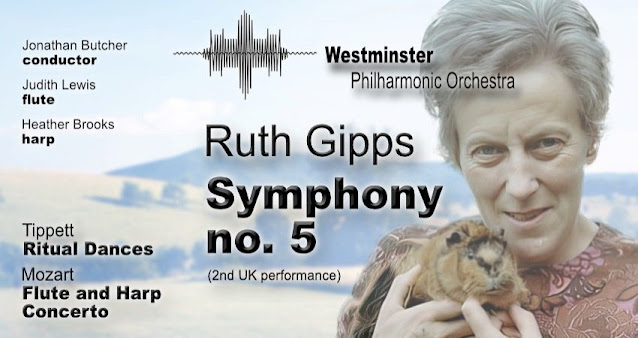
It follows, too, hot on the heels of the revival of the Fifth, first by the Seattle Philharmonic Orchestra and then in London by the Westminster Philharmonic.  I was fortunate enough to be able to attend the latter performance with some friends; it was a tremendous experience to hear it live — a symphony rich in beauty, rescued from obscurity.  I have to say that I found the first movement too fast, so that some of the details, and the excitement, of the tremendous climax was lost — but I cannot really complain, since a live concert performance of the symphony seemed unthinkable only a few years ago.  The programme notes were excellent, incidentally.

All this means that all four of Gipps’ mature symphonies have received concert performances on both sides of the Atlantic.  The first remains something of mystery — rejected or withdrawn because it was an early work?  The clarinet concerto, written when Gipps was nineteen, has been performed and recorded, so there seems no reason to assume that the symphony is not worthy of the same.

It has been such a heartening experience to see Ruth Gipps’ star continue to rise over the last few years, and to hear all these wonderful new recordings — including four live performances.  My only slight anxiety is that the revival is in some ways politically motivated, that is, that Gipps is being promoted more because she was a woman who suffered prejudice than because she was a superb composer.  It is certainly true that she experienced prejudice as a woman composer and conductor, and that the Gipps Revival helps to right that wrong, but the prejudice which seems really to have cut her to the quick was what followed later; the complete rejection of her tonal style of composition at a time when atonalism was all the rage.  This aspect of her story receives less attention.  The lesson to be learned from her life is surely that we should avoid prejudice of all kinds, including those of the fashions of the time — to which the musical world seems surprisingly prone.  If we revive Gipps’ music on political grounds alone, she will lapse back into obscurity the moment the Zeitgeist passes.  But if we judge her as she herself would have wanted to be judged — by her music — then she is assured of a permanent, well-deserved place in the pantheon of twentieth-century British music.

Saturday, May 13, 2023

Ruth Gipps: Fifth Symphony in the ascendant

The Westminster Philharmonic Orchestra will perform Ruth Gipps’ Fifth Symphony next Saturday, 20th May, at St. John’s Church, Waterloo, London.

In the whole sorry tale of the indifference and disdain shown — in official circles at least — towards the music of Ruth Gipps during her lifetime, it is the episode of her Fifth Symphony that seems to sum up the sheer bone-headedness of it all, the blindness into which fashions and fads can lead even intelligent and cultured people.

Gipps’ fifth symphony, completed in 1981, ought to have been the crowning point of her career.  The successful broadcasts of her second, third and fourth ought to have counted for something, yet Gipps had found each of these progressively more difficult to secure — and now, as she was to tell the music agent Alan Poulton, ‘the BBC promptly rejected the 5th,’ adding, ‘I am still made to submit works as if I were a student.’

In 1982, writing to Malcolm Arnold, she hinted that she had rather expected as much.  Where BBC broadcasts were concerned ‘I wait for years,’ she told him, giving several examples of apparent heel-dragging and long delays even for works approved for recording and broadcasts.  ‘So now I write for what I like,’ she said, which in the case of the fifth was a large force with plenty of winds and percussion.  She programmed the symphony in a 1983 concert given by the London Repertoire Orchestra, which she had set up to offer experience and support to newly-qualified professional players.  A recording exists of this concert which, though fairly scratchy, certainly conveys the quality of the music.  ‘It has a great big first movement,’ she told Arnold —

[…] a little tiddly 5/4 intermezzo, a rather difficult scherzo with a cello solo going up to the B above the treble clef in the trio […] and then a very odd finale – a Missa Brevis for orchestra – no singers, but tunes that fit the Latin words if you did have singers; and two listeners without scores said they could follow it through. I’m not a Catholic, by the way, but was brought up on the B minor [Mass by J. S. Bach] at College.  [1]

I think it is Gipps’ greatest symphony, the magnificent first movement being perhaps my favourite of all her musical utterances.  It has all the Gipps hall-marks — the lyrical mistiness, the angularity and spikiness, the occasional audacity in the treble register — but has less of her usual optimism, being shot through with a particular tang of sorrow, a bittersweetness, which I think adds to its power.  It also contains one of the most beautiful solo passages in all of English music.  And yet, after that first performance, the symphony — inexplicably, bewilderingly, frustratingly — fell into complete neglect and was not performed again.

Until April this year, that is — and once again it is the Seattle Philharmonic Orchestra which has ridden to the rescue.  Having given the U.S. premieres of the second and the fourth symphonies, they have now added the first American performance of the fifth to their trophy cabinet.  Their director of music Adam Stern has shown a singular dedication to Ruth Gipps’ music, and in the case of the Fifth it turns out that he had to recopy the whole score and all the orchestral parts, which had been lost.  The six months it took him coincided with the first wave of the Covid pandemic — it is nice to see that something good came from a time that was very difficult for many musicians.

His faith in the music is absolute.  The symphony bears the influences of Malcolm Arnold, Vaughan Williams and William Walton — to whom the work is dedicated — and yet ‘there is nobody else who could have written this symphony but Ruth Gipps,’ he told his players.  ‘It has a new life, and we are giving it life.  We are giving the second performance of this piece — Yes, it’s big, it’s big.’  He also hinted at plans in the pipeline for a studio recording and CD release on the Chandos label, and also mentioned that ‘another orchestra’ needed their parts immediately after the Seattle premiere.

Excitingly for Gipps fans on this side of the Atlantic, the orchestra in question is the Westminster Philharmonic Orchestra, which is performing the symphony in London next Saturday, 20th May, at 7.30 p.m. at St. John’s Church, Waterloo.  This is the first British performance since 1983, and only the third ever.  Further details and tickets are available here.

Many thanks (as I have said so often before!) to the Seattle Philharmonic for their courage in programming Gipps’ music and the fine musicianship audible in the clips below — and to Maestro Stern in particular for his dedication and single-mindedness in promoting this too-long-neglected composer.  Also to whoever digitised and uploaded the recording of the Fifth onto YouTube.  As for the London performance, I cannot wait.

Sources:

[1] Alan Poulton, ‘Malcolm Arnold and Ruth Gipps’, in Beckus (no. 100, Spring 2016), retrieved 13 May 2023 from https://www.malcolmarnoldsociety.co.uk/malcolm-arnold-and-ruth-gipps/

[2] Norman Lebrecht, ‘Ruth Gipps gets a US Premiere’, (Slipped Disc, 15 April 2023), web resource, retrieved 13 May 20223 from https://slippedisc.com/2023/04/ruth-gipps-gets-a-us-premiere/

Monday, February 20, 2023

Theme and Variations for Ruth Gipps’ Birthday

Today is the anniversary of Ruth Gipps, who was born in Bexhill-on-Sea on the 20th February 1921, and whose legacy of melodic, characterful music is now at last enjoying the recognition it deserves.

Here is the second movement, a Theme and Variations, of her Third Symphony (1965), played by the BBC Philharmonic under Rumon Gamba in their superb recent CD release.  The piano reduction of the same movement is also worth a listen.

The next exciting development on the Gipps front will be the United States première of the fine Fifth Symphony (1982), which will be given on April 15th by the Seattle Philharmonic Orchestra.  I am hopeful that some way might be found to stream the concert over the Internet for listeners in Gipps’ native country, but in any case, the ‘Seattle Phil’ has excelled itself again.  More information here: https://seattlephil.org/concerts-and-tickets/concert/gipps-fifth/ .

Wednesday, October 12, 2022

Vaughan Williams 150

A revised version of an article from 2018.

‘And I saw a new heaven and a new earth…’. From Sancta Civitas (1928), the composer’s favourite of his own choral works. 

Today, 12th October 2022, is the hundred-and-fiftieth anniversary of the birth of Ralph Vaughan Williams (1872–1958).  Was he England’s greatest composer?  He has plenty of strong competition of course, and perhaps half the fun is never quite to settle the question — but as far as I am concerned, if anyone is to match Vaughan Williams, then they too will have to draw me, irresistibly, again and again, yet in a different way every time, into a distinctive, great-hearted, masterfully-crafted musical world that is all its own.  He is in first place in my book.

Vaughan Williams photographed at home (The White Gates, Dorking, Surrey) in January, 1949.

His was a life that, in many ways, took place in reverse.  He emerged as a composer relatively late — not completing his first symphony until he was thirty-five — but from then on never diminished in his  output, even intensifying as he aged.  Those who might have perceived in his fifth symphony (premièred in 1942, his seventieth year) a mellowing in age, or a mood of valediction, would hardly have suspected that this was actually the half-way mark, and that there were four more symphonies to follow.  Throughout his last decade — well into his eighties — he seemed unstoppable, completing his three final symphonies, the opera The Pilgrim’s Progress (a lifetime’s work), concertos for harmonica and tuba and much more, all the while maintaining an energetic social life, both conducting and attending concerts.  And it was not only musically that he was thriving: after the death of his wife Adeline in 1951 after decades of illness, he was rejuvenated by a second marriage to the poet and playwright Ursula Wood (whose poetry he set to music).  So he seems almost to have been cut off in his prime, though he lived to eighty-five.

Music for the film 49th Parallel.

I admire Vaughan Williams in the first place for the most straightforward reason: because the sound of so much of his music appeals to me so directly.  Time and again he wove melodies, harmonies, textures and cadences masterfully together in the service of beauty, beauty for its own sake.  This beauty often seems so self-evident that I would struggle to explain it.  Yet that first appeal, having drawn me in, makes me all the more willing to listen again more carefully for details I have missed, or to brave the composer’s more challenging works.  In that way he has taught me a great deal about the more intellectual side of ‘serious music’: its forms, its structures, and the depth of expression that they make possible.  So, for example, I have found my life enriched both by the tuneful English Folk-song Suite, which I have loved since I was small, and by the Fourth and Sixth Symphonies, which I discovered in my twenties.  Yet in all his works the same personality is discernible: a companion and a teacher and a seer, who may challenge but never disregards the listener.

The third movement (Scherzo) of the London Symphony, played by the Spanish Radio and Television Orchestra and conducted by Carlos Kalmar.

This capacity for both simplicity and complexity is only part of another remarkable aspect of Vaughan Williams: his sheer versatility, or his ‘tremendous range’, as Vernon Handley put it.  He wrote music of so many flavours, for so many purposes, and all so convincingly, that it is sometimes hard to believe that they flowed from a single pen.  Is the same man really responsible for the tranquil Greensleeves Fantasia and the enthralling anguish of the fourth symphony; for the diabolical chortling of Satan’s Dance of Triumph (from his ballet Job) and the tiny jewel of an anthem, O Taste and See?  He went off searching for ideas in all sorts of directions, but always came back to his own distinctive drawing-board: his work always bears, somewhere or other, the hall-mark of one and the same personality.  There is Vaughan Williams the collector of folk songs, Vaughan Williams the scorer of films, Vaughan Williams the compiler of the English Hymnal.  His music might be sacred or secular, it might last for four minutes or four movements, it might summon full chorus and orchestra or call simply for a solo violin and piano.  For his harmonies he drew on everything from Tudor polyphony to thirties dance-band music; he also experimented with sonority, including a wind machine in his Seventh Symphony, a flügelhorn in his Ninth and ‘all the ’phones and ’spiels known to the composer’ in the Eighth.  And then there are the moods that pass over his music, as many and as various as the English weather’s: serene or furious, reserved or exuberant; proliferating with detail or hanging austerely in clear air. 


 One of the best ways of hearing many of these moods is in that eighth symphony — even in its first movement alone, which is constructed entirely around the very first four notes played.  Sir Mark Elder conducts the Hallé Orchestra.

Another characteristic of his music is — I can think of no subtler word — its manliness.  So much of it seems to express some aspect of, and to be so evidently the work of, the heart and spirit of a man.  In other words, there is a particularly masculine warmth, an outward robustness, a heartiness, a full-bloodedness about it all.  That is not to suggest that he did not mean his music for men and women alike, nor to assume that it was conscious or deliberate — it is simply part of the character and colour of his music.  His work is shot through with the vigour, the spirituality, the moods, the quickness, the temper, the restlessness, the passions, the solitary questing of manhood.

The second movement of the Concerto for Violin and Strings (1925; originally Concerto Accademico).   André Previn conducts the London Symphony Orchestra; James Buswell is the soloist.

Then there is his Englishness, the quality of his music which is perhaps most often commented on.  Vaughan Williams is credited with reviving and developing a particularly English style of music, one that was in contrast with the German idiom of Beethoven and Brahms and Mendelssohn that had prevailed before.  Vaughan Williams was interested in Tudor polyphony and traditional folk-song and the music of ordinary people, not for shallow or jealous reasons, but in a search for authenticity, and in a spirit of revival of old forgotten things and celebration of the particular — and it worked: his music sounds like home.  Hear how well it goes with Shakespeare, or with Chesterton; see how his hymns and carols have passed straight into the canon.  And he was keenly aware of the threats that England faced in his own day — war, the destruction of landscape, the decline in spirit.  Indeed, the sheer spiritual exhaustion of the modern world in general, sated with banality to the point of grief, is prefigured in much of his music.  Hear, for instance, the desolate passages that close the first movement of the Ninth Symphony:


Against despair and nihilism, though, Vaughan Williams was the great champion of the human spirit, and the idea of the lone pilgrim persevering against the odds preoccupied him all his life.  His reverence for folk-culture is precisely an example of this.  There is surely much to be said for founding ‘high art’ on traditional, unaffected idioms: familiar, time-worn songs keep high culture rooted in earth, while transfiguring the familiar elevates and enriches the popular culture.  And even as Vaughan Williams broke new ground with his symphonies and cantatas, he was content, I think, to be a servant of his age.  His heavy involvement in the Leith Hill Musical Festival, and his prolific output of hymns and film-scores and ‘practical music’ (notably the Concerto Grosso for musicians of varying accomplishment, or the Household Music written in wartime for whatever instruments were to hand) reveal a profoundly public-spirited man, unashamed of belonging to a particular time and place, and lending his talents to the service of others.  He himself was quite firm about this: ‘The composer must not shut himself up and think about art,’ he declared; ‘he must live with his fellows and make his art an expression of the whole community.’

For all these reasons and more besides, it is Vaughan Williams whom I hero-worship as Britain’s greatest composer.  Other composers may have shared many of the qualities I have described, but it is  only in him that they are all united.  His music, in all its variety, sounds as fresh as ever, and is still working its magic on lovers of beauty in new generations.  May it continue to lighten lives for centuries to come.

Ballad from the Suite for Viola and Orchestra

Thursday, May 05, 2022

Gipps’ Fifth to receive its U.S. première

Now this is very exciting news: on the 15th April 2023, the Seattle Philharmonic Orchestra will give the United States première of Ruth Gipps’ Fifth Symphony.  Of her four ‘mature’ symphonies, this is the only one yet to have an outing in the ongoing Gipps Revival, yet it is a work as beautiful as, if not even finer than, any of the others.

In the past few years the Seattle Philharmonic, under its director Adam Stern, have excelled themselves in their dedication to Gipps’ music, putting the American premières of both the Second and Fourth Symphonies to their name.  It is no small risk to perform such large-scale works by a composer whose name until recently has, however unjustly, been so little-known to audiences.  Yet this orchestra has now proven itself bold enough to do so three times — each time bringing the music to new and appreciative listeners — and they surely deserve to be known as Gipps’ foremost champions in America.

The story of the Fifth Symphony offers a perfect example of the frustration and injustice that dogged Gipps’ career.  Completed in 1982, when atonalism still reigned triumphant, its persistence in clear melodies and unveiled romanticism were the final proof, if any were needed, of her refusal to compromise her artistic convictions for the sake of the Zeitgeist.  The symphony’s intricate craftsmanship, imaginative sonority and varied palette of moods counted for nothing, it seemed, against the tide of fashion.  Gipps’ previous symphonies had received at least one broadcast on BBC radio, but this time the composer fought in vain even for that.  In the end, a sole performance was given by the London Repertoire Orchestra, the ensemble founded by Gipps herself for newly-trained musicians.  A scratchy but complete recording of this rendition can be heard on YouTube.

Next year’s concert in Seattle will, then, incredibly, be only the second time that this symphony has ever been heard in the forty years since it was written.  And yet, as I hope can be heard in the extract below, this neglect is no reflection of the quality of the music.  It is, as I have said so often before, intricate, distinctive, at turns characteristically spiky and mellifluous, full-throated and beautifully-crafted music.  Many thanks to all involved in the decision to perform this symphony, and very best wishes for its success.  I have only one question — might there please be the chance of streaming the concert online, or of releasing a recording of it, for those of us who find ourselves on the wrong side of ‘the pond’?

Full information here: 

https://seattlephil.org/concerts-and-tickets/concert/gipps-fifth/

This article has been updated to reflect a change in the scheduling of this concert from an initial date of September 4th, 2022.

The first movement of the fifth symphony, in which one of the most beautiful clarinet solos ever written develops eventually into a majestic anthem-like summit.  The London Repertoire Orchestra is conducted by the composer.

Sunday, January 30, 2022

Bright Music in Mid-January

What a treat, last Thursday evening at the Royal College of Music, to hear Ruth Gipps’ Fourth and Vaughan Williams’ Eighth Symphonies played by the students’ Symphony Orchestra.  In fact, for me it was several treats wrapped up in one: it was the first time I have heard Vaughan Williams’ Eighth played live, the first live performance of a Ruth Gipps symphony I have heard at all, and, more generally, it was a delight to find the future of British music in such safe hands.  And after these past two years it was also a real tonic to drink in the fizz and the liveliness of a university atmosphere.

I already knew and loved these two symphonies, but had not realised what an interesting pairing they would make in concert.  In spite of their contrasting moods, both are adventurous as far as sonority is concerned, making lavish use of the timbres of woodwind and percussion in particular, and producing, in each case, moments of remarkably bright and gleaming sound — just the thing for mid-January.  

But their moods are certainly contrasting.  The Gipps, which was conducted by the great Martyn Brabbins, is overall rather more questioning and unsettled than the Vaughan Williams, even at times agonised, having, as Jill Halstead has put it, ‘an undercurrent of pessimism found in only a handful of her works.’  There is still that weaving together of spiky energy and romantic lyricism that is so characteristic of Gipps, along with melismatic solo, duet or trio passages, but the backdrop against which they are heard is a melancholy and uncertain one of shifting harmonics and rhythms.

“That is a really difficult symphony,” was Martyn Brabbins’ opening to the little ‘mid-amble’ he delivered to the audience after the Gipps, and yet one would hardly have thought, had he not told us, that he and the orchestra had only had two rehearsal sessions together before the performance.  “But that’s how it is in the U. K.: we don’t have much rehearsal time.  So they have to get used to it!” he said.  He was very warm about the musicians.  He also made some observations which put into perspective how remarkable the recent Ruth Gipps Revival has been: even this great British conductor admitted that she had been in his blind spot; he had heard of her name in the seventies, but never met her, and this was only the second piece of hers that he had ever conducted.  She really did seem to have dropped into obscurity.  Yet now, with no small thanks to him, the next generation of young musicians have had the chance to play and hear her music for themselves.

Next came Vaughan Williams’ Symphony no. 8, in which each movement was placed under the baton of a different student conductor (and which resulted in the unusual spectacle of four conductors lining up to take a bow at the end!).   This too was clever programming, because, while the outer movements are famous for using ‘all the ’phones and ’spiels known to the composer’, the second movement uses only the wind sections, and the third only strings.  I rather liked the style of the conductor of the third movement, while the chap who won the jackpot to conduct the tintinnabulous final movement — “it’s just like Christmas,” as Martyn Brabbins put it — was absolutely in his element.  The various solos were carried off masterfully, and the overall blend was testament to rock-solid musicianship.

This is a symphony so full of life and gaiety that it might be a surprise — but if so an instructive one — to find that Vaughan Williams wrote it in his early eighties.  The first movement alone contains almost his entire, and considerable, range of moods: the solemnity, the radiance, the tempestuousness, the serenity.  But the mood is overall joyous and optimistic; only in the thoughtful third movement, the Cavatina, a kind of latter-day Tallis Fantasia, are there pangs of sorrow, or regret, or something like it.  It is full-blooded, lusty music that reminds you that you are alive, and is all wrought together so masterfully: rich and intricate, but never too much.  Martyn Brabbins admitted that he used not to like it when he was young, “but now,” he said, “I can’t do without it;” and nor can I.

How wonderful that this should be done, as Gipps’ centenary year draws to a close, and Vaughan Williams’ begins.  Many thanks to all involved for a wonderful evening.

Saturday, February 20, 2021

Ruth Gipps’ Centenary

It must be six or seven years since I first came across the music of Ruth Gipps (1921–1999) on one of the several YouTube channels maintained by French composer Corentin Boissier and to which he makes regular uploads of, as he puts it, ‘little-known post-romantic classical orchestral works’.  His project had already brought some new musical names to my attention — Els AarneMerab PartshkhaladzeJoseph Jongen — but I was rather taken aback when he put up a work by a British composer: Ruth Gipps’ Symphony no. 2.  I thought I had a reasonable knowledge of English music of the twentieth century, but here was a composer of five symphonies (among much else) whose name was completely unfamiliar to me.  Investigating further, I soon discovered her piano concerto and third symphony and, grateful as I was for Boissier’s uploads — and to those who had originally recorded and digitised the performances  I marvelled that no newer or higher-quality recordings existed of these distinctive, passionate works; indeed, that Gipps’ music received so vanishingly few broadcasts and performances, and that her name had fallen into such obscurity.

Rumon Gamba and the BBC National Orchestra of Wales
recently dedicated an entire disc to Gipps, including
recordings of her Second and Fourth Symphonies.

How wonderful it is to see today, then, on the centenary of Ruth Gipps’ birth, how much has changed in how little time.  The past few years have seen an extraordinary growth of interest in Gipps, and her neglect has rather rapidly been put right.  When I first drew up a list of available recordings of her music, the pickings were fairly sparse: there were only three or four recordings on disc.  Now, only four years later, the list has swelled tremendously (and is incidentally the most-viewed page on this blog).  There have been concerts (the world première of her clarinet concerto in London; her Second Symphony in Birmingham, and the United States premières of her Second and Fourth Symphonies), online recitals on both sides of the Atlantic, live broadcasts (the BBC Scottish Symphony Orchestra gave a fine rendition of the Third Symphony in 2019), and some superb studio recordings of a variety of her orchestral works.  In the week beginning Monday, 8th March, to my surprise and delight, she will be BBC Radio 3’s Composer of the Week, and have five programmes, each an hour long, dedicated to her life and music.  So there is indeed a great deal to celebrate.

The finale of the Horn Concerto: David Pyatt is the soloist; Nicholas Braithwaite conducts the London Philharmonic orchestra.  A few years ago, this recording was one of only a few available of Gipps music.

Many of those involved in the Gipps revival have expressed similar astonishment that such music could ever have fallen into such obscurity.  The conductor Adam Stern, who with the Seattle Philharmonic Orchestra spear-headed the American première performances of the Second and Fourth Symphonies, must have spoken for many when he said, ‘Her music is entering the repertoire, there are new recordings appearing — and it is music of such stunning quality that one can only listen and say, “Why?  Why did we not know this before?”.’  Much of the blame has been attributed to the prejudice that Gipps faced early on in her career, in the 1940s and 1950s, when there was still a tendency to be dismissive of women composers and conductors.  It seems to be at least in part a desire to right this wrong that has motivated much of the recent revival, and her music has accordingly appeared in the programmes of many concerts dedicated to the work of female composers.

It is worth pointing out that this was not the only unfairness that affected Gipps’ career.  Just as difficult in its own way — and, I think, the main reason for her neglect in the later twentieth century — was that her style was out of musical fashion in the decades after the war.  She rejected — admittedly rather vehemently, but out of artistic integrity — the techniques of twelve-tone music, atonalism and serialism which so dominated the Sixties, Seventies and Eighties.  In the very years when her career should have been at its peak, commissions and performances of new tonal music were at their lowest ebb.  Her third and fourth symphonies were broadcast live only once in her lifetime, and she fought in vain to get her fifth onto the radio at all.

The third movement of the Trio (op.10) for oboe, clarinet and piano, played by Tom, Joao and Raúl of the Conservatorio Superior de Música (Higher Conservatoire of Music), Valencia, Spain, in January 2020.

I think it is not unreasonable to suppose that Gipps found this second prejudice at least as hard, if not harder, to bear as the first: to be treated unfairly as a woman had been a broad social wrong that she was not alone in suffering, and one to which her self-possessed character offered a kind of riposte (Herbert Howells called her ‘go-getter Ruth’) — but to be rejected in a such a specific way by her own world, the world of music, and on the grounds of musical fashion, must have been very hard indeed.  There is something rather enjoyably bracing about someone who can come out with such uncompromising assertions as ‘Amplified "pop" is evil and harms everyone who listens to it’, but her outspokenness also perhaps betrays a bitterness, even a hopelessness, in her outlook, a sense that she had nothing to lose by her bluntness.  Jill Halstead, whose biography (‘Anti-Modernism, Nationalism & Difference in English Music’, Ashgate, 2006) has proven a great help to Gipps revivalists, recalls one incident in which —

With typical boldness she confronted [William] Glock [Head of Music at the B.B.C. from 1959 to 1972] face to face, and in what was for her an unforgettable encounter asked him why he wanted so much power and why he felt he had the right to ostracize tonal music.  It is not clear how Glock responded, but such audacity on Gipps’s part did little to help her cause. 

She was scathing, too, about the importance ascribed to ‘originality’ in the musical world, declaring, 

My music is a follow-on from Vaughan Williams, Bliss and Walton — the three giants of music since the Second World War.  All were great and inspired composers […]  I say straight out that I regard all so-called 12-tone music, so-called serial music, so-called electronic music and so-called avant-garde music as utter rubbish and indeed a deliberate conning of the public.  

And yet in fact she was an original composer; her invariably beautifully-crafted music has a distinctive flavour, often combining a bright, audacious spikiness with a misty bittersweetness.  ‘I know I am a real composer; perhaps they will only realise it when I’m dead,’ she said.  Because the narrow sillinesses of human beings cannot last forever, because beauty always wins out in the end, her music is ultimately her greatest testament.  It is wonderful to be able to say, on her hundredth birthday, the most important thing: that her music is being heard.

Update, 24th February, 2020: a concert to be broadcast on BBC Radio 3 on the 8th March, 2021 at 2 p.m. will include a performance of Gipps’ Symphony No. 3.   Rumon Gamba will conduct the BBC Philharmonic Orchestra: https://www.bbc.co.uk/programmes/m000sxzm.


The third movement of Gipps’ Piano Concerto in G Minor, with Murray McLachlan as soloist and the Royal Liverpool Philharmonic Orchestra under Charles Peebles.

Thursday, January 23, 2020

Ruth Gipps in Seattle and Sussex

It is only a few days before another new milestone is marked in the unfolding Ruth Gipps revival:  this coming Saturday (25th January), the United States première of her haunting, otherworldly Fourth Symphony will be given by the Seattle Philharmonic Orchestra, under the baton of Adam Stern.  The concert starts at 2 p.m. (US Pacific Time) in the Benaroya Hall in the orchestra’s home city.  Some other interesting pieces are on the menu as well, including a piece by Mel Bonis, a name I hadn’t known before reading of this concert.  More details are here: http://seattlephil.org/concerts-and-tickets/legendary-women/.  I hope this performance scores as resounding a success as the same orchestra’s première of the Second Symphony in March 2018, and that it brings the music of this remarkable, distinctive composer to ever more music-lovers.

Here’s conductor Adam Stern explaining some of the hidden patterns and ideas that underpin the symphony:


Ruth Gipps’ star is rising on this side of the Atlantic, too: at least two forthcoming British concerts will include her music.  One is a concert at Bromsgrove School (Worcs.), whose first item is ‘Cringlemire Garden’, impression for string orchestra, op. 39: https://www.eso.co.uk/kannehmason-bromsgrove2020/: this will take place a week tomorrow, on Friday January 31, 2020 at 7.30 p.m.

The other is an interesting-looking concert whose centrepiece is ‘On Windover Hill’, a new cantata by Nathan James in praise of the curious chalk figure of the Long Man of Wilmington on the Sussex Downs, but which also includes an excerpt from ‘Goblin Market’, Ruth Gipps’ setting (op. 40) of Christina Rossetti’s poem.  The concert starts at 7.45 p.m. on Saturday, 7 March, at Boxgrove Priory near Chichester.  More information here: https://www.castleymusic.com/onwindoverhill.

Many thanks to all musicians and organisers of these concerts!

Sunday, November 24, 2019

Ruth Gipps: Symphony No. 3 to be broadcast

At the moment, it seems, every other post on this blog is an announcement of some new development in the unfolding revival of the music of Ruth Gipps.  The latest is a piece of particularly good news: a performance of her Third Symphony (1965) by the BBC Philharmonic Orchestra, on the 4th December in a concert starting at 13.55, and which will be broadcast live on BBC Radio 3.  Free tickets for the performance — at the BBC Philharmonic studios in Salford — can be applied for in the ballot here until 10 p.m. this evening.  But anyone else can tune in to Radio 3 just before 2 p.m. here — https://www.bbc.co.uk/programmes/m000bxgl — and hear this lyrical and luminous symphony given a long-overdue rendition.  The conductor will be Rumon Gamba, who was responsible for the recent Chandos ‘all-Gipps’ record.

I don’t know when this symphony was last performed, but this is certainly its first broadcast in half a century.  It last went over the airwaves the 29th October 1969, the composer conducting the BBC Scottish Symphony Orchestra.  The symphony’s only readily-available recording is of this performance: better than nothing, but it will be wonderful to hear it clearly and in stereo.

I would say that, for those unfamiliar with Ruth Gipps, this symphony is a particularly good introduction to her music.  It is full of tunes and sweet passages, and is suffused with her distinctive combination of wistfulness and good humour.  Many thanks to Rumon Gamba and the BBC for masterminding this.  I am looking forward to it very much.


Ruth Gipps: Symphony no. 3, second movement, Theme and Variations.

Saturday, September 07, 2019

Ruth Gipps returns to Seattle!

The long-unsung music of Ruth Gipps (1921–1999) really does seem to be undergoing a serious and sustained revival.  In the past few years, her works have featured in a glorious proliferation of concerts and recordings, of which several have been premières, along with YouTube clips, magazine features and blog articles.  It has all been thoroughly heartening for those who love her music, which has hopefully been brought to many new ears.  I imagine that a great number of those discovering her tuneful and deftly-crafted music will wonder in disbelief (as I did) how they could never have heard of her before.

Even in the past fortnight, two exciting developments have swelled the revival.  The first piece of news is that, on the 25th January 2020, Gipps’ Fourth Symphony is to receive its United States première.  It will be played by the Seattle Philharmonic Orchestra and conducted by Adam Stern, the orchestra’s director of music, who was kind enough to write into this blog with the news.  The symphony will be the finale of a concert starting at 2 p.m. (U.S. Pacific Time) in the Benaroya Hall in the orchestra’s home city in Washington State.  One première was evidently not enough, as the programme also includes the first performance of a piece by Mel Bonis, a name I have not heard before: ‘Le songe de Cléopâtre’.  (Further details here: http://seattlephil.org/concerts-and-tickets/legendary-women).

The name of the Seattle Philharmonic might sound familiar because it already has the U.S. premiere of Gipps’ Second Symphony under its belt (a recording of this performance, given in 2017, also under Adam Stern, was generously made available on YouTube).  That this enterprising orchestra is programming Gipps for a second time is, I feel, a further triumph and serious vindication of Ruth Gipps as a composer.  It is a clear proclamation that her name is worth knowing in its own right, and not only by one or two of her pieces.  It also shows the strength of support for Ruth Gipps that exists across the Atlantic.  (Most of the YouTube clips of her music I have found to date have been of American performances).  Many thanks to the Seattle Philharmonic for their determined promotion of her music, and I hope this première scores as great a success as the last!

The Fourth Symphony makes for very rewarding listening, though it is perhaps a little less immediately accessible than the Second and its four movements plumb moodier, more chromatic depths.  But don’t be afraid!  There are still Gipps’ characteristic memorable melodies, variations of textures and of light and shadow, cadences ‘swaying’ to and fro, tenderness complemented by a certain spikiness, and atmospheric interludes comprising imaginative pairings of instruments in duets, such as the cello and harp towards the end of the last movement.  My own favourite movement, the second, is a moonlit grove of wonders.


Dawn breaks at the beginning of the final movement of Gipps fourth symphony.

The other piece of news is yesterday’s release of a new recording of Gipps’ piano concerto and a small piece for orchestra, ‘Ambervalia’.  The piano concerto is a passionately melodious piece of music, and was one of the works that first drew me to find out about Ruth Gipps (the recording I first found was a 1972 radio broadcast with the BBC Northern Symphony orchestra, Eileen Broster as soloist, and the composer conducting).  Now it has been given its second commercial recording, with the pianist Murray McLachlan and the Royal Liverpool Philharmonic Orchestra under Charles Peebles.  The disc (released by SOMM records) is shared with two other works for piano and orchestra by Dora Bright (1862–1951) — another name that is new to me!  The recording samples sound tremendously rich and exciting.


Update: I have also just found out that Ruth Gipps’ Clarinet Concerto (Op. 9 1940) is in the programme for the London Repertoire Orchestra’s Autumn Concert in St. James’ Church, Piccadilly, London, on the 2nd November 2019, with Peter Cigleris as soloist.  It is described as the ‘first performance’ of a ‘new edition’.  Fantastic news!

Wednesday, June 26, 2019

Ruth Gipps in Cheltenham

There is more good news regarding Ruth Gipps, the hitherto unjustly-neglected British composer.  Her Second Symphony will be performed as part of the Cheltenham Festival on Saturday 6th July, 2019, at 7 p.m.  It will be conducted in the Town Hall there by Mirga Gražinytė-Tyla and played by the City of Birmingham Symphony Orchestra — a later incarnation of the same orchestra in which Ruth Gipps played the oboe early in her career.  More details here: https://www.cheltenhamfestivals.com/music/whats-on/2019/cbso-and-alison-balsom/

It is wonderful that Ruth Gipps is now receiving the attention she deserves, and that her decision to stick to a traditional musical idiom, which cost her so much in her own lifetime, has now been vindicated, as a new generation of listeners discovers and delights in her music.  I am almost confident enough to start a wish list — a recording of the third and fifth symphonies, the première of her oboe and viola concertos, or a major London performance, such as her piano concerto at the Proms…

Here is the second symphony’s grand finale, from this year’s new recording of the symphony by the BBC National Orchestra of Wales under Rumon Gamba:


Update: Unfortunately Mirga Gražinytė-Tyla had to withdraw from the concert due to illness: Edward Gardner deputised, and Ruth Gipps’ symphony was replaced with Walton’s suite from ‘Troilus and Cressida’.  Never mind — another time!  Wishing Mirga Gražinytė-Tyla a swift recovery.

Update no. 2: Ruth Gipps’ second symphony is now due to be performed in  Birmingham’s Symphony Hall at 7.30 p.m. on Wednesday 2nd October (https://cbso.co.uk/event/alison-balsom-plays-musgrave).

Tuesday, November 20, 2018

Hear the U.S. Première of Gipps’ Symphony No. 2!

As reported previously (herehere and here) the first performance in the United States of Ruth Gipps’ second symphony was given on the 31st March this year by the Seattle Philharmonic Orchestra under the baton of Adam Stern.  Now Mr. Stern has kindly written with the news that video recording of their rendition is now available on YouTube.  Here it is, capturing a contrast of flavour that I think is characteristic of Gipps’ music: that between romantic tenderness on one hand, and a light-footed liveliness, almost spikiness, on the other:


Many thanks to the Seattle Philharmonic Orchestra for this performance!  It is wonderful to know that this music is being played and enjoyed on the other side of the Atlantic.  In fact, it is wonderful to hear it being performed like this at all, given the neglect in which Ruth Gipps’ music has been languishing, and from which it seems at last to be emerging.

And this is not the only good news about Ruth Gipps’ music.  In September a new disc was released on the Chandos label of recordings of this same work, the second symphony, along with Gipps’ fourth symphony and two other early works, ‘Knight in Armour’ and the Song for Orchestra.  It is the National Orchestra of Wales under Rumon Gamba who have rectified a long-lasting injustice: the almost total absence of proper commercial recordings of this under-performed and overlooked composer’s music.  The recording and the rendition are of the quality that Ruth Gipps deserves, I feel, and would certainly recommend them.  The fourth symphony is perhaps less accessible than the other works, but is pervaded by an otherworldly, rather nocturnal atmosphere, and repays listening.

It is fantastic that this recording has been made.  The only improvement I can think to suggest is to record the other symphonies, especially the third and fifth, to complement it!

Monday, September 24, 2018

On Majesty

One significant milestone in my formation as a stick-in-the-mud, fogey and all-round defender of old things occurred when I discovered, at the age of about nine, that my very ordinary suburb of south London had once boasted its own cinema.  For several decades, with its confident Art Deco façade, the ‘Majestic’ had presided over the Fair Green in the centre of town, and the flickering world of the pictures had dwelt waiting within.  Of course I straightaway wanted to know what had become of it.  It did not take me long to find out.  Having been converted into a bingo hall in the early 1960s, the building had been pulled down altogether in 1978.  No trace remained, save in the name of the street beside it, Majestic Way.  And what stood in its place?  The blank concrete hulk of the Kwik Save supermarket.
The Majestic Cinema, Mitcham, circa 1970. 
Photographer: E. N. Montague.  © Merton Historical Society; reproduced by their kind permission.

This was, I suppose, a particularly iniquitous piece of mid-twentieth-century urban planning, though practically every town in Britain must have a story to rival it.  It certainly had a formative effect on me, immunising me once and for all against any tendency to presume any superiority in new things over old things.  Certainly I could scarcely comprehend the jettisoning of the cinema, ‘Majestic’ in name and nature, for the insolent windowlessness of its successor with its gimmicky moniker.  It had been ours, and we had thrown it away.  All long before my time, but melancholic nostalgia still flooded and intoxicated my being, rich and dark as ale, and not without a bitter edge either.
Mitcham’s Fair Green in May 2018, seen from about the same position as above.
But it was not a question just of this particular building.  I think I sensed the passage of greater, intangible forces, the tides of culture of which its disappearance was a sign.  I felt cheated, not only of the cinema itself, but of the vanished civilisation that had been capable of building it, sustaining it, and, I think above all, of giving it such a name as ‘Majestic’.  For the word itself spoke volumes.  It was plain enough to me that the culture in which I lived would never choose a name like that for a public building, a cinema or anything else — not in a month of Sundays.  Yet there had existed, not that long before, a world that did.  This modest picture-house with its grand epithet was proof that this world had been alive in my own town.  So, too, was the supermarket proof that the cultural revolution had not left it unvisited.  This, as they say, was personal, which is why its loss struck me with such force.  The old world had been alive here, I realised; and here too it had been lost.

Just as I could see no contest between the Art Deco cinema and the Brutalist supermarket, and none between the names ‘Majestic’ and ‘Kwik Save’, I had no trouble in deciding which I preferred of the respective civilisations that built and christened them.   Everything about the two institutions was different because everything about their worlds was different.  I knew where my loyalties lay.  In one age, an age of muscular steam power and palatial trans-Atlantic liners, even a cinema chain, in all its undoubted mercenary-mindedness, could calculate, correctly, that Thirties glamour and a single crowning resonant adjective, would draw in paying audiences far out in these workaday fringes of south London.  There had been poetry in that world.  But the other, later era, the era in which one might go up a street named Majestic Way only to find, at its culmination, like a grotesque joke, such a thing as a Kwik-Save — this era was hollow, and ironic, and hard of heart.  Conscious as I am of the many faults and sins of that old civilisation, and of the weaknesses and cruelties of people in all ages, and of the irretrievability of the past, I am simply still in far greater sympathy with the first era than with what came later.  Still I know where my loyalties lie.

Well, that is how I became a curmudgeon before I was out of short trousers, and I have been about eighty years old ever since.  But I tell the story because I think it is worth asking the question to which it leads: why is this quality of majesty so singularly lacking in our present age?  Except in a few places and on very few occasions, we build or do hardly anything that is majestic, or grand, or solemn.  For instance, I think it is remarkable, in an era when the physical scale of most new buildings is greater than ever, that their appearance is not more imposing or magnificent.  In London, with its extraordinary rate of new construction, one question asks itself with the completion of nearly every new building: ‘Is that all?’.  So many buildings are gigantic anticlimaxes, catching the eye not by elegance or ornateness, but by their sheer bigness, by brute size.  Surely this is why the nicknames for these new skyscrapers (some Londoners’, some the developers’ own) stick so instantly.  The most prominent of the buildings that have appeared since the new millenium really are shaped like blown-up versions of small objects: gherkinselectric shavers, walkie-talkies.  Would they be any less impressive were they built on half the scale?  Or, asking another way, how much do their chunky shapes gain by the size they are?  They may be ‘bold’ and ‘dynamic’, as is typically claimed, but are they majestic?  No, and I don’t think they were ever meant to be.  Of course, aesthetics are not the architects’ main consideration: these buildings are big because of the perennial imperative to make economic sense of tiny parcels of astronomically expensive land.  So the central doctrine remains the modernists’, that form should follow function.

A big Cheese-grater, a big Walkie-talkie and a big Shard, seen from the top of a big Gherkin
Yet many of London’s older, laboured-over buildings still defy these efforts to dwarf and outgun them, remaining at least as powerful and impressive to the human eye as their newer neighbours, though a fraction of their size.  ‘Majestic’ is surely the first word we reach for on beholding St. Pancras station, Somerset House, the Royal Courts of Justice, the Palace of Westminster or the Prudential building.  How was their effect achieved?  At St. Pancras (which is 150 years old next month), George Gilbert Scott began at a human scale, at the level of doors, windows, tiles and bricks, concentrating on the detail, and he achieved his overall effect by repeating these details a hundredfold, a thousandfold, in all their careful design and craft, along and around and upwards.  The result, in alliance with the verticality of the neo-Gothic, is a soaring range of glorious multiplication, a towering proliferation of decoration, never (in my view) chaotic or disconcerting, but unified by Scott’s eye into a symphony of fine design and accomplished craftsmanship.  “So much detail!” I overheard a tourist exclaim the other month, looking up at it.  But one then wonders why the Shard skyscraper, whose architect also seems to have had verticality uppermost in his mind, does not seem to have the same effect, though it is nearly four times taller than the station.  It is St. Pancras which invites the eye upwards, whereas the Shard simply defies comprehension and measurement.  It is certainly a very impressive work of engineering, but its refusal to make any concession to a human scale means that, to my eye at least, it seems to dominate rather than to crown its surroundings and observers.  St. Pancras offers a feast, and allows the beholder to savour the sight of it, ascending slowly and by degrees from arches, to windows, to turrets, to pinnacles, and to the clock triumphant.  The Shard is so uncompromisingly and instantaneously impressive that it blows the mind and burns it out.
St. Pancras Cathedral station, London, seen from the Euston Road.
Even the design of ordinary flats and houses has followed a similar path.  So much new housing in Britain has an anonymous, mass-produced and plasticky appearance, whereas, well into the twentieth century, even small houses were built with a certain self-contained dignity about them.  Their solidness, their more natural materials, and the simple distinctiveness of generous sashed windows, gables and chimneys reveal something about their architects: that they knew their work would serve an important purpose, to shelter human families.  What do the flat roofs and blank windows of today’s ‘exciting new developments’ say about the frame of mind in which they were designed?

It is not only in architecture that this change has happened.  In music, for instance, sheer volume often serves as the same substitute for majesty as does bigness in architecture.  There is no shortage of music that relies on brute force for its impact: just turn it up and hear the windows rattle!  But what about music that is instead built up meticulously from the smallest details?  For instance, there is William Walton’s first symphony, particularly the first minute and a half of the fourth movement.  The extraordinary thing about this music is that it is not utterly deafening, even though it sounds as if it ought to be.  It derives its magnificence from its ingenious construction.  The composer has written majesty into every detail — just as Gilbert Scott did in his own field of work —  and the overall effect of the music transcends the sum of its parts: it is transcendental.


And from language, too, solemnity and sonority seem to have evaporated, with the fading of poetry from spoken and written English.  Most language in everyday life is firmly earth-bound; if ever we hear it take flight, we do not really know how to respond; we are possibly even embarrassed.  Where now, except on the rarest of occasions, do we meet with language such as in the opening of Elizabeth Jennings’ poem ‘A Chorus’
Over the surging tides and the mountain kingdoms,
Over the pastoral valleys and the meadows,
Over the cities with their factory darkness,
Over the lands where peace is still a power,
Over all these and all this planet carries
A power broods, invisible monarch, a stranger
To some, but by many trusted. Man’s a believer
Until corrupted. This huge trusted power
Is spirit. He moves in the muscle of the world,
In continual creation. He burns the tides, he shines
From the matchless skies. He is the day’s surrender.
Why has majesty vanished so nearly completely from our lives: from speech, from infrastructure, from civic ceremony?  Perhaps Jennings’ poem strikes straight at the answer.  Could it be because we think it is superfluous to and even incompatible with life as we live it now?  For where majestic things, though not directionless, are generally sedate, and measured, and invite and reward contemplation, being the result of careful attention to many details, the modern world is now too quick; it outpaces and leaves unexercised our capacity for concentrated attention.  Magnificent things once thrilled us with their restrained and dignified power, but these days great many other things are valued above dignity and restraint.  Time seems too short for them.  

It is true that a great deal of modern infrastructure, being invisible, silent or glossily efficient in operation, does not lend itself as well to visible majesty, as older technology did.  Immense and elaborate works of software do their work invisibly, imperceptibly and effortlessly, without plumes of smoke or the thrust of pistons.  Although the Internet is a system of extraordinary magnitude, we never call its operation majestic.  A postal system’s mighty empire of apparatus could inspire poetry such as Auden’s Night Mail, and even radio and television have great confident transmitters as their visible symbols, but we never see the Internet at work.  It appears to accomplish everything with instantaneous ease, and without apparent might or power.

But there is more to it than simple circumstance, I am sure.  I wonder if our boredom and urbane cynicism mask a certain fear of the essence of majesty; we are afraid of where it might lead.  For above all, majesty heightens what it touches.  It draws our eyes upwards, lifting us out of everyday life, so that we apprehend something greater than ourselves.  It is held in common by those who behold it: it draws us upwards together.  Majesty is close to mystery; it is a cousin of solemnity, that paradoxically serious business of rejoicing.  Majesty leads us into the foothills of the sacred, and sometimes higher.  But this is where those of us who settle for mediocrity in our individual lives enter dangerous territory: we must avoid, even fear anything that might disturb us.  The dull, flat flood-plain of secularism is so congested with distractions — ‘exciting new developments!’ — that we never notice the higher ground, nor want to notice it.  If we were conscious of our appetite for majesty, we would surely try to fill it, however imperfectly.

Majesty has survived in some places, though.  Most notably it remains in film, television and fantasy video games.  We do sometimes consent to be lifted out of ourselves; we savour the splendour of imaginary worlds and landscapes; we relish orchestral soundtracks.  Isn’t that half the appeal and sheer fun of the television series Thunderbirds, for instance?  precisely the games of timing and scale they played in order to make the models look as realistic and impressive as possible, and the way the machines and craft all took on pathos and tragic dignity when they inevitably crashed, or collapsed, or exploded so gratuitously?  Don’t all small boys dream yearn to be in charge of huge things, bringing a city to a standstill as a Martian Space Probe — doomed anyway, of course — is manoeuvred gingerly towards its its site of launch, ably assisted by a full symphony orchestra?

And majesty abides still in the Church, of course, which certainly does lift us out of ourselves, and is willing to make a nuisance of itself in doing so.  It was the Church that gave us the most visibly uplifting buildings in most towns and cities, and the beautiful craftsmanship within.  What lives in churches is not confined to the past.  We have heart-felt home-made music and meticulous liturgies.  And the words that are uttered in churches leap out at us, either because they are unfamiliar, or because some new significance in them surprises those who thought they knew them well.  Here is an example: all my life I have heard the second half of the Mass beginning with the preface to the Eucharistic Prayer, something like this third preface of Sundays in Ordinary Time.  Familiarity has masked its poetry, but without my noticing it has become one of my favourite parts of the Mass.  Apart from anything else, this is wonderful, ancient poetry which, having first invited its hearers to lift up their hearts, then actually helps them to do so, bearing them heavenwards, towards the angels’ Sanctus:

V. The Lord be with you.
R. And with your spirit.

V. Lift up your hearts.
R. We lift them up to the Lord.

V. Let us give thanks to the Lord our God.
R. It is right and just.

It is truly right and just, our duty and our salvation,
always and everywhere to give you thanks,
Lord, holy Father, almighty and eternal God.

For we know it belongs to your boundless glory,
that you came to the aid of mortal beings with your divinity
and even fashioned for us a remedy out of mortality itself,
that the cause of our downfall
might become the means of our salvation,
through Christ our Lord.

Through him the host of Angels adores your majesty
and rejoices in your presence for ever.
May our voices, we pray, join with theirs
in one chorus of exultant praise, as we acclaim:

Holy, Holy, Holy Lord God of hosts.
Heaven and earth are full of your glory.
Hosanna in the highest.
Blessed is he who comes in the name of the Lord.
Hosanna in the highest.

And this atmosphere of majesty is capable of spilling over from liturgical settings into the secular world.  Simply the heightened form of everyday life that the Church proposes can find fitting expression in uplifting art and music and architecture even outside the liturgy.  There is much to savour, for instance, in a promotional film that was made in advance of World Youth Day in Kraków in 2016: the combination of the poetry of the words (which are delivered in sonorous Polish and given subtitles in English), the richness of the music and the grandeur of the cinematographic art all promise a great and noble occasion, which promise was duly fulfilled.


A civilisation will not build what it does not think it needs.  Our culture, in which we converse with ourselves about ourselves, often forgetting that later ages will overhear us, presents strong evidence that we believe ourselves content with the superficial.  So much about our buildings, art and speech tells of a suspicion of majesty and solemnity.  But we cannot distract ourselves forever from it, and our nature cannot long withstand this truncation.  This is because we have forgotten the majesty that we ourselves possess.  We cannot forever be infants, amused by curiously large and funky shapes on our cities’ skylines.  Mitcham’s Majestic cinema was not all that grand, as majestic buildings go, but it answered a hunger: to paraphrase Philip Larkin, it had been a ‘serious house on serious earth’ (at least before its bingo-hall days, I suppose).  I think we do wish, however secretly, that our lives could be enriched by majesty in our public buildings.  We do want to be uplifted by our music; we would not resent being awed by heightened language.  But for our pride, we should not mind feeling small in the presence of greatness, if the greatness were also benevolent.  We long for the majesty of beauty, for the majesty of things timeless, and, even if we struggle to assent to faith, even if we admit it only on our death-bed, or not at all, we long for the majesty of God to lift us out of ourselves.  We think we know already that we long to be taken seriously, but we do not realise quite how deeply, how earnestly, how utterly we long for the solemnisation of our lives — or, at least we are unable to give expression to that longing.  And that feeling is so strong because we sense the majesty and dignity in which we ourselves are clothed, however hard we try to quell or mar it for the sake of our appetites.  We ourselves are majestic, individual symphonies of fine details, beyond our own power to understand, transcending, in spite of our sins, the sum of our parts.

It is hard and sometimes unconvincing to speak in generalities, and this is why seemingly small details can be so telling.  The great unseen spiritual and cultural forces of the last century only sublimated into visibility at moments like the demolition of Mitcham’s small suburban picture-house for the sake of a brazenly superficial, shamelessly inhuman supermarket.  It was not simply a question of planning or expediency, or the neutral result of the inevitable march of Progress.  Like the construction of any building or the utterance of any word, it was a moral act with a moral effect, which in this case has been to alienate the majestic beings, the people of Mitcham, who lived around it.  Those who built the cinema, for all that they had a business to run, did not forget to make their cinema worthy of their audience.  They raised a house dignified enough to host communal experiences that were secular and yet not entirely profane.  One sign of their achievement is the way in which the cinema is still remembered, forty years after its disappearance.  A local lady I was chatting to at our local Heritage Day the other week spoke fondly of dancing lessons in a room above the front entrance.  The creator of the excellent Mitcham History Notes website has carefully compiled information about the cinema, and transcribed news reports from its lifetime.  And how about Kingsway Models’ range of card kits, where you can actually buy a model of Mitcham’s cinema, along with the Sidcup Regal and the Southall Dominion?  But there is no similar model of the Kwik-Save supermarket.  Which side, then, are we on?  Where do our loyalties lie?  Shall we buy-one-get-one-free?  Or shall we lift up our hearts?