Showing posts with label BBC. Show all posts

Thursday, September 19, 2024

Celebrating Ernest Tomlinson’s centenary

Today is the centenary of the birth of Ernest Tomlinson (1924–2015), the prolific Lancastrian composer of light orchestral music.  He deserves to be remembered not only for his own elegantly-crafted and uplifting music, but for his defence of the entire genre of light music when in the 1960s it fell, or was pushed, so emphatically out of fashion.  The story of his rescuing of music scores thrown out wholesale by the BBC as the Corporation of the time rushed headlong to follow new trends, and of his subsequent foundation of the Library of Light Orchestral Music in a barn on his farm at Longridge in Lancashire, contributed to my own decision to train as a professional archivist.  Having steered the Light Music Society through the lean years of the late twentieth century — during which, for some decades, there was no light music at all on BBC radio, despite, or perhaps because of, its former ubiquity — he lived to see something of a revival in its fortunes.  This remains visible not least in the continued thriving of the Light Music Society (whose membership I have enjoyed for nearly a decade), and the Library’s recent move from Longridge to the Victoria Hall in Bolton.

(There are more details of Tomlinson’s battle for light music in this biography, and also this tribute that I wrote shortly after his death in 2015).

His music helped me through the revision for my final university exams, and having written to him to tell him this, I received a very warm letter in reply, which I will treasure always.

On Friday 27th September, BBC Radio 3’s ‘Friday Night is Music Night’ will be a celebration of his music, along with others of a similar style — including Ruth Gipps!  

‘Miranda’, from an adaptation of The Tempest

Saturday, May 13, 2023

Ruth Gipps: Fifth Symphony in the ascendant

The Westminster Philharmonic Orchestra will perform Ruth Gipps’ Fifth Symphony next Saturday, 20th May, at St. John’s Church, Waterloo, London.

In the whole sorry tale of the indifference and disdain shown — in official circles at least — towards the music of Ruth Gipps during her lifetime, it is the episode of her Fifth Symphony that seems to sum up the sheer bone-headedness of it all, the blindness into which fashions and fads can lead even intelligent and cultured people.

Gipps’ fifth symphony, completed in 1981, ought to have been the crowning point of her career.  The successful broadcasts of her second, third and fourth ought to have counted for something, yet Gipps had found each of these progressively more difficult to secure — and now, as she was to tell the music agent Alan Poulton, ‘the BBC promptly rejected the 5th,’ adding, ‘I am still made to submit works as if I were a student.’

In 1982, writing to Malcolm Arnold, she hinted that she had rather expected as much.  Where BBC broadcasts were concerned ‘I wait for years,’ she told him, giving several examples of apparent heel-dragging and long delays even for works approved for recording and broadcasts.  ‘So now I write for what I like,’ she said, which in the case of the fifth was a large force with plenty of winds and percussion.  She programmed the symphony in a 1983 concert given by the London Repertoire Orchestra, which she had set up to offer experience and support to newly-qualified professional players.  A recording exists of this concert which, though fairly scratchy, certainly conveys the quality of the music.  ‘It has a great big first movement,’ she told Arnold —

[…] a little tiddly 5/4 intermezzo, a rather difficult scherzo with a cello solo going up to the B above the treble clef in the trio […] and then a very odd finale – a Missa Brevis for orchestra – no singers, but tunes that fit the Latin words if you did have singers; and two listeners without scores said they could follow it through. I’m not a Catholic, by the way, but was brought up on the B minor [Mass by J. S. Bach] at College.  [1]

I think it is Gipps’ greatest symphony, the magnificent first movement being perhaps my favourite of all her musical utterances.  It has all the Gipps hall-marks — the lyrical mistiness, the angularity and spikiness, the occasional audacity in the treble register — but has less of her usual optimism, being shot through with a particular tang of sorrow, a bittersweetness, which I think adds to its power.  It also contains one of the most beautiful solo passages in all of English music.  And yet, after that first performance, the symphony — inexplicably, bewilderingly, frustratingly — fell into complete neglect and was not performed again.

Until April this year, that is — and once again it is the Seattle Philharmonic Orchestra which has ridden to the rescue.  Having given the U.S. premieres of the second and the fourth symphonies, they have now added the first American performance of the fifth to their trophy cabinet.  Their director of music Adam Stern has shown a singular dedication to Ruth Gipps’ music, and in the case of the Fifth it turns out that he had to recopy the whole score and all the orchestral parts, which had been lost.  The six months it took him coincided with the first wave of the Covid pandemic — it is nice to see that something good came from a time that was very difficult for many musicians.

His faith in the music is absolute.  The symphony bears the influences of Malcolm Arnold, Vaughan Williams and William Walton — to whom the work is dedicated — and yet ‘there is nobody else who could have written this symphony but Ruth Gipps,’ he told his players.  ‘It has a new life, and we are giving it life.  We are giving the second performance of this piece — Yes, it’s big, it’s big.’  He also hinted at plans in the pipeline for a studio recording and CD release on the Chandos label, and also mentioned that ‘another orchestra’ needed their parts immediately after the Seattle premiere.

Excitingly for Gipps fans on this side of the Atlantic, the orchestra in question is the Westminster Philharmonic Orchestra, which is performing the symphony in London next Saturday, 20th May, at 7.30 p.m. at St. John’s Church, Waterloo.  This is the first British performance since 1983, and only the third ever.  Further details and tickets are available here.

Many thanks (as I have said so often before!) to the Seattle Philharmonic for their courage in programming Gipps’ music and the fine musicianship audible in the clips below — and to Maestro Stern in particular for his dedication and single-mindedness in promoting this too-long-neglected composer.  Also to whoever digitised and uploaded the recording of the Fifth onto YouTube.  As for the London performance, I cannot wait.

Sources:

[1] Alan Poulton, ‘Malcolm Arnold and Ruth Gipps’, in Beckus (no. 100, Spring 2016), retrieved 13 May 2023 from https://www.malcolmarnoldsociety.co.uk/malcolm-arnold-and-ruth-gipps/

[2] Norman Lebrecht, ‘Ruth Gipps gets a US Premiere’, (Slipped Disc, 15 April 2023), web resource, retrieved 13 May 20223 from https://slippedisc.com/2023/04/ruth-gipps-gets-a-us-premiere/

Tuesday, March 30, 2021

Ruth Gipps is Radio 3’s Composer of the Week

The ongoing revival of the music of Ruth Gipps (1921–1999) reached another new high-water mark recently, when she was made the subject of BBC Radio 3’s long-running programme Composer of the Week.  The ever-superb Donald Macleod presented the customary five hour-long broadcasts, interspersing the story of her life with records of her music.  The series can be listened to in full here until the 9th April, but thereafter an abridged, downloadable podcast version will still be available.

Not long ago I had more or less resigned myself to the impossibility of Ruth Gipps’ ever featuring on Composer of the Week, given the apparent paucity of decent recordings of her work: there simply did not seem to be enough musical material to fill the five slots.  Things have changed very rapidly in the past few years, however, and it has now been possible to draw on a much larger catalogue of commercial records.  Moreover, to my surprise and delight, some brand new recordings, some of them premières, also featured: listeners are treated both to foretastes of three forthcoming releases due later this year, and to some recordings made specially for the programme by BBC musicians.  All have been added to my ever-lengthening discography.  I was struck particularly by the first movement of the Clarinet Sonata, with that characteristic bright spikiness that I like to think is particularly reflective of the composer’s character.

Another noteworthy aspect of the programme was the contribution of Ruth Gipps’ daughter-in-law, Victoria Rowe, who joined Donald Macleod for a part of each programme.  Her insightful comments and memories, particularly of Gipps’ work as a conductor, conveyed a vivid impression of the fascinating and forceful character behind the music.

It was also an unexpected surprise to hear the voice of the composer herself, as a guest in BBC interviews during the 1970s and 1980s.  There is also, on the website, a splendid gallery of photographs, formal and informal, which have been generously shared by her family.

Radio 3 really has excelled itself here: I think this programme certainly did justice to this neglected composer.  It has been wonderful to get to know the this remarkable figure even better, and heartening to think that it will have made her music even better-known.  Thank you very much to the BBC and to everyone involved in the making of these programmes.

----

Ruth Gipps’ centenary has been marked elsewhere as well: a Centennial Symposium was held online in early March and can be listened to on YouTube here.  Three recordings were made specially for this event, and are worth a listen in spite of having been recorded remotely:


Members of the City of Birmingham Symphony Orchestra play Gipps Rhapsody in E flat for Clarinet and String Quartet.  The musicians are Oliver Janes (clarinet), Philip Brett (violin), Bryony Morrison (violin), Catherine Bower (viola) and Eduardo Vassallo (cello).

Saturday, February 20, 2021

Ruth Gipps’ Centenary

It must be six or seven years since I first came across the music of Ruth Gipps (1921–1999) on one of the several YouTube channels maintained by French composer Corentin Boissier and to which he makes regular uploads of, as he puts it, ‘little-known post-romantic classical orchestral works’.  His project had already brought some new musical names to my attention — Els AarneMerab PartshkhaladzeJoseph Jongen — but I was rather taken aback when he put up a work by a British composer: Ruth Gipps’ Symphony no. 2.  I thought I had a reasonable knowledge of English music of the twentieth century, but here was a composer of five symphonies (among much else) whose name was completely unfamiliar to me.  Investigating further, I soon discovered her piano concerto and third symphony and, grateful as I was for Boissier’s uploads — and to those who had originally recorded and digitised the performances  I marvelled that no newer or higher-quality recordings existed of these distinctive, passionate works; indeed, that Gipps’ music received so vanishingly few broadcasts and performances, and that her name had fallen into such obscurity.

Rumon Gamba and the BBC National Orchestra of Wales
recently dedicated an entire disc to Gipps, including
recordings of her Second and Fourth Symphonies.

How wonderful it is to see today, then, on the centenary of Ruth Gipps’ birth, how much has changed in how little time.  The past few years have seen an extraordinary growth of interest in Gipps, and her neglect has rather rapidly been put right.  When I first drew up a list of available recordings of her music, the pickings were fairly sparse: there were only three or four recordings on disc.  Now, only four years later, the list has swelled tremendously (and is incidentally the most-viewed page on this blog).  There have been concerts (the world première of her clarinet concerto in London; her Second Symphony in Birmingham, and the United States premières of her Second and Fourth Symphonies), online recitals on both sides of the Atlantic, live broadcasts (the BBC Scottish Symphony Orchestra gave a fine rendition of the Third Symphony in 2019), and some superb studio recordings of a variety of her orchestral works.  In the week beginning Monday, 8th March, to my surprise and delight, she will be BBC Radio 3’s Composer of the Week, and have five programmes, each an hour long, dedicated to her life and music.  So there is indeed a great deal to celebrate.

The finale of the Horn Concerto: David Pyatt is the soloist; Nicholas Braithwaite conducts the London Philharmonic orchestra.  A few years ago, this recording was one of only a few available of Gipps music.

Many of those involved in the Gipps revival have expressed similar astonishment that such music could ever have fallen into such obscurity.  The conductor Adam Stern, who with the Seattle Philharmonic Orchestra spear-headed the American première performances of the Second and Fourth Symphonies, must have spoken for many when he said, ‘Her music is entering the repertoire, there are new recordings appearing — and it is music of such stunning quality that one can only listen and say, “Why?  Why did we not know this before?”.’  Much of the blame has been attributed to the prejudice that Gipps faced early on in her career, in the 1940s and 1950s, when there was still a tendency to be dismissive of women composers and conductors.  It seems to be at least in part a desire to right this wrong that has motivated much of the recent revival, and her music has accordingly appeared in the programmes of many concerts dedicated to the work of female composers.

It is worth pointing out that this was not the only unfairness that affected Gipps’ career.  Just as difficult in its own way — and, I think, the main reason for her neglect in the later twentieth century — was that her style was out of musical fashion in the decades after the war.  She rejected — admittedly rather vehemently, but out of artistic integrity — the techniques of twelve-tone music, atonalism and serialism which so dominated the Sixties, Seventies and Eighties.  In the very years when her career should have been at its peak, commissions and performances of new tonal music were at their lowest ebb.  Her third and fourth symphonies were broadcast live only once in her lifetime, and she fought in vain to get her fifth onto the radio at all.

The third movement of the Trio (op.10) for oboe, clarinet and piano, played by Tom, Joao and Raúl of the Conservatorio Superior de Música (Higher Conservatoire of Music), Valencia, Spain, in January 2020.

I think it is not unreasonable to suppose that Gipps found this second prejudice at least as hard, if not harder, to bear as the first: to be treated unfairly as a woman had been a broad social wrong that she was not alone in suffering, and one to which her self-possessed character offered a kind of riposte (Herbert Howells called her ‘go-getter Ruth’) — but to be rejected in a such a specific way by her own world, the world of music, and on the grounds of musical fashion, must have been very hard indeed.  There is something rather enjoyably bracing about someone who can come out with such uncompromising assertions as ‘Amplified "pop" is evil and harms everyone who listens to it’, but her outspokenness also perhaps betrays a bitterness, even a hopelessness, in her outlook, a sense that she had nothing to lose by her bluntness.  Jill Halstead, whose biography (‘Anti-Modernism, Nationalism & Difference in English Music’, Ashgate, 2006) has proven a great help to Gipps revivalists, recalls one incident in which —

With typical boldness she confronted [William] Glock [Head of Music at the B.B.C. from 1959 to 1972] face to face, and in what was for her an unforgettable encounter asked him why he wanted so much power and why he felt he had the right to ostracize tonal music.  It is not clear how Glock responded, but such audacity on Gipps’s part did little to help her cause. 

She was scathing, too, about the importance ascribed to ‘originality’ in the musical world, declaring, 

My music is a follow-on from Vaughan Williams, Bliss and Walton — the three giants of music since the Second World War.  All were great and inspired composers […]  I say straight out that I regard all so-called 12-tone music, so-called serial music, so-called electronic music and so-called avant-garde music as utter rubbish and indeed a deliberate conning of the public.  

And yet in fact she was an original composer; her invariably beautifully-crafted music has a distinctive flavour, often combining a bright, audacious spikiness with a misty bittersweetness.  ‘I know I am a real composer; perhaps they will only realise it when I’m dead,’ she said.  Because the narrow sillinesses of human beings cannot last forever, because beauty always wins out in the end, her music is ultimately her greatest testament.  It is wonderful to be able to say, on her hundredth birthday, the most important thing: that her music is being heard.

Update, 24th February, 2020: a concert to be broadcast on BBC Radio 3 on the 8th March, 2021 at 2 p.m. will include a performance of Gipps’ Symphony No. 3.   Rumon Gamba will conduct the BBC Philharmonic Orchestra: https://www.bbc.co.uk/programmes/m000sxzm.


The third movement of Gipps’ Piano Concerto in G Minor, with Murray McLachlan as soloist and the Royal Liverpool Philharmonic Orchestra under Charles Peebles.

Friday, September 18, 2020

Ten Years Since Benedict’s Visit

Pope Benedict leaves Lambeth Palace for Westminster, 17th September, 2010

Already it has been ten years since Pope Benedict XVI’s visit to Britain.   Ten years, then, of tea twice daily from my souvenir ‘Papal Mug’ (I make that over seven thousand cups), and ten years, too, that my life has been on the course on which those four days confirmed me: a course with a particular direction, with a particular confidence, in the service of a particular Person.  I cannot be the only one for whom the whole experience helped to affirmed and clarified all that matters most in life, and indeed what life really is.  So, not least because it also happened at a formative time for me, on the threshold of university, I remember the Papal Visit with great happiness, and continue to draw strength from its memory.  It will remain a high moment for the rest of my days.

The long-serving Papal Mug

This had not always seemed likely, however.  One way and another, the months before the visit constituted a rather unpleasant prelude, in which whole swathes of the press and media engaged in an eight-month campaign of hostile publicity not simply against the idea of the visit, but often explicitly and unashamedly against the person of the Pope and the Catholic Church as a whole.  The opposition, overwhelmingly secularist-atheist in character, often went well beyond legitimate criticism of the Church’s institutional failings, or reasonable scrutiny of public expenditure, and curdled swiftly into ill-veiled hatred of the Christian faith itself.  Commentators who ought to have known better indulged in highly personal attacks on Pope Benedict’s character, or fulminated against caricatures of Catholic teaching, or simply ranted against religious belief in general.  Crazed calumnies about Joseph Ratzinger’s supposed corruption or Nazi sympathies or authoritarianism, all nonsense and all child’s play to refute, were sent gleefully off to the printers instead of the compost-heap where they belonged.  Deep down, of course, what these commentators really disliked was Benedict’s resistance to moral relativism; his quiet insistence on the absolute truth of the whole of Catholic Christianity, including those aspects that our age finds difficult.

The most enthusiastic opponents organised themselves into an outfit calling itself ‘Protest the Pope’ (American style — they didn’t even have the decency to protest against the Pope in the British and prepositionally proper manner!).  It was extraordinary to see how much they loathed the Church, or at least what they mistook for the Church; it was both sobering and instructive for us to hear things said and left to stand which, if uttered against almost any other visitor to this country, let alone any other religious leader, would have been seen by all for the smears they were.  The ‘Protest the Pope’ gang was from the outset both very silly and very small, but it received such disproportionately generous airtime from the media that things at one stage began to look serious.  Would Richard Dawkins and his accomplices actually attempt a stunt like a ‘citizen’s arrest’ of Pope Benedict, ridiculous as it sounded? Were they seriously going to ruin the whole thing?  It is by inducing such anxiety that many bullies work, intimidating others as much by their threats as by their actual deeds.  Even in March there was a sense that the whole visit might be in jeopardy:

Some would oppose this proclaimer of peace;
Some disbelieve what he wants to increase;
Some would believe that the world has no hope;
Others know why we must welcome the Pope.

Some have more interest in money than God;
Some are content to give anger the nod;
Others, who know what is built on this rock,
Welcome his peace.  Let him come to his flock.

Well, in the end, this prayer was answered, thank God.  For at last the day came, and the moment Pope Benedict landed in Scotland, the mood changed utterly.  No sooner had all and sundry seen what he was really like, and the public’s true attitude became clear, than the press changed its tune.  The hatred and opprobrium vanished; it was shown to have been over-amplified, even illusory; it was gone with barely a whimper.  ‘Protest the Pope’ simply ceased to be relevant.  There was no longer anything to fear, and we bore our disparagers no ill will.  The BBC, transformed, began excellent and thorough coverage of the visit.  (It is so often the way with the Corporation that it does come up with the goods in the end, when it knows the world is watching!).  Above all, Pope Benedict received the warm and triumphant welcome he deserved, and there followed in succession four days of remarkable gestures, images and experiences.

What strikes me, in retrospect, is to see the different ways in which these moments worked and touched us: though always the same man, he was visiting us in various different guises.  Here was a head of state, a pastor to guide his flock, a thinker with ideas to contribute to our cultural and social conversation, a missionary to a land forgetful of God, and a priest entrusted by Christ with His authority and consolation.  He was both ‘world leader’ and ‘humble worker in the vineyard of the Lord’, and a figure of interest even to non-Catholics, even to non-Christians, including some of my own friends.  This many-layeredness was evident from Pope Benedict’s very first engagement, his meeting with the Queen in Edinburgh.  This being a state visit, the first of any Pope to the British Isles — St. John Paul II’s 1982 journey having been technically a ‘pastoral visit’ — Benedict was, formally speaking, Her Majesty’s guest and counterpart.  But, in the very same moment, the head of the Church of Rome was greeting the head of the Church of England, and the healing of old religious as well as political wounds was continued.  Most simply, and perhaps most importantly, we saw two people who understand and believe the Christian faith and share its hope, who know both the burden and the importance of duty, offering by their steadfast example quiet encouragement to millions of people.  So it was that, even within the first hour, Benedict had touched the people of Britain in the national, the ecclesiastical and the personal spheres.

The day in Scotland concluded with a Mass in Bellahouston Park (with a specially-composed Mass setting by James MacMillan), and the next day, the seventeenth, the Pope came down to London.  That afternoon a group of friends and I went to see if we could catch a glimpse of him leaving Lambeth Palace on his way to Westminster.  Now at last I could see for myself just how mistaken the media had been in the months beforehand.  The mood among the waiting multitude on Lambeth Bridge was one of unalloyed excitement; open delight was alive in this city that is often so jaded and cold-shouldered.  The anticipation steadily grew and grew, until a ripple of cheers rose to our right… all at once the Pope-mobile was in view, sweeping rapidly towards us — and there he was!  A wave of jubilation accompanied Benedict across the bridge in the twixt-season afternoon sunlight.

Only an hour later, the Pope was giving his remarkable speech in Westminster Hall, a speech which remains no less urgently relevant a decade later:

The role of religion in political debate is […] to help purify and shed light upon the application of reason to the discovery of objective moral principles. This “corrective” role of religion vis-à-vis reason is not always welcomed, though, partly because distorted forms of religion, such as sectarianism and fundamentalism, can be seen to create serious social problems themselves.  And in their turn, these distortions of religion arise when insufficient attention is given to the purifying and structuring role of reason within religion.  It is a two-way process.  Without the corrective supplied by religion, though, reason too can fall prey to distortions, as when it is manipulated by ideology, or applied in a partial way that fails to take full account of the dignity of the human person.  Such misuse of reason, after all, was what gave rise to the slave trade in the first place and to many other social evils, not least the totalitarian ideologies of the twentieth century.  This is why I would suggest that the world of reason and the world of faith – the world of secular rationality and the world of religious belief – need one another and should not be afraid to enter into a profound and ongoing dialogue, for the good of our civilization.

Religion, in other words, is not a problem for legislators to solve, but a vital contributor to the national conversation.  In this light, I cannot but voice my concern at the increasing marginalization of religion, particularly of Christianity, that is taking place in some quarters, even in nations which place a great emphasis on tolerance. […] I would invite all of you, therefore, within your respective spheres of influence, to seek ways of promoting and encouraging dialogue between faith and reason at every level of national life.

Pope Benedict XVI, Meeting with the Representatives of British Society, 17th September 2010. <http://www.vatican.va/content/benedict-xvi/en/speeches/2010/september/documents/hf_ben-xvi_spe_20100917_societa-civile.html>

Then came the first visit by any Pope to Westminster Abbey, and sung Evensong.  For those who love England and long for Christian Unity, it was greatly moving to see the Archbishop of Canterbury and the Pope embracing and kneeling side by side in prayer before the shrine of St Edward the Confessor — and then what a sheer treat to hear the music of Herbert Howells thundering from the organ, and the beloved hymn beginning — 

All my hope on God is founded:
He doth still my trust renew.
Me through change and chance He guideth,
Only good and only true.
God unknown,
He alone
Calls my heart to be His own.

Some readers might wonder: why all this excitement for one man?  Well, of course, the Pope is a mortal like all of us.  But the office he holds goes all the way back to Christ; the first of his predecessors was St Peter himself, to whom Christ turned and said ‘You are Peter, and on this rock I will build my Church’.  So he is Christ’s earthly representative — though the authority entrusted to him is not simply raw power to do with what he likes; rather, his is the responsibility of the hand on the tiller and the eye on the horizon.  He keeps the Church together on the straight and narrow through time and space, so that the one eternal Gospel can be proclaimed anew in every age.  This responsibility remains whether or not the Pope himself is a good or a bad man — though it obviously helps if he is a good one.  That Benedict himself is a kind and gentle man, blazingly intelligent and perceptive to the crises and opportunities of our time, only gave us more reasons to love him when he was Pope.

Procession of parish banners in London’s Hyde Park, 18th September

The summit of his 2010 visit was to be the beatification of the much-loved Cardinal — now Saint — John Henry Newman, at Cofton Park on the outskirts of Birmingham.  But it was the vigil the evening before in London’s Hyde Park that was the high point in my book.  As on Lambeth Bridge, it was the atmosphere that made this gathering extraordinary.  The first hint was at at Victoria station, where a proliferation of the distinctive yellow bags with which we had all been issued drew my eye to a large group of fellow pilgrims.  There was a feeling of recognition, of fellowship, of deep togetherness, not in the least bit oppressive, but refreshing and liberating, which only swelled as we converged on Hyde Park.  As we realised how many we were, the great cultural headwind subsided, and another, sweeter spirit took its place.  Eighty thousand of us all together — I had never been in a gathering that size — and with no need of an enemy for our unity.  Yet for all that volume of people, it felt rather like a family gathering, which of course is exactly what it was.  It was such a simple thing, for us all to meet like that together, but even then I knew the memory would be so happy that it would last for years.  Great assemblies of people can be joyful or they can be ugly… but here we had all fallen in with a very good crowd.

Pope Benedict arrives at London’s Hyde Park, 18th September

And we young people present could see for ourselves, by our own sheer numbers, that we were not as alone in our beliefs and hopes as we might feel in ordinary life.  We all went wild when Pope Benedict arrived, of course, but the hush that descended at Adoration was more memorable, and more unique.  What else would bring about such a moment?  Who else could deliver such a lucid, sincere, quietly but deeply stirring address, with that way of calling us ‘Dear young friends…’ as no mere celebrity or political ideologue would do?  Here was a man who knew how seriously young people want to take life, who knew the depth of our hunger for truth and wisdom, who would not patronise us, offering us a serious speech which was also a message of great joy.  He called us not to mere comfort or apathy or fruitless self-indulgence, but to truth and to greatness and to love — the real thing, measured not by the world’s standard but in a higher currency.  Quoting the same John Henry Newman he was to declare a near-saint on the morrow, he urged us to see dwell deeply on our vocations.  He gave us not the off-hand secular doctrine that drawls at us to do as we please, but the call first to discern and then to follow the true path that God has in mind for us, and thereby to discover the only way to real happiness and real greatness:

Here I wish to say a special word to the many young people present.  Dear young friends: only Jesus knows what “definite service” he has in mind for you.  Be open to his voice resounding in the depths of your heart: even now his heart is speaking to your heart.  Christ has need of families to remind the world of the dignity of human love and the beauty of family life.  He needs men and women who devote their lives to the noble task of education, tending the young and forming them in the ways of the Gospel.  He needs those who will consecrate their lives to the pursuit of perfect charity, following him in chastity, poverty and obedience, and serving him in the least of our brothers and sisters.  He needs the powerful love of contemplative religious, who sustain the Church’s witness and activity through their constant prayer.  And he needs priests, good and holy priests, men who are willing to lay down their lives for their sheep.  Ask our Lord what he has in mind for you! Ask him for the generosity to say “yes!”   
Pope Benedict XVI, Address at Hyde Park, 18th September 2010. <https://thepapalvisit.org.uk/home/replay-the-visit/day-three/the-holy-fathers-hyde-park-vigil-address/>

Perhaps it was then that I knew I belonged to the Benedict Generation.  Most thoughtful young people do indeed hunger for some great mission; they do want to be called to marriage or to make some great vow of love; they are drawn to authenticity and integrity; they yearn for worthy and meaningful lives and to pursue truth and goodness; they want to know how to help others, and how to understand the world and the mystery of life.  

There could hardly have been better words ringing in my ears as I began the adventure of university.  I was to encounter the spirit of the Benedict Generation again at Fisher House, the student chaplaincy, where I learned that the Faith is intelligent as well as beautiful.  I was to find it in new friends I have made in the years since.  I was to see it in churches and at lectures.  I know I was not alone in this — it is alive in the articulateness of Catholic Voices, and in the lives of many Catholics now in their twenties and thirties.  It is also worth mentioning Paschal Uche, who delivered an address to Pope Benedict on behalf of all young people in Westminster Cathedral’s Piazza the morning before the Hyde Park vigil.  Since his ordination last month he has been Father Pascal: the call he discerned was a vocation to the priesthood.  In short, we in the Benedict Generation know what we learned from our German Shepherd, and will draw strength from that treasure-store for ever.
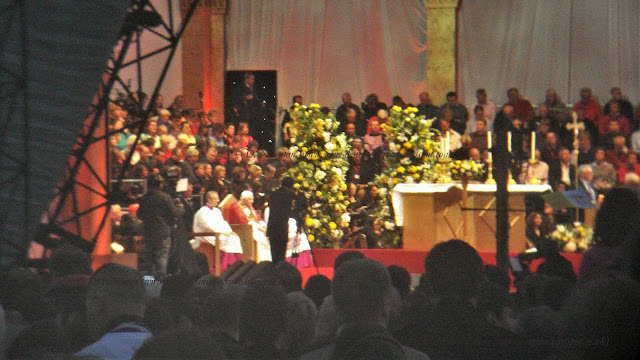
The Hyde Park vigil begins

So it was that those four days made certain things very clear to me at an important moment.  Whereas I had already been well aware that that the Christian faith was hardly the in-thing in the twenty-first century, the visit’s prelude showed me that a significant cohort of fashionable secularist Britain, not content with mere mockery, hated it outright.  But they did not have the last word, nor did they even speak for most ordinary British people, who remained their usual tolerant (or at least rather apathetic!) selves.  For the visit itself revealed the groundlessness and weakness of the hatred — of all hatred — before the strange strength by which inner goodness and holiness drive out evil; the way in which (to quote Douglas Gresham, C. S. Lewis’s step-son) ‘Christianity simply works.’   

How could people hate a man so gentle as Benedict?  The situation presented a clear choice to me.  Whose side was I on?  Was I to go along with fashion, or to be loyal to my Church and my faith, even if this meant dissenting from the spirit of the age?  Yes, I would be I was on Benedict’s side, the side of the Church, and the side of Him whom the Church worships.  I knew where my loyalties lay, and I have never since had cause to regret that choice.  Even when Catholic life requires courage and hard work and unwanted conspicuousness, and however clumsy my efforts, it does not call on any strength that it cannot also supply.  It is the only way.  As they sang in Westminster Abbey, 

Christ doth call one and all:
Ye who follow shall not fall.

Thank you, dear Pope Emeritus Benedict!  May God bless you!  And, as you asked on arriving in our land, “may all Britons continue to live by the values of honesty, respect and fair-mindedness that have won them the esteem and admiration of many.”

Wednesday, June 26, 2019

Ruth Gipps in Cheltenham

There is more good news regarding Ruth Gipps, the hitherto unjustly-neglected British composer.  Her Second Symphony will be performed as part of the Cheltenham Festival on Saturday 6th July, 2019, at 7 p.m.  It will be conducted in the Town Hall there by Mirga Gražinytė-Tyla and played by the City of Birmingham Symphony Orchestra — a later incarnation of the same orchestra in which Ruth Gipps played the oboe early in her career.  More details here: https://www.cheltenhamfestivals.com/music/whats-on/2019/cbso-and-alison-balsom/

It is wonderful that Ruth Gipps is now receiving the attention she deserves, and that her decision to stick to a traditional musical idiom, which cost her so much in her own lifetime, has now been vindicated, as a new generation of listeners discovers and delights in her music.  I am almost confident enough to start a wish list — a recording of the third and fifth symphonies, the première of her oboe and viola concertos, or a major London performance, such as her piano concerto at the Proms…

Here is the second symphony’s grand finale, from this year’s new recording of the symphony by the BBC National Orchestra of Wales under Rumon Gamba:


Update: Unfortunately Mirga Gražinytė-Tyla had to withdraw from the concert due to illness: Edward Gardner deputised, and Ruth Gipps’ symphony was replaced with Walton’s suite from ‘Troilus and Cressida’.  Never mind — another time!  Wishing Mirga Gražinytė-Tyla a swift recovery.

Update no. 2: Ruth Gipps’ second symphony is now due to be performed in  Birmingham’s Symphony Hall at 7.30 p.m. on Wednesday 2nd October (https://cbso.co.uk/event/alison-balsom-plays-musgrave).