Showing posts with label London. Show all posts

Saturday, April 20, 2024

Elegy for the Burn Bullock

Grim news yesterday evening (19th April 2024) of a serious fire at the Burn Bullock pub in Mitcham, south London.  Eighty firefighters and twelve appliances were in attendance.  Nobody was hurt, but the damage to the listed building is considerable, possibly beyond repair.  Although the oldest, Tudor, part is apparently relatively intact, the devastation to rest of the building is obvious from the news pictures.  Behind the handsome eighteenth-century façade overlooking the London Road — from whose false windows I first learned about the ‘window tax’ — the fire has ravaged all three floors, as well as most of the 17th-century wing.  The roof is gone. 

This former coaching inn was known as the King’s Head until 1975, when it was renamed in honour of the cricketer Burnett ‘Burn’ Bullock (d. 1954), who was also a previous landlord.  Cricket is essential to the story of the pub and to this part of Mitcham.  Right next door is the pavilion of the Cricket Club, while across the road the Cricket Green has a serious claim to be the oldest in existence: the game has been played here since 1685.  The Association of Cricket Umpires and Scorers was formed in the pub, in an upstairs room now known to have been destroyed.  The building is a Mitcham landmark, and for three centuries has been an unmistakeable part of the Cricket Green.

What is so painful is that this disaster has been entirely foreseeable.  Since the pub closed in 2013, it has spent more than a decade sinking into dilapidation while its future has been debated.  Various planning applications by an evidently elusive landowner have been found unsuitable by Merton Council (as well as by the neighbouring Cricket Club).  Meanwhile the situation has been exploited by squatters, who have been occupying the building illegally since 2014, and ignored a series of council enforcement notices.  Now the pub’s place on the ‘Heritage at Risk’ register of Historic England has been vindicated in the most horrible way.

A foreseeable disaster, and foreseen.  The Burn Bullock has been ‘disgracefully neglected for years’, Mitcham Cricket Club has said.  ‘Our worst fear’, was the opening to a Twitter thread reporting the fire by a member of the Cricket Green Community & Heritage Association.  They and other organisations have been sounding the alarm repeatedly for some time.  It is a nightmare we have long been dreading; I have been particularly worried about it since the affair of the Crooked House in the West Midlands in which criminal owners tore down the remains of a listed pub building suspiciously promptly after it (equally suspiciously) went up in flames.  So it is very hard not to feel angry as well as bereft.  The thought also crosses the mind that the fire might not have been an accident, not least because it was so spectacular, even after a day of rain.  I suppose we shall soon find out.

It is also depressing because — without pointing the finger of blame at any party in particular — the whole slide to this point has felt so inevitable.  It seems symptomatic of broader trends that seem to be all around us at the moment, not just in Mitcham but in Britain in general: a leaden sense of ineffectiveness, impotence, even hopelessness in public life.  Why were the civil authorities unable to enforce the law; why did an ‘enforcement notice’ turn out to be nothing of the sort?  Why did the landowner, who himself seems to be merely a representative of a larger and even more labyrinthine investment company, allow the building to decay, fail to secure it against intruders, and otherwise neglect his responsibilities — which were as much to his neighbours as to his shareholders?  Why were the mechanisms which exist precisely to prevent such catastrophes ineffective in this case?  The price of this neglect is now paid by the ordinary people of Mitcham who find themselves unable to hand down to the next generation another piece of their heritage, another familiar landmark.  This pub stood for three hundred years, survived road-widening (as neighbouring buildings did not), suburbanisation and the Luftwaffe (which in 1941 scored a direct hit on the nearby Cricketers pub), but we in our own time have been powerless to keep it safe.  Ten years were enough to bring about its downfall — and three hours sufficient for its finale.  

Why does Mitcham always seem to lose out?  In spite of the hard work and determination of many locals doing their best to maintain civic pride (the Pawełek ice-cream parlour and restaurants, the Wednesday Coffee Club at the Royal British Legion, the very welcome Canons refurbishment project, a number of dedicated local conservation groups), they seem to be fighting a losing battle against the encroachment of powerful, impersonal, faceless forces.   Developers who know nothing of the place and seem to have little regard for Mitcham’s vestigal ‘village feel’ (or at least the sense of a ‘village suburb’), are always circling with various outlandish plans for flats as pricey as they are boxy.  The town centre around the Fair Green to the north has slumped badly in the past ten years, and the indifference of the volumes of traffic coursing their way through along all points of the compass seems symbolic of these eroding, homogenising trends.  The damage to the Burn Bullock is a further and irreplaceable blow to that intangible thing, the character of a place: the particular flavour, accumulated with many layers of years and generations of pride and care, that makes it feel like home.

A picture of the pub as it was some time in the late 1980s can be seen here.

Mitcham Cricket Green, where cricket has been played since 1685, with the Burn Bullock pub in the background to the right.  Watercolour by Terry Harrison (1951–2017), reproduced with his widow’s kind permission.

Monday, February 12, 2024

Elizabeth Jennings: a Catholic poet for our times

A talk given on Saturday, 3rd February 2024, to a meeting of Deo Gratias, a circle of Catholic young adults interested in expressions of the Christian faith in culture.  We meet on alternate Saturdays at the Rosary Shrine, Haverstock Hill, London.  After the discussion we visit the church for a time of Adoration, then repair to the pub.

Elizabeth Jennings in the 1940s. 
Reproduced under Creative Commons Licence 3.0 from https://elizabethjennings.dmu.ac.uk/image_viewer5039.html?img=portrait_7&gal=portraits 

We all know the cliché about studying poetry at school.  You spend all your time learning ‘the classics’ by heart — or ‘by rote’ as some more pejoratively call it — a compulsory exercise in memory which  drains all the life out of poetry, so that, by the age of sixteen, you are effectively inoculated against taking any joy whatsoever in it ever again.  That is the cliché — but I think for many in our generation the experience was something like the opposite extreme.  It was as if our GCSE English Literature examiners had fled in terror from daffodils and nightingales, and agreed that their chief priority in selecting poems for the syllabus was that they could never be learned by heart, even if anybody wanted to.

Accordingly, the examiners favoured free-verse poems on gritty, contemporary themes in a punchy, combative style: what a friend of mine calls ‘switchblades and asphalt’ poetry.  For example:

Today I am going to kill something.  Anything. 
I have had enough of being ignored and today 
I am going to play God.  It is an ordinary day, 
a sort of grey with boredom stirring in the streets. 

   — Carol Ann Duffy, ‘Education for Leisure’ 

Or the one about stealing a snowman for no reason, and kicking it to pieces:  

Part of the thrill was knowing 
that children would cry in the morning.  Life’s tough.  
   […] 
Then I was standing 
alone among lumps of snow, sick of the world. 
Boredom.  Mostly I’m so bored I could eat myself. 

   — Carol Ann Duffy, ‘Stealing’ 

The idea, of course, was to try to make a point: that poetry could be ‘relevant’ (that crucial word) to the young people of early twenty-first-century Britain — that it could be as tough and unsentimental and ‘real’, so to speak, as an inner-city housing-estate.  But the poems never transcended the hard realities they were portraying.  There was no real meditation on the suffering or boredom of those lives; no engagement of heart and mind together; no introduction to that interplay of beauty and truth — the balance between form and sense — the marriage of music and meaning, that we recognise in the best and most valuable poetry. 

So I finished my GCSEs aged sixteen rather grumpy with English Literature examiners in general.  How different, then, to open a new anthology at the start of my A-level course and encounter a passage like this: 

                     […] Man’s a believer 
Until corrupted.  This huge trusted power 
Is spirit.  He moves in the muscle of the world, 
In continual creation.  He burns the tides, he shines 
From the matchless skies.  He is the day’s surrender. 
                    […]
This spirit, this power, this holder together of space  
Is about, is aware, is working in your breathing.  
But most he is the need that shows in hunger  
And in the tears shed in the lonely fastness.  

And in sorrow after anger. 

         — ‘A Chorus’ (Moments of Grace, 1979; Collected Poems, p. 440.) 

Notice how, even though the poem alludes to hardship and sorrow — to ‘cities with their factory darkness’, say, or by the way in which the lines ‘hopes fulfilled or forgotten’ and ‘promises kept’ (as opposed to just ‘hopes and promises’) acknowledge, implicitly, the possibility of hopes being dashed, or promises broken – the poem itself transcends these sorrows and hardships, and helps us to see them in the perspective of a greater reality, rather than just languishing in them. 

This was my introduction to Elizabeth Jennings, and it is still one of my favourite poems. I have school examiners to thank for it! One of the many things I love about it is the wonderfully controlled diminuendo that extends over its course.  It doesn’t go where you initially expect.  It begins in a blaze of glory, with these dazzling panoramic views of Creation, but gradually softens, growing steadily more meditative and introspective.  And the last line, ‘And in sorrow after anger’, even feels like a whispered afterthought — almost a confession.  It is a poem that seems to travel from the pulpit to the pew, from the choir-loft to the confessional. In this it is rather like the Te Deum (which begins ‘We praise Thee, O God; we acknowledge Thee to be the Lord; All the earth doth worship thee, the Father everlasting’, but whose last line is the far more intimate ‘O Lord, in thee have I trusted; let me never be confounded’.)   

So who is, as she has been called, ‘England’s best Catholic poet since Gerard Manley Hopkins’?  Who is Elizabeth Jennings? 

Elizabeth Jennings as a child
Reproduced under Creative Commons Licence 3.0 from https://elizabethjennings.dmu.ac.uk/image_viewerc424.html?img=portrait_5&gal=portraits

Elizabeth Jennings was born in Boston in Lincolnshire, in dead-level Fen country, in 1926, and spent an idyllic early childhood there. ‘Six years of a flat land,’ she was to remember, ‘The sea […] Was more luminous even / Than the blazing tulips in formidable ranks’ – but in 1931 her father was appointed County Medical Officer for Oxfordshire, so to Oxford she, with her parents and older sister Aileen, accordingly moved. The city was to be her home for the rest of her life.  In suburban North Oxford the Jennings family were neighbours and fellow parishioners of the Tolkiens, and Priscilla, the Professor’s daughter, was to become a lifelong friend.  Jennings’ love of poetry began at school – they read G. K. Chesterton’s Lepanto (‘Dim drums throbbing, in the hills half heard […] Don John of Austria / Is riding to the sea […]’).  ‘That was one of the key experiences of my life.  It hit me’, she recalled years later. 

In 1944 she went up to St. Anne’s College, Oxford, to study English Literature.  Here she fell in with several up-and-coming writers and novelists: Philip Larkin, Kingsley Amis and Thom Gunn.  She was popular and apparently had many admirers.  Kingsley Amis wrote that ‘she seemed on her bicycle and in her T-shirt very advanced for those days’, though she herself remembered being ‘agonisingly shy’.   It was at this time that she found early success in poetry and was published for the first time.   

Here is the beginning of an early poem, ‘Warning’: 

Child do not tell your images, we kill them 
With argument and I would wish you deaf 
Rather than hear the mad cries of our logic 
Aiming at beauty, wounding it with grief. 
Be silent now and do not tell your magic. 

     – from an early poem, ‘Warning’ (Collected Poems, p. 6) 

She was briefly engaged to be married to a fellow student, but this was broken off.  After graduating she ‘did eight years’ hard labour’, as she put it, in Oxford City Library, before joining the publishers Chatto and Windus as a reader.  All the time she was writing poetry.  Her first full-length collection, ‘Growing Points’, came out 1955.  In 1957 she won the Somerset Maugham Award, the prize being three months in a foreign city of the winner’s choosing.  Jennings chose Rome, and her time there was one of the happiest periods of her life.  Her memories of Rome return time and time again in her poetry. 

However, the 1960s were more difficult, bringing with them a several recurring periods of mental illness.  It is not altogether clear what brought this on: possibly overwork, possibly heartbreak, but either way, she suffered a serious mental breakdown and spent three years in and out of hospital.  Her distress was severe enough that she made several suicide attempts, and she also suffered from alcoholism.  Yet she never stopped writing poetry, even if many were later to be suppressed. 

The story of Jennings’ later life is, looked at in one way – and perhaps the wrong way – a sad one.  She never attained the literary stardom of Larkin and Amis.  Nor did she ever marry or have children, and although she claimed not to regret it, I am not entirely convinced of this. She said, for example, ‘I wouldn’t have been a good proposition for marriage.  I jump out of bed to write poems.  I don’t like housework.  I think I like being independent.  I am a romantic and I don’t think romance lasts.  I can’t bear things ending.’  There’s a tinge of unwilling resignation about the last two remarks, I think.  Still, perhaps she knew her own mind. In any case, having spent a number of years sharing quarters with a Czech refugee, in later years she lived alone in Oxford and gained a reputation more as an eccentric than as a poet.  She used to take her papers in plastic carrier bags to a café, where she would sit and write and observe. Very few people knew who she really was.  She collected trinkets, dolls’ houses and china ornaments, and attracted curiosity by never dressing up for formal occasions, even to receive the CBE in 1993 – her appearance in a duffel-coat resulted in the press rather cruelly calling her ‘bag-lady of the sonnets’.  But again, all the time she was writing poetry, right up until her death in 2001 at the age of seventy-five.

I should say a little about her faith.  Unlike many of our prominent Catholic poets like St. John Henry Newman, Chesterton and Hopkins, Jennings was a cradle Catholic, rather than a convert.  As a small child she and her sister used to play Mass, with a toy oven for a tabernacle, and a wooden train as a thurible.  As she grew up, though, she became less happy.  She found she had questions to which nobody would give her adequate answers.  There was also one particularly horrible incident in Confession where a priest seems to have told her, ‘All you think about is your ugly little self’ and, unbelievably, even though he had given her absolution, told her not to receive Communion with the other children on Sunday.  This, she said, ‘did a great deal of damage’, though not to the extent that she lost her faith.  In an unpublished poem, ‘Abuse of a Sacrament’, she wrote, ‘I have known priests who tore the soul apart […]  O yes, I’ve known the dreadful penance move / All hope away.  For this Christ knew the place / Of agony.’ 

The damage was only really repaired years later in Rome, where, she said, ‘I really found happiness’.  She climbed the Holy Steps on her knees, even though a priest told her they were not authentic. ‘They have been hallowed by centuries of penitence’, she said. Her happiness is clearly mainly because, perhaps for the first time since childhood, she had recognised her faith as a source more of joy than of torment.  And I think this is how it remained, giving her strength in the years of illness and suffering that followed. 

All her life, as far as I know, she was a faithful and regular Mass-goer.  In fact, it is nice that we are discussing her at St. Dominic’s Priory, as she was friends with many Dominican religious, dedicated poems to many of them, and, certainly late in her life, regularly attended Mass at Blackfriars in Oxford.  (Last October I was chatting to a lady here at St. Dominic’s who was from Oxford and had been a parishioner at Blackfriars for long enough to remember Jennings as a small figure huddled in the front pew – though only found out after her death who she was). 

Assessment 

It is easy to underestimate Elizabeth Jennings.  She tends to be thought not to have lived up to the potential of her poetic career.  The American poet Dana Gioia acknowledges that she ‘had the peculiar fate of being in the right place at the right time in the wrong way’, in that she had the brilliant good fortune to coincide with the Oxford literary scene at a time when there was a reaction in poetry against the obscurity and deliberate ‘difficulty’ of Modernism, and a return to a more unadorned style (in something called ‘The Movement’, an unhelpfully vague name) — but, ultimately, her fellow poets at Oxford were cut from a different cloth to her.  As well as being unornamented, the Movement poetry was deliberately unsentimental (even anti-sentimental), not just unpretentious but often curmudgeonly, pessimistic and ironic.  Elizabeth Jennings’ style is more romantic, closer to nineteenth-century poets like Christina Rosetti and Emily Dickinson (though by ‘romantic’ I don’t mean ‘sentimental’).  She was the only woman, and the only Catholic, associated with that movement.  She also committed the cardinal literary sin of being too prolific – but more on that in a moment. 

I actually think that some of the things that have led people to overlook her are precisely what make her worth reading and befriending today, and which make her in many ways a poet for our times. 

Firstly, there is the directness and simplicity of her poetic voice.  In contrast to many of her contemporaries, there is no irony in Jennings’ verse, no sarcasm, and though there can be anger or regret there is seldom outright bitterness.  It is honest verse, sometimes painfully honest, but this honesty brings a clarity, a trustworthiness, which is refreshing in an era of switchblades and asphalt.  Jennings takes ordinary, personal themes — friendship, childhood, bereavement — and very simply tells the truth about them.  Here is the beginning of a well-known poem of hers, ‘Friendship’: 

Such love I cannot analyse; 
It does not rest in lips or eyes, 
Neither in kisses nor caress. 
Partly, I know, it’s gentleness 

And understanding in one word 
Or in brief letters. […]

        – from ‘Friendship’ (Relationships, 1972) 

There is also a great humility to her.  It appears, for instance, in another favourite of mine, a poem called ‘Losing and Finding’ about a six-year-old child who had come to her house to look for her after getting lost and whom she had taken to a playground while waiting for the parents to turn up (which seems to have taken an entire afternoon!  The Seventies were different times).  It ends, 

And it was you who rescued me, you know. 
Among the swings, the meadow and the river, 
You took me out of time, rubbed off on me 
What it feels like to care without restriction, 
To trust and never think of a betrayal. 

        – ‘Losing and Finding’ (Growing Points, 1975; Collected Poems, p. 340) 

A similar example of her humility and self-effacement is a poem she wrote about a visit to a school to meet some A-level students who were studying her work: the poem is all about them and their hopes and worries, not her; they clearly made as strong an impression on her as she might have expected to on them. 

Yet this simplicity and humility is not sentimentalism or naivety.  Her observations, whether interior or exterior, are always acute and perspicacious.  She will say what needs to be said, will confront and dwell on evil if necessary – though always with the searching light of faith.  

For example, here is a poem from a late collection (Times and Seasons, 1992) about the changed, post-Sixties attitudes to romantic love.  Note that it is a sonnet, a form with a long association with love-poetry: 

You take the whole of love.  We lived by touch
And doubt and by the purposes of chance
And yet I think our slow ways carried much
That you have missed — the guess, the wish, the glance. 

        – ‘The Way They Live Now’ (Times and Seasons, 1992; Collected Poems, p. 669) 

I find it very interesting that Jennings was actually asked to read out this poem on Radio 4 when she was interviewed on Desert Island Discs in 1993.  The presenter Sue Lawley called it ‘splendid’. I am not sure that this would happen on today’s BBC.   

So you see the very Christian combination of truth and love that permeates Jennings’ verse.  I think of her as a sort of ‘poetry Auntie’, someone with whom I could happily have spent an evening chatting, but who would certainly have spoken her mind frankly if she needed to. 

And of course Jennings’ faith illuminates the whole of her verse, as well as her life and art.   She was unashamed in taking sacred themes, in writing about feasts and seasons, the sacraments, the saints, the city of Rome.  She returned again and again to Catholic subjects.  There are three poems on Lazarus, for instance; she wrote sequences on the Seven Deadly Sins, the Easter Triduum, and the different kinds of love.  ‘My Roman Catholic religion and my poems are the most important things in my life,’ she said. 

Her faith informed not only her art but her whole attitude to her art, her whole understanding of poetry itself.  I mentioned her prolific output.  From a literary point of view, over-production is often looked down upon, as it suggests a lack of self-criticism, even a lack of self-discipline.  Writing less is taken to imply higher quality.  And look how thick her Collected Poems are!  But reading through these poems – and there are a lot of them – I came to realise that this is not just a literary testament, but a spiritual one.  Not all of her verses are great poems, but literary greatness is not primarily what she was striving for.  

The editor of her Collected Poems, Emma Mason, has pointed out that Jennings recognises poetry as a kind of incarnation.  Ours is, after all, a religion of the Word — Jesus Christ is the Word as well as the Son of God — and so His incarnation elevates not only our human flesh but our human language.  So, in reading these poems, we come to realise that many of them are doing something else at the same time.  As well as poems they are thoughts, or gestures, or feelings that have been incarnated, that have ‘taken flesh’ in the form of printed type or speech.  They are personal reminiscences, memories, jottings, postcards, tributes, farewells, even apologies, meditations — and in one way or another they are almost always prayers.  For her, poetry is always a kind of prayer, and perhaps any prayer is also a kind of poem.  For those of us who love poetry (and who see the Mass, for instance, as a kind of poem) this is a pleasing blurring of boundaries.

Certainly this is how I think much of her work is best understood: as prayer-poems, so to speak.  She sheepishly acknowledged that she wrote fast and revised little – sheepishly but unrepentantly, because for her, writing too much was only like praying too much — and we would hardly try to improve the quality of our prayer by praying less.  So really, this book is a spiritual journal, a legacy of a life of prayer as much as of poetry – which is why she can say, with complete humility, ‘It is, I think, in my own poetry / I meet my God.  He’s a familiar there.’  (from ‘A Way to a Creed’, A Dream of Spring, 1980). 

Here is another of my favourite poems of hers, ‘At a Mass’, in which she meditates on the interplay between art and faith – on how, true as it is that beauty can and should lead us to God, our appreciation of beauty can get in the way, even in church.  To those of us who are deeply sensitive to the beauty of the Mass, it offers food for thought: 

        […] 
I struggle now with my own ideas of love  
And wonder if art and religion mean dividing.  

Each has his way and mine perhaps is to
Suffer the critical sense that cannot rest.  
If the air is cool, the colours right, the spoken  
Words dramatic enough, then I am pleased.  
But why must I ask a sense of style in the broken  
Bread and bring God down to my limited view?  […] 

– ‘At a Mass’ (Song for a Birth or Death, 1961).  Collected Poems p. 96. 

Another interesting poem to read in this light is To a Friend with a Religious Vocation, which reveals her own sense of a poetic vocation, but also that it takes second place to a formal religious vocation – rightly, as she acknowledges, but not without pain: 

Thinking of your vocation, I am filled
With thoughts of my own lack of one. I see 
Within myself no wish to breed or build 

Or take the three vows ringed by poverty. 
And yet I have a sense,  

Vague and inchoate, with no symmetry, 
Of purpose. 
    […] 
You know what you must do, 
So that mere breathing is a way to bless. 
Dark nights, perhaps, but no grey days for you. 

— from ‘To a Friend with a Religious Vocation’ (Song for a Birth or Death, 1961; Collected Poems p. 105). 

(‘Breed or build’ is a quotation from Hopkins’ poem about writer’s block, frustrated vocations and a sense of purposelessness: ‘birds build – but not I build; no, but strain, /  Time’s eunuch, and not breed one work that wakes.’) 

So: simplicity, truth-telling, and faith: these are the main gifts that I think Jennings gives us. 

Conclusion 

When asked how she would like to be remembered, Jennings said simply, ‘As someone who wrote good poems’. I think we might add, ‘someone who wrote good prayers’.  Perhaps this is why it is such a surprise to me, though certainly a welcome one, that she is still on A-level syllabuses. She is, I think, a poet for our times: she only died in 2001, so was more than familiar with the encroachment of secularism and the hidden sorrows of modern life – and certainly with the challenges of sticking to one’s faith even in a cultural headwind, or at professional cost.  I feel that if she were here now she would understand us, sympathise with us – and then go home and write a poem about us. 

In an age of switchblades and asphalt, and of sarcasm and irony, and of joylessness and hopelessness, her poetic voice is like a simple candle which, like the Christian faith itself, is easily dismissed by the world, but unobtrusively sheds consoling and truthgul light for us.  In this way, she can help us to recover simpler, straightforward, unironic speech, and simpler, more straightforward faith. 

To finish, here is one last poem: a late one (from 1998), and I think a very beautiful one, called ‘A Full Moon’. 

            […]     But look again 
That Host-like moon shines where 
All can see him.  Christ took on all pain 
Beyond time’s arbiter. 
            […]
That moon in silence can 
Elevate us till we long to know 
The Trinity’s whole plan. 
Nature was fashioned for this purpose.  See 
A moon reminds us of God’s ministry. 

– ‘A Full Moon’ (Praises, 1998; Collected Poems, p. 760) 

Elizabeth Jennings, c. 1990
Reproduced under Creative Commons Licence 3.0 from https://elizabethjennings.dmu.ac.uk/image_viewer3300.html?img=portrait_2&gal=portraits


 ---

Further reading & listening: 

Elizabeth Jennings, Collected Poems, ed. Emma Mason (Manchester: Carcanet, 2012).  ISBN 9781847770684.   

Elizabeth Jennings, New Selected Poems, ed. Rebecca Watts (Manchester: Carcanet, 2019).  ISBN 9781784108663.   

Hear Jennings reading her own poems on the Poetry Archive website: https://poetryarchive.org/poet/elizabeth-jennings/.

Jennings’ interview on BBC Radio 4’s Desert Island Discs, 8th January 1993: https://www.bbc.co.uk/programmes/p0093x99 . 

Dana Gioia, ‘Clarify Me, Please, God of the Galaxies: In Praise of the Poetry of Elizabeth Jennings’, in First Things (May 2018).  Available online at:  https://www.firstthings.com/article/2018/05/clarify-me-please-god-of-the-galaxies. 

The Elizabeth Jennings Project at De Montfort University, web bibliography and resource.  https://elizabethjennings.dmu.ac.uk/home.html

Excerpts from poems are reproduced under the ‘fair dealing’ copyright exception for quotation.  Images are reproduced under Creative Commons Licence 3.0 from the Elizabeth Jennings Project at De Montfort University (https://elizabethjennings.dmu.ac.uk), in accordance with their copyright notice.

Saturday, May 14, 2022

Farewell to the 455s

Through Mitcham Eastfields on a Horsham train, 10 August 2011

This coming Saturday, 14th May, sees the withdrawal from the suburban routes of the South Central Division — the tangle of railways running out of Victoria and London Bridge into south London — of the class 455 electric multiple units that have held sway in these parts for nearly forty years.  Their siblings on the South Western lines out of Waterloo will apparently follow in the next few months.

Basking in the sun at Victoria, 28 August 2013

Few ordinary passengers are likely to mourn them.  They are not glamorous, nor were they built to be, though I think better care could still have been taken of their interiors in recent years.  They were designed for mass short-distance transport, to lug commuters around the Hills and Commons of the southern boroughs; to venture to climes no more exotic than Crystal Palace, Epsom Downs, Caterham or Dorking.  I doubt they have averaged more than around twenty miles per hour over the course of their working lives.  But they have worked solidly, clocking up thousands upon thousands of rush-hours since the early 1980s.

Rumbling across the South Circular overbridge into Tulse Hill, bound for the Wimbledon loop, 11 April 2019

I am among those who will miss them.  It was against the backdrop of these faithful workhorses, plying their way up to London or down to Dorking, their acceleration distantly, enticingly audible over the suburban rooftops, that my rail enthusiasm was first contracted and swiftly found to be incurable.  The aforementioned South Western sister-class ran right past my grandmother’s garden, and I used a 455 as my subject for the centre-piece of a school art project (because I knew I could draw trains and buildings, but not people!).  More recently — until the pandemic in fact — my train into work was reliably formed by one of these units.

A Victoria-bound semi-fast accelerating through Mitcham Eastfields, 4 January 2011

Like the slightly younger 319s (themselves a familiar sight around South London until a few years ago) and their cousins the recently-scrapped two-car 456s, the 455s were built at York by British Rail Engineering Limited, as lettering on the step-plates proudly declared.  However, in contrast to the 319s — which were more souped-up trains, designed for Luton and Gatwick routes, for people with flights to catch, always seeming cramped by the chords and spurs of suburban south London, itching for the open stretches of the Brighton or Midland main lines — the 455s seemed gentler and more sedate, more suited to the way we do things here, south of the river, in the land of the electrified third rail.  To a 455, with its seldom-attained top speed of 75 mph, it did not seem to matter if we got to Ewell East now or some time next week.  They trundled their way around, taking their time about everything.  No point rushing this curve or that junction; there’ll only be something else to brake for around the next bend.  

Through the window onto dawn-lit commuterland, 1 October 2018

Adding to the dreamy aura of these trains were the various reassuring sounds they made: the chirruping of the brakes and the soft sigh on their release, the warble-piping of the original door alarms, the clunk of the camshaft on departure, and the leisurely thrumming of the brake compressors, this last being the sound I will miss the most.  Then there were the motors, matching the register of a cello, rising from a growl from a standstill to the very top of the tenor range if given the chance to stretch their legs.  The only alarming sound was the occasional crunch of electricity arcing from the third rail. 

Arriving at Streatham Hill on the 1617 to London Bridge, the once-daily parliamentary service via the Leigham Spur and Tulse Hill, 25 April 2019

The motors themselves are worth remarking on, for they are actually recycled.  Incredible as it may sound, they are over eighty years old, and more than twice the age the trains they have been powering.  The early Eighties, when these units were built, were not an easy time for British Rail, which, struggling under persistent inadequacies in government subsidy, had constantly to make do and mend with their scarce resources.  Their solution in this case was to fit the new trains with not only second- but third-hand motors built originally by the Southern Railway for its electric units in the 1930s.  Though now into their ninth decade and effectively dating from the electrification itself, the motors still seem perfectly sound to my ear.  Whatever the reason is for the withdrawal of these trains, I doubt it has anything to do with the traction equipment.

A down train draws into Wandsworth Common, 9 December 2018

I am not the only one sad to see them go.  ‘South London is [going to] feel weird without them,’ said one contributor to the ever-perusable Rail Forums.  Another chap, a driver who also films the modern railway scene and has a presence on YouTube, told me in an exchange in the comments, ‘These were the trains I grew up on, the trains that took me on all sorts of adventures and when I passed out [i.e. qualified] as a driver became my core traction.’

Epsom train rounding the curve south of Mitcham Junction, 4 February 2022

There is always a pang to see the clearing out of the furniture of our beginnings, however ordinary these things may be.  Perhaps, in fact, the more ordinary and the more constant they have seemed, the sharper the pang.  Bit by bit, the railscape of my childhood is disappearing (the analogue signals, the bell at Eastfields level crossing, the late Phil Sayer’s voice over the speakers…), and by the end of this weekend another major part of it will have crumbled completely away.  I will certainly miss the familiar presence of these old units, with the many associations they hold for me.

A final farewell, Mitcham Common, 4 February 2022

But let us end with the nearest a 455 ever came to attaining railway glory.  Under the pre-2018 timetable, one single passenger service each weekday was booked to run non-stop down the fourteen-mile line from Dorking to Horsham, and this was generally allocated to a 455 unit.  So, just before that timetable was abolished, I took one of the last opportunities to experience this run, and filmed the journey from just beyond Betchworth Tunnel to just short of Horsham.  As I have said, 455s hardly ever had the chance of a clear non-stop flat-out run like this, and certainly in their latter years Horsham was the furthest south they ever ventured in regular service.  So it was a rare treat to see this humble suburban unit reliving the glory days of the old Bognor expresses, accelerating to the full line speed of 75 mph along probably my favourite stretch of railway in south-east England.  (We really begin to pick up speed after Holmwood, five minutes in, and after Ockley, at six minutes, there is the added bonus of some jointed track, which we hammer over at full tilt.)  The date was the 14th May, 2018 — four years to the day, as it turns out, before the final withdrawal of the class.

Sunday, October 24, 2021

O Taste and See

Church of the Holy Ghost, Nightingale Square, Balham, London
In requiring as it did of many Christians the longest absence of their lives from the pews of a church, the pandemic sheared us of the sights, the sounds, the smells, the textures, the accidentals of our faith.  Yes, the Church was always there — we knew it was waiting; we could see it online — but there was no church-going.
Westminster Cathedral, London
There were many who lost much more than this, I know, but it was a deprivation all the same, a desert exile.  Perhaps it was experienced differently in the different churches.  I should think that Evangelicals and Pentecostals felt the silence above all most keenly: the absence of the sound of the word of God, and the muting of God’s praises sung by many voices.  Anglicans — even the Anglican clergy themselves — were banished in many cases from places of great beauty, exchanging for the kitchen or living room the houses of God whose atmosphere Roger Scruton evoked so beautifully:
The Anglican church […] is a place of light and shade, of tombs and recesses, of leaf mouldings and windows decked with Gothic tracery and leaded glass.  Strange aedicules line the chancel walls — aumbry, sedilia and vestry door — suggesting the rituals of an ancient temple.  Choir stalls, rood screen, altar, font and pulpit are as though dusted with holiness from the hands that carved them, and the light that falls upon them is strangely intimate, seeming to come from another source than the light that fills the nave.  The scents of damp stone and plaster, of altar flowers and dusty kneelers, mingle to form a kind of restrained incense of their own, and you fall silent as in the presence of a mystery.  People travel up and down England visiting these places, and there is one simple explanation as to why: namely, because they are sacred.
Roger Scruton, Our Church: A Personal History of the Church of England (London: Atlantic Books, 2012), pp. 40–42.
For most British Catholics, God and man agree to meet somewhere rather more out of the way, away from the centre of things: perhaps where a town’s Victorian outskirts would have been, down a side-street or at an awkwardly-angled street corner, in the church of dark brick which, however handsomely built, would originally have have been marked obstinately on town plans as an ‘R. C. Chapel’.  Or perhaps down a suburban avenue, under confident inter-war eaves, still in brick but lent a daring freshness by clean Art Deco lines.  Or maybe a futuristic Sixties concrete marquee awaits, with buckets placed here and there to catch the rainwater dripping through the ceiling.  Some parishes, of course, enjoy the legacies of fantastically wealthy Victorian benefactors trying to chalk one up against the Church of England, as at St John’s Cathedral in Norwich, Our Lady and the English Martyrs in Cambridge, Sacred Heart at Wimbledon, or St Giles’ at Cheadle in Staffordshire.  The fifteenth Duke of Norfolk, seeking a suitable commemoration of his twenty-first birthday in 1868, sold his estates in Sheffield — which meant most of land on which the city was built — and put the proceeds straight towards the construction of Arundel Cathedral in Sussex.  But apart from these glittering heirlooms, most of the fabric of the Catholic Church in Britain has a home-made, slightly scruffy feel to it — a well-worn, well-loved unkemptness.
Sacred Heart, Wimbledon, S.W. London.
That fabric, even over only two centuries of emancipation, has grown rich with detail and cherished associations.  For instance, every diocese is a tapestry of dedications, which have their occasional quirks.  That St Peter and the Guardian Angels, Paradise Street, should be found among London’s brickish former Docklands in Rotherhithe, or that the church of Our Lady of Sorrows should serve the Sussex seaside resort of Bognor Regis (with its Butlin’s holiday camp and all!) seem to me paradoxes in the best Chestertonian tradition.
St Peter and the Guardian Angels, Paradise Street, Rotherhithe, London
They say we are a religion of ‘smells and bells’ — of sense and taste and touch — and so we are, but these are not confined to the liturgy.  A Catholic church is a mingling of many things.  The smells, for example, begin at the door, each church having its distinctive mixture of stale incense, of the reek of must, of faint flowers, of long use.  The other senses swiftly follow: the shock of holy water cold on the fingers and forehead, the tiles unyielding to the genuflecting kneebone, the soft crinklings of the hymn-books.  The muted seething of traffic may seep faintly in from outside, or in winter be displaced by the vainglorious bluster of the electric heating.  The echoes may be gloopy or desiccated according to whether the congregation numbers five on a weekday morning, or is wedged in to the gunwales on Good Friday.
Arundel Cathedral, W. Sussex
If Mass is about to begin, somebody will be pottering around here and there, and pairs of shoulders hunched in prayer will be dotted about in the pews or in the Lady Chapel.  Bars of music might float from the choir loft, or one or two mild emergencies may break out, in a flurry of stage whispers, about who is or is not down on which rota.  There are the same old practical problems: misprints lurking in the hymn book, going up for Communion in the right order so as to return to the pew in the same configuration, the stowage, once the heaters at last have accomplished their labours, of heavy coats in winter so that they will not slither onto the floor, and one in particular which must have been going on for centuries and which we seemingly still cannot sort out: how to ensure the preservation of one’s nose when one is kneeling in prayer and the person directly in front sits back in their pew.  All the while, though, that quiet signal of salvation, the sanctuary lamp, burns unblinkingly at the altar, stilling the great blustering headwinds against our lives.
Saint Martin, Meudon, Île-de-France
And who are we; who are the People of God?  At Mass you will see the whole of life.  The tiny fierce stares of babies all agape at the world; the gleefully wrigglingly irrepressible squirmings of toddlers; teenagers pained with overcorrected gaucheness; students and young adults in greater numbers than the BBC would care to admit; newlyweds and new mothers and fathers; middle-aged stewards and parish stalwarts; the gingerly manoeuvrings of the elderly, many long into widow- or widowerhoods; the twinkling, in the depths of ancient faces, of eyes that have seen everything.  There are the well-turned-out and the down-at-heel; the healthy and the afflicted; the upright and the downtrodden.  There are all manners and ranks of professions or trades; lifelong parishioners and occasional visitors; those firm in faith and those haunted by doubt or listless with indifference.  There are the hidden unborn.  From peers and parliamentarians to the hard-up and homeless, from millionaires to migrants, baronets to binmen, ‘Christ doth call one and all’.  
Arundel Cathedral, south aisle
And, perhaps in London especially, you will see the whole world.  In my home parish, deep in the capital’s southern boroughs, I can immediately think of fellow parishioners from Italy, Uganda, Spain, the Philippines, Nigeria, Portugal, Sri Lanka, Ghana, Goa (and elsewhere in India), Mexico, Poland, South Africa, France and Finland, along with an older generation of Irish Londoners — the Murphys, the Quinns, the Connollys —  and their descendants.  You will hear earthy Wandle Valley talk, or crisp Eastern European consonants, or rich West African speech with its clean vowels.  And just when I think the list is complete, I remember the occasional but disarmingly determined presence of Irish Travellers.   But in all this there is cause neither for fraughtness — providing we remember that our dignity comes from the one God who made us all — nor, pleasing as it is to see the name of Jesus Christ outperforming the sum total of the world’s divisions of Diversity Officers, for self-congratulation.  We are simply the people whom God has entrusted to each other in this particular time and place: a motley bunch to be sure, mumbling the responses and droning the hymns — or ‘praising God with our silence’, as a Nigerian priest once teased me and the rest of his reticent, undemonstrative congregation — all struggling, all knowing ourselves to be less than saints, but all, at least, aboard.
Pugin’s cathedral of St. Chad, Birmingham
Sense and touch are, of course, by no means the whole story.  We do not depend upon them — ‘the Kingdom of Heaven is not food and drink’ — and the privations of the pandemic did not diminish anything of the fundamental truth or validity of the faith.  After all, the Eucharist that dwells at its heart asks for a momentary suspense of our senses.  As Hopkins put it in his translation of the Tantum Ergo — 
Seeing, touching, tasting are in thee deceived:
How says trusty hearing?  that shall be believed;
What God’s Son has told me, take for truth I do;
Truth Himself speaks truly, or there’s nothing true.
Still, this means that sense and sensation are transcended, not rejected outright, when we meet God.  The physical world is not simply to be purged.  After all, He not only made it, and saw that it was good, but saw to it that our very bodies are one day to be incorporated — in a more literal sense than we can know — into Truth Himself, the author of ‘all things, visible and invisible’.  Consequently I rejoice to see the accidentals once again; I taste and see that the Lord is good.
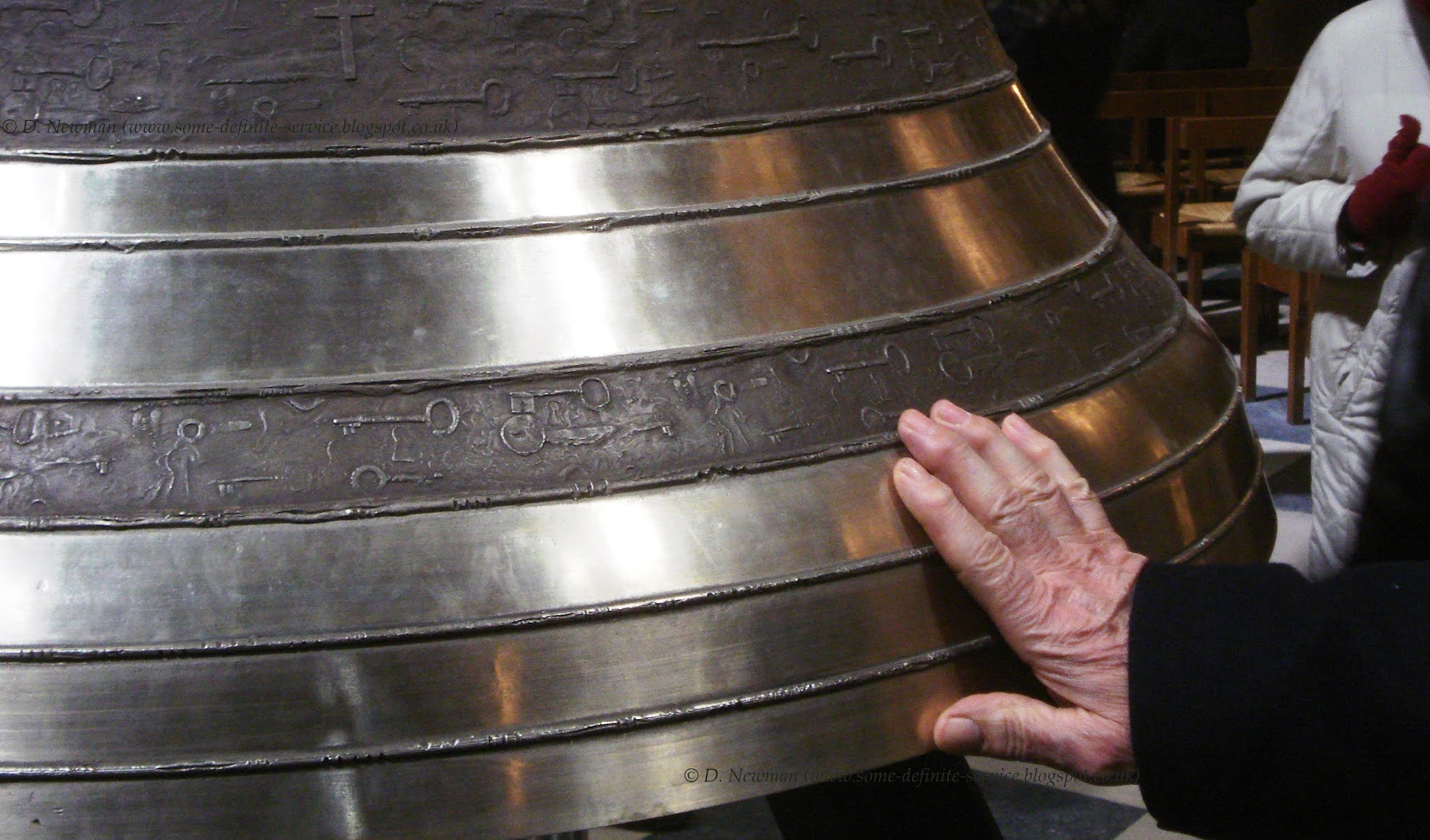
The then-newly-cast bells of Notre-Dame de Paris on display in the cathedral nave, February 2013

Wednesday, September 08, 2021

Thanksgiving for a Fair Summer

The Malvern Hills seen from fields east of Whittington, Worcestershire, in late August 2021.

Does it come about now, the cusp between summer and autumn?  Or has it already passed?  Or is it still to arrive?  The change hides deep in the veins and roots of things, like the turning of a tide, or the recognition of a truth.  Elizabeth Jennings smelled it before she could see it:

Now watch this autumn that arrives
In smells.  All looks like summer still;
Colours are quite unchanged, the air
On green and white serenely thrives.
Heavy the trees with growth and full
The fields.  Flowers flourish everywhere.    [1]

Those lines are a perfect description of days such as Monday was in south-eastern England, though in suburban London there was no hint of smoke of the kind that awoke autumn for Elizabeth Jennings.  Summer still, then — but then Tuesday, with a lessening of the haze or a change in its quality, throwing down a more golden light from a bluer sky, maturing the palette into that of an illuminated manuscript, brought about an anagnorisis of sorts.  On the Common the crickets still sizzle in the parchment-yellow grasses, and there are startling splashes of colour from the thistles and gorse, though the cow-parsley is going over.  The trees are, yes, ‘heavy with growth’, and dark with it, too, as dark as they are green; some already bear rashes and outbreaks of rust, but, less brazenly, even where all seems green at first glance, there is a dustiness, a mauveness, a wine-darkness in the shadows.  It is the purple of finished splendour, of growth itself grown old: the summer is an empire whose conquests are complete.

But the seasons always turn to linger a few times before they are quite gone, and I rather suppose that even these incongruous days of the high twenties are not quite the end.  ‘Ambiguity’ is Jennings’ word for it — 

Summer still raging while a thin 
Column of smoke stirs from the land 
Proving that autumn gropes for us.

I have been trying to work out which should come first: the poem from which these lines are taken, Song at the Beginning of Autumn, or Ruth Pitter’s free-verse Thanksgiving for a Fair Summer.  Perhaps Pitter follows Jennings, even though she is describing weather like today’s.  ‘We had thought summer dead,’ she says —

But now hot camomile in headlands grows,
Strong-smelling as from toil of reaping: bees
Their delicate harvest in the rusty rows
Of scarlet bean, and woodbine that still blows,
Though flower with berry, gather and do not cease;
No mushroom yet, for dryness of the leas;
No leaf too early sere, for droughty root,
Drops from the trees,
But grave broad green guards the thick purple fruit.

The pandemic has taught me much that I have needed to learn about the passage of the seasons, and not only of the seasons, but of the details of the seasons.  Still more has it taught me that they cannot be pinned down by the observer or the poet.  ‘When I said autumn, autumn broke,’ says Jennings, but she is speaking of the memories and associations that autumn, or its herald, releases into her mind.  All the same, there is undoubtedly a counterpoint between the turns of the seasons and the moods of the mind.  For days like these, days of mingled moods, signposting the seasons — and even for those lacklustre, overcast days against which they stand out — I follow Ruth Pitter, and give thanks.

So for the sun
That all men love and understand,
Lo here is one
In gratitude lifts either hand:
O dearest land!
Heaven give harvests without end,
Heaven mend our quarrels, cure our ills,
And the whole peace of heaven descend
On all the English plains and hills!

------------------------------------------------------------

[1]    Emma Mason (ed.), Elizabeth Jennings: The Collected Poems (Manchester: Carcanet, 2012), p. 

[2]    Along with two other poems, Thanksgiving for a Fair Summer can be found on p. 279 of The New English Weekly, 7 July, 1932 (vol. I, no. 12), or p. 11 of the PDF document at this link: www.modernistmagazines.com/media/pdf/294.pdf

The Common yesterday

Tuesday, December 22, 2020

The ‘Portsmouth Lines’ Once More

Passengers resigned to the sedate progress of trains running out from London via Streatham, Mitcham or Carshalton towards Sutton, Epsom, Leatherhead and Dorking might be surprised to discover that, in railway parlance, these are referred to as the ‘Portsmouth lines’.  A strange name, because none of the suburban trains trundling down this way are bound for anywhere nearly as exotic.  Most are content to fizzle out at Epsom or Dorking; the furthest south any direct passenger trains get is the hourly service to Horsham in Sussex.  But this name, hidden away in the technicalities of railway operation, is a clue to the line’s past glories.

Detail (click image to enlarge) of the current railway network of south London, Surrey and West Sussex.  Most of these lines were built by the old London, Brighton and South Coast Railway.  The so-called ‘Portsmouth lines’ run south from Peckham Rye via Tulse Hill, Streatham, Mitcham Junction, Sutton, Epsom and Dorking to Horsham.  London expresses from the south coast formerly used this route between Horsham and the connection at Streatham with the main line into Victoria, but since 1978 have run via Three Bridges and East Croydon.

Because communication on the railway must always be clear and unambiguous, almost every piece of infrastructure — junctions, bridges, tunnels, signals — has an accepted name or number by which drivers, track workers, signallers and engineers alike can be sure they are discussing the right thing.  This goes for every running line on the network, too: every individual track that carries trains has a particular name.  This is usually of two or three words, and generally giving some indication of the line’s route and its direction.  On a four-track main line, for example, there is usually an ‘Up Fast’ or ‘Up Main’, the track carrying expresses towards the railway’s main centre (traditionally either London or Derby), then a ‘Down Fast’ for those coming the other way, and Up and Down ‘Slows’ or ‘Reliefs’ for stopping trains.  All over the place there are ‘Loops’ and ‘Spurs’ or sometimes ‘Reversible’ lines for stretches of bi-directional track.   All this means that tracks and routes can be recognised and distinguished from each other immediately, even at complex junctions.  It allows a driver to communicate a train’s exact position to a signalling centre miles away, or a track worker knows where to aim his pick-axe, and so on.

A diagram of Streatham South Junction from an old version of the Sectional Appendix for Kent and Sussex.  See p. 511 onwards for the entirety of the ‘Portsmouth’ lines.

As with so much on the railways, these names have often been established for decades, even surviving changes in the use of the track itself.  So it is with the ‘Up and Down Portsmouth’, which begin at Peckham Rye in south London of all places, where the lines branch off to the south-west from the South London line out of London Bridge.  The tracks keep their Portsmouth name as far as Leatherhead, the last junction on the line.  Between there and Horsham, since there is no diverging route from which they need to be distinguished, the two tracks are known simply as the ‘Up and Down Main’.

Nowadays this line is seldom thought of as a through route at all; no direct trains travel its whole length in ordinary service.  But its builders, the London, Brighton and South Coast Railway, really did have their sights set on a far prize when they completed it in 1868.  Via Tulse Hill, Streatham, Mitcham Junction, Sutton, Epsom, Leatherhead and Dorking they established a new route to Horsham, and, by running thence onto the Arun Valley line southwards to Arundel and the junction at Ford, to the south coast: Bognor, Littlehampton and the line along the coast to Chichester and Portsmouth.  (On the approach to Portsmouth the L.B.S.C.R. ran afoul of its competitor, the London and South Western, whose rival Portsmouth Direct line offered another, quicker route from London Waterloo via Guildford and Haslemere.  Competition between the two companies had ignited into outright conflict and actual blockades in the so-called Battle of Havant in 1859.)

The L.B.S.C.R. and its successors’ expresses to Portsmouth and Bognor went via Sutton and Dorking for many years.  They generally ran to and from London Victoria, joining and leaving the original route via the spurs and junctions at Streatham where it crosses the Brighton Main Line. (This remains the principal route for trains on this line).  The highest honour in the line’s history was surely on the 2nd February 1901, when Queen Victoria’s funeral train came this way.  She had died at Osborne House on the Isle of Wight on the 22nd January; her body was carried from Portsmouth to London at speeds reported to have reached 80mph.

A video uploaded to Youtube by ‘Bogglesham’ of trains at Dorking (North) station in 1972, including some serving the south coast.  Update: this film can be seen in higher quality here: https://player.bfi.org.uk/free/film/watch-last-years-of-victoria-to-portsmouth-expresses-1977-online

Those days are almost forgotten now.  Regular expresses via Sutton and Dorking came to an end in 1978, when they were almost all re-routed, at least in part in order to serve the rapidly-expanding airport at Gatwick.  Trains coming up the Arun Valley now take the longer but faster-timed route via the Brighton Main Line, running east to Crawley, joining the main line at Three Bridges, and heading for London via Gatwick Airport and East Croydon.  Meanwhile the old line has been relegated to a back route, the service along its southern section especially being cut back to a pretty sparse offering until the improvements of the new timetable of 2018.  Yet even down here the past was not quite buried: at the junction immediately north of Horsham station, the lines to and from Dorking are still referred to as the ‘Up and Down Main’ and the busier lines to Three Bridges merely as the ‘Up and Down Horsham’.


A video by ‘thetransporthub’ on Youtube including a diverted London Victoria – Gatwick train racing through Ockley station earlier this year with that now-rare sound, the glorious percussion of wheels over traditional jointed track at nearly 75 mph.  Sadly for railway romantics, the track is likely to be replaced in August 2021.

Not altogether forgotten, then.  Memories are long on the railways, and about once a year the old route is used for diversions during engineering works, sometimes for trains serving Gatwick but at other times, as at November half-term this year, from distant, far-flung Portsmouth itself (a place whose existence is unimaginable in this pandemic year).  The normal route being closed at Crawley for the installation of a new footbridge, the Portsmouth and Bognor expresses were once again sent the old way.  Running non-stop from Horsham to Clapham Junction apart from an unadvertised call at Epsom (perhaps to pick up or set down a guard, or for a crew change) they offered the unusual sight of twelve coach trains sweeping, if not exactly at high speed, up and down to London from the south coast along a line that is now effectively a suburban branch.  After ten months without any of my usual railway adventures, it was nice to see the ‘Portsmouth lines’ regain, however briefly, a glimmer of their former glory.

Update, 30th December 2020: A shame that a landslip on the embankment near Ockley has scuppered the reprise of this arrangement that had been due this week.

A diverted up express slows for the curves at Mitcham Junction, 21st November 2020.  Ordinarily it would run via Gatwick Airport and East Croydon; today it has been sent via the scenic route.