Showing posts with label Surrey. Show all posts

Tuesday, December 22, 2020

The ‘Portsmouth Lines’ Once More

Passengers resigned to the sedate progress of trains running out from London via Streatham, Mitcham or Carshalton towards Sutton, Epsom, Leatherhead and Dorking might be surprised to discover that, in railway parlance, these are referred to as the ‘Portsmouth lines’.  A strange name, because none of the suburban trains trundling down this way are bound for anywhere nearly as exotic.  Most are content to fizzle out at Epsom or Dorking; the furthest south any direct passenger trains get is the hourly service to Horsham in Sussex.  But this name, hidden away in the technicalities of railway operation, is a clue to the line’s past glories.

Detail (click image to enlarge) of the current railway network of south London, Surrey and West Sussex.  Most of these lines were built by the old London, Brighton and South Coast Railway.  The so-called ‘Portsmouth lines’ run south from Peckham Rye via Tulse Hill, Streatham, Mitcham Junction, Sutton, Epsom and Dorking to Horsham.  London expresses from the south coast formerly used this route between Horsham and the connection at Streatham with the main line into Victoria, but since 1978 have run via Three Bridges and East Croydon.

Because communication on the railway must always be clear and unambiguous, almost every piece of infrastructure — junctions, bridges, tunnels, signals — has an accepted name or number by which drivers, track workers, signallers and engineers alike can be sure they are discussing the right thing.  This goes for every running line on the network, too: every individual track that carries trains has a particular name.  This is usually of two or three words, and generally giving some indication of the line’s route and its direction.  On a four-track main line, for example, there is usually an ‘Up Fast’ or ‘Up Main’, the track carrying expresses towards the railway’s main centre (traditionally either London or Derby), then a ‘Down Fast’ for those coming the other way, and Up and Down ‘Slows’ or ‘Reliefs’ for stopping trains.  All over the place there are ‘Loops’ and ‘Spurs’ or sometimes ‘Reversible’ lines for stretches of bi-directional track.   All this means that tracks and routes can be recognised and distinguished from each other immediately, even at complex junctions.  It allows a driver to communicate a train’s exact position to a signalling centre miles away, or a track worker knows where to aim his pick-axe, and so on.

A diagram of Streatham South Junction from an old version of the Sectional Appendix for Kent and Sussex.  See p. 511 onwards for the entirety of the ‘Portsmouth’ lines.

As with so much on the railways, these names have often been established for decades, even surviving changes in the use of the track itself.  So it is with the ‘Up and Down Portsmouth’, which begin at Peckham Rye in south London of all places, where the lines branch off to the south-west from the South London line out of London Bridge.  The tracks keep their Portsmouth name as far as Leatherhead, the last junction on the line.  Between there and Horsham, since there is no diverging route from which they need to be distinguished, the two tracks are known simply as the ‘Up and Down Main’.

Nowadays this line is seldom thought of as a through route at all; no direct trains travel its whole length in ordinary service.  But its builders, the London, Brighton and South Coast Railway, really did have their sights set on a far prize when they completed it in 1868.  Via Tulse Hill, Streatham, Mitcham Junction, Sutton, Epsom, Leatherhead and Dorking they established a new route to Horsham, and, by running thence onto the Arun Valley line southwards to Arundel and the junction at Ford, to the south coast: Bognor, Littlehampton and the line along the coast to Chichester and Portsmouth.  (On the approach to Portsmouth the L.B.S.C.R. ran afoul of its competitor, the London and South Western, whose rival Portsmouth Direct line offered another, quicker route from London Waterloo via Guildford and Haslemere.  Competition between the two companies had ignited into outright conflict and actual blockades in the so-called Battle of Havant in 1859.)

The L.B.S.C.R. and its successors’ expresses to Portsmouth and Bognor went via Sutton and Dorking for many years.  They generally ran to and from London Victoria, joining and leaving the original route via the spurs and junctions at Streatham where it crosses the Brighton Main Line. (This remains the principal route for trains on this line).  The highest honour in the line’s history was surely on the 2nd February 1901, when Queen Victoria’s funeral train came this way.  She had died at Osborne House on the Isle of Wight on the 22nd January; her body was carried from Portsmouth to London at speeds reported to have reached 80mph.

A video uploaded to Youtube by ‘Bogglesham’ of trains at Dorking (North) station in 1972, including some serving the south coast.  Update: this film can be seen in higher quality here: https://player.bfi.org.uk/free/film/watch-last-years-of-victoria-to-portsmouth-expresses-1977-online

Those days are almost forgotten now.  Regular expresses via Sutton and Dorking came to an end in 1978, when they were almost all re-routed, at least in part in order to serve the rapidly-expanding airport at Gatwick.  Trains coming up the Arun Valley now take the longer but faster-timed route via the Brighton Main Line, running east to Crawley, joining the main line at Three Bridges, and heading for London via Gatwick Airport and East Croydon.  Meanwhile the old line has been relegated to a back route, the service along its southern section especially being cut back to a pretty sparse offering until the improvements of the new timetable of 2018.  Yet even down here the past was not quite buried: at the junction immediately north of Horsham station, the lines to and from Dorking are still referred to as the ‘Up and Down Main’ and the busier lines to Three Bridges merely as the ‘Up and Down Horsham’.


A video by ‘thetransporthub’ on Youtube including a diverted London Victoria – Gatwick train racing through Ockley station earlier this year with that now-rare sound, the glorious percussion of wheels over traditional jointed track at nearly 75 mph.  Sadly for railway romantics, the track is likely to be replaced in August 2021.

Not altogether forgotten, then.  Memories are long on the railways, and about once a year the old route is used for diversions during engineering works, sometimes for trains serving Gatwick but at other times, as at November half-term this year, from distant, far-flung Portsmouth itself (a place whose existence is unimaginable in this pandemic year).  The normal route being closed at Crawley for the installation of a new footbridge, the Portsmouth and Bognor expresses were once again sent the old way.  Running non-stop from Horsham to Clapham Junction apart from an unadvertised call at Epsom (perhaps to pick up or set down a guard, or for a crew change) they offered the unusual sight of twelve coach trains sweeping, if not exactly at high speed, up and down to London from the south coast along a line that is now effectively a suburban branch.  After ten months without any of my usual railway adventures, it was nice to see the ‘Portsmouth lines’ regain, however briefly, a glimmer of their former glory.

Update, 30th December 2020: A shame that a landslip on the embankment near Ockley has scuppered the reprise of this arrangement that had been due this week.

A diverted up express slows for the curves at Mitcham Junction, 21st November 2020.  Ordinarily it would run via Gatwick Airport and East Croydon; today it has been sent via the scenic route.

Monday, March 09, 2020

The View from Leith Hill

Approaching the top of Leith Hill from the east, as I did once again with an old friend the other Saturday, there is always a curious, pleasant sensation of having come round the back by a secret way.  We had met almost nobody among the hollows and meadows of the Hill’s lower slopes, so to find the summit quite busy — converged on by other visitors along more orthodox routes, and with the invariable cluster for refreshments around the National Trust servery at the foot of the Gothic tower — made us feel as if we had sneaked up by unknown paths across undiscovered country.

I doubt that any hill exists that is not worth climbing, but Leith Hill, the crown of Surrey, is one I particularly know and treasure.  Its summit on the Greensand Ridge is the highest point in south-east England (some say second-highest, defining south-east England differently — but I know where my loyalties lie!) and, looking northwards on a clear day, it is possible to see right over the top of the North Downs and Box Hill, themselves six miles distant, and to make out the wide grey clutter of London on the horizon.  To the south, the generous quilted Wealden country spreads all the way to the South Downs — and sometimes, through the Shoreham Gap, there can even be glimpsed a hazy glimmer of sea.  This is a good place to come for a bit of perspective on things.
Looking southwards from the top of Leith Hill Tower, 8th February 2020.
We have the eighteenth-century landowner, Richard Hull, to thank for the existence of the tower, which of course we paid our £3 to climb.  He had it built partly for an even better view over the counties below, and partly out of a fundamental dissatisfaction with the hill’s geomorphology.  That the natural summit stood 965 feet above sea level was for Hull ranklingly, frustratingly short of a thousand.  By the addition of the tower, he determined, the magic figure could be reached and surpassed.  (Did ever Enlightenment rationalism lead so directly to Romantic folly — never mind the building of an actual romantic folly?)  The modern displays in the tower’s first-floor chamber tell of later episodes in the tower’s history: the rowdy eighteenth-century fairs, or the longevity of Mrs Skilton (for over thirty years proprietrix of the tea-servery and ‘highest lady in the county’).  They tell of the near-collision of a passenger plane in 1948, averted by only thirty feet.  It was impossible not to notice, either, a photograph of a firework display held in 1993 to celebrate the entry of the United Kingdom to the European Union in its then-new formation.  (The week before our walk, Britain had formally reversed this very event, unaccompanied by any fireworks, as far as I know: I suppose Parliament has already given us our fill of pyrotechnics over the past few years…)

What do I see, looking down from the top of Leith Hill?  Almost unmitigated England in all directions, ancient with ghosts, curious with old tales, tender with things remembered.  It is known country I am looking down on, though I will never learn all there is to know about it: mile upon mile of palimpsest, all overlain by associations, details, particularities of the ages: Stane Street, the Roman road that we had crossed on the way from the station; the Iron Age hill fort of Anstiebury that we were to skirt on the way back — everyone from Richard Hull and Mrs Skilton and the fairgoers all the way down to ourselves and our fellow visitors this February Saturday.  I think of others who have loved this landscape: the poet George Meredith, he of the Mole Valley under Box Hill, and the composer Ralph Vaughan Williams, whose famous tone poem ‘The Lark Ascending’ took its name from one of  Meredith’s poems.  Vaughan Williams’ childhood home, Leith Hill Place, lies hard under Leith Hill’s southern slopes.

To put it more simply, from the top of Leith Hill I am looking at home.  Home not by title or deed, but by a character and spirit that dwells under my skin and in my soul.  Landscapes, like houses or streets, are sanctified by being lived in and loved: of the landscape below me I can say that I am at home when I walk in it, when I look on it and even when I think of it.  It is home, too, because, in its semi-sacramental beauty, it seems to stand for a certain ideal of the whole of England; to love this landscape is somehow to love the whole.  So today I, up here on the Hill, largely lifted away from England’s sorrow and sin, seeing it resolved into its proper image, into a sunlit heirloom on a crisp midwinter day, do not find it hard to love.  I remember that in fact it is very dear to me indeed.
Looking slightly south-eastwards from the slopes of Leith Hill near Coldharbour.  Gatwick Airport in the distance.

Love of home is for me as old as thought.  It is mostly a gentle thing, but it is also deep and dogged and immovable.  These days it is the fashion to scorn such sentiments, perhaps because of the extremes to which versions of it have been taken in the past.  But fashion, for all its force, holds little sway at the top of Leith Hill.  Up here, I can say boldly that I am blessed by the home we have been given to live in.  I can say that it is a good and natural thing to be grateful for that home, and that it is right and just to regard it as an inheritance, which, however indirectly, we must preserve for those who come after us.  Love of home need not, should not be jealous or selfish.  There is no reason why it should ever be either, not least since when it is authentic it is often actually accompanied by an urge to share it with others.  Nor is it necessarily a false idol: love of England may go very deep without overbalancing into outright worship — though I can sense the fierce flame to which some threat or peril could fan this instinct.


For look: it is indeed in peril.  Not this time by outright war or foreign conquest, but by something less tangible and more insidious, though similarly potent with worldly might.  The homely England I have praised may seem from up here to stretch out timelessly and unendingly, but it is always being threatened and encroached on by another England: that bland, bloated, blemishing England of which Betjeman warned, and Orwell, and Priestley, and Vaughan Williams himself in his later music.  I mean the England of the M23 corridor, just visible in the south-east, all motels and warehouses and commuters’ flats and dual carriageways and business parks.  I mean the pale angular mass of Gatwick Airport (even as I acknowledge the poetry in that airliner drifting dreamily up away from it — bound for Orlando, as my friend informs me).  I mean the scarring noise of traffic from which I have had to travel so far to escape, and the permeating threat of mass development (‘No to 480 homes here,’ a banner near the station had pleaded).  And look, now you can scarcely see, as you could before, the dome of St Paul’s Cathedral, drowned by its boasting and secular skyline.  It is not change in itself that dismays me, but change made blindly, seemingly for its own sake, or for merely economic or pragmatic reasons, on a brutishly massive scale, approved by Larkin’s ‘bespectacled grins’, by immense, distant forces that neither see nor care what they destroy. 


Yet… Leith Hill is a good place for some perspective.   Here it remains, serene above the strife of the world, lifted up from the hurly-burly and the madding crowd.  Now I see how remarkably persistent, how surprisingly tough, is the softness of this south country.  Here all those colours — the green meadows, the blue shadows, that Wealden amethyst, the flood of gold from the low sun — do not merely survive, but triumph, quietly as they may, and, it seems, might well till Doomsday.  For this reason I resolve to remember this part of England when in exile in surroundings quite unlike it — to think of the sun shining down unperturbed, and to give thanks with a grateful heart.
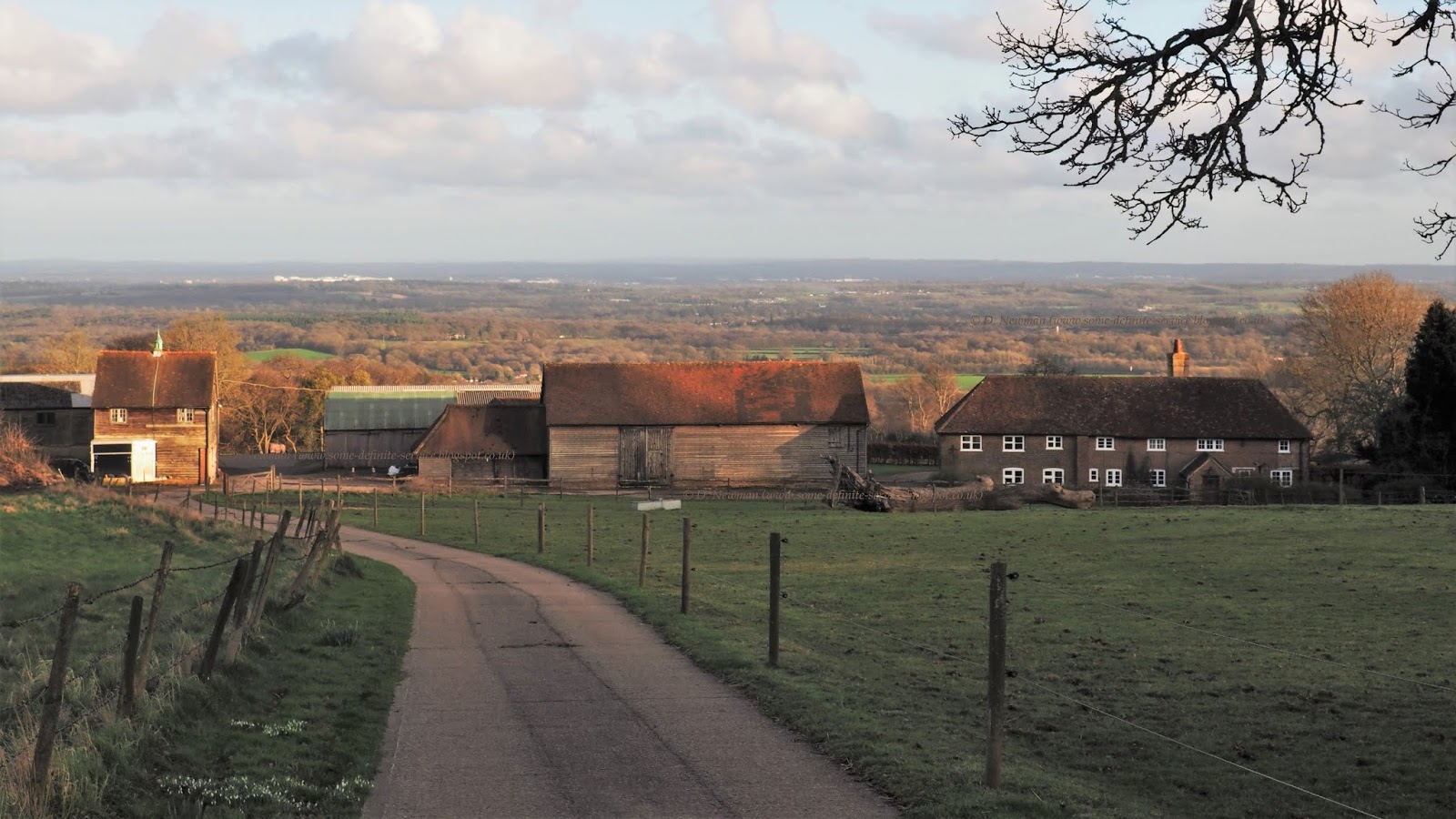
On Moorhurst Lane near Beare Green

Wednesday, July 25, 2018

Farewell to a Quirk

The 0927 to Horsham draws into Ockley station, 14 May 2018.
The new timetable that descended on most of the railways of south-eastern England in late May has, alas, been in the headlines more or less ever since, not really because of any fault in the plan itself, but mainly because one of the largest railway companies involved arrived at D-day without having trained enough drivers for the new regime.  So no sooner had the bright new age dawned than it disintegrated impressively into a cascade of chaos which has only gradually been stemmed.

Of course any railway timetable, which must count among man’s most audacious attempts to impose order on this universe of turmoil, can always be scuppered by the slightest hitch.  Even at the theoretical stage, the task of designing one is tremendously complicated, especially in Britain, whose network is still among the densest in the world.  The idea of imposing upon the tangle of lines and chords and junctions a pattern of regular and reasonably frequent movement, in which no train ever conflicts with another, is enough to turn a grown man weak at the knees.  For, notwithstanding the brilliance and solidity of Victorian engineering and workmanship, a tangle really is what they are.  Our railways were never built to a central coherent plan, but by a multiplicity of companies all after slices of a multiplicity of pies, and willing to create any number of awkward layouts to that end. 

And then there is the catalogue of practical difficulties that reality itself will let loose upon the timetable the moment it is implemented.  On the one hand is the formidable traffic to be handled: in volumes far higher than a hundred and fifty years ago, covering greater distances, and with different flows and peaks.  And on the other hand are, in no particular order, damage to the permanent way, damage to rolling stock, signal failures, track circuit failures, floods, subsidence, frozen points in winter, buckled rails in summer, debris on the line, vandals on the line, leaves on the line and the wrong kind of snow (for all that the press scoffs at these last two, they are both genuine problems), lorries bashing bridges, guards left on platforms, missing drivers…  And what chaos these cannot cause may be provided in abundance, as it turns out, by the directors’ board of the railway company itself.

So the timetable planners are noble souls, going forth to solve a giant puzzle to which the Victorians, who set it, never guaranteed an answer.  The railway map spreads out like a chess-board and the trains like pieces, with their differing routes and differing calling patterns.  All-stations stoppers, outer suburban semi-fasts and inter-city expresses must all move harmoniously and regularly.  Thus a timetable becomes a daring sustained utterance of ideal order against all the forces of chaos ranged against it.  It is both a meticulous work of arithmetic and a courageous act of faith.  Dare I even call the planners poets?  After all, as the character Syme explains in this passage I have seen quoted from G. K. Chesterton’s The Man who was Thursday (a novel which I must get round to reading):
Chaos is dull; because in chaos the train might indeed go anywhere, to Baker Street or to Baghdad. But man is a magician, and his whole magic is in this, that he does say Victoria, and lo! it is Victoria.  No, take your books of mere poetry and prose; let me read a time table, with tears of pride.  Take your Byron, who commemorates the defeats of man; give me Bradshaw, who commemorates his victories.  Give me Bradshaw, I say!
The nearest equivalent to Bradshaw’s famous volume is now a 41-megabyte download from the Network Rail website, though limited editions of the print version are still published.  Some might expect such a tome to be resoundingly dull.  But I wonder whether a majority of passengers would be with Chesterton: the idea that ‘chaos is dull’ must resonate with many who have endured long waits and dwindling hopes these past few months.  Even in ordinary circumstances, any working regular timetable often masks a great deal of complexity.  Perhaps we should marvel not at the scale of disruption that sometimes occurs, but that any timetable should ever have reasonable success.  For instance, to a passenger it might seem the natural order of things that trains from a given station should depart in a given direction at the same number of minutes past each hour throughout the day — 0812, 0912, 1012 and so on — according to a ‘clock-face’ timetable.  But this is more difficult to achieve than it might seem.  Enough time must be left at each terminus to turn around to recover from any delays, for instance.  Also, the circumstances behind the scenes are not the same throughout the day: everything must be in the right place in the morning, and be left in the right place at night, and the preparations to be made on the eve of Sunday are different from those for the eve of Monday.  The timetable also has to shoulder the burden of rush-hour, in its two opposite directions, at each end of the day.  So no wonder the order is not quite universal.

Yet once the timetablers have suppressed most of the chaos, I find I am quite fond of any quirks that are left, providing I am not actually caught out by them.  The old timetable had quite a few variations that were interesting to those of us to whom, I suppose, these things are interesting.  Some were adjustments made to cope with rush-hour traffic; others were stop-gaps to ease miscalculations in the timetable itself.  Still others were Parliamentary trains, one of the token services run perhaps once a day or once a week to prove to the satisfaction of the law, but of very few passengers, that a line or station is still open for business, and thereby to avoid the palaver of applying to close it (There are enough of these to justify the compilation of this list of Passenger Services over Unusual Lines; see also my write-up of an adventure to Shippea Hill, the station that is hardly a station by a hill that is hardly a hill).  Other quirks seemed to exist for reasons no longer discernible, lost in the mists of time, for traditions last long on the railways.  The new regime’s planners, though, have striven to simplify things, adjusting irregularities and ironing out the oddities of the old order, and their achievement is impressive.  But some of the old timings will not pass unmourned; at least, not by those of us who mourn these things.

One quirk that we have lost involved the line that runs southwards from Dorking in Surrey to Horsham in West Sussex, an odd stretch of railway, because, although it was built as a double-track main line (and retains a line speed of 75mph), it is rather a backwater.  Perhaps it is because it does not aim squarely at a terminus as it nears London, but appears to dissolve into the various intertwining strands and loops in the suburbs.  These are now too congested with local traffic to accommodate many non-stop trains, and there are no facilities left for fast trains to overtake slow.  The map below shows how the route becomes ensnared in the confusion of South London.  Gone are the days when coastal expresses ran this way to and from London: the fastest trains from Horsham to Victoria now use the route to the east via Gatwick and East Croydon.  Holmwood, Ockley and Warnham, the three euphonically-named intermediate stations on the stretch between Horsham and Dorking, have only an hourly service in each direction, and all trains stop at all stations.  My complaint is not of dullness, as we have established! — rather, the disappointment lies in the failure to exploit railway infrastructure to the full.  What is a main line for, if you do not send trains down it at top speed?

A tangle really is what they are.  (Click to enlarge; the Dorking-Horsham line is in the lower left-hand corner)
Yet under the old timetable the line was allowed, once a weekday, to reclaim its former glory.  For the unassuming 0756 from London Victoria, having extricated itself from the tangle of South London lines and trundled unhurriedly through outer suburbia in accordance with its designation as secondary passenger service 2E12, was transformed, on its arrival at Dorking just before nine, into the Horsham Flyer, the Wealdman, the Sussexpress, unique in being timetabled to run fast from Dorking to Horsham, non-stop through Holmwood, Ockley and Warnham.  It was not quite clear for whose benefit this dash was made, away from London in the morning peak and rather on the late side for rush hour anyway.  Most likely not for the passengers’: it may well have been for operational ease, to avoid the need for guards who were still needed to oversee stops on this line, or perhaps simply to reach Horsham in time to form an ordinary stopping service back.

Still, it was there to be travelled on by any passengers who wanted it.  It also produced a fluke in the ticketing system.  For those approaching from the north and wanting Ockley or Warnham stations at that time in the morning, it was quicker to take this train to Horsham, be carried straight past the desired station, and then double back with the returning London service, than to wait for the next direct ‘down’ train — and, just this once per day, an easement made this doubling-back perfectly valid on ordinary tickets to these stations.  What more remained for me to do, then, than to concoct some pressing need to arrive at Ockley station at 9.20 in the morning, before the arrival of the direct train seven minutes later, and thus give myself an excuse to try it out?

For months after I discovered it, this drifted around pleasantly in my thoughts as a nice idea to do some day, along with the knowledge that Leith Hill, the highest point in south-east England, stands nearby.  But the advent of an all-standardising, quirk-free new timetable, under which I found this oddity was to be abolished, concentrated my mind.  Yes, definite action was suddenly necessary: there was now a deadline before which a walk from Ockley station to Holmwood station via Leith Hill was absolutely required to take place.  And might 9.27 a.m. not be a little on the late side to set off on this walk?  Indeed, would not a slightly earlier time, such as 9.20, be more or less perfect?

So on the fourteenth of May, in the last week of the old timetable, I too had cause to extricate myself from South London so that I could number myself among the last beneficiaries of the the Unmitigated England Express.  It was a still-golden morning flooded with still-welcome sunshine, long before drought was to drain England of all her colour.  All down the line the train had been emptying, and there were only a handful of us left aboard as we drew unostentatiously out of Dorking, round the corner and into Betchworth tunnel.  Through the darkness we accelerated, bursting out into unsuburbanised Surrey, past trees aflash with fresh May foliage, past stiff haughty pines, past the working farms and all that space in the fields beyond.  And continued to accelerate, leaving behind us the chalk cliffs of the North Downs, and bringing the shadowier evergreen of the Greensand Ridge, with its culmination in the summit of Leith Hill, into view on the right.  Straight through Holmwood, the ride becoming a bit rough, and gaining speed until at least Ockley, after which a stretch of jointed track lay in wait with its ambush of nostalgia.  (To run over jointed track at 75mph is to recall old England to life).  Warnham, warm in the sun, with one lone gentleman on the platform, was gone as soon as it was glimpsed.  The distance to Horsham, 13 miles and 30 chains, was covered in just over fifteen minutes — an average speed of about 53mph.  Not bad, it must be said, for suburban stock designed to pootle around South London all day.


At Horsham I stepped nonchalantly onto the platform and then just as nonchalantly boarded again, and presently the train set off back towards London again, possibly with its own air of nonchalance.  No high speeds but business as usual between there and Ockley, where I alighted.  I noted not without smugness that I had indeed arrived a crucial three minutes earlier than the next down train, and therefore that the detour via Horsham and the Unmitigated England Express had been entirely and unquestionably worth the effort.  The nearby A24 made its presence felt, but I lingered for a while to admire the handsome station building, before then setting off on my walk.

The time I had gained by doubling back via Horsham was immediately wasted faffing around in a half-field-half-scrapyard beside the dual carriageway where nature had been allowed or possibly encouraged to obfuscate the footpath.  So it was the long way round that I came to Capel village (here, as so often with British railways, the station is not named after the nearest significant settlement), and rested in the parish church.

St John the Baptist’s Church, Capel, Surrey.
Setting off westwards from the village I found myself in that sort of England which, not unlike a railway timetable, impossibly survives and even thrives in spite of all that threatens it.  The atmosphere was encroached upon but not shattered by the intrusions of the A24 and A29, nor by the procession of aeroplanes in the bright south descending towards Gatwick.  I met someone only once (a man building a roof in the blazing sun) and lost my way only twice (a GPS reader would have saved me a lot of trouble and spoilt all the fun) in the five or six miles before I reached Leith Hill Place, where stands the childhood home of Ralph Vaughan Williams.
Leith Hill Place
Leith Hill itself is understandably well-known and even on a weekday there were plenty of people at the top.  From its summit on a clear day London can be seen to the north, and the sea glimpsed through Shoreham Gap in the south.  The enjoyable story of the tower at the top is that it was built (or had built!) in 1765 by Richard Hull, an earlier resident of Leith Hill Place, in order to bring the hill, whose natural summit is 965 feet high, to an elevation of a thousand feet.  The tower is looked after by only the fourth keeper since the mid-nineteenth-century, who sells elderflower lemonade from a hatch in the ground floor of the tower.  There are other refreshments for sale as well, but it is the elderflower lemonade I remember.
Leith Hill Place from just below the summit of Leith Hill.  The Weald and South Downs in the distance.
Then down from the summit via Coldharbour village (whose apparently incongruous name probably comes from the French col d’arbour, a wooded hill), back to Holmwood for the London train, and home.  It was almost as if the main point of the exercise had not been to justify the exploitation of an obscure piece of railway operation for the sake of curiosity.

This is something else that railways do.  Their rules and patterns and occasional oddities add spice to the whole idea of planning a jaunt like this, and turn the whole country into a kind of puzzle or board game, though not always in a frivolous way.  Roads have no timetables, so they have no timetable quirks.  I am sure my trip was more enjoyable for all that meticulously-planned messing about in trains.

Thursday, March 16, 2017

To Tulse Hill by Third Rail

Is it a different world this side of the Thames?  Many of us in south London like to think so.  After all, everything south of the river, even right up to Southwark and Lambeth, has traditionally lain beyond the immediate authority of the Cities of London or Westminster over the water.  Partly this is because, in the old days, the diocese of Winchester once came all the way up to the river, so that the South Bank, though actually directly overlooked by St Paul’s Cathedral across the river, lay under the jurisdiction of a see sixty miles away.  All through the history of London the Thames has made all the difference: for instance, it was to avoid trouble from the authorities that the theatres of Shakespeare’s time decamped to their transpontine position.

These administrative and ecclesiastical boundaries all seem quite faded now. Today, the mass of ‘Greater London’ sprawls greyly to horizons north and south alike, and elects a single Mayor (who is not to be confused with the Lord Mayor of the City of London). Not without considerable hesitation can Vauxhall or the Borough be described as being in Surrey, a name which now calls to mind rural red-tiled gables,  or downs descending into denes.  Indeed, how laughable is the name ‘Surrey Quays’ for those old docklands of Rotherhithe, left stranded as they are by the ebbing of their historical county?  In recent years even the insatiable developers have crossed the river, hungry to thicken the skyline of south London, too, with their towers.

All the same, there are certain ways in which the Thames still constitutes a barrier between central London and its southern suburbs, and which have no counterparts to the north.  The swathe the river cuts through the city tends towards the south; it still has an isolating effect on Lambeth and Southwark even as it leaves the north contiguous with the centre.  South Londoners wishing to reach the city proper still have the river to cross first, and this means, in contrast to north Londoners, that they know the sensation of crossing the river into the city, into the heart of things.  They shoot out onto one of the bridges aboard a bus or train, or even slide into Blackfriars railway station, with its new platforms spanning the water — and the sky widens without warning, a panorama unfolds along the Embankment, the Houses of Parliament sail clear — and then they come to land in the heart of the city.  Even if few will murmur that ‘Earth has not anything to show more fair’; even if the feeling can be dulled by habit, it never vanishes entirely, and will last as long as the river itself.  Those coming to the West End or the City from the north, however, miss it altogether.

The Tube, of course, provides southerners with several ways to sneak into London without acknowledging or noticing the river.  But, as we are keen to point out, most of us are in any case a long way from the nearest Underground station.  There is always some sort of change needed from the world of south London to the world of central London.  The Underground network is heavily biased towards and largely contiguous with north London, whereas it hardly ventures south of the river (apart from the bold, incongruous and ultimately rather ironic adventure of the Northern line, through Britain’s longest railway tunnel, to Morden, the Underground’s most southerly station).

Yes, as well as crossing the Thames, the majority of south Londoners going ‘up to town’ have a definite threshold to cross: there is for us a clear moment of arrival in London.  North Londoners, however, can generally pile straight onto the Tube, and are already in the system when they set off from their home station.  In their tunnels they see nothing, poor souls, and apart from the entry to these tunnels their journey into the city crosses no perceptible boundary.  Perhaps this is why ‘Metroland’ is a phenomenon of North London rather than South.

Christian Wolmar’s enjoyable history of the Underground, The Subterranean Railway, offers several explanations for this imbalance in provision between north and south. [1]  For instance, the geology of south London is notoriously difficult to tunnel through.  Apart from the obvious obstacle posed by the Thames, Tube tunnelling was defied almost until the new millennium by the the deposits of gravel that overlie the typical London clay in this area, sometimes to a depth of ten metres.

South Bermondsey station
Wolmar also explains that, by the time that the Underground had begun to expand beyond central London at the turn of the twentieth century, the city’s south had already gained its dense network of suburban railways.  It was North London that had greater need of transport connections, having been neglected by the builders of the lines out of Euston and King’s Cross.  These companies had bigger fish to fry than Edgware or Barnet: their sights were set on the big prizes — Manchester, Newcastle, Edinburgh or Glasgow — and they needed to send express trains as far afield as they could, and as quickly as possible.  They did not concern themselves with the more trifling places in between, and constructed their lines accordingly, forging northwards with a smattering of intermediate stations and only paltry connections between east and west.  Speed and directness were everything: ‘There we were aimed’ was Philip Larkin’s impression, racing from Hull towards London straight up the East Coast Main Line.  It was the Underground that was to fill in the gaps.

In Kent, Surrey and Sussex, the situation had been different.  Across these counties no siren song floated from any industrial belt; no ‘fields of apparatus’, no ‘furnaces / Set on the dark plain like gigantic chessmen’ beckoned the top-hatted industrialist.  The only sources of traffic comparable to the likes of Liverpool and Newcastle were Portsmouth, the trans-Atlantic port of Southampton and, further east, Dover or Newhaven, with their Continental connections.  The other main destinations, such as Eastbourne, Brighton and Hastings, generated a different kind of traffic from the northern cities, local and regional rather than heavy goods or long-distance expresses. (Kidner called London and South Western main line ‘from its earliest days a line for farmers, military men, bishops and high class tourists’). [2]  Moreover, because all of these destinations lay within a hundred miles of the capital, there was relatively little to be gained by sustained high speed, and, in turn, less to be lost by stopping in between.

Neither did the geography of south London and England encourage fast railways.  Instead of straightforward natural courses, such as the Thames presented to Brunel as he went westwards, the builders of railways to the south met almost immediately with long dissuading barriers of high ground.  The first is the ridge rising eastwards from southern Battersea towards Norwood and Sydenham, but beyond lie the North Downs, the Weald, and the South Downs, which can be punched through only with difficulty.  For example, the line from Tonbridge to Hastings passes through eight tunnels in the thirty-two miles of its length.

Thus the companies in the south laid speed aside in favour of a different goal: comprehensiveness of coverage, and not only for the passengers’ sake.  The railway barons were competing with each other for territory as much as for traffic, and often proved themselves willing to build new lines simply to pre-empt their rivals.  What was more, the fewer pickings south of London meant that there was less to be squabbled over, and this was how the suburbs, considered an obstacle north of London, came to be seen in the south as a market in their own right.

All this produced in this part of England a distinctive railway map, the unsung tangle of surface railways on which we have relied ever since.  A dense and wayward network it is, particularly those lines in London’s immediate suburbs and leading directly southwards towards Sussex that were known under British Rail as the ‘South Central Division’.

Geographical map of suburban south London railways, created with use of information © OpenStreetMap contributors
Here in the south is the realm of the ‘rolling English rail’, to paraphrase Chesterton: none of the self-containedness or single-mindedness of the north.  The southern suburban lines criss-cross each other like a board game, before sneaking alongside the main lines to run into startlingly grand termini (Waterloo, Victoria, Charing Cross, London Bridge).  They are inclined to diversions, to duplicating each other merrily and to winding circuitously around obstacles.  Who could blame London-bound travellers on the Tattenham Corner branch for being rather more doubtful than Philip Larkin about where precisely they are ‘aimed’?  Another difference with the North is that physical rail connections between lines are more common than on the Underground, so that trains can in theory be sent along a greater variety of routes.  All around the network it is possible to glimpse chords and spurs and sidings leading off round bends, curving away to who knows where?

This game of joining-the-dots has plenty of practical advantages.  One is the relative ease of travel eastwards and westwards, which can usually be done without having to go via central London.   This perspective of North London shows how all the railways (even the Tube) run quite independently of each other along north-south axes, so that the most practical route from (say) Mill Hill Broadway to Winchmore Hill involves either going all the way into London and out again, or resorting to the bus.  Their unrelenting linearity also restricts north Londoners to a single terminus.  Meanwhile, South London railway stations often enjoy direct services to two or sometimes three different London termini.  It is unusual to have to change trains more than once or twice between any two given south London stations.

And there are quirks and curiosities to match any of the Underground’s.  We have unusual and historic stations such as Peckham Rye or Crystal Palace, both of which see the phenomenon of London-bound trains departing in completely opposite directions.  Then there is Vauxhall, from whose name the Russian word for railway station comes, and Clapham Junction, the busiest station in Britain by the number of trains passing through.  And there is no shortage of memorable names: Gipsy Hill, or Penge West, or Elephant and Castle, or Tooting.  After staring for long enough at a map of the network, patterns loom forth and swirl around, such as the symmetry between Battersea in the west and Bermondsey in the east, echoed neatly by the nearby stations of Queens Road Peckham and Queenstown Road Battersea.
Clapham Junction, unusually quiet
Yet amid these uncritical remarks of mine must be heard another voice, as of a great multitude of passengers, wailing and gnashing their teeth, and saying, ‘But these trains are always late!  And slow!  And overcrowded!  And expensive!  And unreliable!  And late!’  And lo, their lament is far from groundless.  The same layouts that open up the variety of destinations and connections also produce conflicts in movements.  A case in point are the flat junctions, which send trains right across each others’ paths, hamper acceleration and constrain the timetable.  At most stations, the price to pay for the choice of routes is a frequency of trains far sparser than on the Underground.  The guiding principle in south London is this: everything is possible, but only once every half-hour.

The system’s complexity also displays its weaknesses by falling to pieces whenever anything goes wrong.  Disruption is rarely contained along one line or in one area, but spreads like wildfire across the congested network.  The failure of a single set of points can cause chaos in an apparently unrelated part of the network; spectacular delays can be accumulated over only a few miles.  And of course there is the South London trundle: first the hopeful acceleration to about 15mph, then the application of the brakes, slowly but surely gnawing away at the speedometer, slowing and slowing the pace nearer and nearer to a crawl, drawing closer and closer the inevitable red signal and yet always in denial: the signal refuses to change until progress has juddered to an emphatic 0.  And so on and so forth, all the way home. 

Since all railways, representing a noble ideal as they do, are difficult to construct, maintain and improve, most of these problems will remain unresolved for many years to come.  In the meantime, one radical way of surviving commuting, I have found, is to become interested in it.  After all, there is often plenty of time to sit and contemplate the network, even if that time is seldom set aside voluntarily.  Who knows, the long meditative silence of a signal failure might lead some fellow-passengers, not yet thoroughly hardened, to acknowledge that South London’s railways have a certain distinctive atmosphere.  Could it even be said that South London is made distinctive by its railways?  If the best way to see any landscape is by rail, in South London the railways themselves form some of the best aspects of the landscape.  For one thing, they maintain corridors of woodland that ought to be unthinkable this far into London, bringing the countryside deep into the city (just as roads, conversely, are take the town out into the country).  Someone unfamiliar with the area might reasonably think that from Streatham to Peckham Rye stretches a kind of wild garden, populated by occasional gables and chimneys.  Who knows: maybe the last boughs and branches of the old Norwood or Forest Hill are hidden away the in railway cuttings.
North Dulwich station
The suggestion of the rural is enhanced by a feature of the infrastructure: the system of electrification, which supplies power not via bristling overhead catenary but through a discreet ‘third rail’ at ground level.  This arrangement is relatively unusual for main line railways and has practical disadvantages of its own, but it does leave branches and sky unencumbered.  As a matter of fact the electrification programme, undertaken by the Southern Railway in the 1920s and 1930s, was really the only marketing campaign successful enough to mark out these railways as a rival to the Underground.  The Art Deco promise of refuge in suburbia,  brought within comfortable reach by the ‘Southern Electric’, did for the south what ‘Metroland’ had done for the north, and the slogan’s euphony even earned it a footnote in (north-Londoner) Betjeman’s poem ‘Love in a Valley’.  (Betjeman even mentions the third rail in that poem: ‘White down the valley curves the living rail’, he declares from his Coulsdon perch.)

I have wondered if this south London atmosphere exists most completely at Tulse Hill station, a place whose position can only be described as the very middle of deep south London.  The area it serves is much like the rest of the city, except for having served as an unlikely poet’s paradise for Jason Strugnell, Wendy Cope’s spoof 1980s alter ego.  The station itself is in many ways the South London station par excellence: it is a complete muddle.  It has the word ‘Hill’ in its name, for one thing; it has direct but distinctly unhurried services to two different London terminals, Blackfriars and London Bridge; it lies at the convergence of several different routes, and its capacity is constrained irredeemably by two overbridges at each end of its platforms.  (One of these, which crosses the South Circular, was the country’s second most collided-with overbridge last year).  Once a day at mid-morning Tulse Hill even has the quirk of a single Parliamentary train to Streatham Hill (no return).  Finally, after standing on the platform, having stared for long enough at the maps during the aeons of bleak winter-evening delays, there is some satisfaction to be gained in observing that from Tulse Hill the points can theoretically be set so that trains might set off in opposite directions, along quite different routes, and yet be able to reach either London Bridge or Victoria stations without having to reverse.  When the station was first opened, which will be 150 years ago next year, I doubt there seemed any particular reason for it to have been placed where it was.  Now the passenger whose train rounds the excruciatingly tight bends and lumbers at last into Tulse Hill has at least the assurance of being completely lost.

Here then in one place — and Tulse Hill, of all places — is a collection of features that are South London’s own.  On life goes, without anybody noticing; on the railway clunks.  Nobody notices that in north London there is nothing quite like it to be found.  Whether that is a shame or a relief is not necessarily the most pressing matter of the day, but it is enough, I think, to justify my claim that there is something special about the world this side of the Thames.
Tulse Hill station: a two-pronged approach from the south
References:
[1] Christian Wolmar, The Subterranean Railway (London: Atlantic, 2004), p. 14
[2]  R. W. Kidner, The Waterloo – Southampton Line (Oakwood, 1983), p.7.

Tuesday, November 08, 2016

‘Here We Are Again’

DKW_SBFS91_1_SuttonShop_highlight_1908

This is a picture of the High Street in Sutton in Surrey taken at Christmas, 1908 – which is not all that long ago in the grand scheme of things, but long enough, as it turns out, for almost everything visible in this photograph to have disappeared entirely.  Gone are the dignified bunting and proud flags and the banner proclaiming ‘Here we are again’.  Gone are the cumbersome means of transport, the fashion, the manners and mannerisms, the solemn lettering, even Robinson’s High Class Teeth (which might be a good thing).  But I said ‘almost everything’ has disappeared because there has been one remarkable survival from this picture.  It is connected with another of these shops on the right, no. 18: the photography studio of David Knights-Whittome, advertising him as ‘Photographer to His Majesty the King’.  It is his business that we have to thank for some 11,000 photographic negatives taken of Sutton’s townsfolk between 1904 and 1918, and it was his photographic eye that recorded the characters of people who knew and walked this frozen High Street when it was living.  We have to be grateful also to providence that so much of this collection survived the twentieth century against all the odds, so that it is now possible for them be cleaned, conserved, rehoused, catalogued, digitised, researched and put online by Sutton Archives, with the help of local volunteers and a grant from the Heritage Lottery Fund.  The banner that announced ‘Here we are again’ in 1908 turns out to have been a message not only for the ordinary Edwardians of Sutton, but for us in the present day.  Here they are again indeed.
Miss Neate, DKW_30706_30706A_Neate_L
They were ordinary people like Miss Neate who, during her visit to Sutton on the 11th December 1908, might have been able to admire the Christmas decorations if they had been put up, or have thought 1907’s had been better, before she went into Knights-Whittome’s studio to have this photograph taken.  They were ordinary people like Mr. E. A. Blacker who had been a sitter the previous February. 
Mr E.A. Blacker, DKW_30046C_Blacker_L and DKW_30046B_Blacker_L
For single portraits like this, Knights-Whittome tended to use glass plate negatives.  The negative was simply a small rectangle of glass coated in a ‘light-sensitive emulsion of silver salts’.  By the time of these photographs they were being mass-produced.  Knights-Whittome tended to take several exposures per client, sometimes using a single plate for each shot, as he does here, and sometimes squeezing two onto the same plate, as he did for this client, seen here a year later. 
Detective Enticnapp [Enticknap], DKW_30602_Enticnapp_L
A sitter with a name like Detective Enticknap was perhaps not so ordinary, but a  Charles Henry Enticknap was indeed a detective and member of the Metropolitan Police from 1887 to 1913 (his biography is here).  When the print had been taken of the negative and the happy customer had left, the plate was numbered and labelled with the sitter’s surname, put in an envelope and placed on shelves and in boxes in the basement of the shop.

David Knights-Whittome, 1876-1943, self-portrait
This is the man at the heart of the story: David Knights-Whittome, who was born in Greenwich in 1876 and was the seventh child of Joseph Whittome (a warehouseman and Baptist minister) and Eunice Smith.  He probably taught himself the art of photography.  The Borough Archives at Sutton hold a notebook that he compiled at the age of 18, entitled ‘Secrets of Photography’.  There are records of his having worked in Edmonton (North London) and Woking (in Surrey) before he moved to Sutton in 1904.  Here he married, in 1907, Sarah Elizabeth Draper, known as Bessie.  They had two sons, Maurice and Ronald, born in 1908 and 1912 respectively.

He was also indeed a photographer to the King, as he claimed (if not the only one), obtaining a Royal Warrant of Appointment in 1911 and being one of the official photographers at Prince Edward’s investiture as Prince of Wales at Caernarvon Castle in 1911.  His royal subjects included Edward VII, George V and Edward VIII at various ages, and also King Alfonso of Spain, King Manuel of Portugal and Queen Maud of Norway.

To the shop in Sutton, opened in 1904, he added a studio in Epsom in 1911.  All the negatives from both studios were kept together in Sutton without any distinction between the series, which means that any photograph from this date onwards could have been taken in either town.  This has repercussions for the identification of the sitters.

It seems that in 1918 Knights-Whittome gave up photography as a career altogether.  The Sutton and Epsom shops closed, and the family had moved away by 1921 to Wimbledon, then to Bournemouth and finally to retirement in St. Albans, where Knights-Whittome was mayor in 1940. He died in 1943.  As for the one-and-a-half tonnes' worth of glass negatives, they had all been left in the basement of 18, High Street, Sutton in 1918…  There they would remain for sixty years.

The involvement of the Sutton Borough Archives began in 1978, when June Broughton, the Local Studies Librarian, was contacted by a member of the public about a certain large collection of glass plate negatives in the basement of Linwood Strong optician’s in the High Street… The building was to be demolished to make way for a road-widening scheme (this happened in 1986).  So June Broughton and Frank Burgess, a local historian, went to investigate.  In the words of Abby Matthews, the current Project Officer for the ‘Past on Glass’ project, ‘they were met with a scene of neglect and damage’.
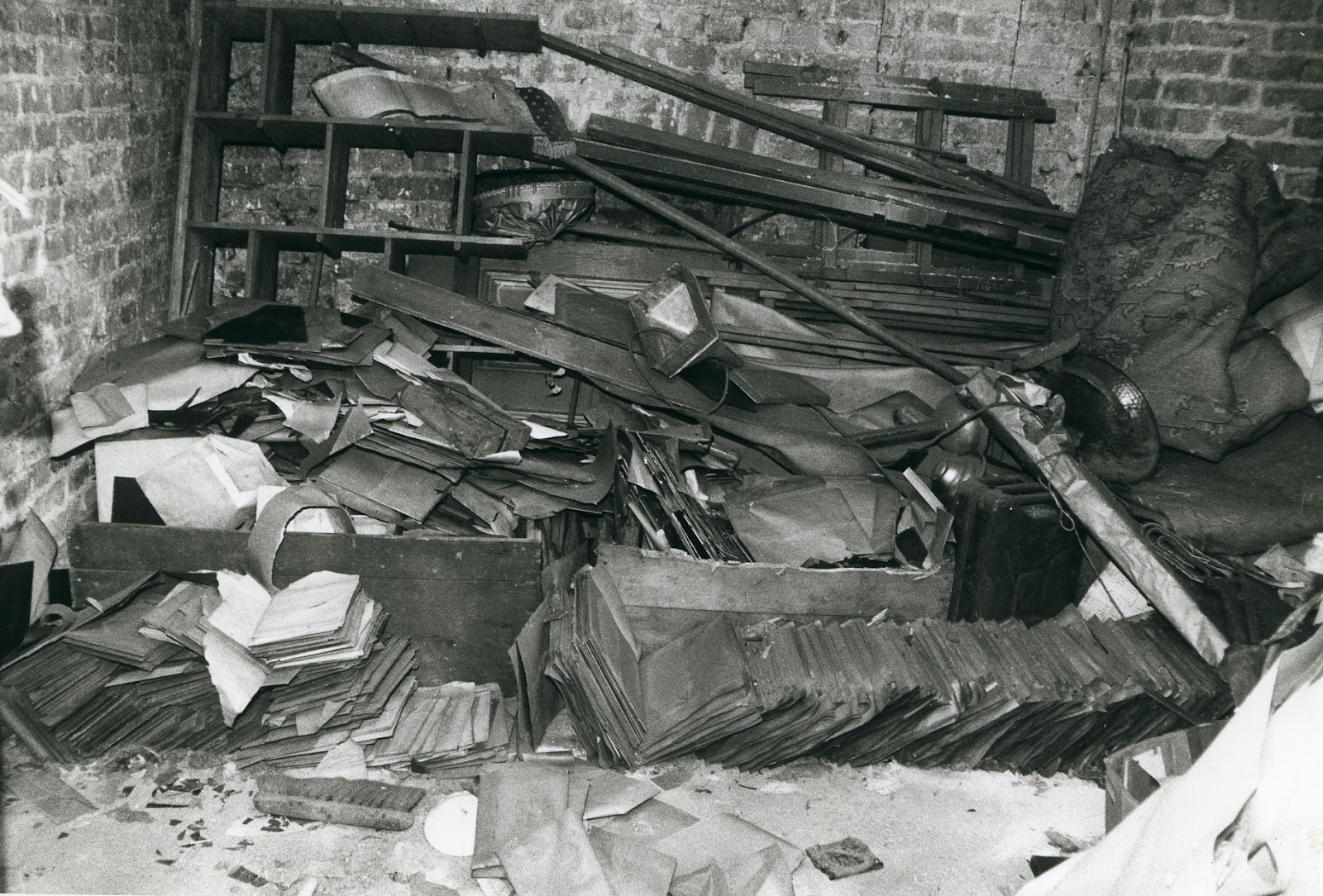
The state of the collection in the basement of 18, High Street, Sutton, Surrey, in 1978.  From the project blog.
Everything remained much as it had been left, on open shelves in original envelopes, except that some of the shelves had collapsed onto others, and some of the plates had been piled up on top of each other anyway, so they were also bearing their own weight.  The inevitable result is shown by the fragments of broken glass visible on the floor.

The plates were moved to Cheam Library as a matter of urgency.  Eventually they were transferred to the main civic offices in Sutton and given to the borough by the Knights-Whittome family.  However, many of the plates had been broken and, worse still, had suffered water damage in the cellar so that they were stuck in their brown envelopes. 
On a large number of plates the emulsion was delaminating, or peeling and flaking off the glass, and with it the image itself.

The collection remained in this position for thirty more years.  Then in 2014, after lengthy audits and consultation with photographic conservators, a successful application was made to the Heritage Lottery Fund for the preservation of the collection.  Nearly £100,000 was awarded so that every plate could be cleaned, rehoused and catalogued, and undergo conservation if necessary.  The funds also provided for their comprehensive digitisation, not least so that they could be made public over the Internet.  The project was called ‘The Past on Glass’.

The Project Officer, Abby Matthews, and Kath Shawcross, the Borough Archivist, oversee a number of local volunteers who clean, catalogue, rehouse and scan as many plates as they can, sending some for conservation.  Some volunteers carry out research on family history websites to try to shed some light on the people in the portraits.  Then they are uploaded to the project’s Flickr page, where there are already about 4,000 images.

The collection might have lain for a hundred years awaiting its moment, but in some respects the timing of this new project is perfect.  Only in recent years has the technology become readily available for a proper digitisation programme.  The same goes for the way in which the Internet can make the collection far more accessible virtually than it ever could have been physically.

As they have done so they have had to contend with all sorts of difficulties.  For example, the writing on these envelopes, all scrawled in ink and bled into the poor paper, are still the only source of information for most of the plates: all the ledgers and account books have disappeared.  And the information that survives is often incomplete: many surnames are illegible or undated.
From an article on the project blog. These envelopes are for photos of quarter-plate size (about A6), the most common for single portraits.
The photograph inside might be stuck, or the emulsion flaking, so it has to be done  gingerly!  Then they have had to catalogue the plates in a way that tries to straighten out Knights-Whittome’s idiosyncratic system of numbering.  But all of this is outweighed by the experience of liberating a photograph that has not seen the light of day for a century, and coming face to face with the people and the characters of that vanished age:
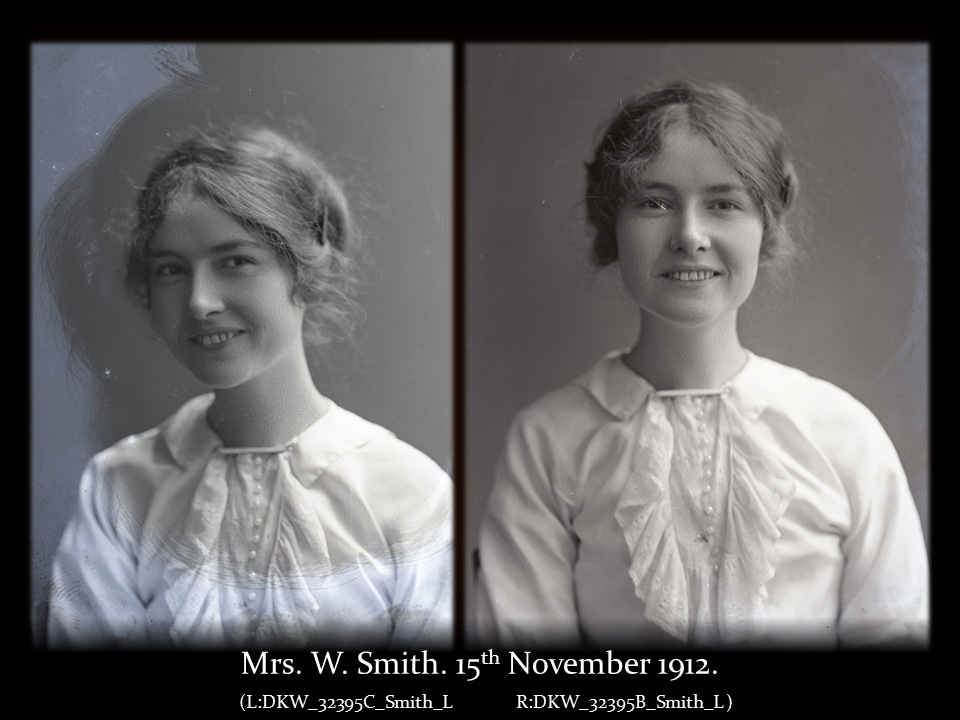
For example, Mrs. W. Smith, photographed on the 15th November, 1912.  Abby Matthews (the Project Officer) has noted that the largest category of photographs are single portraits of women, like this.  One of the reasons she suggests for this is the First World War, which looms large over this collection in many ways.  It would make sense for soldiers who went off to fight to take photographs of their sweethearts with them. 
Correspondingly there are many pictures of officers in uniform. This is J. A. Boyd:
J.A. Boyd, DKW_35442_Boyd_L1
The archives assistant at Sutton found that he had enlisted in the 3rd East Lancashire Field Ambulance Corps two years earlier at the age of sixteen, when he was three years underage.  He survived the war.

Below is Private Harold Dickson Mims, born in North London in 1896; son of Ernest and Sarah Jane Mims; enlisted as a private in the 5th (City of London) Battalion (London Rifle Brigade); embarked for France in January 1915; promoted to Lieutenant in early 1917; killed in action aged 22 on the 27th September, 1918.
There are group portraits as well.  Here is a couple called Bevington, frustratingly with no year given.  I had a go at researching this couple but could not find out anything concrete about them.  But the advantage of their being on the Internet is that the families themselves are more likely to find them and supply the necessary information.
There are also many photographs of babies and children.  This is Baby Bamber on the 10th December 1915:

Mrs Jenkins and baby, DKW_34030C_Jenkins_L
There are some wonderful characters among the plates.  For example, here is Miss Mabuine on the 18th of January, 1907:
Miss Mabuine, DKW_23642A_Mabuine_L
…and a few months later the jovial Mr. Fiddyment sat for his portrait.  Abby Matthews has pointed out that he must be a working man because of the grime in his hands and his worn jacket: unusual, because working men would not normally have been able to afford to have a photograph taken like this.
Mr. Fiddyment, DKW_23745_Fiddyment_L
Miss Biddulph in an impressive hat on the 2nd September 1912:
Miss Biddulph, DKW_32313_Biddulph_L
And there were pets:  Here is Mrs. Henderson and her dog, 5th December 1916:
Mrs. Henderson and dog, DKW_34301A_Henderson_L
Knights-Whittome did occasionally venture outside the studio, for instance to take these pictures of classes at the convent school at Carshalton.

And this is Mr. Andrews who, astonishingly enough, was not satisfied with his portrait, and wrote to Knights-Whittome to tell him so.  It is not yet clear whether this is the offending or the corrected version:
Great Fell
E. Molesey
Aug 7th 1907


Dear Sir,
I am not at all pleased with the photos. Everyone who has seen them says they are very poor & I must ask you to see what you can do towards bettering them.  The one X is all on one side as though the face was badly swollen & twisted. The other is the better of the two & I think can be made to look more natural by turning the nose down & not up as it now is. I am not aware that my nose turns up nor is anyone else who knows me – the head & figure stoops rather too much forward & this can easily be altered when cutting the photo for mount & I think they would look infinitely better if darker about the top of the head – Please adjust these items! Let me have the ½ dozen as soon as you can.


Yours truly,

R.M. Andrews

This goes to show that photographers were in the habit of retouching their work even in those times, mainly by pencil on the reverse of the glass plate.  There is a post here on the project blog about Mr Andrews and his exacting standards!


I count myself very fortunate to have been able to volunteer for this project — only for a short time (and I miss going) but enough to cement my decision to pursue a career as an archivist.  There are plenty of others who have also found it tremendously rewarding.  Recent good news has been that the project has received a second much-needed grant from Lottery Fund.  This means hopefully that the work can be brought to completion.

Of course, this post is a feeble attempt to do justice to this astonishing collection, which throws open not a different era but a vanished civilisation.  There are weddings, grown men in fancy dress, clergymen, schoolchildren and students, and no end of babies and dogs.  There are enigmatic people, too, whose gaze meets ours unsettlingly across the gulf of the twentieth century.  There they are again, full of quirky nooks and eccentric crannies, spirited, upright and full of life, just as we are now.


----------------------------------------------
The Past on Glass Online:

The pictures in this article have all been obtained from the project’s page on Flickr.com, where more are always being added:
www.flickr.com/photos/pastonglass


The project blog:
www.pastonglass.wordpress.com


On Twitter via Sutton Archives:
www.twitter.com/SuttonArchives
#pastonglass


Abby Matthews, project officer:
abby.matthews [at] sutton.gov.uk


Sutton Archives:
https://arena.yourlondonlibrary.net/web/sutton/local-studies-archives


I believe that these images have been reproduced in accordance with to the terms of the Creative Commons Licence but if not will make any necessary changes.  Except for the placing of images in pairs, indications of reference numbers and sitters’ names, and in one case an enhancement of contrast and colour, no alterations have made to the images.  The references and links to the original uploads are given for all pictures..