Showing posts with label John Betjeman. Show all posts

Saturday, August 31, 2024

The Sudden Straight Face

It is strange that one of the saddest songs in the English language should have been written by two comedians.  Michael Flanders and Donald Swann are still best known for their light comic and satirical pieces — ‘The Hippopotamus’, ‘The Gnu’ or ‘The Gas-Man Cometh’ — but when they turned their satirical eye to the Beeching Axe, the mass closure from 1963 of about a third of the British passenger railway network, they produced, in ‘The Slow Train’, for many people the definitive lament for these mostly rural branch lines, and for the way of life that was lost with them.


The song bears all the Flanders and Swann hallmarks — the deft word-play, the affectionate satire, the sense of the ludicrous — but the mood is utterly different from usual.  Seing the damage that Beeching was doing, suddenly they were serious — and indeed, in the live recording, made sixty years ago when it was all actually happening, there is, apart from a few appreciative titters at a pun or a station name, no laughter at all, only rapt silence.

This complete change of key seems to me utterly audacious.  The audience had paid for comedy, after all, yet here suddenly was tragedy, an entirely sincere farewell to a familiar feature of the national landscape, to a distinctive characteristic of our society, destroyed by human folly, with only the word-play providing the thinnest veil of wit.  Audacious, but thoroughly effective: first we are puzzled that we can’t find anything to laugh at, disconcerted to think that we might have missed a joke.  Then the inverse feeling: surprise, in the pit of the stomach, as we realise that we really are being addressed seriously.  There is a sense of having had a narrow escape, as if one has nearly walked giggling into a full and silent church.   (They’re being serious, and we thought it was going to be a joke!).  

And yet it is still satire, for Flanders and Swann had noticed, along with others since, the totally inadvertent poetry of Section 1 Part 3 of Dr. Beeching’s report, the ‘List of Passenger Stations and Halts to be Closed’ (in England, though the destruction in Wales and Scotland was just as wanton).  Buried deep behind the oily bureaucratic euphemism of the report’s title, ‘The Reshaping of British Railways’, is a list that has been called some of the most moving poetry in the language — or are ‘like names on a war memorial’, as the satirist Ian Hislop has said:
Abbey Town
Acrow Halt 
Acton Central 
Addingham 
Adlestrop 
Ainsdale 
Airmyn 
Aldeburgh 
Aldermaston 
Aldridge 
Alford Town (Lincs.) 
Alfreton and South Normanton 
Alresford (Hants.) 
Alrewas 
Altofts and Whitwood 
Alton Towers 
Ambergate 
Andover Town 
Apperley Bridge …
Of course, it is bleakly amusing that those unable to perceive the true value of railways, their marriage of elegance and efficiency, had by their very tin ear betrayed themselves in accidentally producing such moving poetry — fifth on the list is Adlestrop itself! — and Flanders and Swann, simply by transforming it into a serious song, throw this irony into definition.  They are punning away as usual, ‘The sleepers sleep…’ but the music itself has all the pathos of a folk-song.

The British passenger railway network, 1963 (left) and 1984 (right)
The Sudden Straight Face had another strategic advantage in that particular era, and that was the strength it lent to anyone making a point that was easily mocked.  This was the age of the satire boom, satire far more biting than Michael Flanders’. Then, as now, mockery was one of the vandalisers’ chief weapons; anyone who objected to the sweeping away of old things was opening themselves up to a round of scoffing (“Backward!  Nostalgist!  Move with the times!”).  But by proving that they could make an audience laugh, and indeed by laughing at themselves, they could build up a kind of credit with their wit, to be expended in an outbreak of earnestness like ‘The Slow Train’.

The person who knew this as well as Flanders and Swann was, of course, the poet John Betjeman — the man who in some ways ought to have written ‘The Slow Train’.  (In fact, my friend Maolsheachlann justifiably said he was ‘flabbergasted’ I hadn’t mentioned it when I wrote a few years ago about Betjeman’s poem ‘Dilton Marsh Halt’).  Reading A. N. Wilson’s biography of Betjeman reminded me of the occasion in 2018 when I had passed through the Halt, a tiny station of two short platforms on the outskirts of Warminster in Wiltshire.  At the time I wrote that Betjeman’s poem seemed to capture a paradoxical seam that runs through all of his work: irrepressible humour on the one hand hand, and sincere, vulnerable sorrow on the other.  It applied to his life as well: Wilson paints a picture of a man distraught at the ruination of England, acutely conscious of his personal flaws and ‘afraid of being found out’, who nevertheless craved merriment and silliness, and would gleefully assign nicknames to his friends, or throw his table-napkin over his face and howl with glee.  

John Betjeman and Flanders and Swann knew that they were operating in a culture of heavy cynicism.  Sincerity alone, from a standing start, was no good: this was precisely the age in which anyone speaking in defence of old things or high ideals would bring clanging mockery down around his ears.  But the Sudden Straight Face was their secret weapon.  First Betjeman poked fun at this tiny station, answering his own rhetorical question, “Was it worth keeping the Halt open?”…
“…Yes, we said, for in summer the anglers use it,
Two and sometimes three
Will bring their catches of rods and poles and perches
To Westbury, home for tea.”
As many as three passengers for a mile’s journey!  Clearly a vital transport interchange, we chuckle; good old Betjeman, silly old England.  But then in the final stanza comes this outburst: 
And when all the horrible roads are finally done for,
And there’s no more petrol left in the world to burn,
Here to the Halt from Salisbury and from Bristol
Steam trains will return.
Betjeman’s work derives much of its poetic power from this contrast between the gleefully satirical and the ingenuous — in some circles embarrassing — earnestness.  The man is a great jester, as Wilson’s biography shows, but there are some things in this world so serious that they snuff out even the jester’s laughter.  This is why that plangent ‘horrible roads’ and the prophecy of the return of steam, a ripe, irresistible invitation for Sixties mockery, nevertheless withstands that mockery.  The Sixties Modernists stand primed to scoff at anyone avowing a sentimental attachment to this unprofitable station, but the poet has got there first — he has already laughed gently at its ridership of ‘two and sometimes three’ passengers, and has laughed at himself for loving it.  So the love, which is serious, has now been fired by clay; by pre-empting the jeers the poet has hardened his work to withstand and outlast hostility.

I think Betjeman employs this manoeuvre to greatest effect in his poem ‘St. Saviour’s, Aberdeen Park, Highbury, London, N’ (such a Betjemanian touch to give the postal district!).  Here he begins by relating a typical Betjeman church visit, beautifully written as always, but with a hint of self-deprecation of his own style:
With oh such peculiar branching and overreaching of wire
Trolley-bus standards pick their threads from the London sky
Diminishing up the perspective, Highbury-bound retire
Threads and buses and standards with plane trees volleying by
And, more peculiar still, that ever-increasing spire
Bulges over the housetops, polychromatic and high.

Stop the trolley-bus, stop! And here, where the roads unite
Of weariest worn-out London — no cigarettes, no beer,
No repairs undertaken, nothing in stock — alight;
But then the tone changes, and the poem more becomes earnest, and highly personal:
These were the streets they knew; and I, by descent, belong
To these tall neglected houses divided into flats.
Only the church remains, where carriages used to throng
And my mother stepped out in flounces and my father stepped out in spats
To shadowy stained-glass matins or gas-lit evensong
And back in a country quiet with doffing of chimney hats.
Still there is the typical Betjeman detail, the evocation of details of the vanished past.  But now he has made himself vulnerable by writing of his parents, of the deeper, more personal connection that he has to this church.  And then he goes further.  The church is not merely an architectural curiosity, nor even a relic of family history or of a bygone age, but the House of God in which Betjeman is no passing visitor but an invited guest:
Wonder beyond Time’s wonders, that Bread so white and small
Veiled in golden curtains, too mighty for men to see,
Is the Power that sends the shadows up this polychrome wall,
Is God who created the present, the chain-smoking millions and me;
Beyond the throb of the engines is the throbbing heart of all —
Christ, at this Highbury altar, I offer myself to Thee.
So it is that the Sudden Straight Face allows Betjeman to do what I believe he generally struggled with, to write straightforwardly about his faith, in perhaps the most confident proclamation of faith he ever made (and it is nice to think that some of these lines were chosen to accompany his statue at London St. Pancras station in 2007).  By the protective layer of his self-deprecation he pre-empts any mockery or satire of these most personal things, his memories of his parents and his vulnerable faith.  Thus he shows how, even in an age of cynicism, sincerity, once whetted to a blade, cuts cleanly through cynical clinker with a strange and unequalled power.

And we, the audience, cannot deny the sincerity even to ourselves; it is almost as infectious as laughter.  By our uproarious laughter of a moment ago we have proven to each other that we have hearts — at least it has with this open, wholehearted humour of Betjeman and Michael Flanders, as opposed to the sniggering of modern comics.   If we have hearts, we have no need to pretend to be unmoved by sorrow and loss.  So it is, first by laughter and then by sighs, that we find companionship in each other.

More on ‘St. Saviour’s, Aberdeen Park’  from the Rev. Malcolm Guite.

Monday, March 09, 2020

The View from Leith Hill

Approaching the top of Leith Hill from the east, as I did once again with an old friend the other Saturday, there is always a curious, pleasant sensation of having come round the back by a secret way.  We had met almost nobody among the hollows and meadows of the Hill’s lower slopes, so to find the summit quite busy — converged on by other visitors along more orthodox routes, and with the invariable cluster for refreshments around the National Trust servery at the foot of the Gothic tower — made us feel as if we had sneaked up by unknown paths across undiscovered country.

I doubt that any hill exists that is not worth climbing, but Leith Hill, the crown of Surrey, is one I particularly know and treasure.  Its summit on the Greensand Ridge is the highest point in south-east England (some say second-highest, defining south-east England differently — but I know where my loyalties lie!) and, looking northwards on a clear day, it is possible to see right over the top of the North Downs and Box Hill, themselves six miles distant, and to make out the wide grey clutter of London on the horizon.  To the south, the generous quilted Wealden country spreads all the way to the South Downs — and sometimes, through the Shoreham Gap, there can even be glimpsed a hazy glimmer of sea.  This is a good place to come for a bit of perspective on things.
Looking southwards from the top of Leith Hill Tower, 8th February 2020.
We have the eighteenth-century landowner, Richard Hull, to thank for the existence of the tower, which of course we paid our £3 to climb.  He had it built partly for an even better view over the counties below, and partly out of a fundamental dissatisfaction with the hill’s geomorphology.  That the natural summit stood 965 feet above sea level was for Hull ranklingly, frustratingly short of a thousand.  By the addition of the tower, he determined, the magic figure could be reached and surpassed.  (Did ever Enlightenment rationalism lead so directly to Romantic folly — never mind the building of an actual romantic folly?)  The modern displays in the tower’s first-floor chamber tell of later episodes in the tower’s history: the rowdy eighteenth-century fairs, or the longevity of Mrs Skilton (for over thirty years proprietrix of the tea-servery and ‘highest lady in the county’).  They tell of the near-collision of a passenger plane in 1948, averted by only thirty feet.  It was impossible not to notice, either, a photograph of a firework display held in 1993 to celebrate the entry of the United Kingdom to the European Union in its then-new formation.  (The week before our walk, Britain had formally reversed this very event, unaccompanied by any fireworks, as far as I know: I suppose Parliament has already given us our fill of pyrotechnics over the past few years…)

What do I see, looking down from the top of Leith Hill?  Almost unmitigated England in all directions, ancient with ghosts, curious with old tales, tender with things remembered.  It is known country I am looking down on, though I will never learn all there is to know about it: mile upon mile of palimpsest, all overlain by associations, details, particularities of the ages: Stane Street, the Roman road that we had crossed on the way from the station; the Iron Age hill fort of Anstiebury that we were to skirt on the way back — everyone from Richard Hull and Mrs Skilton and the fairgoers all the way down to ourselves and our fellow visitors this February Saturday.  I think of others who have loved this landscape: the poet George Meredith, he of the Mole Valley under Box Hill, and the composer Ralph Vaughan Williams, whose famous tone poem ‘The Lark Ascending’ took its name from one of  Meredith’s poems.  Vaughan Williams’ childhood home, Leith Hill Place, lies hard under Leith Hill’s southern slopes.

To put it more simply, from the top of Leith Hill I am looking at home.  Home not by title or deed, but by a character and spirit that dwells under my skin and in my soul.  Landscapes, like houses or streets, are sanctified by being lived in and loved: of the landscape below me I can say that I am at home when I walk in it, when I look on it and even when I think of it.  It is home, too, because, in its semi-sacramental beauty, it seems to stand for a certain ideal of the whole of England; to love this landscape is somehow to love the whole.  So today I, up here on the Hill, largely lifted away from England’s sorrow and sin, seeing it resolved into its proper image, into a sunlit heirloom on a crisp midwinter day, do not find it hard to love.  I remember that in fact it is very dear to me indeed.
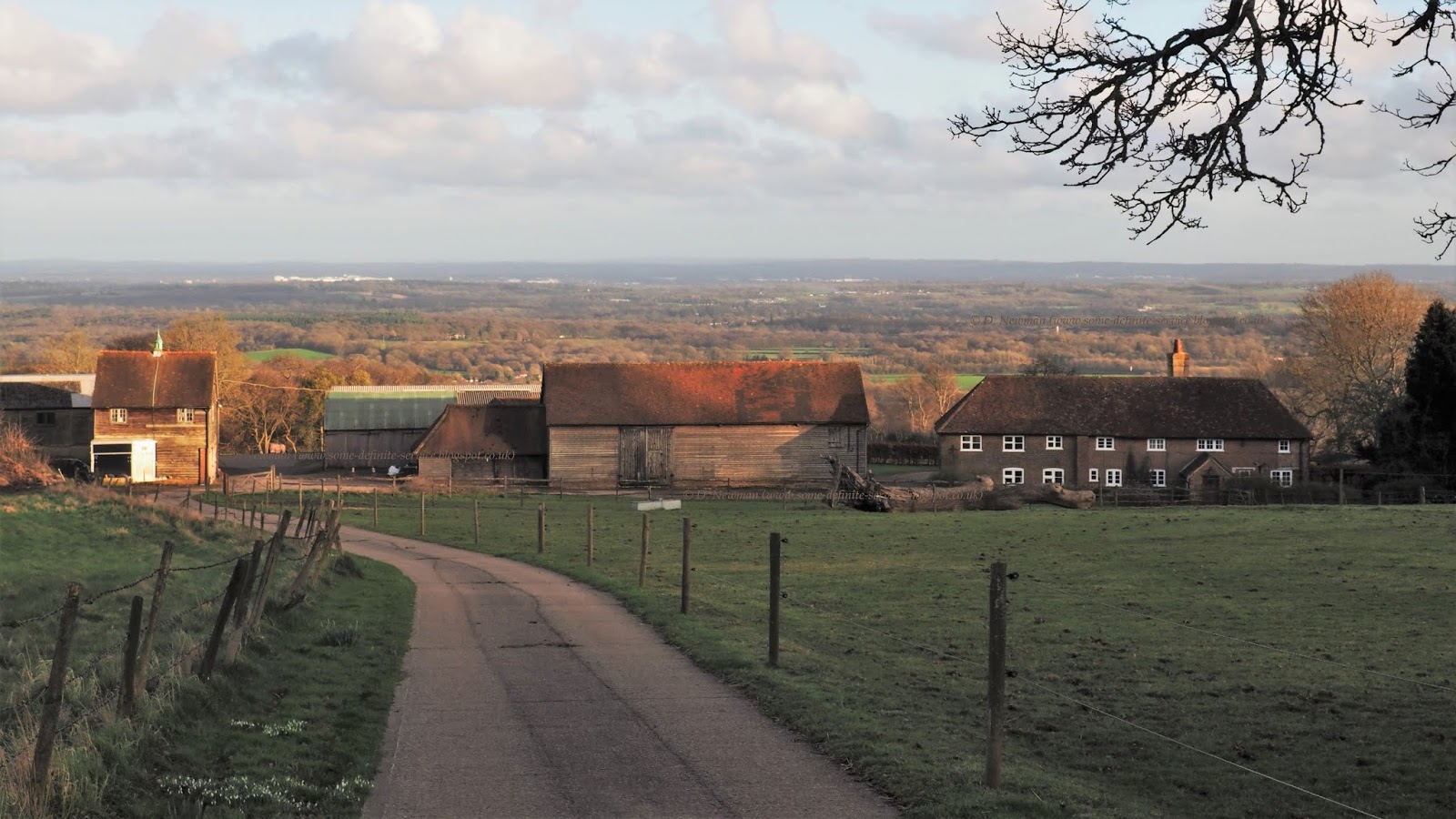
Looking slightly south-eastwards from the slopes of Leith Hill near Coldharbour.  Gatwick Airport in the distance.

Love of home is for me as old as thought.  It is mostly a gentle thing, but it is also deep and dogged and immovable.  These days it is the fashion to scorn such sentiments, perhaps because of the extremes to which versions of it have been taken in the past.  But fashion, for all its force, holds little sway at the top of Leith Hill.  Up here, I can say boldly that I am blessed by the home we have been given to live in.  I can say that it is a good and natural thing to be grateful for that home, and that it is right and just to regard it as an inheritance, which, however indirectly, we must preserve for those who come after us.  Love of home need not, should not be jealous or selfish.  There is no reason why it should ever be either, not least since when it is authentic it is often actually accompanied by an urge to share it with others.  Nor is it necessarily a false idol: love of England may go very deep without overbalancing into outright worship — though I can sense the fierce flame to which some threat or peril could fan this instinct.


For look: it is indeed in peril.  Not this time by outright war or foreign conquest, but by something less tangible and more insidious, though similarly potent with worldly might.  The homely England I have praised may seem from up here to stretch out timelessly and unendingly, but it is always being threatened and encroached on by another England: that bland, bloated, blemishing England of which Betjeman warned, and Orwell, and Priestley, and Vaughan Williams himself in his later music.  I mean the England of the M23 corridor, just visible in the south-east, all motels and warehouses and commuters’ flats and dual carriageways and business parks.  I mean the pale angular mass of Gatwick Airport (even as I acknowledge the poetry in that airliner drifting dreamily up away from it — bound for Orlando, as my friend informs me).  I mean the scarring noise of traffic from which I have had to travel so far to escape, and the permeating threat of mass development (‘No to 480 homes here,’ a banner near the station had pleaded).  And look, now you can scarcely see, as you could before, the dome of St Paul’s Cathedral, drowned by its boasting and secular skyline.  It is not change in itself that dismays me, but change made blindly, seemingly for its own sake, or for merely economic or pragmatic reasons, on a brutishly massive scale, approved by Larkin’s ‘bespectacled grins’, by immense, distant forces that neither see nor care what they destroy. 


Yet… Leith Hill is a good place for some perspective.   Here it remains, serene above the strife of the world, lifted up from the hurly-burly and the madding crowd.  Now I see how remarkably persistent, how surprisingly tough, is the softness of this south country.  Here all those colours — the green meadows, the blue shadows, that Wealden amethyst, the flood of gold from the low sun — do not merely survive, but triumph, quietly as they may, and, it seems, might well till Doomsday.  For this reason I resolve to remember this part of England when in exile in surroundings quite unlike it — to think of the sun shining down unperturbed, and to give thanks with a grateful heart.
On Moorhurst Lane near Beare Green

Monday, December 24, 2018

‘Grant them his blessing that now maken cheer’

Christmas is now the only time of the year when nostalgia is allowed, so we take full advantage of it.  Once a year we modern folk admit, exhausted, that we cannot stand the headlong pursuit of an abstract future any longer.  And we return to sanity: out come the tinsel and the traditions, and the carols and the crackers and the cards.  For once the scoffers win nobody over.  Supermarkets realise that words like ‘magic’ and ‘wonderland’ will swell their sales.  In my London suburb, lights hang from eaves and the innocence of candles is alight in windows: brave beacons of peace and goodwill against the traffic and the darkness.  We think of homely things and home — rightly enough, since that is the meaning of the Greek nostos, from which we derive ‘nostalgia’.  We gather our families for meals and bake Christmas cakes and dig out board games. We remember childhood Christmasses; we mark old customs; we put the radio on for the carols.  ‘And girls in slacks remember Dad, and oafish louts remember Mum’.  We turn homewards.

But in many ways the feast we celebrate today is not really very nostalgic.  The idea that Almighty God in his limitlessness should take on the limits of man, even to the point of knowing a newborn baby’s helplessness, is an unfailingly disconcerting thought, far stranger and wilder than any pagan winter festival; beyond the rationalisation of the secular mind.  And apart from the light and warmth of the manger, and the Lady’s miraculous motherliness, there is nothing particularly homely about the Nativity scene.  The census could not have had worse timing; Joseph had come all this way to his home town only to find the dreadful accommodation of a stable, as we all know, and now his wife was actually having to give birth in it; the town was unfamiliar to her at least, the temperature had plummeted in the clear Middle Eastern night, an infanticidal tyrant was abroad, hopping mad with jealousy and with a plan of pre-emptive retribution to match; safety lay only as far away as Egypt.  And there are the other things foreshadowed, not least in the gifts that were already on the road with three kings: the Passion and the Crucifixion and the seeming finality of the entombment.  ‘He came unto his own, and his own received him not’.

Yet, deeper still, perhaps this mood of Christmas wistfulness is entirely meet and right after all.  The child came at Christmas in order to show us the way home.  And home is what we are all looking for. We are prone to forgetting that we are not at home here on earth; that we do not really belong here.  We may daydream vainly in search of a lost past, an unattainable future or a distant land where we think we could belong, but really we try to suppress our homesickness and have accustomed ourselves to exile.  So our real home, though longed-for, is bound to seem unfamiliar to us.  Strange and disconcerting though the facts of the Incarnation and the Nativity are, our instinctive reaction is sound: this is the way home.  Let us allow the strange homely spirit of Christmas, which is true nostalgia, to break through the cramping walls of our age, and resonate with our inward longing.

We are not the first to feel it.  It is there, hauntingly, in the carols of medieval England, for instance; in the wide-eyed-ness there is about them, and the great depth behind their deceptive simplicity:

 Lullay, my liking, my dere son, my sweting.
 Lullay my dere herte, my own dere darling.

 I saw a fair maiden siten and sing.
 She lulled a little child, a swete Lording.

 That eternal Lord is He that made alle thing:
 Of alle lordes He is Lord, of alle kinges King.

 There was mickle melody at that childes birth:
 Alle that were in Hev’ne bliss they made mickle mirth.

 Angels bright they sang that night, and saiden to that child:
 Blessed be thou, and so be she that is both meek and mild.

 Pray we now to that child, and to his mother dere,
 Grant them blessing, that now maken cheer.

 Lullay, my liking, my dere son, my sweting.
 Lullay my dere herte, my own dere darling.

May God indeed grant us His blessing who now make cheer.  Merry Christmas!


Philip Lawson’s setting of the carol Lullay, myn liking, from the fifteenth-century Sloane Manuscript 2593 (British Library).

Monday, October 01, 2018

150 years of St Pancras Station

St. Pancras station on the morning of its 150th birthday, 1st October, 2018.
Today is the 150th anniversary of the opening of St. Pancras station in London.  The Midland Railway began services from its new terminus on the 1st October 1868, having constructed an edifice fit to beckon travellers to the Kingdom of Heaven, never mind Leicester, Nottingham, Derby, or Sheffield (and eventually Manchester and Scotland).  No expense had been spared in the effort to blow King’s Cross next door, and their rivals the Great Northern Railway, out of the water.  George Gilbert Scott was the architect of the Midland Hotel, which forms the station’s façade onto the Euston Road, and William Barlow’s cast-iron overall train-shed roof contained the ‘widest and largest undivided space’ enclosed by any structure in the world at the time of its completion.

St. Pancras station from Midland Road, September 2018.
It has occurred to me recently how unfortunate it was that the Gothic Revival coincided so squarely with the Industrial Revolution.  For no sooner than these great buildings were finished than they were exposed to the grime and acidic rain of the cities they had been meant to dignify.   The arches and spires that should have soared luminously and goldenly skywards, just as they would have done in the Middle Ages, were gradually blackened and darkened by Victorian dust and soot until, a century later, they had been transformed into the world-weary hulks so detested by modernist architects.  Yet, of course, the Gothic revival had been meant largely as a romantic answer to the Industrial Revolution.  So perhaps it is simply a tale of noble defeat in its battle against utilitarian commercial enterprise.

Or was it?  For there were those like John Betjeman, Jane Fawcett, Bernard Kaukas and others who, when public affection for Victorian architecture was at its lowest ebb, saw through the grime to the glory beneath.  Now, thank goodness, most of the building has been restored to its original splendour.

Exactly the same anniversary is celebrated today by the Peckham Rye – Sutton line in south London, which the London, Brighton and South Coast Railway opened also on October 1st, 1868.  East Dulwich, North Dulwich, Tulse Hill, Streatham, Mitcham Junction, Hackbridge and Carshalton stations also celebrate their 150th birthdays today.  This line, which is probably too ordinary to be called quirky but still not straightforward enough to be wholly dull, diverges just west of Peckham Rye from the South London line that originates at London Bridge, burrows in a cutting through Dulwich, is carried aloft across a valley of surprising green, climbs through a tunnel to Tulse Hill, descends to Streatham, crosses the Wandle plain, and works its way uphill again through Carshalton to join the older line from West Croydon at Sutton, all the time undulating and curving this way and that, threading its way through existing routes.  It is a railway that fills in missing links, is not always altogether clear where it is heading, and merrily duplicates other lines.  It is still generally used only in sections, rather than from end to end as a through route, except in weekday peak hours.

There must have been a sense in 1868 that the main task of building Britain’s railways was accomplished, and that only the finishing touches were needed.  It is true that the Severn estuary and the Firth of Forth had not yet been conquered, but it must have seemed that there was not much left for the insatiable builders to achieve.  Barely forty years after the railway age had begun, the engineer’s task was nearly a matter either of crowning the railways with glory (it must have been hard to imagine what could surpass St. Pancras station) or of filling in any last gaps in the suburbs and the countryside to eliminate any doubt about the system’s comprehensiveness.

Update:
It will have been someone’s onerous duty to polish off this enormous cake!

Sunday, April 15, 2018

Lines to Remember


The railway crossing the river at Bradford-on-Avon, with the fourteenth-century Tithe Barn in the middle distance.
For travellers to London by rail from Bath and Bristol, the most straightforward route is the Great Western main line of course: 125mph to Paddington, with no hesitation or deviation, engineered by Isambard Kingdom Brunel with straightforwardness uppermost in his mind.  Three times a day, however, a train arrives from the capital ‘round the back’ via Salisbury and Warminster, and three times a day there is a return journey to Waterloo.

arr
dep
Bristol Temple Meads 1249
Keynsham 1255 1256
Oldfield Park 1302 1303
Bath Spa 1305 1307
Bradford-on-Avon 1318 1319
Trowbridge 1327 1328
Westbury 1334 1339
Warminster 1346 1346
Salisbury 
(attached to the 1215 from Exeter St. Davids)
1416

1421

Andover  1437 1438
Basingstoke 1455 1457
Woking 1515 1517
Clapham Junction 1536 1537
London Waterloo 1549

The timings of the 1249 from Bristol are perfect for an unhurried afternoon run, as I found last week, joining at Bath.  It was the third day of spring’s first serious uprising against this iron Lenten winter we have been having.  All the trees were bare still, but the sun had spring’s confidence and even spring’s warmth.  Easter holidays had brought children to playgrounds and teenagers to river-banks — though nobody else seemed to need to go anywhere far, as the train was almost empty as it wound up the Avon valley.  From Bradford-on-Avon we ran with assiduous avoidance of alacrity to Trowbridge, and in the platform at the next station, Westbury, we were momentarily facing away from London, in the right direction for Penzance.  Then between there and Warminster lies the village of Dilton Marsh, and we ran non-stop through the Dilton Marsh Halt of John Betjeman’s poem.  When I re-read it on arriving home, this poem struck me anew, because I realise it shows with particular clarity the opposition between two voices that run throughout Betjeman’s poetry.  They are set against each other in this poem, and one of them is a clear victor.

On one hand there is the familiar ironic, comic and parodying voice, the ‘Come-friendly-bombs-and-fall-on-Slough’ schoolboy irreverence that reads as if scribbled in a margin, which Betjeman achieves by singing of mundane modernity in Romantic, Wordsworthian diction, and sending up both.  So, in answer to the question, “Was it worth keeping the Halt open…?” mused on with deliberate bathos ‘as we looked at the sky’, comes the carefully ironic response:
“…Yes, we said, for in summer the anglers use it,
Two and sometimes three
Will bring their catches of rods and poles and perches
To Westbury, home for tea.”
A crucial transport interchange, then!  And later, unmistakeable Betjeman:
O housewife safe in the comprehensive churning
Of the Warminster launderette!
O husband down at the depot with car in car-park!
The Halt is waiting yet.
Ha, ha, ha!  We chuckle at the incongruity of the high register and the supposedly banal subjects.  Or we smile wryly at the witty caricature of modern life.  Good old Betjeman, what a laugh!  But there, in the last line of that stanza, does the parody not fade abruptly?  Just where we might expect a punchline, the Wordsworth mimic vanishes.  No joke is cracked.   ‘The Halt is waiting yet’: the first impression is simply that this sentence is not ironic and that it does not say much, but, read again, in its very plainness there is something mysterious.

And then, proving beyond doubt that this straight face has not been pulled for the sake of rhyme or metre, there follows the extraordinary last verse, casting aside the schoolboy smirk once and for all:
And when all the horrible roads are finally done for,
And there’s no more petrol left in the world to burn,
Here to the Halt from Salisbury and from Bristol
Steam trains will return.
This is the other voice, plangent, disarming and perhaps the truer Betjeman, which appears with particular force in this poem and for which, I contend, the mischief is a front and in fact a defence mechanism.  And I can see why Betjeman needed such a defence mechanism.  The strength of his sentiment might be met with bewilderment even today, but in the 1960s, when the car was the future and anything even faintly Victorian was fair game for gleeful destruction, how much more greatly the laughs would have dwarfed those generated by the Lyrical Ballads spoofery.

Yet the outburst of this last stanza, in its audacious earnestness, shows how visceral nostalgia can be.  Nostalgia is not always an enjoyably fuzzy emotion, a melancholy to wallow in, and it cannot always be held back.  Hopeless it may be, but perhaps it must sometimes cry aloud in defiance of slick progressivists and ‘bespectacled grins’ (did not Philip Larkin too have two voices, one a foil for the other?).

Thursday, March 16, 2017

To Tulse Hill by Third Rail

Is it a different world this side of the Thames?  Many of us in south London like to think so.  After all, everything south of the river, even right up to Southwark and Lambeth, has traditionally lain beyond the immediate authority of the Cities of London or Westminster over the water.  Partly this is because, in the old days, the diocese of Winchester once came all the way up to the river, so that the South Bank, though actually directly overlooked by St Paul’s Cathedral across the river, lay under the jurisdiction of a see sixty miles away.  All through the history of London the Thames has made all the difference: for instance, it was to avoid trouble from the authorities that the theatres of Shakespeare’s time decamped to their transpontine position.

These administrative and ecclesiastical boundaries all seem quite faded now. Today, the mass of ‘Greater London’ sprawls greyly to horizons north and south alike, and elects a single Mayor (who is not to be confused with the Lord Mayor of the City of London). Not without considerable hesitation can Vauxhall or the Borough be described as being in Surrey, a name which now calls to mind rural red-tiled gables,  or downs descending into denes.  Indeed, how laughable is the name ‘Surrey Quays’ for those old docklands of Rotherhithe, left stranded as they are by the ebbing of their historical county?  In recent years even the insatiable developers have crossed the river, hungry to thicken the skyline of south London, too, with their towers.

All the same, there are certain ways in which the Thames still constitutes a barrier between central London and its southern suburbs, and which have no counterparts to the north.  The swathe the river cuts through the city tends towards the south; it still has an isolating effect on Lambeth and Southwark even as it leaves the north contiguous with the centre.  South Londoners wishing to reach the city proper still have the river to cross first, and this means, in contrast to north Londoners, that they know the sensation of crossing the river into the city, into the heart of things.  They shoot out onto one of the bridges aboard a bus or train, or even slide into Blackfriars railway station, with its new platforms spanning the water — and the sky widens without warning, a panorama unfolds along the Embankment, the Houses of Parliament sail clear — and then they come to land in the heart of the city.  Even if few will murmur that ‘Earth has not anything to show more fair’; even if the feeling can be dulled by habit, it never vanishes entirely, and will last as long as the river itself.  Those coming to the West End or the City from the north, however, miss it altogether.

The Tube, of course, provides southerners with several ways to sneak into London without acknowledging or noticing the river.  But, as we are keen to point out, most of us are in any case a long way from the nearest Underground station.  There is always some sort of change needed from the world of south London to the world of central London.  The Underground network is heavily biased towards and largely contiguous with north London, whereas it hardly ventures south of the river (apart from the bold, incongruous and ultimately rather ironic adventure of the Northern line, through Britain’s longest railway tunnel, to Morden, the Underground’s most southerly station).

Yes, as well as crossing the Thames, the majority of south Londoners going ‘up to town’ have a definite threshold to cross: there is for us a clear moment of arrival in London.  North Londoners, however, can generally pile straight onto the Tube, and are already in the system when they set off from their home station.  In their tunnels they see nothing, poor souls, and apart from the entry to these tunnels their journey into the city crosses no perceptible boundary.  Perhaps this is why ‘Metroland’ is a phenomenon of North London rather than South.

Christian Wolmar’s enjoyable history of the Underground, The Subterranean Railway, offers several explanations for this imbalance in provision between north and south. [1]  For instance, the geology of south London is notoriously difficult to tunnel through.  Apart from the obvious obstacle posed by the Thames, Tube tunnelling was defied almost until the new millennium by the the deposits of gravel that overlie the typical London clay in this area, sometimes to a depth of ten metres.

South Bermondsey station
Wolmar also explains that, by the time that the Underground had begun to expand beyond central London at the turn of the twentieth century, the city’s south had already gained its dense network of suburban railways.  It was North London that had greater need of transport connections, having been neglected by the builders of the lines out of Euston and King’s Cross.  These companies had bigger fish to fry than Edgware or Barnet: their sights were set on the big prizes — Manchester, Newcastle, Edinburgh or Glasgow — and they needed to send express trains as far afield as they could, and as quickly as possible.  They did not concern themselves with the more trifling places in between, and constructed their lines accordingly, forging northwards with a smattering of intermediate stations and only paltry connections between east and west.  Speed and directness were everything: ‘There we were aimed’ was Philip Larkin’s impression, racing from Hull towards London straight up the East Coast Main Line.  It was the Underground that was to fill in the gaps.

In Kent, Surrey and Sussex, the situation had been different.  Across these counties no siren song floated from any industrial belt; no ‘fields of apparatus’, no ‘furnaces / Set on the dark plain like gigantic chessmen’ beckoned the top-hatted industrialist.  The only sources of traffic comparable to the likes of Liverpool and Newcastle were Portsmouth, the trans-Atlantic port of Southampton and, further east, Dover or Newhaven, with their Continental connections.  The other main destinations, such as Eastbourne, Brighton and Hastings, generated a different kind of traffic from the northern cities, local and regional rather than heavy goods or long-distance expresses. (Kidner called London and South Western main line ‘from its earliest days a line for farmers, military men, bishops and high class tourists’). [2]  Moreover, because all of these destinations lay within a hundred miles of the capital, there was relatively little to be gained by sustained high speed, and, in turn, less to be lost by stopping in between.

Neither did the geography of south London and England encourage fast railways.  Instead of straightforward natural courses, such as the Thames presented to Brunel as he went westwards, the builders of railways to the south met almost immediately with long dissuading barriers of high ground.  The first is the ridge rising eastwards from southern Battersea towards Norwood and Sydenham, but beyond lie the North Downs, the Weald, and the South Downs, which can be punched through only with difficulty.  For example, the line from Tonbridge to Hastings passes through eight tunnels in the thirty-two miles of its length.

Thus the companies in the south laid speed aside in favour of a different goal: comprehensiveness of coverage, and not only for the passengers’ sake.  The railway barons were competing with each other for territory as much as for traffic, and often proved themselves willing to build new lines simply to pre-empt their rivals.  What was more, the fewer pickings south of London meant that there was less to be squabbled over, and this was how the suburbs, considered an obstacle north of London, came to be seen in the south as a market in their own right.

All this produced in this part of England a distinctive railway map, the unsung tangle of surface railways on which we have relied ever since.  A dense and wayward network it is, particularly those lines in London’s immediate suburbs and leading directly southwards towards Sussex that were known under British Rail as the ‘South Central Division’.

Geographical map of suburban south London railways, created with use of information © OpenStreetMap contributors
Here in the south is the realm of the ‘rolling English rail’, to paraphrase Chesterton: none of the self-containedness or single-mindedness of the north.  The southern suburban lines criss-cross each other like a board game, before sneaking alongside the main lines to run into startlingly grand termini (Waterloo, Victoria, Charing Cross, London Bridge).  They are inclined to diversions, to duplicating each other merrily and to winding circuitously around obstacles.  Who could blame London-bound travellers on the Tattenham Corner branch for being rather more doubtful than Philip Larkin about where precisely they are ‘aimed’?  Another difference with the North is that physical rail connections between lines are more common than on the Underground, so that trains can in theory be sent along a greater variety of routes.  All around the network it is possible to glimpse chords and spurs and sidings leading off round bends, curving away to who knows where?

This game of joining-the-dots has plenty of practical advantages.  One is the relative ease of travel eastwards and westwards, which can usually be done without having to go via central London.   This perspective of North London shows how all the railways (even the Tube) run quite independently of each other along north-south axes, so that the most practical route from (say) Mill Hill Broadway to Winchmore Hill involves either going all the way into London and out again, or resorting to the bus.  Their unrelenting linearity also restricts north Londoners to a single terminus.  Meanwhile, South London railway stations often enjoy direct services to two or sometimes three different London termini.  It is unusual to have to change trains more than once or twice between any two given south London stations.

And there are quirks and curiosities to match any of the Underground’s.  We have unusual and historic stations such as Peckham Rye or Crystal Palace, both of which see the phenomenon of London-bound trains departing in completely opposite directions.  Then there is Vauxhall, from whose name the Russian word for railway station comes, and Clapham Junction, the busiest station in Britain by the number of trains passing through.  And there is no shortage of memorable names: Gipsy Hill, or Penge West, or Elephant and Castle, or Tooting.  After staring for long enough at a map of the network, patterns loom forth and swirl around, such as the symmetry between Battersea in the west and Bermondsey in the east, echoed neatly by the nearby stations of Queens Road Peckham and Queenstown Road Battersea.
Clapham Junction, unusually quiet
Yet amid these uncritical remarks of mine must be heard another voice, as of a great multitude of passengers, wailing and gnashing their teeth, and saying, ‘But these trains are always late!  And slow!  And overcrowded!  And expensive!  And unreliable!  And late!’  And lo, their lament is far from groundless.  The same layouts that open up the variety of destinations and connections also produce conflicts in movements.  A case in point are the flat junctions, which send trains right across each others’ paths, hamper acceleration and constrain the timetable.  At most stations, the price to pay for the choice of routes is a frequency of trains far sparser than on the Underground.  The guiding principle in south London is this: everything is possible, but only once every half-hour.

The system’s complexity also displays its weaknesses by falling to pieces whenever anything goes wrong.  Disruption is rarely contained along one line or in one area, but spreads like wildfire across the congested network.  The failure of a single set of points can cause chaos in an apparently unrelated part of the network; spectacular delays can be accumulated over only a few miles.  And of course there is the South London trundle: first the hopeful acceleration to about 15mph, then the application of the brakes, slowly but surely gnawing away at the speedometer, slowing and slowing the pace nearer and nearer to a crawl, drawing closer and closer the inevitable red signal and yet always in denial: the signal refuses to change until progress has juddered to an emphatic 0.  And so on and so forth, all the way home. 

Since all railways, representing a noble ideal as they do, are difficult to construct, maintain and improve, most of these problems will remain unresolved for many years to come.  In the meantime, one radical way of surviving commuting, I have found, is to become interested in it.  After all, there is often plenty of time to sit and contemplate the network, even if that time is seldom set aside voluntarily.  Who knows, the long meditative silence of a signal failure might lead some fellow-passengers, not yet thoroughly hardened, to acknowledge that South London’s railways have a certain distinctive atmosphere.  Could it even be said that South London is made distinctive by its railways?  If the best way to see any landscape is by rail, in South London the railways themselves form some of the best aspects of the landscape.  For one thing, they maintain corridors of woodland that ought to be unthinkable this far into London, bringing the countryside deep into the city (just as roads, conversely, are take the town out into the country).  Someone unfamiliar with the area might reasonably think that from Streatham to Peckham Rye stretches a kind of wild garden, populated by occasional gables and chimneys.  Who knows: maybe the last boughs and branches of the old Norwood or Forest Hill are hidden away the in railway cuttings.
North Dulwich station
The suggestion of the rural is enhanced by a feature of the infrastructure: the system of electrification, which supplies power not via bristling overhead catenary but through a discreet ‘third rail’ at ground level.  This arrangement is relatively unusual for main line railways and has practical disadvantages of its own, but it does leave branches and sky unencumbered.  As a matter of fact the electrification programme, undertaken by the Southern Railway in the 1920s and 1930s, was really the only marketing campaign successful enough to mark out these railways as a rival to the Underground.  The Art Deco promise of refuge in suburbia,  brought within comfortable reach by the ‘Southern Electric’, did for the south what ‘Metroland’ had done for the north, and the slogan’s euphony even earned it a footnote in (north-Londoner) Betjeman’s poem ‘Love in a Valley’.  (Betjeman even mentions the third rail in that poem: ‘White down the valley curves the living rail’, he declares from his Coulsdon perch.)

I have wondered if this south London atmosphere exists most completely at Tulse Hill station, a place whose position can only be described as the very middle of deep south London.  The area it serves is much like the rest of the city, except for having served as an unlikely poet’s paradise for Jason Strugnell, Wendy Cope’s spoof 1980s alter ego.  The station itself is in many ways the South London station par excellence: it is a complete muddle.  It has the word ‘Hill’ in its name, for one thing; it has direct but distinctly unhurried services to two different London terminals, Blackfriars and London Bridge; it lies at the convergence of several different routes, and its capacity is constrained irredeemably by two overbridges at each end of its platforms.  (One of these, which crosses the South Circular, was the country’s second most collided-with overbridge last year).  Once a day at mid-morning Tulse Hill even has the quirk of a single Parliamentary train to Streatham Hill (no return).  Finally, after standing on the platform, having stared for long enough at the maps during the aeons of bleak winter-evening delays, there is some satisfaction to be gained in observing that from Tulse Hill the points can theoretically be set so that trains might set off in opposite directions, along quite different routes, and yet be able to reach either London Bridge or Victoria stations without having to reverse.  When the station was first opened, which will be 150 years ago next year, I doubt there seemed any particular reason for it to have been placed where it was.  Now the passenger whose train rounds the excruciatingly tight bends and lumbers at last into Tulse Hill has at least the assurance of being completely lost.

Here then in one place — and Tulse Hill, of all places — is a collection of features that are South London’s own.  On life goes, without anybody noticing; on the railway clunks.  Nobody notices that in north London there is nothing quite like it to be found.  Whether that is a shame or a relief is not necessarily the most pressing matter of the day, but it is enough, I think, to justify my claim that there is something special about the world this side of the Thames.
Tulse Hill station: a two-pronged approach from the south
References:
[1] Christian Wolmar, The Subterranean Railway (London: Atlantic, 2004), p. 14
[2]  R. W. Kidner, The Waterloo – Southampton Line (Oakwood, 1983), p.7.

Saturday, August 13, 2016

Betjeman the prophet

Highbridge Wharf, your hopes have died:
They flow like driftwood down the tide,
Out, out into the open sea —
O sad forgotten S. & D.

Any readers who feel like a laid-back half-hour might enjoy this film, ‘A Branch Line Railway’ with John Betjeman, broadcast by the B.B.C. in 1963 and now available indefinitely on the I-Player.  (Since this is the B.B.C.’s website I have a feeling it can be watched only in the U.K.).  It is a journey from Evercreech Junction to Burnham-on-Sea in Somerset, along part of the former Somerset and Dorset Joint Railway.  The ‘S. & D.’ was a line from the west Somerset coast to Bournemouth, with a long arm from Bath joining at Evercreech.  It was built in anticipation of a surge of goods traffic from South Wales and the Midlands to the English Channel and the Continent.  As Betjeman explains, this traffic never emerged; the line was a backwater all its life.  (The music accompanying the film is Percy Grainger’s ‘Lincolnshire Posy’, arrangements of folk-songs that he had collected in that county in the early 1900s).

Most of the Somerset & Dorset is no more: of course, 1963 was also the year of Dr. Beeching’s infamous report on ‘The Reshaping of British Railways’, in which he recommended the pruning of about a third of this country’s route mileage in the name of efficiency (see p. 109 for the renowned list of ‘Passenger Stations and Halts to be Closed’ and its unexpected pathos).  This was so vehemently the age of the motor-car and the motorway that Betjeman’s appeal to save the Doric arch at Euston station in London was a lonely and eventually unsuccessful one, and an era so eager to jettison the past that he, almost alone, deserves the credit for having preserved the splendour of St Pancras station from a modernisation scheme.  Against such a backdrop Betjeman’s nostalgic film gains a rather polemic quality.  His journey is an argument as much as a portrait, and every so often (for example at eight minutes in) there are flashes of rhetoric and rawer protests at the spirit of the age:
You know, I’m not just being nostalgic and sentimental and unpractical about railways.  Railways are bound to be used again.  They’re not a thing of the past. And it’s heart-breaking to see them left to rot and to see the fine men who’ve served them all their lives made uncertain about their own futures and about their jobs.  What’s more, it’s wrong in every way when we all of us know that road traffic is becoming increasingly hellish on this overcrowded island. […] I think it’s more than likely that we’ll deeply regret the branch lines we’ve torn up and the lines that we’ve let to go to rot.
It is easy to think of Betjeman more or less as a nostalgist par excellence, and it is true that the burden of much of his writing and many of his broadcasts was to cherish, to defend and, indeed, to mourn the past.  He was also a prophet, though, and I think rather a better prophet than his modernist, forward-thinking contemporaries.  He saw through the illusory freedom of the internal-combustion engine and the motorway to their fundamental soullessness, and likewise saw through the rust and soot of the post-war railways to their fundamental usefulness, wholesomeness and even moral superiority (about which I have tried to set down my own thoughts here).  So it is that we are slowly and expensively re-opening some of those lines too hastily closed and sold off by British Rail in the 1960s, and so it is that we struggle now to believe that such an idea as the demolition of George Gilbert Scott’s astonishing St. Pancras station, under whose seemingly weightless roof travellers by rail to and from Europe arrive and depart, ever even entered anybody’s mind.

The statue of John Betjeman at St. Pancras station, the building he defended against demolition and now a magnificent welcome for passengers from the Continent.

Thursday, December 31, 2015

Time and Christmastide

Yes, indeed, Happy Christmas to one and all!  I hope both readers are keeping a merry Feast.  

What is it, I wonder, that Christmastide does to our sense of time?   For time in these twelve days does not seem only linear and horizontal, as it does usually.  There is a strange sensation that, as we pass through this diamond in the ring of the year, time is distorted and refracted so that ancient things feel much closer than normal.  And there is that slanted sunlight, T.S. Eliot’s ‘midwinter spring’ and the ‘glare that is blindness in the early afternoon’, that shines as if out of the past.  Peter Hitchens has written simply and beautifully here of ‘the feeling of the world holding its breath, the bells, the haunting light from the low sun, the sensation of the past being mixed up with the present’, whose effect he describes as being weaker now than in the ‘austere Protestant Britain’ of his youth.

To some extent this has to do, of course, with ringing the old year out and the new in.  I think, however, that the mystery of time is bound up with the very heart of Christmas, rather than the New Year.  Every year we churchgoers mark a chronological conundrum.  The central and fathomless mystery is, of course, that God, who is timeless, made a direct intervention in human history, clambering through the narrow doors of time to live on earth beside us.  Even as we consider this moment, though, we must look at once backwards and forwards.  We cannot understand it fully without knowing that it had already been foretold by prophets; neither can we understand it without the Cross in the backs of our minds, as the gift of myrrh (for embalming) and several carols remind us.  Nor can we contemplate Christmas without turning to the mystery of the future, towards which the whole faith points.  So we look backwards to a past event, then we look both further backwards, then slightly forwards again, and finally turn right around in order to look forwards properly.  Christmas is perfect, pluperfect, future in the past (if that is the right term) and future.

This sensation is so strong that it has survived, even if weakened as Peter Hitchens says, into the secular world.  Is this not the only time of year when we leave our twenty-first century cynicism aside to take up old customs again without critiquing or scoffing, when we exchange cards depicting scenes of choristers and snowed-on English spires, when supermarkets play old-fashioned music in earnest, when, as Betjeman observed in a moment of dryness, ‘girls in slacks remember Dad / And oafish louts remember Mum’, or when we decorate our houses and wear party-hats without knowing why, except that an invisible but benevolent force obliges us to?  

The more I look for evidence of this overlapping and mingling of time past and time to come with the present moment, the more I find.  There is the famous example of Dickens’ three ghosts of Christmas Past, Present and Future in A Christmas Carol.  It is in T.S. Eliot’s poem The Cultivation of Christmas Trees.  His portrait of Christmas as seen by a child — a child
For whom the candle is a star, and the gilded angel 
Spreading its wings at the summit of the tree 
Is not only a decoration, but an angel.
and who
wonders at the Christmas Tree: 
Let him continue in the spirit of wonder 
At the Feast as an event not accepted as a pretext […]
— turns seamlessly to a contemplation of the eve of life, still hanging upon that line ‘Let him continue in the spirit of wonder,’
So that the reverence and the gaiety 
May not be forgotten in later experience, 
In the bored habituation, the fatigue, the tedium, 
The awareness of death, the consciousness of failure […]

So that before the end, the eightieth Christmas 

(By “eightieth” meaning whichever is last) 
The accumulated memories of annual emotion 
May be concentrated into a great joy 
Which shall be also a great fear, as on the occasion 
When fear came upon every soul: 
Because the beginning shall remind us of the end 
And the first coming of the second coming.
And here it is in these words of the Queen during her Christmas address:
At this time of year, few sights evoke more feelings of cheer and goodwill than the twinkling lights of a Christmas tree.  The popularity of a tree at Christmas is due in part to my great-great grandparents, Queen Victoria and Prince Albert. After this touching picture was published, many families wanted a Christmas tree of their own, and the custom soon spread.

Thus Her Majesty draws our attention to two heirlooms which continue, almost miraculously it might seem, to bind us in 2015 to the Victorian age: the Christmas tree and her own British crown.  Her words, which we are invited to bear in mind for the coming year, make the past feels much nearer and more familiar.  (By the way, what presidential address could say anything like this?).

I can hear it too in this carol, the ‘other’ setting by Harold Darke of Rosetti’s carol In the Bleak Midwinter, which seems to be being sung longer ago than 2000, and further away than Cambridge…


Perhaps we might expect to be frightened by this confusion of time.  I feel only wonder and enchantment, and so I willingly answer the Queen’s invitation to be ‘grateful for all that brings light to our lives’, and echo her quotation from St John’s Gospel: ‘The light shines in the darkness, and the darkness has not overcome it.’