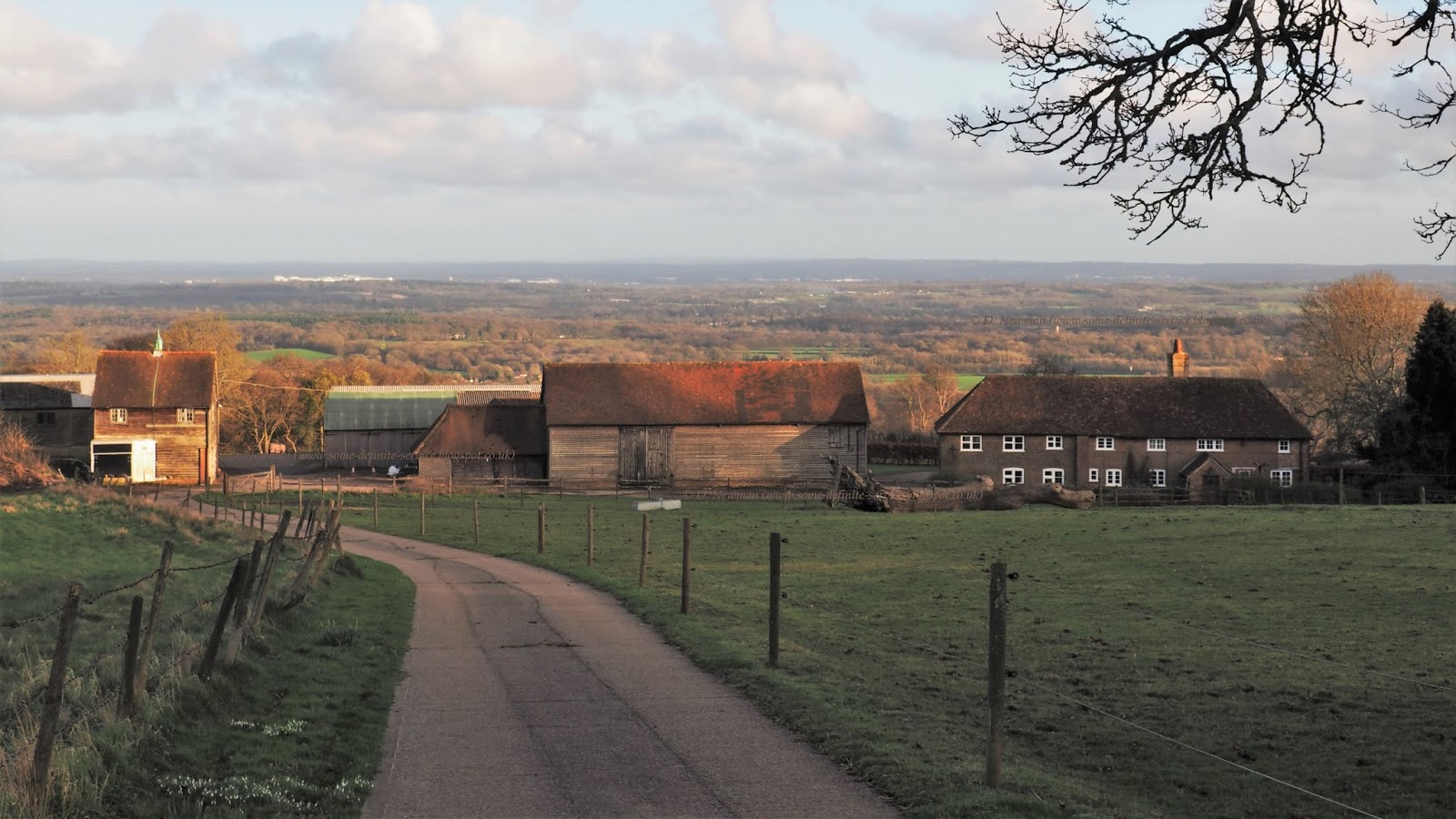
Approaching the top of Leith Hill from the east, as I did once again with an old friend the other Saturday, there is always a curious, pleasant sensation of having come round the back by a secret way. We had met almost nobody among the hollows and meadows of the Hill’s lower slopes, so to find the summit quite busy — converged on by other visitors along more orthodox routes, and with the invariable cluster for refreshments around the National Trust servery at the foot of the Gothic tower — made us feel as if we had sneaked up by unknown paths across undiscovered country.
I doubt that any hill exists that is not worth climbing, but Leith Hill, the crown of Surrey, is one I particularly know and treasure. Its summit on the Greensand Ridge is the highest point in south-east England (some say second-highest, defining south-east England differently — but I know where my loyalties lie!) and, looking northwards on a clear day, it is possible to see right over the top of the North Downs and Box Hill, themselves six miles distant, and to make out the wide grey clutter of London on the horizon. To the south, the generous quilted Wealden country spreads all the way to the South Downs — and sometimes, through the Shoreham Gap, there can even be glimpsed a hazy glimmer of sea. This is a good place to come for a bit of perspective on things.
Looking southwards from the top of Leith Hill Tower, 8th February 2020.
We have the eighteenth-century landowner, Richard Hull, to thank for the existence of the tower, which of course we paid our £3 to climb. He had it built partly for an even better view over the counties below, and partly out of a fundamental dissatisfaction with the hill’s geomorphology. That the natural summit stood 965 feet above sea level was for Hull ranklingly, frustratingly short of a thousand. By the addition of the tower, he determined, the magic figure could be reached and surpassed. (Did ever Enlightenment rationalism lead so directly to Romantic folly — never mind the building of an actual romantic folly?) The modern displays in the tower’s first-floor chamber tell of later episodes in the tower’s history: the rowdy eighteenth-century fairs, or the longevity of Mrs Skilton (for over thirty years proprietrix of the tea-servery and ‘highest lady in the county’). They tell of the near-collision of a passenger plane in 1948, averted by only thirty feet. It was impossible not to notice, either, a photograph of a firework display held in 1993 to celebrate the entry of the United Kingdom to the European Union in its then-new formation. (The week before our walk, Britain had formally reversed this very event, unaccompanied by any fireworks, as far as I know: I suppose Parliament has already given us our fill of pyrotechnics over the past few years…)
What do I see, looking down from the top of Leith Hill? Almost unmitigated England in all directions, ancient with ghosts, curious with old tales, tender with things remembered. It is known country I am looking down on, though I will never learn all there is to know about it: mile upon mile of palimpsest, all overlain by associations, details, particularities of the ages: Stane Street, the Roman road that we had crossed on the way from the station; the Iron Age hill fort of Anstiebury that we were to skirt on the way back — everyone from Richard Hull and Mrs Skilton and the fairgoers all the way down to ourselves and our fellow visitors this February Saturday. I think of others who have loved this landscape: the poet George Meredith, he of the Mole Valley under Box Hill, and the composer Ralph Vaughan Williams, whose famous tone poem ‘The Lark Ascending’ took its name from one of Meredith’s poems. Vaughan Williams’ childhood home, Leith Hill Place, lies hard under Leith Hill’s southern slopes.
To put it more simply, from the top of Leith Hill I am looking at home. Home not by title or deed, but by a character and spirit that dwells under my skin and in my soul. Landscapes, like houses or streets, are sanctified by being lived in and loved: of the landscape below me I can say that I am at home when I walk in it, when I look on it and even when I think of it. It is home, too, because, in its semi-sacramental beauty, it seems to stand for a certain ideal of the whole of England; to love this landscape is somehow to love the whole. So today I, up here on the Hill, largely lifted away from England’s sorrow and sin, seeing it resolved into its proper image, into a sunlit heirloom on a crisp midwinter day, do not find it hard to love. I remember that in fact it is very dear to me indeed.
Looking slightly south-eastwards from the slopes of Leith Hill near Coldharbour. Gatwick Airport in the distance.
Love of home is for me as old as thought. It is mostly a gentle thing, but it is also deep and dogged and immovable. These days it is the fashion to scorn such sentiments, perhaps because of the extremes to which versions of it have been taken in the past. But fashion, for all its force, holds little sway at the top of Leith Hill. Up here, I can say boldly that I am blessed by the home we have been given to live in. I can say that it is a good and natural thing to be grateful for that home, and that it is right and just to regard it as an inheritance, which, however indirectly, we must preserve for those who come after us. Love of home need not, should not be jealous or selfish. There is no reason why it should ever be either, not least since when it is authentic it is often actually accompanied by an urge to share it with others. Nor is it necessarily a false idol: love of England may go very deep without overbalancing into outright worship — though I can sense the fierce flame to which some threat or peril could fan this instinct.
For look: it is indeed in peril. Not this time by outright war or foreign conquest, but by something less tangible and more insidious, though similarly potent with worldly might. The homely England I have praised may seem from up here to stretch out timelessly and unendingly, but it is always being threatened and encroached on by another England: that bland, bloated, blemishing England of which Betjeman warned, and Orwell, and Priestley, and Vaughan Williams himself in his later music. I mean the England of the M23 corridor, just visible in the south-east, all motels and warehouses and commuters’ flats and dual carriageways and business parks. I mean the pale angular mass of Gatwick Airport (even as I acknowledge the poetry in that airliner drifting dreamily up away from it — bound for Orlando, as my friend informs me). I mean the scarring noise of traffic from which I have had to travel so far to escape, and the permeating threat of mass development (‘No to 480 homes here,’ a banner near the station had pleaded). And look, now you can scarcely see, as you could before, the dome of St Paul’s Cathedral, drowned by its boasting and secular skyline. It is not change in itself that dismays me, but change made blindly, seemingly for its own sake, or for merely economic or pragmatic reasons, on a brutishly massive scale, approved by Larkin’s ‘bespectacled grins’, by immense, distant forces that neither see nor care what they destroy.
Yet… Leith Hill is a good place for some perspective. Here it remains, serene above the strife of the world, lifted up from the hurly-burly and the madding crowd. Now I see how remarkably persistent, how surprisingly tough, is the softness of this south country. Here all those colours — the green meadows, the blue shadows, that Wealden amethyst, the flood of gold from the low sun — do not merely survive, but triumph, quietly as they may, and, it seems, might well till Doomsday. For this reason I resolve to remember this part of England when in exile in surroundings quite unlike it — to think of the sun shining down unperturbed, and to give thanks with a grateful heart.
The 0927 to Horsham draws into Ockley station, 14 May 2018.
The new timetable that descended on most of the railways of south-eastern England in late May has, alas, been in the headlines more or less ever since, not really because of any fault in the plan itself, but mainly because one of the largest railway companies involved arrived at D-day without having trained enough drivers for the new regime. So no sooner had the bright new age dawned than it disintegrated impressively into a cascade of chaos which has only gradually been stemmed.
Of course any railway timetable, which must count among man’s most audacious attempts to impose order on this universe of turmoil, can always be scuppered by the slightest hitch. Even at the theoretical stage, the task of designing one is tremendously complicated, especially in Britain, whose network is still among the densest in the world. The idea of imposing upon the tangle of lines and chords and junctions a pattern of regular and reasonably frequent movement, in which no train ever conflicts with another, is enough to turn a grown man weak at the knees. For, notwithstanding the brilliance and solidity of Victorian engineering and workmanship, a tangle really is what they are. Our railways were never built to a central coherent plan, but by a multiplicity of companies all after slices of a multiplicity of pies, and willing to create any number of awkward layouts to that end.
And then there is the catalogue of practical difficulties that reality itself will let loose upon the timetable the moment it is implemented. On the one hand is the formidable traffic to be handled: in volumes far higher than a hundred and fifty years ago, covering greater distances, and with different flows and peaks. And on the other hand are, in no particular order, damage to the permanent way, damage to rolling stock, signal failures, track circuit failures, floods, subsidence, frozen points in winter, buckled rails in summer, debris on the line, vandals on the line, leaves on the line and the wrong kind of snow (for all that the press scoffs at these last two, they are both genuine problems), lorries bashing bridges, guards left on platforms, missing drivers… And what chaos these cannot cause may be provided in abundance, as it turns out, by the directors’ board of the railway company itself.
So the timetable planners are noble souls, going forth to solve a giant puzzle to which the Victorians, who set it, never guaranteed an answer. The railway map spreads out like a chess-board and the trains like pieces, with their differing routes and differing calling patterns. All-stations stoppers, outer suburban semi-fasts and inter-city expresses must all move harmoniously and regularly. Thus a timetable becomes a daring sustained utterance of ideal order against all the forces of chaos ranged against it. It is both a meticulous work of arithmetic and a courageous act of faith. Dare I even call the planners poets? After all, as the character Syme explains in this passage I have seen quoted from G. K. Chesterton’s The Man who was Thursday (a novel which I must get round to reading):
Chaos is dull; because in chaos the train might indeed go anywhere, to Baker Street or to Baghdad. But man is a magician, and his whole magic is in this, that he does say Victoria, and lo! it is Victoria. No, take your books of mere poetry and prose; let me read a time table, with tears of pride. Take your Byron, who commemorates the defeats of man; give me Bradshaw, who commemorates his victories. Give me Bradshaw, I say!
The nearest equivalent to Bradshaw’s famous volume is now a 41-megabyte download from the Network Rail website, though limited editions of the print version are still published. Some might expect such a tome to be resoundingly dull. But I wonder whether a majority of passengers would be with Chesterton: the idea that ‘chaos is dull’ must resonate with many who have endured long waits and dwindling hopes these past few months. Even in ordinary circumstances, any working regular timetable often masks a great deal of complexity. Perhaps we should marvel not at the scale of disruption that sometimes occurs, but that any timetable should ever have reasonable success. For instance, to a passenger it might seem the natural order of things that trains from a given station should depart in a given direction at the same number of minutes past each hour throughout the day — 0812, 0912, 1012 and so on — according to a ‘clock-face’ timetable. But this is more difficult to achieve than it might seem. Enough time must be left at each terminus to turn around to recover from any delays, for instance. Also, the circumstances behind the scenes are not the same throughout the day: everything must be in the right place in the morning, and be left in the right place at night, and the preparations to be made on the eve of Sunday are different from those for the eve of Monday. The timetable also has to shoulder the burden of rush-hour, in its two opposite directions, at each end of the day. So no wonder the order is not quite universal.
Yet once the timetablers have suppressed most of the chaos, I find I am quite fond of any quirks that are left, providing I am not actually caught out by them. The old timetable had quite a few variations that were interesting to those of us to whom, I suppose, these things are interesting. Some were adjustments made to cope with rush-hour traffic; others were stop-gaps to ease miscalculations in the timetable itself. Still others were Parliamentary trains, one of the token services run perhaps once a day or once a week to prove to the satisfaction of the law, but of very few passengers, that a line or station is still open for business, and thereby to avoid the palaver of applying to close it (There are enough of these to justify the compilation of this list of Passenger Services over Unusual Lines; see also my write-up of an adventure to Shippea Hill, the station that is hardly a station by a hill that is hardly a hill). Other quirks seemed to exist for reasons no longer discernible, lost in the mists of time, for traditions last long on the railways. The new regime’s planners, though, have striven to simplify things, adjusting irregularities and ironing out the oddities of the old order, and their achievement is impressive. But some of the old timings will not pass unmourned; at least, not by those of us who mourn these things.
One quirk that we have lost involved the line that runs southwards from Dorking in Surrey to Horsham in West Sussex, an odd stretch of railway, because, although it was built as a double-track main line (and retains a line speed of 75mph), it is rather a backwater. Perhaps it is because it does not aim squarely at a terminus as it nears London, but appears to dissolve into the various intertwining strands and loops in the suburbs. These are now too congested with local traffic to accommodate many non-stop trains, and there are no facilities left for fast trains to overtake slow. The map below shows how the route becomes ensnared in the confusion of South London. Gone are the days when coastal expresses ran this way to and from London: the fastest trains from Horsham to Victoria now use the route to the east via Gatwick and East Croydon. Holmwood, Ockley and Warnham, the three euphonically-named intermediate stations on the stretch between Horsham and Dorking, have only an hourly service in each direction, and all trains stop at all stations. My complaint is not of dullness, as we have established! — rather, the disappointment lies in the failure to exploit railway infrastructure to the full. What is a main line for, if you do not send trains down it at top speed?
A tangle really is what they are. (Click to enlarge; the Dorking-Horsham line is in the lower left-hand corner)
Yet under the old timetable the line was allowed, once a weekday, to reclaim its former glory. For the unassuming 0756 from London Victoria, having extricated itself from the tangle of South London lines and trundled unhurriedly through outer suburbia in accordance with its designation as secondary passenger service 2E12, was transformed, on its arrival at Dorking just before nine, into the Horsham Flyer, the Wealdman, the Sussexpress, unique in being timetabled to run fast from Dorking to Horsham, non-stop through Holmwood, Ockley and Warnham. It was not quite clear for whose benefit this dash was made, away from London in the morning peak and rather on the late side for rush hour anyway. Most likely not for the passengers’: it may well have been for operational ease, to avoid the need for guards who were still needed to oversee stops on this line, or perhaps simply to reach Horsham in time to form an ordinary stopping service back.
Still, it was there to be travelled on by any passengers who wanted it. It also produced a fluke in the ticketing system. For those approaching from the north and wanting Ockley or Warnham stations at that time in the morning, it was quicker to take this train to Horsham, be carried straight past the desired station, and then double back with the returning London service, than to wait for the next direct ‘down’ train — and, just this once per day, an easement made this doubling-back perfectly valid on ordinary tickets to these stations. What more remained for me to do, then, than to concoct some pressing need to arrive at Ockley station at 9.20 in the morning, before the arrival of the direct train seven minutes later, and thus give myself an excuse to try it out?
For months after I discovered it, this drifted around pleasantly in my thoughts as a nice idea to do some day, along with the knowledge that Leith Hill, the highest point in south-east England, stands nearby. But the advent of an all-standardising, quirk-free new timetable, under which I found this oddity was to be abolished, concentrated my mind. Yes, definite action was suddenly necessary: there was now a deadline before which a walk from Ockley station to Holmwood station via Leith Hill was absolutely required to take place. And might 9.27 a.m. not be a little on the late side to set off on this walk? Indeed, would not a slightly earlier time, such as 9.20, be more or less perfect?
So on the fourteenth of May, in the last week of the old timetable, I too had cause to extricate myself from South London so that I could number myself among the last beneficiaries of the the Unmitigated England Express. It was a still-golden morning flooded with still-welcome sunshine, long before drought was to drain England of all her colour. All down the line the train had been emptying, and there were only a handful of us left aboard as we drew unostentatiously out of Dorking, round the corner and into Betchworth tunnel. Through the darkness we accelerated, bursting out into unsuburbanised Surrey, past trees aflash with fresh May foliage, past stiff haughty pines, past the working farms and all that space in the fields beyond. And continued to accelerate, leaving behind us the chalk cliffs of the North Downs, and bringing the shadowier evergreen of the Greensand Ridge, with its culmination in the summit of Leith Hill, into view on the right. Straight through Holmwood, the ride becoming a bit rough, and gaining speed until at least Ockley, after which a stretch of jointed track lay in wait with its ambush of nostalgia. (To run over jointed track at 75mph is to recall old England to life). Warnham, warm in the sun, with one lone gentleman on the platform, was gone as soon as it was glimpsed. The distance to Horsham, 13 miles and 30 chains, was covered in just over fifteen minutes — an average speed of about 53mph. Not bad, it must be said, for suburban stock designed to pootle around South London all day.
At Horsham I stepped nonchalantly onto the platform and then just as nonchalantly boarded again, and presently the train set off back towards London again, possibly with its own air of nonchalance. No high speeds but business as usual between there and Ockley, where I alighted. I noted not without smugness that I had indeed arrived a crucial three minutes earlier than the next down train, and therefore that the detour via Horsham and the Unmitigated England Express had been entirely and unquestionably worth the effort. The nearby A24 made its presence felt, but I lingered for a while to admire the handsome station building, before then setting off on my walk.
The time I had gained by doubling back via Horsham was immediately wasted faffing around in a half-field-half-scrapyard beside the dual carriageway where nature had been allowed or possibly encouraged to obfuscate the footpath. So it was the long way round that I came to Capel village (here, as so often with British railways, the station is not named after the nearest significant settlement), and rested in the parish church.
St John the Baptist’s Church, Capel, Surrey.
Setting off westwards from the village I found myself in that sort of England which, not unlike a railway timetable, impossibly survives and even thrives in spite of all that threatens it. The atmosphere was encroached upon but not shattered by the intrusions of the A24 and A29, nor by the procession of aeroplanes in the bright south descending towards Gatwick. I met someone only once (a man building a roof in the blazing sun) and lost my way only twice (a GPS reader would have saved me a lot of trouble and spoilt all the fun) in the five or six miles before I reached Leith Hill Place, where stands the childhood home of Ralph Vaughan Williams.
Leith Hill Place
Leith Hill itself is understandably well-known and even on a weekday there were plenty of people at the top. From its summit on a clear day London can be seen to the north, and the sea glimpsed through Shoreham Gap in the south. The enjoyable story of the tower at the top is that it was built (or had built!) in 1765 by Richard Hull, an earlier resident of Leith Hill Place, in order to bring the hill, whose natural summit is 965 feet high, to an elevation of a thousand feet. The tower is looked after by only the fourth keeper since the mid-nineteenth-century, who sells elderflower lemonade from a hatch in the ground floor of the tower. There are other refreshments for sale as well, but it is the elderflower lemonade I remember.
Leith Hill Place from just below the summit of Leith Hill. The Weald and South Downs in the distance.
Then down from the summit via Coldharbour village (whose apparently incongruous name probably comes from the French col d’arbour, a wooded hill), back to Holmwood for the London train, and home. It was almost as if the main point of the exercise had not been to justify the exploitation of an obscure piece of railway operation for the sake of curiosity.
This is something else that railways do. Their rules and patterns and occasional oddities add spice to the whole idea of planning a jaunt like this, and turn the whole country into a kind of puzzle or board game, though not always in a frivolous way. Roads have no timetables, so they have no timetable quirks. I am sure my trip was more enjoyable for all that meticulously-planned messing about in trains.