Showing posts with label railways. Show all posts

Wednesday, December 24, 2025

Shippea Hill: in pride of second place

It’s that time of year again!  The Office of Rail and Road has released its annual statistics of passenger numbers per railway station, and as usual I have headed immediately for the lower extremities of the league table with one particular, cherished name in mind.  How had everyone’s favourite bleak fenland outpost done: Shippea Hill, with its tenuous service to an almost totally uninhabited tract of Cambridgeshire farmland?

Second to last!  With 76 passengers, and in 2,585th place, Shippea Hill is this year’s second-least-used station, after Elton and Orton in Nottinghamshire with 68.  Shippea Hill is mentioned in the press release as one of the five most-neglected stations, but it should still attract less limelight than it did ten or so years ago, when, with 22 recorded passengers in 2014/15 and only 12 in 2015/16, it earned the crown of Britain’s most-non-used station two years running.  Alas, or perhaps fortunately, this made it a non-victim of its own non-success: the hordes (relatively speaking) of passengers who then descended on the station with the express aim of trying to boost its statistics (for there could be no other reason to do so) successfully knocked it off the top, or bottom spot, which it has been denied ever since by the likes of Stanlow and Thornton or Redcar British Steel.  This subtle competition does not escape the attention of the Office of Rail and Road, which acknowledges that ‘in previous years, usage at some of the least used stations presented as part of these statistics has increased the following year.  We understand that highlighting the least used stations within these statistics can encourage people to visit them.’

Well, that’s me rumbled.  I have written elsewhere at lengths which I concede must seem extraordinary to any reasonable person about this station with its oft-changed, perennially debatable name and the vague extremity of the Cambridgeshire-Suffolk border that it serves, essentially featureless as it is but for a few million root vegetables and a half-dozen-strong assortment of Portakabins.  Even the ‘hill’ in question meets the relevant criteria solely by virtue of rising to not quite below sea level, in contrast to the land around it — and in the absence of any other prominent feature or settlement whatsoever, ‘Shippea Hill’ is at least more helpful than the station’s former name of ‘Mildenhall Road’, as Mildenhall itself is fourteen miles away.

After all these years, the service at Shippea Hill still remains comically impractical: one weekday morning train towards Norwich at 0726 on Mondays to Fridays, but when it comes to getting back again, nothing.  Only on Saturdays does the 0747 to Norwich have a corresponding return journey (arriving at Shippea Hill at 1615).  There is nothing on Sundays.  There remains no direct service to the neighbouring station of Lakenheath, which, perversely, is served only at weekends and enjoys a lavish Sunday service.

Second-to-last is, I think, the place that suits Shippea Hill the best.  For this is actually the most obscure position: almost as unused as the actual least-used station, but also far less talked about — just avoiding the glare of publicity which would be fatal to its status.  And Shippea Hill by nature shuns celebrity, resisting by its wind-bitten austerity, its sheer remoteness, and the obtuse blankness of the surrounding fenland, as many attempts on conquest as it possibly can.  Of course, penultimate place is also a dangerous position, where its cost-benefit-analysis-scorning situation can be circled in the red pen of some Director of Finance.  But should such threats ever loom, legions (again, relatively speaking) of Shippea Hill revivalists would, I am sure, rally to the cause.  Long may this bare patch of Fenland revel in its almost entirely unusable service — a level of provision as bleak and inhospitable as the landscape that surrounds it — and congratulations to the 70 who made it there this year!

Saturday, August 31, 2024

The Sudden Straight Face

It is strange that one of the saddest songs in the English language should have been written by two comedians.  Michael Flanders and Donald Swann are still best known for their light comic and satirical pieces — ‘The Hippopotamus’, ‘The Gnu’ or ‘The Gas-Man Cometh’ — but when they turned their satirical eye to the Beeching Axe, the mass closure from 1963 of about a third of the British passenger railway network, they produced, in ‘The Slow Train’, for many people the definitive lament for these mostly rural branch lines, and for the way of life that was lost with them.


The song bears all the Flanders and Swann hallmarks — the deft word-play, the affectionate satire, the sense of the ludicrous — but the mood is utterly different from usual.  Seing the damage that Beeching was doing, suddenly they were serious — and indeed, in the live recording, made sixty years ago when it was all actually happening, there is, apart from a few appreciative titters at a pun or a station name, no laughter at all, only rapt silence.

This complete change of key seems to me utterly audacious.  The audience had paid for comedy, after all, yet here suddenly was tragedy, an entirely sincere farewell to a familiar feature of the national landscape, to a distinctive characteristic of our society, destroyed by human folly, with only the word-play providing the thinnest veil of wit.  Audacious, but thoroughly effective: first we are puzzled that we can’t find anything to laugh at, disconcerted to think that we might have missed a joke.  Then the inverse feeling: surprise, in the pit of the stomach, as we realise that we really are being addressed seriously.  There is a sense of having had a narrow escape, as if one has nearly walked giggling into a full and silent church.   (They’re being serious, and we thought it was going to be a joke!).  

And yet it is still satire, for Flanders and Swann had noticed, along with others since, the totally inadvertent poetry of Section 1 Part 3 of Dr. Beeching’s report, the ‘List of Passenger Stations and Halts to be Closed’ (in England, though the destruction in Wales and Scotland was just as wanton).  Buried deep behind the oily bureaucratic euphemism of the report’s title, ‘The Reshaping of British Railways’, is a list that has been called some of the most moving poetry in the language — or are ‘like names on a war memorial’, as the satirist Ian Hislop has said:
Abbey Town
Acrow Halt 
Acton Central 
Addingham 
Adlestrop 
Ainsdale 
Airmyn 
Aldeburgh 
Aldermaston 
Aldridge 
Alford Town (Lincs.) 
Alfreton and South Normanton 
Alresford (Hants.) 
Alrewas 
Altofts and Whitwood 
Alton Towers 
Ambergate 
Andover Town 
Apperley Bridge 
Of course, it is bleakly amusing that those unable to perceive the true value of railways, their marriage of elegance and efficiency, had by their very tin ear betrayed themselves in accidentally producing such moving poetry — fifth on the list is Adlestrop itself! — and Flanders and Swann, simply by transforming it into a serious song, throw this irony into definition.  They are punning away as usual, ‘The sleepers sleep…’ but the music itself has all the pathos of a folk-song.

The British passenger railway network, 1963 (left) and 1984 (right)
The Sudden Straight Face had another strategic advantage in that particular era, and that was the strength it lent to anyone making a point that was easily mocked.  This was the age of the satire boom, satire far more biting than Michael Flanders’. Then, as now, mockery was one of the vandalisers’ chief weapons; anyone who objected to the sweeping away of old things was opening themselves up to a round of scoffing (“Backward!  Nostalgist!  Move with the times!”).  But by proving that they could make an audience laugh, and indeed by laughing at themselves, they could build up a kind of credit with their wit, to be expended in an outbreak of earnestness like ‘The Slow Train’.

The person who knew this as well as Flanders and Swann was, of course, the poet John Betjeman — the man who in some ways ought to have written ‘The Slow Train’.  (In fact, my friend Maolsheachlann justifiably said he was ‘flabbergasted’ I hadn’t mentioned it when I wrote a few years ago about Betjeman’s poem ‘Dilton Marsh Halt’).  Reading A. N. Wilson’s biography of Betjeman reminded me of the occasion in 2018 when I had passed through the Halt, a tiny station of two short platforms on the outskirts of Warminster in Wiltshire.  At the time I wrote that Betjeman’s poem seemed to capture a paradoxical seam that runs through all of his work: irrepressible humour on the one hand hand, and sincere, vulnerable sorrow on the other.  It applied to his life as well: Wilson paints a picture of a man distraught at the ruination of England, acutely conscious of his personal flaws and ‘afraid of being found out’, who nevertheless craved merriment and silliness, and would gleefully assign nicknames to his friends, or throw his table-napkin over his face and howl with glee.  

John Betjeman and Flanders and Swann knew that they were operating in a culture of heavy cynicism.  Sincerity alone, from a standing start, was no good: this was precisely the age in which anyone speaking in defence of old things or high ideals would bring clanging mockery down around his ears.  But the Sudden Straight Face was their secret weapon.  First Betjeman poked fun at this tiny station, answering his own rhetorical question, “Was it worth keeping the Halt open?”…
“…Yes, we said, for in summer the anglers use it,
Two and sometimes three
Will bring their catches of rods and poles and perches
To Westbury, home for tea.”
As many as three passengers for a mile’s journey!  Clearly a vital transport interchange, we chuckle; good old Betjeman, silly old England.  But then in the final stanza comes this outburst: 
And when all the horrible roads are finally done for,
And there’s no more petrol left in the world to burn,
Here to the Halt from Salisbury and from Bristol
Steam trains will return.
Betjeman’s work derives much of its poetic power from this contrast between the gleefully satirical and the ingenuous — in some circles embarrassing — earnestness.  The man is a great jester, as Wilson’s biography shows, but there are some things in this world so serious that they snuff out even the jester’s laughter.  This is why that plangent ‘horrible roads’ and the prophecy of the return of steam, a ripe, irresistible invitation for Sixties mockery, nevertheless withstands that mockery.  The Sixties Modernists stand primed to scoff at anyone avowing a sentimental attachment to this unprofitable station, but the poet has got there first — he has already laughed gently at its ridership of ‘two and sometimes three’ passengers, and has laughed at himself for loving it.  So the love, which is serious, has now been fired by clay; by pre-empting the jeers the poet has hardened his work to withstand and outlast hostility.

I think Betjeman employs this manoeuvre to greatest effect in his poem ‘St. Saviour’s, Aberdeen Park, Highbury, London, N’ (such a Betjemanian touch to give the postal district!).  Here he begins by relating a typical Betjeman church visit, beautifully written as always, but with a hint of self-deprecation of his own style:
With oh such peculiar branching and overreaching of wire
Trolley-bus standards pick their threads from the London sky
Diminishing up the perspective, Highbury-bound retire
Threads and buses and standards with plane trees volleying by
And, more peculiar still, that ever-increasing spire
Bulges over the housetops, polychromatic and high.

Stop the trolley-bus, stop! And here, where the roads unite
Of weariest worn-out London — no cigarettes, no beer,
No repairs undertaken, nothing in stock — alight;
But then the tone changes, and the poem more becomes earnest, and highly personal:
These were the streets they knew; and I, by descent, belong
To these tall neglected houses divided into flats.
Only the church remains, where carriages used to throng
And my mother stepped out in flounces and my father stepped out in spats
To shadowy stained-glass matins or gas-lit evensong
And back in a country quiet with doffing of chimney hats.
Still there is the typical Betjeman detail, the evocation of details of the vanished past.  But now he has made himself vulnerable by writing of his parents, of the deeper, more personal connection that he has to this church.  And then he goes further.  The church is not merely an architectural curiosity, nor even a relic of family history or of a bygone age, but the House of God in which Betjeman is no passing visitor but an invited guest:
Wonder beyond Time’s wonders, that Bread so white and small
Veiled in golden curtains, too mighty for men to see,
Is the Power that sends the shadows up this polychrome wall,
Is God who created the present, the chain-smoking millions and me;
Beyond the throb of the engines is the throbbing heart of all —
Christ, at this Highbury altar, I offer myself to Thee.
So it is that the Sudden Straight Face allows Betjeman to do what I believe he generally struggled with, to write straightforwardly about his faith, in perhaps the most confident proclamation of faith he ever made (and it is nice to think that some of these lines were chosen to accompany his statue at London St. Pancras station in 2007).  By the protective layer of his self-deprecation he pre-empts any mockery or satire of these most personal things, his memories of his parents and his vulnerable faith.  Thus he shows how, even in an age of cynicism, sincerity, once whetted to a blade, cuts cleanly through cynical clinker with a strange and unequalled power.

And we, the audience, cannot deny the sincerity even to ourselves; it is almost as infectious as laughter.  By our uproarious laughter of a moment ago we have proven to each other that we have hearts — at least it has with this open, wholehearted humour of Betjeman and Michael Flanders, as opposed to the sniggering of modern comics.   If we have hearts, we have no need to pretend to be unmoved by sorrow and loss.  So it is, first by laughter and then by sighs, that we find companionship in each other.

More on ‘St. Saviour’s, Aberdeen Park’  from the Rev. Malcolm Guite.

Monday, November 20, 2023

Ticket Offices Saved

Wadhurst station in the Sussex Weald, 27th November 2021.

At long last, some good news for the railways — the proposals to close virtually every railway ticket office in England have now been completely scrapped.  A quarter of a million responses were made to the consultation: a huge public outcry, and a justified one.

One of the railway’s greatest strengths is, or ought to be, its ability to look after passengers and to give them confidence in travelling.  This is something the roads, in the grip as they are of Darwinian principles, cannot do.  The steady withdrawal of personnel from platforms and trains and bureaux undermines this great advantage, to say nothing of discriminating against those who are unable to use the grinning machines installed their place.

As my friend Maolsheachlann says, “People power works!  Let’s not forget it!”

Thursday, August 31, 2023

Ticket office closures: deadline imminent

Ely station, where the staff pride themselves on making their own announcements for the trains, rather than relying on an automated system.  20th May, 2014.

A reminder that tomorrow, September 1st, is the deadline for submissions to the consultation on the proposed closure of virtually every ticket office in England.  If any readers feel even a tenth as strongly as I do that this should not happen, I urge you to fill in the consultation here: https://www.transportfocus.org.uk/ticket-office-consultation/.

I wrote about my own objections in this post, but they are put far more eloquently by my Irish friend Maolsheachlann, who comments:

I have delayed reading this post until now because the subject upsets me so much. There’s always an assumption, or at least a hope, in the back of my mind that there will be SOME end to the dehumanization of daily life. Then something like this happens, or is threatened to happen, and makes me think “no worst, there is none”.

The fact that there is a terrible outcry gives me SOME hope, but it also makes me wonder are the powers that be just behaving strategically, Propose something much worse than they have in mind, and people will feel gratified when it’s modified.

A similar situation occurred in Ireland recently when Allied Irish Banks announced they would be withdrawing cash services from many of their branches. They stepped back from this after a public outcry, but are they always just softening us up?

For once, I strongly agree with the Guardian. Indeed, this is a subject on which right and left can unite.

https://www.independent.ie/irish-news/aib-climbs-down-over-plans-to-remove-cash-services-from-70-branches-due-to-public-unease/41859301.html

I use the various apps to navigate public transport here, and although it’s better to have them than not, I find them extremely stressful and confusing, especially under pressure. A human face with expertise is so much more welcome.

This is happening everywhere. Cinemas are closing box offices and selling tickets at the popcorn stand. Post offices are shutting down. Banks are shunting everybody to the website. In my own university, the library is getting more and more queries for the whole campus because we are one of the few human points of contact.

I hope to God they reconsider and scrap this plan completely. 

He adds,

Once, when I was riding the train through England, I got off at the wrong station for my connecting journey. I remember feeling very panicked and upset, because I didn’t have much money and I couldn’t afford to buy another ticket. The station master was a big fat man with a red face and a gentle voice. He reassured me and printed me off a ticket for another train.

It was actually a lovely moment. The station was very quiet, it was just me and the station master. It was a warm summer’s day. If all I’d been left with was a smartphone, I would have been clean out of luck. And we all know that these other staff supposedly patrolling the station floor are only a bait; they will be gone very soon, if they materialize at all, and the process will be fully automated.

Tuesday, July 25, 2023

Ticket office closures — Beeching all over again

My friend M. down at the station thinks this has been in the offing for years, “We’re closing,” he said in a resigned way when the news first came out, though he has since become more defiant.  His impression was that the Government is moving to implement a long-held ambition (and it does seem to be the Government, the Department for Transport, which wants this change, rather than the railway companies).

And the scale of the proposed cuts is breath-taking: they want to leave only a handful of ticket offices in the larger stations.  It is Beeching all over again.  Only 12% of tickets are sold by ticket clerks, goes the claim, and so at my local station and thousands of others ‘it is proposed that all ticket office windows […] will close, with staff moving to other areas of the station, where there is customer demand’.  

This slippery language makes my blood boil.  Customer demand is directed precisely to the ticket office, the accepted place for buying tickets and obtaining information.  This is decline, but worse than decline; decline with a smirk on its face, the brazen cheek to speak of a ‘change’ to the ticket office when what is intended is its outright elimination.  So might Henry VIII have spoken of his ‘change’ to the monasteries, or Brutus of his ‘change’ to Caesar’s abdomen.  

The difficulties of financing the railways are not trivial.  Passenger numbers are currently somewhere between 94–100% of pre-pandemic figures, but, because the recovery has been stronger in cheaper off-peak leisure travel than in the traditional backbone of passenger railways’ finances, namely commuter traffic, overall revenue is not.  Even so, the answer is surely to grow that revenue, not, as here, to cut off streams of revenue merely because they seem to be less efficient.

But a broader point is to be made beyond the merely financial.  One of the great strengths of the railways is that they are able to say to the passenger, ‘We can look after you’.  The network is complicated; ticketing as presently arranged is confusing; plenty of people lack confidence in travelling.  The ticket clerk can offer passengers something intangible yet incredibly valuable — peace of mind.  And this extends to the atmosphere of the station — the sense of emptiness and alienation resulting from the decline, in recent decades and across all sorts of public realms, of staff ‘keeping a general eye on things’ should already have taught us this lesson.

The 0927 to Horsham draws into Ockley station in Surrey, 14th May 2018.

This development is poor reward for the sterling work M. and his colleagues have done over the years.  He told me yesterday that he isn’t interested in standing about in the wind and the rain; it isn’t worth risking his health and he will probably give up if the plans go ahead.  Another friendly face lost, and we will all be the poorer for it.

What does give me a degree of hope is that the response to the consultation — which which can be answered here until Friday 1st September  — seems to have been pretty robust.  Let’s hope it is enough to persuade the Department for Transport to change its mind.  Here is my own response:

Dear Sir / Madam,

I am writing in answer to the consultation on the proposed general closure of railway station ticket offices.  I am afraid I must express my strong opposition to these plans.  Of the many reasons for my opposition, I would like to emphasise three in particular.

The first is that this decision, if implemented, will result in discrimination against passengers unable to buy tickets via machine or online.  Not everybody owns a computer or smartphone; not everybody has Internet access; not everybody is able to use a ticket machine.  We would not withdraw assistance for disabled passengers on the grounds that only a minority uses a wheelchair; surely the same logic applies here.

The second is that the decision is simply impractical.  I cannot see how it would be easier, let alone more economical, to sell tickets in ‘other areas of the station’ as the consultation poster puts it — anywhere other than in a ticket office.  How would cash be handled?  How would tickets be printed?  How could anything work in bad weather?  Has the safety of railway staff been taken into account?  The current proposals leave the practicalities entirely unexplained.

The third reason has to do with the common good.  One tremendous advantage of the railways is that they can undertake to look after their passengers, including those less confident in travelling.  The railway can say, ‘We can look after you.’  The reassuring and knowledgeable presence of the ticket clerk, in an accepted location, is a vital part of this.  It seems unbelievable that this should be dismissed so lightly.  Removing ticket offices will make the station environment far less welcoming, lower the confidence of travellers, and ultimately harm the railway’s prospects.

I am a strong supporter of the railways and use them more or less daily both for work and leisure.  I understand that growth in revenue is an urgent priority and am sympathetic to the railways’ efforts to balance the books.  However, I am astonished and dismayed by the severity of these proposals, which risk doing deep and lasting damage.  Other measures, such as increasing ticket inspections, should be tried first (on the Sutton loop in south London, in spite of travelling more or less daily, I have had my ticket checked only once in the past two years).  Indeed, the railways should be making ticket offices more efficient by expanding the number of services they offer, such as by equipping them to sell advance fares, which are currently only available online.

I would be grateful if you would pass these points on to Govia Thameslink Railway and to urge them in the strongest terms to reconsider their plans.

Yours faithfully, &c.

Updated 26th July 2023 in the light of the extension of the consultation deadline from 26th July to 1st September. 

Friday, June 24, 2022

Finding Adlestrop

Yes.  I remember Adlestrop —
The name, because one afternoon
Of heat the express-train drew up there
Unwontedly.  It was late June.

In fact it was the twenty-fourth of June: today is the anniversary of the ‘afternoon of heat’ that inspired this much-loved poem.  On this day in 1914 Edward Thomas was aboard the London to Hereford express, climbing up over the north Cotswolds, on his way to the poets’ colony at Dymock in Gloucestershire.  It was, as he recorded in his journal —

[…] a glorious day from 4:20 am and at 10 tiers above tiers of white cloud with dirtied grey bars above the sea of slate and dull brick by Battersea Park — then at Oxford tiers of pure white with loose large masses above and gaps of dark clear blue above haymaking and elms.

Then we stopped at Adlestrop, through the willows could be heard a chain of blackbirds songs at 12:45 and one thrush and no man seen, only a hiss of engine letting off steam.

Stopping outside Campden by banks of long grass willowherb and meadowsweet, extraordinary silence between the two periods of travel — looking out on grey dry stones between metals and the shining metals and over it all the elms willows and long grass — one man clears his throat — greater than rustic silence.  No house in view.  Stop only for a minute till signal is up. 

Another stop like this outside Colwell [Colwall, just west of the Malverns?] on 27th with thrush singing on hillside above on road.

I hope I do Edward Thomas no disservice in observing that it is as much because of circumstance as the poem’s beauty in itself that this poem is so fondly and firmly remembered.  Within three months of that afternoon Britain was at war; three years later Thomas was dead, killed by a shell at Arras.  In March 1963 they came for the station as well: if you turn in your copy of Richard Beeching’s ‘The Reshaping of British Railways’ part 1, section 3, to page 109, the list for England of ‘Passenger Stations and Halts to be Closed’ — a list which reads, Ian Hislop has observed, ‘like the names on a war memorial’ — there it is, the fifth item from the top, ‘Adlestrop’, in cold dispassionate print between Addingham and Ainsdale: so callously tin-eared, so ruthlessly bureaucratic and ignorant, so bone-headedly inevitable, that there is something actually poetic and tragic about its presence on this list.

The steam hissed. Someone cleared his throat.
No one left and no one came
On the bare platform. What I saw
Was Adlestrop — only the name

And willows, willow-herb, and grass,
And meadowsweet, and haycocks dry,
No whit less still and lonely fair
Than the high cloudlets in the sky.

And for that minute a blackbird sang
Close by, and round him, mistier,
Farther and farther, all the birds
Of Oxfordshire and Gloucestershire.

Thomas recorded the event because he knew it was fleeting, one of those in-between moments that we so seldom remember to remember — but did he realise how fleeting how much of it was?  For it is not only the moment that is now lost, but the country, the world in which it was possible.  Not only ‘that minute’ but most of what was in it and around it: the locomotive, the station, the silence aboard stationary carriages; no doubt most of the birdsong too.  The Dymock colony, the whole reason for the journey — the whole set of circumstances upon which it was contingent.  The railway survives — Brunel’s ‘Cotswold line’ from Oxford to Worcester is still one of Britain’s loveliest —  but of the station, other than the stationmaster’s house, nothing is left but the sign, mounted on a bus stop in the village  — only the name.  

The poem itself seems in retrospect as fragile and precious as the moment it is describing: written just in time, in the last years when such a poem could be made, by Thomas or anyone else.  This one vignette of a single signal-check has been pressed and hardened by the tremendous historical forces around it into a tiny treasured gem, standing not only for itself, but for all those other unwonted moments of ‘extraordinary silence’ that were possible, and about which poems could have been written, in that old world before the war.  Almost by accident, then, we have this snapshot from a time, perhaps the last time, when Deep England could still make a riposte to the modern world, could conspire to bring a modern express train to a grinding halt and ambush its passengers with her shocking stillness.  Thomas’s sketch — which even in finished form retains the jotted-down freshness of his original journal entry — is now as strangely dizzying as one of those old autochrome photographs, so real we can scarcely believe it.

The site of Adlestrop station is between Kingham and Moreton-in-Marsh stations on the climb to Chipping Campden summit; the precise coordinates are 51.9360°N 1.6591°W, immediately north-west of the overbridge carrying the road from Adlestrop to Oddington.  On this cab-ride video of the journey from London Paddington to Hereford, the site can be seen just after the bridge at 1h 16m seconds.  (The former stationmaster’s house can just be glimpsed on the left).

Thomas was absolutely correct, by the way, to speak of ‘Oxfordshire and Gloucestershire’ — the county boundary crosses the railway less than a mile from the station in the up direction. (Its rough position is indicated by a caption on the cab-ride video at 1h 14m 40s; the line it takes is rather convoluted but it makes its final crossing of the railway at the end of the wall of tall trees on the right).  Thomas’s last line was as accurate as it was evocative.

What does it mean, I wonder, that at the poem’s centenary in 2014, a special train was organised to recreate the ‘unwonted stop’, slowing down at the old station so that the lines could be read over the loudspeaker?  Here is a video taken from aboard the train —

— and here is another from the overbridge itself, where the poem was also read as the train rounded the curve.

I cannot help feeling that something deep and beautiful is happening here.  These people have come to a particular place at a particular time — in other words, come on pilgrimage — for the sake of a much-loved, long-remembered poem.  Poetry often seems to be at its strongest when it works through the memory, and this poem, in touching not only our minds and hearts but the English landscape and time itself, has become a kind of memorial — one not of marble or granite, but made up of all four of those elements: minds, hearts, landscape, time.  Thus, just as the poem has come to stand for a whole vanished world, so this remembrance of the poem was a remembrance of that world.  To remember Adlestrop is to remember England.  And, even though it has been blotted out of the landscape and is no more than a memory, Adlestrop station still persists; it still somehow belongs to the English landscape, and the poem keeps it there. 

So for that minute a lost world lived again, proven still to abide in many minds and hearts; and poetry sustained it, poetry summoned it into sight.  Poetry is deeper than we know; it is as deep as England, as history, as life itself.

Sunday, May 29, 2022

The Elizabeth line: more pictures

Of course, I haven’t been able to resist some more rides on the Elizabeth line in its first week of operation.  On Friday I ventured to Liverpool Street station, whose new platforms are so long that at their western end there is a direct connection to Moorgate station.  Similarly, the eastern end of Farringdon has a connection with Barbican on the Metropolitan line.  That gives an idea of the colossal scale of this project — as do, I hope, the pictures below.  All show the Moorgate exit at Liverpool Street.


Perhaps, too, I will withdraw my previous comment about the trains feeling narrow and dull… on subsequent trips they have seemed much more spacious than I first thought.  The lighting is subtle, rather than dull.  And they are British-built (by Bombardier in Derby) too.

Wednesday, May 25, 2022

The Elizabeth Line is Open

London’s long-awaited new railway, the Elizabeth line, or Crossrail, is open at last.  Three colleagues and I could not resist going down yesterday lunchtime for a ride on its first day, and found our newest underground railway just as impressive as I had hoped.  The first impression — conveyed mainly by the ambience of the stations — is extraordinary.  They are immensely spacious — goodness knows how much earth they have brought up out of them — and the arches and vaults are of cathedralline proportions.  Their gentle contours, combined with the clever up-lighting of the arched ceilings, produce a remarkably soft, calming effect.  The acoustics, too, are soft, almost homely; neither echoing nor claustrophobic.  There were plenty of people around, but they were being absorbed effortlessly into the space.  There is a clear intelligibility and straightforwardness to the layout, and therefore to navigation.  There seems to be far less of the disorientation that one can find in the narrow corridors of the old Tube.

Farringdon station

The platforms are similarly wide and generous.  As on the Jubilee line extension (a different line for a different Jubilee!), a long row of glass doors protects waiting passengers from arriving trains —  and it is along this structure, not the ceilings or walls, that the departure boards are mounted.  This is another factor in the remarkably clean, uncluttered atmosphere — there is a clear line of sight right down the long, dead-straight platforms.

At Paddington

The class 345 trains, too, are excellent.  By comparison to the stations they feel a little narrow and less brightly-lit, and the platform barriers add to a slight sense of stepping into the unknown, but I think this was bound to be the case by comparison, and it should not take long to get used to.  Beyond question, though, they are very sleek, very fast, very smooth, and very quiet.  The line speed must be something like 40–50mph, but it would be hard to tell this either by the noise or the vibration; indeed, the ride quality is superior to that of some inter-city trains!

Farringdon

‘Space-age’ is YouTube personality Geoff Marshall’s verdict, and I think he is quite right: not only in its architecture and atmosphere, but also in the way it warps space and time.  I had expected the excitement of seeing the new line, but I did not anticipate another, deeper, sensation that came on gradually during the first journey, and which still has not fully subsided: a kind of semi-euphoric vertigo, a disbelieving wonder at the change; not just at the new infrastructure in itself but the change it has brought to London as a whole.  To see the name ‘Tottenham Court Road’ appearing through the window when I had only just got on at Farringdon seemed impossible, as if some rule of physics had been broken; it was a little like seeing water flowing uphill.  My known city has been remoulded and remade, its entire east-west dimension shrunk or tightened by an elastic belt.  Back on the surface I found myself struggling slightly to believe that it had all been real, and not some cheese-sandwich-induced lunchtime daydream.  It was a feeling exactly opposite to my disbelieving horror at the fire at Notre-Dame in Paris: a struggle to comprehend to a new reality, though in this case the change is altogether welcome.  

Farringdon

This sensation has probably been intensified by its rarity.  One way and another, I am used to bracing myself against dismay at most major events or developments in today’s Britain, including most construction projects.  Yet in contrast to so many dispiriting new developments, with their chunky and plasticky intrusions into our city-scape, this line is, as Mary Harrington points out in a new article, beyond question ‘something London wants and London needs’.  It is an unambiguous and unequivocal contribution towards our common good.  What is more, down underground, with no well-weathered or hand-made surroundings to clash with, its modernist and futuristic architecture not only makes sense but works in practice.  Here, then, for once, is something new that still corresponds to my Britain as I imagine it.  A new 50-mph underground line named after the Queen is something I myself might have dreamt of, something I would have had built if I were in charge!  Somehow, in spite of everything that has gone wrong in our poor country, we have got this right.  The air of excited discovery among the first-day passengers, our delight at the transfigured city — even the smiles, a rare sight indeed on the Underground! —  is surely testament to this.

Farringdon

The new line has summoned up the spice of excitement, the thrilling realisation that bold things really are possible; that it is possible to change a city — to change the fabric of the world! — for the better.  It is a rare taste of the Victorian age, or alternatively of what it is like to be French.  But the overall impression of sleekness and effortlessness belies how hard-won this triumph has been.  It has been a gigantic and complicated task, completed against considerable odds.  

This is a historic day for London and indeed the whole country.  The Elizabeth line may have suffered severe delays to its opening, but it has worked out all right as it now constitutes a magnificent Jubilee present for us all.  It is a superb addition to Britain’s railways, and worthy of the name it bears.

Saturday, May 14, 2022

Farewell to the 455s

Through Mitcham Eastfields on a Horsham train, 10 August 2011

This coming Saturday, 14th May, sees the withdrawal from the suburban routes of the South Central Division — the tangle of railways running out of Victoria and London Bridge into south London — of the class 455 electric multiple units that have held sway in these parts for nearly forty years.  Their siblings on the South Western lines out of Waterloo will apparently follow in the next few months.

Basking in the sun at Victoria, 28 August 2013

Few ordinary passengers are likely to mourn them.  They are not glamorous, nor were they built to be, though I think better care could still have been taken of their interiors in recent years.  They were designed for mass short-distance transport, to lug commuters around the Hills and Commons of the southern boroughs; to venture to climes no more exotic than Crystal Palace, Epsom Downs, Caterham or Dorking.  I doubt they have averaged more than around twenty miles per hour over the course of their working lives.  But they have worked solidly, clocking up thousands upon thousands of rush-hours since the early 1980s.

Rumbling across the South Circular overbridge into Tulse Hill, bound for the Wimbledon loop, 11 April 2019

I am among those who will miss them.  It was against the backdrop of these faithful workhorses, plying their way up to London or down to Dorking, their acceleration distantly, enticingly audible over the suburban rooftops, that my rail enthusiasm was first contracted and swiftly found to be incurable.  The aforementioned South Western sister-class ran right past my grandmother’s garden, and I used a 455 as my subject for the centre-piece of a school art project (because I knew I could draw trains and buildings, but not people!).  More recently — until the pandemic in fact — my train into work was reliably formed by one of these units.

A Victoria-bound semi-fast accelerating through Mitcham Eastfields, 4 January 2011

Like the slightly younger 319s (themselves a familiar sight around South London until a few years ago) and their cousins the recently-scrapped two-car 456s, the 455s were built at York by British Rail Engineering Limited, as lettering on the step-plates proudly declared.  However, in contrast to the 319s — which were more souped-up trains, designed for Luton and Gatwick routes, for people with flights to catch, always seeming cramped by the chords and spurs of suburban south London, itching for the open stretches of the Brighton or Midland main lines — the 455s seemed gentler and more sedate, more suited to the way we do things here, south of the river, in the land of the electrified third rail.  To a 455, with its seldom-attained top speed of 75 mph, it did not seem to matter if we got to Ewell East now or some time next week.  They trundled their way around, taking their time about everything.  No point rushing this curve or that junction; there’ll only be something else to brake for around the next bend.  

Through the window onto dawn-lit commuterland, 1 October 2018

Adding to the dreamy aura of these trains were the various reassuring sounds they made: the chirruping of the brakes and the soft sigh on their release, the warble-piping of the original door alarms, the clunk of the camshaft on departure, and the leisurely thrumming of the brake compressors, this last being the sound I will miss the most.  Then there were the motors, matching the register of a cello, rising from a growl from a standstill to the very top of the tenor range if given the chance to stretch their legs.  The only alarming sound was the occasional crunch of electricity arcing from the third rail. 

Arriving at Streatham Hill on the 1617 to London Bridge, the once-daily parliamentary service via the Leigham Spur and Tulse Hill, 25 April 2019

The motors themselves are worth remarking on, for they are actually recycled.  Incredible as it may sound, they are over eighty years old, and more than twice the age the trains they have been powering.  The early Eighties, when these units were built, were not an easy time for British Rail, which, struggling under persistent inadequacies in government subsidy, had constantly to make do and mend with their scarce resources.  Their solution in this case was to fit the new trains with not only second- but third-hand motors built originally by the Southern Railway for its electric units in the 1930s.  Though now into their ninth decade and effectively dating from the electrification itself, the motors still seem perfectly sound to my ear.  Whatever the reason is for the withdrawal of these trains, I doubt it has anything to do with the traction equipment.

A down train draws into Wandsworth Common, 9 December 2018

I am not the only one sad to see them go.  ‘South London is [going to] feel weird without them,’ said one contributor to the ever-perusable Rail Forums.  Another chap, a driver who also films the modern railway scene and has a presence on YouTube, told me in an exchange in the comments, ‘These were the trains I grew up on, the trains that took me on all sorts of adventures and when I passed out [i.e. qualified] as a driver became my core traction.’

Epsom train rounding the curve south of Mitcham Junction, 4 February 2022

There is always a pang to see the clearing out of the furniture of our beginnings, however ordinary these things may be.  Perhaps, in fact, the more ordinary and the more constant they have seemed, the sharper the pang.  Bit by bit, the railscape of my childhood is disappearing (the analogue signals, the bell at Eastfields level crossing, the late Phil Sayer’s voice over the speakers…), and by the end of this weekend another major part of it will have crumbled completely away.  I will certainly miss the familiar presence of these old units, with the many associations they hold for me.

A final farewell, Mitcham Common, 4 February 2022

But let us end with the nearest a 455 ever came to attaining railway glory.  Under the pre-2018 timetable, one single passenger service each weekday was booked to run non-stop down the fourteen-mile line from Dorking to Horsham, and this was generally allocated to a 455 unit.  So, just before that timetable was abolished, I took one of the last opportunities to experience this run, and filmed the journey from just beyond Betchworth Tunnel to just short of Horsham.  As I have said, 455s hardly ever had the chance of a clear non-stop flat-out run like this, and certainly in their latter years Horsham was the furthest south they ever ventured in regular service.  So it was a rare treat to see this humble suburban unit reliving the glory days of the old Bognor expresses, accelerating to the full line speed of 75 mph along probably my favourite stretch of railway in south-east England.  (We really begin to pick up speed after Holmwood, five minutes in, and after Ockley, at six minutes, there is the added bonus of some jointed track, which we hammer over at full tilt.)  The date was the 14th May, 2018 — four years to the day, as it turns out, before the final withdrawal of the class.

Thursday, June 17, 2021

Lincolnshire Towers: St. Botolph’s, Boston

Part of a series, ‘Lincolnshire Towers’.

Today, the seventeenth of June, being the feast-day of St. Botolph, I am reminded of a memorable trip I made a few years ago, one unseasonably warm February day, to one of England’s greatest parish churches: a church dedicated to him, and whose town is named after him: Botolph’s town, or Boston, in Lincolnshire.

The tower of St. Botolph’s, Boston, seen from Church Street (February, 2019).
In truth, it all began with St. Wulfram, and his church at Grantham.  A few months previously I had finally done as I had long intended, and got off the train for a proper look at it — at least, one longer than the fifteen-seconds’ vision with which it beguiles the passengers of London- or Scotland-bound expresses, soaring heart-stoppingly into view above the blurred tiles and whizzing chimneys of its parish.  After all the occasions on which this astonishing spire — briefly England’s highest, and still the fifth-tallest of all our medieval steeples — had flashed before my eyes, a visit seemed long overdue, and it did not disappoint.  But then I realised that the spire of St. Wulfram’s was not alone, and that Grantham is the gateway of a county whose sky-line is studded with great and graceful towers: as well as Boston there was Louth, and of course the great cathedral at Lincoln itself, which had been for two centuries, before the collapse of its spires in 1548, the tallest building on earth.

So northwards from London it was once again, out of King’s Cross through an unpromising, almost greenish-grey morning.  Harringay… Hatfield… Hitchin… Huntingdon… and not forgetting, after Peterborough, to ‘hail humble Helpstone’, the home parish, resting-place, and in many ways the whole world of the poet John Clare.  (Incidentally, the parish church here is also St. Botolph’s.)
‘Hail, humble Helpstone’: a glimpse of John Clare country near Peterborough.
Boston from London means changing at Grantham, so before the Skegness train came in I had a chance to admire the tower of St. Wulfram’s once again, and to wonder how St Botolph’s would compare with it.  These two Lincolnshire towers both stand on the same river, the Witham, Grantham quite near its source and Boston at its mouth, but as well as sixty miles of river, two centuries and great differences of style lie between them. [1]  Grantham’s steeple, finished in 1320, is in all the handsomeness of the Decorated style, while Boston’s — mostly in the more ornate and intricate Perpendicular — was begun much later, in around 1430, and took until at least 1500 to complete.  St. Wulfram’s had been a launch into the unknown, literally to new heights, and its masons were learning as they went, but at Boston the Gothic style was being finessed and perfected — though this is not to imply any lack of audacity or inspiration in its construction.  On the contrary, these qualities were, as we shall see, abundant.

Onto the Poacher Line, then, and the train, soon happening clatteringly onto jointed railway track, wound on into Lincolnshire, past the Roman town of Ancaster (source of much limestone for the county’s churches, as well as for the colleges of Cambridge), through Sleaford with its despondent and derelict Bass Maltings, and then out into the open Fens.  ‘Six years of a flat land,’ wrote the poet Elizabeth Jennings, who was born in Boston, where her father was Chief Medical Officer: she meant the first six years of her life, before the family moved to Oxford.  A rather laconic verdict (and, remarkably, she never returned), but it must be admitted that there is something uncompromising about the sheer flatness of these parts, something that leaves nothing much to be said.  They are as flat as that, and that is flat.

How extraordinary to glimpse on the horizon, then, amid the relentless horizontality of everything, a vertical shape: a tower aimed straight at Heaven, built in an architectural style which took as its fundamental principle precisely the emphasis, the exaltation of verticality at every opportunity.  The closer it draws, the clearer the sheer contradiction it offers to its surroundings, and the sheer scale at which it does so.  ‘It dominates the town, it dominates the landscape,’ said Betjeman. [2]  Naturally, then, it has with been known for centuries with wry affection as ‘the Stump’.
The ‘Stump’ from just south of Boston’s Grand Sluice. The scaffolding is a frustration, but does provide a measure of the tower’s height — that of a forty-floor tower-block.
The sky was still sullen as we rounded the curve into Boston, and this, combined with the warehouses and supermarkets around the station, lent weight to a first impression of the town as a place with its sleeves rolled up, unprettified and unpretentious.  Although it is a market town amid swathes of arable land, it was originally (and indeed remains) a port —  after all, it was from the sea, and the wool trade, that the wealth came to the church — and the town retains, I think, a port’s brisk unkemptness, a refusal to give itself airs, even though, with its handsome Georgian buildings, it could afford to do so.  Yet even as I approached the church from the station, a strengthening sun dispelled the cloud, and the day transfigured itself into bright cloudless warmth, quite untypical of February.  And there it was, the mighty tower, the great upthrust of Gothic glory, with an incredible audacity, even a youthfulness about it, seeming all the more extraordinary after the greyness and the garages a moment before.

Only one thing marred the view: the scaffolding cladding the entire western face of the tower — quite a contract for someone!  The programme of works on the tower also meant that, unusually, it was closed to the public.  On the other hand, the filigree of poles and planks did provide a useful measure of the tower’s scale — and, already, an excuse to return for a second visit.

St Botolph’s from the Market Square
‘One of the glories of England,’ Peter Hitchens has said of it, ‘and in my view one of the sights of the world (and I’ve seen a few).’  Julian Flannery, in his magisterial survey of English medieval steeples, calls the tower —
…one of the greatest triumphs of medieval engineering.  It is quite as daring as the hammer-beam roof of Westminster Hall, the octagonal lantern of Ely Cathedral or the pendant fan vault of the Henry VII Chapel at Westminster Abbey, and yet is on a greater scale than any of these masterpieces.  For sheer spectacle, the 266 feet of masonry soaring straight from the pavement to the sky is unsurpassed by any church or cathedral in England. [3]
‘Dizzyingly open’, even with
scaffolding 
Two-hundred-and-sixty-six feet makes this the seventh tallest of any extant English medieval tower.  Older churches had risen higher — Grantham to 274ft — and the weathercock of St. James’ church at Louth, at 287 feet the highest parish church in England, was placed into position not long after Boston was completed — but, since all the other towers incorporate a spire, this is the tallest medieval parish church tower measured ‘to its roof’.  It was not a question simply of height, though; there were other things in the masons’ minds.  Flannery observes out how slenderly and economically the tower was built, with the walls between the load-bearing buttresses so lean (scarcely three feet thick) as to be almost skins of stone.  The result, as Flannery goes on to point out, is an interior spacious enough that it could fit most ordinary church towers inside.  The space beneath the tower is also flooded with light, fulfilling another principal aspiration of medieval masons — it is ‘dizzyingly open from inside’, says Betjeman.  Again, on my visit in 2019, scaffolding impeded the view, but even this seemed to leave open an incredible amount of space and height.

Excavations in the north aisle.
Even without the great tower, the older body of the church itself would be worth coming a long way to see.  Not least because nave and chancel are contiguous with the enormous space under the tower, this is the largest parish church in England by volume.  It is also a ‘calendar church’, having twelve internal pillars for the months of the year, fifty-two windows for the weeks of the year, seven doors, and three hundred and sixty-five steps to the top of the tower. [4]  The chancel, built to a scale which in most churches would make for an impressive nave, contains fourteenth-century stalls and misericords, and a remarkable altar-piece.  There was plenty of life in the church, in spite of the works: a little gift-shop, where I bought a post-card for my desk at work, a growing scale Lego model to raise funds for the church, and other pilgrims moving quietly round the church — families, a group of Scouts, a young couple holding hands.

The chancel with fourteenth-century stalls and misericords.
It was time to have a look at the town itself, so I ambled around the market-place, and the side-streets, and then a little way upstream to the Boston Lock Café for lunch (the all-day breakfast is warmly recommended).  The ‘Lock’ of the café’s name is the Grand Sluice right in front of it: it is here that the river Witham technically ends, and the tidal waters of the Haven, leading out to the Wash and the open sea, begin.  Various works in the eighteenth century to improve the navigation of the Witham brought about a second heyday for Boston, hence its many Georgian buildings.  Fortunes seem to rise and fall nowhere so dramatically as in ports, or at any rate seem to rise and fall much faster than a great church can be planned and built.  In fact, even as the tower here was being raised, the town itself had fallen on hard times, and the booming trade of the thirteenth century was a thing of the past.  Julian Flannery draws an interesting comparison with the city of Liverpool, where construction of the Anglican cathedral was completed in the 1970s under economic circumstances quite different from those in which is had started in 1904.
Where Red Lion Street meets Wormgate.
The course of my amblings was largely determined by the sheer difficulty of photographing the tower: I had to retreat by some distance simply to fit it into the frame.  As the afternoon wore on, I found myself to the east of the church, and meeting with the sight of the sun shining straight through the open lantern at the top: another demonstration of the slenderness and lightness of the construction.  Yet the tower is still strong enough to hold a full peal of ten bells, and these above the cavernous space already described — there must be few belfries higher than Boston’s.
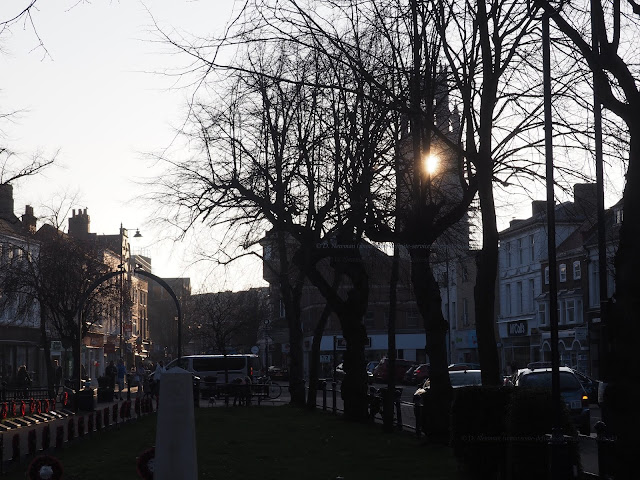
From Wide Bargate in late afternoon
Yes, they built it not only beautifully but masterfully, for in spite of its position right on the banks of the Haven it has never needed shoring up or major structural work.  There was a practical purpose to it, as well: the tower has served as an unmistakeable aid to navigation for miles around, especially for seafarers on the Wash.  (Scorch-marks on the masonry offer evidence that beacons were hung here for precisely this purpose: it really was a lantern tower.)  On a clear day the Stump is even visible from the west coast of Norfolk, and I have never forgotten a spine-tingling picture of St. Botolph’s on the horizon, silhouetted starkly against the setting sun, which the photographer Gary Pearson captured from Hunstanton, twenty-one miles away.
From the Market Place
Another interesting aspect of the tower observed by Flannery are its four distinct levels, corresponding roughly to the four generations of masons it took to build it.  He adds, though, that in order to avoid too prominent a horizontal division between them, and so to maintain the priority of verticality, the breaks in the masonry of the buttresses at the corners are made at different levels to those of the tower faces.  By thus interrupting the horizontal lines, while keeping the vertical lines continuous, there is nothing to distract or mislead the eye as it is drawn heavenwards.  The similarity of the tower’s lower half to that of St James’s at Louth has led some to suppose that a spire was the original intention here too, but owing to various aspects of the construction Flannery thinks this unlikely.  As for the unmistakeable octagonal lantern tower, he points out precedents and possible influences as various and far-flung as Beverley Minster, the belfry at Bruges and Brussels’ Town Hall as evidence that this was the intention all along.  The Flemish connection is interesting: ‘People called it Holland,’ remembered Elizabeth Jennings, and not only because of the flatness: in the other Low Counties, too, great belfries like this were raised.
The ‘Stump’ and the Haven in evening light.  
Spring-like as the weather might have been, the law of the sun was still winter’s, and all too soon the time came for the train home.  From London a day-trip to Boston is easily possible by train, but it perhaps does not allow for a very long day.  I could hardly complain about mine, though, as the train set off back westwards, through the the dark levels and glassy drains, to Grantham and the main line — but I knew there would have to be a return, once the scaffolding was gone, to admire the tower in its full glory.
The South Forty Foot Drain, west of Boston, seen from the Nottingham train

References / footnotes:
1.   The river Witham has a curious course: from Grantham it flows northwards all the way to Lincoln (at one point being separated from the Trent by only a narrow watershed) and then, once through the Lincoln Gap, back south-eastwards again.  Though it is eighty-two miles in length, its mouth and its source are fewer than thirty miles apart as the crow flies.
2.  Richard Surman (ed.), Betjeman’s Best British Churches (London: Collins, 2001))
3.  Julian Flannery, Fifty English Steeples (New York: Thames & Hudson, 2016),
4.  Soul architects, ‘Conservation Architect for St Botolph’s Church ‘Boston Stump’, Lincolnshire’, web article retrieved 17 June 2021 from <https://soularchitects.co.uk/conservation-architect-for-st-botolphs-church-boston-stump-lincolnshire/>.

A down express flies past St. Wulfram’s Church, Grantham, in the dusk.