Showing posts with label Britain. Show all posts

Tuesday, December 03, 2024

Assisted Suicide and the Cheapening of Human Dignity

A quick note to record my dismay and sorrow at the passing through its second reading in the House of Commons of the Terminally Ill Adults (End of Life) Bill last Friday, 29th November, by 330 votes to 275.  Although the Bill is not yet law, it suddenly brings us alarmingly close to permitting assisted suicide in this country for the first time.

I know that many of the Bill’s supporters are motivated by a just desire to alleviate suffering, but the ease with which assisted suicide has been alighted upon as the answer — as opposed to improved palliative care, or sustained maintenance of health provision — is alarming.  The slippery slope, though a cliché, is perfectly real, and there are appalling stories from Canada and the Low Countries about euthanasia being granted on the grounds of treatable or manageable conditions such as depression or anorexia — and of its being extended to children.  Campaigners for disabled people are understandably alarmed by and fiercely opposed to the Bill, and worried about its likely effect on social attitudes.

There is also, as ever, an emphasis on the idea of dying ‘with dignity’, which is taken to mean on our own terms, within our own control, while sentient and in possession of our faculties.  This is perfectly understandable from the perspective of secular society, but it misses the wisdom of the older, Christian vision that we are losing: that our human dignity has a deeper, firmer, more reliable foundation than we readily perceive; that it is not diminished one jot by suffering or infirmity.  The fading of this belief will have consequences graver than our leaders now realise.

Robert Jenrick MP put it like this:

My last point is not about how we can improve the Bill; it is about something that we can never resolve as a House.  The Bill is not so much a slippery slope as a cliff edge.  When we walk out of this Chamber, or out of the gates of this building tonight, we will, in a way, walk into a different country if the Bill passes.  There will be different conversations around kitchen tables.  There will be different conversations had by couples lying in bed at night, or on quiet country walks where people talk about difficult things.  They will not be conversations that make our country a better place.

More important, there will be people who do not speak about these things at all.  There will be imperceptible changes in behaviours.  There will be the grandmother who worries about her grandchildren’s inheritance if she does not end her life.  There will be the widow who relies on the kindness of strangers who worries — it preys on her conscience.  There will be people — we all know them in our lives — who are shy, who have low self-esteem, who have demons within them.  I know those people.  I can see them in my mind’s eye.  They are often poor.  They are vulnerable.  They are the weakest in our society.  And they look to us, to Parliament, to represent them, to support them, to protect them.  In their interests, I am going to vote against the Bill today.  Sometimes we must fetter our freedoms.  We the competent, the capable, the informed sometimes must put the most vulnerable in society first.

Once again I feel this sense of a great cheapening of everything around us: of language, of our sense of the value of human life, of the bonds of duty and of love that exist between us.  The journalist Tim Stanley quoted a ‘very clever’ friend of his who pointed out that the Bill divides the ‘libertarians from the conservatives and the progressives from the socialists’.  Certainly, the proponents of the Bill seem as keen on promoting individual liberty as on lessening suffering: the idea that we must always be able live life on our own terms, even to the point of death, seems to come foremost.  That so many of our political leaders seem to believe human life to be negotiable or mutable at its end, as well as its beginning, is profoundly dismaying.

I am very grateful to my own MP for having voted against this Bill, as she has against similar Bills in the past.  And the Catholic Church, led from the front by Cardinal Nichols, has upheld the sanctity of life very strongly.  It has been pointed out that that a significant number of MPs were undecided when they voted ‘Aye’, wanting to have a longer debate, and that only twenty-eight MPs need to change their minds at the Third Reading for the bill to fail.  It is to be hoped and prayed for that this comes to pass.

I might as well say that I am proud to belong to a Church which stands up for all human life without question, even inconvenient human life — especially inconvenient human life; which says, to those who worry that they are a burden, who feel undignified, who question even their own worth, ‘No.  Your God-given dignity is absolute and inviolable.  We will defend it if all others deny it, even if you deny it yourself.’  My hope is that others will see the wisdom and love that underlie this stance, and will be moved to adopt it.

Bishop Philip Egan of Portsmouth has put things very frankly, in a pastoral message to his diocese: 

This legislation […] makes one thing crystal clear.  Britain is no longer a Christian country.  To be a Christian in future will not be easy, if ever it was.  More and more, as in ages past, we will stand out from the crowd and from others in our society who see human life, its dignity and value, in a radically different way. 

It is my hope that God will give us the grace to live our discipleship ever more authentically so that the true beauty of our Catholic faith might become even more evident.  I pray that the splendor veritatis, the beauty of the Truth, the hope it gives, especially to the vulnerable, and the Gospel vision of the human person — fallen but redeemed, an incarnate spirit called to live a good life here on earth and one day to be with God for ever in Paradise — will shine out for all to see.

Prayer, then, that the Bill will fall in favour of greater care of the sick and dying, and for courage in any case.  And please write to your M.P.!

Sir James MacMillan: the Kyrie from his 2000 setting of the Mass, sung by the choir of Westminster Cathedral under Martin Baker.

Thursday, July 04, 2024

Thoughts on Polling Day

Recently I have been trying to notice more, and appreciate, how nicely-kept some of the front gardens are around my part of south London.  In May and June particularly, their fresh colours have stood out against the brick and pebble-dash or arid drop-down driveways around them.  They stand out too against a broader backdrop of dullness, for around them is generally a street, is a borough, is a city, is a country, in which all sorts of things seem to be going downhill.  The town centre, for instance, is becoming noticeably more litter-strewn, more graffiti-spattered, emptier, less hospitable: we sense we are in decline.  And there are some things that seem to crystallise this decline.  One wet day in April a local pub, the Burn Bullock, a seventeenth-century coaching inn long neglected by its owners, was gutted by a fire so spectacular that local suspicions of foul play seem quite understandable.  There is much frustration at the negligence of the owners and the borough council’s seeming impotence in the matter.

And Britain, too, suffering a similar sense of decline, of the decay of public infrastructure, of a weakening of solidarity and a sense of the common good, of moral and social disillusionment, goes to the polls today.  With good reason many people are unhappy with the present government, dissatisfied with their record, and angry at the personal moral failures of its members, particularly during the crisis of the pandemic, and the indication of the polls is that they will be thrown out of office.

2024 is a year of many elections around the world, and ours is not the only anxious and fractious electorate with compelling reasons for its frustration.  In some places crisis has spilled over into catastrophe: war (both in those places whose names we know only too well, and also in others of which we hear little), drought (East Africa), economic collapse (Lebanon, Venezuela) and the persecution of minorities (China, India, Pakistan, Nigeria, and more).

We remain fortunate in this country that, flawed and skewed as it may be, we have a working democracy; that we can vote out an unpopular government, and that the verdict will be accepted.  Of course, in voting out a government we also need to vote in a new one, and, sanctimonious as it may sound, it is surely healthier to look for something to vote for, rather than the obvious things we might vote against — but this is harder than it sounds, and in this election the choice seems as narrow as ever.  Anyone asking how the parties will look after the weakest and most vulnerable — the disabled, the destitute, the elderly, the unborn, small children, those vulnerable to crime, genuine refugees, and the otherwise downtrodden — and also those less immediately vulnerable but still in precarity — renters, the lonely, young fathers and mothers, the indebted, the unhappily employed — will find slim pickings indeed.  Which of the parties will foster the common good and civic society?  Who will uphold marriage and family life, and the happiness of children?  Who has a competent answer to the twin problem of the energy crisis and our duty of stewardship to the natural world, our ‘common home’, and to people whose livelihoods bear the brunt of our over-consumption and waste?  Who will enable the police and the courts of law to apply justice (tempered with mercy, not excuse-making), to the scourge of crime, of drugs, of dangerous driving, of vandalism, of burglary, of robbery, of assault and of murder, so that the law-abiding can live in peace?  Who will manage the public finances prudently and with integrity?  Who is worthy of the stewardship of the extraordinary bequest of our country from generations past, or worthy of the responsibility to hand it on, at least intact if not improved, to the generations to come?  I am afraid I have found no clear answers.

I wonder if the main answer lies (and has always lain?) with us, with ordinary people.  To return to the suburban gardens — here they still are, little defiant oases, easily missed but there all the same, quiet but eloquent counter-witnesses.  Seeing them I realise that it is every day, not just polling-day, that we make a difference to our surroundings and our neighbours — and thereby to the world, however modestly.  After all, a front garden, too, is a kind of vote: a mark made for a cause, a cross planted in a box, with a spirit of hope for the future.

Thursday, June 06, 2024

D-Day 80

Today is the eightieth anniversary of the D-Day landings in Normandy, Operation Overlord, on 6th June 1944: the first phase in the Allied invasion and liberation of Europe, and thus of final victory in the Second World War.

Four years ago, our Nation and Empire stood alone against an overwhelming enemy, with our backs to the wall.  Tested as never before in our history, in God’s providence we survived that test; the spirit of the people, resolute, dedicated, burned like a bright flame, lit surely from those unseen fires which nothing can quench.

Now once more a supreme test has to be faced.  This time, the challenge is not to fight to survive but to fight to win the final victory for the good cause.  Once again what is demanded from us all is something more than courage and endurance; we need a revival of spirit, a new unconquerable resolve.  After nearly five years of toil and suffering, we must renew that crusading impulse on which we entered the war and met its darkest hour.  We and our Allies are sure that our fight is against evil and for a world in which goodness and honour may be the foundation of the life of men in every land.

That we may be worthily matched with this new summons of destiny, I desire solemnly to call my people to prayer and dedication.  We are not unmindful of our own shortcomings, past and present.  We shall ask not that God may do our will, but that we may be enabled to do the will of God: and we dare to believe that God has used our Nation and Empire as an instrument for fulfilling his high purpose.

After nearly five years of toil and suffering, we must renew that crusading impulse on which we entered the war and met its darkest hour.

I hope that throughout the present crisis of the liberation of Europe there may be offered up earnest, continuous and widespread prayer.  We who remain in this land can most effectively enter into the sufferings of subjugated Europe by prayer, whereby we can fortify the determination of our sailors, soldiers and airmen who go forth to set the captives free.

The Queen joins with me in sending you this message.  She well understands the anxieties and cares of our womenfolk at this time and she knows that many of them will find, as she does herself, fresh strength and comfort in such waiting upon God.  She feels that many women will be glad in this way to keep vigil with their menfolk as they man the ships, storm the beaches and fill the skies.

At this historic moment surely not one of us is too busy, too young or too old to play a part in a nationwide, perchance a worldwide, vigil of prayer as the great crusade sets forth.  If from every place of worship, from home and factory, from men and women of all ages and many races and occupations, our intercessions rise, then, please God, both now and in a future not remote, the predictions of an ancient Psalm may be fulfilled: ‘The Lord will give strength unto his people: the Lord will give his people the blessing of peace.’

The address of King George VI on D-Day, 6th June 1944, from <https://www.royal.uk/80th-anniversary-d-day-landings>.  Only with difficulty were he and the Prime Minister, Winston Churchill, dissuaded from crossing the Channel to watch the landings for themselves.

Wednesday, February 21, 2024

Will-ful Destruction: consultation to close this Friday

Just a reminder that the consultation on proposals by the Ministry of Justice to destroy the paper originals of English and Welsh wills after 25 years, and to rely thereafter on digital copies, is due to close this Friday, 23rd February.  The consultation is available here and I have put down some thoughts here.

If you do not have time to answer the consultation but would like to object to the plans, a petition has also been set up.  So far it has garnered well over 13,000 signatures.  I (and I think the entire archival profession, and all our descendants!) would be grateful for every voice raised in protest!

Sunday, December 24, 2023

Fear Not


And so we come once again to the fireside of the year, where the strange and lovely truth of Christmas draws us to homely things.  As the years go by, and I find myself less and less at home in the time and place given to me, I cross the threshold of this feast with ever greater relief.

It is not easy to live in, this age of deceptive appearances.  Behind the superficial glass and the liquid crystal screens our sorrows are undiminished.  The Britain in which, for the first time in fifteen centuries, a minority of people now profess to be Christians, is no happier for its loss of faith.  The old ways we tore to pieces are giving way not to the promised utopia, but to a new, sullen, disenchanted, resentful existence.   Not only are things going wrong, but we struggle to agree about what has gone wrong, let alone how to make things better.  Identity politics have captured many formerly trusted institutions and done great damage to their reputations, as well as confusing or upsetting many well-meaning people.  And our response to the general economic strain is not, in general, an effort to build up solidarity and courage, or to provide an alternative to rapaciousness and greed, but renewed howling against our forebears and the foundations of our society.  That old, gentle Britain to which we owe so much, and for which I still stand, has become our scapegoat.

This is now a Britain in which many shared things are no longer well-made or looked after; in which even those trying to do well seem unable to overcome the shoulder-shrugging culture around them.  Wherever we go, any expectations of high standards seem to be frustrated.  Thoroughfares and public spaces are tatty and uncared for; lifts and escalators are broken or vandalised.  Or things will not be as they first appear.  The Internet, for instance is full of false promises: websites will co-operate for a moment before the sentence you were reading disappears behind a salvo of pop-ups about cookie settings or newsletter subscriptions.  A special offer will turn out to entail endless and spurious terms and conditions.  Sorry, all our operatives are busy at the moment.  Sorry, this desk is unstaffed.  Sorry, this machine is out of order.

It is a Britain in which language itself is often used insincerely, too often more for the purposes of manipulation than anything else.  Euphemisms and weasel words and empty slogans are so prevalent that it is a constant effort to pare speech of them, to speak or write plainly and truthfully.  We often feel patronised and tricked and taken advantage of.

It is a Britain in which people of good will increasingly bear the brunt of the selfishness of those of ill-will; in which those in positions of responsibility are often unable to exercise their offices with principle and clarity; in which those who shout loudest tend to get their way.  Only amongst a few is there even a sense of embarrassment at our irreverence, our arrogance, our squandering of our inheritance.  It is a Britain which, I now see, is indeed mortal.

It is an old and noble nation forgetting her honour, and learning anew the barbarism that the old faith once kept at bay.  There are grave misdeeds and acts of calculatedly barbaric violence at home and abroad, an ebbing away of civility and common decency, and the unabated undermining of marriage and the family and of the Christian vision of the dignity of the human person.

But amidst all this, even as the darkness presses in, another voice, another kind of language.  And there were in the same country shepherds abiding in the fields… Words which, strange as they are to the ear, are not evasive, do not deceive; which have that unmistakable ring of truth:

And, lo, the angel of the Lord came upon them, and the glory of the Lord shone round about them: and they were sore afraid.  

And the angel said unto them, Fear not: for, behold, I bring you good tidings of great joy, which shall be to all people.

For unto you is born this day in the city of David a Saviour, which is Christ the Lord.

They are words which contradict all the smirking arrogance and squalid tragedies of our time, but not as we would have supposed or dared to have hoped.  Something different is going on: something strange and also sweet… Something so strange and sweet as the call of our true and longed-for home.

The darkness presses in on us, often as intensely as it pressed in on the Roman province of Judaea and on Bethlehem; pressed right down on the stable-roof and sought entry.  But from within that stable it was repelled and defied, as it is repelled and defied tonight, and for ever, by light — by the one Light which, as we have often been told, the darkness cannot overpower.  And our liberation is both more cosmic and more intimate than instant deliverance from hard times or a faithless epoch could ever have been: we are freed from the very foes that blight us most: sin and death.

This year is the 110th anniversary of one of my favourite Christmas poems: Noel: Christmas Eve 1913, by Robert Bridges.  Gerald Finzi set it to music in his Christmas cantata In Terra Pax (see above) though for the third stanza he substituted the verses quoted above, from the second chapter of Luke’s Gospel.

Noel: Christmas Eve, 1913
Pax hominibus bonae voluntatis. 

A frosty Christmas Eve
when the stars were shining
Fared I forth alone
where westward falls the hill,
And from many a village
in the water’d valley
Distant music reach’d me
peals of bells a-ringing:
The constellated sounds
ran sprinking on earth’s floor
As the dark vault above
with stars was spangled o’er.

Then sped my thoughts to keep
that first Christmas of all
When the shepherds watching
by their folds ere the dawn
Heard music in the fields
and marvelling could not tell
Whether it were angels
or the bright stars singing.

Now blessed be the tow’rs
that crown England so fair
That stand up strong in prayer
unto God for our souls:
Blessed be their founders
(said I) an’ our country folk
Who are ringing for Christ
in the belfries to-night
With arms lifted to clutch
the rattling ropes that race
Into the dark above
and the mad romping din.

But to me heard afar
it was starry music
Angels’ song, comforting
as the comfort of Christ
When he spake tenderly
to his sorrowful flock:
The old words came to me
by the riches of time
Mellow’d and transfigured
as I stood on the hill
Heark’ning in the aspect
of th’ eternal silence.

Wishing all readers a very merry and restful Christmas.

Friday, September 08, 2023

A year since the loss of Queen Elizabeth

What is there to say, on the first anniversary of the death of our beloved Queen Elizabeth?  I miss her, as I knew I would, and know I always will.  Her wisdom, her smile, her words of encouragement: we are having to carry on without them.

The grief was very deep — the void in the stomach, the taste of iron on the tongue — but so too was the consolation of all that followed: the lying-in-state, the funeral procession, the final Committal at Windsor; their dignity and beauty.  They were days out of time, in which we were reminded of a different way of doing things — the Queen’s way — the only false note being the decision to bring her coffin to London by air, rather than by rail.  But in any case I shall never forget the wordless television pictures of the mourners filing past her coffin in Westminster Hall — mourners whose numbers I had the privilege to join.  That collective four-day farewell was also a pact of remembrance: we who recognised in that witness, in that pilgrimage, a vindication of the Queen’s faith and virtue, stepped out of Westminster Hall with a greater determination to live our ordinary lives more as Elizabeth lived her extraordinary one.

But we remain loyal to and continue to pray for our Sovereign King Charles, who in his benevolent melancholic way is exercising wisdom of his own.  His Majesty has written today,

In marking the first anniversary of Her late Majesty’s death and my Accession, we recall with great affection her long life, devoted service and all she meant to so many of us.

I am deeply grateful, too, for the love and support that has been shown to my wife and myself during this year as we do our utmost to be of service to you all.

Charles R.

The reception of H. M. the late Queen’s coffin at Westminster Hall.  James ODonnells arrangement of the 139th Psalm is sung by the choirs of Westminster Abbey and the Chapel Royal.  ‘O Lord, thou hast searched me out, and known me: thou knowest my down-sitting, and mine up-rising…’

Tuesday, July 25, 2023

Ticket office closures — Beeching all over again

My friend M. down at the station thinks this has been in the offing for years, “We’re closing,” he said in a resigned way when the news first came out, though he has since become more defiant.  His impression was that the Government is moving to implement a long-held ambition (and it does seem to be the Government, the Department for Transport, which wants this change, rather than the railway companies).

And the scale of the proposed cuts is breath-taking: they want to leave only a handful of ticket offices in the larger stations.  It is Beeching all over again.  Only 12% of tickets are sold by ticket clerks, goes the claim, and so at my local station and thousands of others ‘it is proposed that all ticket office windows […] will close, with staff moving to other areas of the station, where there is customer demand’.  

This slippery language makes my blood boil.  Customer demand is directed precisely to the ticket office, the accepted place for buying tickets and obtaining information.  This is decline, but worse than decline; decline with a smirk on its face, the brazen cheek to speak of a ‘change’ to the ticket office when what is intended is its outright elimination.  So might Henry VIII have spoken of his ‘change’ to the monasteries, or Brutus of his ‘change’ to Caesar’s abdomen.  

The difficulties of financing the railways are not trivial.  Passenger numbers are currently somewhere between 94–100% of pre-pandemic figures, but, because the recovery has been stronger in cheaper off-peak leisure travel than in the traditional backbone of passenger railways’ finances, namely commuter traffic, overall revenue is not.  Even so, the answer is surely to grow that revenue, not, as here, to cut off streams of revenue merely because they seem to be less efficient.

But a broader point is to be made beyond the merely financial.  One of the great strengths of the railways is that they are able to say to the passenger, ‘We can look after you’.  The network is complicated; ticketing as presently arranged is confusing; plenty of people lack confidence in travelling.  The ticket clerk can offer passengers something intangible yet incredibly valuable — peace of mind.  And this extends to the atmosphere of the station — the sense of emptiness and alienation resulting from the decline, in recent decades and across all sorts of public realms, of staff ‘keeping a general eye on things’ should already have taught us this lesson.

The 0927 to Horsham draws into Ockley station in Surrey, 14th May 2018.

This development is poor reward for the sterling work M. and his colleagues have done over the years.  He told me yesterday that he isn’t interested in standing about in the wind and the rain; it isn’t worth risking his health and he will probably give up if the plans go ahead.  Another friendly face lost, and we will all be the poorer for it.

What does give me a degree of hope is that the response to the consultation — which which can be answered here until Friday 1st September  — seems to have been pretty robust.  Let’s hope it is enough to persuade the Department for Transport to change its mind.  Here is my own response:

Dear Sir / Madam,

I am writing in answer to the consultation on the proposed general closure of railway station ticket offices.  I am afraid I must express my strong opposition to these plans.  Of the many reasons for my opposition, I would like to emphasise three in particular.

The first is that this decision, if implemented, will result in discrimination against passengers unable to buy tickets via machine or online.  Not everybody owns a computer or smartphone; not everybody has Internet access; not everybody is able to use a ticket machine.  We would not withdraw assistance for disabled passengers on the grounds that only a minority uses a wheelchair; surely the same logic applies here.

The second is that the decision is simply impractical.  I cannot see how it would be easier, let alone more economical, to sell tickets in ‘other areas of the station’ as the consultation poster puts it — anywhere other than in a ticket office.  How would cash be handled?  How would tickets be printed?  How could anything work in bad weather?  Has the safety of railway staff been taken into account?  The current proposals leave the practicalities entirely unexplained.

The third reason has to do with the common good.  One tremendous advantage of the railways is that they can undertake to look after their passengers, including those less confident in travelling.  The railway can say, ‘We can look after you.’  The reassuring and knowledgeable presence of the ticket clerk, in an accepted location, is a vital part of this.  It seems unbelievable that this should be dismissed so lightly.  Removing ticket offices will make the station environment far less welcoming, lower the confidence of travellers, and ultimately harm the railway’s prospects.

I am a strong supporter of the railways and use them more or less daily both for work and leisure.  I understand that growth in revenue is an urgent priority and am sympathetic to the railways’ efforts to balance the books.  However, I am astonished and dismayed by the severity of these proposals, which risk doing deep and lasting damage.  Other measures, such as increasing ticket inspections, should be tried first (on the Sutton loop in south London, in spite of travelling more or less daily, I have had my ticket checked only once in the past two years).  Indeed, the railways should be making ticket offices more efficient by expanding the number of services they offer, such as by equipping them to sell advance fares, which are currently only available online.

I would be grateful if you would pass these points on to Govia Thameslink Railway and to urge them in the strongest terms to reconsider their plans.

Yours faithfully, &c.

Updated 26th July 2023 in the light of the extension of the consultation deadline from 26th July to 1st September. 

Tuesday, May 16, 2023

Some Grounds for Catholic Optimism

The Archbishop of Westminster, Cardinal Vincent Nichols, began his New Year message for 2022 by comparing two different kinds of hope.  One he called the ‘pragmatic version’ — in which ‘a secure present’ gives us confidence to ‘look forward to an uncertain future’ — whereas the other, he said, was the ‘theological virtue’ of hope — ‘the capacity to face an uncertain present’ because, beyond it, we trust in an ‘utterly secure future.’  

Most of us in the Church would recognise this distinction.  After all, the first kind of hope, which we might also call ‘optimism’, is in distinctly short supply these days.  As the memory of the old faith drains steadily out of our cities and civilisation, as the tenets of the Creed are forgotten one by one, as forces mighty as Goliath yet insidious as the serpent conspire to hobble the Church and smother the Gospel, the psalms of lamentation come easily to the lips: ‘How shall we sing the Lord’s song in a strange land?’  And so we cultivate the second kind of hope, setting our sights and our hearts on the ‘utterly secure future’ of the kingdom of Heaven.  We brace ourselves for the ‘Long Defeat’, as Tolkien put it, in sure hope of the Final Victory.

But what if even earthly hope is not altogether lost?  For although this nurturing of Deep Hope is fundamentally the right approach to our situation, it nevertheless carries with it an understandable temptation: to give up on the immediate future altogether, and thereby to miss such possibilities as do in fact lie before us.  We are not Albigensians; we should not turn our backs completely on the world.  The Resurrection of Christ was as earthly a thing as it was supernatural, and changes the present moment as much as it does eternity; its implications are not only cosmic but comprehensive, changing the world not only in general but in detail, and from within, not from without.  Our everyday lives on earth are shot through with a new life-force — the Word, whispering perpetually into every crisis, ‘This is not the end — for I was, I am and ever shall be.’  Even in these bewildering times, there is an onward path to tread.

Cardinal Vincent in his message goes on to point out the ‘middle ground’ that exists between the two kinds of hope.  His point, if I understand rightly, is that we need to develop an intelligent combination of both: Deep Hope in the long term; courage and fortitude in the short.  Even if ‘optimism’ is hardly the first word we might use to characterise our immediate outlook, it has to be an ingredient in our approach.  Even a dash will do.  As we heard from the prophet Jeremiah (of all people!) one Sunday last year:

A blessing on the man who puts his trust in the Lord, with the Lord for his hope.  He is like a tree by the waterside that thrusts its roots to the stream: when the heat comes it feels no alarm, its foliage stays green; it has no worries in a year of drought, and never ceases to bear fruit. 
(Jeremiah 17: 5–8)

‘Never ceases to bear fruit’…  Mainstream opinion-formers may think the Catholic Church obsolete, deluded and contemptible, but we must not give the slightest impression of believing them.  Certainly we should be prudent in the deployment of our energies; absolutely we must attend to the deep and inner roots, but in the drought of the coming decades we must never lose confidence that the Church will indeed ‘never cease to bear fruit’ — because she retains countless ways to prove herself essential not only to her own members, but to our whole society.

What sort of thing do I mean?  Here are some ideas.

1.  Pro-life victory is certain

I am absolutely confident of the eventual victory, on earth, of the pro-life movement.  This might sound absurd, given the present total dominance of the abortion lobby in law and politics.  All the same, of the innumerable logical contradictions at the heart of the revolutionary secular-progressive project, this is the hardest to sustain, and indeed can be sustained only by shrill campaigning and a constant flow of cash.  A succession of scientific discoveries is steadily and consistently vindicating the Church’s position, and, sadly, so is the testimony of ever greater numbers of women as to the offence done by abortion against their dignity and happiness.  The strength of the pro-choice lobby is nearing its high water mark; it has little further ground to gain; it is already having to become defensive of its establishment position.  Its members are beginning, rightly, to recognise the possibility that they will, as the phrase goes, ‘lose the narrative’ to the joyful and energetic pro-life message.
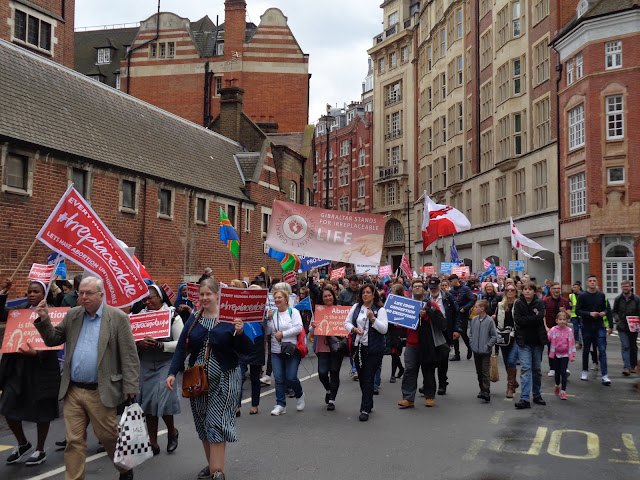
March for Life, London, September 2018

I do not mean to sound complacent — after all, the cost in unborn lives now runs at over two hundred thousand every year in England and Wales alone — but I am not being complacent; I am being confident.  As with the trans-Atlantic slave trade two centuries ago, the whole outrage is likely to end abruptly, even unexpectedly, with a sudden anagnorisis and revulsion at the horror.  Unless our society is completely overtaken by nihilism, a point will be reached at which the injustice can be denied no more; someone at some point will ask, in a loud enough voice and in a way which will suddenly be listened to, why (for instance) we see hardly anybody with Down’s syndrome around any more; will ask why we uphold the rights of God’s animal creatures, as we should, without extending the same defence to our own unborn children.  When the tide does turn, the sheer consistency and integrity of the Church’s pro-life position, as well as her record in providing for mothers in need, will stand her in good stead when it comes to establishing a new and authentic culture of life.

That is one concrete reason for hope in our age, but still stretches the definition of ‘optimism’ a little far.  What about today and tomorrow?

2.  Fire-power isn’t everything

It is worth remembering that we still have great resources in the nature of our presence in society.  Secular progressivism is on the warpath, and hardening into a religion of its own, having at its disposal many organised shock-troops with strident and persuasive voices, and tightening its grip on our culture.  But if the Church seems not quite able to match this sheer fire-power, it is not because we lack good arguments or articulate ripostes.  It is because we have other things on our plate as well.  Unlike the cultural revolutionaries, we have always been concerned about more than mere propaganda.  The Church may be in battle, but she is not merely a battleship: she has to be a rescue vessel and a hospital ship and a flagship all at once.  She cannot be expected to swivel and aim her guns as adeptly as a purpose-built destroyer.

What is more, so much of the strength of our witness actually lies in our silence.  This is true in two senses: firstly in the simple fact of our not going along with propaganda or slogans, and secondly in the positive quality of the silence of our sanctuaries.  Especially these days, when moments of peace, let alone peace by oneself with God, are so hard to come by, precious indeed are the physical refuges of our churches amid the howling cities.

Our strength lies, too, in the aspects of the Church’s life that never make the headlines: her presence in hospitals, in hospices, in prisons, in homeless shelters, in ports, in refugee camps, in the armed forces, in universities, in schools.  And her charities: the tireless work of CAFOD for overseas development, Aid to the Church in Need for persecuted Christians, the St. Vincent de Paul Society for the homeless, and so on.  All those things that are never chalked up on the scoreboard of history: the Masses, rosaries, hymns and prayers; the confraternities, the prayer-groups, the pilgrimages, the devotions; the ‘ecclesiolae’ or ‘little churches’ of families holding their own day after day.  The kindly priest in the lit confessional; the Mary-garden under the railway arch; the soup-bowl in the homeless shelter: in all these ways the Church, with that gentle tenacity of hers, persists in living the ‘life to the full’ that her Founder promised.

The cultural revolution tends to be keener on the commanding heights of the culture — the law, the government, the arts, schools, universities, and the apparatus of civil society — than on the welfare of ordinary people.  This tells us that it is only really interested in power; that for all its capacity for intimidation it is necessarily brittle and lacking foundations, and that its strength, though incontestable for the moment, will prove ephemeral.  The Church’s appearance, by contrast, is no mere veneer.  Under the surface she is true to her word.

3.  The Church comprehends the new and pluralised Britain 

Another opportunity for the Church in years to come, one in which it stands as good a chance of success as any other institution apart from the Crown, is in making sure we fashion a harmonious society of the new pluralised Britain, and preventing the emergence of any division or mutual alienation.  Relatively few things can be said to unify us as a country these days, and certain fractures are emerging which the Faith is placed uniquely to heal.  What but the Christian imagination could even conceive of bringing into serious dialogue, say, the secular liberal on the one hand — whose instinct for mercy, though misproportioned, echoes a distinctively Christian idea — and the observant Muslim on the other, whose concern for justice, codified by the bracing tenets of Islamic law, testifies to a sincere attentiveness to God’s will?  Because the Church understands this paradox of justice and mercy, knowing how to temper one with the other, she can, I think, foster more fruit from such a conversation than anyone else.

And where else but within the Church can the demographic changes of the past fifty years be not only reconciled but harmonised convincingly with the deepest roots of our society?  To take only one of countless examples, consider the Tamil pilgrimages to Our Lady’s shrine at Walsingham, which I understand attract the largest numbers of all the pilgrim groups.  In this village in the heart of rural Norfolk, a place of pilgrimage since before the Norman Conquest, an ancient English devotion is unified with a Tamil one.  There is no contradiction between love of England and love of neighbour; there is simply one faith, one Church and one Lord.  Thus the world-wide roots of today’s pilgrims are entwined with the very depths of England and Englishness, new Britons follow in the footsteps of medieval kings, and all pilgrims throughout the ages are unified in peace and goodwill.  For many immigrants and their families and descendants, the Catholic Church is a ‘home away from home’ — and yet it has been here in England, waiting for them, it seems, since England’s very beginning.

Tamil Pilgrimage to Walsingham, Norfolk, 2016

4.  New alliances amid the crisis of meaning

Then there is the crisis of meaning: the alarming and deepening void at the centre of modern life, and, which is often even more horrifying, all that is rushing in to fill the void.  Only a decade ago the New Atheists were trumpeting the new dawn of a fanaticism-free secular age of cool rationalism, but now their vision seems completely unequal to the socio-cultural forces of our present time — forces which I am convinced are also spiritual.  As R. S. Thomas wrote,

In cities that
have outgrown their promise people
are becoming pilgrims
again, if not to this place,
then to the recreation of it
in their own spirits […]

Amid a loss of confidence in our institutions, our culture and even ourselves, a tremendous spiritual famine has suddenly declared itself: often vague, often outwardly hostile to formal religion, but unmistakeably spiritual in character.  This manifests itself in some obvious ways — the growing and understandable popularity of ‘mindfulness’, or the emergence of whole new academic fields such as ‘Loneliness Studies’ — but also in some more alarming forms: in the new ideologies sweeping every public institution, our blind faith in progressivism, and the many genuinely troubled young people.

Writers such as the essential Mary Eberstadt have long been observing how sixty years of aggressive secularism have been incubating this situation — but plenty of non-churchgoers are also noticing the crisis.  They share our alarm at the widespread subjugation of truth and reason to personal desire, and many are realising that even the Church may have something interesting to say about it.  We can and must do our best to repay that confidence; if we do, we may find ourselves entering into some new and fruitful kinds of dialogue.  (I say this from personal experience.) 

5.  The crisis of gender, though tragic, is a particular opportunity

One friend with whom I regularly enjoy such conversations recently brought to my attention a recent lecture on freedom of speech, one of the BBC’s annual series of Reith Lectures, by Nigerian-born novelist Chimamanda Ngozi Adichie.  At the core of this address was an appeal for a ‘coalition of the reasonable’ to maintain the standards of public debate.  She was speaking mainly with reference to the extraordinary behaviour in recent years of many advocates of gender theory, who have often been using outrageous tactics in order to advance their contentious cause, organising social media storms, releasing personal information, and even hounding their opponents from their jobs.

Adichie’s is an invitation to which the Church can and must respond positively.  We believe in reason and know that civil and reasonable debate are essential to our whole society — so there is an opportunity here for some real solidarity and co-operation.  In forming such alliances we do not have to pretend to agree where we disagree, but there is no reason why an edifying exchange of ideas should not take place.  The ‘reasonable secularists’ can discover our sincere interest in truth and reason, while we might draw some inspiration from their strength of purpose and concern for accountability and integrity.  Maybe, in finding ourselves on the same side for once, the discussion will be more constructive than it has been for many years.

Perhaps, too, at a relaxed moment, the conversation might turn to higher things, and to the spiritual dimension of the crisis of our time.  We might mention Benedict XVI’s insight that as well as reason we need faith, and that the two are not only compatible with but absolutely essential to each other.  We might make the point that the sense of meaninglessness from which so much of the crisis has stemmed corresponds to a deep reality about ourselves — that our longing for meaning is not some vague and inconvenient appetite, nor some functional or dietary need to be satisfied by the appropriate vitamin, but is a sign of the deepest truths about ourselves: the spiritual truths.

Even so, the urgent task remains to offer charitable but robust collective opposition to gender theory, which even now is doing irreversible damage to many confused and unhappy young people, as well as offending in a particular way against the rights and dignity of women.

6.  The Re-evangelisation of Romance

Another obvious mission for the Church is also one of the most dangerous: to confront head-on the ongoing melting down and recasting of marriage and the family, and to re-evangelise the sphere of romantic and marital love with the fullness and beauty of the Church’s teaching.  

Here, as with abortion, the post-Sixties revolutionary movement is visibly running into difficulties, and beginning to fray amid its own contradictions.  But its power is still tremendous, and its price exacted mainly on the young — who secretly, often even without knowing it themselves, long to hear the truth.  They long to be told what deep down they suspect: that all men and women were made for each other’s mutual respect and friendship, not for sullen rivalry; that the unique kind of friendship which is life-long marriage, the real thing, is no fancy but the gold standard, given to us by God for our flourishing; that a bride and bridegroom really are worth to the other nothing less than the gift of a great cosmic vow, one equal to the weight of an entire human life and strong enough to sustain the multiplication of new life; that such a vow is no mere formality, but something we long with all our hearts to make and to fulfil.  Youth seeks truth — the truth about ourselves, a truth which is written in our bodies as well as in our souls — and the Church, with teaching that is as beautiful as it is true, must be there to meet their longing.  Our culture is near enough rock bottom to hear it.  

We will often run up against wild rage and hatred — for those entrapped by darkness hate and fear beauty and truth — but there are millions of others waiting to be captivated by the high mission to which the Church calls them.

As Mary Eberstadt said in a recent interview,

Catholics should be proud — in the right way — of all these unpopular teachings.  They’re only unpopular for the moment, and […] they resonate with the human heart.  That again is to our advantage as we try to press this case.

This is one of the few spheres of life in which many people will still acknowledge a spiritual dimension, while often remaining sceptical about the form of marriage.  We are in much the same situation as those who argue for rhyme and metre in poetry: our task is to show how the form gives sense to the feeling; how the rules and vows give the underlying human impulse the sense and the strength to endure.  Against the pessimism of liberalism, with its fear of commitment, with its cynical assumptions about loyalty and perseverance, many will be surprised and inspired by the frankness, the freshness, the bracing realism, and, yes, the sheer optimism of the Church’s vision.

7. How hope works

I have one final remark on the way hope itself works, and where to look for it.  Whether pragmatic or theological, hope does not usually come marching over the hill; it grows fierce and green in unlikeliest places, as tenacious as grass or wildflowers.

One hot day a few years ago I was riding down a cycle path alongside a heaving A-road in south London, gritting my teeth against the noise and hostility around me, when the path narrowed and, seeing a child of about ten or eleven coming the other way, I braked to let him through.  To my complete astonishment, he very sincerely and deliberately thanked me; I hadn’t expected it and was too stunned to respond adequately.  There, uncrushed by the juggernauts and the tyres, defying the smirking warlords of the road, a tiny counter-witness, a green shoot of hope — something so vital, so ‘original, spare, strange’, that it offered a stronger riposte to its surroundings than perhaps the boy knew.  Like Lovejoy’s garden in Rumer Godden’s book An Episode of Sparrows, hope grows and germinates in defiance of overwhelming forces, even in spite of ourselves, in the ‘fields of our hearts that dead and bare have been…’

In the same way, as we should know from our own lives — and at Eastertide of all seasons — the vindication of the faith is with us, on earth, in this very hour.  ‘Christianity works,’ as Douglas Gresham, C. S. Lewis’s straight-talking step-son, once said.  It works in our lives, in every detail of our lives, even if the wider world is ignoring it for the present.  

---

I am under no illusions: this is a very uncertain and unsettling age, and things will not be easy for the Church for some time.  Many of the opportunities I describe may only be born of various crises and amid great suffering: it may be that we can be optimistic only to the extent of being poised to respond to a crisis.  It is also undeniable that the Church as an institution — in Europe and the West at least — has been severely weakened in the past fifty years — partly by mockery and marginalisation from without, partly by slacking and scandal from within.  But the Church’s members on the ground are chastened and made wise by crisis; we are all, clergy and laity alike, more alert, less complacent, and more capable of giving an account of ourselves than we have been for some time.  And in an age when all institutions are struggling to win trust, the Church is again as well-placed as any other to recover her integrity and a visible authenticity.

As far as external threats go, the Church can handle crises far better than she can uncertainty and apathy.  Our very foundation began with an utter catastrophe which was gloriously and outrageously inverted into triumph.  We have the ‘utterly secure future’; we have the Final Victory — but the near future is worth fighting for as well.  Keeping courage, then, means keeping courage in the short term as well as the long; today and tomorrow, this hour and the next, so that, in a happier time, our descendants will remember and give thanks for their forbears in faith, as we give thanks for ours.

The Lord is my light and my salvation; whom shall I fear?…
Though an army encamp against me, my heart shall not fear.
For in the time of trouble he shall hide me in his pavilion:
In the secret of his tabernacle shall he hide me; he shall set me up upon a rock.
  

(Psalm 27: 1–5)

Pope Benedict at Hyde Park, September 2010.

Friday, May 05, 2023

God Save the King!


And so we come to Coronationtide, as the great Eleanor Parker reminds us to call it — though no wonder we had forgotten, as this is the first for seventy years.  It is quite something to sense once again, as we did at the death of the late Queen, the heavy mechanisms of state and of history swinging into motion, though this time to music in a major, not a minor key.  Again I sense, and savour, an older, deeper Britain rising almost to the surface.  I expect this sensation will only intensify as we approach Saturday, and that during the ceremony itself we will feel very close indeed to high voltage — as if we need only reach out to touch the charged cable of history, leading all the way back through the centuries, to the very beginnings of our nation.  

It is strangely ironic that the remarkable gift of the late Queen’s long reign — her very longevity and personal constancy — may have distracted us from the even greater length of the thread of historical continuity to which she belonged and of which even she represented only the final stretch.  Now that her son is King, there is a curious change of perspective: where until last year we might have marvelled that the Queen had been reigning since 1953, now it is easier to notice again the remarkable truth that our monarchy itself goes back — well, all the way to Alfred (let us not dwell on Cromwell), and English Coronations to King Edgar in the year 973.  Our perspective suddenly broadens out from beyond the lifetime of a single individual, remarkable though she was, and recognise that even she (as she knew quite well, and often implied) was only a part of something far older, far richer, far deeper.

Now Charles is to be crowned King, and with his crowning a new chapter opens in our national story.  It is not like 1953, when the young Queen Elizabeth shone with gem-bright optimism amid war-weary and soot-bleared, though dignified, Fifties London.  It was a brightness she kept till the very end, so, without at all making a criticism of her, it is an interesting and by no means unpleasant change to look now to the more pensive, even melancholy figure of Charles in her place.  He is a philosopher king, a man who seems to carry the weight of the world on his shoulders, and in that sense he is the man of the moment.  These are troubled times — troubled spiritually, as we are beginning to realise; a time of uncertainty and fear in which so many are struggling to find their bearings, and in which there is a great, yet widely unanswered thirst for the eternal consolations of goodness, truth and beauty.  Judging by the manner and aesthetics of his reign so far, Charles seems to understand these things.

Not that those aesthetics are at all gloomy or pessimistic — their dignity and beauty and confidence have lifted my spirits considerably.  The Coronation emblem (above), which I think is simply magnificent, is the work of Sir Jony Ive, who previously designed iPhones for Apple.  Everything from the King’s own dress-sense to the new commemorative stamps (also splendid), from the splendid programme of music for Saturday’s service and the newly-embroidered screen which will veil the moment of his anointing from the prying cameras — all doubtless done with the King’s own close involvement — communicates the prizing of slow craftsmanship and care, as well as a deliberate combination of rootedness and inventiveness: just the kind of the old-fashioned modernism, or futuristic traditionalism, to which I would willingly subscribe.  Some commentators have been excitedly wondering aloud if a ‘New Carolean aesthetic’ is on the cards in art and design; I for one hope it takes off.

Finally, in this era of rapacious and often vindictively revolutionary change, it is a deeper consolation to me than I can express to find that the Coronation service itself remains consciously and explicitly a ceremony carried out before God.  In recent days I have read some online comments, albeit favourable to the Coronation, along the lines that ‘the ceremony is bizarre, but it does our society good’.  But why must everything be ironic and detached?  What if it is serious; what if God might actually hear the prayers addressed to Him in His house built for that same purpose?  What if He takes our Coronations seriously because He takes us seriously —  and the health of nations, and the welfare of His people — and will, in truth, help the King to fulfil his promise to uphold this country as a place of peace and justice?  Then Coronations matter very much indeed.  That is why on Saturday I shall not only sing, but pray quite sincerely —

Thy choicest gifts in store
On him be pleased to pour,
Long may he reign.
May he defend our laws,
And ever give us cause,
To sing with heart and voice,
God save the King!

William WaltonCoronation Te Deum’, written for the Coronation of Elizabeth II in 1953.  Sung here by the Wayneflete Singers and Winchester Cathedral choirs with the organist Timothy Byram-Wigfield and the Bournemouth Symphony Orchestra, conducted by David Hill.

Tuesday, January 31, 2023

Farewell to Benedict the Great

And so we must begin the new year without those two great figures, those beacons in our time, Elizabeth II and Benedict XVI.  We were not unprepared for the losses; we cannot complain that long life was not theirs, but we always knew that the world would be a colder and lonelier place without them.  The torches they carried, we realise with a pang, are handed down to us.  I try not to allow myself too many living heroes, but that is what both have been for me.  They stood for truth and faith in a cynical and darkening age.  They used word and gesture to encourage and hearten people of good will.  They made it clear that they understood their offices as vocations, their authority as a form of service, and their main power to be that of the quiet example — which they each set unfailingly, in a strikingly similar style, and with comparable courage. 

The praise of the intelligence, erudition and churchmanship of Joseph Ratzinger I will leave to others better qualified to judge — ‘an essential European thinker’, ‘the greatest mind to reach the papacy in a millennium’, ‘a man with the intelligence of twelve theology professors but the innocence of a child at his First Communion’.  Mine must be a more personal tribute: the thanksgiving of an ordinary rank-and-file pew-filler whose privilege it was to live through, and be formed by, his papacy.  The reign of Benedict XVI corresponded almost exactly with my adolescence: I was confirmed less than a month after his election in 2005, and was most of my way through university when he resigned.  In between, of course, in September 2010, came his visit to Britain, an event which smote my spirit right when the iron was hottest.

Much has been said about the clarity of Joseph Ratzinger’s prose, but this was not a quality confined to his writings or even his speech.  Clarity was a characteristic of all his actions and gestures; it surrounded him like an aura.  Simply by his presence, by occupying his square, he shed light by which others around him could see and think more clearly.  This was certainly true for me: his visit to Britain clarified my life and clarified my faith; it set a seal on me, exactly when I needed it, and deeply and lastingly.

I don’t mean that there was a dramatic conversion.  To grow up with and into the faith in mid-suburban south London in the 2000s was to be more than familiar with the ennui and malaise of our times.  It was, then as now, to live against the grain of the surrounding culture.  There was always an awareness of being held to different, I dare say higher standards; always a discernible change in atmosphere between the Church and the mainstream, secular-materialist world whose raucous tide came right up to the front porch.  I knew that this world thought Christian believers mawkish and irrelevant and obsolete.  I knew about Dawkins and Hitchens and the fashionable New Atheists  though the prevailing mood, at school for example, was less outright hostility than a flippant indifference to serious conversation of any kind.   Yet I was certain that all churches were inhabited; that they were Someone’s house, and that this indwelling presence was a benevolent influence on life.  So the awareness that to practise my faith was to risk the bemusement or ridicule of others was not something I minded — in fact, I probably enjoyed it rather too much.  I felt myself lacking in intellectual formation — and since it was on intellectual grounds that the New Atheists were attacking religious faith, I wanted to know how to mount a defence — but socially, I did not mind being a bit of an outsider.

What I did not altogether realise, though, was what became clear almost at the moment Pope Benedict’s visit was announced in February 2010: the sheer proliferation of quarters in which the Church is actually hated.  Hated not just by celebrity atheists with a book to sell, not merely by self-promoting comedians, but by considerable numbers of influential, intelligent people in actual positions of responsibility. Journalists in reputable papers, politicians, personalities, even employees of government offices — all felt quite free, even in self-proclaimed tolerant Britain, to articulate that hatred to their spleen’s content.

Now, I knew I could not expect unbounded enthusiasm from the media, but this went beyond, say, reasonable concern about public expenditure, or just excoriation of corruption in the Church (corruption which Catholics hate as fiercely as anyone else, if not more).  It was plain that what they hated was the Church itself, and the faith itself, and Pope Benedict himself.  It was personal and it was nasty.  In modern Britain it would have been tolerated towards no other religious leader.  It was different, too, from the residual Protestant anti-Catholic prejudice which had led some to protest against Pope John Paul II’s visit in 1982.  This had a different source: secular progressivism, the new faith of Europe, whose chummy mask had slipped to reveal a face twisted with rage.  It was an outbreak of what we now call ‘cancel culture’, and they certainly wanted Benedict cancelled.

I had not known all that much about Joseph Ratzinger, but all this impelled me to find out pretty quickly.  For us Catholics, an attack on the Pope is like hearing an insult directed at your grandfather — the immediate instinct is to rush to his defence — but even a dispassionate observer should have been able to see the extraordinary discrepancy between Benedict’s media image and the man himself.  This discrepancy was its own wordless vindication of Pope Benedict, of course, but, being a fire-blooded adolescent, I wanted to see some hefty ripostes from our own side.  Many of the most spirited defences I initially found online were mounted by bloggers sympathetic to traditionalist worship, and ever since, though always an English Mass-goer myself, I have been disposed to sympathy for those who prefer the traditional Mass (though it has since been dismayingly instructive to see some other traditionalist blogs turn as nasty about Pope Francis as the secularists were about Benedict).  Benedict had other defenders, too, not least Catholic Voices, which was established precisely in order to offer intelligent, robust, charitable defences of Catholic positions  — an approach which, I now realise, was entirely consistent with the style of the Pope himself.

What I discovered in Benedict was a man alert to the times but not subservient to them, quietly but firmly addressing himself to the modern world, diagnosing its ailments acutely, warning with gentle urgency against its errors, pointing some possible ways ahead.  He explained with startling lucidity what I had long hoped and suspected: that intelligence and faith, far from being opposed, illuminate each other; that there is no contradiction between truth and love; that the small flame of the sanctuary lamp remains the vital spark of life, in this age as in any other.  More immediately, I found a gentle and grandfatherly man, perhaps the most misrepresented man of the past half-century.  

The protesting secularists probably bothered me far more than they did Benedict himself.  Still, there was considerable and justifiable concern that the visit was going to be marred or hijacked in some way, and the eight-month media circus offered little reassurance on this score.  But this was where his clarity came in.  His character, simply by its sheer contrast to the mud-slingers, presented me with a clear choice.  One side was sneering at faith, hating beauty, scoffing at marriage, dismissing hope; on the other sat Pope Benedict and the Church, quietly but firmly standing for the ‘splendour of truth’, defending the absolute and irreducible human dignity of every human being, even when it is inconvenient — perhaps especially when it is inconvenient — and holding up defiantly the model of the person of Christ.  The whole experience confirmed my suspicions about the the secular-progressivist modern West, and my sorrow at the ebbing away of Old Britain.  I saw that I might one day have to choose between my own culture and the Church; that when it came to it, the Faith might actually cost me something.  Before he even landed, then, Pope Benedict made it clear to me where my loyalties lay.

But then he did land — and the mood changed utterly.  There he was on the television, chatting with the Queen at Holyrood; suddenly the BBC was wearing the seriousness and respectability of the national broadcaster, and the grown-ups were back in charge.  And it was not that Benedict routed or shamed the protestors. It was that they just seemed to melt away, and their menace evaporated.  A demonstration against the visit did go ahead in London somewhere, but it had simply ceased to matter.  I almost forgot about them — and if I did give them a moment’s thought, they seemed rather sad and silly and lonely.  Meanwhile, the crowds who came out to see Benedict, Catholics and non-Catholics alike, were unequivocally benevolent, if not jubilant.  That change of mood alone taught me several lessons I have since found useful — how far a media narrative can diverge from public opinion, and how quickly simple spiritual sunlight can evaporate hostility.  It also confirmed everything I had ever been taught about withstanding bullies and their largely illusory power.

But even while all this was sinking in, Pope Benedict himself, twinkling away, was healing the hurt of centuries.  Here he was, at the the Queen’s invitation, not merely on a pastoral visit (as Pope John Paul II had been), but also a state visit.  The following day, the seventeenth of September, he was down in London, meeting the Archbishop of Canterbury at Lambeth Palace, and, later that evening, during a profoundly moving Evensong in Westminster Abbey which included some of my very favourite hymns, kneeling with him at the shrine of St. Edward the Confessor.  This was, however fleeting, a startlingly coherent and plausible expression of Christian unity, an image of how things could be if the divisions between Canterbury and Rome could finally be healed.  It was an act of worship held together not merely by politeness or decorum, I believe, but by an aesthetic and spiritual harmony.  And so, in sudden contrast to the outsiderhood I had been experiencing as a Catholic Englishman only a few days before, I suddenly found deep congruence between my faith and the very roots of Englishness, and a way opened up and out — as if illuminated by a lightning flash in the middle of the night — towards reconciliation between the Churches.  This had a great deal to do with the organisers on both the Anglican and Catholic sides, of course, but it was also because Pope Benedict himself understood the power of symbolic gesture.

That Benedict knew this personally is, I think, proven by my favourite story about him, an incident which occurred during the Lambeth Palace visit.  It was told by the late, great Fr. Mark Langham, himself an ardent ecumenicist, who was present at the time:

At the conclusion of the speeches we prayed together the Lord’s Prayer, and we came to that awkward bit — the bit where the Roman Catholics stop and Anglicans carry on.  The Anglican bishops, sensitive to the Roman Catholic tradition, graciously concluded, “But deliver us from evil,” and there was a pause.  And then one voice continued, “For thine is the kingdom, the power and the glory.”  It was the voice of Pope Benedict.

I think this simple gesture speaks volumes about the man.  He was salving and resolving the past, blessing the present, and giving us hope for the future.  Between the Lambeth Palace visit and the Evensong in the Abbey, he delivered one of the great speeches of his pontificate in the great hammer-beamed Hall of the Palace of Westminster, arguing that faith and reason are not only compatible but essential to each other.  With his impeccable manners he was proposing a vision for Britain — a vision in keeping with our best traditions, and one which would lead us to a happy and harmonious future.  “May all Britons continue to live by the values of honesty, respect and fair-mindedness that have won them the esteem and admiration of many,” was his prayer.  It has occurred to me that the visit meant a great deal to him, as well as to us; I think these words of his were entirely heartfelt.

It remains a special memory for me that I saw him when he was in the midst of all these monumental errands.  Having travelled up with some Sixth Form friends (incidentally none Catholic) to greet him on Lambeth Bridge, we saw him in the Pope-mobile, twenty feet away, as he travelled to Westminster from his meeting with the Anglican bishops.   

Now, so far, everything may seem to have been on the political or national sphere, rather than the personal.  The main spiritual experience took place the following day, Friday 18th, at the great vigil in Hyde Park on the eve of the beatification of John Henry Newman.  It is worth remembering, when watching back film of the crowds on the Mall past which the Pope travelled, that Hyde Park was already full of 80,000 of us waiting for him; the two gatherings have to be taken together!  It was a tremendous joy, to be gathered all together, to see how many of us there were — and, for me, not least, to see so many other Catholics of my own age.  The music — with its full chorus and orchestra — was both dignified and uplifting.  Then came his unforgettable speech.  What other figure, addressing young people, would refuse to talk down to them, would steer clear of slogans or cheap platitudes?  “Dear young friends,” he called us, and one sensed, by the fondness with which he spoke about John Henry Newman that this speech was clearly his own work, and sincerely felt.  There was a sense of his speaking personally to us — indeed, to me.  The three lessons he drew from the life of John Henry Newman were, just as he said, ‘very relevant to our lives as believers and to the life of the Church today’: firstly, that we are capable of knowing — and were created to know — the truth, which, in a word, is Christ; secondly, that this truth requires our commitment, our ‘intellectual honesty’, which may come at a cost; and thirdly, our beliefs and our lives must be consistent with each other: our faith must be no mere intellectual pose or stance, but permeate our hearts and influence our every word and action, so that, by this courageous integrity, health might flow back not only into the human person but into families, into nations, into the whole world:

One of the Cardinal’s best-loved meditations includes the words, “God has created me to do him some definite service.  He has committed some work to me which he has not committed to another.”  Here we see Newman’s fine Christian realism, the point at which faith and life inevitably intersect.  Faith is meant to bear fruit in the transformation of our world through the power of the Holy Spirit at work in the lives and activity of believers.  No one who looks realistically at our world today could think that Christians can afford to go on with business as usual, ignoring the profound crisis of faith which has overtaken our society, or simply trusting that the patrimony of values handed down by the Christian centuries will continue to inspire and shape the future of our society.  We know that in times of crisis and upheaval God has raised up great saints and prophets for the renewal of the Church and Christian society; we trust in his providence and we pray for his continued guidance.  But each of us, in accordance with his or her state of life, is called to work for the advancement of God’s Kingdom by imbuing temporal life with the values of the Gospel.  Each of us has a mission, each of us is called to change the world, to work for a culture of life, a culture forged by love and respect for the dignity of each human person.  As our Lord tells us in the Gospel we have just heard, our light must shine in the sight of all, so that, seeing our good works, they may give praise to our heavenly Father.

And then in the cool September night we fell silent for Adoration, all together in prayer in the middle of London with Pope Benedict, on the eve of the beatification of a great Englishman.  It was an unutterable privilege.

There is much else that I owe to Pope Benedict — I have not even mentioned a greater reverence in the liturgy, and the new English translation of the Mass, which I associated closely with him —  but this visit was the centre-piece of his legacy for me.  Barely a fortnight after hearing this speech I began university; it was a natural step to join the student chaplaincy, and there I found the same irresistible combination of vigour and conviviality which I have been able to find in various different places to this day, and which is so characteristic of the Church. 

Did he have weaknesses?  It is true that neither his visit nor his papacy appear in the short term to have arrested Britain’s, and Europe’s, slide into despondency and self-loathing; true that few of the British parliamentarians who heard his speech have since made any sign of having paid the slightest attention to him.  Some of my friends outside the Church have only an impression of a man overwhelmed by scandals and crises, and even some of his admirers have criticised him for his decision to resign his office.  It is arguable, I suppose, that even a good pastor and perceptive intellectual may lack the strength of will to govern effectively.  But I think some of the things he had to deal with would have been a fairly hellish proposition even for a younger man — and in any case, even before he became Pope, he had already spent twenty years meticulously, if unspectacularly, driving out rot as head of the Congregation for the Doctrine of the Faith.  Likewise, though I was as shocked as anyone else by his resignation, I don’t find myself worrying too much about it now.  I agree with many others that it was a sign of his humility, and his awareness of his own limits, for, much as I would have loved him to be able to carry on for ever, he seemed clearly weakened and bowed down.  It was also a sign to us not to pin all our hopes on him.  He had, in any case, arguably already established his legacy.  His emphasis as Pope was on Europe, and on issuing the last warning to her not to tear up her roots, and on encouraging the faithful as the shadows fall.  At the same time, he knew as well as anyone that the greatest vitality in the Church today is in Africa and Asia, and I could well believe that, having given all he had for the faith in Europe, he felt the need to stand aside to let this new growth flourish.

Pope Benedict XVI was one of those rare people who were both great and good in both mind and heart — too great and too good, perhaps, to be summed up at this short remove; I agree with those who expect his clarifying influence to be making itself felt centuries hence.  He was, as our own Cardinal Nichols has said (himself, I sense, strongly influenced by the visit), ‘through and through a gentleman, through and through a scholar, through and through a pastor, through and through a man of God’ — and, he added in a BBC interview on the day of the funeral, simply ‘a lovely man’.  I am proud to belong to the Benedict Generation.  May the God whom he served so faithfully and so courageously welcome him into the courts of Paradise.

Papal visit: Welcome by HM The Queen

Sunday, November 27, 2022

‘Go forth, O Christian soul…’

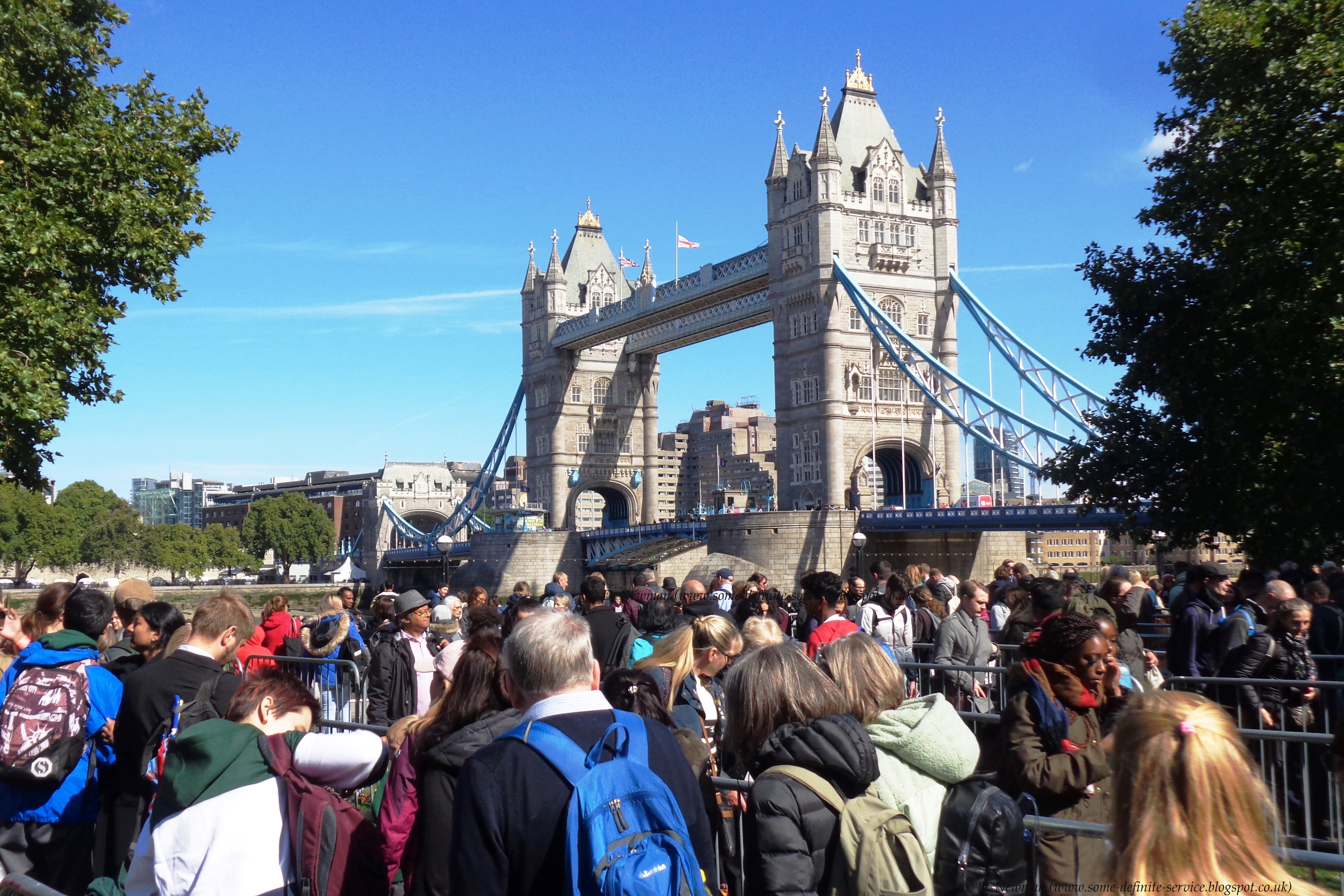
The queue for the Queen’s lying-in-state at the King’s Stairs Gardens, Bermondsey, roughly five miles from Westminster.  10.30 a.m., 17th September 2022. 

My final contribution to the Second Elizabethan Age was, as it turned out, to take half a dozen newly-catalogued manuscripts down to the store, slide them into fresh envelopes, fasten them with archival tape, label them, and put them ready for shelving.  I had seen the lunchtime announcement about the Queen’s health, and worried and prayed as I worked, actually rather glad there was no computer downstairs.  By the time I surfaced again, the news had broken: it was a colleague in Security, an ex-serviceman, who told me.  “If it hadn’t been for her, this country would have gone to the dogs years ago,” he said flatly.

The day afterwards, a friend of mine happened to be cataloguing a file of condolence letters received by an actor’s widow, and came across a nice phrase: ‘You can prepare your mind, but you cannot prepare your heart.’  We had known the day would come and dreaded it, but even I was slightly taken aback by the grief that took hold of me when it did.  As others have said, the Queen’s death was not a surprise — but it was a shock.

Yet the way it happened was in several respects fitting, and therefore already consoling.  Not until after the pandemic, and the great Platinum Jubilee, and even this summer of ferocious heat and the shocking beige of drought were over; only once welcome showers were sending some of the life and colour flowing back into Britain’s veins, so that our landscapes were beginning to look themselves again, did the moment arrive.  The Queen saw us through, and then she went home.

And from the ten days of mourning that followed, too — with a first autumnal bittersweetness in the air, with the tearful glory of rainbows in the skies, with torn ragged clouds trailing overhead at dusk like smoke, with the hard underframe of the national story to which we all belong suddenly only just below the surface — I shall remember not only sorrow, but deep consolation.  I mean not only the constitutional reassurances — the ancient mechanisms of the accession ceremony, swinging into motion like a pair of sombre oaken doors, just, I realise, as they would have done, if needed, on any other day between 1952 and 2022 — I mean something deeper: spiritual consolation.  The lying-in-state, for instance, was balm for the soul, even when seen on television: the solemnity, the simple formality, the reverence.  And it worked, for in filed, and kept filing, thousands upon thousands of mourners, their faces strangely beautiful with love and grief, passing reverently through Westminster Hall, curtseying or bowing or even crossing themselves.  The live-streamed television pictures of this procession, though at times zooming a little intrusively into people’s faces, must be one of the most moving broadcasts I have ever seen.

The queue down Shad Thames, just E. of Tower Bridge.
And the extraordinary lengths of the queues showed the extent of the grief and the love, even as the pictures showed their depth.  Seeing dire warnings of a twenty-two-hour-long wait on the Saturday morning, my sister and cousin and I initially abandoned our plans to join the queue, deciding instead that we would walk along its length, past the mourners, pay our respects outside Westminster Hall, and then perhaps go to see the flowers in Green Park.  But just as we reached the start of the queue at Southwark Park, it was reopened with an estimated length of a mere sixteen hours, and we changed our minds and queued after all.

It was, as many have noticed, a pilgrimage — starting, for us, under the dingy girders of South Bermondsey station, along past Galleywall Road, through Southwark Park and a first set of interminable zigzags into the queue, past the makeshift tea-stands set up by enterprising residents, snaking among converted warehouses and bridges and embankments and theatres, over Lambeth Bridge, until, after a further two hours shuffling concertina-wise up and down Victoria Gardens, and a jarring bag-search and body-scan, at last we slipped into the thick solemn hush of Westminster Hall, with the rich colours of the catafalque before us, and the priceless brilliance of the Imperial State Crown flashing finely at journey’s end.

Zigs and zags at Tower Bridge

The whole experience (which turned out to be eleven hours long, not sixteen) taught me something about pilgrimage: that it is the natural expression of gratitude.  I had, and have, no way of repaying the Queen for her years of faith, and integrity, and quiet constant example.  All I could offer was a mark of respect before her coffin.  Small recompense indeed — but there was subconscious logic at work; the knowledge that if this little gesture could somehow be made to cost me more — if I had had to stand in a queue six miles long in order to be able to make it — perhaps it would actually come to be worth more.  Rather like the widow’s mite in the Gospel, my little bow would take on a greater meaning, because I had ‘given all I had’.

The Lambeth Embankment, across the river from Parliament, as the afternoon wears on

This, I think, has something to do with why, when I had heard that the queuing time had nearly doubled, my initial reaction was not dismay, but a strange instinctive determination that I was Jolly Well going to queue, come what may.  This is surely the same impulse that drives people to walk barefoot and impose on themselves all sorts of hard, tough exigencies while on pilgrimage.  It is, however heartily we laugh and joke with our fellow pilgrims along the way, a serious, deep, even primal gesture of love.

The Palace of Westminster from Lambeth Bridge, with flag at half-mast

I think the same is true of the great marches and the funeral offices: as well as solemn duties, they were acts of love and gratitude.  How beautiful, then, that they healed us even as we undertook them.  How comforting, too, were the beautiful prayers of the Anglican liturgy, their loving poetic language, commending our Queen to our God, and telling us again and again what we needed to hear: that whereas we rightly grieve our Sovereign who ‘now rests in sleep’, we may nevertheless have confidence both that ‘we shall rise again at the coming of our Saviour Jesus Christ’  —  and, furthermore, that ‘in due time, we may share with our sister that clearer vision when we shall see thy face.’  We are right to grieve, but it is not the end: again and again I drank in the medicine of those words.  One sensed the wisdom of ages in the knowledge that ten full days would be needed for the initial salving and bandaging of the wound, for that ‘gracious promise’ to sink in once again.  

The two-mile-long concertina in Victoria Gardens

“We will miss Queen Elizabeth terribly, said Archbishop of Southwark, John Wilson, at a beautiful Requiem Mass at St. George’s Cathedral the following morning.  I have written at length elsewhere in these pages of my admiration for the Queen, and of how extraordinarily blessed we have been to have at the heart of our national life a person who placed love so clearly above power, and for so long, and with such constancy.  She may not have made her personal opinions known, but she did show her beliefs, and the response to her death, the outpouring of grief and love, shows that this did not go unnoticed.  And so, as that extraordinary and bittersweet month slides away off into the past, and as we who share those beliefs, shouldering our loads, turn to carry on without her, we may take slow-burning courage from this parting gift: the vindication in her death of the manner of her life.

Go forth upon thy journey from this world, O Christian soul;
In the name of God the Father Almighty who created thee;
In the name of Jesus Christ who suffered for thee;
In the name of the Holy Spirit who strengtheneth thee.
In communion with the blessèd saints,
and aided by Angels and Archangels,
and all the armies of the heavenly host,
may thy portion this day be in peace,
and thy dwelling in the heavenly Jerusalem.  Amen.
A still frame from the BBC’s live stream from Westminster Hall.