Showing posts with label marriage. Show all posts

Tuesday, May 16, 2023

Some Grounds for Catholic Optimism

The Archbishop of Westminster, Cardinal Vincent Nichols, began his New Year message for 2022 by comparing two different kinds of hope.  One he called the ‘pragmatic version’ — in which ‘a secure present’ gives us confidence to ‘look forward to an uncertain future’ — whereas the other, he said, was the ‘theological virtue’ of hope — ‘the capacity to face an uncertain present’ because, beyond it, we trust in an ‘utterly secure future.’  

Most of us in the Church would recognise this distinction.  After all, the first kind of hope, which we might also call ‘optimism’, is in distinctly short supply these days.  As the memory of the old faith drains steadily out of our cities and civilisation, as the tenets of the Creed are forgotten one by one, as forces mighty as Goliath yet insidious as the serpent conspire to hobble the Church and smother the Gospel, the psalms of lamentation come easily to the lips: ‘How shall we sing the Lord’s song in a strange land?’  And so we cultivate the second kind of hope, setting our sights and our hearts on the ‘utterly secure future’ of the kingdom of Heaven.  We brace ourselves for the ‘Long Defeat’, as Tolkien put it, in sure hope of the Final Victory.

But what if even earthly hope is not altogether lost?  For although this nurturing of Deep Hope is fundamentally the right approach to our situation, it nevertheless carries with it an understandable temptation: to give up on the immediate future altogether, and thereby to miss such possibilities as do in fact lie before us.  We are not Albigensians; we should not turn our backs completely on the world.  The Resurrection of Christ was as earthly a thing as it was supernatural, and changes the present moment as much as it does eternity; its implications are not only cosmic but comprehensive, changing the world not only in general but in detail, and from within, not from without.  Our everyday lives on earth are shot through with a new life-force — the Word, whispering perpetually into every crisis, ‘This is not the end — for I was, I am and ever shall be.’  Even in these bewildering times, there is an onward path to tread.

Cardinal Vincent in his message goes on to point out the ‘middle ground’ that exists between the two kinds of hope.  His point, if I understand rightly, is that we need to develop an intelligent combination of both: Deep Hope in the long term; courage and fortitude in the short.  Even if ‘optimism’ is hardly the first word we might use to characterise our immediate outlook, it has to be an ingredient in our approach.  Even a dash will do.  As we heard from the prophet Jeremiah (of all people!) one Sunday last year:

A blessing on the man who puts his trust in the Lord, with the Lord for his hope.  He is like a tree by the waterside that thrusts its roots to the stream: when the heat comes it feels no alarm, its foliage stays green; it has no worries in a year of drought, and never ceases to bear fruit. 
(Jeremiah 17: 5–8)

‘Never ceases to bear fruit’…  Mainstream opinion-formers may think the Catholic Church obsolete, deluded and contemptible, but we must not give the slightest impression of believing them.  Certainly we should be prudent in the deployment of our energies; absolutely we must attend to the deep and inner roots, but in the drought of the coming decades we must never lose confidence that the Church will indeed ‘never cease to bear fruit’ — because she retains countless ways to prove herself essential not only to her own members, but to our whole society.

What sort of thing do I mean?  Here are some ideas.

1.  Pro-life victory is certain

I am absolutely confident of the eventual victory, on earth, of the pro-life movement.  This might sound absurd, given the present total dominance of the abortion lobby in law and politics.  All the same, of the innumerable logical contradictions at the heart of the revolutionary secular-progressive project, this is the hardest to sustain, and indeed can be sustained only by shrill campaigning and a constant flow of cash.  A succession of scientific discoveries is steadily and consistently vindicating the Church’s position, and, sadly, so is the testimony of ever greater numbers of women as to the offence done by abortion against their dignity and happiness.  The strength of the pro-choice lobby is nearing its high water mark; it has little further ground to gain; it is already having to become defensive of its establishment position.  Its members are beginning, rightly, to recognise the possibility that they will, as the phrase goes, ‘lose the narrative’ to the joyful and energetic pro-life message.

March for Life, London, September 2018

I do not mean to sound complacent — after all, the cost in unborn lives now runs at over two hundred thousand every year in England and Wales alone — but I am not being complacent; I am being confident.  As with the trans-Atlantic slave trade two centuries ago, the whole outrage is likely to end abruptly, even unexpectedly, with a sudden anagnorisis and revulsion at the horror.  Unless our society is completely overtaken by nihilism, a point will be reached at which the injustice can be denied no more; someone at some point will ask, in a loud enough voice and in a way which will suddenly be listened to, why (for instance) we see hardly anybody with Down’s syndrome around any more; will ask why we uphold the rights of God’s animal creatures, as we should, without extending the same defence to our own unborn children.  When the tide does turn, the sheer consistency and integrity of the Church’s pro-life position, as well as her record in providing for mothers in need, will stand her in good stead when it comes to establishing a new and authentic culture of life.

That is one concrete reason for hope in our age, but still stretches the definition of ‘optimism’ a little far.  What about today and tomorrow?

2.  Fire-power isn’t everything

It is worth remembering that we still have great resources in the nature of our presence in society.  Secular progressivism is on the warpath, and hardening into a religion of its own, having at its disposal many organised shock-troops with strident and persuasive voices, and tightening its grip on our culture.  But if the Church seems not quite able to match this sheer fire-power, it is not because we lack good arguments or articulate ripostes.  It is because we have other things on our plate as well.  Unlike the cultural revolutionaries, we have always been concerned about more than mere propaganda.  The Church may be in battle, but she is not merely a battleship: she has to be a rescue vessel and a hospital ship and a flagship all at once.  She cannot be expected to swivel and aim her guns as adeptly as a purpose-built destroyer.

What is more, so much of the strength of our witness actually lies in our silence.  This is true in two senses: firstly in the simple fact of our not going along with propaganda or slogans, and secondly in the positive quality of the silence of our sanctuaries.  Especially these days, when moments of peace, let alone peace by oneself with God, are so hard to come by, precious indeed are the physical refuges of our churches amid the howling cities.

Our strength lies, too, in the aspects of the Church’s life that never make the headlines: her presence in hospitals, in hospices, in prisons, in homeless shelters, in ports, in refugee camps, in the armed forces, in universities, in schools.  And her charities: the tireless work of CAFOD for overseas development, Aid to the Church in Need for persecuted Christians, the St. Vincent de Paul Society for the homeless, and so on.  All those things that are never chalked up on the scoreboard of history: the Masses, rosaries, hymns and prayers; the confraternities, the prayer-groups, the pilgrimages, the devotions; the ‘ecclesiolae’ or ‘little churches’ of families holding their own day after day.  The kindly priest in the lit confessional; the Mary-garden under the railway arch; the soup-bowl in the homeless shelter: in all these ways the Church, with that gentle tenacity of hers, persists in living the ‘life to the full’ that her Founder promised.

The cultural revolution tends to be keener on the commanding heights of the culture — the law, the government, the arts, schools, universities, and the apparatus of civil society — than on the welfare of ordinary people.  This tells us that it is only really interested in power; that for all its capacity for intimidation it is necessarily brittle and lacking foundations, and that its strength, though incontestable for the moment, will prove ephemeral.  The Church’s appearance, by contrast, is no mere veneer.  Under the surface she is true to her word.

3.  The Church comprehends the new and pluralised Britain 

Another opportunity for the Church in years to come, one in which it stands as good a chance of success as any other institution apart from the Crown, is in making sure we fashion a harmonious society of the new pluralised Britain, and preventing the emergence of any division or mutual alienation.  Relatively few things can be said to unify us as a country these days, and certain fractures are emerging which the Faith is placed uniquely to heal.  What but the Christian imagination could even conceive of bringing into serious dialogue, say, the secular liberal on the one hand — whose instinct for mercy, though misproportioned, echoes a distinctively Christian idea — and the observant Muslim on the other, whose concern for justice, codified by the bracing tenets of Islamic law, testifies to a sincere attentiveness to God’s will?  Because the Church understands this paradox of justice and mercy, knowing how to temper one with the other, she can, I think, foster more fruit from such a conversation than anyone else.

And where else but within the Church can the demographic changes of the past fifty years be not only reconciled but harmonised convincingly with the deepest roots of our society?  To take only one of countless examples, consider the Tamil pilgrimages to Our Lady’s shrine at Walsingham, which I understand attract the largest numbers of all the pilgrim groups.  In this village in the heart of rural Norfolk, a place of pilgrimage since before the Norman Conquest, an ancient English devotion is unified with a Tamil one.  There is no contradiction between love of England and love of neighbour; there is simply one faith, one Church and one Lord.  Thus the world-wide roots of today’s pilgrims are entwined with the very depths of England and Englishness, new Britons follow in the footsteps of medieval kings, and all pilgrims throughout the ages are unified in peace and goodwill.  For many immigrants and their families and descendants, the Catholic Church is a ‘home away from home’ — and yet it has been here in England, waiting for them, it seems, since England’s very beginning.

Tamil Pilgrimage to Walsingham, Norfolk, 2016

4.  New alliances amid the crisis of meaning

Then there is the crisis of meaning: the alarming and deepening void at the centre of modern life, and, which is often even more horrifying, all that is rushing in to fill the void.  Only a decade ago the New Atheists were trumpeting the new dawn of a fanaticism-free secular age of cool rationalism, but now their vision seems completely unequal to the socio-cultural forces of our present time — forces which I am convinced are also spiritual.  As R. S. Thomas wrote,

In cities that
have outgrown their promise people
are becoming pilgrims
again, if not to this place,
then to the recreation of it
in their own spirits […]

Amid a loss of confidence in our institutions, our culture and even ourselves, a tremendous spiritual famine has suddenly declared itself: often vague, often outwardly hostile to formal religion, but unmistakeably spiritual in character.  This manifests itself in some obvious ways — the growing and understandable popularity of ‘mindfulness’, or the emergence of whole new academic fields such as ‘Loneliness Studies’ — but also in some more alarming forms: in the new ideologies sweeping every public institution, our blind faith in progressivism, and the many genuinely troubled young people.

Writers such as the essential Mary Eberstadt have long been observing how sixty years of aggressive secularism have been incubating this situation — but plenty of non-churchgoers are also noticing the crisis.  They share our alarm at the widespread subjugation of truth and reason to personal desire, and many are realising that even the Church may have something interesting to say about it.  We can and must do our best to repay that confidence; if we do, we may find ourselves entering into some new and fruitful kinds of dialogue.  (I say this from personal experience.) 

5.  The crisis of gender, though tragic, is a particular opportunity

One friend with whom I regularly enjoy such conversations recently brought to my attention a recent lecture on freedom of speech, one of the BBC’s annual series of Reith Lectures, by Nigerian-born novelist Chimamanda Ngozi Adichie.  At the core of this address was an appeal for a ‘coalition of the reasonable’ to maintain the standards of public debate.  She was speaking mainly with reference to the extraordinary behaviour in recent years of many advocates of gender theory, who have often been using outrageous tactics in order to advance their contentious cause, organising social media storms, releasing personal information, and even hounding their opponents from their jobs.

Adichie’s is an invitation to which the Church can and must respond positively.  We believe in reason and know that civil and reasonable debate are essential to our whole society — so there is an opportunity here for some real solidarity and co-operation.  In forming such alliances we do not have to pretend to agree where we disagree, but there is no reason why an edifying exchange of ideas should not take place.  The ‘reasonable secularists’ can discover our sincere interest in truth and reason, while we might draw some inspiration from their strength of purpose and concern for accountability and integrity.  Maybe, in finding ourselves on the same side for once, the discussion will be more constructive than it has been for many years.

Perhaps, too, at a relaxed moment, the conversation might turn to higher things, and to the spiritual dimension of the crisis of our time.  We might mention Benedict XVI’s insight that as well as reason we need faith, and that the two are not only compatible with but absolutely essential to each other.  We might make the point that the sense of meaninglessness from which so much of the crisis has stemmed corresponds to a deep reality about ourselves — that our longing for meaning is not some vague and inconvenient appetite, nor some functional or dietary need to be satisfied by the appropriate vitamin, but is a sign of the deepest truths about ourselves: the spiritual truths.

Even so, the urgent task remains to offer charitable but robust collective opposition to gender theory, which even now is doing irreversible damage to many confused and unhappy young people, as well as offending in a particular way against the rights and dignity of women.

6.  The Re-evangelisation of Romance

Another obvious mission for the Church is also one of the most dangerous: to confront head-on the ongoing melting down and recasting of marriage and the family, and to re-evangelise the sphere of romantic and marital love with the fullness and beauty of the Church’s teaching.  

Here, as with abortion, the post-Sixties revolutionary movement is visibly running into difficulties, and beginning to fray amid its own contradictions.  But its power is still tremendous, and its price exacted mainly on the young — who secretly, often even without knowing it themselves, long to hear the truth.  They long to be told what deep down they suspect: that all men and women were made for each other’s mutual respect and friendship, not for sullen rivalry; that the unique kind of friendship which is life-long marriage, the real thing, is no fancy but the gold standard, given to us by God for our flourishing; that a bride and bridegroom really are worth to the other nothing less than the gift of a great cosmic vow, one equal to the weight of an entire human life and strong enough to sustain the multiplication of new life; that such a vow is no mere formality, but something we long with all our hearts to make and to fulfil.  Youth seeks truth — the truth about ourselves, a truth which is written in our bodies as well as in our souls — and the Church, with teaching that is as beautiful as it is true, must be there to meet their longing.  Our culture is near enough rock bottom to hear it.  

We will often run up against wild rage and hatred — for those entrapped by darkness hate and fear beauty and truth — but there are millions of others waiting to be captivated by the high mission to which the Church calls them.

As Mary Eberstadt said in a recent interview,

Catholics should be proud — in the right way — of all these unpopular teachings.  They’re only unpopular for the moment, and […] they resonate with the human heart.  That again is to our advantage as we try to press this case.

This is one of the few spheres of life in which many people will still acknowledge a spiritual dimension, while often remaining sceptical about the form of marriage.  We are in much the same situation as those who argue for rhyme and metre in poetry: our task is to show how the form gives sense to the feeling; how the rules and vows give the underlying human impulse the sense and the strength to endure.  Against the pessimism of liberalism, with its fear of commitment, with its cynical assumptions about loyalty and perseverance, many will be surprised and inspired by the frankness, the freshness, the bracing realism, and, yes, the sheer optimism of the Church’s vision.

7. How hope works

I have one final remark on the way hope itself works, and where to look for it.  Whether pragmatic or theological, hope does not usually come marching over the hill; it grows fierce and green in unlikeliest places, as tenacious as grass or wildflowers.

One hot day a few years ago I was riding down a cycle path alongside a heaving A-road in south London, gritting my teeth against the noise and hostility around me, when the path narrowed and, seeing a child of about ten or eleven coming the other way, I braked to let him through.  To my complete astonishment, he very sincerely and deliberately thanked me; I hadn’t expected it and was too stunned to respond adequately.  There, uncrushed by the juggernauts and the tyres, defying the smirking warlords of the road, a tiny counter-witness, a green shoot of hope — something so vital, so ‘original, spare, strange’, that it offered a stronger riposte to its surroundings than perhaps the boy knew.  Like Lovejoy’s garden in Rumer Godden’s book An Episode of Sparrows, hope grows and germinates in defiance of overwhelming forces, even in spite of ourselves, in the ‘fields of our hearts that dead and bare have been…’

In the same way, as we should know from our own lives — and at Eastertide of all seasons — the vindication of the faith is with us, on earth, in this very hour.  ‘Christianity works,’ as Douglas Gresham, C. S. Lewis’s straight-talking step-son, once said.  It works in our lives, in every detail of our lives, even if the wider world is ignoring it for the present.  

---

I am under no illusions: this is a very uncertain and unsettling age, and things will not be easy for the Church for some time.  Many of the opportunities I describe may only be born of various crises and amid great suffering: it may be that we can be optimistic only to the extent of being poised to respond to a crisis.  It is also undeniable that the Church as an institution — in Europe and the West at least — has been severely weakened in the past fifty years — partly by mockery and marginalisation from without, partly by slacking and scandal from within.  But the Church’s members on the ground are chastened and made wise by crisis; we are all, clergy and laity alike, more alert, less complacent, and more capable of giving an account of ourselves than we have been for some time.  And in an age when all institutions are struggling to win trust, the Church is again as well-placed as any other to recover her integrity and a visible authenticity.

As far as external threats go, the Church can handle crises far better than she can uncertainty and apathy.  Our very foundation began with an utter catastrophe which was gloriously and outrageously inverted into triumph.  We have the ‘utterly secure future’; we have the Final Victory — but the near future is worth fighting for as well.  Keeping courage, then, means keeping courage in the short term as well as the long; today and tomorrow, this hour and the next, so that, in a happier time, our descendants will remember and give thanks for their forbears in faith, as we give thanks for ours.

The Lord is my light and my salvation; whom shall I fear?…
Though an army encamp against me, my heart shall not fear.
For in the time of trouble he shall hide me in his pavilion:
In the secret of his tabernacle shall he hide me; he shall set me up upon a rock.
  

(Psalm 27: 1–5)

Pope Benedict at Hyde Park, September 2010.

Saturday, April 25, 2020

Spring, Regardless

When last did silence lie over South London as it has in the past few weeks?  The Seventies?  The Sixties?  The Fifties?  Only the brief ‘stillness of the solemn air’ after heavy snowfall, as in February 2009, seems comparable, but even then I am not sure there was ever a hush so thick as that which now descends on London at night, not just in the street outside, but in all the roads around, and the roads beyond them, for miles and miles and miles.  The slick, insufferable, incessant, suburb-saturating, sempiternal seething of traffic has vanished.  Some reports suggest that the number of cars on the road has gone down by two thirds to its lowest level for sixty years; I could well believe this.  Now, four weeks into the national quarantine, I am noticing the volume of traffic creeping up again, but it is still bearable for now.  Any relief is welcome.

Council notice on the Common.
I am well aware of the suffering wrought by the pandemic, and that I write from well behind the front lines of the great battle against it, and indeed that I am relying largely on others to do the fighting.  All the same, I think it is not unfair to observe the silver linings I described a few weeks ago.  The quietening of London’s madness is one; another is the community spirit that has been the paradoxical fruit of enforced isolation.  Even having to keep our distance from each other has brought about a kind of solidarity: it is sometimes awkward to leap into the road or brambles when meeting someone coming the other way, but most people see the point and even, sometimes, humour in it (“Don’t get yourself stung!” a lady told me when she saw that I had leapt off the path into some shallow brambles to let her pass).  Children have decorated windows and pavements with innocent rainbows, and on my daily constitutionals I am exchanging friendly greetings with strangers in a manner completely at odds with London’s usual way of doing things.  

Then there is the weekly eight o’clock round of applause for doctors and nurses, which has been kept up vigorously in our street.  A friend reports that the clapping in his village at the fringes of London is lessening every week, but round near me (much further in) I am sure it is growing, if anything.  The neighbours add to the clamour by hammering on pots and pans, or by thumping their wheelie bins, while passing cars sound their horns.  Then after a minute or so, we down tools, wave to each other or call in greeting across the street, and withdraw.  Some might scoff at this, but I feel this is just the sort of custom that many parts of Britain, mine included, have long lacked.

It occurs to me that this pandemic may well cement the National Health Service into place as the established religion of Britain.  This is entirely understandable: our debt to doctors and nurses is now partly due in a currency other than that in which we pay our taxes.  But it may cause problems in the future if, as tends to happen with any large institution, the NHS comes to need reform of some sort, and public feeling produces misplaced resistance, legitimate changes being mistaken for undue interference.  On the other hand, the strength of public faith in the NHS will also serve as protection against any short-sighted erosion or thinning out of its services by its overseers.  Maybe, though, we will soon have worse to worry about than either of these problems.  (And I would also observe quietly that there are some needs which even the NHS cannot be expected to answer.)
Local pavement decoration
Daily walks over the now-well-worn paths of the Common have also given me the chance to see spring’s great leafburst in far more detail than usual.  In previous years, I put its seeming to happen overnight down to my lack of observation.  But now, regular visits in quick succession have shown me the remarkable proliferation that really does take place over only a two or three days, as if all that life is kept pent up in the earth until it can be contained no longer.

I have not altogether forgotten about the world outside my parish, though.  One gloomy piece of news that has almost been lost amid the coronavirus coverage is the continued collapse of marriage in Britain: the number registered in 2017 was a new record low, and of these the proportion of ceremonies with any religious dimension was also the lowest ever recorded: 22%.  It may sound blunt to say this, but this is the sign of a civilisation that scarcely believes in the future at all, let alone in lasting love.

But there has been cause for good cheer, such as the birthdays of Benedict XVI (ninety-three) and H.M. the Queen (ninety-four).  And Pope Francis has also given an interview here — https://www.thetablet.co.uk/features/2/17845/pope-francis-says-pandemic-can-be-a-place-of-conversion- — with something to hearten and challenge everyone, as is characteristic. For example:
It’s true, a number of governments have taken exemplary measures to defend the population on the basis of clear priorities. But we’re realising that all our thinking, like it or not, has been shaped around the economy. In the world of finance it has seemed normal to sacrifice [people], to practise a politics of the throwaway culture, from the beginning to the end of life. I’m thinking, for example, of pre-natal selection. It’s very unusual these days to meet Down’s Syndrome people on the street; when the tomograph [scan] detects them, they are binned. It’s a culture of euthanasia, either legal or covert, in which the elderly are given medication but only up to a point.
And —
Yet the elderly continue to be our roots. And they must speak to the young. This tension between young and old must always be resolved in the encounter with each other. Because the young person is bud and foliage, but without roots they cannot bear fruit. The elderly are the roots. I would say to them, today: I know you feel death is close, and you are afraid, but look elsewhere, remember your children, and do not stop dreaming. This is what God asks of you: to dream (Joel 3:1). 
What would I say to the young people? Have the courage to look ahead, and to be prophetic.  May the dreams of the old correspond to your prophecies.
 I hope all readers, and their friends and families, are safe and well.

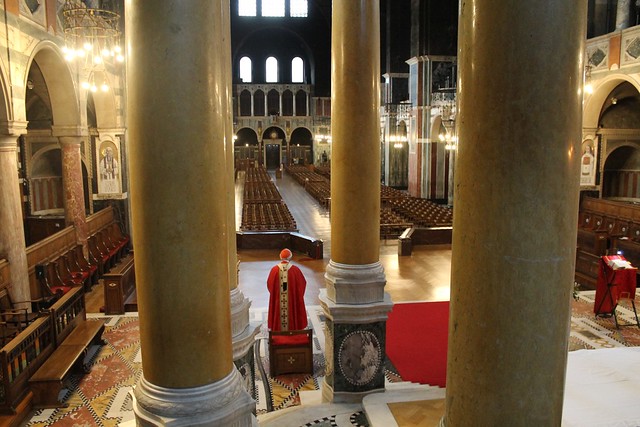
IMG_3880
Cardinal Vincent Nichols (Archbishop of Westminster) celebrates Mass for National Health Service workers, carers, the sick and their families, in Westminster Cathedral.  
Photo from https://www.flickr.com/photos/catholicwestminster/49812472648/ (IMG_3880, 23rd April 2020).

Monday, June 10, 2019

Whitsuntide and Sanity

Happy Whitsun!  This is the feast of Pentecost, when the Holy Spirit burst into the Upper Room, ambushing the disciples cowering there with tongues of fire and a rushing wind — and set the Church off on its great adventure.  We in Britain celebrate it rather feebly these days.  Eleanor Parker, author of one of the best blogs on the Internet, ‘A Clerk of Oxford’, has an article on the ‘lost holiday’ of Whitsuntide.  It was, as she puts it, ‘the time for fairs, Morris dancing, games, ale-drinking, school and church processions, weddings, wandering into the countryside, and generally having a good time’.  It is only very recently that this has faded away.  The Clerk gives a link to a newsreel film of Manchester’s grand Whit Monday procession in 1927.  It is almost unbearably evocative of that vanished solemn world of cast-iron, and trams, and Corporations.  The white clothes of thousands of children are startling amid the huge soot-blackened hulks of mighty civic buildings — a sight that is now impossible and even unthinkable, though, thankfully, the Mancunian Whit Walks continue to this day.   Even in the early 1950s, Philip Larkin could still observe, in one of his finest and best-known poems, the tradition of Whitsun weddings.  Did he guess how completely the sight he was recording was about to fade away?  Was it he, as much as anyone, who was ‘out on the end of an event / Waving goodbye / To something that survived it?’  For look at what has happened to Whitsun since then.  The holiday has had all its character and flavour rationalised and secularised out of it.  Where once, seven weeks after the moveable feast of Easter, we had Whitsuntide, with its fire and wind and its brass bands and ale, we now have merely a bureaucratically static day off, the ‘Late May Bank Holiday’ — yawn.  It is better than no holiday at all, I hasten to stress — but it seems so dull and flat, and it has lost us our bearings, the flavour of our season and our bond with the past.

It has occurred to me recently that the Thing, whatever it is we should call it — hardly a Spirit — the materialistic, individualistic, over-liberal, progressive secularism of our day, will founder in the end mainly because of its own sheer dullness.  We have done a pretty good job of disenchanting life.  What now?  The exhilaration of life lived only for the moment and for the self, day after day, with only earth-bound hopes and the vaguest beacons of transcendent meaning, can only last so long.  We cannot distract ourselves for ever from the question that never goes away: what will fill the chasm of longing within us?  We know that the world of the performance appraisal, and the retail park, and the ready meal, is ultimately an insult to the dignity and depth of the human being, a dignity and a depth which cannot be ignored or privatised without consequence.  We have lost the words and the gestures by which we once articulated the magnitude of birth or marriage or death, and compassed moments of particular joy or suffering.  Where are our feasts and seasons to illuminate the year, the occasions for majesty or solemnity, our resonant poetry and song, or a deep spirit of togetherness that does not rely on an opponent or scapegoat for its strength?  Where is our hope for eternal life?  We will soon recognise, with alarm, how truncated is our sense of history, how disenchanted our sense of place, how stifled our hunger after wonder, and how hollow the inheritance bequeathed to us by the spirit of secularism: boring art, boring ideas, bored lives.  Secularism will fail because it is boring.

And secularism will run out of steam, too, because of its fundamental pessimism about the human person.  This may seem a strange thing to say about a tide of thought with so much to say about self-esteem and self-fulfilment.  But I am sure it is true.  For instance, the idea that our lives can mean whatever we decide, though it sounds good at first, conceals a cold indifference, for it leaves us perfectly free to decide that it means little or nothing at all, and, since many of us sometimes need encouragement to find and pursue real meaning, it leaves huge numbers of people open to the clutches of nihilism.  And, more broadly, many currents of thought that have become prominent in Britain, especially since the 1960s, have relied on pessimistic, often cynical arguments.  We all know how they run: the answer to difficulties in marriage is divorce; the answer to crisis pregnancies is abortion; the answer to terminal illness is euthanasia.  The idea of quality of life is turned to ill-use, to the evaluation that some lives are not worth living.  St. John Paul II’s phrase ‘culture of death’ was not too strong an expression.  It can’t last for ever, and indeed it isn’t lasting.

Even in the last century, C.S. Lewis observed the difficulty that our culture has in aspiring to high ideals.  He lamented that people seem unable to recognise that ‘when B is better than C, A may be even better than B’, or that people prefer ‘thinking in terms of good and bad, not of good, better and best, or bad, worse and worst’ (‘Mere Christianity’, Collins, 2012, p.108).  So many people think that the Church, if it speaks against B, is condemning people to C, whereas it is really hoping for A for us all.  It is an irony that, even as it aspires to utopia, and even as it criticises the Christian doctrine of original sin, the secular world nevertheless seems to have resigned itself to the inevitability of certain evils.  The recent introduction of so-called ‘no-fault divorce’ into law has given us yet another chance to see this habit of thought at work.  The advocates of that idea argue that what they called ‘amicable divorce’ is preferable to an ‘acrimonious divorce’, as if anybody would suggest that conflict should be aggravated where it could be lessened.  But they take it entirely for granted that divorce is simply a fact of life, like illness or bad weather.  But what if — one might ask — what if we tried to avoid divorce as much as possible; indeed, altogether?  We have free will, and we can use it to keep promises just as much as to break them.  What if we encouraged husbands and wives to stick together in moments of difficulty?  Is this not why they once made their vows?  Should we not help them towards heroic reconciliation, with the help of family, friends or counsellors, anything that it takes?  Those in favour of the new law might scoff that this assertion is simply childish naïvety.  But is it rather childlike innocence, which is something quite different — and, what is more, since it is children who tend to suffer most from divorce, is it so misplaced?  Contrary to the egregious posters that appeared all over railway stations a few months ago, advertising a divorce app — with a phonily jolly message from a fictional Mr. and Mrs. Foster who have decided that ‘things really haven’t worked out and we’re calling it quits’ — ‘amicable divorce’ is a contradiction in terms.  The sundering of vows causes great suffering to all concerned; nobody arrives at that point unscathed by grief, and divorce carries no promise that things will not worsen (it is divorce, not marriage, that weaponises children).  By asserting that such things are commonplace, and should be the foundation of rights and laws, secularism belies its fundamental pessimism and hopelessness.  Meanwhile, though, the Church asks, quietly, and with that ingenuousness that will save the world: what if a vow actually means a vow?  What if chaos need not necessarily have the final word?

I say all this not to pass judgement on those who go through divorce, especially in today’s climate, but to give an example of the ways in which secularism abandons people in difficulty.  The Thing seems very adept at working out the lesser of evils, but pretty hopeless at aspiring to the greatest good.  It has worsened that startling lack of moral verticality that C. S. Lewis observed; a kind of Brutalist shoulder-shrugging style of ethics which lowers the ceiling of human love and self-giving, and which often assumes that heroism is unrealistic, that sainthood is fantastical, and that we can afford simply to give up too easily.  The result of all this is that we all settle for too little from ourselves and from each other.  So, one implication is that men don’t hold themselves to high enough standards of manners and speech; women therefore don’t believe men are capable of high standards and so don’t dare to expect them; and so both settle for less and less, and end up demoralised.  (Meanwhile, in the spheres of education or career, people often expect far too much of themselves, making all kinds of sacrifices for things which do not, in the end, determine their dignity).  And is there another reason why we settle for too little: that we do not believe in mercy?  Do we fear that to aspire to high standards in our lives is to set ourselves up for a fall from which we will never recover? How swiftly this idea leads to cynicism and nihilism — and again it is because there are questions which secularism doesn’t know how to begin to answer.

The Thing seems all-powerful just at the moment.  It has claimed the media, the mainstream and the momentum.  Worse, it holds considerable sway over the language, manners and customs of ordinary people.  But it will have to last another nineteen centuries if it is to outlast the Church and since, in the end, it is reductive, and boring, and it sells us short, and tells us that we are less than we are, that we are merely granules of egos, zooming about directionlessly until we are extinguished, I would not bet on its staying the course.  It is too cynical to understand heroism; too superficial to comprehend beauty; to shallow to nourish friendship.  Birth is beyond its understanding; death defeats it.  Our dignity cannot stand this for ever.  Ultimately, too, the culture of death must die.   

Secularism may not necessarily fail violently or dramatically, but when it does fail, as fail it will, the Church will still be there, with hope and pageantry intact, along with the year’s colourful wheel of feasts and seasons, the tongues of fire and the rushing wind.  We know that life matters beyond what we see, however hard we try to deny it; we know it has a meaning too deep for words and thought, and we sense the immortality of our souls.  Religion, properly practised, lends life the dignity that befits it, and the paradox is that this makes us joyful and light-hearted in spite of our suffering.  We will keep the feast of Whitsun as of old, and sanity will prevail.

Saturday, December 30, 2017

Vows and Vocations


At three o’clock — or sometimes shortly thereafter, now that live broadcasts can be rewound — we allow the television to interrupt our merry-making on Christmas Day.  The Christmas pudding having been doused in brandy and set fire to and sung over and most assiduously devoured, we are usually just in time for one of the more unfrenetic and comforting broadcasts left on the main channels: the Queen’s Christmas message.  I find it invigoratingly traditional in spirit, and there is a rare feeling of national togetherness as the Queen invites us to look back on the year.  Gloriously heedless of the BBC’s dull secularist ethos, H.M. always makes unforceful but unambiguous (and therefore courageous) mention of her Christian faith. This year’s message was the fiftieth the Queen has made by television, so it is a well-established tradition in its own right.

But even fifty years of Christmas broadcasts struggle to shine against the seven decades of the Queen’s marriage to the Duke of Edinburgh.  There beside the Queen as she delivered her message, next to the portraits of her great-grandchildren George and Charlotte, are two photographs of Elizabeth and Prince Philip.  One was taken on their wedding day in 1947, and the other in November this year to mark their Platinum Anniversary.  Seventy years separate the pictures, but one reciprocal vow is common to both.


This is marriage, the real thing, and this particular marriage is special because it belongs to us in much the same way as the Queen herself belongs to us.  It is one of the last lit beacons in bleak Britain, whose marital statistics show that a third of all marriages are sooner or later put asunder, and that more and more couples move in under the same roof without entering into marriage at all.  More than three million families have been begun without the security of wedlock.  It is some decades since the State showed any understanding of its proper responsibility in this field, which is to create all the right conditions for stable family life, especially for the sake of its oldest and youngest citizens, without meddling in it.  What has happened instead is that marriage has been undermined so that, from a simply practical point of view, people can hardly be blamed for choosing to set up home in co-habitation.  The social and financial benefits that marriage once brought do not now make economic sense, and to many people the law appears to set a trap, being still just tenacious enough to protract and sour any parting, yet not firm enough to banish the very idea from people’s minds, encouraging building rather than dismantling.  By Britain’s national anticulture, by spectres of the imagination and by the reality of people’s own experiences, many have come to fear the unsunderable vows.  Yet couples who are ready to found a household should surely wish for just such a bond.  Marriage helps couples, before they ever enter into it, by serving as a test or proof: if they do not feel they trust each other enough to marry, then they cannot know whether they trust each other to start and sustain a family.  On the other hand, if their mutual trust does indeed go far enough that children seem a real possibility, then why delay in giving form to the natural truth?  Marriage is for life because children join their parents for life.  The great vow is there to protect first husband and wife, and then their children, against human weakness and the evils of the world outside.

But we have also forgotten not only the practicality and common sense of marriage, but its transcendent, spiritual dimension.  This is another casualty of the dictatorship of relativism — Benedict XVI’s phrase — the tyranny of indifference that surrounds us, unctuously bidding us do as we please but offering no railings of guidance, and certainly no healing, if our desires lead us into wrongdoing and suffering.  The idea of marriage as a calling to high friendship, as a sacrificial mission that elevates the dignity of man and woman, has vanished, and along with it a sense of motherhood and fatherhood as vocations, to be honoured far above mere career or material prosperity or political engagement.  So people no longer know what to hope for, nor what to build, are therefore afraid of commitment, and so settle for too little from themselves and others.

Yet the Church insists not only on its spiritual dimension but on recognising it as a sacrament, that is, an encounter with the explicit presence of God.  Marriage is, indeed, a minor miracle.  I don’t mean this in a facetious way.  It is one of the great paradoxes of life, this unexpected, triumphant treaty of accord by which men and women, in their rival camps with their baffling, amusing, mysterious, undefinable differences, can find not merely reconciliation, nor even simply fleeting pleasure, but actually their highest earthly adventure by pairing up with a member of the other team (the rival team!), and sealing with them an all-transfiguring, world-creating pact, each a match for the other, and each the other’s match.

The impossible union is not only a wonder, but a plausible reality.  A bride will cost a man his life, but, mirabile dictu, it can come to pass that even such a wayward creature as a man will vow to pay, and keep his vow.  The hard-won reward is generous: he finds himself the beneficiary of a vow of equal magnitude, and he finds himself in a unique position to give the gift of self.  Moreover, the happiness and security this brings him overflows into any children the marriage produces, children who encounter no pit of dread in asking two of the most important questions in growing up: ‘Who am I?’ and ‘Whom can I trust?’, though many young people do encounter such a chasm.  And the Queen, who in her life has had to make some fearsome vows before God, to her bridegroom and to her realm, is one of our greatest living examples in this regard.  Her own family has not been untouched by the turmoil of marriage in late twentieth-century Britain, but she and her husband have kept their faith and their vows, and quietly encouraged the rest of us to do the same.

In marriage is found, and from marriage comes, the ‘home’ of which the Queen spoke in her Christmas message.  I think it would be a good challenge for the Church and all people of good will to make this a year of promoting marriage, simply the idea, in our tired culture.  The Coalition for Marriage is already doing an excellent job in keeping an eye on the state of things, informing public opinion and encouraging the Government to do the right thing.  But marriage ought to be an urgent topic of conversation.  It needs to be allowed to set alight the imaginations of young people (I write as one) who are hungry for a mission, and the message needs to be proclaimed that marriage is a good thing from alpha to omega and at every scale: national, local and in the innermostnesses of the soul.  It ought to be given a place near the heart of the New Evangelisation; to solve the marriage crisis would be to ease many of the other social, moral and spiritual problems that afflict us.  Along with the other sacraments of mission (Holy Orders and Confirmation), it is the antidote to the dictatorship of relativism’s shrugs of indifference, and the soundest, least wasteful vessel into which to pour, with generosity and joy, the fruit of one’s sacrifices.

Meanwhile… Merry Christmas!  Keep feasting!


(Malcolm Archer’s setting of the Linden Tree Carol)