Showing posts with label tradition. Show all posts

Wednesday, March 05, 2025

Rondel for Ash Wednesday

Reposted according to tradition… 

All friends of Christ, hold fast, hold fast;
Fear not these desert days of Lent. 
All grunged-up souls, all people pent 
In pleasure’s prison, bravely cast 
Your senseless sin aside at last: 
Believe the Gospel and repent. 
All friends of Christ, hold fast, hold fast;
Fear not these desert days of Lent.
The thirst and hunger will not last, 
For by God’s Son, who underwent 
The Cross, we know that we are meant 
For Heaven’s home when pain is past — 
All friends of Christ, hold fast, hold fast.
Brancaster Bay, north Norfolk, August 2024

Friday, May 29, 2020

Happy Oak Apple Day!

I have been reminded (by the blog ‘Once I was a Clever Boy’, via the British Catholic Blogs list) that today, 29th May, is Oak Apple Day.  (I shouldn’t have forgotten, but all the days are running into each other)…  A happy celebration of Charles II’s Restoration to all readers!

(An Oak Apple, by the way, is a gall, from one particular kind of which iron gall ink was once made).

Under the boughs of a local oak, 29 May 2020.

Saturday, April 25, 2020

Spring, Regardless

When last did silence lie over South London as it has in the past few weeks?  The Seventies?  The Sixties?  The Fifties?  Only the brief ‘stillness of the solemn air’ after heavy snowfall, as in February 2009, seems comparable, but even then I am not sure there was ever a hush so thick as that which now descends on London at night, not just in the street outside, but in all the roads around, and the roads beyond them, for miles and miles and miles.  The slick, insufferable, incessant, suburb-saturating, sempiternal seething of traffic has vanished.  Some reports suggest that the number of cars on the road has gone down by two thirds to its lowest level for sixty years; I could well believe this.  Now, four weeks into the national quarantine, I am noticing the volume of traffic creeping up again, but it is still bearable for now.  Any relief is welcome.

Council notice on the Common.
I am well aware of the suffering wrought by the pandemic, and that I write from well behind the front lines of the great battle against it, and indeed that I am relying largely on others to do the fighting.  All the same, I think it is not unfair to observe the silver linings I described a few weeks ago.  The quietening of London’s madness is one; another is the community spirit that has been the paradoxical fruit of enforced isolation.  Even having to keep our distance from each other has brought about a kind of solidarity: it is sometimes awkward to leap into the road or brambles when meeting someone coming the other way, but most people see the point and even, sometimes, humour in it (“Don’t get yourself stung!” a lady told me when she saw that I had leapt off the path into some shallow brambles to let her pass).  Children have decorated windows and pavements with innocent rainbows, and on my daily constitutionals I am exchanging friendly greetings with strangers in a manner completely at odds with London’s usual way of doing things.  

Then there is the weekly eight o’clock round of applause for doctors and nurses, which has been kept up vigorously in our street.  A friend reports that the clapping in his village at the fringes of London is lessening every week, but round near me (much further in) I am sure it is growing, if anything.  The neighbours add to the clamour by hammering on pots and pans, or by thumping their wheelie bins, while passing cars sound their horns.  Then after a minute or so, we down tools, wave to each other or call in greeting across the street, and withdraw.  Some might scoff at this, but I feel this is just the sort of custom that many parts of Britain, mine included, have long lacked.

It occurs to me that this pandemic may well cement the National Health Service into place as the established religion of Britain.  This is entirely understandable: our debt to doctors and nurses is now partly due in a currency other than that in which we pay our taxes.  But it may cause problems in the future if, as tends to happen with any large institution, the NHS comes to need reform of some sort, and public feeling produces misplaced resistance, legitimate changes being mistaken for undue interference.  On the other hand, the strength of public faith in the NHS will also serve as protection against any short-sighted erosion or thinning out of its services by its overseers.  Maybe, though, we will soon have worse to worry about than either of these problems.  (And I would also observe quietly that there are some needs which even the NHS cannot be expected to answer.)
Local pavement decoration
Daily walks over the now-well-worn paths of the Common have also given me the chance to see spring’s great leafburst in far more detail than usual.  In previous years, I put its seeming to happen overnight down to my lack of observation.  But now, regular visits in quick succession have shown me the remarkable proliferation that really does take place over only a two or three days, as if all that life is kept pent up in the earth until it can be contained no longer.

I have not altogether forgotten about the world outside my parish, though.  One gloomy piece of news that has almost been lost amid the coronavirus coverage is the continued collapse of marriage in Britain: the number registered in 2017 was a new record low, and of these the proportion of ceremonies with any religious dimension was also the lowest ever recorded: 22%.  It may sound blunt to say this, but this is the sign of a civilisation that scarcely believes in the future at all, let alone in lasting love.

But there has been cause for good cheer, such as the birthdays of Benedict XVI (ninety-three) and H.M. the Queen (ninety-four).  And Pope Francis has also given an interview here — https://www.thetablet.co.uk/features/2/17845/pope-francis-says-pandemic-can-be-a-place-of-conversion- — with something to hearten and challenge everyone, as is characteristic. For example:
It’s true, a number of governments have taken exemplary measures to defend the population on the basis of clear priorities. But we’re realising that all our thinking, like it or not, has been shaped around the economy. In the world of finance it has seemed normal to sacrifice [people], to practise a politics of the throwaway culture, from the beginning to the end of life. I’m thinking, for example, of pre-natal selection. It’s very unusual these days to meet Down’s Syndrome people on the street; when the tomograph [scan] detects them, they are binned. It’s a culture of euthanasia, either legal or covert, in which the elderly are given medication but only up to a point.
And —
Yet the elderly continue to be our roots. And they must speak to the young. This tension between young and old must always be resolved in the encounter with each other. Because the young person is bud and foliage, but without roots they cannot bear fruit. The elderly are the roots. I would say to them, today: I know you feel death is close, and you are afraid, but look elsewhere, remember your children, and do not stop dreaming. This is what God asks of you: to dream (Joel 3:1). 
What would I say to the young people? Have the courage to look ahead, and to be prophetic.  May the dreams of the old correspond to your prophecies.
 I hope all readers, and their friends and families, are safe and well.

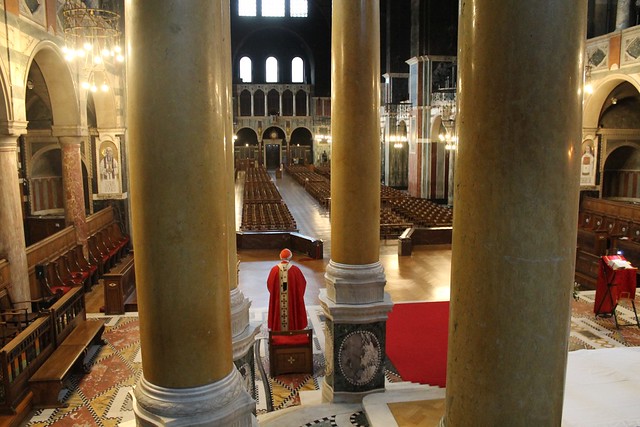
IMG_3880
Cardinal Vincent Nichols (Archbishop of Westminster) celebrates Mass for National Health Service workers, carers, the sick and their families, in Westminster Cathedral.  
Photo from https://www.flickr.com/photos/catholicwestminster/49812472648/ (IMG_3880, 23rd April 2020).

Tuesday, December 31, 2019

‘A Babe is born, all of a maid…’

I hope all readers are enjoying a very merry Christmas!

Year after year I find my treasuring of Christmastide undiminished.  In this season we really are breathing different air.  Things quieten down; the music in the shops grows merrier and less aggressive, and the world becomes gentler and quieter.  Once the moment arrives, even the forces of commerce cannot touch us.  Britain returns to the common observance of a festival of light and sweetness.  The mainstream feels a little more like home, the great cultural headwind abates slightly, and, more importantly, there is good will and merriment about, and hearts are softened to peace and goodwill.  The season gives us an excuse to wish each other well, to mend differences, to make amends.

Maolsheachlann Ó Ceallaigh has a good article here (published in the Irish magazine The Burkean), observing that the modern world, at Christmas, when it thinks nobody is looking, ‘indulges in a celebration of everything it usually disdains: family, nostalgia, tradition, sentimentality, innocence, festivity, ceremony, and even (albeit usually indirectly) religion’.  And why not?  These are natural things, and we mere mortals can only pretend to be cynical and individualistic for so long.  There was a time, not so long ago, when this sweet sensation of high day and holiday, that heady feeling of living in time outside time, came round several times a year: now only the one ‘festive period’ is left to us.  But even a single chink of light in the year is better than none.  It is better than nothing even if the world only half-remembers that the Creator of all things has taken flesh, lived in the knowledge of our frailty, brought forth warmth into the cold world, and thereby changed the very fabric of the universe, and changed it utterly.  That is no longer a void between our lonely souls, but Love.

Here is an exuberant setting by the Welsh composer William Mathias (1934-1992) of the fifteenth-century English carol ‘A babe is born all of a maid’, one of several preserved in the famous medieval Sloane manuscript 2593 (catalogue record here).  Eleanor Parker writes more about it on her wonderful ‘Clerk of Oxford’ blog: https://aclerkofoxford.blogspot.com/2012/01/babe-is-born-all-of-may.html.  The choir of King’s College, Cambridge, is led by the Director of Music, the late Sir Stephen Cleobury (who died on St Cecilia’s day last year; a great loss to the world of music).


Wishing all readers much continued Christmas merriment, and happiness in the New Year.

Friday, January 06, 2017

On a Wise Queen


One among many Christmas Day traditions in our family is ‘the Queen’ — assembling in front of the telly just in time for H.M.’s Christmas broadcast at three in the afternoon.  This annual broadcast of under ten minutes’ length might be easy to take for granted.  The National Anthem is played at the beginning, the Queen delivers her message, and there is another piece of music at the end.  Its simplicity, dignity and reassuring mood are often thrown into relief by the B.B.C.’s tendency to sandwich it between frenetic adverts for the usual televisual fare.  Yet while the Queen speaks, all is calm. 

I know I’ve written plenty already in praise of monarchy in principle and the person of our present monarch.  But it needs repeating: Queen Elizabeth is a tower of strength, strength that she has proved in endurance and constancy.  And I think in the Christmas broadcasts of recent years she has become — to me — noticeably franker about her understanding of the source of this strength.  I thought this year’s (the whole text of which can be read here) was remarkable in several ways.  Here are the last paragraphs:
When people face a challenge they sometimes talk about taking a deep breath to find courage or strength.  In fact, the word inspire’ literally means ‘to breathe in’.  But even with the inspiration of others, it’s understandable that we sometimes think the world’s problems are so big that we can do little to help.  On our own, we cannot end wars or wipe out injustice, but the cumulative impact of thousands of small acts of goodness can be bigger than we imagine.

At Christmas, our attention is drawn to the birth of a baby some two thousand years ago.  It was the humblest of beginnings, and his parents, Joseph and Mary, did not think they were important. 


Jesus Christ lived obscurely for most of his life, and never travelled far.  He was maligned and rejected by many, though he had done no wrong.  And yet, billions of people now follow his teaching and find in him the guiding light for their lives.  I am one of them because Christ’s example helps me see the value of doing small things with great love, whoever does them and whatever they themselves believe.
This is, as any of Elizabeth’s churchgoing subjects will know, strong stuff by the standards of modern Britain — not least since these words follow a quotation from St Teresa of Calcutta and a reference to her canonisation.  It is well-known, I suppose, that the Queen takes her faith very seriously, but here it is expressed with an ear-catching boldness.  The media hunger for the slightest morsel of the Queen’s personal opinions, but here is one that she has chosen carefully to make known.  There can be no mistake about the bell-clear words, "I am one of them."  And she is speaking not only to viewers who share her faith but, as always, to "you all".  It can fairly be called evangelistic.

There must over the years have been no shortage of advisors wringing their hands at this aspect of the Queen’s person, urging her to water it down lest she appear ‘out-of-touch’, that gravest of modern sins.   But the vows she once made, and has unfailingly kept, were to God as much as to her people.  She has known that she could not be just to the latter without being faithful to the former.  Her faith is the foundation of her understanding of the dramatic, fulfilling idea of vocation (largely neglected by our unhappy, rudderless age) which, in turn, underpins her life and reign.  She has received a calling, and having answered it, has not faltered. 

And there is a remarkable humility and saneness in that sentence, “I am one of them.”  With these piercing monosyllables the Queen punches through the distraction of her extraordinary situation: we should all have the same attitude, she is saying, since we all have our vocations to ‘some definite service’, and this makes us equal.  She has answered hers; we each should answer ours.  It is the proof of her level-headedness that she, one of the greatest women on earth, who has always had to be great, has seen and is able to assure us if we only ‘do small things with great love’, we will have done our part.  I submit, of course, that she has also done a great thing with great love.

People on television often praise the Queen for her ‘service’, which irritates me since I sometimes suspect they are trying to avoid using the word ‘reign’.  Of course she has served, but it is more complicated than that.  She has served us by reigning over us, and in doing so also served God.  And the humble acceptance of a great office is a humbler, worthier thing than even the television personalities are hoping for.

Thus on this feast of the Epiphany I record my gratitude for a living monarch who kneels with the three Kings, and who has been rewarded with a wisdom that makes her worthy not only of her subjects’ loyalty to her office, but of their trust in her person.