Showing posts with label Coronavirus. Show all posts

Thursday, December 24, 2020

‘Sing lullaby to Jesus, the Saviour of all’

This has been, I should think, an unsettling year for all of us.  The pandemic has been a tremendous challenge; few of us in Britain will forget that vertiginous feeling that ionised the air in February and March, as the ground under our feet was sucked and drawn away by who knew how great an approaching wave?  And the wave, when it came, broke not so seriously as to overwhelm the health service, as we had feared, but still seriously, and has returned in several successive, sporadic, unpredicted surges.  It has been a hard time for most people, and for some very hard indeed.  There has been sickness, bereavement, ruin, loneliness and fear.

Just as difficult to reckon with, in their own way, have been the strange counsels that are abroad, the contentious political ideas declaring themselves in nearly every corner of public life, insisting with alarming and hyperbolic jargon on a single new diagnosis, a single new solution for our problems.  The intentions may often be good, I know, but in many places a tendency towards intemperate language, an extraordinary willingness to rush to conclusions and sometimes an actual mirthless enthusiasm for outrage has, combined with a lack of level-headed and prudent leadership, brought about a hard, bright, livid atmosphere, one which smothers honest dialogue and, disturbingly, makes Britain feel quite unlike itself.  I think it is no wonder that people are upset and alienated when, for instance, irresponsible use is made of the positions enjoyed by cherished institutions to advocate partisan causes — many seem to have no idea how much damage they risk doing to their own reputations — and the politicisation of whole swathes of ordinary life is so relentless that there seems to be no escape.   There is even the nasty feeling that in some quarters the pandemic is being exploited deliberately for political ends.  Here, too, one feels the ground lurching under one’s feet, the lumbering of great engines of power.

But I think that much of what I mused in March still stands: even amid deepening shadow we have seen where the light is, and how brightly it shines; we have seen the light that darkness cannot overpower.  Many people have been moved to tremendous kindness and generosity, even to heroism, by this pandemic, and even by the unpleasant politics.   And there has been wisdom to glean, too: the long quarantines provided a blank background against which it was unusually easy to see how unexpectedly good days and hard days tend to arrive; how they all dawn alike.  And then there is the Church, which I think has been, in its quiet way, as alive and imaginative under this year’s circumstances as ever, or at the very least has trudged faithfully on.  And I think sometimes of the rededication of England to Our Lady of Walsingham, an event which turned out to coincide so intriguingly with the first, most frightening days of the pandemic.  Perhaps at some point I will write more about this, but it seems to tell us that England is, in the right way, worth loving for its own sake; that, amid this age of anti-patriotism, and a general deep unhappiness and listlessness of a kind that seldom ends well, even such flawed and mortal things as nations can rightly be loved and revered.

And what of ourselves?   What hope is there for us; what fundamental answer is there to the deepest question, the question we cannot even utter?  We who try to follow the Gospel, believing that truth is not merely something we construct or concoct, but is Truth itself, and comes from God, have indeed been given an answer.  It is an answer we could never have designed ourselves, nor ever thought to hope for; it is nothing so straightforward as an explanation; rather, it is a mystery, the same mystery as was given to us two thousand and twenty years ago.  Yet as sure as it is mysterious, it is by the helpless newborn Child in the manger that all the engines of power, and the kings of the earth, sickness, grief, and even death itself are undone.  Every year the wondrous truth is spoken: this is how God chose to enter the world, not by marching en masse against the foe, but by ‘sneaking behind enemy lines’, as C. S. Lewis put it; entering the world exactly like us, in weakness and woe; no less a Lord, but one who is obeyed in love, not fear.

‘Fear not’, the angel had to tell even the hardened, hill-patrolling shepherds; Heaven knows we need telling too.  Power may thrive on fear, but only for a time, and it never expects the one thing that defeats it, Love; it never expects the Baby in the manger.  And so it is by this one Lord’s law of love that the potentates of power are brought low, and, better still, that good triumphs in our very hearts, and in the end shall triumph for ever.

That shabby stable was a fortress, not of worldly might, but of Love, the real thing: it was a little citadel of Love.   I think of all the millions of such fortresses all over the world in which the feast of Christmas, even this muted Christmas of 2020, will be kept faithfully, and merriment made.  That is where hope lies.

Wishing all readers as merry a Christmas as possible after this hard year.


‘Sing Lullaby’: a setting written in 1920 by Herbert Howells (1892–1983) of words by his friend and fellow son of Gloucestershire Frederick William Harvey (1888–1957). There is an interesting article at MusicWeb International about this carol and its simple but piercing words.

Friday, July 31, 2020

Poem in July 2020

Entered for a poetry competition organised by my parish.

  And we were once again the Israelites,
  Lost in the desert, driven with our tents
  Into lean lives for forty days and nights,

  With fear for foe.  But from that lengthiest Lent’s
  Bright soundless skies
  There fell strange manna, semi-sacraments:

  Unsullied sunlight, bolder birdsong, the surprise
  Of spring’s long-hoped-for leaf-burst jubilee;
  New green, new gilding, seen with clearer eyes.

  And more: the Gospel-truths shown differently,
  How we are all one body, and how light
  In shadow only shines more radiantly.

  Let quiet thanks, although there is in sight
  No end of troubles in the years ahead,
  Be given for the easing of our plight,

  And for our brethren, all whose souls were led
  Out of this world of mingled grace and vice,
  Let Requiems be said,

  That by the Lord’s love, and His sacrifice,
  They may see Paradise.

Vaulting above One Island Pond, 29th May, 2020.

Friday, June 12, 2020

‘Jednego Serca Jednego Ducha’: online edition

The feast of Corpus Christi, which was celebrated in Poland yesterday, is usually the occasion for the great ‘Jednego Serca Jednego Ducha’ hymn-singing concerts (about which I have written here and here).  This year’s, however, has gone the way of all large public gatherings: yet another casualty of the Coronavirus pandemic.  

The organisers did not admit complete defeat, however!  They put together an edition of the concert to stream over the Internet so that, although the Sybiraków park in the city of Rzeszów lay empty, where it should have been full of tens of thousands of people, the music at least could carry on.  It’s not the same as the real thing, but definitely something to cheer us all up.  See below to watch it, or click here: <https://www.youtube.com/watch?v=8f9V3DJ_9gU>.  

Saturday, April 25, 2020

Spring, Regardless

When last did silence lie over South London as it has in the past few weeks?  The Seventies?  The Sixties?  The Fifties?  Only the brief ‘stillness of the solemn air’ after heavy snowfall, as in February 2009, seems comparable, but even then I am not sure there was ever a hush so thick as that which now descends on London at night, not just in the street outside, but in all the roads around, and the roads beyond them, for miles and miles and miles.  The slick, insufferable, incessant, suburb-saturating, sempiternal seething of traffic has vanished.  Some reports suggest that the number of cars on the road has gone down by two thirds to its lowest level for sixty years; I could well believe this.  Now, four weeks into the national quarantine, I am noticing the volume of traffic creeping up again, but it is still bearable for now.  Any relief is welcome.

Council notice on the Common.
I am well aware of the suffering wrought by the pandemic, and that I write from well behind the front lines of the great battle against it, and indeed that I am relying largely on others to do the fighting.  All the same, I think it is not unfair to observe the silver linings I described a few weeks ago.  The quietening of London’s madness is one; another is the community spirit that has been the paradoxical fruit of enforced isolation.  Even having to keep our distance from each other has brought about a kind of solidarity: it is sometimes awkward to leap into the road or brambles when meeting someone coming the other way, but most people see the point and even, sometimes, humour in it (“Don’t get yourself stung!” a lady told me when she saw that I had leapt off the path into some shallow brambles to let her pass).  Children have decorated windows and pavements with innocent rainbows, and on my daily constitutionals I am exchanging friendly greetings with strangers in a manner completely at odds with London’s usual way of doing things.  

Then there is the weekly eight o’clock round of applause for doctors and nurses, which has been kept up vigorously in our street.  A friend reports that the clapping in his village at the fringes of London is lessening every week, but round near me (much further in) I am sure it is growing, if anything.  The neighbours add to the clamour by hammering on pots and pans, or by thumping their wheelie bins, while passing cars sound their horns.  Then after a minute or so, we down tools, wave to each other or call in greeting across the street, and withdraw.  Some might scoff at this, but I feel this is just the sort of custom that many parts of Britain, mine included, have long lacked.

It occurs to me that this pandemic may well cement the National Health Service into place as the established religion of Britain.  This is entirely understandable: our debt to doctors and nurses is now partly due in a currency other than that in which we pay our taxes.  But it may cause problems in the future if, as tends to happen with any large institution, the NHS comes to need reform of some sort, and public feeling produces misplaced resistance, legitimate changes being mistaken for undue interference.  On the other hand, the strength of public faith in the NHS will also serve as protection against any short-sighted erosion or thinning out of its services by its overseers.  Maybe, though, we will soon have worse to worry about than either of these problems.  (And I would also observe quietly that there are some needs which even the NHS cannot be expected to answer.)
Local pavement decoration
Daily walks over the now-well-worn paths of the Common have also given me the chance to see spring’s great leafburst in far more detail than usual.  In previous years, I put its seeming to happen overnight down to my lack of observation.  But now, regular visits in quick succession have shown me the remarkable proliferation that really does take place over only a two or three days, as if all that life is kept pent up in the earth until it can be contained no longer.

I have not altogether forgotten about the world outside my parish, though.  One gloomy piece of news that has almost been lost amid the coronavirus coverage is the continued collapse of marriage in Britain: the number registered in 2017 was a new record low, and of these the proportion of ceremonies with any religious dimension was also the lowest ever recorded: 22%.  It may sound blunt to say this, but this is the sign of a civilisation that scarcely believes in the future at all, let alone in lasting love.

But there has been cause for good cheer, such as the birthdays of Benedict XVI (ninety-three) and H.M. the Queen (ninety-four).  And Pope Francis has also given an interview here — https://www.thetablet.co.uk/features/2/17845/pope-francis-says-pandemic-can-be-a-place-of-conversion- — with something to hearten and challenge everyone, as is characteristic. For example:
It’s true, a number of governments have taken exemplary measures to defend the population on the basis of clear priorities. But we’re realising that all our thinking, like it or not, has been shaped around the economy. In the world of finance it has seemed normal to sacrifice [people], to practise a politics of the throwaway culture, from the beginning to the end of life. I’m thinking, for example, of pre-natal selection. It’s very unusual these days to meet Down’s Syndrome people on the street; when the tomograph [scan] detects them, they are binned. It’s a culture of euthanasia, either legal or covert, in which the elderly are given medication but only up to a point.
And —
Yet the elderly continue to be our roots. And they must speak to the young. This tension between young and old must always be resolved in the encounter with each other. Because the young person is bud and foliage, but without roots they cannot bear fruit. The elderly are the roots. I would say to them, today: I know you feel death is close, and you are afraid, but look elsewhere, remember your children, and do not stop dreaming. This is what God asks of you: to dream (Joel 3:1). 
What would I say to the young people? Have the courage to look ahead, and to be prophetic.  May the dreams of the old correspond to your prophecies.
 I hope all readers, and their friends and families, are safe and well.

IMG_3880
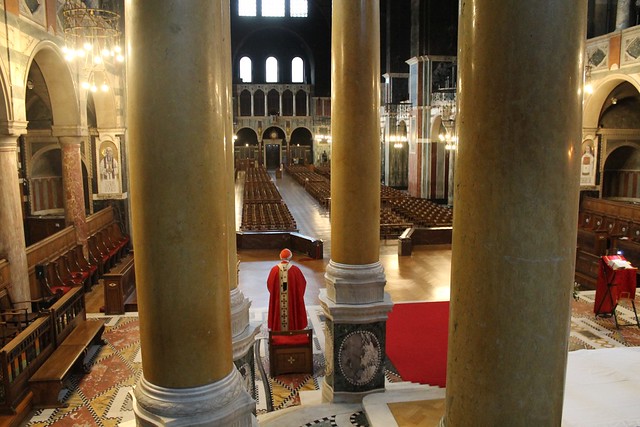
Cardinal Vincent Nichols (Archbishop of Westminster) celebrates Mass for National Health Service workers, carers, the sick and their families, in Westminster Cathedral.  
Photo from https://www.flickr.com/photos/catholicwestminster/49812472648/ (IMG_3880, 23rd April 2020).

Sunday, April 05, 2020

‘Better Days Will Return’

From the message of Her Majesty the Queen to the United Kingdom and the Commonwealth, broadcast this evening at 8 p.m. (B.S.T.):
I hope in the years to come everyone will be able to take pride in how they responded to this challenge. And those who come after us will say that the Britons of this generation were as strong as any.  That the attributes of self-discipline, of quiet good-humoured resolve and of fellow-feeling still characterise this country.  The pride in who we are is not a part of our past, it defines our present and our future.  […]
While we have faced challenges before, this one is different.  This time we join with all nations across the globe in a common endeavour, using the great advances of science and our instinctive compassion to heal. We will succeed — and that success will belong to every one of us.
We should take comfort that while we may have more still to endure, better days will return: we will be with our friends again; we will be with our families again; we will meet again.
But for now, I send my thanks and warmest good wishes to you all. 
Her Majesty’s message can be read in full here.

Saturday, March 28, 2020

Light against Shadow

It is an awe-striking thing to see our self-assured, hyper-ingenious civilisation brought so completely to a standstill.  An old peril has returned to stalk the world, and has swept over us with breathtaking speed.  Maybe January’s floods distracted me, but it was not really until the Coronavirus reached Lombardy that I started paying it close attention — and this was on the advice of a friend with whom I had been hoping to make my first visit to Italy in April, and who, having lived through the SARS epidemic in Singapore in 2003, had some idea of the approaching danger.  His early alertness has been completely vindicated.  (On the other hand, the pandemic really has erupted with extraordinary speed, and I don’t think that we need blame ourselves if we were taken by surprise.)  All in all, it was not until perhaps two and a half weeks ago that the scale of the crisis dawned on me, and I realised that it was only a matter of time before it engulfed us in Britain too.

Since then, an uneasy stillness has grown gradually heavier and heavier over our lives.  Even a fortnight ago, central London was perceptibly emptying out, which means I suppose that it was merely very busy rather than, as under normal conditions, pandemonium.  Road traffic subsided noticeably: one evening, on my way back home from the station, peals of church bells came to me in a street where I have never before heard them over the noise, and a blackbird’s song sounded with startling clarity from a branch high above me in the dusk.  Long before the streets fell silent, though, the atmosphere had changed: all was sober, muted, as if we were all marking some joyless anti-Christmas.  Before we were sent home from work a week ago last Tuesday, the air in the office was ionised with anxiety, and however hard we tried, we could hardly talk of anything but the virus.  We knew the wave was coming, and we were waiting for it to break over us.  Now it is upon us, and suddenly, I think still to our disbelief, we are all stuck.  Nothing can happen; nothing can move.  We find ourselves (in the Clerk of Oxford’s words) in the ‘longest Lent of our lives’.

Now the skies are empty of aeroplanes, and the torrents of traffic that usually come stampeding down my road have abated, most strikingly at night.  The new hush is slightly disconcerting, but to one who finds London’s noise immensely wearing, not unwelcome at all.  Being cut off from work, the pub, the rest of the country and from church is still taking some getting used to, though, and what an odd sight it was to see the Prime Minister leaning over his desk on Monday (23rd) to grab our lapels and tell us all to keep to our houses.  His instructions on how to wash our hands a few weeks ago was a strange enough sight… the only other public leader I can think of with such a strong opinion on this subject was Pontius Pilate.

The coronavirus had set me thinking about light and shadow even before I heard the words of last Sunday’s second reading ringing around the walls of Fisher House, the Catholic chaplaincy of the University of Cambridge, over the Internet and out through speakers into our living room.  "Be like children of light," read Fr. Chase, Lent-robed in pixellated purple, and the words of St. Paul as fiery as ever. "Try to discover what the Lord wants of you, having nothing to do with the futile works of darkness but exposing them by contrast… Anything exposed to the light will be illuminated, and anything illuminated turns into light".  Without a doubt, a new darkness has entered the world, but what happens when it meets the light is, as ever, far from straightforward: it is a mystery, one that we in our day are not the first to notice.  Already we can see that its effect is not simply to cast a shadow over things, but to embolden the light where it shines, or to show where it is thrown at different angles, in rays we would never normally see.  What the shadow brings is causing us great suffering: the unexpected and hastened deaths, the pain of the stricken, the fear of the vulnerable (and ours on their behalf), the anxiety of doctors and nurses before the unknown, the ruin of businesses and commerce, the evaporation of holidays and weddings and grand projects, and the load added to the existing troubles of so many (for example, are there people in Worcestershire, Shropshire, Yorkshire and the valleys of South Wales now confined to homes still damaged by flood?).  The shadow is real enough, and may be as grave a menace as we fear.  But it does not go unanswered.

I can see many silver linings being fanned into brilliance.  One is that we have just had an opportunity to prove to ourselves how much we value human life, and I think we have acquitted ourselves pretty well.  Are we prepared to bring the economy to a grinding halt in order to save life, even fragile life?  Yes, we are.  This is worth knowing, it seems to me.

Secondly, we are building new solidarity.  The virus is everybody’s common foe, so our common purpose is to defeat it: we are all on the same side.  What is more, it is a silly little cell with knobbly bits which has no feelings.  There is no other side to the argument; we have no need to consider its point of view: it must be vanquished.  So there is a strange relief with which we can throw ourselves wholeheartedly into that one uniting purpose, even if the noblest pinnacle of our sacrifice is to sit in a chair at home.  In tight corners we find out moral choices sharpened and starkened.  They are not always made easier, but sometimes the right course of action at least becomes clearer, and I think that is happening here.  Once or twice in the past week a rare feeling has caught me, one which I remember once shivering surprisingly down my spine when I came across a photograph of a gigantic, catastrophic pall of smoke over London after a Blitz bombing raid: the East End burning.  Even at a remove of seventy-five years, a cold intoxicating thrill swept over me, the beautiful clarity of war that an enemy brings about by placing himself wholly in the wrong, and us, together, gloriously, in the right.  This can be, of course, a highly dangerous feeling, and one which can be transmuted in seconds into fire-blooded vengefulness.  But as long as we limit our vengeance to the virus, maybe this new just war will do us good, and unify us, straighten our priorities, and remind us of our common humanity.  So it is that, paradoxically, even in this grave situation, there is a sense in which I feel more at home in Britain now than I usually do.

The East End of London in flames, 7th September, 1940. 
From www.ghmartinez.blogspot.com.
But we are forging new and valuable bonds in quieter ways as well.  The Internet is being used with tremendous energy and imagination in order to help the vulnerable and overcome our collective isolation.  (I would include the Church in this, which I think has responded commendably to this crisis, as I rather suspected it would).  There have been the email circulars that various firms have sent to ‘customers and colleagues’ alike, so that civilians like me overhear their thanks to their staff.  (The cynical might scoff, but I am willing to give them the benefit of the doubt and presume that the message is sincere.)  A colleague at work told me that in the hour and a half she had spent queuing in Morrison’s the previous Sunday (15th March), she spoke to more of her neighbours than in all the fifteen years she has lived in that part of London.  And then there was the extraordinary occurrence in my street on Thursday evening: the audible and visible observance of a national round of applause in support of the National Health Service.  Normally, this sort of thing simply doesn’t happen on our road, in which, one way and another, neighbourhood sentiment is on the patchy side.  Jubilees, Royal Weddings and Remembrancetide had all passed by unmarked, but now applause rang out from the front gardens and windows of neighbours who do not really know each other that well, but had found a common cause.  It helped that we were all bound to be at home anyway, and of course there was no traffic to compete with, but it was still a moving and heartening occasion.  For the first time I have ever seen, there was a general exchange of ‘Good night’ across the street.

I think a time of enforced monasticism will do us no harm, either, and maybe we will all emerge from this strange time a little wiser than before.  There are those of us whose lives only a world-wide pandemic could slow down!  Perhaps we will find new aspects of life to notice.  For instance, we might observe the strange paradox that, even as this virus reminds us of our physical, incarnated nature — that we really are one body — those of us not actually struck down by it are experiencing it as a malevolent spiritual force, invisible and silent.  The material and the spiritual are not so easily distinguished as we think.

In passing, I think I will note some other miscellaneous aspects of this crisis that have struck me.  For instance, that China has sent doctors to Italy and medical testing kits to Spain.  Also, that it is interesting how many prominent people have gone down with the illness: politicians, public figures, and even the Prince of Wales.  And is this the moment at which the phrase ‘to stay home’ (American, surely?) will supplant the British ‘to stay at home’ in our speech on this side of the Atlantic?  Finally, one more reason to hope: it has occurred to me that the pandemic will spark ambitions in scores of youngsters to become pathologists or doctors.  So, although a time of fear and uncertainty like this ‘has the capacity to bring out both the best and the worst of our human nature’, as our Archbishop John Wilson has said, I think we can have every hope that this darkness too will be ‘exposed by contrast’ with the light, and driven away.

I hope and pray that all readers, and those dear to them, are safe and well and as cheerful as we can be in these times.

In the original version of this article I stated mistakenly that the words of St. Paul, ‘Be like children of light…’, the Second Reading for Sunday 22nd March, had been read by Fr. Mark Langham; actually they were read by Fr. Chase Pepper, who was con-celebrating.