Showing posts with label Queen Elizabeth II. Show all posts

Friday, September 08, 2023

A year since the loss of Queen Elizabeth

What is there to say, on the first anniversary of the death of our beloved Queen Elizabeth?  I miss her, as I knew I would, and know I always will.  Her wisdom, her smile, her words of encouragement: we are having to carry on without them.

The grief was very deep — the void in the stomach, the taste of iron on the tongue — but so too was the consolation of all that followed: the lying-in-state, the funeral procession, the final Committal at Windsor; their dignity and beauty.  They were days out of time, in which we were reminded of a different way of doing things — the Queen’s way — the only false note being the decision to bring her coffin to London by air, rather than by rail.  But in any case I shall never forget the wordless television pictures of the mourners filing past her coffin in Westminster Hall — mourners whose numbers I had the privilege to join.  That collective four-day farewell was also a pact of remembrance: we who recognised in that witness, in that pilgrimage, a vindication of the Queen’s faith and virtue, stepped out of Westminster Hall with a greater determination to live our ordinary lives more as Elizabeth lived her extraordinary one.

But we remain loyal to and continue to pray for our Sovereign King Charles, who in his benevolent melancholic way is exercising wisdom of his own.  His Majesty has written today,

In marking the first anniversary of Her late Majesty’s death and my Accession, we recall with great affection her long life, devoted service and all she meant to so many of us.

I am deeply grateful, too, for the love and support that has been shown to my wife and myself during this year as we do our utmost to be of service to you all.

Charles R.

The reception of H. M. the late Queen’s coffin at Westminster Hall.  James O’Donnell’s arrangement of the 139th Psalm is sung by the choirs of Westminster Abbey and the Chapel Royal.  ‘O Lord, thou hast searched me out, and known me: thou knowest my down-sitting, and mine up-rising…’

Sunday, November 27, 2022

‘Go forth, O Christian soul…’

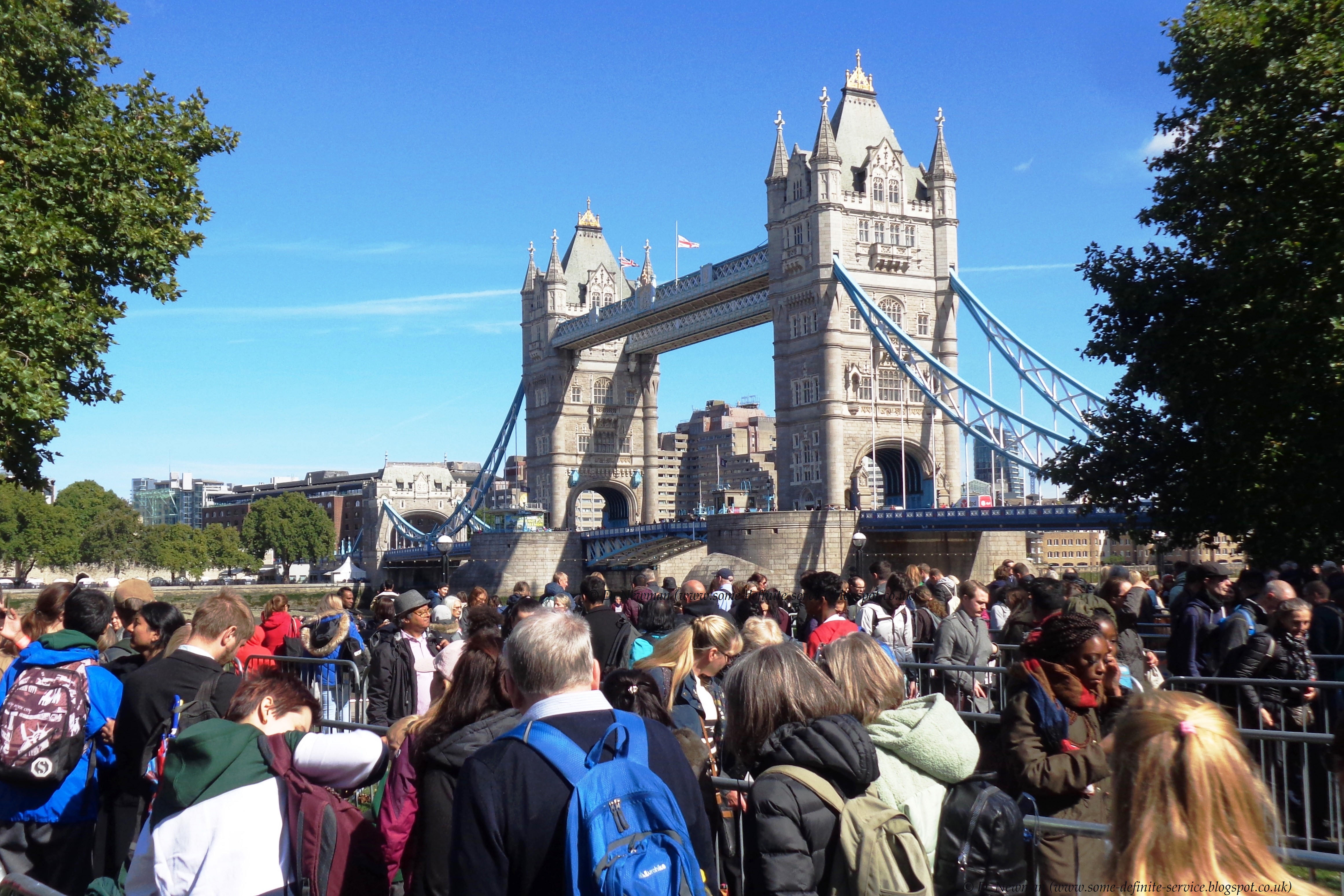
The queue for the Queen’s lying-in-state at the King’s Stairs Gardens, Bermondsey, roughly five miles from Westminster.  10.30 a.m., 17th September 2022. 

My final contribution to the Second Elizabethan Age was, as it turned out, to take half a dozen newly-catalogued manuscripts down to the store, slide them into fresh envelopes, fasten them with archival tape, label them, and put them ready for shelving.  I had seen the lunchtime announcement about the Queen’s health, and worried and prayed as I worked, actually rather glad there was no computer downstairs.  By the time I surfaced again, the news had broken: it was a colleague in Security, an ex-serviceman, who told me.  “If it hadn’t been for her, this country would have gone to the dogs years ago,” he said flatly.

The day afterwards, a friend of mine happened to be cataloguing a file of condolence letters received by an actor’s widow, and came across a nice phrase: ‘You can prepare your mind, but you cannot prepare your heart.’  We had known the day would come and dreaded it, but even I was slightly taken aback by the grief that took hold of me when it did.  As others have said, the Queen’s death was not a surprise — but it was a shock.

Yet the way it happened was in several respects fitting, and therefore already consoling.  Not until after the pandemic, and the great Platinum Jubilee, and even this summer of ferocious heat and the shocking beige of drought were over; only once welcome showers were sending some of the life and colour flowing back into Britain’s veins, so that our landscapes were beginning to look themselves again, did the moment arrive.  The Queen saw us through, and then she went home.

And from the ten days of mourning that followed, too — with a first autumnal bittersweetness in the air, with the tearful glory of rainbows in the skies, with torn ragged clouds trailing overhead at dusk like smoke, with the hard underframe of the national story to which we all belong suddenly only just below the surface — I shall remember not only sorrow, but deep consolation.  I mean not only the constitutional reassurances — the ancient mechanisms of the accession ceremony, swinging into motion like a pair of sombre oaken doors, just, I realise, as they would have done, if needed, on any other day between 1952 and 2022 — I mean something deeper: spiritual consolation.  The lying-in-state, for instance, was balm for the soul, even when seen on television: the solemnity, the simple formality, the reverence.  And it worked, for in filed, and kept filing, thousands upon thousands of mourners, their faces strangely beautiful with love and grief, passing reverently through Westminster Hall, curtseying or bowing or even crossing themselves.  The live-streamed television pictures of this procession, though at times zooming a little intrusively into people’s faces, must be one of the most moving broadcasts I have ever seen.

The queue down Shad Thames, just E. of Tower Bridge.
And the extraordinary lengths of the queues showed the extent of the grief and the love, even as the pictures showed their depth.  Seeing dire warnings of a twenty-two-hour-long wait on the Saturday morning, my sister and cousin and I initially abandoned our plans to join the queue, deciding instead that we would walk along its length, past the mourners, pay our respects outside Westminster Hall, and then perhaps go to see the flowers in Green Park.  But just as we reached the start of the queue at Southwark Park, it was reopened with an estimated length of a mere sixteen hours, and we changed our minds and queued after all.

It was, as many have noticed, a pilgrimage — starting, for us, under the dingy girders of South Bermondsey station, along past Galleywall Road, through Southwark Park and a first set of interminable zigzags into the queue, past the makeshift tea-stands set up by enterprising residents, snaking among converted warehouses and bridges and embankments and theatres, over Lambeth Bridge, until, after a further two hours shuffling concertina-wise up and down Victoria Gardens, and a jarring bag-search and body-scan, at last we slipped into the thick solemn hush of Westminster Hall, with the rich colours of the catafalque before us, and the priceless brilliance of the Imperial State Crown flashing finely at journey’s end.

Zigs and zags at Tower Bridge

The whole experience (which turned out to be eleven hours long, not sixteen) taught me something about pilgrimage: that it is the natural expression of gratitude.  I had, and have, no way of repaying the Queen for her years of faith, and integrity, and quiet constant example.  All I could offer was a mark of respect before her coffin.  Small recompense indeed — but there was subconscious logic at work; the knowledge that if this little gesture could somehow be made to cost me more — if I had had to stand in a queue six miles long in order to be able to make it — perhaps it would actually come to be worth more.  Rather like the widow’s mite in the Gospel, my little bow would take on a greater meaning, because I had ‘given all I had’.

The Lambeth Embankment, across the river from Parliament, as the afternoon wears on

This, I think, has something to do with why, when I had heard that the queuing time had nearly doubled, my initial reaction was not dismay, but a strange instinctive determination that I was Jolly Well going to queue, come what may.  This is surely the same impulse that drives people to walk barefoot and impose on themselves all sorts of hard, tough exigencies while on pilgrimage.  It is, however heartily we laugh and joke with our fellow pilgrims along the way, a serious, deep, even primal gesture of love.

The Palace of Westminster from Lambeth Bridge, with flag at half-mast

I think the same is true of the great marches and the funeral offices: as well as solemn duties, they were acts of love and gratitude.  How beautiful, then, that they healed us even as we undertook them.  How comforting, too, were the beautiful prayers of the Anglican liturgy, their loving poetic language, commending our Queen to our God, and telling us again and again what we needed to hear: that whereas we rightly grieve our Sovereign who ‘now rests in sleep’, we may nevertheless have confidence both that ‘we shall rise again at the coming of our Saviour Jesus Christ’  —  and, furthermore, that ‘in due time, we may share with our sister that clearer vision when we shall see thy face.’  We are right to grieve, but it is not the end: again and again I drank in the medicine of those words.  One sensed the wisdom of ages in the knowledge that ten full days would be needed for the initial salving and bandaging of the wound, for that ‘gracious promise’ to sink in once again.  

The two-mile-long concertina in Victoria Gardens

“We will miss Queen Elizabeth terribly,” said Archbishop of Southwark, John Wilson, at a beautiful Requiem Mass at St. George’s Cathedral the following morning.  I have written at length elsewhere in these pages of my admiration for the Queen, and of how extraordinarily blessed we have been to have at the heart of our national life a person who placed love so clearly above power, and for so long, and with such constancy.  She may not have made her personal opinions known, but she did show her beliefs, and the response to her death, the outpouring of grief and love, shows that this did not go unnoticed.  And so, as that extraordinary and bittersweet month slides away off into the past, and as we who share those beliefs, shouldering our loads, turn to carry on without her, we may take slow-burning courage from this parting gift: the vindication in her death of the manner of her life.

Go forth upon thy journey from this world, O Christian soul;
In the name of God the Father Almighty who created thee;
In the name of Jesus Christ who suffered for thee;
In the name of the Holy Spirit who strengtheneth thee.
In communion with the blessèd saints,
and aided by Angels and Archangels,
and all the armies of the heavenly host,
may thy portion this day be in peace,
and thy dwelling in the heavenly Jerusalem.  Amen.
A still frame from the BBC’s live stream from Westminster Hall.

Wednesday, October 12, 2022

Vaughan Williams 150

A revised version of an article from 2018.

‘And I saw a new heaven and a new earth…’. From Sancta Civitas (1928), the composer’s favourite of his own choral works. 

Today, 12th October 2022, is the hundred-and-fiftieth anniversary of the birth of Ralph Vaughan Williams (1872–1958).  Was he England’s greatest composer?  He has plenty of strong competition of course, and perhaps half the fun is never quite to settle the question — but as far as I am concerned, if anyone is to match Vaughan Williams, then they too will have to draw me, irresistibly, again and again, yet in a different way every time, into a distinctive, great-hearted, masterfully-crafted musical world that is all its own.  He is in first place in my book.

Vaughan Williams photographed at home (The White Gates, Dorking, Surrey) in January, 1949.

His was a life that, in many ways, took place in reverse.  He emerged as a composer relatively late — not completing his first symphony until he was thirty-five — but from then on never diminished in his  output, even intensifying as he aged.  Those who might have perceived in his fifth symphony (premièred in 1942, his seventieth year) a mellowing in age, or a mood of valediction, would hardly have suspected that this was actually the half-way mark, and that there were four more symphonies to follow.  Throughout his last decade — well into his eighties — he seemed unstoppable, completing his three final symphonies, the opera The Pilgrim’s Progress (a lifetime’s work), concertos for harmonica and tuba and much more, all the while maintaining an energetic social life, both conducting and attending concerts.  And it was not only musically that he was thriving: after the death of his wife Adeline in 1951 after decades of illness, he was rejuvenated by a second marriage to the poet and playwright Ursula Wood (whose poetry he set to music).  So he seems almost to have been cut off in his prime, though he lived to eighty-five.

Music for the film 49th Parallel.

I admire Vaughan Williams in the first place for the most straightforward reason: because the sound of so much of his music appeals to me so directly.  Time and again he wove melodies, harmonies, textures and cadences masterfully together in the service of beauty, beauty for its own sake.  This beauty often seems so self-evident that I would struggle to explain it.  Yet that first appeal, having drawn me in, makes me all the more willing to listen again more carefully for details I have missed, or to brave the composer’s more challenging works.  In that way he has taught me a great deal about the more intellectual side of ‘serious music’: its forms, its structures, and the depth of expression that they make possible.  So, for example, I have found my life enriched both by the tuneful English Folk-song Suite, which I have loved since I was small, and by the Fourth and Sixth Symphonies, which I discovered in my twenties.  Yet in all his works the same personality is discernible: a companion and a teacher and a seer, who may challenge but never disregards the listener.

The third movement (Scherzo) of the London Symphony, played by the Spanish Radio and Television Orchestra and conducted by Carlos Kalmar.

This capacity for both simplicity and complexity is only part of another remarkable aspect of Vaughan Williams: his sheer versatility, or his ‘tremendous range’, as Vernon Handley put it.  He wrote music of so many flavours, for so many purposes, and all so convincingly, that it is sometimes hard to believe that they flowed from a single pen.  Is the same man really responsible for the tranquil Greensleeves Fantasia and the enthralling anguish of the fourth symphony; for the diabolical chortling of Satan’s Dance of Triumph (from his ballet Job) and the tiny jewel of an anthem, O Taste and See?  He went off searching for ideas in all sorts of directions, but always came back to his own distinctive drawing-board: his work always bears, somewhere or other, the hall-mark of one and the same personality.  There is Vaughan Williams the collector of folk songs, Vaughan Williams the scorer of films, Vaughan Williams the compiler of the English Hymnal.  His music might be sacred or secular, it might last for four minutes or four movements, it might summon full chorus and orchestra or call simply for a solo violin and piano.  For his harmonies he drew on everything from Tudor polyphony to thirties dance-band music; he also experimented with sonority, including a wind machine in his Seventh Symphony, a flügelhorn in his Ninth and ‘all the ’phones and ’spiels known to the composer’ in the Eighth.  And then there are the moods that pass over his music, as many and as various as the English weather’s: serene or furious, reserved or exuberant; proliferating with detail or hanging austerely in clear air. 


 One of the best ways of hearing many of these moods is in that eighth symphony — even in its first movement alone, which is constructed entirely around the very first four notes played.  Sir Mark Elder conducts the Hallé Orchestra.

Another characteristic of his music is — I can think of no subtler word — its manliness.  So much of it seems to express some aspect of, and to be so evidently the work of, the heart and spirit of a man.  In other words, there is a particularly masculine warmth, an outward robustness, a heartiness, a full-bloodedness about it all.  That is not to suggest that he did not mean his music for men and women alike, nor to assume that it was conscious or deliberate — it is simply part of the character and colour of his music.  His work is shot through with the vigour, the spirituality, the moods, the quickness, the temper, the restlessness, the passions, the solitary questing of manhood.

The second movement of the Concerto for Violin and Strings (1925; originally Concerto Accademico).   André Previn conducts the London Symphony Orchestra; James Buswell is the soloist.

Then there is his Englishness, the quality of his music which is perhaps most often commented on.  Vaughan Williams is credited with reviving and developing a particularly English style of music, one that was in contrast with the German idiom of Beethoven and Brahms and Mendelssohn that had prevailed before.  Vaughan Williams was interested in Tudor polyphony and traditional folk-song and the music of ordinary people, not for shallow or jealous reasons, but in a search for authenticity, and in a spirit of revival of old forgotten things and celebration of the particular — and it worked: his music sounds like home.  Hear how well it goes with Shakespeare, or with Chesterton; see how his hymns and carols have passed straight into the canon.  And he was keenly aware of the threats that England faced in his own day — war, the destruction of landscape, the decline in spirit.  Indeed, the sheer spiritual exhaustion of the modern world in general, sated with banality to the point of grief, is prefigured in much of his music.  Hear, for instance, the desolate passages that close the first movement of the Ninth Symphony:


Against despair and nihilism, though, Vaughan Williams was the great champion of the human spirit, and the idea of the lone pilgrim persevering against the odds preoccupied him all his life.  His reverence for folk-culture is precisely an example of this.  There is surely much to be said for founding ‘high art’ on traditional, unaffected idioms: familiar, time-worn songs keep high culture rooted in earth, while transfiguring the familiar elevates and enriches the popular culture.  And even as Vaughan Williams broke new ground with his symphonies and cantatas, he was content, I think, to be a servant of his age.  His heavy involvement in the Leith Hill Musical Festival, and his prolific output of hymns and film-scores and ‘practical music’ (notably the Concerto Grosso for musicians of varying accomplishment, or the Household Music written in wartime for whatever instruments were to hand) reveal a profoundly public-spirited man, unashamed of belonging to a particular time and place, and lending his talents to the service of others.  He himself was quite firm about this: ‘The composer must not shut himself up and think about art,’ he declared; ‘he must live with his fellows and make his art an expression of the whole community.’

For all these reasons and more besides, it is Vaughan Williams whom I hero-worship as Britain’s greatest composer.  Other composers may have shared many of the qualities I have described, but it is  only in him that they are all united.  His music, in all its variety, sounds as fresh as ever, and is still working its magic on lovers of beauty in new generations.  May it continue to lighten lives for centuries to come.

Ballad from the Suite for Viola and Orchestra

Thursday, September 15, 2022

It is Meet and Right

Herbert Howells’ anthem for the late Queen’s Coronation in 1953: music that has been much in mind these past few days.  ‘Behold, O God, our defender, and look upon the face of thine anointed.  For one day in thy courts is better than a thousand.’  (Psalm 84)

It is remarkable: Britain has rediscovered solemnity.  Amid my grief — and it certainly has been grief, with the immovable knot of dread in the gut, the catch in the heart, the oblique recurring waves of disbelief — there is a deep well of consolation in seeing the dignified, fond farewell that we are giving our beloved Queen.

Of course, plenty of people are carrying on more or less as normal — loud phone conversations on trains, and so on — and conversations with friends and colleagues have revealed that not everyone is feeling particularly bereaved — several have admitted as much.  Some try to find something humorous to say, while others, perhaps wary of the ambush of sorrow, say breezily, ‘Well, it’s all part of history.’  Maybe at moments like these it has always been so: not everyone sees things in the same way and, after all, feelings cannot be forced.  But to me there is a real change in the air.

For instance, there was the sight of the flowers in Green Park on Sunday, the aisles and aisles of them under the September-heavy trees.  At first, as I wandered up and down them, my thoughts snagged on a mild anxiety that this might all be a little too sentimental, a little too much about us and not enough about the Queen, but then I saw the volunteers, going steadily through the flowers to remove the plastic wrapping — the sort of unglamorous but necessary task that the Queen herself would have noticed and admired — and was reassured.  I made my way up the Mall, past St. James’ Palace from whose window-sills the new King had been proclaimed the previous day, caught the conclusion of the Changing of the Guard at Horse Guards Parade, cut through into Whitehall, went on across Parliament Square and down Millbank, over the Thames at Lambeth Bridge, and ultimately to a beautifully said and sung Requiem Mass at St. George’s Cathedral.  I signed the condolence book there which had been carefully laid out.

This change in the air is a reassurance and a consolation.  Whereas normally, and above all in the pandemic ‘lockdowns’, we have had row after row of identical days like the cells of a blank spreadsheet, these days are heavy with meaning.  That weight tells us that we are right to mourn and to grieve, and to miss the Queen; that we are not being silly or over-sensitive in our sorrow.  Dignity and reverence and solemnity have returned, and for the right reasons.  (The sole mistake so far has been the decision to bring the Queen’s coffin to London by air, rather than by rail as was the original plan.)  Even the screens that usually flicker their deranging advertisements at us now display still pictures of the late Queen with a sober message of condolence.

And then there was yesterday’s cortège, the slow drum-beat, the polished sombre brass, the thud of the guns and Big Ben tolling once every minute.  We of the smartphone generation, the children of the Internet Age, saw the coffin borne in sorrowful dutiful stateliness to the Palace of Westminster.  And  in Westminster Hall, where for now she lies in state, how fitting it all is, how right.  How rich all the colours are, so deep that they can be felt imbuing themselves into the memory.  They are as rich and deep as our grief: the thick warm yellow translucence of the candle-wax, the scarlet and gold of the furled standard, the clean stone, the purple-shrouded catafalque.

The BBC’s live stream of the vigil in Westminster Hall is, though a little intrusively zoomed-in on occasions, very moving to watch.  How strangely beautiful is the grief in the faces of the mourner-pilgrims who have waited many hours to pause, or to bow, or to make the sign of the Cross, or to salute, or even to blow a kiss.

The Queen has ‘surprised a hunger in ourselves to be more serious’ — and this, I think, is the first, immediate example of the way in which her life continues, and will continue, to bear fruit for us.  This is how it works, the life of faith: light catches light, heart speaks unto heart.  Those of us who shared or sympathised with her hopes and beliefs now feel the burden of responsibility falling on us, the duty to be little bolder in standing up for those beliefs, and living by them.

Part of our duty to the late Queen is, of course, giving the new King the acclamation he deserves.  And so we have, with such wonderful sonorous language — ‘Whereas it has pleased God to call to Himself our late Sovereign Lady Elizabeth of happy memory…’

I feel strangely at home in these otherworldly days of sorrow.  This is a deeply sad parting, a real wrench, and it is hard not to worry about the future — I am trying not to think about the loneliness which may well sweep in again after the funeral, that sense of an autumn of many things — but, as Joanna Bogle has pointed out, this is fundamentally not a horrible grief, as one feels after an outrage or a tragedy — it is a gentle farewell, mingled with deep gratitude and with confidence that the Lord whom our Queen served so well will say, ‘Well done, good and faithful servant,’ and receive her at last into Heaven.  And since, after all, as Her late Majesty herself told us, ‘grief is the price we pay for love’, it is only fair that I should settle my account.  So, strange to say, thanks be to God for this moment of togetherness in grief and love, and for all His bittersweet blessings.

Thursday, September 08, 2022

Our Sovereign Lady Elizabeth

Her Late Majesty outside Hitchin station, 14th June 2012

Queen Elizabeth, for seventy years our unfailingly good and just sovereign, died earlier today.  

Eternal rest grant unto her, O Lord, and let perpetual light shine upon her.  Welcome her into the kingdom of Heaven.  Amen.

For the moment I have no other words than these, written for her Platinum Jubilee:

Beacons

After the fanfare the beacons flare 
Out in the dusk and the still June air; 
Thousands of parishes blaze brave light 
Loyally into the nearing night, 
And on the hillside a quiet prayer 

Lifts, though the words are hard to find, 
Up from the heart; because, behind 
These great festivities, we know 
There are some deeper thanks we owe —
Thanks for deep faith, the quiet kind; 

Faith shown in small things that fulfil 
Great vows of youth; that sows good-will; 
Faith that has long encouraged us; 
Faith without faltering or fuss, 
Plain as a beacon on a hill. 

This long example that you have set 
Shows us, Your Majesty, how we yet 
May find eternal jubilee: 
We see, we understand and we 
Will not forget, will not forget.

Tuesday, August 09, 2022

Jubilee Thoughts

I had been worried that I would not enjoy the Queen’s Platinum Jubilee — not because I lacked enthusiasm for the occasion, but because I feared that the national celebration would not do it justice.  There is an impression often given by the purveyors of mainstream or at least mass culture, that they think the Crown exists merely on licence, so to speak, and that they are entitled to permit it to survive solely in the measure that it conforms to the tone, the language and the beliefs of secular modernity.  I worried too that the general inability of our culture to take anything seriously would drain the whole Jubilee of the solemnity, of the mystery, that underlies the celebration.  

Many of these fears did materialise, at least in part, but one way and another I found myself not minding too much.  At least, it certainly did not spoil a thoroughly enjoyable weekend which left me with plenty of happy memories.  There were some wonderful occasions which seemed to capture the spirit of the celebration marvellously — the lighting of the Jubilee beacons on a local summit of suburban south London, and a trip to Windsor to see a flotilla of barges and a display of classic cars — and in general it was heartening to see proper cheerful Union Jacks hung from houses and to know that people were making merry and having a good time together.  The flypast and Trooping the Colour (seen via television) were magnificent; the service at Westminster Abbey was dignified and beautiful.  There was also, on BBC Four, the very moving and warmly recommended programme ‘The Unseen Queen’: a compilation, presented by the Queen herself, of personal cine-films from her early life.  My strong impression was that Her Majesty intended this film less as an autobiography than as a tribute to her father George VI.

This Jubilee was the first chance for a national celebration we have had for some time — indeed for far too long.  The pandemic is the obvious cause of this drought, but we have had other troubles too.  Immediately before that we had had a great deal of understandable disagreement over the result of the European Union referendum, wrangling which, in retrospect, feels like something whose development and duration ought to have been expected but which, until the General Election in 2019, felt as if it would never end.  As it was, we went into the pandemic without those divisions properly healed.  The pandemic itself might have brought about a degree of unity, but of course not for celebration — and even that unity began, probably inevitably, to break down.  Then, during that strange and disturbing summer of 2020, partly, I think, in revenge for the referendum result, advantage was taken of our mutual isolation to push radical and alarming political agendas to the very top of non-political institutions.  So, all in all, for quite some time we have not been ourselves, and have been in need of a cause for proper and convivial unity, a chance for some national sentiment — and our Queen’s unwavering reign gave us one.

How long the good sentiments will last I do not know.  The Queen by her own example makes it clear to us what sort of a country, what sort of a people, she believes we ought to be.  Too many of us pretend not to hear her.  She must know — and, deep down, so must we — that she has been a better Queen to us than we have been subjects to her.  Rather like a grandmother who never ceases to love the grandchildren who have turned their backs on her and all her wisdom, she says no word of reproach, but neither does she concede one shred of principle.  Those of us who still believe in the old values, the eternal verities, hear and understand her, and we will keep her words in mind long after the bunting has been taken down.

For what we are celebrating — the mystery beneath the merriment — is the fulfilment of a great vow.  The Jubilee reminds us, among other things, that such achievements, such greatnesses, remain possible.  It is a wondrous and a fearsome truth, and reason for heartfelt thanksgiving.

Sunday, June 05, 2022

Beacons: a poem for the Jubilee

to Her Majesty the Queen, on the occasion of her Platinum Jubilee

After the fanfare the beacons flare 
Out in the dusk and the still June air; 
Thousands of parishes blaze brave light 
Loyally into the nearing night, 
And on the hillside a quiet prayer 

Lifts, though the words are hard to find, 
Up from the heart; because, behind 
These great festivities, we know 
There are some deeper thanks we owe —
Thanks for deep faith, the quiet kind; 

Faith shown in small things that fulfil 
Great vows of youth; that sows good-will; 
Faith that has long encouraged us; 
Faith without faltering or fuss, 
Plain as a beacon on a hill. 

This long example that you have set 
Shows us, Your Majesty, how we yet 
May find eternal jubilee: 
We see, we understand and we 
Will not forget, will not forget. 

   Pentecost Sunday, 5th June, 2022.

The Jubilee Beacon, St. Helier, south London, 2nd June 2022.

Thursday, June 02, 2022

Happy Jubilee!

Well, the moment is here.  Wishing a very happy Jubilee holiday to one and all, but most of all to our beloved Queen Elizabeth, who has reigned over us so long and so well, and whose example has been unfailing.  May God bless her and keep her always.

A new portrait by Ronald Mackechnie
“I cannot lead you into battle; I do not give you laws or administer justice; but I can do something else: I can give you my heart and my devotion to these old islands and to all the peoples of our brotherhood of nations.”

— from the Christmas Broadcast of 1957

Thursday, April 21, 2022

Happy Birthday to H. M. the Queen

Wishing a very Happy Birthday to Her Majesty the Queen, who celebrates her ninety-sixth birthday today.  May God save and bless and keep her always. 

Sunday, February 06, 2022

God Save the Queen

A message from Her Majesty the Queen on the seventieth anniversary of her accession to the throne.  Amid its characteristic understatement are certain poignant details; I am particularly moved by the beginning of the final paragraph.

Thank God for our Queen.

Tomorrow, 6th February, marks the 70th anniversary of my Accession in 1952.  It is a day that, even after 70 years, I still remember as much for the death of my father, King George VI, as for the start of my reign.

As we mark this anniversary, it gives me pleasure to renew to you the pledge I gave in 1947 that my life will always be devoted to your service.

As I look ahead with a sense of hope and optimism to the year of my Platinum Jubilee, I am reminded of how much we can be thankful for.  These last seven decades have seen extraordinary progress socially, technologically and culturally that have benefitted us all; and I am confident that the future will offer similar opportunities to us and especially to the younger generations in the United Kingdom and throughout the Commonwealth.

I am fortunate to have had the steadfast and loving support of my family.

I was blessed that in Prince Philip I had a partner willing to carry out the role of consort and unselfishly make the sacrifices that go with it.  It is a role I saw my own mother perform during my father’s reign.

This anniversary also affords me a time to reflect on the goodwill shown to me by people of all nationalities, faiths and ages in this country and around the world over these years.  I would like to express my thanks to you all for your support.  I remain eternally grateful for, and humbled by, the loyalty and affection that you continue to give me.  And when, in the fullness of time, my son Charles becomes King, I know you will give him and his wife Camilla the same support that you have given me; and it is my sincere wish that, when that time comes, Camilla will be known as Queen Consort as she continues her own loyal service.

And so as I look forward to continuing to serve you with all my heart, I hope this Jubilee will bring together families and friends, neighbours and communities – after some difficult times for so many of us – in order to enjoy the celebrations and to reflect on the positive developments in our day-to-day lives that have so happily coincided with my reign.

Retrieved from https://www.royal.uk/queens-accession-day-message

I do not myself think that there has been overall social or cultural improvement in Britain over the course of our present Queen’s reign, but that is no fault of hers: it is we who have failed in following her example.  But her words here show that in spite of that, without bitterness, she is thinking foremost of our unity in the years ahead.

Friday, May 14, 2021

The Unbelief, yet Half-Religion, of Herbert Howells (III)

Continued from part 1 here and part 2 here.

Having gone some way, in a fair manner I hope, to work out what Herbert Howells and Vaughan Williams really believed about life and the ultimate things, and how their glorious music fitted into it, there is another question waiting to be answered: where does the unbelief of these church composers — however nuanced, however thoughtful — leave us, their listeners?  

John Skelton’s whimsical ode ‘To Mistress Margaret Hussey’, the middle movement from Howells’ suite ‘In Green Ways’, 1919.  This mood of whimsy disappeared for ever from Howells’ music after the death of his son Michael.

One way to approach this question, of course, is from the national perspective: to ask how, and why, these great Englishmen seem to have anticipated the enormous lapsation in faith that has befallen this country over the course of the past century or so.  There is no question that they were highly attuned to the spirit, character and landscape of England (indeed, both men received commissions for the Queen’s Coronation ceremony in 1953, setting to music prayers for the entire country.)  What change did these men, sensitive as they were, and so well-acquainted with Christian tradition, detect in the air; why did they not find in the old religion the assurances their forefathers found, as so many of our countrymen do not find it now?  An answer to this might take us some way towards working out why the Christian and the English imaginations have, for the moment, so catastrophically lost each other.  But, of course, their own personal reticence about these things — in its very Englishness! — deprives us of a clear answer.  

Howells’ anthem for the Coronation of Elizabeth II: ‘Behold, O God our defender, and look upon the face of thine anointed’.  The opening motif in the strings is echoed, more duskily, more lingeringly, in the final bars.  The most extraordinarily beautiful music.

And what of us as individual listeners?  The writer Boyd Tonkin has recently argued — and I do not disagree — that agnostic listeners should not hesitate to draw spiritual comfort from church music, not least given that this is precisely what its composers, believers and unbelievers alike, were often seeking. [1]  But what about the other way around?  Can believing listeners find valid affirmation of a confessional faith in the sacred music of an unbelieving composer?  Or can an agnostic composer ultimately only ever compose ‘agnostic music’?  If we are uplifted by a Vaughan Williams hymn or a Howells anthem; if, as well as beauty, we find it expressive of truth to which we know they did not assent, are we misleading ourselves in our faith, and doing an injustice to their legacy?  

From the score of the anthem ‘Like as the Hart desireth the waterbrooks’ (Oxford University Press).
The question bites because we are afraid of deceiving ourselves.  Are we dupes?  Doubt, and the fear of mistaken belief, can be at least as contagious as faith, and there is something chilling about those words of Howells, ‘You know there’s nothing’.  Michael White is blunt: ‘Countless churchgoers who find Christian affirmation in the Howells oeuvre are hearing things he did not put there.’ [2]  When I asked a comparable question about the Soviet-Armenian composer Aram Khachaturian, whether his vivid and lyrical music is spoiled by his apparently unswerving loyalty to the Soviet Union, my hope was to be able to distance the music from the composer’s professed ideological fervour, to hold it at arm’s length, so that I could enjoy his music in greater comfort.  But with Howells it is the other way around: his position introduces an unwanted distance that we have neither anticipated nor desired.  By turning aside from the very Christian religion that his music ornamented and beautified, it is he, however unknowingly, however blamelessly, who seems to hold himself away from us.

It is not simply a question of comfort, though.  The fear behind the question is not simplistic; it is not that we are afraid of ambiguity or adventure.  After all, even confirmed and practising composers do not always offer an easy ride: that is not what faith is for; faith is full of mystery.  The difference is that, in the case of a believing composer, we are surer of our ground in approaching the music in the first place; more confident that we will know where to look for its meaning; more assured that we are all entering the world of the music through the same door, side-by-side with the composer.  The difficulty with Howells, then, is not that his music is mysterious — far from it; this is largely what is so appealing about it! — but that we are not quite sure how we are supposed to approach its mysteries.  We are necessarily less sure in our grasp of the inner sense of his work.

The orchestrated version of Howells’ setting of the Te Deum for King’s College, Cambridge (Collegium Regale), sung by the choir and in the chapel for which it was written.

Here are some personal thoughts as to a sensible approach.  Firstly, although faith, truth and authorial intention do matter, and although it would be unjust to brush over the doubts of such thoughtful composers, the simple truth is that both Howells and Vaughan Williams definitely intended their music to enrich Christian worship and belief.  They were not being cynical: they were willing for their work to sustain in others something they did not possess themselves.  Secondly, since the music they wrote was undoubtedly good and beautiful, and since the Church always upholds whatever is truly good and beautiful whatever its source, the right response is very clear: we are to rejoice in it.  Thirdly, we should not fear that in worshipping God in their music we are press-ganging their names onto our team, so to speak, as if we were a political party or a football team.  God exists beyond us and outside us, as well as within us; He is as He is, whatever we might say or do; He does not allow himself to be co-opted into factions or camps.  (In that sense, our religion is not our own possession).  

‘Vouchsafe, O Lord, to keep us this day without sin…’  Hear how differently Howells treats the same words, the final verses of the Te Deum, at the end of his Collegium Regale setting above, and here, in the last bars of the setting for St George’s Chapel, Windsor.

Fourthly, I think this matter has something to teach us about the transcendence of great art, for, without ever coming loose from them, without ever drifting away as mere floatings of authorless ‘discourse’, artistic greatness is nevertheless capable of surpassing its creators, and their troubles or weaknesses, just as it can escape the limits of their circumstances and times.  It may indeed be the case, to repeat Michael White’s phrase, that ‘countless churchgoers who find Christian affirmation in the Howells oeuvre are hearing things he did not put there’ — but this does not mean that they are not there all the same, without him having had to put them there.  Howells may not himself have put the spirit of faith into his music, but I think it may fairly be said that he left room for it, a space where its animating force might nevertheless come to dwell.

Fifthly, I think that such composers’ doubts teach us to be grateful for our own faith, to remember that it is indeed a gift, as is even the desire for faith; and also that the gift of faith is distinct from the gift of spiritual insight through artistic sensitivity, however great a gift this too may be.  True faith, though it can rightly be approached rationally, ultimately belongs to a realm above and beyond reason, one that is mysterious even to believing folk, and one to which the point of assent or unbelief can seldom, if ever, be pinned down.  The doubts of great artists teach us the importance of generosity and humility towards those who, though without the gift of formal faith themselves, might yet have something to tell us about the eternal verities.

There is one particular work of Howells, one of his last, made in the very evening of his life, which I think it is fair to regard as his last testament.  Both the music and the words seem to encompass his whole spirit and artistic endeavour.  Here in one anthem is all that is characteristic of Howells: the radiance of creative ecstasy, the melancholic sensitivity to the fleetingness of earthly things, the ambiguity about God even as the harmonies set His name ablaze, and the adoration of beauty — except that this time the adoration is explicitly and confidently proclaimed, with all the solemnity of a Credo.  The words, by Robert Bridges, run —
I love all beauteous things,
I seek and adore them;
God hath no better praise,
And man in his hasty days
Is honoured for them.

I too will something make
And joy in the making;
Altho’ to-morrow it seem
Like the empty words of a dream
Remembered on waking.

Both Howells and Vaughan Williams were thoughtful and serious men; they were unafraid to contend with the truth about life; they were generous with their talents and our lives are the richer for them.  The Church is bigger and deeper than we know; let us who love their music give grateful thanks for their lives and for the art that they have left to us.

Howells’ setting of Robert Bridges’ poem ‘I love all beauteous things,’ sung by the choir of St. Alban’s Cathedral under Peter Hurford, broadcast on BBC radio on the 25th May 1977.

References
1.  Boyd Tonkin, ‘O come, all ye faithless’, published in UnHerd online magazine, retrieved 13 May 2021 from <https://unherd.com/2020/12/o-come-all-ye-faithless/>

Saturday, April 10, 2021

H. R. H. Prince Philip, Duke of Edinburgh

A sad day for this country: Prince Philip, the Duke of Edinburgh, has died.  

Throughout his long and remarkable life he was, as so many others have already said, an unshowy but resolute example of the timeless virtues of courage, reserve, loyalty, steadfastness, and good humour.   His achievements are many, but perhaps his greatest is to have been, as all husbands and fathers should be, simply and steadily there, in season and out of season, for better and for worse.  This serious core was never far beneath the levity.  That such a man held the position he did is not, I think, to be taken for granted.

Her Majesty the Queen, who has lost her ‘strength and stay’, is very much in mind, as is the whole of the Royal Family.

He rests from his labours; may life everlasting be his.

Friday, September 18, 2020

Ten Years Since Benedict’s Visit

Pope Benedict leaves Lambeth Palace for Westminster, 17th September, 2010

Already it has been ten years since Pope Benedict XVI’s visit to Britain.   Ten years, then, of tea twice daily from my souvenir ‘Papal Mug’ (I make that over seven thousand cups), and ten years, too, that my life has been on the course on which those four days confirmed me: a course with a particular direction, with a particular confidence, in the service of a particular Person.  I cannot be the only one for whom the whole experience helped to affirmed and clarified all that matters most in life, and indeed what life really is.  So, not least because it also happened at a formative time for me, on the threshold of university, I remember the Papal Visit with great happiness, and continue to draw strength from its memory.  It will remain a high moment for the rest of my days.

The long-serving Papal Mug

This had not always seemed likely, however.  One way and another, the months before the visit constituted a rather unpleasant prelude, in which whole swathes of the press and media engaged in an eight-month campaign of hostile publicity not simply against the idea of the visit, but often explicitly and unashamedly against the person of the Pope and the Catholic Church as a whole.  The opposition, overwhelmingly secularist-atheist in character, often went well beyond legitimate criticism of the Church’s institutional failings, or reasonable scrutiny of public expenditure, and curdled swiftly into ill-veiled hatred of the Christian faith itself.  Commentators who ought to have known better indulged in highly personal attacks on Pope Benedict’s character, or fulminated against caricatures of Catholic teaching, or simply ranted against religious belief in general.  Crazed calumnies about Joseph Ratzinger’s supposed corruption or Nazi sympathies or authoritarianism, all nonsense and all child’s play to refute, were sent gleefully off to the printers instead of the compost-heap where they belonged.  Deep down, of course, what these commentators really disliked was Benedict’s resistance to moral relativism; his quiet insistence on the absolute truth of the whole of Catholic Christianity, including those aspects that our age finds difficult.

The most enthusiastic opponents organised themselves into an outfit calling itself ‘Protest the Pope’ (American style — they didn’t even have the decency to protest against the Pope in the British and prepositionally proper manner!).  It was extraordinary to see how much they loathed the Church, or at least what they mistook for the Church; it was both sobering and instructive for us to hear things said and left to stand which, if uttered against almost any other visitor to this country, let alone any other religious leader, would have been seen by all for the smears they were.  The ‘Protest the Pope’ gang was from the outset both very silly and very small, but it received such disproportionately generous airtime from the media that things at one stage began to look serious.  Would Richard Dawkins and his accomplices actually attempt a stunt like a ‘citizen’s arrest’ of Pope Benedict, ridiculous as it sounded? Were they seriously going to ruin the whole thing?  It is by inducing such anxiety that many bullies work, intimidating others as much by their threats as by their actual deeds.  Even in March there was a sense that the whole visit might be in jeopardy:

Some would oppose this proclaimer of peace;
Some disbelieve what he wants to increase;
Some would believe that the world has no hope;
Others know why we must welcome the Pope.

Some have more interest in money than God;
Some are content to give anger the nod;
Others, who know what is built on this rock,
Welcome his peace.  Let him come to his flock.

Well, in the end, this prayer was answered, thank God.  For at last the day came, and the moment Pope Benedict landed in Scotland, the mood changed utterly.  No sooner had all and sundry seen what he was really like, and the public’s true attitude became clear, than the press changed its tune.  The hatred and opprobrium vanished; it was shown to have been over-amplified, even illusory; it was gone with barely a whimper.  ‘Protest the Pope’ simply ceased to be relevant.  There was no longer anything to fear, and we bore our disparagers no ill will.  The BBC, transformed, began excellent and thorough coverage of the visit.  (It is so often the way with the Corporation that it does come up with the goods in the end, when it knows the world is watching!).  Above all, Pope Benedict received the warm and triumphant welcome he deserved, and there followed in succession four days of remarkable gestures, images and experiences.

What strikes me, in retrospect, is to see the different ways in which these moments worked and touched us: though always the same man, he was visiting us in various different guises.  Here was a head of state, a pastor to guide his flock, a thinker with ideas to contribute to our cultural and social conversation, a missionary to a land forgetful of God, and a priest entrusted by Christ with His authority and consolation.  He was both ‘world leader’ and ‘humble worker in the vineyard of the Lord’, and a figure of interest even to non-Catholics, even to non-Christians, including some of my own friends.  This many-layeredness was evident from Pope Benedict’s very first engagement, his meeting with the Queen in Edinburgh.  This being a state visit, the first of any Pope to the British Isles — St. John Paul II’s 1982 journey having been technically a ‘pastoral visit’ — Benedict was, formally speaking, Her Majesty’s guest and counterpart.  But, in the very same moment, the head of the Church of Rome was greeting the head of the Church of England, and the healing of old religious as well as political wounds was continued.  Most simply, and perhaps most importantly, we saw two people who understand and believe the Christian faith and share its hope, who know both the burden and the importance of duty, offering by their steadfast example quiet encouragement to millions of people.  So it was that, even within the first hour, Benedict had touched the people of Britain in the national, the ecclesiastical and the personal spheres.

The day in Scotland concluded with a Mass in Bellahouston Park (with a specially-composed Mass setting by James MacMillan), and the next day, the seventeenth, the Pope came down to London.  That afternoon a group of friends and I went to see if we could catch a glimpse of him leaving Lambeth Palace on his way to Westminster.  Now at last I could see for myself just how mistaken the media had been in the months beforehand.  The mood among the waiting multitude on Lambeth Bridge was one of unalloyed excitement; open delight was alive in this city that is often so jaded and cold-shouldered.  The anticipation steadily grew and grew, until a ripple of cheers rose to our right… all at once the Pope-mobile was in view, sweeping rapidly towards us — and there he was!  A wave of jubilation accompanied Benedict across the bridge in the twixt-season afternoon sunlight.

Only an hour later, the Pope was giving his remarkable speech in Westminster Hall, a speech which remains no less urgently relevant a decade later:

The role of religion in political debate is […] to help purify and shed light upon the application of reason to the discovery of objective moral principles. This “corrective” role of religion vis-à-vis reason is not always welcomed, though, partly because distorted forms of religion, such as sectarianism and fundamentalism, can be seen to create serious social problems themselves.  And in their turn, these distortions of religion arise when insufficient attention is given to the purifying and structuring role of reason within religion.  It is a two-way process.  Without the corrective supplied by religion, though, reason too can fall prey to distortions, as when it is manipulated by ideology, or applied in a partial way that fails to take full account of the dignity of the human person.  Such misuse of reason, after all, was what gave rise to the slave trade in the first place and to many other social evils, not least the totalitarian ideologies of the twentieth century.  This is why I would suggest that the world of reason and the world of faith – the world of secular rationality and the world of religious belief – need one another and should not be afraid to enter into a profound and ongoing dialogue, for the good of our civilization.

Religion, in other words, is not a problem for legislators to solve, but a vital contributor to the national conversation.  In this light, I cannot but voice my concern at the increasing marginalization of religion, particularly of Christianity, that is taking place in some quarters, even in nations which place a great emphasis on tolerance. […] I would invite all of you, therefore, within your respective spheres of influence, to seek ways of promoting and encouraging dialogue between faith and reason at every level of national life.

Pope Benedict XVI, Meeting with the Representatives of British Society, 17th September 2010. <http://www.vatican.va/content/benedict-xvi/en/speeches/2010/september/documents/hf_ben-xvi_spe_20100917_societa-civile.html>

Then came the first visit by any Pope to Westminster Abbey, and sung Evensong.  For those who love England and long for Christian Unity, it was greatly moving to see the Archbishop of Canterbury and the Pope embracing and kneeling side by side in prayer before the shrine of St Edward the Confessor — and then what a sheer treat to hear the music of Herbert Howells thundering from the organ, and the beloved hymn beginning — 

All my hope on God is founded:
He doth still my trust renew.
Me through change and chance He guideth,
Only good and only true.
God unknown,
He alone
Calls my heart to be His own.

Some readers might wonder: why all this excitement for one man?  Well, of course, the Pope is a mortal like all of us.  But the office he holds goes all the way back to Christ; the first of his predecessors was St Peter himself, to whom Christ turned and said ‘You are Peter, and on this rock I will build my Church’.  So he is Christ’s earthly representative — though the authority entrusted to him is not simply raw power to do with what he likes; rather, his is the responsibility of the hand on the tiller and the eye on the horizon.  He keeps the Church together on the straight and narrow through time and space, so that the one eternal Gospel can be proclaimed anew in every age.  This responsibility remains whether or not the Pope himself is a good or a bad man — though it obviously helps if he is a good one.  That Benedict himself is a kind and gentle man, blazingly intelligent and perceptive to the crises and opportunities of our time, only gave us more reasons to love him when he was Pope.

Procession of parish banners in London’s Hyde Park, 18th September

The summit of his 2010 visit was to be the beatification of the much-loved Cardinal — now Saint — John Henry Newman, at Cofton Park on the outskirts of Birmingham.  But it was the vigil the evening before in London’s Hyde Park that was the high point in my book.  As on Lambeth Bridge, it was the atmosphere that made this gathering extraordinary.  The first hint was at at Victoria station, where a proliferation of the distinctive yellow bags with which we had all been issued drew my eye to a large group of fellow pilgrims.  There was a feeling of recognition, of fellowship, of deep togetherness, not in the least bit oppressive, but refreshing and liberating, which only swelled as we converged on Hyde Park.  As we realised how many we were, the great cultural headwind subsided, and another, sweeter spirit took its place.  Eighty thousand of us all together — I had never been in a gathering that size — and with no need of an enemy for our unity.  Yet for all that volume of people, it felt rather like a family gathering, which of course is exactly what it was.  It was such a simple thing, for us all to meet like that together, but even then I knew the memory would be so happy that it would last for years.  Great assemblies of people can be joyful or they can be ugly… but here we had all fallen in with a very good crowd.

Pope Benedict arrives at London’s Hyde Park, 18th September

And we young people present could see for ourselves, by our own sheer numbers, that we were not as alone in our beliefs and hopes as we might feel in ordinary life.  We all went wild when Pope Benedict arrived, of course, but the hush that descended at Adoration was more memorable, and more unique.  What else would bring about such a moment?  Who else could deliver such a lucid, sincere, quietly but deeply stirring address, with that way of calling us ‘Dear young friends…’ as no mere celebrity or political ideologue would do?  Here was a man who knew how seriously young people want to take life, who knew the depth of our hunger for truth and wisdom, who would not patronise us, offering us a serious speech which was also a message of great joy.  He called us not to mere comfort or apathy or fruitless self-indulgence, but to truth and to greatness and to love — the real thing, measured not by the world’s standard but in a higher currency.  Quoting the same John Henry Newman he was to declare a near-saint on the morrow, he urged us to see dwell deeply on our vocations.  He gave us not the off-hand secular doctrine that drawls at us to do as we please, but the call first to discern and then to follow the true path that God has in mind for us, and thereby to discover the only way to real happiness and real greatness:

Here I wish to say a special word to the many young people present.  Dear young friends: only Jesus knows what “definite service” he has in mind for you.  Be open to his voice resounding in the depths of your heart: even now his heart is speaking to your heart.  Christ has need of families to remind the world of the dignity of human love and the beauty of family life.  He needs men and women who devote their lives to the noble task of education, tending the young and forming them in the ways of the Gospel.  He needs those who will consecrate their lives to the pursuit of perfect charity, following him in chastity, poverty and obedience, and serving him in the least of our brothers and sisters.  He needs the powerful love of contemplative religious, who sustain the Church’s witness and activity through their constant prayer.  And he needs priests, good and holy priests, men who are willing to lay down their lives for their sheep.  Ask our Lord what he has in mind for you! Ask him for the generosity to say “yes!”   
Pope Benedict XVI, Address at Hyde Park, 18th September 2010. <https://thepapalvisit.org.uk/home/replay-the-visit/day-three/the-holy-fathers-hyde-park-vigil-address/>

Perhaps it was then that I knew I belonged to the Benedict Generation.  Most thoughtful young people do indeed hunger for some great mission; they do want to be called to marriage or to make some great vow of love; they are drawn to authenticity and integrity; they yearn for worthy and meaningful lives and to pursue truth and goodness; they want to know how to help others, and how to understand the world and the mystery of life.  

There could hardly have been better words ringing in my ears as I began the adventure of university.  I was to encounter the spirit of the Benedict Generation again at Fisher House, the student chaplaincy, where I learned that the Faith is intelligent as well as beautiful.  I was to find it in new friends I have made in the years since.  I was to see it in churches and at lectures.  I know I was not alone in this — it is alive in the articulateness of Catholic Voices, and in the lives of many Catholics now in their twenties and thirties.  It is also worth mentioning Paschal Uche, who delivered an address to Pope Benedict on behalf of all young people in Westminster Cathedral’s Piazza the morning before the Hyde Park vigil.  Since his ordination last month he has been Father Pascal: the call he discerned was a vocation to the priesthood.  In short, we in the Benedict Generation know what we learned from our German Shepherd, and will draw strength from that treasure-store for ever.

The Hyde Park vigil begins

So it was that those four days made certain things very clear to me at an important moment.  Whereas I had already been well aware that that the Christian faith was hardly the in-thing in the twenty-first century, the visit’s prelude showed me that a significant cohort of fashionable secularist Britain, not content with mere mockery, hated it outright.  But they did not have the last word, nor did they even speak for most ordinary British people, who remained their usual tolerant (or at least rather apathetic!) selves.  For the visit itself revealed the groundlessness and weakness of the hatred — of all hatred — before the strange strength by which inner goodness and holiness drive out evil; the way in which (to quote Douglas Gresham, C. S. Lewis’s step-son) ‘Christianity simply works.’   

How could people hate a man so gentle as Benedict?  The situation presented a clear choice to me.  Whose side was I on?  Was I to go along with fashion, or to be loyal to my Church and my faith, even if this meant dissenting from the spirit of the age?  Yes, I would be I was on Benedict’s side, the side of the Church, and the side of Him whom the Church worships.  I knew where my loyalties lay, and I have never since had cause to regret that choice.  Even when Catholic life requires courage and hard work and unwanted conspicuousness, and however clumsy my efforts, it does not call on any strength that it cannot also supply.  It is the only way.  As they sang in Westminster Abbey, 

Christ doth call one and all:
Ye who follow shall not fall.

Thank you, dear Pope Emeritus Benedict!  May God bless you!  And, as you asked on arriving in our land, “may all Britons continue to live by the values of honesty, respect and fair-mindedness that have won them the esteem and admiration of many.”