Showing posts with label John Wilson (bishop). Show all posts

Friday, May 12, 2023

Vivat Carolus Rex

I must say, I thought the Coronation was marvellous.  The service in Westminster Abbey was a feast of uplifting splendour, rich in mystery and poetry, and shot through with that serious joy that characterises all the most meaningful occasions.  Careful thought had clearly gone into every aspect of the ceremony; the symbols were deep and rich, he prayers weighty and resonant and the music absolutely magnificent.  

Several things particularly moved me, often moments of simplicity: the chorister’s fearless opening greeting to the King, recalling the ‘boy bishops’ of the Middle Ages, and not without the hint of a challenge — “Your Majesty, as children of the the Kingdom of God, we welcome you in the name of the King of Kings” — and the King’s simple, correct reply, correct because it echoed Christ, “I come not to be served but to serve.”  Later, just before the anointing, there was the sight of His Majesty in a simple white shirt — for a moment visibly a man like any other.  Then the veiling by the embroidered screen, so as show that some things are still too sacred even for television’s eye.  There was also the Byzantine chanting which accompanied the presentation of the Sword of Offering and the Spurs and the Orb — a remarkable combination which opened up an especially startling glimpse into the depths of time. 

Some criticism of the service has been made even by sympathetic commentators, lamenting the absence of certain traditions, or finding the mystery diminished by the zoomed-in, high-definition television pictures.  But I must say I found myself decidedly heartened by it all, above all by its explicitly Christian nature.  I know that we in England are very good at pretending to say one thing and then actually doing something quite different, but in times like these, when so many ancient things are simply being openly jettisoned or reinterpreted to suit our modern whims, it means a great deal that such serious prayers were still said, that our country was still committed, at its heart, to God, and that an ancient covenant was sealed afresh.

Decorations in Cowley Street behind Westminster Abbey (whose towers are just visible in the background), 7th May, 2023.  The house in the foreground was formerly the residence of Lord John Reith, first Director General of the BBC.

Those of us who are in favour of all this — who believe in the quiet wisdom of constitutional monarchy, in its gentle ceremony and stateliness, and in the particular way of loving Britain that it gives us — are well aware that we are keeping a flame alight in an age when many people miss its purpose.  The Coronation gives strength to this flame.  It seems to me that it matters less whether we matched the full splendour of Queen Elizabeth’s Coronation in 1953 than that a moment of this kind should have happened at all.   The outward form of Coronations is bound to change over time; the important thing is to make sure it is done, to maintain the links in the chain, to keep faith with our forebears and hand on our society intact to our descendants.  That the Coronation was so resplendent, should have remained so untainted by plastic secular modernity, and been enjoyed by so many is, in some ways, secondary, though I did savour every minute.  Given the kinds of outrages against our culture that seem to have become a matter of course in public life, I think it was a moment of hope, and a great counter-witness to the irony and cynicism with which so many shut their hearts against the the sacred or mysterious.  It was also a highly intelligent blend of our ancient inheritance and the reality of modern Britain: for instance, I thought the contribution of the other Christian leaders (including our own Cardinal Vincent Nichols) and the leaders from other religions was handled with great dignity and respect.  All people of good will should have been able to find some encouragement in the Coronation: an opportunity for national unity and strength in troubling and confusing times, a chance to step outside our own age for a moment, and an affirmation of higher ideals.  The memory is a treasure to which I will return in the months and years to come.

And not only to the service itself but to everything that surrounded it: it was wonderful to see the flags on the Mall on Sunday, and also for our parish Youth Choir to sing at a special Mass on the Bank Holiday Monday, an occasion for which our auxiliary bishop joined us.  This is no coincidence, but part of the ripples of goodwill that radiate from events like this, quietly building up ‘bonds of connexion between persons’, as St. John Henry Newman put it.

The Mall looking splendid

“It is deep within our Catholic spirit to love our country and to pray for our Sovereign,” said my Archbishop John Wilson at a Solemn Mass at the Cathedral on Sunday. “King Charles and Queen Camilla have set themselves to be servants after the heart and mind and example of the Lord Jesus.  We seek to do the same and to pray for Their Majesties and for our lands.” There is a strong sense, expressed not least in Cardinal Vincent’s excellent loyal address, that the Church is behind the King; and that the King knows this.  There is a hard road ahead for our nation, and much cause for concern in the increasing violence and the sense of a weakening of civil society — but last weekend a clear sign of the attitude with which to overcome these problems, in both the short term and the long.

Forgive the repetition: I cannot resist posting Saturday’s rendition of William Walton’s Coronation Te Deum…  Andrew Nethsinga conducts choristers from Westminster Abbey, the Chapel Royal at St. James’s Palace, Truro Cathedral, and the Methodist College in Belfast, with Sir Antonio Pappano directing the orchestra in the organ-loft. 

Sunday, November 27, 2022

‘Go forth, O Christian soul…’

The queue for the Queen’s lying-in-state at the King’s Stairs Gardens, Bermondsey, roughly five miles from Westminster.  10.30 a.m., 17th September 2022. 

My final contribution to the Second Elizabethan Age was, as it turned out, to take half a dozen newly-catalogued manuscripts down to the store, slide them into fresh envelopes, fasten them with archival tape, label them, and put them ready for shelving.  I had seen the lunchtime announcement about the Queen’s health, and worried and prayed as I worked, actually rather glad there was no computer downstairs.  By the time I surfaced again, the news had broken: it was a colleague in Security, an ex-serviceman, who told me.  “If it hadn’t been for her, this country would have gone to the dogs years ago,” he said flatly.

The day afterwards, a friend of mine happened to be cataloguing a file of condolence letters received by an actor’s widow, and came across a nice phrase: ‘You can prepare your mind, but you cannot prepare your heart.’  We had known the day would come and dreaded it, but even I was slightly taken aback by the grief that took hold of me when it did.  As others have said, the Queen’s death was not a surprise — but it was a shock.

Yet the way it happened was in several respects fitting, and therefore already consoling.  Not until after the pandemic, and the great Platinum Jubilee, and even this summer of ferocious heat and the shocking beige of drought were over; only once welcome showers were sending some of the life and colour flowing back into Britain’s veins, so that our landscapes were beginning to look themselves again, did the moment arrive.  The Queen saw us through, and then she went home.

And from the ten days of mourning that followed, too — with a first autumnal bittersweetness in the air, with the tearful glory of rainbows in the skies, with torn ragged clouds trailing overhead at dusk like smoke, with the hard underframe of the national story to which we all belong suddenly only just below the surface — I shall remember not only sorrow, but deep consolation.  I mean not only the constitutional reassurances — the ancient mechanisms of the accession ceremony, swinging into motion like a pair of sombre oaken doors, just, I realise, as they would have done, if needed, on any other day between 1952 and 2022 — I mean something deeper: spiritual consolation.  The lying-in-state, for instance, was balm for the soul, even when seen on television: the solemnity, the simple formality, the reverence.  And it worked, for in filed, and kept filing, thousands upon thousands of mourners, their faces strangely beautiful with love and grief, passing reverently through Westminster Hall, curtseying or bowing or even crossing themselves.  The live-streamed television pictures of this procession, though at times zooming a little intrusively into people’s faces, must be one of the most moving broadcasts I have ever seen.

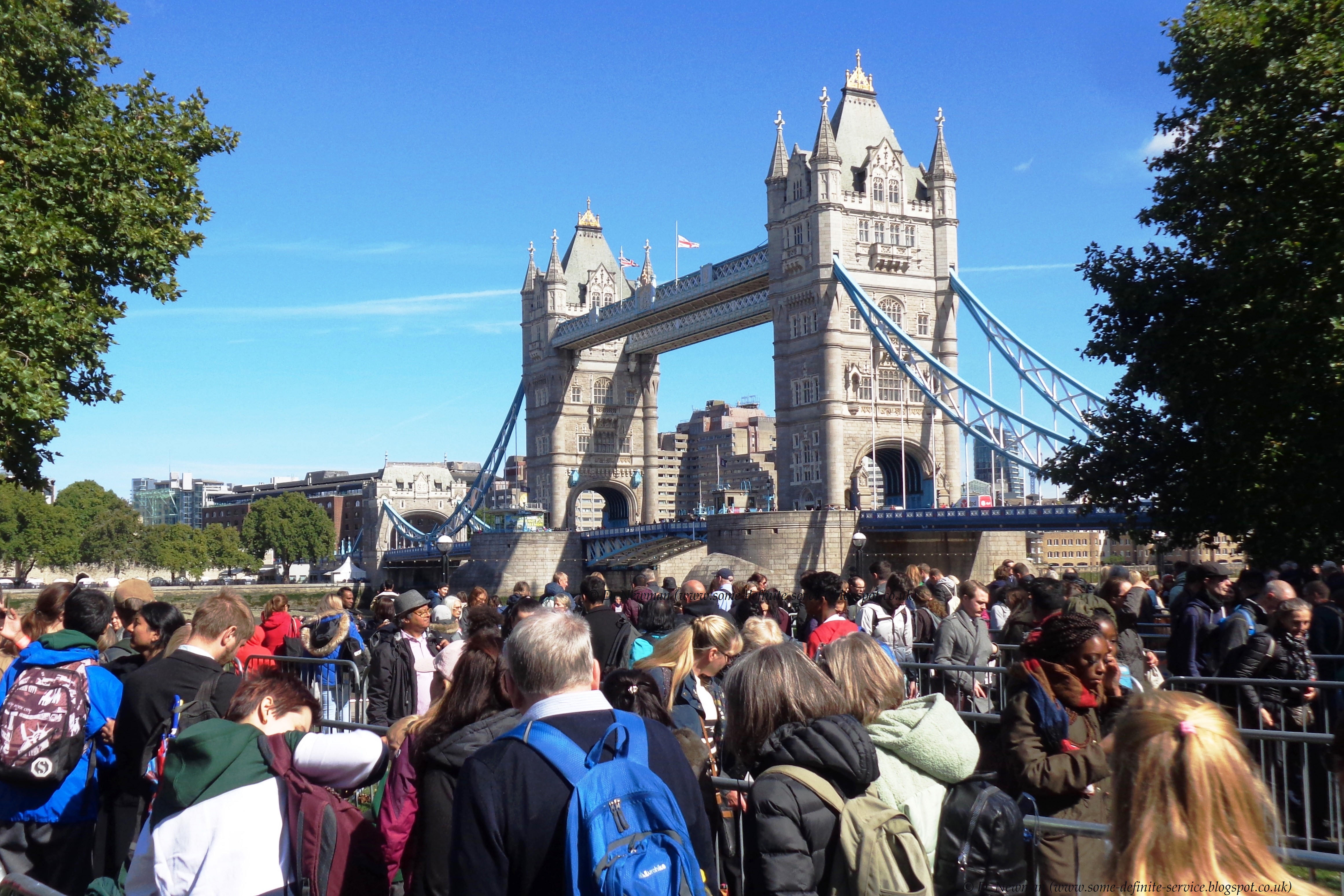
The queue down Shad Thames, just E. of Tower Bridge.
And the extraordinary lengths of the queues showed the extent of the grief and the love, even as the pictures showed their depth.  Seeing dire warnings of a twenty-two-hour-long wait on the Saturday morning, my sister and cousin and I initially abandoned our plans to join the queue, deciding instead that we would walk along its length, past the mourners, pay our respects outside Westminster Hall, and then perhaps go to see the flowers in Green Park.  But just as we reached the start of the queue at Southwark Park, it was reopened with an estimated length of a mere sixteen hours, and we changed our minds and queued after all.

It was, as many have noticed, a pilgrimage — starting, for us, under the dingy girders of South Bermondsey station, along past Galleywall Road, through Southwark Park and a first set of interminable zigzags into the queue, past the makeshift tea-stands set up by enterprising residents, snaking among converted warehouses and bridges and embankments and theatres, over Lambeth Bridge, until, after a further two hours shuffling concertina-wise up and down Victoria Gardens, and a jarring bag-search and body-scan, at last we slipped into the thick solemn hush of Westminster Hall, with the rich colours of the catafalque before us, and the priceless brilliance of the Imperial State Crown flashing finely at journey’s end.

Zigs and zags at Tower Bridge

The whole experience (which turned out to be eleven hours long, not sixteen) taught me something about pilgrimage: that it is the natural expression of gratitude.  I had, and have, no way of repaying the Queen for her years of faith, and integrity, and quiet constant example.  All I could offer was a mark of respect before her coffin.  Small recompense indeed — but there was subconscious logic at work; the knowledge that if this little gesture could somehow be made to cost me more — if I had had to stand in a queue six miles long in order to be able to make it — perhaps it would actually come to be worth more.  Rather like the widow’s mite in the Gospel, my little bow would take on a greater meaning, because I had ‘given all I had’.

The Lambeth Embankment, across the river from Parliament, as the afternoon wears on

This, I think, has something to do with why, when I had heard that the queuing time had nearly doubled, my initial reaction was not dismay, but a strange instinctive determination that I was Jolly Well going to queue, come what may.  This is surely the same impulse that drives people to walk barefoot and impose on themselves all sorts of hard, tough exigencies while on pilgrimage.  It is, however heartily we laugh and joke with our fellow pilgrims along the way, a serious, deep, even primal gesture of love.

The Palace of Westminster from Lambeth Bridge, with flag at half-mast

I think the same is true of the great marches and the funeral offices: as well as solemn duties, they were acts of love and gratitude.  How beautiful, then, that they healed us even as we undertook them.  How comforting, too, were the beautiful prayers of the Anglican liturgy, their loving poetic language, commending our Queen to our God, and telling us again and again what we needed to hear: that whereas we rightly grieve our Sovereign who ‘now rests in sleep’, we may nevertheless have confidence both that ‘we shall rise again at the coming of our Saviour Jesus Christ’  —  and, furthermore, that ‘in due time, we may share with our sister that clearer vision when we shall see thy face.’  We are right to grieve, but it is not the end: again and again I drank in the medicine of those words.  One sensed the wisdom of ages in the knowledge that ten full days would be needed for the initial salving and bandaging of the wound, for that ‘gracious promise’ to sink in once again.  

The two-mile-long concertina in Victoria Gardens

“We will miss Queen Elizabeth terribly,” said Archbishop of Southwark, John Wilson, at a beautiful Requiem Mass at St. George’s Cathedral the following morning.  I have written at length elsewhere in these pages of my admiration for the Queen, and of how extraordinarily blessed we have been to have at the heart of our national life a person who placed love so clearly above power, and for so long, and with such constancy.  She may not have made her personal opinions known, but she did show her beliefs, and the response to her death, the outpouring of grief and love, shows that this did not go unnoticed.  And so, as that extraordinary and bittersweet month slides away off into the past, and as we who share those beliefs, shouldering our loads, turn to carry on without her, we may take slow-burning courage from this parting gift: the vindication in her death of the manner of her life.

Go forth upon thy journey from this world, O Christian soul;
In the name of God the Father Almighty who created thee;
In the name of Jesus Christ who suffered for thee;
In the name of the Holy Spirit who strengtheneth thee.
In communion with the blessèd saints,
and aided by Angels and Archangels,
and all the armies of the heavenly host,
may thy portion this day be in peace,
and thy dwelling in the heavenly Jerusalem.  Amen.
A still frame from the BBC’s live stream from Westminster Hall.