Showing posts with label secularism. Show all posts

Thursday, April 17, 2025

An Ambush of Hope on Maundy Thursday

There was I preparing my usual Maundy Thursday jeremiad on the crises of our time, the evaporation of meaning from our language and culture — all the usual things — when, all of a sudden, from various different sources, I was ambushed by a fusillade of extraordinary statistics.  In London’s largest Catholic diocese of Westminster, there has been a twenty-five per cent increase in adult baptisms in a single year; taking neighbouring Southwark into account, nearly a thousand adult Londoners will be baptisedAcross all churches in Britain there has been a fifty-five per cent increase in numbers since 2018.  Moreover, the growth is among young people: whereas in 2018 only 4% of 18–24-year-olds were regular church goers, that proportion has now risen to 16%, and of this number, 41% are Catholic.  Meanwhile, in France, there has been a record number (17,800) of adult baptisms, a growth of forty-five per cent in a single year.  Again, young people seem to be the driving force: an extraordinary 42% of those baptised are aged between 18–25.

Living in London, I have long had a sense of the vitality of the Church here, and it is remarkable to see now this hard evidence of a revival, of a New Evangelisation under way.  It is my privilege to count several of these recent converts among my friends, and I can attest to their dedication and energy; also to their level-headedness and prudence.  From them I draw the same conclusion as the statistics suggest: this is is no fad or emotional spasm, but the sum total of many careful decisions made after long thought and prayer, and a serious and genuine trend.  ‘Something is happening out there,’ as the American social commentator Mary Eberstadt has said, and it is as true on this side of the pond as it is on hers.

Screenshot from Catherine Pepinster’s article in the Telegraph, 13 April 2025: ‘The extraordinary resurgence of the Catholic faith in Britain’.

The situation has even piqued the interest of (largely secular) colleagues at (very secular) work, and on more than one occasion I have found myself fielding questions in, it seemed, an impromptu press conference.  They were intrigued enough to hazard their own explanations, many I think accurate: the crises of our time, both visible and invisible (in the first category, pandemic, war, climate change and the economy; in the second, of meaning, relationships and of the human body).  The degradation of our culture, the damage to the environment, the chaos of the online continent, the philosophical challenges posed by political upheavals and by the rise of the smartphone and by artificial intelligence… these are the crises that we all know about.  And also playing their part are the crises that the Church has, however unfashionably,  long been predicting, and which now even the secular world cannot avoid noticing: the collapse of trust and happiness between the sexes, the unsustainably low numbers of births, the decline of marriage and the prevalence of family breakdown.  (Another astonishing statistic from Versailles diocese was that 80% of catechumens in their twenties come from broken homes).

But the reason for the conversions is not necessarily, and certainly should not be, entirely negative.  It is not solely out of fear and uncertainty that we ‘turn to religion’ as my colleagues put it.  The explanation might be far simpler: that our spirits crave more than the sugary junk of the moral and cultural menu that secular progressivism has been serving up for the last six decades, and that we long for more — that we hunger for beauty, truth and goodness — that we seek the face of God.

What is also inspiring is that many of these converts have found their way to the faith from quite a remote position: raised without a connection to the Church, they have set out and found their way home, in the face of all fashion, against all trends, and indeed, risking outright disapproval from all directions.  And in their search for meaning and clarity they have fallen for none of the insane ideologies waiting to scam their souls — or at least have not fallen for them permanently.  They have come to the Church that so many wrote off, mocked, dismissed, sought to smother.

But, this being Maundy Thursday, are we getting ahead of ourselves?  Statistics are only statistics: after all, in the early 1960s the seminaries were full, and few foresaw the decline that is still the general trend.  Professor Stephen Bullivant has said that, numerically, the Catholic Church is only doing the least badly of the Christian Churches; in 2023 Mass attendance in England and Wales was only 555,000, compared to pre-pandemic figure of 702,000.  And if in bleaker years we have remembered rightly that the Church does not depend on numbers, that ‘Truth draws strength from itself, not from the number of votes in its favour’, or that ‘where two or three gather in my name, there am I among them’, then increased numbers now do not in themselves make the faith any more or less true.  The disciples, arrived in Jerusalem for Passover, might have reckoned they had done a decent job over the previous three years, but events were imminently to render any performance appraisal utterly irrelevant, to leave their competencies as against agreed objectives quite beside the point.

Likewise we in the Church, soon to be blessed at the Easter Vigil with so many new brothers and sisters, know that this remarkable gift is not just the measure of mission statements and strategies — true though it is that a great deal of hard work and courage lies behind this new growth.  It is again a sign that God’s ways are not our ways, that we are His instruments in the New Evangelisation, not He ours.  And certainly, seeing things in this way, there is never a dull moment: it is at times like these that we see how dramatic the results can be.  

And speaking of drama, now we follow the disciples into the Upper Room, as evening falls, and the lamps are lit, and the shadows play around the walls…

The setting by Maurice Duruflé (1902–1986) of the Tantum ergo, sung by the French ensemble La Cité de la Voix in the Basilica of Sainte-Madeleine de Vézelay, Yonne.  ‘Therefore, so great a Sacrament / Let us venerate with heads bowed, / And let the old practice / Give way to the new rite; / Let faith provide a supplement / For the failure of the senses.

Sunday, December 24, 2023

Fear Not


And so we come once again to the fireside of the year, where the strange and lovely truth of Christmas draws us to homely things.  As the years go by, and I find myself less and less at home in the time and place given to me, I cross the threshold of this feast with ever greater relief.

It is not easy to live in, this age of deceptive appearances.  Behind the superficial glass and the liquid crystal screens our sorrows are undiminished.  The Britain in which, for the first time in fifteen centuries, a minority of people now profess to be Christians, is no happier for its loss of faith.  The old ways we tore to pieces are giving way not to the promised utopia, but to a new, sullen, disenchanted, resentful existence.   Not only are things going wrong, but we struggle to agree about what has gone wrong, let alone how to make things better.  Identity politics have captured many formerly trusted institutions and done great damage to their reputations, as well as confusing or upsetting many well-meaning people.  And our response to the general economic strain is not, in general, an effort to build up solidarity and courage, or to provide an alternative to rapaciousness and greed, but renewed howling against our forebears and the foundations of our society.  That old, gentle Britain to which we owe so much, and for which I still stand, has become our scapegoat.

This is now a Britain in which many shared things are no longer well-made or looked after; in which even those trying to do well seem unable to overcome the shoulder-shrugging culture around them.  Wherever we go, any expectations of high standards seem to be frustrated.  Thoroughfares and public spaces are tatty and uncared for; lifts and escalators are broken or vandalised.  Or things will not be as they first appear.  The Internet, for instance is full of false promises: websites will co-operate for a moment before the sentence you were reading disappears behind a salvo of pop-ups about cookie settings or newsletter subscriptions.  A special offer will turn out to entail endless and spurious terms and conditions.  Sorry, all our operatives are busy at the moment.  Sorry, this desk is unstaffed.  Sorry, this machine is out of order.

It is a Britain in which language itself is often used insincerely, too often more for the purposes of manipulation than anything else.  Euphemisms and weasel words and empty slogans are so prevalent that it is a constant effort to pare speech of them, to speak or write plainly and truthfully.  We often feel patronised and tricked and taken advantage of.

It is a Britain in which people of good will increasingly bear the brunt of the selfishness of those of ill-will; in which those in positions of responsibility are often unable to exercise their offices with principle and clarity; in which those who shout loudest tend to get their way.  Only amongst a few is there even a sense of embarrassment at our irreverence, our arrogance, our squandering of our inheritance.  It is a Britain which, I now see, is indeed mortal.

It is an old and noble nation forgetting her honour, and learning anew the barbarism that the old faith once kept at bay.  There are grave misdeeds and acts of calculatedly barbaric violence at home and abroad, an ebbing away of civility and common decency, and the unabated undermining of marriage and the family and of the Christian vision of the dignity of the human person.

But amidst all this, even as the darkness presses in, another voice, another kind of language.  And there were in the same country shepherds abiding in the fields… Words which, strange as they are to the ear, are not evasive, do not deceive; which have that unmistakable ring of truth:

And, lo, the angel of the Lord came upon them, and the glory of the Lord shone round about them: and they were sore afraid.  

And the angel said unto them, Fear not: for, behold, I bring you good tidings of great joy, which shall be to all people.

For unto you is born this day in the city of David a Saviour, which is Christ the Lord.

They are words which contradict all the smirking arrogance and squalid tragedies of our time, but not as we would have supposed or dared to have hoped.  Something different is going on: something strange and also sweet… Something so strange and sweet as the call of our true and longed-for home.

The darkness presses in on us, often as intensely as it pressed in on the Roman province of Judaea and on Bethlehem; pressed right down on the stable-roof and sought entry.  But from within that stable it was repelled and defied, as it is repelled and defied tonight, and for ever, by light — by the one Light which, as we have often been told, the darkness cannot overpower.  And our liberation is both more cosmic and more intimate than instant deliverance from hard times or a faithless epoch could ever have been: we are freed from the very foes that blight us most: sin and death.

This year is the 110th anniversary of one of my favourite Christmas poems: Noel: Christmas Eve 1913, by Robert Bridges.  Gerald Finzi set it to music in his Christmas cantata In Terra Pax (see above) though for the third stanza he substituted the verses quoted above, from the second chapter of Luke’s Gospel.

Noel: Christmas Eve, 1913
Pax hominibus bonae voluntatis. 

A frosty Christmas Eve
when the stars were shining
Fared I forth alone
where westward falls the hill,
And from many a village
in the water’d valley
Distant music reach’d me
peals of bells a-ringing:
The constellated sounds
ran sprinking on earth’s floor
As the dark vault above
with stars was spangled o’er.

Then sped my thoughts to keep
that first Christmas of all
When the shepherds watching
by their folds ere the dawn
Heard music in the fields
and marvelling could not tell
Whether it were angels
or the bright stars singing.

Now blessed be the tow’rs
that crown England so fair
That stand up strong in prayer
unto God for our souls:
Blessed be their founders
(said I) an’ our country folk
Who are ringing for Christ
in the belfries to-night
With arms lifted to clutch
the rattling ropes that race
Into the dark above
and the mad romping din.

But to me heard afar
it was starry music
Angels’ song, comforting
as the comfort of Christ
When he spake tenderly
to his sorrowful flock:
The old words came to me
by the riches of time
Mellow’d and transfigured
as I stood on the hill
Heark’ning in the aspect
of th’ eternal silence.

Wishing all readers a very merry and restful Christmas.

Tuesday, May 16, 2023

Some Grounds for Catholic Optimism

The Archbishop of Westminster, Cardinal Vincent Nichols, began his New Year message for 2022 by comparing two different kinds of hope.  One he called the ‘pragmatic version’ — in which ‘a secure present’ gives us confidence to ‘look forward to an uncertain future’ — whereas the other, he said, was the ‘theological virtue’ of hope — ‘the capacity to face an uncertain present’ because, beyond it, we trust in an ‘utterly secure future.’  

Most of us in the Church would recognise this distinction.  After all, the first kind of hope, which we might also call ‘optimism’, is in distinctly short supply these days.  As the memory of the old faith drains steadily out of our cities and civilisation, as the tenets of the Creed are forgotten one by one, as forces mighty as Goliath yet insidious as the serpent conspire to hobble the Church and smother the Gospel, the psalms of lamentation come easily to the lips: ‘How shall we sing the Lord’s song in a strange land?’  And so we cultivate the second kind of hope, setting our sights and our hearts on the ‘utterly secure future’ of the kingdom of Heaven.  We brace ourselves for the ‘Long Defeat’, as Tolkien put it, in sure hope of the Final Victory.

But what if even earthly hope is not altogether lost?  For although this nurturing of Deep Hope is fundamentally the right approach to our situation, it nevertheless carries with it an understandable temptation: to give up on the immediate future altogether, and thereby to miss such possibilities as do in fact lie before us.  We are not Albigensians; we should not turn our backs completely on the world.  The Resurrection of Christ was as earthly a thing as it was supernatural, and changes the present moment as much as it does eternity; its implications are not only cosmic but comprehensive, changing the world not only in general but in detail, and from within, not from without.  Our everyday lives on earth are shot through with a new life-force — the Word, whispering perpetually into every crisis, ‘This is not the end — for I was, I am and ever shall be.’  Even in these bewildering times, there is an onward path to tread.

Cardinal Vincent in his message goes on to point out the ‘middle ground’ that exists between the two kinds of hope.  His point, if I understand rightly, is that we need to develop an intelligent combination of both: Deep Hope in the long term; courage and fortitude in the short.  Even if ‘optimism’ is hardly the first word we might use to characterise our immediate outlook, it has to be an ingredient in our approach.  Even a dash will do.  As we heard from the prophet Jeremiah (of all people!) one Sunday last year:

A blessing on the man who puts his trust in the Lord, with the Lord for his hope.  He is like a tree by the waterside that thrusts its roots to the stream: when the heat comes it feels no alarm, its foliage stays green; it has no worries in a year of drought, and never ceases to bear fruit. 
(Jeremiah 17: 5–8)

‘Never ceases to bear fruit’…  Mainstream opinion-formers may think the Catholic Church obsolete, deluded and contemptible, but we must not give the slightest impression of believing them.  Certainly we should be prudent in the deployment of our energies; absolutely we must attend to the deep and inner roots, but in the drought of the coming decades we must never lose confidence that the Church will indeed ‘never cease to bear fruit’ — because she retains countless ways to prove herself essential not only to her own members, but to our whole society.

What sort of thing do I mean?  Here are some ideas.

1.  Pro-life victory is certain

I am absolutely confident of the eventual victory, on earth, of the pro-life movement.  This might sound absurd, given the present total dominance of the abortion lobby in law and politics.  All the same, of the innumerable logical contradictions at the heart of the revolutionary secular-progressive project, this is the hardest to sustain, and indeed can be sustained only by shrill campaigning and a constant flow of cash.  A succession of scientific discoveries is steadily and consistently vindicating the Church’s position, and, sadly, so is the testimony of ever greater numbers of women as to the offence done by abortion against their dignity and happiness.  The strength of the pro-choice lobby is nearing its high water mark; it has little further ground to gain; it is already having to become defensive of its establishment position.  Its members are beginning, rightly, to recognise the possibility that they will, as the phrase goes, ‘lose the narrative’ to the joyful and energetic pro-life message.
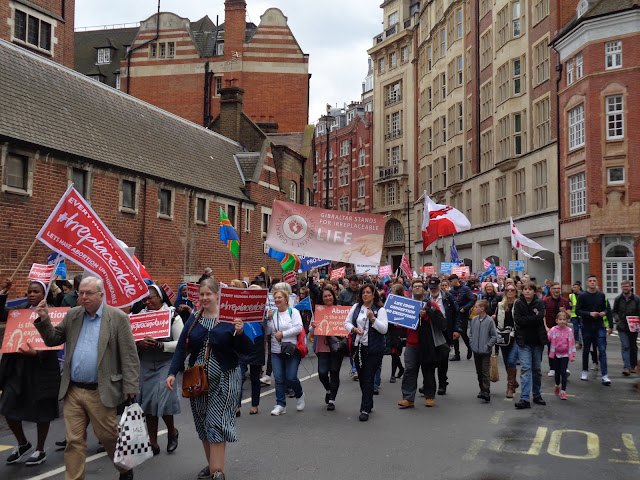
March for Life, London, September 2018

I do not mean to sound complacent — after all, the cost in unborn lives now runs at over two hundred thousand every year in England and Wales alone — but I am not being complacent; I am being confident.  As with the trans-Atlantic slave trade two centuries ago, the whole outrage is likely to end abruptly, even unexpectedly, with a sudden anagnorisis and revulsion at the horror.  Unless our society is completely overtaken by nihilism, a point will be reached at which the injustice can be denied no more; someone at some point will ask, in a loud enough voice and in a way which will suddenly be listened to, why (for instance) we see hardly anybody with Down’s syndrome around any more; will ask why we uphold the rights of God’s animal creatures, as we should, without extending the same defence to our own unborn children.  When the tide does turn, the sheer consistency and integrity of the Church’s pro-life position, as well as her record in providing for mothers in need, will stand her in good stead when it comes to establishing a new and authentic culture of life.

That is one concrete reason for hope in our age, but still stretches the definition of ‘optimism’ a little far.  What about today and tomorrow?

2.  Fire-power isn’t everything

It is worth remembering that we still have great resources in the nature of our presence in society.  Secular progressivism is on the warpath, and hardening into a religion of its own, having at its disposal many organised shock-troops with strident and persuasive voices, and tightening its grip on our culture.  But if the Church seems not quite able to match this sheer fire-power, it is not because we lack good arguments or articulate ripostes.  It is because we have other things on our plate as well.  Unlike the cultural revolutionaries, we have always been concerned about more than mere propaganda.  The Church may be in battle, but she is not merely a battleship: she has to be a rescue vessel and a hospital ship and a flagship all at once.  She cannot be expected to swivel and aim her guns as adeptly as a purpose-built destroyer.

What is more, so much of the strength of our witness actually lies in our silence.  This is true in two senses: firstly in the simple fact of our not going along with propaganda or slogans, and secondly in the positive quality of the silence of our sanctuaries.  Especially these days, when moments of peace, let alone peace by oneself with God, are so hard to come by, precious indeed are the physical refuges of our churches amid the howling cities.

Our strength lies, too, in the aspects of the Church’s life that never make the headlines: her presence in hospitals, in hospices, in prisons, in homeless shelters, in ports, in refugee camps, in the armed forces, in universities, in schools.  And her charities: the tireless work of CAFOD for overseas development, Aid to the Church in Need for persecuted Christians, the St. Vincent de Paul Society for the homeless, and so on.  All those things that are never chalked up on the scoreboard of history: the Masses, rosaries, hymns and prayers; the confraternities, the prayer-groups, the pilgrimages, the devotions; the ‘ecclesiolae’ or ‘little churches’ of families holding their own day after day.  The kindly priest in the lit confessional; the Mary-garden under the railway arch; the soup-bowl in the homeless shelter: in all these ways the Church, with that gentle tenacity of hers, persists in living the ‘life to the full’ that her Founder promised.

The cultural revolution tends to be keener on the commanding heights of the culture — the law, the government, the arts, schools, universities, and the apparatus of civil society — than on the welfare of ordinary people.  This tells us that it is only really interested in power; that for all its capacity for intimidation it is necessarily brittle and lacking foundations, and that its strength, though incontestable for the moment, will prove ephemeral.  The Church’s appearance, by contrast, is no mere veneer.  Under the surface she is true to her word.

3.  The Church comprehends the new and pluralised Britain 

Another opportunity for the Church in years to come, one in which it stands as good a chance of success as any other institution apart from the Crown, is in making sure we fashion a harmonious society of the new pluralised Britain, and preventing the emergence of any division or mutual alienation.  Relatively few things can be said to unify us as a country these days, and certain fractures are emerging which the Faith is placed uniquely to heal.  What but the Christian imagination could even conceive of bringing into serious dialogue, say, the secular liberal on the one hand — whose instinct for mercy, though misproportioned, echoes a distinctively Christian idea — and the observant Muslim on the other, whose concern for justice, codified by the bracing tenets of Islamic law, testifies to a sincere attentiveness to God’s will?  Because the Church understands this paradox of justice and mercy, knowing how to temper one with the other, she can, I think, foster more fruit from such a conversation than anyone else.

And where else but within the Church can the demographic changes of the past fifty years be not only reconciled but harmonised convincingly with the deepest roots of our society?  To take only one of countless examples, consider the Tamil pilgrimages to Our Lady’s shrine at Walsingham, which I understand attract the largest numbers of all the pilgrim groups.  In this village in the heart of rural Norfolk, a place of pilgrimage since before the Norman Conquest, an ancient English devotion is unified with a Tamil one.  There is no contradiction between love of England and love of neighbour; there is simply one faith, one Church and one Lord.  Thus the world-wide roots of today’s pilgrims are entwined with the very depths of England and Englishness, new Britons follow in the footsteps of medieval kings, and all pilgrims throughout the ages are unified in peace and goodwill.  For many immigrants and their families and descendants, the Catholic Church is a ‘home away from home’ — and yet it has been here in England, waiting for them, it seems, since England’s very beginning.

Tamil Pilgrimage to Walsingham, Norfolk, 2016

4.  New alliances amid the crisis of meaning

Then there is the crisis of meaning: the alarming and deepening void at the centre of modern life, and, which is often even more horrifying, all that is rushing in to fill the void.  Only a decade ago the New Atheists were trumpeting the new dawn of a fanaticism-free secular age of cool rationalism, but now their vision seems completely unequal to the socio-cultural forces of our present time — forces which I am convinced are also spiritual.  As R. S. Thomas wrote,

In cities that
have outgrown their promise people
are becoming pilgrims
again, if not to this place,
then to the recreation of it
in their own spirits […]

Amid a loss of confidence in our institutions, our culture and even ourselves, a tremendous spiritual famine has suddenly declared itself: often vague, often outwardly hostile to formal religion, but unmistakeably spiritual in character.  This manifests itself in some obvious ways — the growing and understandable popularity of ‘mindfulness’, or the emergence of whole new academic fields such as ‘Loneliness Studies’ — but also in some more alarming forms: in the new ideologies sweeping every public institution, our blind faith in progressivism, and the many genuinely troubled young people.

Writers such as the essential Mary Eberstadt have long been observing how sixty years of aggressive secularism have been incubating this situation — but plenty of non-churchgoers are also noticing the crisis.  They share our alarm at the widespread subjugation of truth and reason to personal desire, and many are realising that even the Church may have something interesting to say about it.  We can and must do our best to repay that confidence; if we do, we may find ourselves entering into some new and fruitful kinds of dialogue.  (I say this from personal experience.) 

5.  The crisis of gender, though tragic, is a particular opportunity

One friend with whom I regularly enjoy such conversations recently brought to my attention a recent lecture on freedom of speech, one of the BBC’s annual series of Reith Lectures, by Nigerian-born novelist Chimamanda Ngozi Adichie.  At the core of this address was an appeal for a ‘coalition of the reasonable’ to maintain the standards of public debate.  She was speaking mainly with reference to the extraordinary behaviour in recent years of many advocates of gender theory, who have often been using outrageous tactics in order to advance their contentious cause, organising social media storms, releasing personal information, and even hounding their opponents from their jobs.

Adichie’s is an invitation to which the Church can and must respond positively.  We believe in reason and know that civil and reasonable debate are essential to our whole society — so there is an opportunity here for some real solidarity and co-operation.  In forming such alliances we do not have to pretend to agree where we disagree, but there is no reason why an edifying exchange of ideas should not take place.  The ‘reasonable secularists’ can discover our sincere interest in truth and reason, while we might draw some inspiration from their strength of purpose and concern for accountability and integrity.  Maybe, in finding ourselves on the same side for once, the discussion will be more constructive than it has been for many years.

Perhaps, too, at a relaxed moment, the conversation might turn to higher things, and to the spiritual dimension of the crisis of our time.  We might mention Benedict XVI’s insight that as well as reason we need faith, and that the two are not only compatible with but absolutely essential to each other.  We might make the point that the sense of meaninglessness from which so much of the crisis has stemmed corresponds to a deep reality about ourselves — that our longing for meaning is not some vague and inconvenient appetite, nor some functional or dietary need to be satisfied by the appropriate vitamin, but is a sign of the deepest truths about ourselves: the spiritual truths.

Even so, the urgent task remains to offer charitable but robust collective opposition to gender theory, which even now is doing irreversible damage to many confused and unhappy young people, as well as offending in a particular way against the rights and dignity of women.

6.  The Re-evangelisation of Romance

Another obvious mission for the Church is also one of the most dangerous: to confront head-on the ongoing melting down and recasting of marriage and the family, and to re-evangelise the sphere of romantic and marital love with the fullness and beauty of the Church’s teaching.  

Here, as with abortion, the post-Sixties revolutionary movement is visibly running into difficulties, and beginning to fray amid its own contradictions.  But its power is still tremendous, and its price exacted mainly on the young — who secretly, often even without knowing it themselves, long to hear the truth.  They long to be told what deep down they suspect: that all men and women were made for each other’s mutual respect and friendship, not for sullen rivalry; that the unique kind of friendship which is life-long marriage, the real thing, is no fancy but the gold standard, given to us by God for our flourishing; that a bride and bridegroom really are worth to the other nothing less than the gift of a great cosmic vow, one equal to the weight of an entire human life and strong enough to sustain the multiplication of new life; that such a vow is no mere formality, but something we long with all our hearts to make and to fulfil.  Youth seeks truth — the truth about ourselves, a truth which is written in our bodies as well as in our souls — and the Church, with teaching that is as beautiful as it is true, must be there to meet their longing.  Our culture is near enough rock bottom to hear it.  

We will often run up against wild rage and hatred — for those entrapped by darkness hate and fear beauty and truth — but there are millions of others waiting to be captivated by the high mission to which the Church calls them.

As Mary Eberstadt said in a recent interview,

Catholics should be proud — in the right way — of all these unpopular teachings.  They’re only unpopular for the moment, and […] they resonate with the human heart.  That again is to our advantage as we try to press this case.

This is one of the few spheres of life in which many people will still acknowledge a spiritual dimension, while often remaining sceptical about the form of marriage.  We are in much the same situation as those who argue for rhyme and metre in poetry: our task is to show how the form gives sense to the feeling; how the rules and vows give the underlying human impulse the sense and the strength to endure.  Against the pessimism of liberalism, with its fear of commitment, with its cynical assumptions about loyalty and perseverance, many will be surprised and inspired by the frankness, the freshness, the bracing realism, and, yes, the sheer optimism of the Church’s vision.

7. How hope works

I have one final remark on the way hope itself works, and where to look for it.  Whether pragmatic or theological, hope does not usually come marching over the hill; it grows fierce and green in unlikeliest places, as tenacious as grass or wildflowers.

One hot day a few years ago I was riding down a cycle path alongside a heaving A-road in south London, gritting my teeth against the noise and hostility around me, when the path narrowed and, seeing a child of about ten or eleven coming the other way, I braked to let him through.  To my complete astonishment, he very sincerely and deliberately thanked me; I hadn’t expected it and was too stunned to respond adequately.  There, uncrushed by the juggernauts and the tyres, defying the smirking warlords of the road, a tiny counter-witness, a green shoot of hope — something so vital, so ‘original, spare, strange’, that it offered a stronger riposte to its surroundings than perhaps the boy knew.  Like Lovejoy’s garden in Rumer Godden’s book An Episode of Sparrows, hope grows and germinates in defiance of overwhelming forces, even in spite of ourselves, in the ‘fields of our hearts that dead and bare have been…’

In the same way, as we should know from our own lives — and at Eastertide of all seasons — the vindication of the faith is with us, on earth, in this very hour.  ‘Christianity works,’ as Douglas Gresham, C. S. Lewis’s straight-talking step-son, once said.  It works in our lives, in every detail of our lives, even if the wider world is ignoring it for the present.  

---

I am under no illusions: this is a very uncertain and unsettling age, and things will not be easy for the Church for some time.  Many of the opportunities I describe may only be born of various crises and amid great suffering: it may be that we can be optimistic only to the extent of being poised to respond to a crisis.  It is also undeniable that the Church as an institution — in Europe and the West at least — has been severely weakened in the past fifty years — partly by mockery and marginalisation from without, partly by slacking and scandal from within.  But the Church’s members on the ground are chastened and made wise by crisis; we are all, clergy and laity alike, more alert, less complacent, and more capable of giving an account of ourselves than we have been for some time.  And in an age when all institutions are struggling to win trust, the Church is again as well-placed as any other to recover her integrity and a visible authenticity.

As far as external threats go, the Church can handle crises far better than she can uncertainty and apathy.  Our very foundation began with an utter catastrophe which was gloriously and outrageously inverted into triumph.  We have the ‘utterly secure future’; we have the Final Victory — but the near future is worth fighting for as well.  Keeping courage, then, means keeping courage in the short term as well as the long; today and tomorrow, this hour and the next, so that, in a happier time, our descendants will remember and give thanks for their forbears in faith, as we give thanks for ours.

The Lord is my light and my salvation; whom shall I fear?…
Though an army encamp against me, my heart shall not fear.
For in the time of trouble he shall hide me in his pavilion:
In the secret of his tabernacle shall he hide me; he shall set me up upon a rock.
  

(Psalm 27: 1–5)

Pope Benedict at Hyde Park, September 2010.

Tuesday, January 31, 2023

Farewell to Benedict the Great

And so we must begin the new year without those two great figures, those beacons in our time, Elizabeth II and Benedict XVI.  We were not unprepared for the losses; we cannot complain that long life was not theirs, but we always knew that the world would be a colder and lonelier place without them.  The torches they carried, we realise with a pang, are handed down to us.  I try not to allow myself too many living heroes, but that is what both have been for me.  They stood for truth and faith in a cynical and darkening age.  They used word and gesture to encourage and hearten people of good will.  They made it clear that they understood their offices as vocations, their authority as a form of service, and their main power to be that of the quiet example — which they each set unfailingly, in a strikingly similar style, and with comparable courage. 

The praise of the intelligence, erudition and churchmanship of Joseph Ratzinger I will leave to others better qualified to judge — ‘an essential European thinker’, ‘the greatest mind to reach the papacy in a millennium’, ‘a man with the intelligence of twelve theology professors but the innocence of a child at his First Communion’.  Mine must be a more personal tribute: the thanksgiving of an ordinary rank-and-file pew-filler whose privilege it was to live through, and be formed by, his papacy.  The reign of Benedict XVI corresponded almost exactly with my adolescence: I was confirmed less than a month after his election in 2005, and was most of my way through university when he resigned.  In between, of course, in September 2010, came his visit to Britain, an event which smote my spirit right when the iron was hottest.

Much has been said about the clarity of Joseph Ratzinger’s prose, but this was not a quality confined to his writings or even his speech.  Clarity was a characteristic of all his actions and gestures; it surrounded him like an aura.  Simply by his presence, by occupying his square, he shed light by which others around him could see and think more clearly.  This was certainly true for me: his visit to Britain clarified my life and clarified my faith; it set a seal on me, exactly when I needed it, and deeply and lastingly.

I don’t mean that there was a dramatic conversion.  To grow up with and into the faith in mid-suburban south London in the 2000s was to be more than familiar with the ennui and malaise of our times.  It was, then as now, to live against the grain of the surrounding culture.  There was always an awareness of being held to different, I dare say higher standards; always a discernible change in atmosphere between the Church and the mainstream, secular-materialist world whose raucous tide came right up to the front porch.  I knew that this world thought Christian believers mawkish and irrelevant and obsolete.  I knew about Dawkins and Hitchens and the fashionable New Atheists  though the prevailing mood, at school for example, was less outright hostility than a flippant indifference to serious conversation of any kind.   Yet I was certain that all churches were inhabited; that they were Someone’s house, and that this indwelling presence was a benevolent influence on life.  So the awareness that to practise my faith was to risk the bemusement or ridicule of others was not something I minded — in fact, I probably enjoyed it rather too much.  I felt myself lacking in intellectual formation — and since it was on intellectual grounds that the New Atheists were attacking religious faith, I wanted to know how to mount a defence — but socially, I did not mind being a bit of an outsider.

What I did not altogether realise, though, was what became clear almost at the moment Pope Benedict’s visit was announced in February 2010: the sheer proliferation of quarters in which the Church is actually hated.  Hated not just by celebrity atheists with a book to sell, not merely by self-promoting comedians, but by considerable numbers of influential, intelligent people in actual positions of responsibility. Journalists in reputable papers, politicians, personalities, even employees of government offices — all felt quite free, even in self-proclaimed tolerant Britain, to articulate that hatred to their spleen’s content.

Now, I knew I could not expect unbounded enthusiasm from the media, but this went beyond, say, reasonable concern about public expenditure, or just excoriation of corruption in the Church (corruption which Catholics hate as fiercely as anyone else, if not more).  It was plain that what they hated was the Church itself, and the faith itself, and Pope Benedict himself.  It was personal and it was nasty.  In modern Britain it would have been tolerated towards no other religious leader.  It was different, too, from the residual Protestant anti-Catholic prejudice which had led some to protest against Pope John Paul II’s visit in 1982.  This had a different source: secular progressivism, the new faith of Europe, whose chummy mask had slipped to reveal a face twisted with rage.  It was an outbreak of what we now call ‘cancel culture’, and they certainly wanted Benedict cancelled.

I had not known all that much about Joseph Ratzinger, but all this impelled me to find out pretty quickly.  For us Catholics, an attack on the Pope is like hearing an insult directed at your grandfather — the immediate instinct is to rush to his defence — but even a dispassionate observer should have been able to see the extraordinary discrepancy between Benedict’s media image and the man himself.  This discrepancy was its own wordless vindication of Pope Benedict, of course, but, being a fire-blooded adolescent, I wanted to see some hefty ripostes from our own side.  Many of the most spirited defences I initially found online were mounted by bloggers sympathetic to traditionalist worship, and ever since, though always an English Mass-goer myself, I have been disposed to sympathy for those who prefer the traditional Mass (though it has since been dismayingly instructive to see some other traditionalist blogs turn as nasty about Pope Francis as the secularists were about Benedict).  Benedict had other defenders, too, not least Catholic Voices, which was established precisely in order to offer intelligent, robust, charitable defences of Catholic positions  — an approach which, I now realise, was entirely consistent with the style of the Pope himself.

What I discovered in Benedict was a man alert to the times but not subservient to them, quietly but firmly addressing himself to the modern world, diagnosing its ailments acutely, warning with gentle urgency against its errors, pointing some possible ways ahead.  He explained with startling lucidity what I had long hoped and suspected: that intelligence and faith, far from being opposed, illuminate each other; that there is no contradiction between truth and love; that the small flame of the sanctuary lamp remains the vital spark of life, in this age as in any other.  More immediately, I found a gentle and grandfatherly man, perhaps the most misrepresented man of the past half-century.  

The protesting secularists probably bothered me far more than they did Benedict himself.  Still, there was considerable and justifiable concern that the visit was going to be marred or hijacked in some way, and the eight-month media circus offered little reassurance on this score.  But this was where his clarity came in.  His character, simply by its sheer contrast to the mud-slingers, presented me with a clear choice.  One side was sneering at faith, hating beauty, scoffing at marriage, dismissing hope; on the other sat Pope Benedict and the Church, quietly but firmly standing for the ‘splendour of truth’, defending the absolute and irreducible human dignity of every human being, even when it is inconvenient — perhaps especially when it is inconvenient — and holding up defiantly the model of the person of Christ.  The whole experience confirmed my suspicions about the the secular-progressivist modern West, and my sorrow at the ebbing away of Old Britain.  I saw that I might one day have to choose between my own culture and the Church; that when it came to it, the Faith might actually cost me something.  Before he even landed, then, Pope Benedict made it clear to me where my loyalties lay.

But then he did land — and the mood changed utterly.  There he was on the television, chatting with the Queen at Holyrood; suddenly the BBC was wearing the seriousness and respectability of the national broadcaster, and the grown-ups were back in charge.  And it was not that Benedict routed or shamed the protestors. It was that they just seemed to melt away, and their menace evaporated.  A demonstration against the visit did go ahead in London somewhere, but it had simply ceased to matter.  I almost forgot about them — and if I did give them a moment’s thought, they seemed rather sad and silly and lonely.  Meanwhile, the crowds who came out to see Benedict, Catholics and non-Catholics alike, were unequivocally benevolent, if not jubilant.  That change of mood alone taught me several lessons I have since found useful — how far a media narrative can diverge from public opinion, and how quickly simple spiritual sunlight can evaporate hostility.  It also confirmed everything I had ever been taught about withstanding bullies and their largely illusory power.

But even while all this was sinking in, Pope Benedict himself, twinkling away, was healing the hurt of centuries.  Here he was, at the the Queen’s invitation, not merely on a pastoral visit (as Pope John Paul II had been), but also a state visit.  The following day, the seventeenth of September, he was down in London, meeting the Archbishop of Canterbury at Lambeth Palace, and, later that evening, during a profoundly moving Evensong in Westminster Abbey which included some of my very favourite hymns, kneeling with him at the shrine of St. Edward the Confessor.  This was, however fleeting, a startlingly coherent and plausible expression of Christian unity, an image of how things could be if the divisions between Canterbury and Rome could finally be healed.  It was an act of worship held together not merely by politeness or decorum, I believe, but by an aesthetic and spiritual harmony.  And so, in sudden contrast to the outsiderhood I had been experiencing as a Catholic Englishman only a few days before, I suddenly found deep congruence between my faith and the very roots of Englishness, and a way opened up and out — as if illuminated by a lightning flash in the middle of the night — towards reconciliation between the Churches.  This had a great deal to do with the organisers on both the Anglican and Catholic sides, of course, but it was also because Pope Benedict himself understood the power of symbolic gesture.

That Benedict knew this personally is, I think, proven by my favourite story about him, an incident which occurred during the Lambeth Palace visit.  It was told by the late, great Fr. Mark Langham, himself an ardent ecumenicist, who was present at the time:

At the conclusion of the speeches we prayed together the Lord’s Prayer, and we came to that awkward bit — the bit where the Roman Catholics stop and Anglicans carry on.  The Anglican bishops, sensitive to the Roman Catholic tradition, graciously concluded, “But deliver us from evil,” and there was a pause.  And then one voice continued, “For thine is the kingdom, the power and the glory.”  It was the voice of Pope Benedict.

I think this simple gesture speaks volumes about the man.  He was salving and resolving the past, blessing the present, and giving us hope for the future.  Between the Lambeth Palace visit and the Evensong in the Abbey, he delivered one of the great speeches of his pontificate in the great hammer-beamed Hall of the Palace of Westminster, arguing that faith and reason are not only compatible but essential to each other.  With his impeccable manners he was proposing a vision for Britain — a vision in keeping with our best traditions, and one which would lead us to a happy and harmonious future.  “May all Britons continue to live by the values of honesty, respect and fair-mindedness that have won them the esteem and admiration of many,” was his prayer.  It has occurred to me that the visit meant a great deal to him, as well as to us; I think these words of his were entirely heartfelt.

It remains a special memory for me that I saw him when he was in the midst of all these monumental errands.  Having travelled up with some Sixth Form friends (incidentally none Catholic) to greet him on Lambeth Bridge, we saw him in the Pope-mobile, twenty feet away, as he travelled to Westminster from his meeting with the Anglican bishops.   

Now, so far, everything may seem to have been on the political or national sphere, rather than the personal.  The main spiritual experience took place the following day, Friday 18th, at the great vigil in Hyde Park on the eve of the beatification of John Henry Newman.  It is worth remembering, when watching back film of the crowds on the Mall past which the Pope travelled, that Hyde Park was already full of 80,000 of us waiting for him; the two gatherings have to be taken together!  It was a tremendous joy, to be gathered all together, to see how many of us there were — and, for me, not least, to see so many other Catholics of my own age.  The music — with its full chorus and orchestra — was both dignified and uplifting.  Then came his unforgettable speech.  What other figure, addressing young people, would refuse to talk down to them, would steer clear of slogans or cheap platitudes?  “Dear young friends,” he called us, and one sensed, by the fondness with which he spoke about John Henry Newman that this speech was clearly his own work, and sincerely felt.  There was a sense of his speaking personally to us — indeed, to me.  The three lessons he drew from the life of John Henry Newman were, just as he said, ‘very relevant to our lives as believers and to the life of the Church today’: firstly, that we are capable of knowing — and were created to know — the truth, which, in a word, is Christ; secondly, that this truth requires our commitment, our ‘intellectual honesty’, which may come at a cost; and thirdly, our beliefs and our lives must be consistent with each other: our faith must be no mere intellectual pose or stance, but permeate our hearts and influence our every word and action, so that, by this courageous integrity, health might flow back not only into the human person but into families, into nations, into the whole world:

One of the Cardinal’s best-loved meditations includes the words, “God has created me to do him some definite service.  He has committed some work to me which he has not committed to another.”  Here we see Newman’s fine Christian realism, the point at which faith and life inevitably intersect.  Faith is meant to bear fruit in the transformation of our world through the power of the Holy Spirit at work in the lives and activity of believers.  No one who looks realistically at our world today could think that Christians can afford to go on with business as usual, ignoring the profound crisis of faith which has overtaken our society, or simply trusting that the patrimony of values handed down by the Christian centuries will continue to inspire and shape the future of our society.  We know that in times of crisis and upheaval God has raised up great saints and prophets for the renewal of the Church and Christian society; we trust in his providence and we pray for his continued guidance.  But each of us, in accordance with his or her state of life, is called to work for the advancement of God’s Kingdom by imbuing temporal life with the values of the Gospel.  Each of us has a mission, each of us is called to change the world, to work for a culture of life, a culture forged by love and respect for the dignity of each human person.  As our Lord tells us in the Gospel we have just heard, our light must shine in the sight of all, so that, seeing our good works, they may give praise to our heavenly Father.

And then in the cool September night we fell silent for Adoration, all together in prayer in the middle of London with Pope Benedict, on the eve of the beatification of a great Englishman.  It was an unutterable privilege.

There is much else that I owe to Pope Benedict — I have not even mentioned a greater reverence in the liturgy, and the new English translation of the Mass, which I associated closely with him —  but this visit was the centre-piece of his legacy for me.  Barely a fortnight after hearing this speech I began university; it was a natural step to join the student chaplaincy, and there I found the same irresistible combination of vigour and conviviality which I have been able to find in various different places to this day, and which is so characteristic of the Church. 

Did he have weaknesses?  It is true that neither his visit nor his papacy appear in the short term to have arrested Britain’s, and Europe’s, slide into despondency and self-loathing; true that few of the British parliamentarians who heard his speech have since made any sign of having paid the slightest attention to him.  Some of my friends outside the Church have only an impression of a man overwhelmed by scandals and crises, and even some of his admirers have criticised him for his decision to resign his office.  It is arguable, I suppose, that even a good pastor and perceptive intellectual may lack the strength of will to govern effectively.  But I think some of the things he had to deal with would have been a fairly hellish proposition even for a younger man — and in any case, even before he became Pope, he had already spent twenty years meticulously, if unspectacularly, driving out rot as head of the Congregation for the Doctrine of the Faith.  Likewise, though I was as shocked as anyone else by his resignation, I don’t find myself worrying too much about it now.  I agree with many others that it was a sign of his humility, and his awareness of his own limits, for, much as I would have loved him to be able to carry on for ever, he seemed clearly weakened and bowed down.  It was also a sign to us not to pin all our hopes on him.  He had, in any case, arguably already established his legacy.  His emphasis as Pope was on Europe, and on issuing the last warning to her not to tear up her roots, and on encouraging the faithful as the shadows fall.  At the same time, he knew as well as anyone that the greatest vitality in the Church today is in Africa and Asia, and I could well believe that, having given all he had for the faith in Europe, he felt the need to stand aside to let this new growth flourish.

Pope Benedict XVI was one of those rare people who were both great and good in both mind and heart — too great and too good, perhaps, to be summed up at this short remove; I agree with those who expect his clarifying influence to be making itself felt centuries hence.  He was, as our own Cardinal Nichols has said (himself, I sense, strongly influenced by the visit), ‘through and through a gentleman, through and through a scholar, through and through a pastor, through and through a man of God’ — and, he added in a BBC interview on the day of the funeral, simply ‘a lovely man’.  I am proud to belong to the Benedict Generation.  May the God whom he served so faithfully and so courageously welcome him into the courts of Paradise.

Papal visit: Welcome by HM The Queen

Friday, December 31, 2021

Thoughts at the Year’s Close

Long, long ago,
Oh!  so long ago,
Christ was born in Bethlehem 
To heal the world’s woe.

These have now been nearly two rather difficult years.  The hardship of the pandemic continues, menacing us not only in the obvious ways, with sickness and the threat of sickness, but also by disorientation and incertitude.  So much about it seems so hard to read, so impossible to predict; even with reliable statistics, it is often a struggle to work out what such figures actually mean for our lives.  Hard information is not enough by itself to arbitrate between imperatives; for that, something different is needed: the gift of wisdom.

Many of the strands of hope I thought I perceived at the onset of the pandemic — greater local feeling, a sense of unity, a new awareness of the sanctity of life — seemed to fade with the receding of the first wave of the virus.  The blessed quietness of the roads lasted only a few weeks here in mid-suburban south London before the traffic came surging back, if anything heavier and more aggressive than before (though I have been surprised this past month by a distinct lessening in comparison to December last year.  The mood on the roads often seems a useful barometer for the public mood in general).  Even during the first wave, certain things marred the solidarity: I did not like the police helicopters on the lookout for gatherings on the nearby Common — a huge expenditure of resources supposedly too scarce to provide basic foot patrols in ordinary times — nor the Government’s almost immediate resort to the law to enforce the ‘lockdowns’, even though the great majority of people clearly understood the seriousness of the diesease and were already taking heed of the unfolding crisis.  As for a pro-life revival, its seeds are evidently yet to spring; only this past autumn the House of Lords was debating yet another motion for assisted suicide.  There is much to be grateful for in the development of the vaccines, and some aspects of the good things I hoped for have come about — but overall it has been an uncertain, unsettling time.

Then there is the new gear into which the dictatorship of relativism has shifted, the breathtaking speed with which that nameless thing, the ideological movement that is all around us, has conquered so completely the mainstream of our culture.  Identity politics, imported wholesale from the United States, is one way to describe it, or radical-secularist-progressivist-post-modernism; I do not really think we yet have an adequate word for it.  But it is frightening and dangerous.  In Britain for the first time in something like a century it is once again fashionable and respectable to judge people not by their character but by their arbitrary and immutable characteristics.  Meanwhile, in the highest and most venerable institutions, simplistic or ideological readings of history go unchallenged, extreme conclusions are drawn, and guilty verdicts are passed on our forbears.  All high principles, all traditional distinctions are undermined and torn down.  

If, as the claim runs, there is no truth, merely power, no wonder the dictatorship of relativism wants that power for itself, however stridently it proclaims its good intentions.  Such is the strength of this thing that even the pandemic itself has been relativised before it, and never more clearly than at that dizzying moment when the mass protests and disorder of summer 2020 actually found favour with respectable public opinion.  That episode, to me, was more alarming even than the first wave of the pandemic: to see the three months’ solidarity evaporate not for weddings, not for funerals, not even for the national memorial of V. E. Day, but for contentious street protests inspired by events in a different country and advocating a hostile and revolutionary ideology; and then to witness the behaviour of supposedly serious and grown-up public bodies — even the most cherished and trusted public institutions in the land — suddenly issuing startlingly, embarrassingly politicised ‘statements’ in support of these protests.  One feels the ground moving under one’s feet in noticing the kinds of remarks, however outrageous, that because they are politically approved one can get away with saying in public, by comparison to those that one cannot say: the plain common sense, the eternal verities even.  A radical and narrow-minded agenda is taking advantage of a general crisis of leadership to flourish in our institutions, and it is an agenda that is growing ever more overtly hostile to common decency, to fair-mindedness, to traditional Britain and ultimately to the Christian faith and imagination.

The whole movement is a caustic solvent, dissolving memories, restraints and all kinds of proper boundaries, notably those between the political and the personal, and between the political and the religious.  In many circles it is increasingly difficult to demur, to reserve judgement on a matter, to remain apolitical, let alone to make one’s own mind up about a particular issue (no sooner does a newsworthy event occur than one particular interpretation of it emerges and is pressed home).  Many people feel considerable misgivings about it all, even as they experience the not inconsiderable pressure to give in and go along with it.

The cultural upheaval has, on the other hand, brought certain grounds for hope, such as the possibility of interesting and fruitful alliances between, say, us inveterate churchgoers, who are well used to life on Progressivism’s list of enemies, and those newer to troublemaker status, such as those of a ‘secular liberal’ persuasion who recognise and reject the authoritarian streak in identity politics.  Only a few years ago we might have considered each other opponents; now, though, there is an opportunity to find some common cause, an unexpected way to put into practice Pope Francis’s ‘culture of encounter’, and a chance to remind the world — and perhaps ourselves as well — that the Church is always keen to take part in exciting conversations, wherever they are happening and whomever between, and willing to make its contribution to the public forum.  The New Evangelisation has some interesting new dialogues to enter, and I think some surprises await us.

All the same, ordinary life is undoubtedly growing more difficult for those of us who wish simply to live a quiet life in accordance with the wisdom of our forbears; increasingly, it will take actual grit.  The lines that began this post were composed by the writer and ornithologist John Buxton on Christmas Eve in 1941 while a prisoner-of-war at Laufen camp in Salzburg.  Our situation is obviously very different from his, but I think we can still profit from the wisdom of his approach.  Half the battle, in these next few years, will be to keep our heads: we, like Buxton, in that ingenuous style reminiscent of a medieval carol, might find ourselves reciting simple truths in defiance of the world’s madnesses:

His mother in the stable
Watched him where he lay,
And knew, for all his frailty,
He was the world’s stay.

Now of course this is Christmastide, when it is proper to feast and make merry, and I should not really be striking such a minor key here.  (In truth I had originally intended this post for the end of Advent; New Year’s Eve seemed the next most thoughtful moment!)  This is a precious time of year, one of the few seasons when we can return properly into the real world of our homes and families, and precious not only because the celebrations of Christmas will give us the strength to face the year to come, but because they are good and glorious at the present moment, for their own sake.  And in any case, they do not only give us strength for the future; ultimately they are the future; they are a foretaste of the chord into which all things, the world’s woe and all, shall resolve.

For he should be the Saviour,
Making wars to cease,
Who gives joy to all men,
And brings them peace.

Wishing all readers good health and much happiness in the New Year. 

Herbert Howells’ haunting setting of John Buxton’s carol ‘Long, long ago’.  Sung by I Fagiolini, 24th December 2020.

Saturday, September 18, 2021

Eleven years ago today…

Eleven years ago, Pope Benedict delivered these words to a multitude of 80,000 in Hyde Park in London…

This is an evening of joy, of immense spiritual joy, for all of us. We are gathered here in prayerful vigil to prepare for tomorrow’s Mass, during which a great son of this nation, Cardinal John Henry Newman, will be declared Blessed.  How many people, in England and throughout the world, have longed for this moment!  It is also a great joy for me, personally, to share this experience with you.  As you know, Newman has long been an important influence in my own life and thought, as he has been for so many people beyond these isles.  The drama of Newman’s life invites us to examine our lives, to see them against the vast horizon of God’s plan, and to grow in communion with the Church of every time and place: the Church of the apostles, the Church of the martyrs, the Church of the saints, the Church which Newman loved and to whose mission he devoted his entire life. 

I thank Archbishop Peter Smith for his kind words of welcome in your name, and I am especially pleased to see the many young people who are present for this vigil.  This evening, in the context of our common prayer, I would like to reflect with you about a few aspects of Newman’s life which I consider very relevant to our lives as believers and to the life of the Church today.  Let me begin by recalling that Newman, by his own account, traced the course of his whole life back to a powerful experience of conversion which he had as a young man.  It was an immediate experience of the truth of God’s word, of the objective reality of Christian revelation as handed down in the Church.  This experience, at once religious and intellectual, would inspire his vocation to be a minister of the Gospel, his discernment of the source of authoritative teaching in the Church of God, and his zeal for the renewal of ecclesial life in fidelity to the apostolic tradition.  At the end of his life, Newman would describe his life’s work as a struggle against the growing tendency to view religion as a purely private and subjective matter, a question of personal opinion.  Here is the first lesson we can learn from his life: in our day, when an intellectual and moral relativism threatens to sap the very foundations of our society, Newman reminds us that, as men and women made in the image and likeness of God, we were created to know the truth, to find in that truth our ultimate freedom and the fulfilment of our deepest human aspirations.  In a word, we are meant to know Christ, who is himself “the way, and the truth, and the life”.

Newman’s life also teaches us that passion for the truth, intellectual honesty and genuine conversion are costly.  The truth that sets us free cannot be kept to ourselves; it calls for testimony, it begs to be heard, and in the end its convincing power comes from itself and not from the human eloquence or arguments in which it may be couched.  Not far from here, at Tyburn, great numbers of our brothers and sisters died for the faith; the witness of their fidelity to the end was ever more powerful than the inspired words that so many of them spoke before surrendering everything to the Lord.  In our own time, the price to be paid for fidelity to the Gospel is no longer being hanged, drawn and quartered, but it often involves being dismissed out of hand, ridiculed or parodied.  And yet, the Church cannot withdraw from the task of proclaiming Christ and his Gospel as saving truth, the source of our ultimate happiness as individuals and as the foundation of a just and humane society.

Finally, Newman teaches us that if we have accepted the truth of Christ and committed our lives to him, there can be no separation between what we believe and the way we live our lives.  Our every thought, word and action must be directed to the glory of God and the spread of his Kingdom.  Newman understood this, and was the great champion of the prophetic office of the Christian laity.  He saw clearly that we do not so much accept the truth in a purely intellectual act as embrace it in a spiritual dynamic that penetrates to the core of our being.  Truth is passed on not merely by formal teaching, important as that is, but also by the witness of lives lived in integrity, fidelity and holiness; those who live in and by the truth instinctively recognize what is false and, precisely as false, inimical to the beauty and goodness which accompany the splendour of truth, veritatis splendor.

Tonight’s first reading is the magnificent prayer in which Saint Paul asks that we be granted to know “the love of Christ which surpasses all understanding”. The Apostle prays that Christ may dwell in our hearts through faith, and that we may come to “grasp, with all the saints, the breadth and the length, the height and the depth” of that love.  Through faith we come to see God’s word as a lamp for our steps and light for our path.  Newman, like the countless saints who preceded him along the path of Christian discipleship, taught that the “kindly light” of faith leads us to realize the truth about ourselves, our dignity as God’s children, and the sublime destiny which awaits us in heaven.  By letting the light of faith shine in our hearts, and by abiding in that light through our daily union with the Lord in prayer and participation in the life-giving sacraments of the Church, we ourselves become light to those around us; we exercise our “prophetic office”; often, without even knowing it, we draw people one step closer to the Lord and his truth. Without the life of prayer, without the interior transformation which takes place through the grace of the sacraments, we cannot, in Newman’s words, “radiate Christ”; we become just another “clashing cymbal” (1 Cor 13:1) in a world filled with growing noise and confusion, filled with false paths leading only to heartbreak and illusion.

One of the Cardinal’s best-loved meditations includes the words, “God has created me to do him some definite service. He has committed some work to me which he has not committed to another”.  Here we see Newman’s fine Christian realism, the point at which faith and life inevitably intersect.  Faith is meant to bear fruit in the transformation of our world through the power of the Holy Spirit at work in the lives and activity of believers. No one who looks realistically at our world today could think that Christians can afford to go on with business as usual, ignoring the profound crisis of faith which has overtaken our society, or simply trusting that the patrimony of values handed down by the Christian centuries will continue to inspire and shape the future of our society.  We know that in times of crisis and upheaval God has raised up great saints and prophets for the renewal of the Church and Christian society; we trust in his providence and we pray for his continued guidance.  But each of us, in accordance with his or her state of life, is called to work for the advancement of God’s Kingdom by imbuing temporal life with the values of the Gospel.  Each of us has a mission, each of us is called to change the world, to work for a culture of life, a culture forged by love and respect for the dignity of each human person.  As our Lord tells us in the Gospel we have just heard, our light must shine in the sight of all, so that, seeing our good works, they may give praise to our heavenly Father.

From the homily of Pope Benedict XVI at the Prayer Vigil in Hyde Park, Saturday, 18th September 2010, retrieved 18 September 2021 from https://thepapalvisit.org.uk/home/replay-the-visit/day-three/the-holy-fathers-hyde-park-vigil-address/

Tuesday, August 31, 2021

Stronger than Anyone Suspects

The secular-progressive opponents of the Church think of her only as a worldly force; a powerful one, yes, and stubborn, but one whose final defeat now seems within reach.  And if it could be defeated, what a prize that would be for Progress!   All those treasures in the Vatican citadel broken up and sold off… all those schools and universities and halls of propagation scattered to the four winds… all that power torn away — this supreme manifestation of Organised Religion, this most oppressive of ‘oppressive structures’, finally toppled and brought to ruin!  Think how many other, mightier empires and kingdoms Progress has already vanquished, that now are but the dust of the Wrong Side of History… the Church too, they think, with one big effort, could be overthrown.  ‘How many divisions has the Pope?’ they would not be the first to scoff.

Meanwhile we, the poor peasantry in the pews, grin wryly to ourselves.  If only they knew, the secular-progressivists, the sheer ricketiness of the whole outfit!  Organised religion?  More like disorganised religion!  Dripping ceilings, peeling paint, prehistoric plumbing…  and parish incomes, these days, scarcely greater than those of a meagre crowd-funding campaign for any secular cause.  Artistic treasures, in the main, do not pay the bills.  And this is before we come to our other weaknesses: self-interest, grudges, fear, indifference; the confusion and the cynicism and woeful inadequacies amongst our own members — in our own hearts — even as the Faith ebbs steadily out of our cities and civilisation.

But still, to everyone’s surprise, the Church abides, and will not go away.  Here it is, this ramshackle body of believers which, owing to what he memorably called its ‘knavish imbecility’, Hilaire Belloc was certain would not have lasted two weeks without divine assistance; here it is, after all these centuries, ever being made new.  The Church’s long defeat by the forces of this world may go on and on and on, but it is never accomplished; it is never finished.  But it should not be a surprise: after all, the Faith on Good Friday was finished as completely as anything has ever been finished, but on Easter Sunday found itself suddenly and entirely back in business.  After that, she can survive anything.  What Chesterton once said of the virtue of faith applies to the Church as well: it is ‘a perpetually defeated thing which survives all conquerors’, one which resolutely contradicts, if only by quiet non-assent, the world’s madnesses and iron ideologies, and which awaits in patient hope the turning of the tables, the unassailable vindication, the unanswerable victory — and the gates of Hell shall not prevail against it.

Side-chapel in the church of Saint Maurice, Lille, France, December 2019.

Wednesday, May 12, 2021

The Unbelief, yet Half-Religion, of Herbert Howells (II)

Continued from part 1 here.

The Howells family in 1930. 
Royal College of Music, ref. LDRCM.HH.1.138, retrieved from
http://museumcollections.rcm.ac.uk/collection/Details/collect/5037,
reproduced under CC BY 4.0 licence, cropped and enhanced slightly.
If Herbert Howells’ half-religion was indeed a personalised theology of his own creation, one of art and ardour without tenets or sacraments, it was not, however, a shallow or trivial one.  For one thing, his view of the world was forged in great suffering: he was a man who knew pain in plenty.  The experience at the age of eleven of his father’s bankruptcy scarred him considerably; the subsequent ostracisation of his family by the local townspeople left him with a life-long anxiety about money.  Then, a decade later, there was the brutality with which the Great War cut short his youth, and with it the company of the poet Frederick William Harvey and of Ivor Gurney, whose life was to end so unhappily, and so far away from his beloved Gloucestershire, in a Dartford mental asylum.  Francis Purcell Warren, a friend from the Royal College of Music, to whom Howells had dedicated a movement of his orchestral suite ‘The B’s’, was killed in the Battle of the Somme, and his body never found; ‘and one of humanity’s tenderest possessions was ruthlessly destroyed,’ as Hubert Parry’ said. [1]  Howells himself avoided military action only because he was facing death on a different front: having been diagnosed with Graves’ disease, he was told at one point that he had only months to live, and at this time was among the first people in Britain to undergo radium treatment.  Years later, even the Second World War was not to spare him: his house in Barnes was bombed in an air-raid, with great loss to his library and manuscripts.  Surpassing all these, however, one supreme pall of grief lay over his life: that cast by the death, aged nine, on the 6th September 1935, from a form of meningitis or polio, and within a matter of days after the first signs of illness, of his son Michael.

A Sequence for St. Michael (1961), sung by the choir of St. John’s College, Cambridge.

The effects of this catastrophe were as deep and irreversible as might be imagined.  For some time afterwards, frozen, Howells could not compose a single note of music.  Eventually, though, his daughter Ursula encouraged him actually to work out his grief in music, and this he did.  There had been dedications before — ‘Michael’ was already the name of the tune to which we commonly sing the hymn ‘All my hope on God is founded’ — but now it was with grief, as well as with love, that he was to inscribe his son’s name above the manuscripts.  Given this context, it is actually rather difficult to hear, in the opening bars of his Sequence for St Michael of 1961, the name ‘Michael’ cried in bright anguish to heaven, and not, we realise, to the Archangel alone.  But the greatest memorial that Howells made to his son grew from one of the first pieces he took up when he began composing again: an earlier Requiem that he had already written for a cappella choir.  This he expanded, orchestrated, and indeed transfigured into Hymnus Paradisi, the first of his three great master-works for chorus, orchestra and soloists.  In spite of its enormous scale, he made known its existence to almost nobody for years, until various friends — notably Ralph Vaughan Williams and Herbert Sumsion — persuaded him to allow its performance during the Three Choirs Festival of 1950. [2]

Howells at Gloucester Cathedral on the 7th September,
1950, just before conducting the first performance of
Hymnus Paradisi.  The previous day had been the fifteenth
anniversary of his son Michael’s death.
Royal College of Music, ref. LDRCM.Ph.22.77, retrieved from
http://museumcollections.rcm.ac.uk/collection/Details/collect/5038,
reproduced under CC BY 4.0 licence, cropped and enhanced slightly
Like the later Missa SabrinensisHymnus Paradisi was non-liturgical in character.  Howells made much freer with his texts in this first work, intertwining the Sanctus with the 121st Psalm, and choosing for his final movement words from the Salisbury Diurnal: ‘Holy is the true light, and passing wonderful, / Lending radiance to them that endured in the heat of the conflict.’  It was, then, a personal and personalised Requiem, but one with a deadly serious purpose, far more so than in the case of the Mass.  Its creation was a religious act in which Howells’ artistic half-Christianity was put to the test, and required to perform a real and serious spiritual duty: a direct reckoning with the worst of griefs.  The remarkable and sobering thing is that in great measure it worked: it solemnised Howells’ grief; it made his anguish expressible, and in doing so made it to some extent measurable and compassable.   Beauty being only one face of the mountain of God, it was by no means a resolution — twenty years later, the well of grief remained deep enough for him to draw forth a third choral-orchestral work, his 1965 setting of the Stabat Mater, with its unflinching depiction of Mary’s grief at the foot of the Cross —  but, in circumstances under which any straightforward healing seems inconceivable, it is notable that Howells did find a degree of consolation.  And it should be said that Hymnus Paradisi is, like all memorials, meant for the rest of us, too: the music itself, its ascent into supernovic light, its supplication for perpetual light for the departed and consolation for the bereaved, can never be forgotten once heard.  Surely even those untouched by the music itself will be moved by the circumstances of its creation, and by the consecration of such a complex, magnificent work of art, one of the greatest English musical works of the twentieth century, to the memory of a child of nine.  

Requiem aeternam  The second movement of Hymnus Paradisi, given in a memorable Proms performance on the 29th August, 2012, by the combined forces of the BBC Symphony Chorus, the London Philharmonic Choir, the BBC Symphony Orchestra and soloists, conducted by Martyn Brabbins.  The music runs on without a break into the 23rd Psalm.

Amid Howells’ output, Hymnus Paradisi stands in a class of its own.  But there is another sense, too, in which it may be rather an exception.  For whereas in this particular work Howells the composer and Howells the grieving father are evidently one and the same figure — and although it must be said that Michael’s death had a profound effect on his father’s musical output, bringing to an end to the largely orchestral and chamber music of his early career, along with all trace of their moments of whimsy, and being followed almost exclusively by his bittersweet, chromatic, luminously shadowy music for the Church — there is in much of his life a discernible distinction, one drawn by Howells himself, between his identities as a composer and as a man — and the man was rather more private than his music might suggest.  We have already seen how, even in the case of Hymnus Paradisi, others had to persuade him both to write it and to allow its performance.  It also seems unexpected, though consistent with his teaching duties, that he lived most of his adult life not in Gloucestershire but in the London suburb of Barnes (even if he did return every year to Michael’s grave and the Three Choirs Festival in Hereford, Worcester or Gloucester).

Moreover, it has to be said that there was a certain poise or archness, even an artifice, in his public manner.  Even allowing for the greater formality of his age compared to ours, his speech and writing can come across as oddly contrived.  When writing about his own work, he had a tendency to refer to himself in the third person, as if he were a critic of his music, not its composer: consider the earlier-quoted remark about the Missa Sabrinensis’ being ‘essentially a composer’s personal and creative reaction to a text of immense, immemorial significance,’ and, again, in a letter to a friend about the same work: ‘In each movement the composer seems to have sought a dominant mood and to [have] allowed such mood to stamp itself intensively upon thought and expression.’ [3]  Maybe he was aiming for a sober, objective, academic tone, but the effect is inevitably to cordon off or bracket his art; effectively to secularise it.  The very man who might have provided us with insight into the music seems as intrigued by it as anyone else, even abashed, as if anyone’s guess is as good as his when it comes to its meaning.  A similar stiffness is discernible in the only moving film of him available online as I write, in which he recalls attending the first performance of Vaughan Williams’ Fantasia on a Theme of Thomas Tallis.  There is the poise of a man wishing to appear well before the camera, seeming almost to be acting the part of a great composer (which may seem exaggerated, but, on the other hand, his daughter Ursula was a professional actress.)  And yet Howells is describing an occasion which he repeatedly acknowledged to have changed his life, another moment at which, as he admits explicitly, the composer and the man were one — ‘It was after then that I really felt I knew myself, as an artist and as a man.’ [4]

Herbert Howells, interviewed in 1970, describes one of the most significant moments in twentieth-century English music, at which he was remarkably fortunate to be present: the premiere performance of Vaughan Williams’ Fantasia on a Theme of Thomas Tallis in Gloucester Cathedral on the 6th September, 1910.

It seems almost as if his two identities became whole and integral only at the moments of greatest joy or rawest grief, the revelation of the Tallis Fantasia or the blinding trauma of his bereavement (which events, incidentally, both share the anniversary of the 6th September.)  Most of the time, strange as it may seem, Howells half-holds himself from us, with a reserve that is perhaps almost as old as the first Elizabethan age.  A dual identity is indeed an extraordinary paradox to find in the composer of such apparently intimate music as his, but it is another answer to the central question of this essay, another way in which Howells was able to maintain simultaneously his personal unbelief and his composition of explicitly spiritual music.  

From left to right: Isobel Baillie (?), Herbert Howells, Ralph Vaughan
Williams and Rutland Boughton.  (Gloucestershire, mid-1930s). 
Royal College of Music, ref. LDRCM.HH.1.138, retrieved from
http://museumcollections.rcm.ac.uk/collection/Details/collect/6566,
reproduced under CC BY 4.0 licence, cropped and enhanced slightly
Was it the times in which he lived?  It hardly needs saying that the twentieth century was no age of faith.  First there came the iron ideologies, of course, and then, after the various cataclysms they detonated, the widespread attempt to reject, in the West at least, any strong, dogmatic belief concerning anything abstract or supernatural.  Even in the Victorian era, the age of Darwin, of Matthew Arnold’s withdrawing ‘sea of faith’, there had been circles in which the secular attitudes familiar in our own day had already set in.  Howells’ great friend and inspiration Ralph Vaughan Williams is a useful comparison at this point, for here was a man almost a generation older (1872–1958), a composer whose arrangements of hymns are sung throughout the land in church on Sunday, who set the Te Deum twice, the Benedicite, the Song of Songs in ‘Flos Campi’, the Book of Revelation in Sancta Civitas, the poetry of George Herbert in his Five Mystical Songs, and the words of Pilgrim’s Progress — and yet who was no more a churchgoer than Howells, who indeed, as an undergraduate at Trinity College Cambridge, even as he was setting the Mass to music, was apparently a ‘frightful atheist’, though he later mellowed into a ‘cheerful agnostic’.  When questioned about his dark, terrifying, yet strangely addictive Sixth Symphony (1948), he responded simply by quoting a line from Shakespeare’s Tempest: ‘We are such stuff as dreams are made on, and our little lives are rounded with a sleep.’  To the critics’ (not unreasonable!) verdict that the work was a War Symphony, or a cry of protest against atomic war, Vaughan Williams offered characteristically robust resistance — but he was, however, apparently pleased with a friend’s suggestion that the astonishing last movement — ten minutes of icy and unrelieved pianissimo, fading into merciless uncertainty, refusing consolation to the last — might be thought of as an ‘agnostic’s Paradiso’. [5]  Stephen Johnson has pointed out that certain figures in the last movement are actually an inversion of the ‘Amen cadence’ (as here, first in the brass, then in the strings). [6]  It is hard not to hear in this backwards Amen an anti-resolution, a sign of things falling apart, of the undoing of hope; a confirmation of doubt.

Yet with Vaughan Williams, as with Howells, doubt is mingled with a definite kind of faith.  Here was another profoundly spiritual man whose spirituality he had largely fashioned himself from tradition and from culture, and which was devoted ultimately to the transcendent quality of beauty.  This is borne out in the words of his second wife Ursula (née Wood; not to be confused with Howells’ daughter; this essay owes a great deal to the testimonies of Ursulas!), who said said that her husband ‘was far too deeply absorbed in music to feel any need for religious observance’.  Near the end of his life he famously remarked that after death, ‘I shan’t be doing music; I shall be being it.’  Put bluntly, music was Vaughan Williams’ religion, too.

Music from the last movement of Vaughan Williams’ Sixth Symphony, with its chilling ‘backwards Amen’, serves very effectively as an accompaniment to a bleak segment of John Betjeman’s 1977 documentary ‘A Passion for Churches’.

Through his mother Vaughan Williams was actually related to Charles Darwin, and would presumably have been no stranger to the debate over the theory of natural selection, neither its initial challenge to Christian cosmology, nor the subsequent contention with Christianity altogether.  He, like Howells, also lost friends in the Great War; indeed, as an ambulance-driver on the Western Front, he saw its horror first-hand.  Then there was the mood of the artistic world, in which, as elsewhere, the twentieth century came swiftly to be seen as an age of doubt, in contrast to the Victorians’ robust faith (a faith that was placed in science and progress as much as in Christianity).  Doubt, to these artists, may have seemed the only tenable artistic position to hold with integrity, not least given that its open expression in music was new, and that in any case there is something compelling and tragic about it, and therefore appealing to artists.

Yet it seems somehow insufficient to say that Howells and Vaughan Williams were simply men of their age, still less that they were just casting themselves as heroes in their own spiritual epic.  Both were complicated, thoughtful, spirited men.  Consider Vaughan Williams’ perennial fascination with the idea of the human soul questing into the unknown, a theme present from his settings of the Walt Whitman’s humanist verse (the Sea Symphony, ‘Toward the Unknown Region’) all the way to the Sinfonia Antartica and Pilgrim’s Progress — this last was ‘the preoccupation of a lifetime’, according to Lewis Foreman. [7]  These were questions of the highest order: neither he nor Howells were simplistically reductionist or fashionable in their lack of faith.  Michael Kennedy’s words about Vaughan Williams (in the light of his having composed a Mass while still a ‘frightful atheist’) could just as well apply to Howells: 
In Vaughan Williams we have above all else a creative artist of deep humanity — that is the supreme quality of his work […] No doubt he pondered on the great mystery of existence after death; perhaps the Finale of the Sixth Symphony is an attempt to peer into that particular void […]  But Vaughan Williams was essentially a positive, affirmatory artist: he is concerned with life, not death, in all its facets — and these include the contradictions and conflicts epitomised in the spiritual uncertainty of the Sixth.  As for the taunt that an atheist has no business to be writing a Mass, that is altogether too naive an argument.  A composer is a man of imaginative vision and insight, and the inspiration of the words of the Mass alone would enable Vaughan Williams to respond to their humanity and drama, just as a great actor assumes a role entirely different from his own character, just as he of all people would be bound to respond to the implications of a Christian tradition, as opposed to dogma or theology — the tradition which bound generations of men and women together, into which folklore and folksong are interwoven, all part of man’s eternal quest. [8]
True artists are always attuned to reality; they are prophets and seers of a certain kind, but even so we cannot always expect the whole answer from them, neatly packaged and explained.  We pay attention to what they say because we know that they themselves are at the limits, reporting what they find, in dialogue with forces that are greater than man, and beyond his understanding.  They walk into the mystery.  True composers, I now realise, do not write music that they want to write, but music that they have to write.  They do not set out to write, but to discern what they are commanded to write, by something quite beyond themselves.  Vaughan Williams in his Sixth Symphony was not exactly trying to write an ‘agnostic’s Paradiso’, or proving it could be done for the sake of it — it was simply what he was given to write at the time.

Howells, too, though he felt only too keenly what was wrong with the world, knew that the beauty it contained commanded a serious and reverent response; he knew that something to be longed for lay beyond this world, and he knew that his work had a spiritual dimension.  He, likewise, can be said to have written only the music he had to write, in spite of his own unbelief.  That he found a spiritual home for his half-religion in a temple whose tenets he did not share may even have been as puzzling to him as it is to us, but it was in that position that he sought to transcend his faults and his griefs, and, by the beauty of his music if nothing else, to mark the glory and anguish of mankind.

Continued in part 3 here

-----------------------------------------------------------------------
References
1.  Entry for Francis Purcell Warren (1895–1916) from ‘War Composers’, web resource.  Retrieved April 2021 from <https://www.warcomposers.co.uk/warren>.
2.  Andrew Burn, sleeve-notes for ‘Hymnus Paradisi & An English Mass’ (1991), record on Hyperion, catalogue no. CDA66488, retrieved 11th May 2021 from <https://www.hyperion-records.co.uk/notes/66488-B.pdf>
3.  Herbert Howells, quoted in Jonathan Clinch, sleeve-notes for Hyperion’s disc  ‘Howells Missa Sabrinensis’ (catalogue number CDA68294), retrieved 11 May 2021 from <https://jclinch.com/2020/07/16/hyperion-programme-note-for-herbert-howells-missa-sabrinensis/>
4.  Lionel Pike, ‘Tallis—Vaughan Williams—Howells: Reflections on Mode Three,’ in Tempo, 1984, p. 2.  Retrieved 11th May 2021 from <http://dx.doi.org/10.1017/S0040298200058496>.
5.  Michael Kennedy, ‘The Unknown Vaughan Williams’. Proceedings of the Royal Musical Association, no. 99 (1972), p. 32. Retrieved 11th May 2021, from <http://www.jstor.org/stable/766153>.
6.  Stephen Johnson, ‘Discovering Music: Vaughan Williams: Symphony No. 6’, radio programme, first broadcast on BBC Radio 3, 11 May 2014.  Retrieved 11 May 2021 from <https://www.bbc.co.uk/programmes/p01yxd4b?.
7.  Lewis Foreman, ‘Ralph Vaughan Williams’, biographical note for the website of Hyperion Records.  Retrieved 6th May 2021  from <https://www.hyperion-records.co.uk/c.asp?c=C611>.
8.  Kennedy, p. 35.