Showing posts with label abortion. Show all posts

Sunday, June 29, 2025

Life in the Culture of Death

In the past decade it has been discovered that at the moment of conception, at our very beginning, in a phase intrinsic to the formation of the first single cell from which we grow, there occurs an eruption of metallic ions in a brilliant flash of light, or ‘zinc spark’, as embryologists have called it.  As with so many things in life, how we respond to this knowledge depends on how we choose to look at it.  To those to whom the unborn child is ‘just a clump of cells’, this flash of light will be just a flash of light.  But to the thoughtful, humble observer, this zinc spark is a signal, a signal that calls to us and invites us to consider its meaning.  What we conclude may carry certain implications and charge us with certain responsibilities.  But if the signal betokens a reality, and if it matters to us that we live in accordance with reality, then we should be keen to make an accurate interpretation of that signal.

I for one believe that the meaning of the signal is so clear that if I had been seeking merely to fabricate embryological phenomena for the sake of pro-life propaganda, I would have rejected the idea of a ‘zinc spark’ as too obvious, too miraculous, too unequivocal a witness to our humanity.  But there it is: the vindication in empirical and impartial observation of the consistent Christian teaching of the ages.  Of course even these beginnings are often fragile, and in the hands of God, but in so far as these matters are entrusted to us, the sign is clear: the life of the unborn child is not ours to take.

The ends of our lives can, it is true, be more blurred and complicated, but, for the centuries in which Britain’s moral aspirations were Christian in name and nature, the idea of a ‘natural death’ was broadly accepted: that there comes a point at which the soul (the same as once was ignited in a wink of zinc) subsides into embers too cool to revive, and that even if it is sometimes hard for us to tell quite when the soul has departed from the body, this moment is beyond our say-so.  For as long as the Christian faith held gentle sway in these islands, and for all our shortcomings, we knew of our responsibility for each other for the whole duration between these two moments.  That belief has, for the present, it seems, come definitively to an end in Britain, given that a fortnight ago, in a single week, the House of Commons made two decisions that fundamentally undermine this principle, both at the beginning of life, and at its end.

The law’s been passed and I am lying low
Hoping to hide from those who think they are
Kindly, compassionate.  My step is slow.
I hurry.  Will the executioner
Be watching how I go?
Others about me clearly feel the same.
The deafest one pretends that she can hear.
The blindest hides her white stick while the lame
Attempt to stride.  Life has become so dear. 

from ‘Euthanasia’ by Elizabeth Jennings (1926–2001) 

The voting through of these Bills, to say nothing of the immaturity and haste of the debates preceding them, has as far as I am concerned brought disgrace on our country.  We are now going downhill distressingly quickly.  I want to climb to the rooftops and bellow that I had no part in it; I long to carve into clean stone a testament to my bitter opposition and set it into a wall or a crypt, to be found by such of our descendants as we allow to be born.  This Bill represents the direct opposite of the Britain that I consider myself to have inherited and which, in my small corner, I am trying to sustain.  I am filled with grief at the prospect of the suffering these Bills will cause if they become law, and, yes, with anger at the short-sightedness and shallow thought of our elected representatives.  The shame of Britain, her giggling and smirking as she brings herself low, burns me and torments me.

And yet I do not condemn our Parliamentarians outright.  There were many who offered principled and articulate opposition to the Bill.  And even those who voted Yes generally did so with perfectly human instincts, albeit woefully incomplete and ill-formed.  They may have spoken of dignity and freedom and compassion, but I think they were motivated mainly by fear: the fear of dependency, the fear of being depended upon, the fear of suffering, the fear of watching others suffer.  All quite understandable feelings: but by their vote our elected representative have sought to place the sovereign will in the driving-seat in the hope that we can each outrun these things, to allow us to take whichever exit we choose off the motorway of life, rather than to remain all together in the same carriage bound for the same terminus.  (They also fear having to cede their right of way over the new lives joining us off the slip-roads.)  All human beings know these fears, and they are not trivial.  But the pagan solution adopted by our MPs reveals that they simply do not know ‘the perfect love that casts out fear’.  They do not know the true meaning of the word compassion, which is literally ‘to suffer with’, to share the burden of suffering, and to strengthen a bond of intimacy and brotherly love with another person, and thereby to defeat the fear and loneliness that is often a sharper sting than the suffering itself. They do not know that Christianity, and indeed the natural law that undergirds all the world’s nobler traditions of wisdom, offers this vital rejoinder to our sorrows: that our humanity is deeper even than our will and our desires, that it is not diminished one jot by suffering, by pain, by weakness, by imminent death.  It proclaims that our dignity transcends our indignities.  Indeed, our dignity is often found precisely in our response to suffering.

Britain now feels less like Britain than I can ever remember, and not only because of the stifling weather.  My mood is much as it was after the news of Ireland’s repealing of her Eighth Amendment: three parts dismay to one part hope.  There is the grief at the wrong decision, and horror at another advance of the Dictatorship of Relativism, building and pressing down like this towering heat.  Then there is resignation, for none of this really comes as a surprise after so many years of secularisation.  But there is also a suspicion that the Culture of Death has again overplayed its hand — that the victory was too blatant, too hasty, too enthusiastically crowed over, and that, in its very cheapness, the very ease with which it has been achieved, it has sown the seeds of its own defeat.  This article by Sebastian Milbank suggests as much of the Assisted Suicide debate:

Watch the debate.  Search the faces and the gestures, listen closely to the words that were spoken.  Look beyond the specific arguments, and feel the pulse of feeling, sentiment and motivation racing underneath.  The constant back-patting about the good-natured quality of the discussion, the strength and sincerity of feelings, the pure and decent motives of MPs, and cries of “parliament at its best” are not merely the self-congratulations they appear. It is the collective nervous tic of guilty men and women […]  This almost unseemly urgency buzzed at the edges of today’s vote.  Those in favour continually stressed that doing nothing was worse than doing something, that the “status quo” was untenable.  The bill was ideological displacement activity; a release valve for the neuroses of a governing class waking up to a country in crisis, and a public sector on the brink of collapse.

Again, many courageous Parliamentarians have fought honourably against the Assisted Suicide Bill, and their words will remain in Hansard until their final vindication.  Also, many will have seen how the Catholic Church has offered some of the strongest opposition.  But the abortion Bill, meanwhile, was the result of a hijack, an ambush, and rushed through before we could do anything about it.  We may still pray that the Bills are heavily amended, and ideally defeated in the House of Lords.  If not, then we light another long, slow-burning candle in our hearts for their ultimate repealing.  But regardless of what happens, all the while, at the moment of every human conception, the zinc spark will continue to send its signal, a gentle but insistent reproach to those who do not believe in life, and a quiet encouragement to those who do.

Tuesday, May 16, 2023

Some Grounds for Catholic Optimism

The Archbishop of Westminster, Cardinal Vincent Nichols, began his New Year message for 2022 by comparing two different kinds of hope.  One he called the ‘pragmatic version’ — in which ‘a secure present’ gives us confidence to ‘look forward to an uncertain future’ — whereas the other, he said, was the ‘theological virtue’ of hope — ‘the capacity to face an uncertain present’ because, beyond it, we trust in an ‘utterly secure future.’  

Most of us in the Church would recognise this distinction.  After all, the first kind of hope, which we might also call ‘optimism’, is in distinctly short supply these days.  As the memory of the old faith drains steadily out of our cities and civilisation, as the tenets of the Creed are forgotten one by one, as forces mighty as Goliath yet insidious as the serpent conspire to hobble the Church and smother the Gospel, the psalms of lamentation come easily to the lips: ‘How shall we sing the Lord’s song in a strange land?’  And so we cultivate the second kind of hope, setting our sights and our hearts on the ‘utterly secure future’ of the kingdom of Heaven.  We brace ourselves for the ‘Long Defeat’, as Tolkien put it, in sure hope of the Final Victory.

But what if even earthly hope is not altogether lost?  For although this nurturing of Deep Hope is fundamentally the right approach to our situation, it nevertheless carries with it an understandable temptation: to give up on the immediate future altogether, and thereby to miss such possibilities as do in fact lie before us.  We are not Albigensians; we should not turn our backs completely on the world.  The Resurrection of Christ was as earthly a thing as it was supernatural, and changes the present moment as much as it does eternity; its implications are not only cosmic but comprehensive, changing the world not only in general but in detail, and from within, not from without.  Our everyday lives on earth are shot through with a new life-force — the Word, whispering perpetually into every crisis, ‘This is not the end — for I was, I am and ever shall be.’  Even in these bewildering times, there is an onward path to tread.

Cardinal Vincent in his message goes on to point out the ‘middle ground’ that exists between the two kinds of hope.  His point, if I understand rightly, is that we need to develop an intelligent combination of both: Deep Hope in the long term; courage and fortitude in the short.  Even if ‘optimism’ is hardly the first word we might use to characterise our immediate outlook, it has to be an ingredient in our approach.  Even a dash will do.  As we heard from the prophet Jeremiah (of all people!) one Sunday last year:

A blessing on the man who puts his trust in the Lord, with the Lord for his hope.  He is like a tree by the waterside that thrusts its roots to the stream: when the heat comes it feels no alarm, its foliage stays green; it has no worries in a year of drought, and never ceases to bear fruit. 
(Jeremiah 17: 5–8)

‘Never ceases to bear fruit’…  Mainstream opinion-formers may think the Catholic Church obsolete, deluded and contemptible, but we must not give the slightest impression of believing them.  Certainly we should be prudent in the deployment of our energies; absolutely we must attend to the deep and inner roots, but in the drought of the coming decades we must never lose confidence that the Church will indeed ‘never cease to bear fruit’ — because she retains countless ways to prove herself essential not only to her own members, but to our whole society.

What sort of thing do I mean?  Here are some ideas.

1.  Pro-life victory is certain

I am absolutely confident of the eventual victory, on earth, of the pro-life movement.  This might sound absurd, given the present total dominance of the abortion lobby in law and politics.  All the same, of the innumerable logical contradictions at the heart of the revolutionary secular-progressive project, this is the hardest to sustain, and indeed can be sustained only by shrill campaigning and a constant flow of cash.  A succession of scientific discoveries is steadily and consistently vindicating the Church’s position, and, sadly, so is the testimony of ever greater numbers of women as to the offence done by abortion against their dignity and happiness.  The strength of the pro-choice lobby is nearing its high water mark; it has little further ground to gain; it is already having to become defensive of its establishment position.  Its members are beginning, rightly, to recognise the possibility that they will, as the phrase goes, ‘lose the narrative’ to the joyful and energetic pro-life message.
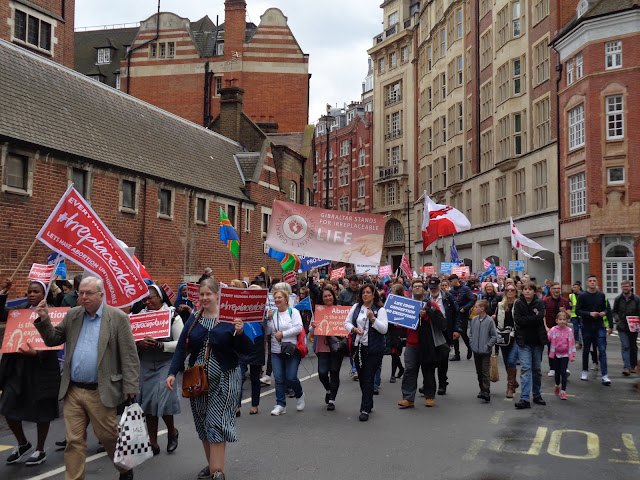
March for Life, London, September 2018

I do not mean to sound complacent — after all, the cost in unborn lives now runs at over two hundred thousand every year in England and Wales alone — but I am not being complacent; I am being confident.  As with the trans-Atlantic slave trade two centuries ago, the whole outrage is likely to end abruptly, even unexpectedly, with a sudden anagnorisis and revulsion at the horror.  Unless our society is completely overtaken by nihilism, a point will be reached at which the injustice can be denied no more; someone at some point will ask, in a loud enough voice and in a way which will suddenly be listened to, why (for instance) we see hardly anybody with Down’s syndrome around any more; will ask why we uphold the rights of God’s animal creatures, as we should, without extending the same defence to our own unborn children.  When the tide does turn, the sheer consistency and integrity of the Church’s pro-life position, as well as her record in providing for mothers in need, will stand her in good stead when it comes to establishing a new and authentic culture of life.

That is one concrete reason for hope in our age, but still stretches the definition of ‘optimism’ a little far.  What about today and tomorrow?

2.  Fire-power isn’t everything

It is worth remembering that we still have great resources in the nature of our presence in society.  Secular progressivism is on the warpath, and hardening into a religion of its own, having at its disposal many organised shock-troops with strident and persuasive voices, and tightening its grip on our culture.  But if the Church seems not quite able to match this sheer fire-power, it is not because we lack good arguments or articulate ripostes.  It is because we have other things on our plate as well.  Unlike the cultural revolutionaries, we have always been concerned about more than mere propaganda.  The Church may be in battle, but she is not merely a battleship: she has to be a rescue vessel and a hospital ship and a flagship all at once.  She cannot be expected to swivel and aim her guns as adeptly as a purpose-built destroyer.

What is more, so much of the strength of our witness actually lies in our silence.  This is true in two senses: firstly in the simple fact of our not going along with propaganda or slogans, and secondly in the positive quality of the silence of our sanctuaries.  Especially these days, when moments of peace, let alone peace by oneself with God, are so hard to come by, precious indeed are the physical refuges of our churches amid the howling cities.

Our strength lies, too, in the aspects of the Church’s life that never make the headlines: her presence in hospitals, in hospices, in prisons, in homeless shelters, in ports, in refugee camps, in the armed forces, in universities, in schools.  And her charities: the tireless work of CAFOD for overseas development, Aid to the Church in Need for persecuted Christians, the St. Vincent de Paul Society for the homeless, and so on.  All those things that are never chalked up on the scoreboard of history: the Masses, rosaries, hymns and prayers; the confraternities, the prayer-groups, the pilgrimages, the devotions; the ‘ecclesiolae’ or ‘little churches’ of families holding their own day after day.  The kindly priest in the lit confessional; the Mary-garden under the railway arch; the soup-bowl in the homeless shelter: in all these ways the Church, with that gentle tenacity of hers, persists in living the ‘life to the full’ that her Founder promised.

The cultural revolution tends to be keener on the commanding heights of the culture — the law, the government, the arts, schools, universities, and the apparatus of civil society — than on the welfare of ordinary people.  This tells us that it is only really interested in power; that for all its capacity for intimidation it is necessarily brittle and lacking foundations, and that its strength, though incontestable for the moment, will prove ephemeral.  The Church’s appearance, by contrast, is no mere veneer.  Under the surface she is true to her word.

3.  The Church comprehends the new and pluralised Britain 

Another opportunity for the Church in years to come, one in which it stands as good a chance of success as any other institution apart from the Crown, is in making sure we fashion a harmonious society of the new pluralised Britain, and preventing the emergence of any division or mutual alienation.  Relatively few things can be said to unify us as a country these days, and certain fractures are emerging which the Faith is placed uniquely to heal.  What but the Christian imagination could even conceive of bringing into serious dialogue, say, the secular liberal on the one hand — whose instinct for mercy, though misproportioned, echoes a distinctively Christian idea — and the observant Muslim on the other, whose concern for justice, codified by the bracing tenets of Islamic law, testifies to a sincere attentiveness to God’s will?  Because the Church understands this paradox of justice and mercy, knowing how to temper one with the other, she can, I think, foster more fruit from such a conversation than anyone else.

And where else but within the Church can the demographic changes of the past fifty years be not only reconciled but harmonised convincingly with the deepest roots of our society?  To take only one of countless examples, consider the Tamil pilgrimages to Our Lady’s shrine at Walsingham, which I understand attract the largest numbers of all the pilgrim groups.  In this village in the heart of rural Norfolk, a place of pilgrimage since before the Norman Conquest, an ancient English devotion is unified with a Tamil one.  There is no contradiction between love of England and love of neighbour; there is simply one faith, one Church and one Lord.  Thus the world-wide roots of today’s pilgrims are entwined with the very depths of England and Englishness, new Britons follow in the footsteps of medieval kings, and all pilgrims throughout the ages are unified in peace and goodwill.  For many immigrants and their families and descendants, the Catholic Church is a ‘home away from home’ — and yet it has been here in England, waiting for them, it seems, since England’s very beginning.

Tamil Pilgrimage to Walsingham, Norfolk, 2016

4.  New alliances amid the crisis of meaning

Then there is the crisis of meaning: the alarming and deepening void at the centre of modern life, and, which is often even more horrifying, all that is rushing in to fill the void.  Only a decade ago the New Atheists were trumpeting the new dawn of a fanaticism-free secular age of cool rationalism, but now their vision seems completely unequal to the socio-cultural forces of our present time — forces which I am convinced are also spiritual.  As R. S. Thomas wrote,

In cities that
have outgrown their promise people
are becoming pilgrims
again, if not to this place,
then to the recreation of it
in their own spirits […]

Amid a loss of confidence in our institutions, our culture and even ourselves, a tremendous spiritual famine has suddenly declared itself: often vague, often outwardly hostile to formal religion, but unmistakeably spiritual in character.  This manifests itself in some obvious ways — the growing and understandable popularity of ‘mindfulness’, or the emergence of whole new academic fields such as ‘Loneliness Studies’ — but also in some more alarming forms: in the new ideologies sweeping every public institution, our blind faith in progressivism, and the many genuinely troubled young people.

Writers such as the essential Mary Eberstadt have long been observing how sixty years of aggressive secularism have been incubating this situation — but plenty of non-churchgoers are also noticing the crisis.  They share our alarm at the widespread subjugation of truth and reason to personal desire, and many are realising that even the Church may have something interesting to say about it.  We can and must do our best to repay that confidence; if we do, we may find ourselves entering into some new and fruitful kinds of dialogue.  (I say this from personal experience.) 

5.  The crisis of gender, though tragic, is a particular opportunity

One friend with whom I regularly enjoy such conversations recently brought to my attention a recent lecture on freedom of speech, one of the BBC’s annual series of Reith Lectures, by Nigerian-born novelist Chimamanda Ngozi Adichie.  At the core of this address was an appeal for a ‘coalition of the reasonable’ to maintain the standards of public debate.  She was speaking mainly with reference to the extraordinary behaviour in recent years of many advocates of gender theory, who have often been using outrageous tactics in order to advance their contentious cause, organising social media storms, releasing personal information, and even hounding their opponents from their jobs.

Adichie’s is an invitation to which the Church can and must respond positively.  We believe in reason and know that civil and reasonable debate are essential to our whole society — so there is an opportunity here for some real solidarity and co-operation.  In forming such alliances we do not have to pretend to agree where we disagree, but there is no reason why an edifying exchange of ideas should not take place.  The ‘reasonable secularists’ can discover our sincere interest in truth and reason, while we might draw some inspiration from their strength of purpose and concern for accountability and integrity.  Maybe, in finding ourselves on the same side for once, the discussion will be more constructive than it has been for many years.

Perhaps, too, at a relaxed moment, the conversation might turn to higher things, and to the spiritual dimension of the crisis of our time.  We might mention Benedict XVI’s insight that as well as reason we need faith, and that the two are not only compatible with but absolutely essential to each other.  We might make the point that the sense of meaninglessness from which so much of the crisis has stemmed corresponds to a deep reality about ourselves — that our longing for meaning is not some vague and inconvenient appetite, nor some functional or dietary need to be satisfied by the appropriate vitamin, but is a sign of the deepest truths about ourselves: the spiritual truths.

Even so, the urgent task remains to offer charitable but robust collective opposition to gender theory, which even now is doing irreversible damage to many confused and unhappy young people, as well as offending in a particular way against the rights and dignity of women.

6.  The Re-evangelisation of Romance

Another obvious mission for the Church is also one of the most dangerous: to confront head-on the ongoing melting down and recasting of marriage and the family, and to re-evangelise the sphere of romantic and marital love with the fullness and beauty of the Church’s teaching.  

Here, as with abortion, the post-Sixties revolutionary movement is visibly running into difficulties, and beginning to fray amid its own contradictions.  But its power is still tremendous, and its price exacted mainly on the young — who secretly, often even without knowing it themselves, long to hear the truth.  They long to be told what deep down they suspect: that all men and women were made for each other’s mutual respect and friendship, not for sullen rivalry; that the unique kind of friendship which is life-long marriage, the real thing, is no fancy but the gold standard, given to us by God for our flourishing; that a bride and bridegroom really are worth to the other nothing less than the gift of a great cosmic vow, one equal to the weight of an entire human life and strong enough to sustain the multiplication of new life; that such a vow is no mere formality, but something we long with all our hearts to make and to fulfil.  Youth seeks truth — the truth about ourselves, a truth which is written in our bodies as well as in our souls — and the Church, with teaching that is as beautiful as it is true, must be there to meet their longing.  Our culture is near enough rock bottom to hear it.  

We will often run up against wild rage and hatred — for those entrapped by darkness hate and fear beauty and truth — but there are millions of others waiting to be captivated by the high mission to which the Church calls them.

As Mary Eberstadt said in a recent interview,

Catholics should be proud — in the right way — of all these unpopular teachings.  They’re only unpopular for the moment, and […] they resonate with the human heart.  That again is to our advantage as we try to press this case.

This is one of the few spheres of life in which many people will still acknowledge a spiritual dimension, while often remaining sceptical about the form of marriage.  We are in much the same situation as those who argue for rhyme and metre in poetry: our task is to show how the form gives sense to the feeling; how the rules and vows give the underlying human impulse the sense and the strength to endure.  Against the pessimism of liberalism, with its fear of commitment, with its cynical assumptions about loyalty and perseverance, many will be surprised and inspired by the frankness, the freshness, the bracing realism, and, yes, the sheer optimism of the Church’s vision.

7. How hope works

I have one final remark on the way hope itself works, and where to look for it.  Whether pragmatic or theological, hope does not usually come marching over the hill; it grows fierce and green in unlikeliest places, as tenacious as grass or wildflowers.

One hot day a few years ago I was riding down a cycle path alongside a heaving A-road in south London, gritting my teeth against the noise and hostility around me, when the path narrowed and, seeing a child of about ten or eleven coming the other way, I braked to let him through.  To my complete astonishment, he very sincerely and deliberately thanked me; I hadn’t expected it and was too stunned to respond adequately.  There, uncrushed by the juggernauts and the tyres, defying the smirking warlords of the road, a tiny counter-witness, a green shoot of hope — something so vital, so ‘original, spare, strange’, that it offered a stronger riposte to its surroundings than perhaps the boy knew.  Like Lovejoy’s garden in Rumer Godden’s book An Episode of Sparrows, hope grows and germinates in defiance of overwhelming forces, even in spite of ourselves, in the ‘fields of our hearts that dead and bare have been…’

In the same way, as we should know from our own lives — and at Eastertide of all seasons — the vindication of the faith is with us, on earth, in this very hour.  ‘Christianity works,’ as Douglas Gresham, C. S. Lewis’s straight-talking step-son, once said.  It works in our lives, in every detail of our lives, even if the wider world is ignoring it for the present.  

---

I am under no illusions: this is a very uncertain and unsettling age, and things will not be easy for the Church for some time.  Many of the opportunities I describe may only be born of various crises and amid great suffering: it may be that we can be optimistic only to the extent of being poised to respond to a crisis.  It is also undeniable that the Church as an institution — in Europe and the West at least — has been severely weakened in the past fifty years — partly by mockery and marginalisation from without, partly by slacking and scandal from within.  But the Church’s members on the ground are chastened and made wise by crisis; we are all, clergy and laity alike, more alert, less complacent, and more capable of giving an account of ourselves than we have been for some time.  And in an age when all institutions are struggling to win trust, the Church is again as well-placed as any other to recover her integrity and a visible authenticity.

As far as external threats go, the Church can handle crises far better than she can uncertainty and apathy.  Our very foundation began with an utter catastrophe which was gloriously and outrageously inverted into triumph.  We have the ‘utterly secure future’; we have the Final Victory — but the near future is worth fighting for as well.  Keeping courage, then, means keeping courage in the short term as well as the long; today and tomorrow, this hour and the next, so that, in a happier time, our descendants will remember and give thanks for their forbears in faith, as we give thanks for ours.

The Lord is my light and my salvation; whom shall I fear?…
Though an army encamp against me, my heart shall not fear.
For in the time of trouble he shall hide me in his pavilion:
In the secret of his tabernacle shall he hide me; he shall set me up upon a rock.
  

(Psalm 27: 1–5)

Pope Benedict at Hyde Park, September 2010.

Tuesday, May 28, 2019

Impressions from London’s March for Life

The March for Life begins, 11th May, 2019.
Something must have gone deeply wrong in our society, I thought to myself the other Saturday, if someone as wary as I am of political controversy feels obliged to go out demonstrating on the streets.  Yet here I was, swelling the numbers of the March for Life in London (11th May, 2019), having decided that I could not really, in good conscience, stay away.

Well, something has indeed gone deeply wrong in our society.  Maybe it has many causes, maybe we did not mean it, and maybe it is a new form of an old sin, but I think it is real, it is gravely dangerous, and it has got down into the foundations.  We have forgotten that children are gifts.  That is the problem: until they join the ranks of independent adults, we are no longer entirely sure what they are for; we worry too much about what they will cost us, and we fear their destabilising effect on the centre of gravity of our lives.

And we have a particular blind spot where unborn children are concerned.  It seems that we really would rather not think too much about them, for in our age of amazing material wealth and technological advancement, in which we profess to be civilised and compassionate, we contradict ourselves.  Even as advancement after embryological advancement clarifies the miracle of the child in the womb — the fingerprints at seventeen weeks, the heartbeat at twenty-one days, the dreaming at seven months — the disagreement about the morality of abortion jostles on unresolved.  Worse still, it is taking on an alarming new shape, and the tone of the discussion is deteriorating rapidly.  It is becoming plainer than ever that the attitude with which the Abortion Act was apparently passed in 1967 — a degree of reluctance, and a determination that abortion should be reserved for extreme cases only — is vanishing, to be replaced by a far more radical, far less circumspect current of thought.  Louder and louder voices are proclaiming the disturbing idea that abortion is not simply to be permitted with regret, but to be promoted positively, even celebrated, as a right or liberty of women.  As it is, nearly 200,000 abortions now take place in England and Wales every year, adding catastrophically to the current total of nine million in the fifty years since the Act became law — yet there are those who want Parliament to declare abortion available as a matter of course, without restriction, as the standard response to what they call an unwanted pregnancy.  And they know how to make themselves heard.

The March passes the headquarters of Channel Four Television
This appalling idea has gathered far too much traction among too many people with national responsibilities and influence, especially in Parliament and among the media.  And, all over the place, forces are at work promoting it far and wide.  It is this attitude, for example, which a year ago seems to have swayed the referendum on the Eighth Amendment to the constitution of the Republic of Ireland, repealing a clause which — this is a crucial detail — had explicitly given equal legal protection to the lives of mothers and their unborn children.  (Every time I remember the nauseating jubilation over the result of that referendum, especially the big supposedly-spontaneous party in Dublin Castle, which embarrassed even many on the pro-choice side, I feel sick in the pit of my guts).  Activists have the pro-life provisions of the law in Northern Ireland in their sights.  And it is not just a question of law, for the prevailing attitude of mainstream culture seems to be pro-choice.  At least, pro-choice sentiments in public life are expressed more vocally than pro-life views, and earn more fulsome applause from the fashionable.  But that does not necessarily make them right.

The tide may already be turning. The Catholic Church is probably the most prominent of institutions standing up for the unborn, but we are not alone.  What is more, science is our ally, steadily vindicating our convictions that human life begins at the moment of conception, that we must never wilfully destroy human life, that abortion is therefore never the answer to a crisis pregnancy, and that there is always another way.  Meanwhile, bitter experience is confirming, at considerable cost, that it also does great damage to women and is a grievous offence against their dignity.
A view backwards from the same position and at the same time as the picture above
The March for Life has for several years offered a way of making a visible sign of our wish to change things, and to promote alternatives to abortion.  Having been held in Birmingham for several years, the March moved to London in 2018.  I thought a great deal about it before I decided to join in, and paid very careful attention to its aims and flavour, but I found it entirely reasonable.  I know that abortion is a politically controversial subject, but I cannot really help that.  This matter goes deeper than politics, all the way down to the moral foundations of our society.  What do we really believe human life is worth, especially when it is inconvenient?  What does it mean when we hardly ever see any people with Down’s Syndrome these days, since nine tenths of them are eliminated before birth?  I am fundamentally convinced that abortion is a grave injustice, and that we must bring it to an end.  One small way of helping to do so, I thought, would be to join this peaceful, good-humoured demonstration, which is growing by the year.

The March for Life takes a reasonable position and tone, having enough confidence in the truth of its message that it has no need to overstate its case.  It says its piece calmly, clearly and joyfully.  It does not make any kind of swipe at women who have sought or undergone abortions, knowing that in the majority of cases they do so under pressure, or with insufficient guidance, and later regret what has happened: they are often victims as well.  There is general agreement that the main villains of the piece are really the abortionists and abortion providers (‘Say hey, say ho, Marie Stopes has got to go!’).  The March places its emphasis on the humanity and sanctity of unborn life, and on the importance of providing assistance in crisis pregnancies: in short, protecting both mothers and their unborn babies.

The aim of the pro-life movement is not to score a short-term political goal, or to achieve legislative changes alone.  The law is quite a blunt instrument if it is unsupported by the underlying culture: all it should ideally have to do is to set the seal on an existing way of doing things.  This is why we need to build an authentic culture of life, in which the irreducible dignity of the human being is universally and instinctively recognised wherever it appears, from conception to natural death — and in which children are understood and revered as gifts.   This will only be brought about by changing, or honing, the thought of ordinary people.  So, a change in minds and hearts is needed more than a change in the law: something trickier to bring about, but truer, longer-lasting, and better for the human family.

So there we were, a good solid crowd — of 5,000, we were told — processing around Westminster, up past Victoria Gardens and right into Parliament Square.  I have to say I rather enjoyed myself.  There was a remarkably uplifting and joyful atmosphere of goodwill and peace.  Maybe it was because many of the people there were, like me, not typical demo-merchants!  Or maybe it was because the fundamental message is one of peace and hope, raised in defence of the weakest among us.  I saw no placards nor heard any chants that I believed were anywhere near gratuitously offensive.  I did see all sorts of people, though — a transect of the whole country (and by no means all Catholics).  Some had evidently travelled considerable distances to attend: just in my section of the march there was the Scottish saltire, the flag of Lincolnshire, a placard reading ‘Exeter Students for Life’ and even the banner of the Gibraltar Pro-Life Movement.   I think it is important to note — particularly as far as this matter is concerned — that there were roughly equal numbers of men and women; if anything, women slightly outnumbered men.  Equally importantly, all ages were represented: many of our elders, plenty of young families — and easily over a thousand young people, students and other young adults, like me, in their twenties — including a huge number of young women, whose opinion on this matter has perhaps the most clout of all.  The pro-life generation was out in force.

A pro-choice counter-demonstration, perhaps seventy or eighty strong, appeared on the pavement of Victoria Street to liven things up, and when we came round to Parliament Square they were waiting for us again.  (Labour voters might like to note that Sadiq Khan, the Mayor of London, sent a message of support to these pro-choicers, rather than to the March for Life.)  They waved their bright pink placards and chanted and sang at the tops of their voices, but I like to think the March for Life had a quiet power to which they had no answer.  One interesting interaction, which I did not witness in person, can be watched on the Facebook page of the March for Life.  The pro-life presenter approached the pro-choice demonstrators and asked two of them — in a reasonable way — if they would like to explain their position to the camera.  And they seemed willing, but before they could speak, they were hastily dissuaded by several of their co-protesters: “Don’t do it, don’t do it!” one emerged out of nowhere to warn them.  So an important opportunity for dialogue was lost.
Pro-choice counter-demonstration in Parliament Square
Dialogue would have been very useful, because, in this matter, along with many others, I think there is a certain deafness and misunderstanding between the two sides.  We are not even locking horns properly.  And I honestly think that it is the pro-choice side, not the pro-life side, that closes itself to dialogue.  I think they suspect us of bad faith, and are afraid of speaking to us: they seem to think very little about our motives, and find it easier to dismiss us.  They are not particularly interested in the nuances of language, either.  Somehow or other they are missing the point: we are not, as they suggest, going around trying to impose ourselves on others because we have nothing better to do with our Saturdays.  We are really and deeply convinced that the unborn child is a child, and that abortion is wrong because it destroys this life.  I think, too — and this is not meant as a cheap shot — that the pro-choicers are afraid of the weaknesses in their own argument and lack complete confidence in their own position.  Recently I heard a pro-life speaker observe that the stakes in the battle are higher for them: if they are wrong, they have to apprehend the reality that nine million lives have been thrown away since 1967.  No wonder they dig their heels in and shout and scream.  They may have snappier slogans and slicker public relations, but we have authenticity, and that is the only thing that can carry the day in the end.

How do we deal with this?  Well, until we can reach the other side by words, we must show them by example and put our convictions into action.  As many of us already do, we should give to pro-life charities, or even volunteer for them, and ask our elected representatives what they can do to help.  Just as our pro-life principles lead us to stand up for any other poor and marginalised people, we should defend the unborn, without dismissing any of the difficulties that lead people to the abortionist’s door.

Obianuju Ekeocha, bio-medical scientist and founder
of Culture of Life Africa, addresses the assembly
That does not mean that we should dispense with words in the meantime, though, and there are certainly some very compelling speakers in the pro-life movement.  The March for Life was addressed by the biomedical scientist Obianuju Ekeocha, founder of the Culture of Life Africa movement, whose allusion to Wilberforce’s battle to abolish slavery was uncomfortable but apt, by Bishop Keenan of Paisley, and by a woman named Melissa Ohden who, incredibly, had herself survived an abortion procedure when she came into this world.  There was also a remarkable address by a couple who, in February of this year, actually turned up for an appointment at an abortion clinic, but changed their minds at the last minute and decided to keep their baby.

The media’s bias was somewhat dismaying: the march was simply ignored by the mainstream secular press, even though 5,000 is not an inconsiderable size for a march.  Channel Four Television, for instance, was completely silent even though we marched right past their headquarters — yet, the following week, for example, they reported on a march of 2,000 calling for action to protect the environment.

Thousands in Parliament Square
Belonging to the Catholic Church is not always easy, but that Saturday I was proud of our Church for its courageous witness, and grateful for all who joined the march and added to its atmosphere, including the Orthodox Christians for Life.  This, I realised, looking around at my fellow marchers, is the inheritance of Chesterton and Belloc and Malcolm Muggeridge, and of countless other bold defenders of human dignity in this country — maybe indeed Wilberforce himself.  This is where their work is carried on.  Here is the organised resistance to the culture of death, and — better still — the energetic, optimistic and confident builders of a new culture of life.

Monday, May 28, 2018

Ireland’s Verdict

History will coolly record the facts as these: the final result of the referendum in the Republic of Ireland last Friday, 25 May, was that the electorate voted by 66.4% to 33.6% to repeal their Constitution’s Eighth Amendment, the clause which since 1983 has established in law the equal right to life of a mother and her unborn child.  This result will, it seems, leave the way clear for Irish law to permit abortion for any reason during the first twelve weeks of pregnancy.

Some shocks, however well anticipated, can never quite be braced for.  I knew that Ireland has hastened into secularism in recent decades; I knew that the mainstream media and popular feeling there was opposed to the crisis-stricken Catholic Church as an institution; I knew that Ireland’s Eighth Amendment was an obvious target for the international pro-choice movement.  Even so, for Ireland — Ireland! — to vote so decisively in favour of an idea so directly contrary to its past and character, to move so freely and willingly against the moral universe that made her what she is, takes some moments to sink in.  Behind Friday’s result is also a second slower, deeper horror in the emergence of a new Ireland, an Ireland willing to conform to its neighbours in a way that is wholly unprecedented and utterly out of character.  When before has Ireland ever jettisoned the values of its ancestors for the sake of popular opinion, for the sake of membership of a gang of more fashionably-minded nations?  (Precisely because Britain is a ring-leader of this gang, there are no grounds for self-satisfaction this side of the Irish Sea, either).  At Mass in my South London parish yesterday, listening to all the Irish names among the anniversary prayers for the deceased — the Murphys, the Collinses, the Kavanaghs — I wondered what they might have made of it, and sensed a great void, a great sliding into the sea of a cliff that, not long ago, had seemed unassailable crystalline granite.  The writer Maolsheachlann Ó Ceallaigh says simply that ‘It is the most shameful day in Irish history’.  Indeed it is a defeat for the pro-life movement, a defeat for the Catholic Church, and a defeat for humanity.  I believe the referendum will come to be greatly regretted, and possibly sooner than many think.

We who have an eternal hope can look squarely at this defeat, however.  Yes, it is a very hard defeat.  We may see, as we look, the media’s slick tango to success, the bowed, wounded Church, many of its wounds its own work, and, in every Irish county but one, the triumph of individualism.  And yet the clearer and less flinching our eye, the better we see the vindication of the pro-life position, even in its defeat.  We see the fakeness and the joylessness in the very climax of the Repealers’ celebrations, the hollowness of the triumph even in its freshness.  What next?  Where next?  they seem to be asking.  We perceive in the shallowness of the slogans the barrenness that lurks behind the worship of the self and the will.  And in the very flimsiness of much of the argumentation, even as it carries the day, there comes to mind the one thing that the false and the shallow cannot resist, defy it as it might: the attrition of truth’s alliance with time.

Now, that has described a certain kind of pro-choice position, that of those most politically engaged.  I do not know how reluctantly or under what pressure some ‘Yes’ (‘Repeal’) voters will have cast their vote, and I am aware that I am observing the affair from a different country.  There are in Ireland, as in Britain, a great many people of ordinary good will who are simply not sure what they think about this issue, knowing only that it is very sensitive: their ‘Yes, Repeal’ votes will not have been born of firm principle.  Although the fundamental question is whether the life of the child in the womb is a human life, I think many people are reluctant to entertain the idea, out of fear, or guilt, perhaps.  They may, however, have been moved by the hard cases that must necessarily be examined when discussing abortion, and in voting ‘Yes’ done what they believed to be compassionate.  They may have remained impervious to the alternative vision of humanity offered by the ‘No’ side because it was nearly drowned out, or simply lost faith in the old Ireland and felt willing to throw in their lot with the new.  The temptation to treat this vote as another referendum on the Catholic Church will have been more or less irresistible, I should think.  The question might as well have been phrased ‘Do you want to give the Church another kicking?’.  Of course many people will have answered ‘Yes’.  Yet it is that first question, that of the humanity of the child in the womb, which is the more momentous.  It will not go away, and eventually we will be able to avoid it no longer.

I think, also, that this victory seems a little too obvious, a little too complete, much as the Crucifixion was a little too obvious and complete.  This bull’s-eye victory must mark nearly the zenith of the pro-choice movement, I think.  Having reached the zenith, the movement will then have to hold onto its position, and this is where all destructive revolutions begin to founder.  When secular paganescent progressivism has had its day, as it will have done sooner or later, what then?  Well, this is uncertain.  If referendums could produce pro-life results in 1983 and 1992, then this result is not least a sign not simply that people are for abortion, but that their moral positions are fickle and easily changed, perhaps because the idea of absolute moral principles has been so weakened.  At the moment Ireland, like a teenager in a tantrum, feels that it cannot throw off its Catholic heritage quickly enough, ashamed that it lasted so long.  Yet when this is over and all we are left with are the crises that readily-available abortion will produce — inconsolable unhappiness, spiritual and mental anguish, emptinesses and silences that children and the young should have filled — people of good will shall begin to ask questions.  They will need, instead of adolescent revolution, more solid fare: a serious discussion of the nature of humanity, the dignity of human life and our proper response to crisis pregnancies.  Whatever their religious position, they will return to the natural law.  They will hunger for a new vision that transcends the tired, inward-looking individualism of the 2010s.  Even at this moment, when the spirit of our time lent such a fair wind to the ‘Yes’ side, still a third of voters remained unconvinced.  If the New Evangelisation keeps lit the lights that it should, it will be able to step into the breach and speak, as once St. Patrick did, of the radical and irreducible nature of human dignity, of the strange commandment of love. 

In the meantime, though, Irish or not, we must bear the consequences of Friday’s decision and do what we can on the ground to ease the profound damage and pain that it will cause.

Friday, May 25, 2018

Ireland Decides

A brief note on this matter which, though sensitive, is of such tremendous importance that silence is impossible.  Writing from Britain, I hope that the Irish people make the decision to keep the Eighth Amendment to their Constitution and, in any case, that we shall all strive for an alternative to abortion, because:
    a) the idea of abortion suits all the wrong people and lends leverage to the pressure they apply: men unwilling to shoulder their responsibilities, hard-hearted families, apostles of population control, and profit-hungry businesses, including the abortion industry itself;
    b) abortion includes among its victims the women who undergo them, for whom ‘choice’ is often precisely what they feel they do not have, and who are at grave risk of mental, psychological and spiritual suffering (will the abortionist help them then?); 

    and, above all, 
    c) if it is a child that is at the heart of the question, then it is a child, and although we may and must move mountains to help mothers in crisis pregnancies, do we not all have within ourselves this instinct, that we may not deliberately extinguish life, within or without the womb?
The referendum, and indeed the general debate about abortion in the Western world, does not really seem to be about the ‘hard cases’ such as life-threatening pregnancies, but about the general question of personal choice and autonomy.  But surely our humanity does not depend merely upon our plannedness at our beginnings?

Saturday, October 28, 2017

8,894,355

In the end I have decided I cannot in good conscience let this day pass without a note, however sombre it must be, on the fiftieth anniversary of the 1967 Abortion Act.  This week the Catholic Herald’s front cover announces that this law has now cost us nearly nine million lives.  This does not take account of almost the same number of mothers to whom it will have caused suffering without mercy, one way or another, sooner or later.  Nor the abortions funded by the British government abroad, especially in developing countries.

Lord Alton’s tour de force in the same issue of the Herald, which contained as much compassion as it did force, sets out the situation as well as anyone else could.  The fundamental question remains whether the sanctity of human life is irreducible, or merely negotiable.  I say with the Church that it is the former, by Heaven, and therefore that its deliberate destruction is out of the question.  I am unconvinced by any argument that life does not begin at conception.  Even those who are not sure should feel hesitant to to take the risk.  We may and must move mountains to help any expectant mother in a crisis, but we have no right to extinguish the new life being knit within her.  How can one unborn child be revered, and another deemed unfit for life?

I should think, and at least hope, that many of the Members of Parliament who voted in favour of the 1967 Act did so with compassionate intentions, and in the sincere belief that an abortion would remain a regrettable last resort to rare and extreme crises.  What would they make of the incomputable figure at which we have now arrived, though?  Is this moral landscape of 2017 really what most of them intended?

The pro-life movement now faces two different fronts.  One is the explicitly pro-choice movement, with which I have very little patience: forthright and sinister, understanding women’s independence of mind and body through a particularly contorted prism, sloganising, resorting to intimidation and accordingly unafraid to requisition the law in the promotion of such slogans.  Abortion, for them, is not regrettable in the slightest, but a positive political ideal; their claim is to the symbolic liberation of all women.  Well, their questions deserve answering, but bluntly.   The pro-life generation holds the life of the mother and the life of the child to be equal.  Both lives must be preserved.  If the growing being is a child, then it is a child, and its life is sacrosanct, just as the mother’s life is sacrosanct.  Meanwhile, the proclamations of ‘choice’ are, for all their vehemence, quite vacuous: for instance there is no acknowledgement of women who have felt precisely that they have had no choice at all but to see an abortionist, often under pressure from families withholding material or moral support, or from men unwilling to face their responsibilities.  While such men are certainly liberated in their wickedness, there is no liberation for the women concerned.

On the other hand, there is is the other front of people with whom I hope my tone would be quite different.  They are the plain folk of Britain, who I suppose are not so different from the House of Commons of 1967.  Surely most of them, if asked, otherwise preferring not to think about abortion, would regret its existence but, meaning to be compassionate, express a view along lines that under extreme circumstances it must be considered a necessary evil.  They are people of good will.  So they might well understand justice and mercy; they might reasonably expect the pro-life movement’s mettle to be shown in action as well as in words, and want proof that a culture of life they propose will abound in practical and merciful help to those in difficulties.  And indeed it already does precisely this where it is not prevented from doing so: the Life Charity provides moral and material support to mothers in crisis, and until recently the Catholic Church was free to run adoption services and thereby bring help to mothers in distress and happiness to childless couples.

Much is said, too, about sitting in judgment on women who seek abortions.  I think the pro-life movement makes it very clear that, certainly in these days of commonplace abortion, the moral culpability of a mother who has recourse to this avenue is often, even generally, significantly diminished.  The abortion is always wrong, but the mother is not always guilty.  There is, however, surely seldom a guiltier party than the abortionist, who in sober mind and cold blood has devoted all that precious medical knowledge to the opposite of its purpose, to the destruction of life.  Yet when we say that the Church, in obedience to its Founder, is as rich in mercy as it is resolute in justice, we mean it.  Even for the abortionist.

If Martin Luther King’s niece, Alveda King, calls the pro-life cause ‘the new civil rights movement’, then I think we had better take notice.  Lord Alton’s estimation that ‘the tide is turning’ may well be correct: the pro-choice quarters are powerful but they are beginning to bluster and lash out, which is a sign of an awareness of losing ground.  They are going to try very hard to persuade the Irish people to repeal the Eighth Amendment of their constitution next year, but those slogans cannot last forever, and at some point they will have to ask themselves more carefully what really motivates the defenders of life, and why they will not give up.  The sooner they do so the better, and the sooner we can turn our attention to the real business of helping women and the unborn in need, rather than numbing our consciences to a dangerous compromise and wounding short-cut.  Let there rise up a proliferation of pro-lifers, holding aloft the twin lanterns of justice and mercy, in this as in all things!