Showing posts with label churches. Show all posts

Tuesday, May 16, 2023

Some Grounds for Catholic Optimism

The Archbishop of Westminster, Cardinal Vincent Nichols, began his New Year message for 2022 by comparing two different kinds of hope.  One he called the ‘pragmatic version’ — in which ‘a secure present’ gives us confidence to ‘look forward to an uncertain future’ — whereas the other, he said, was the ‘theological virtue’ of hope — ‘the capacity to face an uncertain present’ because, beyond it, we trust in an ‘utterly secure future.’  

Most of us in the Church would recognise this distinction.  After all, the first kind of hope, which we might also call ‘optimism’, is in distinctly short supply these days.  As the memory of the old faith drains steadily out of our cities and civilisation, as the tenets of the Creed are forgotten one by one, as forces mighty as Goliath yet insidious as the serpent conspire to hobble the Church and smother the Gospel, the psalms of lamentation come easily to the lips: ‘How shall we sing the Lord’s song in a strange land?’  And so we cultivate the second kind of hope, setting our sights and our hearts on the ‘utterly secure future’ of the kingdom of Heaven.  We brace ourselves for the ‘Long Defeat’, as Tolkien put it, in sure hope of the Final Victory.

But what if even earthly hope is not altogether lost?  For although this nurturing of Deep Hope is fundamentally the right approach to our situation, it nevertheless carries with it an understandable temptation: to give up on the immediate future altogether, and thereby to miss such possibilities as do in fact lie before us.  We are not Albigensians; we should not turn our backs completely on the world.  The Resurrection of Christ was as earthly a thing as it was supernatural, and changes the present moment as much as it does eternity; its implications are not only cosmic but comprehensive, changing the world not only in general but in detail, and from within, not from without.  Our everyday lives on earth are shot through with a new life-force — the Word, whispering perpetually into every crisis, ‘This is not the end — for I was, I am and ever shall be.’  Even in these bewildering times, there is an onward path to tread.

Cardinal Vincent in his message goes on to point out the ‘middle ground’ that exists between the two kinds of hope.  His point, if I understand rightly, is that we need to develop an intelligent combination of both: Deep Hope in the long term; courage and fortitude in the short.  Even if ‘optimism’ is hardly the first word we might use to characterise our immediate outlook, it has to be an ingredient in our approach.  Even a dash will do.  As we heard from the prophet Jeremiah (of all people!) one Sunday last year:

A blessing on the man who puts his trust in the Lord, with the Lord for his hope.  He is like a tree by the waterside that thrusts its roots to the stream: when the heat comes it feels no alarm, its foliage stays green; it has no worries in a year of drought, and never ceases to bear fruit. 
(Jeremiah 17: 5–8)

‘Never ceases to bear fruit’…  Mainstream opinion-formers may think the Catholic Church obsolete, deluded and contemptible, but we must not give the slightest impression of believing them.  Certainly we should be prudent in the deployment of our energies; absolutely we must attend to the deep and inner roots, but in the drought of the coming decades we must never lose confidence that the Church will indeed ‘never cease to bear fruit’ — because she retains countless ways to prove herself essential not only to her own members, but to our whole society.

What sort of thing do I mean?  Here are some ideas.

1.  Pro-life victory is certain

I am absolutely confident of the eventual victory, on earth, of the pro-life movement.  This might sound absurd, given the present total dominance of the abortion lobby in law and politics.  All the same, of the innumerable logical contradictions at the heart of the revolutionary secular-progressive project, this is the hardest to sustain, and indeed can be sustained only by shrill campaigning and a constant flow of cash.  A succession of scientific discoveries is steadily and consistently vindicating the Church’s position, and, sadly, so is the testimony of ever greater numbers of women as to the offence done by abortion against their dignity and happiness.  The strength of the pro-choice lobby is nearing its high water mark; it has little further ground to gain; it is already having to become defensive of its establishment position.  Its members are beginning, rightly, to recognise the possibility that they will, as the phrase goes, ‘lose the narrative’ to the joyful and energetic pro-life message.

March for Life, London, September 2018

I do not mean to sound complacent — after all, the cost in unborn lives now runs at over two hundred thousand every year in England and Wales alone — but I am not being complacent; I am being confident.  As with the trans-Atlantic slave trade two centuries ago, the whole outrage is likely to end abruptly, even unexpectedly, with a sudden anagnorisis and revulsion at the horror.  Unless our society is completely overtaken by nihilism, a point will be reached at which the injustice can be denied no more; someone at some point will ask, in a loud enough voice and in a way which will suddenly be listened to, why (for instance) we see hardly anybody with Down’s syndrome around any more; will ask why we uphold the rights of God’s animal creatures, as we should, without extending the same defence to our own unborn children.  When the tide does turn, the sheer consistency and integrity of the Church’s pro-life position, as well as her record in providing for mothers in need, will stand her in good stead when it comes to establishing a new and authentic culture of life.

That is one concrete reason for hope in our age, but still stretches the definition of ‘optimism’ a little far.  What about today and tomorrow?

2.  Fire-power isn’t everything

It is worth remembering that we still have great resources in the nature of our presence in society.  Secular progressivism is on the warpath, and hardening into a religion of its own, having at its disposal many organised shock-troops with strident and persuasive voices, and tightening its grip on our culture.  But if the Church seems not quite able to match this sheer fire-power, it is not because we lack good arguments or articulate ripostes.  It is because we have other things on our plate as well.  Unlike the cultural revolutionaries, we have always been concerned about more than mere propaganda.  The Church may be in battle, but she is not merely a battleship: she has to be a rescue vessel and a hospital ship and a flagship all at once.  She cannot be expected to swivel and aim her guns as adeptly as a purpose-built destroyer.

What is more, so much of the strength of our witness actually lies in our silence.  This is true in two senses: firstly in the simple fact of our not going along with propaganda or slogans, and secondly in the positive quality of the silence of our sanctuaries.  Especially these days, when moments of peace, let alone peace by oneself with God, are so hard to come by, precious indeed are the physical refuges of our churches amid the howling cities.

Our strength lies, too, in the aspects of the Church’s life that never make the headlines: her presence in hospitals, in hospices, in prisons, in homeless shelters, in ports, in refugee camps, in the armed forces, in universities, in schools.  And her charities: the tireless work of CAFOD for overseas development, Aid to the Church in Need for persecuted Christians, the St. Vincent de Paul Society for the homeless, and so on.  All those things that are never chalked up on the scoreboard of history: the Masses, rosaries, hymns and prayers; the confraternities, the prayer-groups, the pilgrimages, the devotions; the ‘ecclesiolae’ or ‘little churches’ of families holding their own day after day.  The kindly priest in the lit confessional; the Mary-garden under the railway arch; the soup-bowl in the homeless shelter: in all these ways the Church, with that gentle tenacity of hers, persists in living the ‘life to the full’ that her Founder promised.

The cultural revolution tends to be keener on the commanding heights of the culture — the law, the government, the arts, schools, universities, and the apparatus of civil society — than on the welfare of ordinary people.  This tells us that it is only really interested in power; that for all its capacity for intimidation it is necessarily brittle and lacking foundations, and that its strength, though incontestable for the moment, will prove ephemeral.  The Church’s appearance, by contrast, is no mere veneer.  Under the surface she is true to her word.

3.  The Church comprehends the new and pluralised Britain 

Another opportunity for the Church in years to come, one in which it stands as good a chance of success as any other institution apart from the Crown, is in making sure we fashion a harmonious society of the new pluralised Britain, and preventing the emergence of any division or mutual alienation.  Relatively few things can be said to unify us as a country these days, and certain fractures are emerging which the Faith is placed uniquely to heal.  What but the Christian imagination could even conceive of bringing into serious dialogue, say, the secular liberal on the one hand — whose instinct for mercy, though misproportioned, echoes a distinctively Christian idea — and the observant Muslim on the other, whose concern for justice, codified by the bracing tenets of Islamic law, testifies to a sincere attentiveness to God’s will?  Because the Church understands this paradox of justice and mercy, knowing how to temper one with the other, she can, I think, foster more fruit from such a conversation than anyone else.

And where else but within the Church can the demographic changes of the past fifty years be not only reconciled but harmonised convincingly with the deepest roots of our society?  To take only one of countless examples, consider the Tamil pilgrimages to Our Lady’s shrine at Walsingham, which I understand attract the largest numbers of all the pilgrim groups.  In this village in the heart of rural Norfolk, a place of pilgrimage since before the Norman Conquest, an ancient English devotion is unified with a Tamil one.  There is no contradiction between love of England and love of neighbour; there is simply one faith, one Church and one Lord.  Thus the world-wide roots of today’s pilgrims are entwined with the very depths of England and Englishness, new Britons follow in the footsteps of medieval kings, and all pilgrims throughout the ages are unified in peace and goodwill.  For many immigrants and their families and descendants, the Catholic Church is a ‘home away from home’ — and yet it has been here in England, waiting for them, it seems, since England’s very beginning.

Tamil Pilgrimage to Walsingham, Norfolk, 2016

4.  New alliances amid the crisis of meaning

Then there is the crisis of meaning: the alarming and deepening void at the centre of modern life, and, which is often even more horrifying, all that is rushing in to fill the void.  Only a decade ago the New Atheists were trumpeting the new dawn of a fanaticism-free secular age of cool rationalism, but now their vision seems completely unequal to the socio-cultural forces of our present time — forces which I am convinced are also spiritual.  As R. S. Thomas wrote,

In cities that
have outgrown their promise people
are becoming pilgrims
again, if not to this place,
then to the recreation of it
in their own spirits […]

Amid a loss of confidence in our institutions, our culture and even ourselves, a tremendous spiritual famine has suddenly declared itself: often vague, often outwardly hostile to formal religion, but unmistakeably spiritual in character.  This manifests itself in some obvious ways — the growing and understandable popularity of ‘mindfulness’, or the emergence of whole new academic fields such as ‘Loneliness Studies’ — but also in some more alarming forms: in the new ideologies sweeping every public institution, our blind faith in progressivism, and the many genuinely troubled young people.

Writers such as the essential Mary Eberstadt have long been observing how sixty years of aggressive secularism have been incubating this situation — but plenty of non-churchgoers are also noticing the crisis.  They share our alarm at the widespread subjugation of truth and reason to personal desire, and many are realising that even the Church may have something interesting to say about it.  We can and must do our best to repay that confidence; if we do, we may find ourselves entering into some new and fruitful kinds of dialogue.  (I say this from personal experience.) 

5.  The crisis of gender, though tragic, is a particular opportunity

One friend with whom I regularly enjoy such conversations recently brought to my attention a recent lecture on freedom of speech, one of the BBC’s annual series of Reith Lectures, by Nigerian-born novelist Chimamanda Ngozi Adichie.  At the core of this address was an appeal for a ‘coalition of the reasonable’ to maintain the standards of public debate.  She was speaking mainly with reference to the extraordinary behaviour in recent years of many advocates of gender theory, who have often been using outrageous tactics in order to advance their contentious cause, organising social media storms, releasing personal information, and even hounding their opponents from their jobs.

Adichie’s is an invitation to which the Church can and must respond positively.  We believe in reason and know that civil and reasonable debate are essential to our whole society — so there is an opportunity here for some real solidarity and co-operation.  In forming such alliances we do not have to pretend to agree where we disagree, but there is no reason why an edifying exchange of ideas should not take place.  The ‘reasonable secularists’ can discover our sincere interest in truth and reason, while we might draw some inspiration from their strength of purpose and concern for accountability and integrity.  Maybe, in finding ourselves on the same side for once, the discussion will be more constructive than it has been for many years.

Perhaps, too, at a relaxed moment, the conversation might turn to higher things, and to the spiritual dimension of the crisis of our time.  We might mention Benedict XVI’s insight that as well as reason we need faith, and that the two are not only compatible with but absolutely essential to each other.  We might make the point that the sense of meaninglessness from which so much of the crisis has stemmed corresponds to a deep reality about ourselves — that our longing for meaning is not some vague and inconvenient appetite, nor some functional or dietary need to be satisfied by the appropriate vitamin, but is a sign of the deepest truths about ourselves: the spiritual truths.

Even so, the urgent task remains to offer charitable but robust collective opposition to gender theory, which even now is doing irreversible damage to many confused and unhappy young people, as well as offending in a particular way against the rights and dignity of women.

6.  The Re-evangelisation of Romance

Another obvious mission for the Church is also one of the most dangerous: to confront head-on the ongoing melting down and recasting of marriage and the family, and to re-evangelise the sphere of romantic and marital love with the fullness and beauty of the Church’s teaching.  

Here, as with abortion, the post-Sixties revolutionary movement is visibly running into difficulties, and beginning to fray amid its own contradictions.  But its power is still tremendous, and its price exacted mainly on the young — who secretly, often even without knowing it themselves, long to hear the truth.  They long to be told what deep down they suspect: that all men and women were made for each other’s mutual respect and friendship, not for sullen rivalry; that the unique kind of friendship which is life-long marriage, the real thing, is no fancy but the gold standard, given to us by God for our flourishing; that a bride and bridegroom really are worth to the other nothing less than the gift of a great cosmic vow, one equal to the weight of an entire human life and strong enough to sustain the multiplication of new life; that such a vow is no mere formality, but something we long with all our hearts to make and to fulfil.  Youth seeks truth — the truth about ourselves, a truth which is written in our bodies as well as in our souls — and the Church, with teaching that is as beautiful as it is true, must be there to meet their longing.  Our culture is near enough rock bottom to hear it.  

We will often run up against wild rage and hatred — for those entrapped by darkness hate and fear beauty and truth — but there are millions of others waiting to be captivated by the high mission to which the Church calls them.

As Mary Eberstadt said in a recent interview,

Catholics should be proud — in the right way — of all these unpopular teachings.  They’re only unpopular for the moment, and […] they resonate with the human heart.  That again is to our advantage as we try to press this case.

This is one of the few spheres of life in which many people will still acknowledge a spiritual dimension, while often remaining sceptical about the form of marriage.  We are in much the same situation as those who argue for rhyme and metre in poetry: our task is to show how the form gives sense to the feeling; how the rules and vows give the underlying human impulse the sense and the strength to endure.  Against the pessimism of liberalism, with its fear of commitment, with its cynical assumptions about loyalty and perseverance, many will be surprised and inspired by the frankness, the freshness, the bracing realism, and, yes, the sheer optimism of the Church’s vision.

7. How hope works

I have one final remark on the way hope itself works, and where to look for it.  Whether pragmatic or theological, hope does not usually come marching over the hill; it grows fierce and green in unlikeliest places, as tenacious as grass or wildflowers.

One hot day a few years ago I was riding down a cycle path alongside a heaving A-road in south London, gritting my teeth against the noise and hostility around me, when the path narrowed and, seeing a child of about ten or eleven coming the other way, I braked to let him through.  To my complete astonishment, he very sincerely and deliberately thanked me; I hadn’t expected it and was too stunned to respond adequately.  There, uncrushed by the juggernauts and the tyres, defying the smirking warlords of the road, a tiny counter-witness, a green shoot of hope — something so vital, so ‘original, spare, strange’, that it offered a stronger riposte to its surroundings than perhaps the boy knew.  Like Lovejoy’s garden in Rumer Godden’s book An Episode of Sparrows, hope grows and germinates in defiance of overwhelming forces, even in spite of ourselves, in the ‘fields of our hearts that dead and bare have been…’

In the same way, as we should know from our own lives — and at Eastertide of all seasons — the vindication of the faith is with us, on earth, in this very hour.  ‘Christianity works,’ as Douglas Gresham, C. S. Lewis’s straight-talking step-son, once said.  It works in our lives, in every detail of our lives, even if the wider world is ignoring it for the present.  

---

I am under no illusions: this is a very uncertain and unsettling age, and things will not be easy for the Church for some time.  Many of the opportunities I describe may only be born of various crises and amid great suffering: it may be that we can be optimistic only to the extent of being poised to respond to a crisis.  It is also undeniable that the Church as an institution — in Europe and the West at least — has been severely weakened in the past fifty years — partly by mockery and marginalisation from without, partly by slacking and scandal from within.  But the Church’s members on the ground are chastened and made wise by crisis; we are all, clergy and laity alike, more alert, less complacent, and more capable of giving an account of ourselves than we have been for some time.  And in an age when all institutions are struggling to win trust, the Church is again as well-placed as any other to recover her integrity and a visible authenticity.

As far as external threats go, the Church can handle crises far better than she can uncertainty and apathy.  Our very foundation began with an utter catastrophe which was gloriously and outrageously inverted into triumph.  We have the ‘utterly secure future’; we have the Final Victory — but the near future is worth fighting for as well.  Keeping courage, then, means keeping courage in the short term as well as the long; today and tomorrow, this hour and the next, so that, in a happier time, our descendants will remember and give thanks for their forbears in faith, as we give thanks for ours.

The Lord is my light and my salvation; whom shall I fear?…
Though an army encamp against me, my heart shall not fear.
For in the time of trouble he shall hide me in his pavilion:
In the secret of his tabernacle shall he hide me; he shall set me up upon a rock.
  

(Psalm 27: 1–5)

Pope Benedict at Hyde Park, September 2010.

Tuesday, January 31, 2023

Farewell to Benedict the Great

And so we must begin the new year without those two great figures, those beacons in our time, Elizabeth II and Benedict XVI.  We were not unprepared for the losses; we cannot complain that long life was not theirs, but we always knew that the world would be a colder and lonelier place without them.  The torches they carried, we realise with a pang, are handed down to us.  I try not to allow myself too many living heroes, but that is what both have been for me.  They stood for truth and faith in a cynical and darkening age.  They used word and gesture to encourage and hearten people of good will.  They made it clear that they understood their offices as vocations, their authority as a form of service, and their main power to be that of the quiet example — which they each set unfailingly, in a strikingly similar style, and with comparable courage. 

The praise of the intelligence, erudition and churchmanship of Joseph Ratzinger I will leave to others better qualified to judge — ‘an essential European thinker’, ‘the greatest mind to reach the papacy in a millennium’, ‘a man with the intelligence of twelve theology professors but the innocence of a child at his First Communion’.  Mine must be a more personal tribute: the thanksgiving of an ordinary rank-and-file pew-filler whose privilege it was to live through, and be formed by, his papacy.  The reign of Benedict XVI corresponded almost exactly with my adolescence: I was confirmed less than a month after his election in 2005, and was most of my way through university when he resigned.  In between, of course, in September 2010, came his visit to Britain, an event which smote my spirit right when the iron was hottest.

Much has been said about the clarity of Joseph Ratzinger’s prose, but this was not a quality confined to his writings or even his speech.  Clarity was a characteristic of all his actions and gestures; it surrounded him like an aura.  Simply by his presence, by occupying his square, he shed light by which others around him could see and think more clearly.  This was certainly true for me: his visit to Britain clarified my life and clarified my faith; it set a seal on me, exactly when I needed it, and deeply and lastingly.

I don’t mean that there was a dramatic conversion.  To grow up with and into the faith in mid-suburban south London in the 2000s was to be more than familiar with the ennui and malaise of our times.  It was, then as now, to live against the grain of the surrounding culture.  There was always an awareness of being held to different, I dare say higher standards; always a discernible change in atmosphere between the Church and the mainstream, secular-materialist world whose raucous tide came right up to the front porch.  I knew that this world thought Christian believers mawkish and irrelevant and obsolete.  I knew about Dawkins and Hitchens and the fashionable New Atheists — though the prevailing mood, at school for example, was less outright hostility than a flippant indifference to serious conversation of any kind.   Yet I was certain that all churches were inhabited; that they were Someone’s house, and that this indwelling presence was a benevolent influence on life.  So the awareness that to practise my faith was to risk the bemusement or ridicule of others was not something I minded — in fact, I probably enjoyed it rather too much.  I felt myself lacking in intellectual formation — and since it was on intellectual grounds that the New Atheists were attacking religious faith, I wanted to know how to mount a defence — but socially, I did not mind being a bit of an outsider.

What I did not altogether realise, though, was what became clear almost at the moment Pope Benedict’s visit was announced in February 2010: the sheer proliferation of quarters in which the Church is actually hated.  Hated not just by celebrity atheists with a book to sell, not merely by self-promoting comedians, but by considerable numbers of influential, intelligent people in actual positions of responsibility. Journalists in reputable papers, politicians, personalities, even employees of government offices — all felt quite free, even in self-proclaimed tolerant Britain, to articulate that hatred to their spleen’s content.

Now, I knew I could not expect unbounded enthusiasm from the media, but this went beyond, say, reasonable concern about public expenditure, or just excoriation of corruption in the Church (corruption which Catholics hate as fiercely as anyone else, if not more).  It was plain that what they hated was the Church itself, and the faith itself, and Pope Benedict himself.  It was personal and it was nasty.  In modern Britain it would have been tolerated towards no other religious leader.  It was different, too, from the residual Protestant anti-Catholic prejudice which had led some to protest against Pope John Paul II’s visit in 1982.  This had a different source: secular progressivism, the new faith of Europe, whose chummy mask had slipped to reveal a face twisted with rage.  It was an outbreak of what we now call ‘cancel culture’, and they certainly wanted Benedict cancelled.

I had not known all that much about Joseph Ratzinger, but all this impelled me to find out pretty quickly.  For us Catholics, an attack on the Pope is like hearing an insult directed at your grandfather — the immediate instinct is to rush to his defence — but even a dispassionate observer should have been able to see the extraordinary discrepancy between Benedict’s media image and the man himself.  This discrepancy was its own wordless vindication of Pope Benedict, of course, but, being a fire-blooded adolescent, I wanted to see some hefty ripostes from our own side.  Many of the most spirited defences I initially found online were mounted by bloggers sympathetic to traditionalist worship, and ever since, though always an English Mass-goer myself, I have been disposed to sympathy for those who prefer the traditional Mass (though it has since been dismayingly instructive to see some other traditionalist blogs turn as nasty about Pope Francis as the secularists were about Benedict).  Benedict had other defenders, too, not least Catholic Voices, which was established precisely in order to offer intelligent, robust, charitable defences of Catholic positions  — an approach which, I now realise, was entirely consistent with the style of the Pope himself.

What I discovered in Benedict was a man alert to the times but not subservient to them, quietly but firmly addressing himself to the modern world, diagnosing its ailments acutely, warning with gentle urgency against its errors, pointing some possible ways ahead.  He explained with startling lucidity what I had long hoped and suspected: that intelligence and faith, far from being opposed, illuminate each other; that there is no contradiction between truth and love; that the small flame of the sanctuary lamp remains the vital spark of life, in this age as in any other.  More immediately, I found a gentle and grandfatherly man, perhaps the most misrepresented man of the past half-century.  

The protesting secularists probably bothered me far more than they did Benedict himself.  Still, there was considerable and justifiable concern that the visit was going to be marred or hijacked in some way, and the eight-month media circus offered little reassurance on this score.  But this was where his clarity came in.  His character, simply by its sheer contrast to the mud-slingers, presented me with a clear choice.  One side was sneering at faith, hating beauty, scoffing at marriage, dismissing hope; on the other sat Pope Benedict and the Church, quietly but firmly standing for the ‘splendour of truth’, defending the absolute and irreducible human dignity of every human being, even when it is inconvenient — perhaps especially when it is inconvenient — and holding up defiantly the model of the person of Christ.  The whole experience confirmed my suspicions about the the secular-progressivist modern West, and my sorrow at the ebbing away of Old Britain.  I saw that I might one day have to choose between my own culture and the Church; that when it came to it, the Faith might actually cost me something.  Before he even landed, then, Pope Benedict made it clear to me where my loyalties lay.

But then he did land — and the mood changed utterly.  There he was on the television, chatting with the Queen at Holyrood; suddenly the BBC was wearing the seriousness and respectability of the national broadcaster, and the grown-ups were back in charge.  And it was not that Benedict routed or shamed the protestors. It was that they just seemed to melt away, and their menace evaporated.  A demonstration against the visit did go ahead in London somewhere, but it had simply ceased to matter.  I almost forgot about them — and if I did give them a moment’s thought, they seemed rather sad and silly and lonely.  Meanwhile, the crowds who came out to see Benedict, Catholics and non-Catholics alike, were unequivocally benevolent, if not jubilant.  That change of mood alone taught me several lessons I have since found useful — how far a media narrative can diverge from public opinion, and how quickly simple spiritual sunlight can evaporate hostility.  It also confirmed everything I had ever been taught about withstanding bullies and their largely illusory power.

But even while all this was sinking in, Pope Benedict himself, twinkling away, was healing the hurt of centuries.  Here he was, at the the Queen’s invitation, not merely on a pastoral visit (as Pope John Paul II had been), but also a state visit.  The following day, the seventeenth of September, he was down in London, meeting the Archbishop of Canterbury at Lambeth Palace, and, later that evening, during a profoundly moving Evensong in Westminster Abbey which included some of my very favourite hymns, kneeling with him at the shrine of St. Edward the Confessor.  This was, however fleeting, a startlingly coherent and plausible expression of Christian unity, an image of how things could be if the divisions between Canterbury and Rome could finally be healed.  It was an act of worship held together not merely by politeness or decorum, I believe, but by an aesthetic and spiritual harmony.  And so, in sudden contrast to the outsiderhood I had been experiencing as a Catholic Englishman only a few days before, I suddenly found deep congruence between my faith and the very roots of Englishness, and a way opened up and out — as if illuminated by a lightning flash in the middle of the night — towards reconciliation between the Churches.  This had a great deal to do with the organisers on both the Anglican and Catholic sides, of course, but it was also because Pope Benedict himself understood the power of symbolic gesture.

That Benedict knew this personally is, I think, proven by my favourite story about him, an incident which occurred during the Lambeth Palace visit.  It was told by the late, great Fr. Mark Langham, himself an ardent ecumenicist, who was present at the time:

At the conclusion of the speeches we prayed together the Lord’s Prayer, and we came to that awkward bit — the bit where the Roman Catholics stop and Anglicans carry on.  The Anglican bishops, sensitive to the Roman Catholic tradition, graciously concluded, “But deliver us from evil,” and there was a pause.  And then one voice continued, “For thine is the kingdom, the power and the glory.”  It was the voice of Pope Benedict.

I think this simple gesture speaks volumes about the man.  He was salving and resolving the past, blessing the present, and giving us hope for the future.  Between the Lambeth Palace visit and the Evensong in the Abbey, he delivered one of the great speeches of his pontificate in the great hammer-beamed Hall of the Palace of Westminster, arguing that faith and reason are not only compatible but essential to each other.  With his impeccable manners he was proposing a vision for Britain — a vision in keeping with our best traditions, and one which would lead us to a happy and harmonious future.  “May all Britons continue to live by the values of honesty, respect and fair-mindedness that have won them the esteem and admiration of many,” was his prayer.  It has occurred to me that the visit meant a great deal to him, as well as to us; I think these words of his were entirely heartfelt.

It remains a special memory for me that I saw him when he was in the midst of all these monumental errands.  Having travelled up with some Sixth Form friends (incidentally none Catholic) to greet him on Lambeth Bridge, we saw him in the Pope-mobile, twenty feet away, as he travelled to Westminster from his meeting with the Anglican bishops.   

Now, so far, everything may seem to have been on the political or national sphere, rather than the personal.  The main spiritual experience took place the following day, Friday 18th, at the great vigil in Hyde Park on the eve of the beatification of John Henry Newman.  It is worth remembering, when watching back film of the crowds on the Mall past which the Pope travelled, that Hyde Park was already full of 80,000 of us waiting for him; the two gatherings have to be taken together!  It was a tremendous joy, to be gathered all together, to see how many of us there were — and, for me, not least, to see so many other Catholics of my own age.  The music — with its full chorus and orchestra — was both dignified and uplifting.  Then came his unforgettable speech.  What other figure, addressing young people, would refuse to talk down to them, would steer clear of slogans or cheap platitudes?  “Dear young friends,” he called us, and one sensed, by the fondness with which he spoke about John Henry Newman that this speech was clearly his own work, and sincerely felt.  There was a sense of his speaking personally to us — indeed, to me.  The three lessons he drew from the life of John Henry Newman were, just as he said, ‘very relevant to our lives as believers and to the life of the Church today’: firstly, that we are capable of knowing — and were created to know — the truth, which, in a word, is Christ; secondly, that this truth requires our commitment, our ‘intellectual honesty’, which may come at a cost; and thirdly, our beliefs and our lives must be consistent with each other: our faith must be no mere intellectual pose or stance, but permeate our hearts and influence our every word and action, so that, by this courageous integrity, health might flow back not only into the human person but into families, into nations, into the whole world:

One of the Cardinal’s best-loved meditations includes the words, “God has created me to do him some definite service.  He has committed some work to me which he has not committed to another.”  Here we see Newman’s fine Christian realism, the point at which faith and life inevitably intersect.  Faith is meant to bear fruit in the transformation of our world through the power of the Holy Spirit at work in the lives and activity of believers.  No one who looks realistically at our world today could think that Christians can afford to go on with business as usual, ignoring the profound crisis of faith which has overtaken our society, or simply trusting that the patrimony of values handed down by the Christian centuries will continue to inspire and shape the future of our society.  We know that in times of crisis and upheaval God has raised up great saints and prophets for the renewal of the Church and Christian society; we trust in his providence and we pray for his continued guidance.  But each of us, in accordance with his or her state of life, is called to work for the advancement of God’s Kingdom by imbuing temporal life with the values of the Gospel.  Each of us has a mission, each of us is called to change the world, to work for a culture of life, a culture forged by love and respect for the dignity of each human person.  As our Lord tells us in the Gospel we have just heard, our light must shine in the sight of all, so that, seeing our good works, they may give praise to our heavenly Father.

And then in the cool September night we fell silent for Adoration, all together in prayer in the middle of London with Pope Benedict, on the eve of the beatification of a great Englishman.  It was an unutterable privilege.

There is much else that I owe to Pope Benedict — I have not even mentioned a greater reverence in the liturgy, and the new English translation of the Mass, which I associated closely with him —  but this visit was the centre-piece of his legacy for me.  Barely a fortnight after hearing this speech I began university; it was a natural step to join the student chaplaincy, and there I found the same irresistible combination of vigour and conviviality which I have been able to find in various different places to this day, and which is so characteristic of the Church. 

Did he have weaknesses?  It is true that neither his visit nor his papacy appear in the short term to have arrested Britain’s, and Europe’s, slide into despondency and self-loathing; true that few of the British parliamentarians who heard his speech have since made any sign of having paid the slightest attention to him.  Some of my friends outside the Church have only an impression of a man overwhelmed by scandals and crises, and even some of his admirers have criticised him for his decision to resign his office.  It is arguable, I suppose, that even a good pastor and perceptive intellectual may lack the strength of will to govern effectively.  But I think some of the things he had to deal with would have been a fairly hellish proposition even for a younger man — and in any case, even before he became Pope, he had already spent twenty years meticulously, if unspectacularly, driving out rot as head of the Congregation for the Doctrine of the Faith.  Likewise, though I was as shocked as anyone else by his resignation, I don’t find myself worrying too much about it now.  I agree with many others that it was a sign of his humility, and his awareness of his own limits, for, much as I would have loved him to be able to carry on for ever, he seemed clearly weakened and bowed down.  It was also a sign to us not to pin all our hopes on him.  He had, in any case, arguably already established his legacy.  His emphasis as Pope was on Europe, and on issuing the last warning to her not to tear up her roots, and on encouraging the faithful as the shadows fall.  At the same time, he knew as well as anyone that the greatest vitality in the Church today is in Africa and Asia, and I could well believe that, having given all he had for the faith in Europe, he felt the need to stand aside to let this new growth flourish.

Pope Benedict XVI was one of those rare people who were both great and good in both mind and heart — too great and too good, perhaps, to be summed up at this short remove; I agree with those who expect his clarifying influence to be making itself felt centuries hence.  He was, as our own Cardinal Nichols has said (himself, I sense, strongly influenced by the visit), ‘through and through a gentleman, through and through a scholar, through and through a pastor, through and through a man of God’ — and, he added in a BBC interview on the day of the funeral, simply ‘a lovely man’.  I am proud to belong to the Benedict Generation.  May the God whom he served so faithfully and so courageously welcome him into the courts of Paradise.

Papal visit: Welcome by HM The Queen

Sunday, October 24, 2021

O Taste and See

Church of the Holy Ghost, Nightingale Square, Balham, London
In requiring as it did of many Christians the longest absence of their lives from the pews of a church, the pandemic sheared us of the sights, the sounds, the smells, the textures, the accidentals of our faith.  Yes, the Church was always there — we knew it was waiting; we could see it online — but there was no church-going.
Westminster Cathedral, London
There were many who lost much more than this, I know, but it was a deprivation all the same, a desert exile.  Perhaps it was experienced differently in the different churches.  I should think that Evangelicals and Pentecostals felt the silence above all most keenly: the absence of the sound of the word of God, and the muting of God’s praises sung by many voices.  Anglicans — even the Anglican clergy themselves — were banished in many cases from places of great beauty, exchanging for the kitchen or living room the houses of God whose atmosphere Roger Scruton evoked so beautifully:
The Anglican church […] is a place of light and shade, of tombs and recesses, of leaf mouldings and windows decked with Gothic tracery and leaded glass.  Strange aedicules line the chancel walls — aumbry, sedilia and vestry door — suggesting the rituals of an ancient temple.  Choir stalls, rood screen, altar, font and pulpit are as though dusted with holiness from the hands that carved them, and the light that falls upon them is strangely intimate, seeming to come from another source than the light that fills the nave.  The scents of damp stone and plaster, of altar flowers and dusty kneelers, mingle to form a kind of restrained incense of their own, and you fall silent as in the presence of a mystery.  People travel up and down England visiting these places, and there is one simple explanation as to why: namely, because they are sacred.
Roger Scruton, Our Church: A Personal History of the Church of England (London: Atlantic Books, 2012), pp. 40–42.
For most British Catholics, God and man agree to meet somewhere rather more out of the way, away from the centre of things: perhaps where a town’s Victorian outskirts would have been, down a side-street or at an awkwardly-angled street corner, in the church of dark brick which, however handsomely built, would originally have have been marked obstinately on town plans as an ‘R. C. Chapel’.  Or perhaps down a suburban avenue, under confident inter-war eaves, still in brick but lent a daring freshness by clean Art Deco lines.  Or maybe a futuristic Sixties concrete marquee awaits, with buckets placed here and there to catch the rainwater dripping through the ceiling.  Some parishes, of course, enjoy the legacies of fantastically wealthy Victorian benefactors trying to chalk one up against the Church of England, as at St John’s Cathedral in Norwich, Our Lady and the English Martyrs in Cambridge, Sacred Heart at Wimbledon, or St Giles’ at Cheadle in Staffordshire.  The fifteenth Duke of Norfolk, seeking a suitable commemoration of his twenty-first birthday in 1868, sold his estates in Sheffield — which meant most of land on which the city was built — and put the proceeds straight towards the construction of Arundel Cathedral in Sussex.  But apart from these glittering heirlooms, most of the fabric of the Catholic Church in Britain has a home-made, slightly scruffy feel to it — a well-worn, well-loved unkemptness.
Sacred Heart, Wimbledon, S.W. London.
That fabric, even over only two centuries of emancipation, has grown rich with detail and cherished associations.  For instance, every diocese is a tapestry of dedications, which have their occasional quirks.  That St Peter and the Guardian Angels, Paradise Street, should be found among London’s brickish former Docklands in Rotherhithe, or that the church of Our Lady of Sorrows should serve the Sussex seaside resort of Bognor Regis (with its Butlin’s holiday camp and all!) seem to me paradoxes in the best Chestertonian tradition.
St Peter and the Guardian Angels, Paradise Street, Rotherhithe, London
They say we are a religion of ‘smells and bells’ — of sense and taste and touch — and so we are, but these are not confined to the liturgy.  A Catholic church is a mingling of many things.  The smells, for example, begin at the door, each church having its distinctive mixture of stale incense, of the reek of must, of faint flowers, of long use.  The other senses swiftly follow: the shock of holy water cold on the fingers and forehead, the tiles unyielding to the genuflecting kneebone, the soft crinklings of the hymn-books.  The muted seething of traffic may seep faintly in from outside, or in winter be displaced by the vainglorious bluster of the electric heating.  The echoes may be gloopy or desiccated according to whether the congregation numbers five on a weekday morning, or is wedged in to the gunwales on Good Friday.
Arundel Cathedral, W. Sussex
If Mass is about to begin, somebody will be pottering around here and there, and pairs of shoulders hunched in prayer will be dotted about in the pews or in the Lady Chapel.  Bars of music might float from the choir loft, or one or two mild emergencies may break out, in a flurry of stage whispers, about who is or is not down on which rota.  There are the same old practical problems: misprints lurking in the hymn book, going up for Communion in the right order so as to return to the pew in the same configuration, the stowage, once the heaters at last have accomplished their labours, of heavy coats in winter so that they will not slither onto the floor, and one in particular which must have been going on for centuries and which we seemingly still cannot sort out: how to ensure the preservation of one’s nose when one is kneeling in prayer and the person directly in front sits back in their pew.  All the while, though, that quiet signal of salvation, the sanctuary lamp, burns unblinkingly at the altar, stilling the great blustering headwinds against our lives.
Saint Martin, Meudon, ÃŽle-de-France
And who are we; who are the People of God?  At Mass you will see the whole of life.  The tiny fierce stares of babies all agape at the world; the gleefully wrigglingly irrepressible squirmings of toddlers; teenagers pained with overcorrected gaucheness; students and young adults in greater numbers than the BBC would care to admit; newlyweds and new mothers and fathers; middle-aged stewards and parish stalwarts; the gingerly manoeuvrings of the elderly, many long into widow- or widowerhoods; the twinkling, in the depths of ancient faces, of eyes that have seen everything.  There are the well-turned-out and the down-at-heel; the healthy and the afflicted; the upright and the downtrodden.  There are all manners and ranks of professions or trades; lifelong parishioners and occasional visitors; those firm in faith and those haunted by doubt or listless with indifference.  There are the hidden unborn.  From peers and parliamentarians to the hard-up and homeless, from millionaires to migrants, baronets to binmen, ‘Christ doth call one and all’.  
Arundel Cathedral, south aisle
And, perhaps in London especially, you will see the whole world.  In my home parish, deep in the capital’s southern boroughs, I can immediately think of fellow parishioners from Italy, Uganda, Spain, the Philippines, Nigeria, Portugal, Sri Lanka, Ghana, Goa (and elsewhere in India), Mexico, Poland, South Africa, France and Finland, along with an older generation of Irish Londoners — the Murphys, the Quinns, the Connollys —  and their descendants.  You will hear earthy Wandle Valley talk, or crisp Eastern European consonants, or rich West African speech with its clean vowels.  And just when I think the list is complete, I remember the occasional but disarmingly determined presence of Irish Travellers.   But in all this there is cause neither for fraughtness — providing we remember that our dignity comes from the one God who made us all — nor, pleasing as it is to see the name of Jesus Christ outperforming the sum total of the world’s divisions of Diversity Officers, for self-congratulation.  We are simply the people whom God has entrusted to each other in this particular time and place: a motley bunch to be sure, mumbling the responses and droning the hymns — or ‘praising God with our silence’, as a Nigerian priest once teased me and the rest of his reticent, undemonstrative congregation — all struggling, all knowing ourselves to be less than saints, but all, at least, aboard.
Pugin’s cathedral of St. Chad, Birmingham
Sense and touch are, of course, by no means the whole story.  We do not depend upon them — ‘the Kingdom of Heaven is not food and drink’ — and the privations of the pandemic did not diminish anything of the fundamental truth or validity of the faith.  After all, the Eucharist that dwells at its heart asks for a momentary suspense of our senses.  As Hopkins put it in his translation of the Tantum Ergo — 
Seeing, touching, tasting are in thee deceived:
How says trusty hearing?  that shall be believed;
What God’s Son has told me, take for truth I do;
Truth Himself speaks truly, or there’s nothing true.
Still, this means that sense and sensation are transcended, not rejected outright, when we meet God.  The physical world is not simply to be purged.  After all, He not only made it, and saw that it was good, but saw to it that our very bodies are one day to be incorporated — in a more literal sense than we can know — into Truth Himself, the author of ‘all things, visible and invisible’.  Consequently I rejoice to see the accidentals once again; I taste and see that the Lord is good.
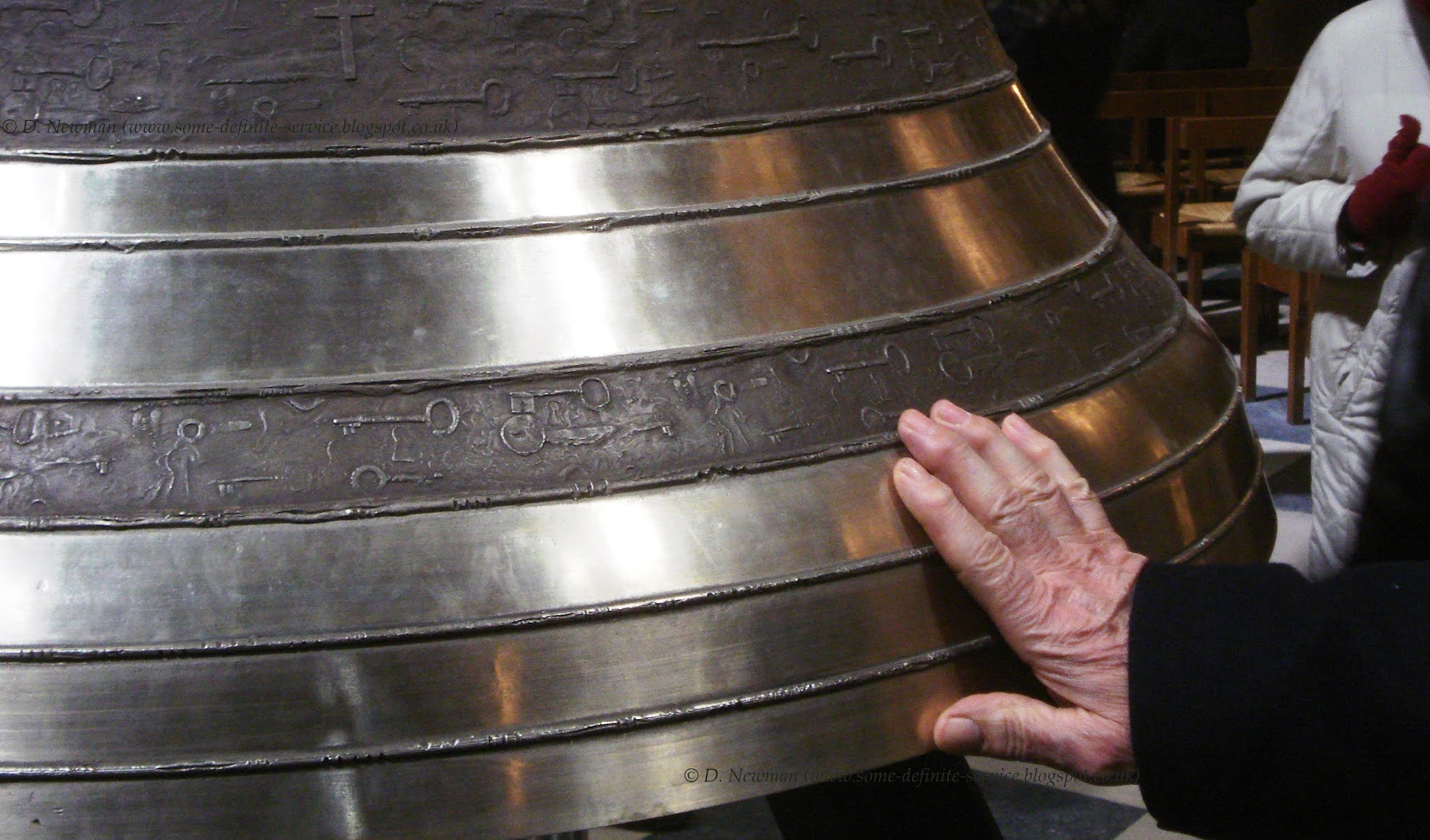
The then-newly-cast bells of Notre-Dame de Paris on display in the cathedral nave, February 2013

Tuesday, August 31, 2021

Stronger than Anyone Suspects

The secular-progressive opponents of the Church think of her only as a worldly force; a powerful one, yes, and stubborn, but one whose final defeat now seems within reach.  And if it could be defeated, what a prize that would be for Progress!   All those treasures in the Vatican citadel broken up and sold off… all those schools and universities and halls of propagation scattered to the four winds… all that power torn away — this supreme manifestation of Organised Religion, this most oppressive of ‘oppressive structures’, finally toppled and brought to ruin!  Think how many other, mightier empires and kingdoms Progress has already vanquished, that now are but the dust of the Wrong Side of History… the Church too, they think, with one big effort, could be overthrown.  ‘How many divisions has the Pope?’ they would not be the first to scoff.

Meanwhile we, the poor peasantry in the pews, grin wryly to ourselves.  If only they knew, the secular-progressivists, the sheer ricketiness of the whole outfit!  Organised religion?  More like disorganised religion!  Dripping ceilings, peeling paint, prehistoric plumbing…  and parish incomes, these days, scarcely greater than those of a meagre crowd-funding campaign for any secular cause.  Artistic treasures, in the main, do not pay the bills.  And this is before we come to our other weaknesses: self-interest, grudges, fear, indifference; the confusion and the cynicism and woeful inadequacies amongst our own members — in our own hearts — even as the Faith ebbs steadily out of our cities and civilisation.

But still, to everyone’s surprise, the Church abides, and will not go away.  Here it is, this ramshackle body of believers which, owing to what he memorably called its ‘knavish imbecility’, Hilaire Belloc was certain would not have lasted two weeks without divine assistance; here it is, after all these centuries, ever being made new.  The Church’s long defeat by the forces of this world may go on and on and on, but it is never accomplished; it is never finished.  But it should not be a surprise: after all, the Faith on Good Friday was finished as completely as anything has ever been finished, but on Easter Sunday found itself suddenly and entirely back in business.  After that, she can survive anything.  What Chesterton once said of the virtue of faith applies to the Church as well: it is ‘a perpetually defeated thing which survives all conquerors’, one which resolutely contradicts, if only by quiet non-assent, the world’s madnesses and iron ideologies, and which awaits in patient hope the turning of the tables, the unassailable vindication, the unanswerable victory — and the gates of Hell shall not prevail against it.

Side-chapel in the church of Saint Maurice, Lille, France, December 2019.

Thursday, June 17, 2021

Lincolnshire Towers: St. Botolph’s, Boston

Part of a series, ‘Lincolnshire Towers’.

Today, the seventeenth of June, being the feast-day of St. Botolph, I am reminded of a memorable trip I made a few years ago, one unseasonably warm February day, to one of England’s greatest parish churches: a church dedicated to him, and whose town is named after him: Botolph’s town, or Boston, in Lincolnshire.

The tower of St. Botolph’s, Boston, seen from Church Street (February, 2019).
In truth, it all began with St. Wulfram, and his church at Grantham.  A few months previously I had finally done as I had long intended, and got off the train for a proper look at it — at least, one longer than the fifteen-seconds’ vision with which it beguiles the passengers of London- or Scotland-bound expresses, soaring heart-stoppingly into view above the blurred tiles and whizzing chimneys of its parish.  After all the occasions on which this astonishing spire — briefly England’s highest, and still the fifth-tallest of all our medieval steeples — had flashed before my eyes, a visit seemed long overdue, and it did not disappoint.  But then I realised that the spire of St. Wulfram’s was not alone, and that Grantham is the gateway of a county whose sky-line is studded with great and graceful towers: as well as Boston there was Louth, and of course the great cathedral at Lincoln itself, which had been for two centuries, before the collapse of its spires in 1548, the tallest building on earth.

So northwards from London it was once again, out of King’s Cross through an unpromising, almost greenish-grey morning.  Harringay… Hatfield… Hitchin… Huntingdon… and not forgetting, after Peterborough, to ‘hail humble Helpstone’, the home parish, resting-place, and in many ways the whole world of the poet John Clare.  (Incidentally, the parish church here is also St. Botolph’s.)
‘Hail, humble Helpstone’: a glimpse of John Clare country near Peterborough.
Boston from London means changing at Grantham, so before the Skegness train came in I had a chance to admire the tower of St. Wulfram’s once again, and to wonder how St Botolph’s would compare with it.  These two Lincolnshire towers both stand on the same river, the Witham, Grantham quite near its source and Boston at its mouth, but as well as sixty miles of river, two centuries and great differences of style lie between them. [1]  Grantham’s steeple, finished in 1320, is in all the handsomeness of the Decorated style, while Boston’s — mostly in the more ornate and intricate Perpendicular — was begun much later, in around 1430, and took until at least 1500 to complete.  St. Wulfram’s had been a launch into the unknown, literally to new heights, and its masons were learning as they went, but at Boston the Gothic style was being finessed and perfected — though this is not to imply any lack of audacity or inspiration in its construction.  On the contrary, these qualities were, as we shall see, abundant.

Onto the Poacher Line, then, and the train, soon happening clatteringly onto jointed railway track, wound on into Lincolnshire, past the Roman town of Ancaster (source of much limestone for the county’s churches, as well as for the colleges of Cambridge), through Sleaford with its despondent and derelict Bass Maltings, and then out into the open Fens.  ‘Six years of a flat land,’ wrote the poet Elizabeth Jennings, who was born in Boston, where her father was Chief Medical Officer: she meant the first six years of her life, before the family moved to Oxford.  A rather laconic verdict (and, remarkably, she never returned), but it must be admitted that there is something uncompromising about the sheer flatness of these parts, something that leaves nothing much to be said.  They are as flat as that, and that is flat.

How extraordinary to glimpse on the horizon, then, amid the relentless horizontality of everything, a vertical shape: a tower aimed straight at Heaven, built in an architectural style which took as its fundamental principle precisely the emphasis, the exaltation of verticality at every opportunity.  The closer it draws, the clearer the sheer contradiction it offers to its surroundings, and the sheer scale at which it does so.  ‘It dominates the town, it dominates the landscape,’ said Betjeman. [2]  Naturally, then, it has with been known for centuries with wry affection as ‘the Stump’.
The ‘Stump’ from just south of Boston’s Grand Sluice. The scaffolding is a frustration, but does provide a measure of the tower’s height — that of a forty-floor tower-block.
The sky was still sullen as we rounded the curve into Boston, and this, combined with the warehouses and supermarkets around the station, lent weight to a first impression of the town as a place with its sleeves rolled up, unprettified and unpretentious.  Although it is a market town amid swathes of arable land, it was originally (and indeed remains) a port —  after all, it was from the sea, and the wool trade, that the wealth came to the church — and the town retains, I think, a port’s brisk unkemptness, a refusal to give itself airs, even though, with its handsome Georgian buildings, it could afford to do so.  Yet even as I approached the church from the station, a strengthening sun dispelled the cloud, and the day transfigured itself into bright cloudless warmth, quite untypical of February.  And there it was, the mighty tower, the great upthrust of Gothic glory, with an incredible audacity, even a youthfulness about it, seeming all the more extraordinary after the greyness and the garages a moment before.

Only one thing marred the view: the scaffolding cladding the entire western face of the tower — quite a contract for someone!  The programme of works on the tower also meant that, unusually, it was closed to the public.  On the other hand, the filigree of poles and planks did provide a useful measure of the tower’s scale — and, already, an excuse to return for a second visit.

St Botolph’s from the Market Square
‘One of the glories of England,’ Peter Hitchens has said of it, ‘and in my view one of the sights of the world (and I’ve seen a few).’  Julian Flannery, in his magisterial survey of English medieval steeples, calls the tower —
…one of the greatest triumphs of medieval engineering.  It is quite as daring as the hammer-beam roof of Westminster Hall, the octagonal lantern of Ely Cathedral or the pendant fan vault of the Henry VII Chapel at Westminster Abbey, and yet is on a greater scale than any of these masterpieces.  For sheer spectacle, the 266 feet of masonry soaring straight from the pavement to the sky is unsurpassed by any church or cathedral in England. [3]
‘Dizzyingly open’, even with
scaffolding 
Two-hundred-and-sixty-six feet makes this the seventh tallest of any extant English medieval tower.  Older churches had risen higher — Grantham to 274ft — and the weathercock of St. James’ church at Louth, at 287 feet the highest parish church in England, was placed into position not long after Boston was completed — but, since all the other towers incorporate a spire, this is the tallest medieval parish church tower measured ‘to its roof’.  It was not a question simply of height, though; there were other things in the masons’ minds.  Flannery observes out how slenderly and economically the tower was built, with the walls between the load-bearing buttresses so lean (scarcely three feet thick) as to be almost skins of stone.  The result, as Flannery goes on to point out, is an interior spacious enough that it could fit most ordinary church towers inside.  The space beneath the tower is also flooded with light, fulfilling another principal aspiration of medieval masons — it is ‘dizzyingly open from inside’, says Betjeman.  Again, on my visit in 2019, scaffolding impeded the view, but even this seemed to leave open an incredible amount of space and height.

Excavations in the north aisle.
Even without the great tower, the older body of the church itself would be worth coming a long way to see.  Not least because nave and chancel are contiguous with the enormous space under the tower, this is the largest parish church in England by volume.  It is also a ‘calendar church’, having twelve internal pillars for the months of the year, fifty-two windows for the weeks of the year, seven doors, and three hundred and sixty-five steps to the top of the tower. [4]  The chancel, built to a scale which in most churches would make for an impressive nave, contains fourteenth-century stalls and misericords, and a remarkable altar-piece.  There was plenty of life in the church, in spite of the works: a little gift-shop, where I bought a post-card for my desk at work, a growing scale Lego model to raise funds for the church, and other pilgrims moving quietly round the church — families, a group of Scouts, a young couple holding hands.

The chancel with fourteenth-century stalls and misericords.
It was time to have a look at the town itself, so I ambled around the market-place, and the side-streets, and then a little way upstream to the Boston Lock Café for lunch (the all-day breakfast is warmly recommended).  The ‘Lock’ of the café’s name is the Grand Sluice right in front of it: it is here that the river Witham technically ends, and the tidal waters of the Haven, leading out to the Wash and the open sea, begin.  Various works in the eighteenth century to improve the navigation of the Witham brought about a second heyday for Boston, hence its many Georgian buildings.  Fortunes seem to rise and fall nowhere so dramatically as in ports, or at any rate seem to rise and fall much faster than a great church can be planned and built.  In fact, even as the tower here was being raised, the town itself had fallen on hard times, and the booming trade of the thirteenth century was a thing of the past.  Julian Flannery draws an interesting comparison with the city of Liverpool, where construction of the Anglican cathedral was completed in the 1970s under economic circumstances quite different from those in which is had started in 1904.
Where Red Lion Street meets Wormgate.
The course of my amblings was largely determined by the sheer difficulty of photographing the tower: I had to retreat by some distance simply to fit it into the frame.  As the afternoon wore on, I found myself to the east of the church, and meeting with the sight of the sun shining straight through the open lantern at the top: another demonstration of the slenderness and lightness of the construction.  Yet the tower is still strong enough to hold a full peal of ten bells, and these above the cavernous space already described — there must be few belfries higher than Boston’s.
From Wide Bargate in late afternoon
Yes, they built it not only beautifully but masterfully, for in spite of its position right on the banks of the Haven it has never needed shoring up or major structural work.  There was a practical purpose to it, as well: the tower has served as an unmistakeable aid to navigation for miles around, especially for seafarers on the Wash.  (Scorch-marks on the masonry offer evidence that beacons were hung here for precisely this purpose: it really was a lantern tower.)  On a clear day the Stump is even visible from the west coast of Norfolk, and I have never forgotten a spine-tingling picture of St. Botolph’s on the horizon, silhouetted starkly against the setting sun, which the photographer Gary Pearson captured from Hunstanton, twenty-one miles away.
From the Market Place
Another interesting aspect of the tower observed by Flannery are its four distinct levels, corresponding roughly to the four generations of masons it took to build it.  He adds, though, that in order to avoid too prominent a horizontal division between them, and so to maintain the priority of verticality, the breaks in the masonry of the buttresses at the corners are made at different levels to those of the tower faces.  By thus interrupting the horizontal lines, while keeping the vertical lines continuous, there is nothing to distract or mislead the eye as it is drawn heavenwards.  The similarity of the tower’s lower half to that of St James’s at Louth has led some to suppose that a spire was the original intention here too, but owing to various aspects of the construction Flannery thinks this unlikely.  As for the unmistakeable octagonal lantern tower, he points out precedents and possible influences as various and far-flung as Beverley Minster, the belfry at Bruges and Brussels’ Town Hall as evidence that this was the intention all along.  The Flemish connection is interesting: ‘People called it Holland,’ remembered Elizabeth Jennings, and not only because of the flatness: in the other Low Counties, too, great belfries like this were raised.
The ‘Stump’ and the Haven in evening light.  
Spring-like as the weather might have been, the law of the sun was still winter’s, and all too soon the time came for the train home.  From London a day-trip to Boston is easily possible by train, but it perhaps does not allow for a very long day.  I could hardly complain about mine, though, as the train set off back westwards, through the the dark levels and glassy drains, to Grantham and the main line — but I knew there would have to be a return, once the scaffolding was gone, to admire the tower in its full glory.
The South Forty Foot Drain, west of Boston, seen from the Nottingham train

References / footnotes:
1.   The river Witham has a curious course: from Grantham it flows northwards all the way to Lincoln (at one point being separated from the Trent by only a narrow watershed) and then, once through the Lincoln Gap, back south-eastwards again.  Though it is eighty-two miles in length, its mouth and its source are fewer than thirty miles apart as the crow flies.
2.  Richard Surman (ed.), Betjeman’s Best British Churches (London: Collins, 2001))
3.  Julian Flannery, Fifty English Steeples (New York: Thames & Hudson, 2016),
4.  Soul architects, ‘Conservation Architect for St Botolph’s Church ‘Boston Stump’, Lincolnshire’, web article retrieved 17 June 2021 from <https://soularchitects.co.uk/conservation-architect-for-st-botolphs-church-boston-stump-lincolnshire/>.

A down express flies past St. Wulfram’s Church, Grantham, in the dusk.