Showing posts with label Pope Francis. Show all posts

Thursday, May 08, 2025

Not made for Death, but for Life

Happy Easter to all readers!  I have been meaning to blog sooner, but have been particularly busy over the last month or so.  And there has been no shortage of news – most significantly the loss of Pope Francis on Easter Monday.  We had of course been well aware of his serious illness the previous month, but he had seemed to be recovering – and had we not seen the pictures of him in St. Peter’s Square the previous day, and had he not wished us a happy Easter, and met the Vice-President of the United States, and in his Easter homily (albeit read aloud on his behalf), declared that “we were not made for death, but for life”?  So to lose him was rather a jolt.

I suppose, in a way, it is appropriate: he was ever the Pope of the dramatic gesture, with a sense of the theatrical about him, and was always encouraging us to put our feet where our faith is.  Perhaps, in his dying on Easter Monday, we might see a similar thing.

Yet I remember this aspect of him taking a little getting used to at first, especially after the careful manner of Pope Benedict.  Pope Francis had less time for words, even a certain impatience with them, and perhaps the same went for formalities.  He always gave the impression that there was no time to lose, and so it is characteristic that he should have had his foot on the accelerator to the very end.  This was a man who in embraced a disfigured man without hesitation; who actually knelt to kiss the feet of the warring leaders of South Sudan, who amid evening rainfall calmly blessed the whole world in those vertiginous first weeks of the pandemic.  A critic might call it a ‘PR papacy’, and indeed any photo-op carries the risk of playing to the camera; yet these images, which were challenging and conscience-pricking, were also a kind of riposte to the age of the age of airbrushing and virtue-signalling.

Embed from Getty Images

The media, of course, also put their own spin on him, as is their wont; to them he was simply the Pope who wanted to make the Church more ‘progressive’ and ‘forward-looking’, and apparently a change from previous Popes (which is of course a jab at Pope Benedict, something they can never resist).  But as ever the media reveal their selective hearing, choosing to ignore the moments when he expressed himself with startling directness, capable of criticising liberal and conservative excesses with equal enthusiasm, while also pointing out that the Christian faith transcends either.  He was perfectly willing to fire from both barrels, and indeed I have found him more chastening and challenging than I did the supposedly stricter (but actually very gentle) Pope Benedict.

Yet of course he did strike a particular tone of mercy.  His description of the Church as a field-hospital has stayed with me, as with so many: the priority of getting people, in whatever condition or state of life, out of the rain and the cold of the world, and into the warm and dry of the Church.  He is right this is a world that urgently needs the Church (the world’s largest provider of healthcare, and its largest educational institution, and perhaps the largest humanitarian organisation overall, even before we get onto spiritual matters…).  He was right we cannot necessarily afford to wait until everything is neat and tidy before putting out into the deep.  Similarly, his promotion of a ‘culture of encounter’ has encouraged me to overcome my reserved nature and speak (and, I hope, listen!) to more people.  Finally, his extension of mercy above all – the unique priority of the Christian faith – was also absolutely urgent.  So, may the Lord soon welcome him to his reward, and grant him the eternal life in which he taught us to hope.

Now, as we await his successor, here again is his final homily:

Christ is risen, alleluia!

Dear brothers and sisters, Happy Easter!

Today at last, the singing of the ‘alleluia’ is heard once more in the Church, passing from mouth to mouth, from heart to heart, and this makes the people of God throughout the world shed tears of joy.

From the empty tomb in Jerusalem, we hear unexpected good news: Jesus, who was crucified, ‘is not here, he has risen’.  Jesus is not in the tomb, he is alive!

Love has triumphed over hatred, light over darkness and truth over falsehood.  Forgiveness has triumphed over revenge.  Evil has not disappeared from history; it will remain until the end, but it no longer has the upper hand; it no longer has power over those who accept the grace of this day.

Sisters and brothers, especially those of you experiencing pain and sorrow, your silent cry has been heard and your tears have been counted; not one of them has been lost!

In the passion and death of Jesus, God has taken upon himself all the evil in this world and in his infinite mercy has defeated it.  He has uprooted the diabolical pride that poisons the human heart and wreaks violence and corruption on every side.  The Lamb of God is victorious! That is why, today, we can joyfully cry out: ‘Christ, my hope, has risen!’ .

The resurrection of Jesus is indeed the basis of our hope.  For in the light of this event, hope is no longer an illusion.  Thanks to Christ — crucified and risen from the dead — hope does not disappoint!  Spes non confundit!  That hope is not an evasion, but a challenge; it does not delude, but empowers us.

All those who put their hope in God place their feeble hands in his strong and mighty hand; they let themselves be raised up and set out on a journey.  Together with the risen Jesus, they become pilgrims of hope, witnesses of the victory of love and of the disarmed power of Life.

Christ is risen!  These words capture the whole meaning of our existence, for we were not made for death but for life.  Easter is the celebration of life!  God created us for life and wants the human family to rise again!  In his eyes, every life is precious!  The life of a child in the mother’s womb, as well as the lives of the elderly and the sick, who in more and more countries are looked upon as people to be discarded.

What a great thirst for death, for killing, we witness each day in the many conflicts raging in different parts of our world!  How much violence we see, often even within families, directed at women and children!  How much contempt is stirred up at times towards the vulnerable, the marginalised, and migrants!

On this day, I would like all of us to hope anew and to revive our trust in others, including those who are different than ourselves, or who come from distant lands, bringing unfamiliar customs, ways of life and ideas!  For all of us are children of God!

I would like us to renew our hope that peace is possible!  From the Holy Sepulchre, the Church of the Resurrection, where this year Easter is being celebrated by Catholics and Orthodox on the same day, may the light of peace radiate throughout the Holy Land and the entire world.

I express my closeness to the sufferings of Christians in Palestine and Israel, and to all the Israeli people and the Palestinian people. The growing climate of anti-Semitism throughout the world is worrisome.  Yet at the same time, I think of the people of Gaza, and its Christian community in particular, where the terrible conflict continues to cause death and destruction and to create a dramatic and deplorable humanitarian situation.

I appeal to the warring parties: call a ceasefire, release the hostages and come to the aid of a starving people that aspires to a future of peace!

Let us pray for the Christian communities in Lebanon and in Syria, presently experiencing a delicate transition in its history.  They aspire to stability and to participation in the life of their respective nations.  I urge the whole Church to keep the Christians of the beloved Middle East in its thoughts and prayers.

I also think in particular of the people of Yemen, who are experiencing one of the world’s most serious and prolonged humanitarian crises because of war, and I invite all to find solutions through a constructive dialogue.

May the risen Christ grant Ukraine, devastated by war, his Easter gift of peace, and encourage all parties involved to pursue efforts aimed at achieving a just and lasting peace.

On this festive day, let us remember the South Caucasus and pray that a final peace agreement between Armenia and Azerbaijan will soon be signed and implemented, and lead to long-awaited reconciliation in the region.

May the light of Easter inspire efforts to promote harmony in the western Balkans and sustain political leaders in their efforts to allay tensions and crises, and, together with their partner countries in the region, to reject dangerous and destabilising actions.

May the risen Christ, our hope, grant peace and consolation to the African peoples who are victims of violence and conflict, especially in the Democratic Republic of the Congo, in Sudan and South Sudan.  May he sustain those suffering from the tensions in the Sahel, the Horn of Africa and the Great Lakes region, as well as those Christians who in many places are not able freely to profess their faith.

There can be no peace without freedom of religion, freedom of thought, freedom of expression and respect for the views of others.

Nor is peace possible without true disarmament!  The requirement that every people provide for its own defence must not turn into a race to rearmament.

The light of Easter impels us to break down the barriers that create division and are fraught with grave political and economic consequences.  It impels us to care for one another, to increase our mutual solidarity, and to work for the integral development of each human person.

During this time, let us not fail to assist the people of Myanmar, plagued by long years of armed conflict, who, with courage and patience, are dealing with the aftermath of the devastating earthquake in Sagaing, which caused the death of thousands and great suffering for the many survivors, including orphans and the elderly.  We pray for the victims and their loved ones, and we heartily thank all the generous volunteers carrying out the relief operations.

The announcement of a ceasefire by various actors in the country is a sign of hope for the whole of Myanmar.

I appeal to all those in positions of political responsibility in our world not to yield to the logic of fear which only leads to isolation from others, but rather to use the resources available to help the needy, to fight hunger and to encourage initiatives that promote development.  These are the ‘weapons’ of peace: weapons that build the future, instead of sowing seeds of death!

May the principle of humanity never fail to be the hallmark of our daily actions.  In the face of the cruelty of conflicts that involve defenceless civilians and attack schools, hospitals and humanitarian workers, we cannot allow ourselves to forget that it is not targets that are struck, but persons, each possessed of a soul and human dignity.

In this Jubilee year, may Easter also be a fitting occasion for the liberation of prisoners of war and political prisoners!

Dear brothers and sisters,

In the Lord’s Paschal Mystery, death and life contended in a stupendous struggle, but the Lord now lives forever.  He fills us with the certainty that we too are called to share in the life that knows no end, when the clash of arms and the rumble of death will be heard no more.  Let us entrust ourselves to him, for he alone can make all things new!

Happy Easter to everyone!

An ‘Easter banger’ (to coin a phrase!) from OLEM, Our Lady of the English Martyrs in Cambridge, Easter Vigil, 24th April, 2025: Peter Latona’s setting of the antiphon for the Rite of Sprinkling: ‘I saw water flowing from the right side of the Temple’ (‘Vidi aquam’).

Saturday, April 25, 2020

Spring, Regardless

When last did silence lie over South London as it has in the past few weeks?  The Seventies?  The Sixties?  The Fifties?  Only the brief ‘stillness of the solemn air’ after heavy snowfall, as in February 2009, seems comparable, but even then I am not sure there was ever a hush so thick as that which now descends on London at night, not just in the street outside, but in all the roads around, and the roads beyond them, for miles and miles and miles.  The slick, insufferable, incessant, suburb-saturating, sempiternal seething of traffic has vanished.  Some reports suggest that the number of cars on the road has gone down by two thirds to its lowest level for sixty years; I could well believe this.  Now, four weeks into the national quarantine, I am noticing the volume of traffic creeping up again, but it is still bearable for now.  Any relief is welcome.

Council notice on the Common.
I am well aware of the suffering wrought by the pandemic, and that I write from well behind the front lines of the great battle against it, and indeed that I am relying largely on others to do the fighting.  All the same, I think it is not unfair to observe the silver linings I described a few weeks ago.  The quietening of London’s madness is one; another is the community spirit that has been the paradoxical fruit of enforced isolation.  Even having to keep our distance from each other has brought about a kind of solidarity: it is sometimes awkward to leap into the road or brambles when meeting someone coming the other way, but most people see the point and even, sometimes, humour in it (“Don’t get yourself stung!” a lady told me when she saw that I had leapt off the path into some shallow brambles to let her pass).  Children have decorated windows and pavements with innocent rainbows, and on my daily constitutionals I am exchanging friendly greetings with strangers in a manner completely at odds with London’s usual way of doing things.  

Then there is the weekly eight o’clock round of applause for doctors and nurses, which has been kept up vigorously in our street.  A friend reports that the clapping in his village at the fringes of London is lessening every week, but round near me (much further in) I am sure it is growing, if anything.  The neighbours add to the clamour by hammering on pots and pans, or by thumping their wheelie bins, while passing cars sound their horns.  Then after a minute or so, we down tools, wave to each other or call in greeting across the street, and withdraw.  Some might scoff at this, but I feel this is just the sort of custom that many parts of Britain, mine included, have long lacked.

It occurs to me that this pandemic may well cement the National Health Service into place as the established religion of Britain.  This is entirely understandable: our debt to doctors and nurses is now partly due in a currency other than that in which we pay our taxes.  But it may cause problems in the future if, as tends to happen with any large institution, the NHS comes to need reform of some sort, and public feeling produces misplaced resistance, legitimate changes being mistaken for undue interference.  On the other hand, the strength of public faith in the NHS will also serve as protection against any short-sighted erosion or thinning out of its services by its overseers.  Maybe, though, we will soon have worse to worry about than either of these problems.  (And I would also observe quietly that there are some needs which even the NHS cannot be expected to answer.)
Local pavement decoration
Daily walks over the now-well-worn paths of the Common have also given me the chance to see spring’s great leafburst in far more detail than usual.  In previous years, I put its seeming to happen overnight down to my lack of observation.  But now, regular visits in quick succession have shown me the remarkable proliferation that really does take place over only a two or three days, as if all that life is kept pent up in the earth until it can be contained no longer.

I have not altogether forgotten about the world outside my parish, though.  One gloomy piece of news that has almost been lost amid the coronavirus coverage is the continued collapse of marriage in Britain: the number registered in 2017 was a new record low, and of these the proportion of ceremonies with any religious dimension was also the lowest ever recorded: 22%.  It may sound blunt to say this, but this is the sign of a civilisation that scarcely believes in the future at all, let alone in lasting love.

But there has been cause for good cheer, such as the birthdays of Benedict XVI (ninety-three) and H.M. the Queen (ninety-four).  And Pope Francis has also given an interview here — https://www.thetablet.co.uk/features/2/17845/pope-francis-says-pandemic-can-be-a-place-of-conversion- — with something to hearten and challenge everyone, as is characteristic. For example:
It’s true, a number of governments have taken exemplary measures to defend the population on the basis of clear priorities. But we’re realising that all our thinking, like it or not, has been shaped around the economy. In the world of finance it has seemed normal to sacrifice [people], to practise a politics of the throwaway culture, from the beginning to the end of life. I’m thinking, for example, of pre-natal selection. It’s very unusual these days to meet Down’s Syndrome people on the street; when the tomograph [scan] detects them, they are binned. It’s a culture of euthanasia, either legal or covert, in which the elderly are given medication but only up to a point.
And —
Yet the elderly continue to be our roots. And they must speak to the young. This tension between young and old must always be resolved in the encounter with each other. Because the young person is bud and foliage, but without roots they cannot bear fruit. The elderly are the roots. I would say to them, today: I know you feel death is close, and you are afraid, but look elsewhere, remember your children, and do not stop dreaming. This is what God asks of you: to dream (Joel 3:1). 
What would I say to the young people? Have the courage to look ahead, and to be prophetic.  May the dreams of the old correspond to your prophecies.
 I hope all readers, and their friends and families, are safe and well.

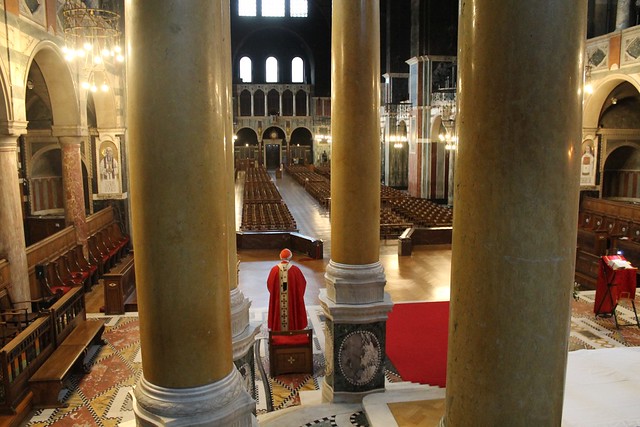
IMG_3880
Cardinal Vincent Nichols (Archbishop of Westminster) celebrates Mass for National Health Service workers, carers, the sick and their families, in Westminster Cathedral.  
Photo from https://www.flickr.com/photos/catholicwestminster/49812472648/ (IMG_3880, 23rd April 2020).

Sunday, August 26, 2018

Pope Francis over Britain

Following Pope Francis’ flight back to Rome from his visit to Ireland, it was rather nice to see from Flightradar24.com that he passed through British airspace.  At about seven o’clock he flew high over the Ceredigion coast and crossed Wales (which remains unvisited by any Pope!) and then over southern England and on Romewards.

A screen capture of Pope Francis’ flight from Flightradar24.com
At about a quarter past seven he was right above the part of Gloucestershire that I wrote about in this piece from last year.  It is odd to think of him up there!

Saturday, December 17, 2016

Happy birthday, Pope Francis!

Happy eightieth birthday to the unstoppable Pope Francis, who continues to teach and us less by words (which I think he sees as a secondary tool) than by gesture and example, in which his real homilies are to be found. 


“How many of you speak Spanish?” Pope Francis prays with refugees in Rome.

He is certainly a Pope who pulls no punches: man has, he says, “slapped nature in the face”; young people are to “renounce the sofa” — and remember the “Curse my mother; expect a punch” line?  People don’t realise how much tougher a nut he is than Benedict ever was!  But he has to be tough.  Time is short.  The world is awash with wrongdoing and riven by evil, and Francis has more to contend with even than the unfolding spiritual decline of the West.  As I have pointed out before, I think he wants to concentrate on the rest of the world before Europe, whose faithful remnant, with its particular mission, can still draw on the (far-from-exhausted) well of teaching of Benedict and St. John Paul, in addition to Francis’s, for years to come.

“Pray for me,” he has asked us, so we should do so.  And the same for his predecessor.

Monday, August 01, 2016

Yes, the Church lives indeed: Jezu, ufam Tobie!

World Youth Day drew to a close yesterday: at least two and half million people were present as Pope Francis celebrated Mass at Krakow.  If that figure is anything to go by (and it is, and people need to know about it) then the Church lives indeed.  As Archbishop Vincent Nichols of Westminster observes in the field, what other institution, or what other reason, or, ultimately what other Person, can reliably summon such numbers from a hundred and sixty-seven nationalities to a single place, year after year?

There seems to be an intoxicating, jubilant mood when the pilgrims gather for the great vigils and Masses.  It is an astonishing atmosphere that can hardly be diminished by being parcelled into pixels over YouTube: after all the Holy Spirit can hardly be compressed into 1s and 0s.  Gatherings like this might not be for everyone, but all sorts of other things go on as well in churches round about — catechesis, Adoration, concerts and so on — and the party atmosphere belies the spiritual demands that go with any pilgrimage.  And, when all these hundreds and thousands of young pilgrims from all over the world are invited to prayer, how swiftly and utterly silence falls and a million hearts are turned in unison to God.

I have also been reminded — rather abruptly, I must admit — of Poland’s unabashed allegiance to the Church.  I had known that this is a land of great and heroic faith, with many saints even in recent times, but I have been able to see, albeit imperfectly, how noble it is.  This is how a churchgoing country actually looks; these are the crowds that can be mustered; this is what it is like for statesmen and -women to receive Communion without anybody batting an eyelid.  I am aware that not all is well in Poland, but spiritually they are surely leagues ahead of us in Britain.  If we (and other European countries, come to that) were more like Poland, I would be much less uneasy about leaving the E.U. This is a nation which says ‘Jezu, ufam Tobie!’ — ‘Jesus, I trust in You’ — and this is the result.

Another aspect of these celebrations has been the music, which I think has been tremendous.  The organisers rightly settled for nothing less than a full chorus and orchestra.  And the music itself was congregational and inviting without at all being shallow or trivial.  After last Tuesday’s post I have done some rummaging around, lamenting my complete ignorance of the Polish language, and matched some names and composers to tunes.

One name to remember, I think, is Fr. Dawid Kusz, who has not only been one of the festival’s conductors but is also responsible for writing the hymns which I found most striking and powerful.  Here he is conducting his own ‘CaÅ‚a ziemio, woÅ‚aj z radoÅ›ci’ (‘All the earth, cry out with joy’ — Psalm 97 (98)):


and here, with a different mood, but no less congregational, and matching the words just as well: ‘Skosztujcie i zobaczcie jak dobry jest Pan’ (‘Taste and see that the Lord is good’ — Psalm 33 (34)):


The setting of the Mass sung both at the opening Mass with Cardinal Dsiwisz (St JP II’s secretary and close friend) and at the closing Mass with Pope Francis was commissioned especially for this World Youth Day and was composed by Henryk Jan Botor.  He wrote it in honour of St John Paul II, and apparently completed it on April 2nd this year, the eleventh anniversary of his death.   Fr. Robert TyraÅ‚a, World Youth Day’s musical director, said in one of the Polish articles I subjected to Google Translate and its munching cogs suggested that it combined elements of Gregorian chant and elements of film music: a simple recipe indeed, the treasures of the past mixed with the valid fruits of modern times, but arguably the best.


Beautiful music is not the most important aspect of the Mass, but that says more about the Mass than it does about music.  One sign of health in the Church should be a proliferation of composers and hymn-writers, who should write sincere, authentic music like this and in turn evangelise the sullen and inauthentic art-galleries, concert-halls and television screens of the West.

I can’t resist mentioning Pope Francis’ declaration of war on sofas.  This is quite a powerful insight, I find.  It is true that, especially in the West, we can be lulled into material comfort and the pool of wonders of a computer screen, and hours can be lost while others thrive, such as those for whom ‘it is much easier […] to have drowsy and dull kids who confuse happiness with a sofa [… than] young people who are alert and searching, trying to respond to God’s dream and to all the restlessness present in the human heart.’  That is going to be quite a difficult piece of advice to carry out, especially for young people who have never known life without a computer or the Internet.  One thing it probably means is that you should stop reading this blog (and I should stop writing it!): for there are children of the light to be defended, and a culture of life to be sown, and a civilisation of love to be built.

Friday, August 28, 2015

Reading ‘Pope Francis: Untying the Knots’ by Paul Vallely

Some time ago a friend kindly lent me ‘Pope Francis: Untying the Knots’, a biography of the Holy Father by Paul Vallely.  It is an absorbing and pacy book: I remember its being published remarkably soon after the election, and read it bearing in mind that speed had been of the essence when was being researched and written.

From www.paulvallely.com
Vallely works through the run of Jorge Bergoglio’s life with methodical detail and also sprinkles it with some wonderful vignettes.  For instance, he discovered his vocation in a confessional which he had only entered on second thoughts on his way to make a proposal of marriage.  His mother used to gather the children around radio to hear broadcasts of whole operas.  Then there is the nickname of El Chabon that he is given in villa 31, a slum of Buenos Aires, which apparently translates as ‘The Dude’.

Paul Vallely’s contention throughout the book is that Pope Francis’ characteristic humility, simplicity, authenticity and concern for the downtrodden pour forth now so startlingly only because of difficult trials he underwent in the past.  For instance, Vallely paints a picture of his time as superior of the Jesuit province in Argentina, soon after the Second Vatican Council, in which he apparently reacted fiercely against new movements and ideas (such as Liberation Theology or modern ecclesiastical architecture) and thus divided Argentinian Jesuits into supporters and adversaries.  Then there were the difficulties of the Argentinian ‘Dirty War’ of 1976—1983 in which a military regime, trying to stamp out any hint of Communism, included in its long list of political enemies priests who seemed too attached to the cause of workers or slum-dwellers.  Moreover, Vallely describes various examples of collusion between representatives of the Church and the regime; even within the Church, it was difficult for Jorge Bergoglio to know where and with whom he stood.  Vallely also dwells at length upon an incident involving two priests from whom, because they had expressly disobeyed his request to stop working in the slums for their safety, Jorge Bergoglio removed the licence to say Mass and therefore, in the military’s eyes, the Church’s protection.  These priests were kidnapped shortly afterwards and, it seems, were fortunate to avoid death, let alone to be released. 

It was against this background, Vallely tells us, that Jorge Bergoglio was sent to Bavaria in 1986 to research a Ph.D.  Here, in the church of St. Peter am Perlach in Augsburg, he encountered a painting of Our Lady entitled ‘Mary, Untier of Knots’.  This image resonated with him precisely because of the troubles he had faced in Argentina, and he took back copies of the painting on his return.  Vallely’s belief is that this picture played no small part in a conversion, or something like it, that the future Pope underwent.  After this change of heart and mind, we read that he came to believe that poverty could not be eradicated without a conversion of society; he became less opposed to Liberation Theology and he set himself the challenge of adopting humility as a ‘religious decision’.  It was the experience of division and disunity in the Church, of murkiness with regard to the 1976-1983 regime and the unassuaged plight of the Argentinian poor that forged the Pope Francis who now unsettles us and challenges us with his humility and directness.

It is a tale compellingly told.  I have misgivings about one aspect of its telling, however.  This portrait of Pope Francis often reads as if meant to be considered in contrast to, even in rupture with the recent history of the Church and indeed Pope Benedict in particular.  Vallely’s use of the word ‘conservative’ (a word which I think ought particularly to be avoided in Church affairs) might justly be described as liberal, and he does not mean it as a compliment.  How thinly Vallely has veiled his disapproval of the Church’s administration can be told by his use of phrases like ‘Vatican crackdown’ or ‘conservative hierarchy’; see also his description of Benedict XVI’s liturgical formality as a ‘predilection for lace and Latin’.  It seems fair enough for Vallely to pit Francis against the Curia, since the Curia has certainly been in need of reform, but the assumption is made that the Curia’s problems come from attachment to tradition, or antipathy towards modernity, rather than from nepotism, insularity or, come to that, from sin.  There is even the implication that, before his ‘conversion’, in his antipathy towards revolution, readiness to assert authority and decision to decorate a bare modernist chapel interior, Jorge Bergoglio had resembled Joseph Ratzinger, and that the new version is an improvement precisely because he apparently no longer does so.

In the first instance I find this unfair to Benedict, whose character and mission might have been different from Francis’, but was far from deficient (I have sung B16’s praises here).  It is certainly true that Benedict was a man of words and thoughts where Francis is more obviously a man of action and gesture, but a contemplative approach does not necessarily lead to a ‘Church turned in on its inner spirituality’.  As I see it, Benedict knew his strengths and their limits — a deep understanding of Europe, along with the intelligence to grapple with it.  So, in his seven years, although he never forgot that he was Pope for all the world’s Catholics, he laid down the intellectual and spiritual foundations of the New Evangelisation in Europe in particular.  He confronted the dictatorship of relativism on the very fronts on which it had declared war on the Church, and did not waver when the Western media retaliated.  He provided European Christians with the intellectual equipment to engage with the New Atheism, gender theory, the dictatorship of relativism and consumerism, and fought sin’s particular footholds in Western society.  Simply by insisting that we can speak of such a thing as absolute truth, truth that comes from God, he did a great service for hope.

If he revived Papal fashions and invited the European faithful to a careful consideration of the liturgy, it was not to flee from the plight of the world’s poor.  Rather, it dealt with one of the greatest threats to Western Christianity, namely the wholesale abolition of an awareness of its past.  How tempting it is to believe that this is the greatest of ages simply by virtue of our living in it, and consequently that our ancestors’ way of life is entirely obsolete (how often do we hear this or that idea hastened along ‘because it’s the twenty-first century’?).  By reviving traditions in the Church, Benedict reminded us that wisdom is gained not by rejecting the past solely on the grounds of its mistakes, but by sifting carefully through the ages, avoiding its errors and, better still, embracing its triumphs.  It was a way of asking the New Evangelisation’s great question to Europe: ‘Do you remember that we believed because it is true?’.  

Benedict was aware that Europe carries ever less weight in the Christian world.  I think it is reasonable to suppose that one reason for his resignation was to open the way for someone more knowledgeable about the non-European Church.  So in the end, he allowed himself seven years to lay the foundations of the New Evangelisation in the West (foundations that we are to build upon with his legacy), which in turn allowed Pope Francis to concentrate on his own strengths.

This does not mean that we can afford to pay less attention to Pope Francis (who himself has said that ‘every age has but a meagre awareness of its own limitations’).  I simply think that Pope Benedict had a particular mission, as Pope Francis has his.  Modern Europe is not like the rest of the world: the challenge of building the Church is very different, even to the extent of needing two different kinds of Pope at different times.  This is illustrated by Vallely’s own description of Argentinean popular piety and the informal, exuberant mood at Mass in the slums of Buenos Aires.  Coming from a place where the Christian faith has life like that, Pope Francis could be excused if he were baffled by European cynicism and sulky reticence towards any discussion of faith, though Laudato Si shows that he understands it very well indeed.  I see these two Popes in continuity with each other; they may have different characters and gifts, but both put these at the service of the servants of God.

Vallely’s (and others’) frame of thought, in which two apparently distinct halves vie for supremacy — liturgically and morally doctrinaire ‘conservatives’ versus energetic upholders of social justice —  is not only over-simplistic, but also produces a thoroughly disillusioning vision of the Church, which at any moment might be lost to the wrong side.  Of course there exist within the Church divisions, disagreements and (fundamentally) sin, but I do not think that these align themselves along battle-lines in the way that Vallely describes.  Vallely says, for instance: ‘For all his growing sense of the need for social justice, Jorge Mario Bergoglio was doctrinally orthodox and mainstream’, as if the two were incompatible.  Yet concern for social justice is a pillar of Catholic doctrine, set out clearly in Catholic Social Teaching, and social justice is achieved precisely by a universal, willing adherence to the Church’s teachings.  It may be that some of the faithful are overly concerned by liturgy and rubrics, and that others have an excessively political and secular conception of social injustice, but the ideal is a combination of both spirituality and action, two things which do not contradict each other but go together in the same direction, just as Benedict’s and Francis’ papacies do.  All are called to the harvest (which, we are told, is rich, and the labourers few); each must bring what he can.

Wednesday, March 04, 2015

Music from South Sudan

Being an ecumenical sort of chap, I am becoming rather a fan of Justin Welby, the Archbishop of Canterbury.  I think that he explains himself clearly and intelligently, and speaks in complete paragraphs of measured English, which is rare in the media these days.  His sincerity and sense of humour give him an approachable, slickness-free media presence, which no doubt matches the impression he must give in person.  Above all, his faith spills out of him, qualmless and unabashed, in an invigorating and heartening way.

I mention him because the other day I listened to his appearance on ‘Desert Island Discs’ (which should be audible here).  Kirsty Young’s questions were not always easy, so he was perhaps less relaxed than I have heard him elsewhere (here, for example), but it was certainly enjoyable.  In any case, my main reason for listening was my curiosity about his taste in music (I have admitted to being nosey about this sort of thing!).  There was a broad spectrum: Tavener, Beethoven, ‘You’ll Never Walk Alone’, an evangelical worship-song by Matt and Beth Redman, and even ‘The Lion Sleeps Tonight’.

His fourth choice, however, stood right out from the others:


It is a South Sudanese folk-song called ‘Yesu Odechi’ (the translation is given as ‘Jesus Number One’, so perhaps it is more of a folk-hymn).  I was stunned by its freshness, even rawness of sound and by the soloist’s incredible voice.   Looking it up, I found that it is in fact very new, having been composed by its very singers (they are members of the Kachipo tribe).  In fact, there was apparently some trouble in transcribing the words, Kachipo culture being entirely oral.  Although the accompaniment was added later in a studio, the mood and sound seem unfakeably unchoreographed and authentic.  

This music speaks (or sings?) for itself, but I cannot resist noting the light it sheds on one of the paradoxes of our age, which is itself made up of two contradictions.  The first paradox, as Justin Welby observes, is the brightness of this music against South Sudan’s already bloodstained short history (some of which he has witnessed at first hand).  The second, on the other hand, is that we who enjoy relative peace do not write peaceful music, but instead content ourselves with sordid lyrics set to mindless beats or pride ourselves on our supposed edginess.  It is needless to say that the victims of war are little to be envied, but I think they (as opposed to the wagers of war) seem to have a firmer grasp of truth, in faith as well as in art, than we do in our indulgent age.   Perhaps this is one of the things Pope Francis meant when he said, "Certain realities in life can only be seen through eyes cleansed by tears".

Thursday, January 22, 2015

Really?

In my first entry, I blurted out that Benedict XVI, Pope from 2005-2013, now Pope Emeritus, is ‘one of my heroes’.  But I am a young man in Britain — in the twenty-first century!  Am I mad?  What am I saying?

Well, I probably am mad, but that’s a different question from whether, of the prominent figures of the past decade — intellectual, political, certainly religious — Benedict XVI is among the greatest.  He is a man both fiercely intelligent and steadfastly good: Cardinal Joachim Meisner said of him that ‘[er ist] einerseits ein ganzes Dutzend hochstehender Theologieprofessoren, andererseits ist er so fromm wie ein Erstkommunionkind [He is worth a dozen prominent theology professors and is as pious as a child on the day of his first communion].’   A good and learned Pope was precisely what was needed in a world — particularly the Western world — laden down by secularism, by materialism, by cynicism, by impoverishment of culture, by faithlessness and by selfishness.

This goodness is all the more remarkable because of the circumstances in which it has been tested, and thereby proved.  When conscripted into the Hitler Youth at the age of fourteen, he risked serious punishment by playing truant.  More courageously still, he later deserted the German army in 1944 and made his way home — where, seeing that Mass was being said in the parish church, and wishing to avoid a commotion, he did not go in, but waited for his family to come out at the end.

His goodness has also been tested where we have all been able to witness it.  The trials and missiles came relentlessly during his pontificate, perhaps precisely because of his intelligence, perception and lucid words.  The architects of not merely secular but anti-Christian society felt threatened by him, as their equivalents had been by St John Paul II, and they responded with falsehood and rage.  Many in the media (though by no means all) treated him unsympathetically, either by action or omission.  Yet he remained patient and steadfast in the pursuit of truth.  He did not flee for fear of the wolves; he did not falter in the face of the ‘dictatorship of relativism’, and in response to the prevalent belief that the only absolute is ‘one’s own ego and desires’ he presented, again and again, ‘a different goal: the Son of God, the true man.’  He has left for us both an intellectual defence of the Catholic faith and an example, itself founded on Christ’s example, fit to shine forth in the twenty-first century. 

And he knew about young people. Which other public figure — apart now from Pope Francis —  in our era’s vain and brittle superficiality will, for example, begin an address with the simple sincerity of "Dear young friends!", and mean it?  Who else will refuse to patronise them or to water down his wisdom for them?  Who else will, as he did at World Youth Day in Madrid, decline to flee a freak thunderstorm and instead remain with the million-strong gathering of young pilgrims?  And who else knows that this works?  Who would have thought that an uncharismatic and grandfatherly gentleman could earn the cheers of 80,000 young people (and your correspondent’s) in Hyde Park, during the magnificent and unforgettable Papal Visit to Britain in 2010?  It works of course because it is not really about him: he never forgot that he was the servant of the servants of God.  And since what he was bound to teach is as true for the young as it is for the old, he could say with conviction in his introduction to the new Youth Catechism:
“Many people say to me: The youth of today are not interested in this. I disagree, and I am certain that I am right. The youth of today are not as superficial as some think. They want to know what life is really all about.”
Vigil at Hyde Park in London, 18th September 2010, on the eve of the beatification of Bl. John Henry Newman.  No relation: he is a Blessed, after all!