Showing posts with label Shippea Hill. Show all posts

Wednesday, December 24, 2025

Shippea Hill: in pride of second place

It’s that time of year again!  The Office of Rail and Road has released its annual statistics of passenger numbers per railway station, and as usual I have headed immediately for the lower extremities of the league table with one particular, cherished name in mind.  How had everyone’s favourite bleak fenland outpost done: Shippea Hill, with its tenuous service to an almost totally uninhabited tract of Cambridgeshire farmland?

Second to last!  With 76 passengers, and in 2,585th place, Shippea Hill is this year’s second-least-used station, after Elton and Orton in Nottinghamshire with 68.  Shippea Hill is mentioned in the press release as one of the five most-neglected stations, but it should still attract less limelight than it did ten or so years ago, when, with 22 recorded passengers in 2014/15 and only 12 in 2015/16, it earned the crown of Britain’s most-non-used station two years running.  Alas, or perhaps fortunately, this made it a non-victim of its own non-success: the hordes (relatively speaking) of passengers who then descended on the station with the express aim of trying to boost its statistics (for there could be no other reason to do so) successfully knocked it off the top, or bottom spot, which it has been denied ever since by the likes of Stanlow and Thornton or Redcar British Steel.  This subtle competition does not escape the attention of the Office of Rail and Road, which acknowledges that ‘in previous years, usage at some of the least used stations presented as part of these statistics has increased the following year.  We understand that highlighting the least used stations within these statistics can encourage people to visit them.’

Well, that’s me rumbled.  I have written elsewhere at lengths which I concede must seem extraordinary to any reasonable person about this station with its oft-changed, perennially debatable name and the vague extremity of the Cambridgeshire-Suffolk border that it serves, essentially featureless as it is but for a few million root vegetables and a half-dozen-strong assortment of Portakabins.  Even the ‘hill’ in question meets the relevant criteria solely by virtue of rising to not quite below sea level, in contrast to the land around it — and in the absence of any other prominent feature or settlement whatsoever, ‘Shippea Hill’ is at least more helpful than the station’s former name of ‘Mildenhall Road’, as Mildenhall itself is fourteen miles away.

After all these years, the service at Shippea Hill still remains comically impractical: one weekday morning train towards Norwich at 0726 on Mondays to Fridays, but when it comes to getting back again, nothing.  Only on Saturdays does the 0747 to Norwich have a corresponding return journey (arriving at Shippea Hill at 1615).  There is nothing on Sundays.  There remains no direct service to the neighbouring station of Lakenheath, which, perversely, is served only at weekends and enjoys a lavish Sunday service.

Second-to-last is, I think, the place that suits Shippea Hill the best.  For this is actually the most obscure position: almost as unused as the actual least-used station, but also far less talked about — just avoiding the glare of publicity which would be fatal to its status.  And Shippea Hill by nature shuns celebrity, resisting by its wind-bitten austerity, its sheer remoteness, and the obtuse blankness of the surrounding fenland, as many attempts on conquest as it possibly can.  Of course, penultimate place is also a dangerous position, where its cost-benefit-analysis-scorning situation can be circled in the red pen of some Director of Finance.  But should such threats ever loom, legions (again, relatively speaking) of Shippea Hill revivalists would, I am sure, rally to the cause.  Long may this bare patch of Fenland revel in its almost entirely unusable service — a level of provision as bleak and inhospitable as the landscape that surrounds it — and congratulations to the 70 who made it there this year!

Saturday, December 17, 2016

Fame again for Shippea Hill


Last January I wrote (here) at about my proud membership of that select club of 22 people who, in 2014–15, had found (or concocted) a reason to alight at or depart from Shippea Hill station in Cambridgeshire.   So select was this club that, in the annual statistics of passenger usage at British railway stations that year, Shippea Hill had the distinction of coming last.

Now the station is in the news again:  according to this year’s statistics it has retained its position of honour, having attracted a grand total of twelve passengers.  It might seem natural to ask why so few people should use it, but, when it comes to Shippea Hill, as I explained last year, the question is really why the figure should be as high as it is!  For Shippea Hill is notable for having purported to serve, since 1845, a blank, unpopulated fen, the ‘hill’ of its name turning out to be a patch of ground qualifying as a hill only because it is not below sea level, and therefore attains a dizzying altitude compared to all the land around.  As for the trains, there is a single service per week-day, in one direction only, which calls on request only and is totally unsupplemented and uncomplemented by any bus or even a practical service at the next station down the line at Lakenheath.  There is no pub, shop or phone box; there is only the unchecked wind, the uncompromising Fenland horizon and the small bluish vessel of Ely Cathedral, eight miles away.

Thursday, January 07, 2016

Destination Shippea Hill

This was the view I had, not far from the summit of Shippea Hill in Cambridgeshire, early on the 13th March, 2014:
Shippea Hill station, 13th March, 2014, with convenient red arm-chair outside the signal-box
The perceptive reader, contemplating this tableau, might make several observations and deductions.  For instance, the engineer’s mind might wonder how the builders of the railway negotiated the hill of the station’s name.  A sceptical, troublesome reader (we all know the sort), developing a strong suspicion that the author arrived by train, might keep eyes peeled for any hint of a claim to have made the ascent under his own steam.  A more sympathetic reader, noting the heavy fog, might regret that the view has been so comprehensively obscured, and imagine that the 13th March 2014 must have been the occasion of a wasted trip.

I wonder now what these same readers will make of the picture below, taken from the same point a few months later on the 20th June, 2014:
Shippea Hill station, 20th June, 2014
Several observations might again be made — for instance, that the weather has cleared up admirably, or that, at some point since March, the signal-box appears to have been relieved both of its sign and of the red arm-chair perched outside.  Or perhaps something else is more immediately amiss?  For in this place, Shippea Hill, there seems to be no visible sign of any actual hillas the sceptical reader would doubtless point out without hesitation.  Indeed, we would appear to be in the Fens, a part of the world not renowned for its craggy splendour.  Warming quickly to his tune, the indignant reader might add indignantly that there is not a ship or a pea in sight either (though one cannot quite rule the latter out in this agricultural region of England).

I suppose it is no use denying that the elevation of the summit of Shippea Hill above sea level is, well, negligible.  Yet it qualifies as a hill because all of the peat fenland around it (Burnt Fen) lies at an altitude at or below 0.  The clue is in the Anglo-Saxon suffix ‘ea’, which in the old days referred to an island of firm, raised ground above the prevailing wateriness of the undrained fens.

This means that I can now attest without shame to having arrived by train, since I can hardly be accused of gaining any altitudinous advantage by doing so.  In fact, my riposte to the sceptical reader is that my achievement in making the journey by train is possibly greater than if I had arrived on foot.  Shippea Hill station is served by a single train a day — not a single train in each direction, but one train, a Norwich-bound service at 7.28 a.m., and that is it.  There is no return train (except on Saturdays), and no Sunday service at all.  All other traffic along this stretch of railway, the well-used Breckland line between Ely and Norwich, hammers straight through.

One might expect the good people of Shippea Hill to be up in arms about this state of affairs.  But it is far from certain how many ‘people of Shippea Hill’, good or bad, it is possible to speak of.  There is no village, no pub, no church for miles.  The only signs of habitation in the empty breadths of peatland are the austere, solitary farms with their strange, unhomely names (Lark Engine Farm, Bulldog Bridge Farm, Letter F Farm).  As any map makes plain, the only apparent reason for the existence of this station, which has stood here on its lonely fen since 1845, is the road that meets the railway at this point.  In fact, the station was originally called ‘Mildenhall Road’ — small matter that Mildenhall itself lies eight miles away.  It is hard to say which is the more tenuous: the claim to serve Mildenhall or the toponym ‘Hill’.
Thus the reader will understand why, on the two occasions that I have managed to drag my friends out into the middle of the Fens to this apparently unremarkable but resolutely contrary place, almost an almost military standard of precision and planning has been required.  Coming from the direction of Cambridge, we would make ourselves known to the guard, ask for the train to stop, find ourselves duly deposited on the platform, congratulate ourselves on our initiative and daring, and then, at half seven in the morning, apprehend the reality of our predicament:  there was now nothing for it but to spend most of the rest of the day making for civilisation on foot.  For a bus service is something else that there is not at Shippea Hill.

Considerable alertness was required, too, not to be taken in by the tantalising presence, five miles further down the line, of another station, Lakenheath.  It would not be unreasonable to assume that this might be a good place to a catch a return train.  Alas, it is no help at all.  Perhaps the reader will not now be surprised to learn that the service provided here is almost the direct inverse of Shippea Hill’s.  It has no trains at all on weekdays, there is one train in each direction on Saturdays, and on Sundays it enjoys a service that might almost be called lavish.  For all that these are two adjacent stations on the same line, it is generally impossible, and always totally impractical, to travel between Shippea Hill and Lakenheath by train.  No single train serves both consecutively in either direction.  The only itinerary that does not actually involve breaking the journey overnight is on Saturdays, when it is possible to go from Shippea Hill to Lakenheath by catching the 0728 Norwich train, hurtling straight through Lakenheath, getting off at Brandon and catching a train back west.  This journey takes three hours, and the same in reverse takes four.  It is just as well that nobody much lives near Lakenheath station either.

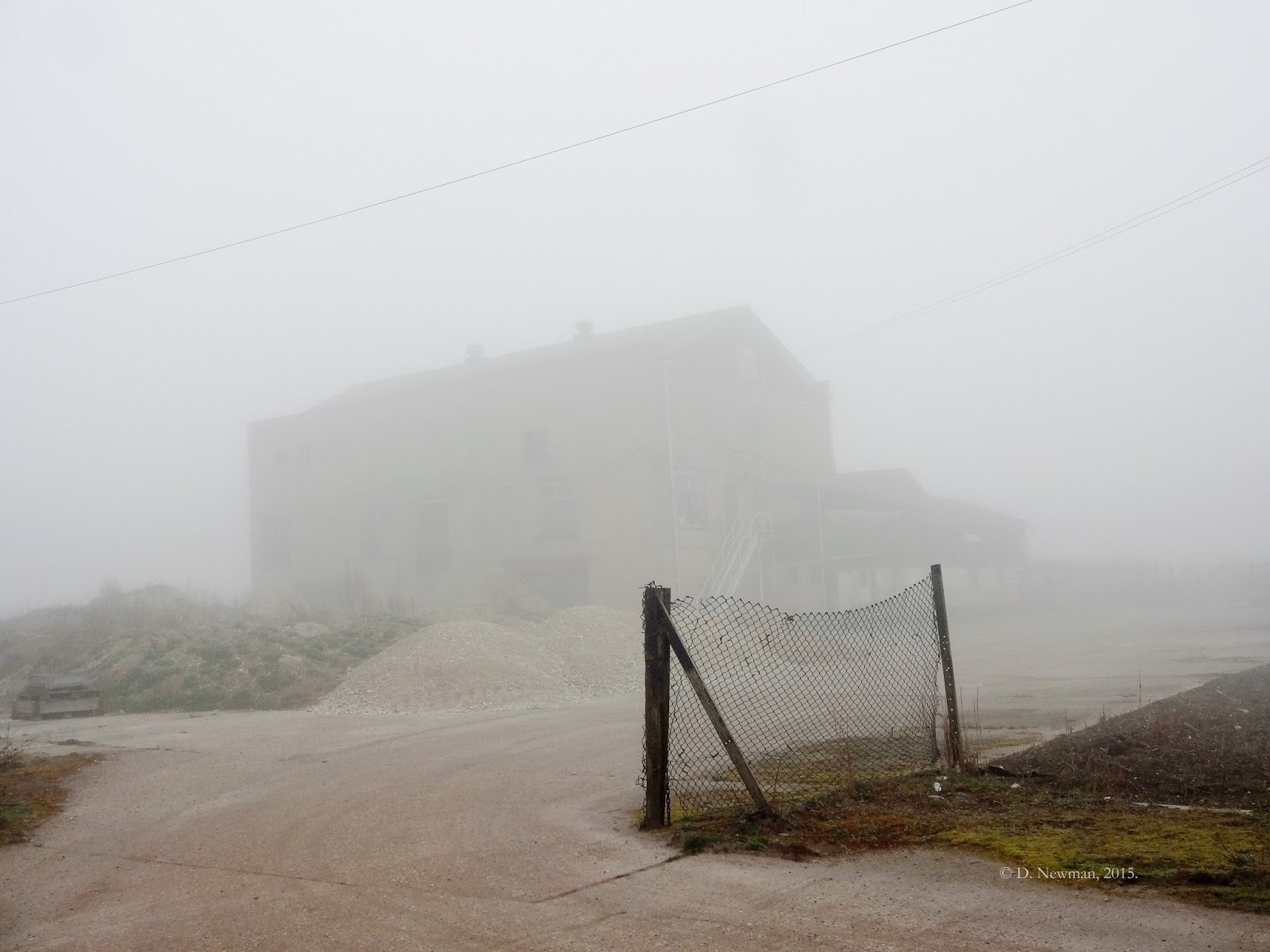
It was to Brandon, in fact, that my long-suffering friends and I made our way on foot on the first (foggy) occasion, along the Hereward Way.  And very spooky the journey was too:


Lakenheath station
East of Lakenheath, things cleared up slightly:
View over the Little Ouse east of Lakenheath
Near Brandon
My friends forbore this escapade with superhuman patience.  All the same, since these foggy photographs would hardly have satisfied the Shippea Hill Tourist Board, and I still had scarcely any idea what the view from the summit actually looked like, I decided to make a second excursion, with another unsuspecting friend, this time setting off back towards Ely from the train.  The weather was much clearer, and this time there was no obstruction to those strange fenland views, which go on and on and on for miles across the level, and are in their own way almost as disconcerting as the fog had been.
At Shippea Hill again, looking eastwards towards Brandon
Westwards towards Ely
This was not a public bus — it was taking farm labourers to work.
The typically enormous Fenland skies and foreground 
Level crossing at Mile End, Prickwillow
Towards Ely Cathedral
One might have thought it impossible that anything else should remain to be said about this station that is scarcely a station and its hill that is hardly a hill.  Imagine my surprise in early December 2015, then, to read this article about the latest estimated passenger numbers at stations in Great Britain.  Lo and behold, there is Shippea Hill station in pride of place as the quietest in Britain.  Your humble scribe hereby boasts of finding himself among a rather select club of people who actually used the station in 2014/15: a grand total of twenty-two.

It is true of course, as the O.R.R. admits, that there are some limitations to this data.  For instance, since on the first trip my friends and I had bought returns to Brandon, I doubt that our perfectly valid visit to Shippea Hill will have been registered in the statistics.  We are presumably not alone in having done this, so the actual number of passengers is probably higher than the figures show.  But that only raises another question: for what conceivable reason could Shippea Hill station have been visited by even as many as 22 people?

And might any of them have anything to say about a missing station sign and a red arm-chair?
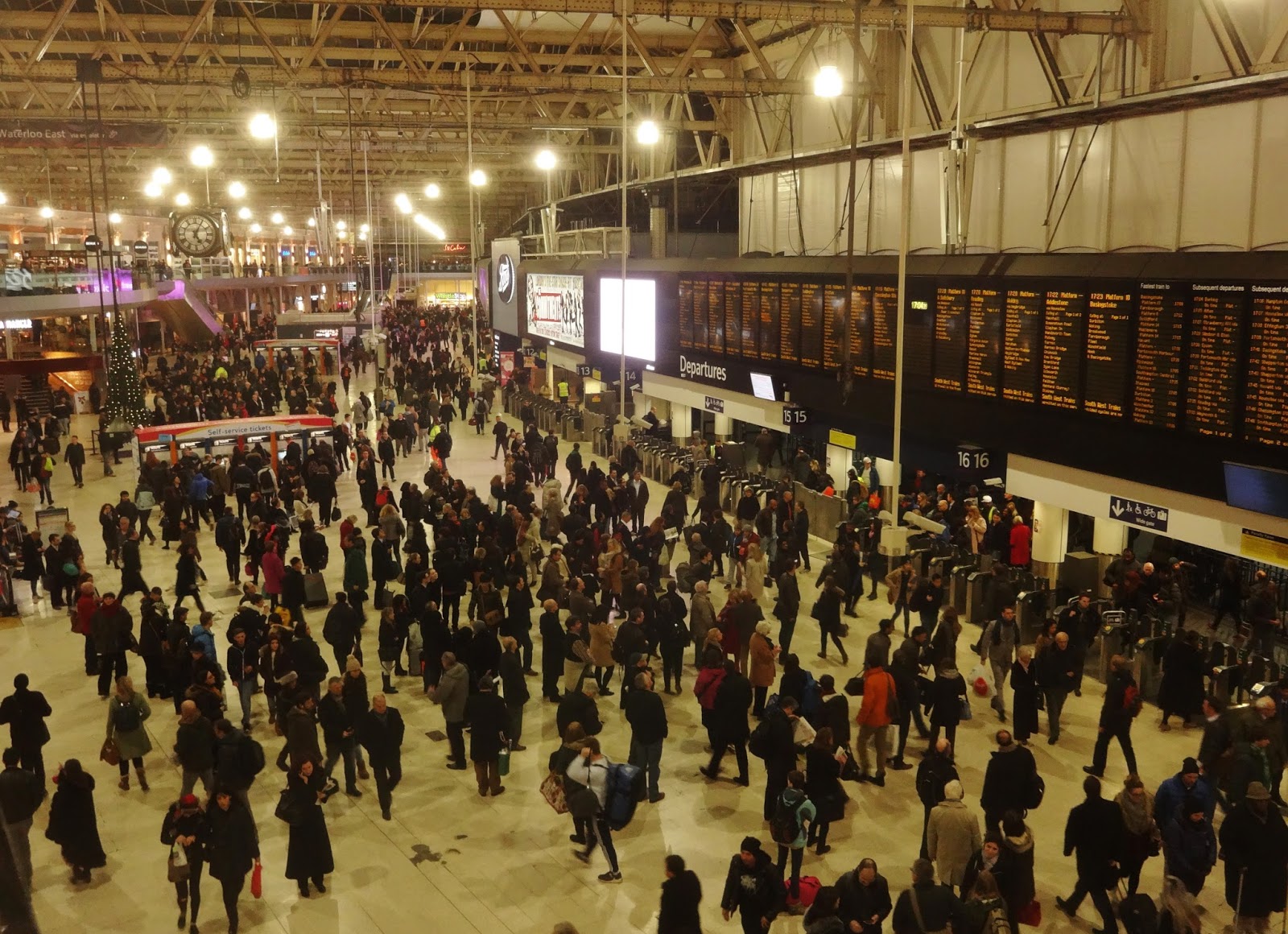
The author is also a member of a somewhat less exclusive club of 99, 201, 604 people who  last year used London Waterloo, the most alighted-/boarded-at station in Britain, and through which the equivalent of Shippea Hill’s entire annual footfall passes every seven seconds…!