Showing posts with label Ely. Show all posts

Thursday, December 25, 2025

Merry Christmas!

And so another year draws towards its close; another Advent leads us to the manger-side and, we are told, to the fruition of our hopes.  Again the question is asked of us: do we believe that this small bemused knot of being, this wriggling, inarticulate bundle, this tiny brother to us, is the Son of God Almighty, is the answer to our prayers?  This year has been as full as any other of gratuitous violence, of greed, of injustice, of licence, of untruth, of vandalism, of wrong-doing of both the red-hot and the cold and calculated varieties.  It has contained illness, or frustration, or loneliness, or uncertainty.  Or it seems to have allowed our own failures to have defeated us.  And to live in Britain has been to observe continued cultural decline, even a new darkening of the national mood, as fundamental questions about the future of our country are exposed, some for the first time in centuries, and lacking any easy resolution; meanwhile, revolutions both moral and technological pose new challenges to human dignity even as their advantages seem irresistible to many.  Even the talk of a ‘Quiet Revival’ in the churches can seem like small beer in the face of it all.  Sometimes — indeed, often — we long, as the Israelites did, for Christ to come marching over the hills with a massed army, and liberate us by the sword.

But instead we find this child.  This is the shock, the twist, the wit, of Christianity, and of its author: the idea that a baby will have the last word — that already He is the last word.  Is this a joke?  Well, perhaps in a way it is, in its sheer surprise, its drop-shot deftness.  But not in its essence.  For God takes His love seriously: He means exactly what He says and does.  Any humour in the situation is at the devil’s expense, not at ours.  The idea alone — even to a sceptic, even as a proposition entertained merely for argument’s sake — is so shocking as almost to defy formulation in words: that God Himself (and not merely ‘a god’) should be born of human woman, should clothe Himself in our nature, compromised as it is, and take on our humanity entirely, even while remaining entirely Himself.  The very idea that God should consider a human body fit for habitation — or at least that He should choose to make it fit for habitation simply by inhabiting it — shows us that here we are not dealing with spirit-worlds, or Pantheons, or icons of our desires, or even any reasonable human idea of God, but with a dramatic God outside our imaginings: not bribable or capricious or tyrannical, but careful yet surprising, gentle yet deliberate, many-dimensional, knowing His own mind: in other words, real.  This Incarnation, this enfleshment — long before we even consider the Passion and the Resurrection — throws open the door of understanding to us.  Now we see what God is really all about: it is this child, ostensibly needing us more than we need him, who is our longed-for liberator, whose conquest will be final and unanswerable.

It does not mean that we are wrong to ask for an end to the world’s evil.  One day it will all indeed be defeated, and by this same minuscule right fist.  Yesterday’s antiphon at the beginning of Mass, the penultimate of the Great Advent Antiphons, ‘O Rex Gentium’, assured us of this: of Christ’s ultimate supremacy over all things, including temporal, even if the opposition continues to work what havoc it can while it may.  But the gift of a child, not a massed army, shows us that evil will be defeated not only in general but in minute particulars: not only the enormous wrongs with their towering pillars of smoke, but all the snide creeping erroneous whisperings that conspire in ourselves and in our nature.  Hence the confidence and uncompromised serenity of the Star above Bethlehem, sign of the tiny child by whom all despair will be defeated and all loss made good.  Hence, today, the final O antiphon, we acknowledge the true fulfilment of the old promise: ‘O Emmanuel’ — God with us, and far more closely than we can imagine.

Wishing all readers a very merry Christmas.

The choir of Ely cathedral sing David Willcocks’ arrangement of Prudentius’ hymn:

Of the Father’s heart begotten
Ere the world from chaos rose,
He is Alpha: from that Fountain,
All that is and hath been flows;
He is Omega, of all things
Yet to come the mystic Close,
Evermore and evermore.

By his word was all created;
He commanded and ’twas done;
Earth and sky and boundless ocean,
Universe of three in one,
All that sees the moon’s soft radiance,
All that breathes beneath the sun,
Evermore and evermore.

He assumed this mortal body,
Frail and feeble, doomed to die,
That the race from dust created
Might not perish utterly,
Which the dreadful Law had sentenced
In the depths of hell to lie,
Evermore and evermore.

O how blest that wondrous birthday,
When the Maid the curse retrieved,
Brought to birth mankind’s salvation,
By the Holy Ghost conceived,
And the Babe, the world’s Redeemer,
In her loving arms received,
Evermore and evermore.

This is he, whom seer and sybil
Sang in ages long gone by;
This is he of old revealèd
In the page of prophecy;
Lo! he comes, the promised Saviour;
Let the world his praises cry!
Evermore and evermore.

Sing, ye heights of heaven, his praises;
Angels and Archangels, sing!
Wheresoe’er ye be, ye faithful,
Let your joyous anthems ring,
Every tongue his name confessing,
Countless voices answering,
Evermore and evermore.

Aurelius Clemens Prudentius (348–c. 410), tr. R. F. Davis (1866–1937)

Sunday, February 13, 2022

Seven Hundred Years Ago Today

Seven hundred years ago today, at half-past four on the morning of the 13th February 1322, the monks of Ely were creeping back to bed having just said Lauds, when a terrifying explosion of sound burst from the cathedral next door.  An earthquake, was their first thought, and, given what they found when they ran into the nave, there might as well have been one.  The Norman crossing tower had collapsed; rubble choked the floor;  the church lay open to the sky.

The disaster had not been altogether without warning.  Cracks in the tower’s masonry had developed not long after work had begun on the new Lady Chapel just to the north, so the monks were already taking the precaution of avoiding the cathedral sanctuary.  This was one reason why nobody was killed in the collapse.  Even so, the sacristan, Alan of Walsingham, was in understandable despair at the scene, ‘not knowing which way to turn nor what to do.’ [1]  He had only been in office for three months, and he must have suspected that the Lady Chapel works, which he himself had put in hand, had hastened the catastrophe.  Never mind that he had already presided over Ely’s other recent misfortunes; in 1314 it had been Alan who had opened the shrine of St. Alban, the first English martyr-saint, in order for Edward II himself to declare the relics veracity, only for the King to declare that the true relics were not these, as Ely had claimed since 1045, but those in the possession of the abbey at St. Albans.  Now not only was Ely’s reputation in tatters, but the very fabric of its building lay in ruins.
Yet Alan of Walsingham turned out to be exactly the right man for his job, for it was he who, once he had recovered himself, devised and oversaw the replacement of the crossing tower — which was not merely a replacement, but its far surpassing.  Already considered ‘remarkable for his skill in goldsmith’s work’, he was about to prove an acute knowledge of and instinct for the science and art of architecture.  Within six months he had had cleared not only the rubble of the old tower but the four columns that had supported its corners, widening the crossing into a huge octagonal space.  Over this he placed a structure so audacious that the cathedral might have been built to incorporate it, rather than the other way around: the famous and quite unique octagon lantern tower.   With the help of the master carpenter William Hurley, Master of the King’s works south of the river Trent, Alan’s brainchild was translated into reality.  By their extraordinary imagination and the magnificent workmanship they oversaw, four hundred and fifty tons of lead and timber were made to soar weightlessly into heaven, where they have remained ever since, letting nearly seven centuries of photons flood down into the nave.
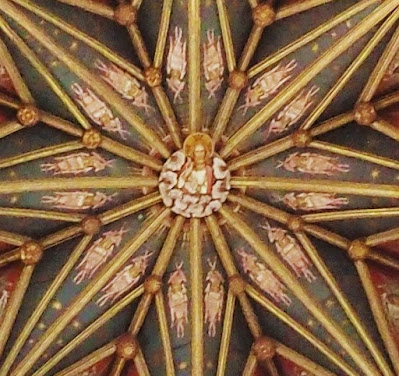
Detail of picture above: John of Burwell’s carving of Christ in Majesty, in the place it has occupied since 1340. 
It is remarkable that we know all these names; in tales of cathedral-building, most of the heroes are anonymous.  Yet at Ely we even know who carved the the central roof-boss at the octagon’s culmination, the figure of Christ in Majesty on which all its lines converge.  The craftsman was John of Burwell, a local man from a village south-east of Ely, and his carving was lowered into position in 1340.  Only eighteen years after disaster befell his city, he made good its crowning triumph joining the ranks of the men had brought this architectural masterpiece to completion, a perfect marriage of art, engineering and devotion that remains the jewel of Ely to this day.

The Cathedral and octagon tower from across the river Great Ouse
[1] Jon Cannon, ‘Cathedral: the Great English Cathedrals and the World that Made them’, (London: Constable, 2011), p. 323.

Monday, December 25, 2017

Merry Christmas!

Just a brief note to wish all or any readers a very happy Christmas indeed!  This evening our Youth Choir sang the music for the Vigil Mass and led our parish in south London into the feast.  Now our waiting is at an end; make you merry as our ancestors did!  Pour brandy over the Christmas pudding and set it alight, put the radio on for the Nine Lessons and Carols, and don’t forget the Queen at three!   May the feast glow with the same world-surprising wonder that first brought the rough-hewn shepherds of old to their knees.  We have as much cause to kneel, and to wonder, as they did.

Here’s an ancient hymn — this isn’t our choir! — from the choristers of Ely Cathedral.

Saturday, December 17, 2016

Fame again for Shippea Hill


Last January I wrote (here) at about my proud membership of that select club of 22 people who, in 2014–15, had found (or concocted) a reason to alight at or depart from Shippea Hill station in Cambridgeshire.   So select was this club that, in the annual statistics of passenger usage at British railway stations that year, Shippea Hill had the distinction of coming last.

Now the station is in the news again:  according to this year’s statistics it has retained its position of honour, having attracted a grand total of twelve passengers.  It might seem natural to ask why so few people should use it, but, when it comes to Shippea Hill, as I explained last year, the question is really why the figure should be as high as it is!  For Shippea Hill is notable for having purported to serve, since 1845, a blank, unpopulated fen, the ‘hill’ of its name turning out to be a patch of ground qualifying as a hill only because it is not below sea level, and therefore attains a dizzying altitude compared to all the land around.  As for the trains, there is a single service per week-day, in one direction only, which calls on request only and is totally unsupplemented and uncomplemented by any bus or even a practical service at the next station down the line at Lakenheath.  There is no pub, shop or phone box; there is only the unchecked wind, the uncompromising Fenland horizon and the small bluish vessel of Ely Cathedral, eight miles away.

Thursday, January 07, 2016

Destination Shippea Hill

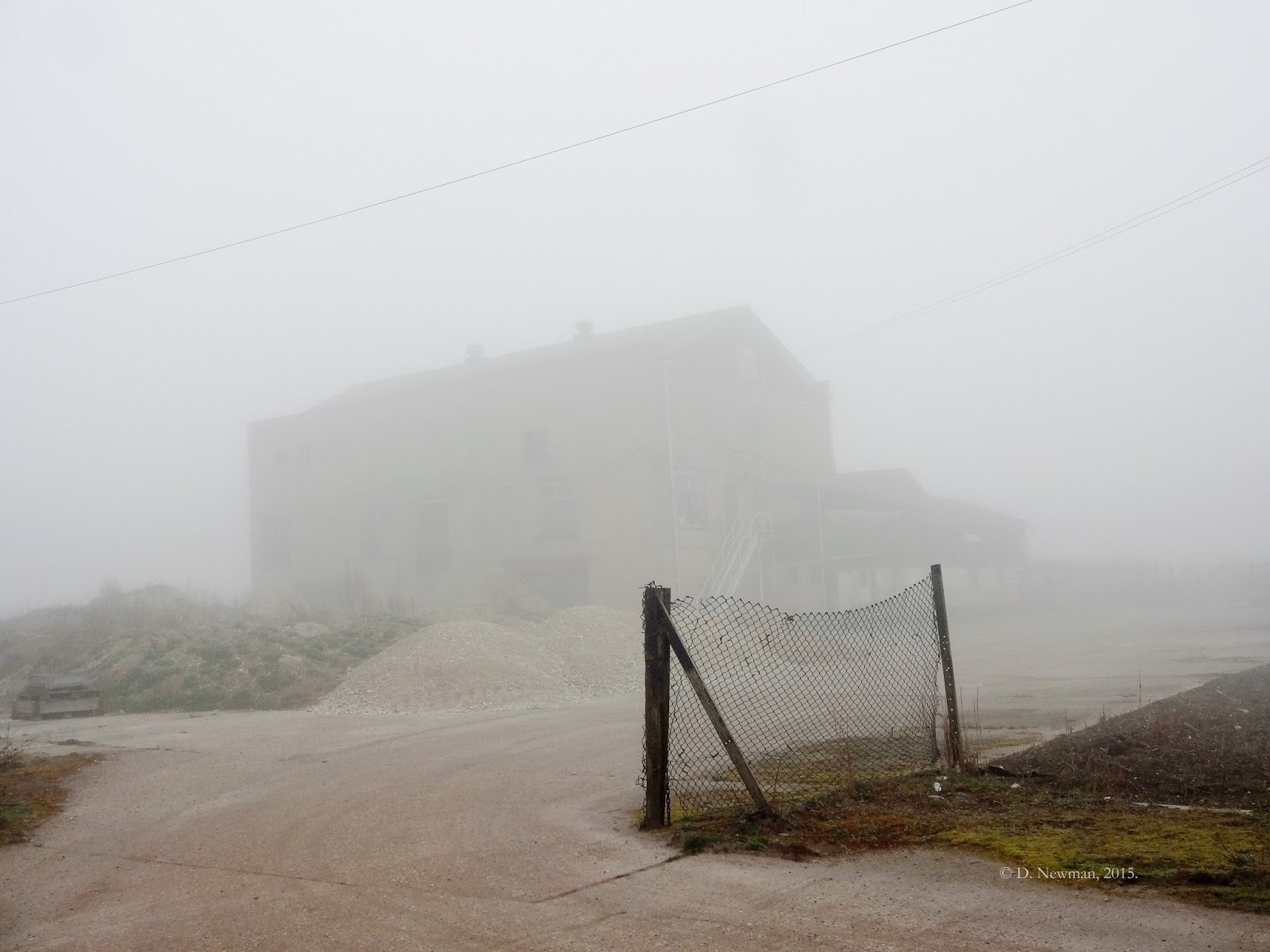
This was the view I had, not far from the summit of Shippea Hill in Cambridgeshire, early on the 13th March, 2014:
Shippea Hill station, 13th March, 2014, with convenient red arm-chair outside the signal-box
The perceptive reader, contemplating this tableau, might make several observations and deductions.  For instance, the engineer’s mind might wonder how the builders of the railway negotiated the hill of the station’s name.  A sceptical, troublesome reader (we all know the sort), developing a strong suspicion that the author arrived by train, might keep eyes peeled for any hint of a claim to have made the ascent under his own steam.  A more sympathetic reader, noting the heavy fog, might regret that the view has been so comprehensively obscured, and imagine that the 13th March 2014 must have been the occasion of a wasted trip.

I wonder now what these same readers will make of the picture below, taken from the same point a few months later on the 20th June, 2014:
Shippea Hill station, 20th June, 2014
Several observations might again be made — for instance, that the weather has cleared up admirably, or that, at some point since March, the signal-box appears to have been relieved both of its sign and of the red arm-chair perched outside.  Or perhaps something else is more immediately amiss?  For in this place, Shippea Hill, there seems to be no visible sign of any actual hillas the sceptical reader would doubtless point out without hesitation.  Indeed, we would appear to be in the Fens, a part of the world not renowned for its craggy splendour.  Warming quickly to his tune, the indignant reader might add indignantly that there is not a ship or a pea in sight either (though one cannot quite rule the latter out in this agricultural region of England).

I suppose it is no use denying that the elevation of the summit of Shippea Hill above sea level is, well, negligible.  Yet it qualifies as a hill because all of the peat fenland around it (Burnt Fen) lies at an altitude at or below 0.  The clue is in the Anglo-Saxon suffix ‘ea’, which in the old days referred to an island of firm, raised ground above the prevailing wateriness of the undrained fens.

This means that I can now attest without shame to having arrived by train, since I can hardly be accused of gaining any altitudinous advantage by doing so.  In fact, my riposte to the sceptical reader is that my achievement in making the journey by train is possibly greater than if I had arrived on foot.  Shippea Hill station is served by a single train a day — not a single train in each direction, but one train, a Norwich-bound service at 7.28 a.m., and that is it.  There is no return train (except on Saturdays), and no Sunday service at all.  All other traffic along this stretch of railway, the well-used Breckland line between Ely and Norwich, hammers straight through.

One might expect the good people of Shippea Hill to be up in arms about this state of affairs.  But it is far from certain how many ‘people of Shippea Hill’, good or bad, it is possible to speak of.  There is no village, no pub, no church for miles.  The only signs of habitation in the empty breadths of peatland are the austere, solitary farms with their strange, unhomely names (Lark Engine Farm, Bulldog Bridge Farm, Letter F Farm).  As any map makes plain, the only apparent reason for the existence of this station, which has stood here on its lonely fen since 1845, is the road that meets the railway at this point.  In fact, the station was originally called ‘Mildenhall Road’ — small matter that Mildenhall itself lies eight miles away.  It is hard to say which is the more tenuous: the claim to serve Mildenhall or the toponym ‘Hill’.
Thus the reader will understand why, on the two occasions that I have managed to drag my friends out into the middle of the Fens to this apparently unremarkable but resolutely contrary place, almost an almost military standard of precision and planning has been required.  Coming from the direction of Cambridge, we would make ourselves known to the guard, ask for the train to stop, find ourselves duly deposited on the platform, congratulate ourselves on our initiative and daring, and then, at half seven in the morning, apprehend the reality of our predicament:  there was now nothing for it but to spend most of the rest of the day making for civilisation on foot.  For a bus service is something else that there is not at Shippea Hill.

Considerable alertness was required, too, not to be taken in by the tantalising presence, five miles further down the line, of another station, Lakenheath.  It would not be unreasonable to assume that this might be a good place to a catch a return train.  Alas, it is no help at all.  Perhaps the reader will not now be surprised to learn that the service provided here is almost the direct inverse of Shippea Hill’s.  It has no trains at all on weekdays, there is one train in each direction on Saturdays, and on Sundays it enjoys a service that might almost be called lavish.  For all that these are two adjacent stations on the same line, it is generally impossible, and always totally impractical, to travel between Shippea Hill and Lakenheath by train.  No single train serves both consecutively in either direction.  The only itinerary that does not actually involve breaking the journey overnight is on Saturdays, when it is possible to go from Shippea Hill to Lakenheath by catching the 0728 Norwich train, hurtling straight through Lakenheath, getting off at Brandon and catching a train back west.  This journey takes three hours, and the same in reverse takes four.  It is just as well that nobody much lives near Lakenheath station either.

It was to Brandon, in fact, that my long-suffering friends and I made our way on foot on the first (foggy) occasion, along the Hereward Way.  And very spooky the journey was too:


Lakenheath station
East of Lakenheath, things cleared up slightly:
View over the Little Ouse east of Lakenheath
Near Brandon
My friends forbore this escapade with superhuman patience.  All the same, since these foggy photographs would hardly have satisfied the Shippea Hill Tourist Board, and I still had scarcely any idea what the view from the summit actually looked like, I decided to make a second excursion, with another unsuspecting friend, this time setting off back towards Ely from the train.  The weather was much clearer, and this time there was no obstruction to those strange fenland views, which go on and on and on for miles across the level, and are in their own way almost as disconcerting as the fog had been.
At Shippea Hill again, looking eastwards towards Brandon
Westwards towards Ely
This was not a public bus — it was taking farm labourers to work.
The typically enormous Fenland skies and foreground 
Level crossing at Mile End, Prickwillow
Towards Ely Cathedral
One might have thought it impossible that anything else should remain to be said about this station that is scarcely a station and its hill that is hardly a hill.  Imagine my surprise in early December 2015, then, to read this article about the latest estimated passenger numbers at stations in Great Britain.  Lo and behold, there is Shippea Hill station in pride of place as the quietest in Britain.  Your humble scribe hereby boasts of finding himself among a rather select club of people who actually used the station in 2014/15: a grand total of twenty-two.

It is true of course, as the O.R.R. admits, that there are some limitations to this data.  For instance, since on the first trip my friends and I had bought returns to Brandon, I doubt that our perfectly valid visit to Shippea Hill will have been registered in the statistics.  We are presumably not alone in having done this, so the actual number of passengers is probably higher than the figures show.  But that only raises another question: for what conceivable reason could Shippea Hill station have been visited by even as many as 22 people?

And might any of them have anything to say about a missing station sign and a red arm-chair?
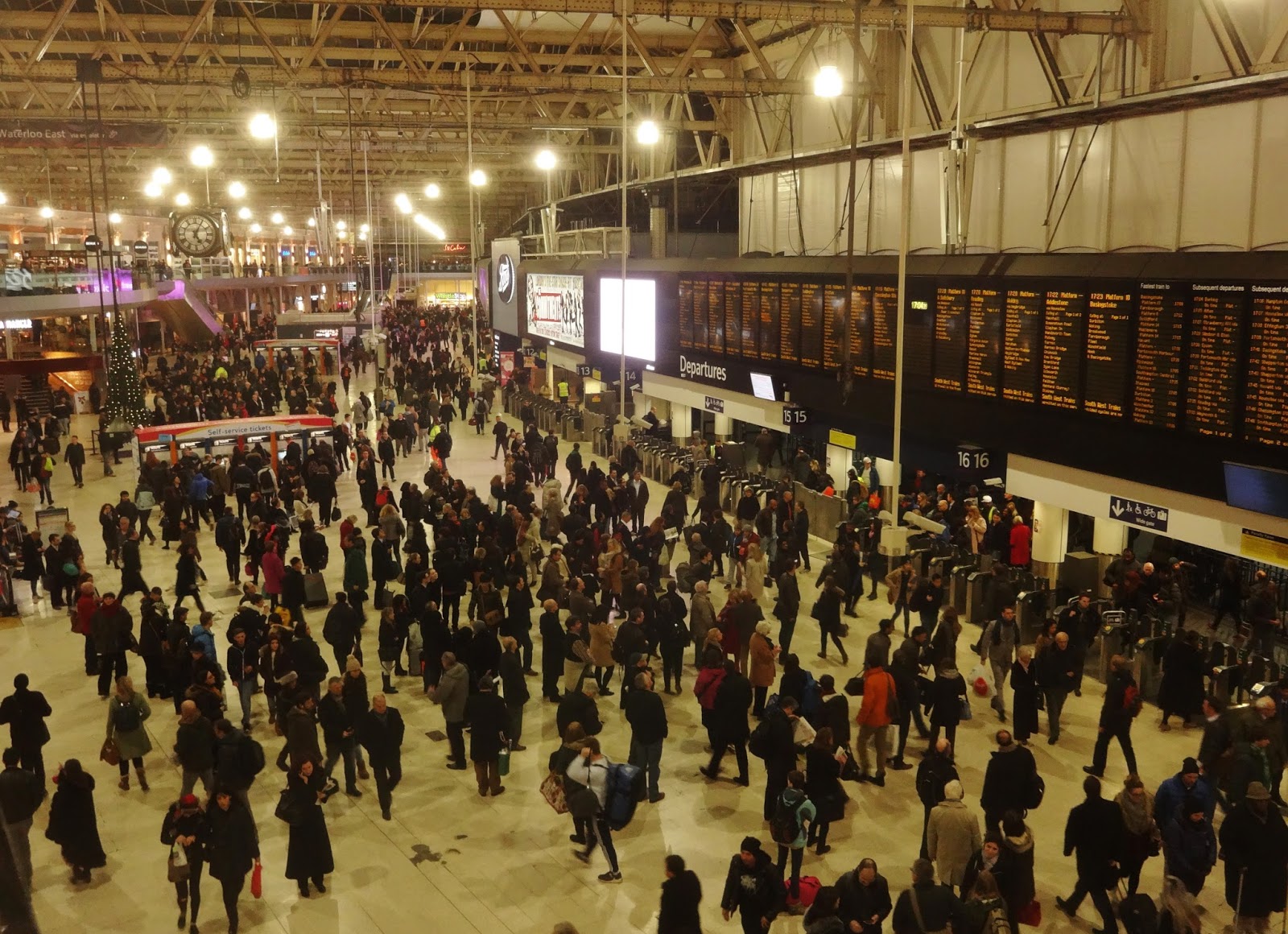
The author is also a member of a somewhat less exclusive club of 99, 201, 604 people who  last year used London Waterloo, the most alighted-/boarded-at station in Britain, and through which the equivalent of Shippea Hill’s entire annual footfall passes every seven seconds…!

Monday, November 23, 2015

The Permanent Way (and the Truth and the Life?)

‘The line to heaven by Christ was made,
With heavenly truth the Rails are laid,
From Earth to Heaven the line extends
To Life Eternal where it ends.
On a tablet in the southern porch of Ely Cathedral is inscribed a poem called ‘The Spiritual Railway’, written in memory of William Pickering and Richard Edger, who lost their lives in a railway accident on Christmas Eve, 1845.  That year was only a decade and a half after the opening of the first modern railway between Liverpool and Manchester, but England had already gained two and a half thousand miles of track.  The ‘Railway Mania’ construction boom of the 1840s, gathering pace all the time, had reached Ely the previous July, when the Eastern Counties Railway opened the first route from London to Norwich.  The elegist saw a homiletic opportunity in the transport revolution, and the fruit of his labour has survived, even if, to us, it sometimes seems strained by his determination to make the analogy work and the verse scan:
‘God’s Word is the first Engineer
It points the way to Heaven so clear
Through tunnels dark and dreary here,
It does the way to Glory steer.
This poem may sound ripe for a round of twenty-first century scoffing, and easy to dismiss as a rather contrived effort.  But the idea of a bond between religion and the railway is more compelling than it might seem.  For two bodies with such apparently different purposes there seem to be a surprising number of similarities, of all kinds, between them.  I find myself as determined as the poet to make something of it!

For instance, to set off on one track, there is the disproportion of railway enthusiasts among the clergy.  An obvious example is the Revd. W. V. Awdry, author of the ‘Thomas the Tank Engine’ books.  But there is also Eric TreacyBishop of Wakefield from 1968 to 1976 and a prolific railway photographer, who incidentally died at Appleby station on the famous Settle-Carlisle line, having gone to photograph a steam-hauled excursion.   Then there is the Revd. H. D. E. Rokeby’s collection of photographs of British railway stations.  Others have noticed this phenomenon, especially with regard to model railways: Paul Roberts, himself a self-described ‘Restless Rector’ with a model railway in his garage, has written an interesting blog-post here, and there is an article by Christopher Howse here, with a nice reference to Canon Tony Chesterman’s ferroequinological reading of a verse from the prophet Isaiah: ‘I saw the Lord… and His train filled the temple… and the temple was filled with smoke…’ 

Both these authors consider the idea that the appeal to clergymen lies in order, without which no railway could be run properly.  One of Howse’s sources makes a suggestion (upon which Howse himself actually pours cold water) that the clergy seek in the model railway an ‘antidote to the often more nebulous realm of theology.’  The Restless Rector imagines that, for many, the antidote is rather to the ‘stress of parish life and… awkward people that one sometimes has to deal with.’  Railways appeal to him because of their ‘order and communication’, and he also wonders whether ‘building and running a model railway [might reflect] something of the creativeness of God, and his fatherly care.’  A model railway is an ideal world, built on a blank slate, cut off from the world’s chaos.  Even the real railway forms its own self-contained system, even its own world.  It is run from signalling centres as if its signals, track-circuits and points were isolated from the elements.  That world may be broken into by trees falling onto the line and lorries colliding with bridges, but, still, there is a sense that the railways, needing a higher level of order than other transport systems, give themselves a better chance of running as they ought by sealing themselves off from the outside world and having as little as possible to do with it.

I would agree with both writers that order is indeed the main link between railways and churches, but would go further.  My contention is that, far from being an antidote to parish life and still less to theology, the appeal of the railway is that it actually resembles the Church, in that the order of a railway is a mirror of the divine order of the Church.  Naturally I am not suggesting that we should all go on pilgrimage to Clapham Junction, or will all reach Heaven by way of Kensal Green.  But it seems that a railway — precisely by being reasonably cut off or set aside from the world — can be seen as a kind of model or proto-Church, or in which ideas unappealing to modern man, such as discipline, or self-sacrifice, or assent to a given doctrine, can be shown to be necessary, rewarding and ennobling.  
‘From Earth to Heaven the line extends…’ 
This idea becomes especially interesting when compared with other forms of transport: for example, with the motorway.  Surely it is not a coincidence that, in a secular, self-centred and ungentle culture, this should be the foremost means of national transport.  In both construction and operation, motorways leave us languishing in chaos, whereas railways elevate everyone and everything they touch to the level of their order.  Here is an example.  Victorian engineers had to thread their railways through difficult terrain, obliged to avoid too sharp a curvature in the track and any gradient steeper than 1 in 100.  These rules made the work more difficult but the result more beautifuljust as the constraints of rhyme and metre, used properly, make poetry ring with beauty.  Railways fit into the landscape; often they even embellish it, exactly as churches do.  But since motor-cars can deal more readily with gradients and curves than can trains, the builders of the motorways could be much freer.  They simply planted their highways virtually unrestrained across the countryside, or carved straight through the landscape, as at Stokenchurch in Buckinghamshire, and they threw up concrete flyovers however they pleased.  My perhaps rather controversial theory is that, just as railways fitted in perfectly with the Victorian revival of church architecture and indeed church-going, so do motorways with the profane self-indulgence of modern Britain.  It is not a coincidence that the Victorian age, for all its flaws, produced such masterpieces as London’s St. Pancras station, while the motorways have nothing to match (the sole exceptions, to my mind, being the Humber Bridge and first Severn Crossing).

I think the same pattern applies to the way each mode of transport works, too.  For instance, a railway journey explicitly requires discipline, and rewards it.  Between railway passengers there is an unspoken contract: without realising it, they all agree to turn up at a given place, at a given time, in order to travel together more efficiently and reduce each other’s costs.  With this contract comes the risk of missing the train, as painful experience teaches us, but those who do catch it should enjoy relatively rapid, comfortable, spacious, relaxing and (importantly) safe transport.  Motorists face no such obligation and no such discipline.  No arrangement exists, even between those making similar journeys.  They have the freedom to set off whenever they like, with the result that a thousand individual cars, most containing only one or two people each, burn countless gallons of fuel in order to achieve the same result.  Moreover, the freedom of the motorway is selective.  The flexibility it offers the motorist comes at the cost of swathes of countryside, of further untold swathes of silence around it, the freedom of nearby residents to live in peace and quiet, the freedom to go freely across the land on foot, and so on.  Railways, by comparison, take up far less space and make far less noise.

Railways are formative; we are the better for them.  Passengers looking out at the landscape gain a geographical understanding of the journey.  They will pass the Chilterns, then Cannock Chase, then undulating Cheshire; they will see the Forest of Bowland to the east and Morecambe Bay to the west.  Their picture of the country will be built up by passing directly through its towns and cities: Peterborough, Grantham, Newark, Retford, Doncaster, York.  Road travel, however, is not really experienced as movement through a landscape that could be learned, recognised or loved.  It is not a journey but a process, and often a dull one at that.  Driver and passengers are strapped into their seats, and progress is less intuitively apparent, not sliding past sideways but flickering and enlarging in the windscreen.  Anonymous numbered junctions diverge and merge from left and right.  The landscape can barely be seen beyond the crash-barriers, the sheer breadth of the carriageway and the far rim of concrete.  It is possible to make a road journey without any reference to the points of the compass or any sensation of having travelled anywhere.  Motorways do not even fit the landscape.  The road-signs and furniture have no human scale.  No art there; only artifice.
A minor motorway sign is still perhaps eleven feet tall and wide: compare its scale to the footpath on the left!
Railways have dignity and majesty.  Whenever a train calls at a station, particularly on inter-city services, there is still ceremony and custom, even this long after the age of steam.  A familiar voice announces a platform, a litany of cities is read, the signal changes, the train draws solemnly in, passengers alight or board, the doors slam, the whistle is blown and the train heaves itself into motion again.  Procedures introduced solely for safety’s sake take on the vestures of ritual.  But roads have no time for ceremony; motorists are in no mood for custom.  Clutch in, accelerator down.

Railways leaven our communal lives, too.  Passengers on a railway journey often fall into conversation, discover common interests and keep common courtesy alive.  They are encouraged to have consideration for others in order to share a common space.  They must stand clear, move aside, open doors, lift down luggage, move down inside the carriage and mind the gap.  These are all things in which far too many fail, but they are more likely to learn from these social encounters, in which people actually meet face-to-face, than they are on the road, where we are all shielded from each other by walls of metal which must be made ever thicker and Darwinian as the manners for which they are substitutes decline.  Cars offer us two temptations: to intoxicate ourselves with power, and to blind ourselves to others.  So many people give into these temptations so habitually, and to the point of such callous selfishness, that a road journey in modern Britain is now nearly impossible without at least one near-accident.

I think my theory stands even in the realm of law and obedience.  Many motorists tend to react to the rules of the road by pushing them as far as they will go: speed limits are regarded as a target to be hit; vehicles push in against right of way; traffic lights are just squeezed past at amber.  The Highway Code becomes surprisingly elastic when there are a few extra seconds to gain: I think I will go so far as to say that this is moral relativism in full operation.  Meanwhile, safety on the railway is quite a different affair.  The rules are absolutes; nobody is above them.  Every action made by a modern train driver is recorded electronically and the records downloaded for inspection at any point.  If the line speed (speed limit) is exceeded by even three miles an hour, a formal warning can be issued.  The rules must never be disobeyed.  A train must never enter a section of single track without a token.  A signal must never be passed at danger without permission.  Everything must be done to prevent any accident.  Many of these rules seem over-zealous and fussy at first, but there is often a death or serious injury behind them.  All railway staff have to do something that is very unfashionable these days: to profess their obedience to an authority higher than themselves.  The overall result, on British railways and elsewhere, has been an excellent safety record.
Lincoln Central station and 11th-century church of St Mary le Wigford.
My refrain, then, often repeated to long-suffering friends, is that rail travel is the most civilised means of transport known to man.   Whereas railways have an improving and uplifting effect upon those who run them and use them, even on those most in need of redemption, such as London commuters, car culture seems to corrupt drivers by the tens of thousands.  And what better evidence of the fundamental benevolence of this invention of the railways than the instinctive delight taken by children — who have a perceptive, if imperfect, grasp of good and evil  in railways and the trains they carry, even the nondescript electric trains of suburban south London?  Children love railways; they do not love motorways.
Fundamentally benevolent
Just as the railways dignify and uplift us, so does the Church.  Just as motorways wear us down with false freedom, so do many aspects of secular society.  The Church, like the railway, has its illogical aspects, and the failures of both are used by their opponents to call for their abolition in their entireties.  Motorways, like secular society, make too much sense: that is because they are seen only from one perspective, that of the Self.  Motorways and secularism promise cheap freedom, but turn out to deaden the spirit.  Railways and the Church ask for self-sacrifice, self-restraint and self-discipline, and give in return beauty, order, ceremony and majesty.  (The railway cannot quite manage the forgiveness of sins, the resurrection of the body or the life everlasting, of course).

I don’t know whether any of this enormous tract sounds at all convincing to any reader patient enough to have trawled through it…?  To me the comparison seems to work consistently enough for there to be something in it.  If nothing else, I can appeal to the story told by Michael Flanders about the lady who said, ‘If God had intended us to fly, he would never have given us the railways’!  (If only she had made that remark in reaction to the development of motorways).  Incidentally, I do not really think that modern British car culture can easily be defeated, nor that the railways will again come to be seen as the country’s principal means of transport, even though passenger numbers at the time of writing are at their highest for about fifty years.  Perhaps all that can be done is to persuade some poet to write a verse, perhaps entitled ‘The Spiritual Motorway’, describing souls hurtling around the M25 of secularism until they all end up snarled up in a traffic-jam.
Ely Cathedral, with station in the foreground, seen across the river Great Ouse.