Showing posts with label the European Union. Show all posts

Monday, March 09, 2020

The View from Leith Hill

Approaching the top of Leith Hill from the east, as I did once again with an old friend the other Saturday, there is always a curious, pleasant sensation of having come round the back by a secret way.  We had met almost nobody among the hollows and meadows of the Hill’s lower slopes, so to find the summit quite busy — converged on by other visitors along more orthodox routes, and with the invariable cluster for refreshments around the National Trust servery at the foot of the Gothic tower — made us feel as if we had sneaked up by unknown paths across undiscovered country.

I doubt that any hill exists that is not worth climbing, but Leith Hill, the crown of Surrey, is one I particularly know and treasure.  Its summit on the Greensand Ridge is the highest point in south-east England (some say second-highest, defining south-east England differently — but I know where my loyalties lie!) and, looking northwards on a clear day, it is possible to see right over the top of the North Downs and Box Hill, themselves six miles distant, and to make out the wide grey clutter of London on the horizon.  To the south, the generous quilted Wealden country spreads all the way to the South Downs — and sometimes, through the Shoreham Gap, there can even be glimpsed a hazy glimmer of sea.  This is a good place to come for a bit of perspective on things.
Looking southwards from the top of Leith Hill Tower, 8th February 2020.
We have the eighteenth-century landowner, Richard Hull, to thank for the existence of the tower, which of course we paid our £3 to climb.  He had it built partly for an even better view over the counties below, and partly out of a fundamental dissatisfaction with the hill’s geomorphology.  That the natural summit stood 965 feet above sea level was for Hull ranklingly, frustratingly short of a thousand.  By the addition of the tower, he determined, the magic figure could be reached and surpassed.  (Did ever Enlightenment rationalism lead so directly to Romantic folly — never mind the building of an actual romantic folly?)  The modern displays in the tower’s first-floor chamber tell of later episodes in the tower’s history: the rowdy eighteenth-century fairs, or the longevity of Mrs Skilton (for over thirty years proprietrix of the tea-servery and ‘highest lady in the county’).  They tell of the near-collision of a passenger plane in 1948, averted by only thirty feet.  It was impossible not to notice, either, a photograph of a firework display held in 1993 to celebrate the entry of the United Kingdom to the European Union in its then-new formation.  (The week before our walk, Britain had formally reversed this very event, unaccompanied by any fireworks, as far as I know: I suppose Parliament has already given us our fill of pyrotechnics over the past few years…)

What do I see, looking down from the top of Leith Hill?  Almost unmitigated England in all directions, ancient with ghosts, curious with old tales, tender with things remembered.  It is known country I am looking down on, though I will never learn all there is to know about it: mile upon mile of palimpsest, all overlain by associations, details, particularities of the ages: Stane Street, the Roman road that we had crossed on the way from the station; the Iron Age hill fort of Anstiebury that we were to skirt on the way back — everyone from Richard Hull and Mrs Skilton and the fairgoers all the way down to ourselves and our fellow visitors this February Saturday.  I think of others who have loved this landscape: the poet George Meredith, he of the Mole Valley under Box Hill, and the composer Ralph Vaughan Williams, whose famous tone poem ‘The Lark Ascending’ took its name from one of  Meredith’s poems.  Vaughan Williams’ childhood home, Leith Hill Place, lies hard under Leith Hill’s southern slopes.
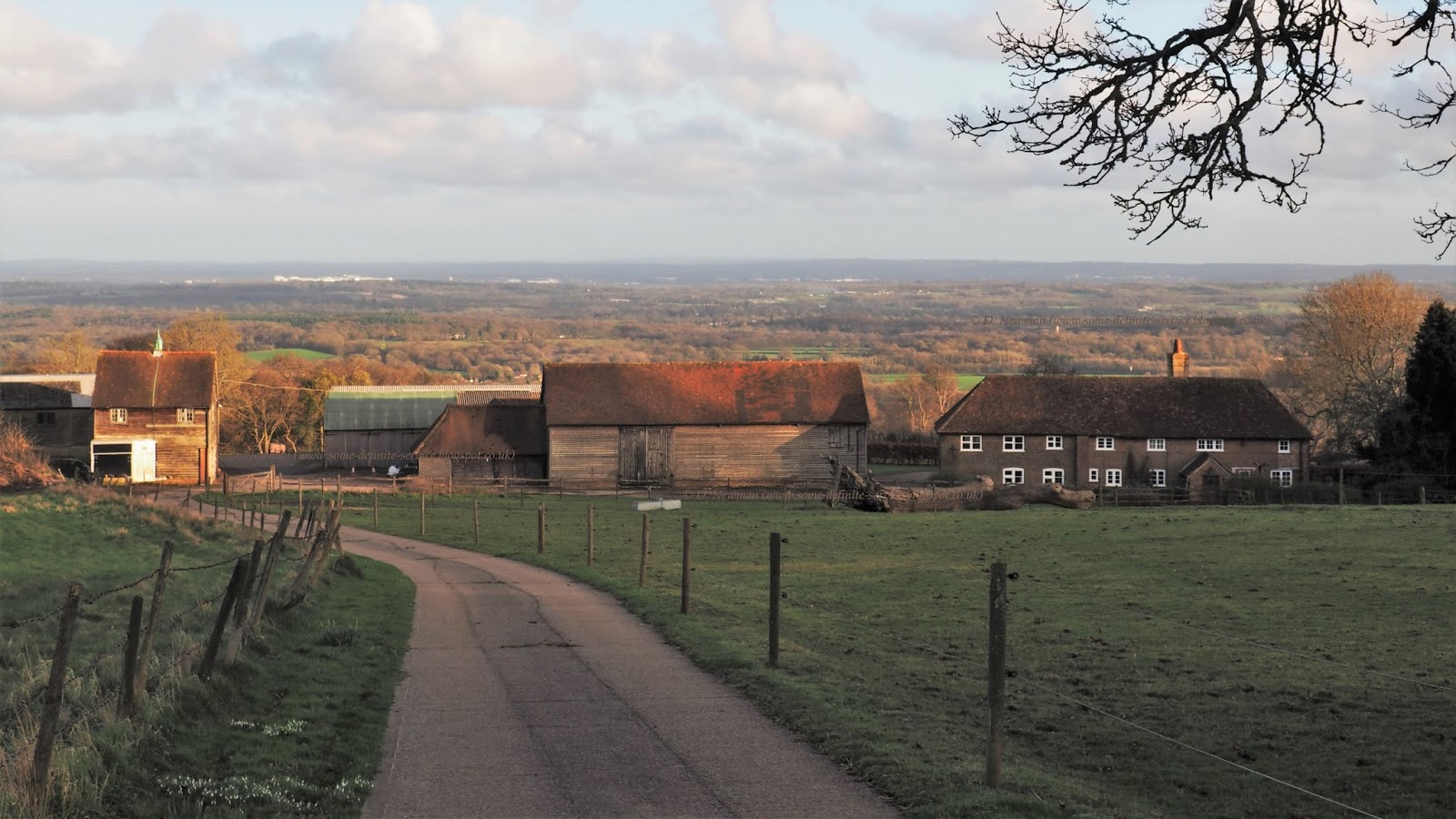
To put it more simply, from the top of Leith Hill I am looking at home.  Home not by title or deed, but by a character and spirit that dwells under my skin and in my soul.  Landscapes, like houses or streets, are sanctified by being lived in and loved: of the landscape below me I can say that I am at home when I walk in it, when I look on it and even when I think of it.  It is home, too, because, in its semi-sacramental beauty, it seems to stand for a certain ideal of the whole of England; to love this landscape is somehow to love the whole.  So today I, up here on the Hill, largely lifted away from England’s sorrow and sin, seeing it resolved into its proper image, into a sunlit heirloom on a crisp midwinter day, do not find it hard to love.  I remember that in fact it is very dear to me indeed.
Looking slightly south-eastwards from the slopes of Leith Hill near Coldharbour.  Gatwick Airport in the distance.

Love of home is for me as old as thought.  It is mostly a gentle thing, but it is also deep and dogged and immovable.  These days it is the fashion to scorn such sentiments, perhaps because of the extremes to which versions of it have been taken in the past.  But fashion, for all its force, holds little sway at the top of Leith Hill.  Up here, I can say boldly that I am blessed by the home we have been given to live in.  I can say that it is a good and natural thing to be grateful for that home, and that it is right and just to regard it as an inheritance, which, however indirectly, we must preserve for those who come after us.  Love of home need not, should not be jealous or selfish.  There is no reason why it should ever be either, not least since when it is authentic it is often actually accompanied by an urge to share it with others.  Nor is it necessarily a false idol: love of England may go very deep without overbalancing into outright worship — though I can sense the fierce flame to which some threat or peril could fan this instinct.


For look: it is indeed in peril.  Not this time by outright war or foreign conquest, but by something less tangible and more insidious, though similarly potent with worldly might.  The homely England I have praised may seem from up here to stretch out timelessly and unendingly, but it is always being threatened and encroached on by another England: that bland, bloated, blemishing England of which Betjeman warned, and Orwell, and Priestley, and Vaughan Williams himself in his later music.  I mean the England of the M23 corridor, just visible in the south-east, all motels and warehouses and commuters’ flats and dual carriageways and business parks.  I mean the pale angular mass of Gatwick Airport (even as I acknowledge the poetry in that airliner drifting dreamily up away from it — bound for Orlando, as my friend informs me).  I mean the scarring noise of traffic from which I have had to travel so far to escape, and the permeating threat of mass development (‘No to 480 homes here,’ a banner near the station had pleaded).  And look, now you can scarcely see, as you could before, the dome of St Paul’s Cathedral, drowned by its boasting and secular skyline.  It is not change in itself that dismays me, but change made blindly, seemingly for its own sake, or for merely economic or pragmatic reasons, on a brutishly massive scale, approved by Larkin’s ‘bespectacled grins’, by immense, distant forces that neither see nor care what they destroy. 


Yet… Leith Hill is a good place for some perspective.   Here it remains, serene above the strife of the world, lifted up from the hurly-burly and the madding crowd.  Now I see how remarkably persistent, how surprisingly tough, is the softness of this south country.  Here all those colours — the green meadows, the blue shadows, that Wealden amethyst, the flood of gold from the low sun — do not merely survive, but triumph, quietly as they may, and, it seems, might well till Doomsday.  For this reason I resolve to remember this part of England when in exile in surroundings quite unlike it — to think of the sun shining down unperturbed, and to give thanks with a grateful heart.
On Moorhurst Lane near Beare Green

Wednesday, December 11, 2019

Polling-Eve Ponderings

The eastern outskirts of the city of Worcester, seen from the top of the Cathedral tower, 30th November 2019.
And so an unhappy country braces itself to go to the polls, and I record my thoughts so that I will know how I felt before the result turns out to be whatever the result turns out to be.

In many ways, our present difficulties are simply the result of things working properly.  A government lacking a big majority, such as we have had ever since the European Union referendum, cannot do very much, even if it is not splintered by disagreement within its own ranks, as this one has been.  If it is frustrating for many that Britain’s departure from the European Union is proving less than graceful, not all the reasons for this are bad reasons.  Some are simply the results of the encumbrances we accept as the price of democracy.

This may also be the case with the strange episode of the Supreme Court which, as I understand it and record here for future reference, went like this.  At the end of August, Boris Johnson, faced with the challenge of persuading a pro-Remain Parliament to approve a Brexit Bill by a deadline of 31st October, sought to prorogue or suspend Parliament for a number of weeks.  By all appearances this was done for no reason other than to short-circuit the opposition: to scupper any stratagems of Remainers by simply pulling the plug on them.  A private individual (the pro-Remain businesswoman Gina Miller) then appealed to the courts in the hope that they would declare this tactic unlawful.  In response, the courts first had to work out whether or not they had any say in the matter at all: the Scottish High Court decided not, but the Supreme Court, to which Ms. Miller appealed next, took the opposite view.  The prorogation of Parliament was thus found indeed to be a matter for the courts, and the Government’s actions were indeed found to be unlawful.  Parliament was duly recalled and business resumed.

That was a moment at which everything felt too close and too momentous to gain a proper perspective and make up my mind what was going on; I couldn’t really tell how significant these developments were.  But was this, too, simply everything working properly? In some ways the ruling of the Supreme Court looked like a restraint on power, something I would be inclined to favour.  Certainly, there was the sensation of a system being put to the test by the impetuosity and imprudence of a bull in a china shop, and holding firm.  It seemed not unduly alarming that some sort of mechanism should swing into action and restrain the Prime Minister.  Yet I remain unsure of our reasons for having a Supreme Court in the first place, and worry that it is just as likely that such a body might equally have taken power for itself.  Some commentators have been of this opinion.  (But what do I, a mere peasant, know of such constitutional technicalities?!)

But really, our problems are far deeper than can be resolved by any mere general election.  Our crisis is not only political, but also spiritual.  What I hope for in Britain, a renewed culture, is simply not on offer at this election. Indeed, no political party alone could offer it.  Meanwhile,  as things stand, many people find themselves angry and unhappy without really knowing why.  The offerings on the menu at this election will hardly make them less so.  Can a serious churchgoer vote for any of these parties in good conscience?  Do any of them have at the forefront of their concerns the downtrodden, the marginalised, the unborn, the elderly, refugees? The security of families, the happiness of children? Do any of them seriously mean to serve the common good?  I know that there are many good and hard-working candidates sincerely hoping to do the best for their constituencies, but the top links of the parties, the forgers of policies, all seem to be in thrall to the dictatorship of relativism, and unfriendly to the Christian Church.  How can I vote for such parties?  I suppose we were told to expect nothing less.  But, just to take one example, it is disillusioning to see the Liberal Democrats and Labour Party, almost as a footnote but with a kind of forensic spite, pledge to abolish the Marriage Tax Allowance: a petty, partisan thing to do, to single out this particular policy for abolition, trampling on tradition just for the sake of it.  (The other parties are little better.)  And all while millions of people suffer the purposelessness and alienation that some sort of encouragement to marriage might just — who knows? — help to dispel.  A new survey has revealed that British teenagers are among the least likely to believe that their lives have meaning or purpose, marriage rates are collapsing, and so many people suffer from loneliness that a ministerial position has been created to deal with it.  (At least the need has been noticed).  But these problems present too great a portfolio for any minister.

I say that our problems are deeper than any General Election could solve, but not that they cannot be solved at all.  There are great numbers of ordinary people with sensible heads on their shoulders, keeping things going, quietly maintaining the social fabric of the world.  I realised recently that the cleaner of the office where I work, who is unfailingly cheery and good-humoured, never mentions politics or complains about politicians, in spite of the hardships of her job.  Even among my own generation, of which I am sometimes tempted to despair, it would do me good to remember that there are huge numbers of quiet people who think carefully and sensibly and wisely, and act accordingly.  The amazing thing is that many of them are my friends.  Heed not the words of the loud, but the deeds of the quiet.

But the surest answer to our problems, though rather drowned out this year by all this electoral flurry, is quietly hoped for all through Advent.  When tomorrow is all over, we will have perhaps a fortnight left of Advent’s sweet suspense.

Tuesday, February 07, 2017

Press On Wards

This blog does not usually venture into politics, but I think I can say that last June’s referendum on our membership of the European Union transcended politics: it was History (capital H!).  Since I wrote the flurry of posts at the time (on the eve of the vote, the following morning and the day after), it has all given me plenty to think about.

There was an interesting article yesterday from the BBC, which has been going through the details of the votes by electoral ward, every pocket of country, and finding trends and quirks in the result.  I find this fascinating —  it is proof of the variety and character of the country that has always been there.  To think of this result as a revolt by the English and Welsh ‘regions’ against the London ‘metropolitan elite’, with Scotland and Northern Ireland going their own way, was always rather a simplification.  The BBC finds all sorts of patterns — islands of one result isolated by swathes of the other, sharp contrasts between wards in similar regions — and so on.  The article asserts that the factor that correlated most strikingly with the results was the level of formal education.  The lower this was per ward, the more strongly that ward tended to vote to Leave.  Thus 82.5% of the people of Brambles and Thorntree in Middlesbrough, where 5% of people have a degree, voted to Leave; Market ward in Cambridge, which includes most of the colleges, voted 87.8% to Remain.  Rural areas and more deprived parts of England, on the fringes — places people never visit, which are the places I am interested in — were more likely to want to Leave.

Perhaps this goes some way towards explaining why I dithered so much about my vote.  On paper, it seems I ought to be a staunch Remainer.  I am in my twenties, have grown up in London and have a degree — come to that, a degree in French and German.  I am very fond of European cultures.  Yet I fall wholeheartedly, even gratefully, into the category of the ‘Left Behind’.  Perhaps the very interest I have in the particularity of the wards, even the delight I take in their names (Milkstone and Deeplish!  I had never heard of either) betrays this.   Globalisation, or at least globalised culture, makes me dizzy.  I feel much of the time as if I am living in the future, not the present.  I have never taken an international flight in my life; my instinctive idea of a holiday is not to go abroad but to plunge into the narrow hollows or intricate coastline of my own country.  It isn’t at all that I’m not curious and deeply interested in the whole world.  But I can only enjoy it in tiny mouthfuls, because everything I find I must savour.  (But how much does this have to do with the European Union?  I’m not sure).  I think, too, that I shared with Leave voters a feeling that sovereignty was the crux of the whole affair.  The nation is far looser and less important than the family (and the British have lost sight of this in the past) but there is the crucial similarity that we are, to a greater or lesser extent, rooted in both.  These feelings did not make me a Brexiteer any more than the others made me a Remainer, but I have more of an idea now why, almost alone it seems, I felt sympathy in such stubbornly equal parts towards ordinary voters (as opposed to campaigners) in both camps.  

In fact I don’t, incidentally, really think there ought to be a contradiction between these two feelings.  My studies and ventures into Europe made me more fiercely fond of my own country even as I came to know and understand French- and German-speaking cultures better.  It did not, however, stop me from dithering over my vote to the point of its hardly seeming to count…

I would be dithering still, if I allowed myself to.  But I have decided not to.  Now that we have a result, there is no reason why we should not all set to and try and make a success of it.
One way of seeing the result: A view northwards from Leith Hill, the highest point in south-eastern England, down across the Holmwoods ward (57% Leave) in the foreground, over Dorking South (63% Remain) in the dip this side of Box Hill in the middle distance, and then London, world city, practically its own nation and most certainly Remain, in the far distance.  All this variation in the landscape of Meredith and Vaughan Williams and the Lark Ascending.
Of course, I would be a lot happier about it all if I had more faith in the country.  It is often tempting to despair at the scale of the decline of civility, the collapse of marriage and the family, the unthinking public swearing, the callous behaviour on the roads, the ugliness in both popular and high culture, the characterlessness of architecture, the dry tonelessness of language, the dictatorship of relativism, the moral uncertitude, the unhappiness of so many people — especially among young people of my generation, where it might least be expected — the materialism it is such an effort to resist, the crush of fashion, the burdens that people have to shoulder, often alone.  

But then I take myself in hand.  There are many people trying, and indeed succeeding, in doing good, all over the place.  Often they are not seen, which is the proof of the goodness of their actions.  And there are all sorts of movements, ideas, societies, choirs, clubs, even traditions, that carry on unobtrusively without making a spectacle of themselves.  One of the things I was wholeheartedly pleased to see in the referendum was the quiet but firm subversion of celebrity culture, which I would once cynically have supposed held us all in a glitzy grip.  And there are legions of good and just people — I could reel off the names of a hundred people, known to me, many my friends, who number among them — who will not let civilisation crumble on their watch.

Postscript: By the way, I think we should resist the drawing of comparisons between our own referendum and events trans-Atlantic.  It may be that both represent an apparently-unexpected popular uprising, but what has happened in America is the triumph of a brand, whereas the British referendum went the way it did precisely because it was unbranded.  The question was put to us with few bearings, and without the attachments of the main parties, so people voted more freely.  So in my opinion it is unwise to speak of the two events in the same breath, and certainly not allow our feelings about one to affect our opinion of the other.  Right, enough politics!

Saturday, June 25, 2016

Referendum, part III

Having spent months dithering in the seemingly miniscule ‘Undecided’ camp before making a decision about the E.U. referendum, I now don’t know what to feel about the result: on the one hand the unexpected exhilaration that anyone might feel as a wave of history breaks over them, and on the other anxiety about the country’s mood.  And exasperation that the ugly word-phrase-pun-thing ‘Brexit’ is going to have years of use and end up in the O.E.D.  Am I the only person in the land who sympathises with both the victors’ ‘We’ve done it!’ Orb-and-Sceptre jubilation and the Remainers’ lament of ‘What have we done?’, a nasty feeling that we have forgotten how much easier it is to tear down than to build and thrown something away without really considering its value?  I don’t think we have been very prudent, but neither can I tell whether this is necessarily a bad thing.  Either way, there is a sensation that the twentieth century has just been given a heavy shunt into the past, and the European Union’s construction project a similar shove into the future. 

I don’t think sudden shocks are good for the health of nations and I don’t like revolutions: this, though peaceful, seems to have been one.  A referendum like this sounds the country out, like a hammer striking a bell, unmuffled by the ambiguity of a general election.  The note struck by Thursday’s vote has not rung entirely purely, and I fear there are some cracks in the bell that were not apparent before.  Mark Easton of the B.B.C. has written a good article here about the divisions that it has laid bare.

Some of these are old divisions that the dazzling modern world, distracting us from our history, seemed to have papered over: but here they are again, the traditionally rebellious east of England which snapped up the Book of Common Prayer so enthusiastically, the North of England holding its own politically against London as it did when the industries thrived, Scotland (alas) setting her face against England.  What has happened feels both very old and very new.  It is new because it is unprecedented: no nation has left its membership of the European Union before.  By ‘old’ I mean the resurgence of regional differences and rivalries and old-fashioned, even patriotic instincts.  I think the referendum proves that we have spirit if nothing else, and the idea that nations have spirits has of course been scoffed at for decades.  This is certainly not the result of a nation limply and entirely in thrall to plastic modernity, as I have been believing.

I am not sure whether this is a good or a bad thing either.  I wrote yesterday about being less worried about the actual result than the motivations behind it; now I am realising that there is a lot of anger in this vote.  One thing that I admitted to myself before making my own decision was that I hadn’t actually altogether lost patience with the European Union.  A lot of people have, however.  There is anger in the other direction, too, among my generation and in the universities.  I have spoken to only two other people in their twenties who thought we should leave, though being students from overseas neither of them was eligible to vote.  I am a hopeless curmudgeon as far as social media is concerned, but am told that people on Facebook are furious about the referendum, and saying so.  (Can we vote to leave Facebook?).  In an informal reading group of graduates all under thirty yesterday, I was taken aback by how some of them seemed to be trying to outdo each other in their disgust (not merely disappointment) in the result, and by their scathing remarks about the voters and their supposed motives.

Yet I think most of the seventeen million voters to leave have thought quite carefully about their choice, even if I disagree with some aspects of their arguments and sentiments.  Many have certainly felt disenfranchised and many are even angry, but the scale of this result compared to others is evidence that they do not allow anger to cloud their judgement.  Discontentment has not led even a fraction of these people to support far-right parties with whose names I won’t deface this blog, though the implication by some on the Remain side is that they might have done.  They were not even tempted to vote in such numbers for the (surely now defunct?) UKIP: even though it offered what they wanted, they sensed its air of tackiness and did not fall for Nigel Farage’s salesmanship.  Only when offered the possibility of a plain vote without party or brand did they vote to ‘Rebel’.

I am not under the illusion that this is simply an inversion of the 1975 referendum.  There will be no return to the past and this result, for all that it is supposed to ‘take back control’, will not necessarily bring back the old, gentle Britain where my loyalties lie.  I’m not at all confident about our national culture in general.  Are there any great statesmen or stateswomen in Parliament?  Who are our great philanthropists?  Who is the greatest engineer, the greatest novelist, the greatest architect of our day?  I can’t name any.  Where is our Vaughan Williams, where is our Tennyson and where is our Constable?  (While I am on the subject, if she is at all worth her salt, or rather her sherry, we should have some words from our Poet Laureate on this of all occasions).  And although the E.U. is no friend of the Church, I don’t see much of a reversal of secularism after our departure.  If this is so, the referendum will be in vain, as Joanna Bogle points out here, for ‘at heart, the problems of Europe and all of the West are spiritual ones. Only a great re-evangelisation, a new flowering of the Christian faith, can really offer hope — for Britain and for other lands that are currently sensing a loss of their sense of identity and heritage. It will be a tragedy if this is ignored and a misplaced nationalism, albeit with occasionally Christian overtones, takes centre-stage.’  Here is the real challenge that as many of us as possible need to take as seriously as we can.  Non-churchgoers are not exempt: they can do their bit to build up the spiritual life of the nation as well.

Of course very few of us know how exactly we are meant to proceed now.  Fr. Alexander Lucie-Smith has written a very reassuring article here: the most important thing we need to remember is that ‘it is the future that is important now, our common, shared future, and we need to put the divisions of the past behind us. Our European friends who live in Britain, and those abroad, need to know that friendships that have been important in the past are still important to us.’  This country has dealt with severer trials and blanker pages of history: let the 23rd June 2016 open a hopeful chapter in these islands’ tale.

Friday, June 24, 2016

Referendum, part II

What a surprise I had, turning on the radio this morning, to hear a member of the ‘Remain’ campaign being asked why he was feeling ‘dejected’.  For the result of yesterday’s referendum — a result I had thought wouldn’t actually happen — is that the United Kingdom has voted to leave the European Union.

It’s an exciting result, but is it a good result?  That depends, as I said yesterday, on my countrymen’s motivations and inward thoughts.  We have proved to ourselves that our democracy works, and that a cross on a ballot paper can actually do something, but have we remembered what our democracy is for? I hope it isn’t simply a strop or ‘a vote of no confidence by the British in what their country has become’, as a Radio 4 commentator has just suggested; I hope the votes have been cast in favour of something good rather than against something bad.  This is bound to be the case in some quarters, but surely not (I have enough faith to believe) in 51% of quarters.  I hope it has been a principled vote.  Otherwise it is a hollow result indeed.

Of course, the result is not quite as simple as I said: in saying that the United Kingdom has voted to leave, some strain is placed on its ‘United’ aspect.  London, the deafening cauldron of mostly sound and fury, has proven itself to be almost its own country.  More seriously still, 63% of votes cast in Scotland have been to Remain.  I am saddened that this result, compared with last year’s independence referendum, suggests a greater attachment in Scotland to the European Union than to ‘our’ Union (though the turnout there was much lower this time; I don’t know how numbers of votes actually compare).  The Union is precious to me and I fear this result might endanger it.

Another interesting statistic is that 75% of 18–24 year-olds voted to Remain (compared to 39% of voters aged 65 and older).  If the referendum had been of people aged 56 and below, the outcome would have been the opposite.

Well, that is that, for now at least.  Mr. Cameron has announced his resignation: an honourable thing for which he deserves credit, I think.  Let us forge our untrodden path with wisdom and understanding, retaining friendly relations with our European neighbours (especially France and Germany, of which I am especially fond), strengthening the circle of friendship that we have in the Commonwealth and keeping our eye on the common good, not only for ourselves but for the whole world.

I just wish I knew what the Queen thinks about it all!

Thursday, June 23, 2016

Referendum

A prayer today for our country, as we go to the polls and decide whether to remain a member of the European Union or to leave it, that all cast their votes with wisdom and understanding and for the sake of the common good.

I have come to my own decision, though the difficulty I have had in choosing a side throughout the campaign seems to leave me in a small minority.  All I have known is that I want a high turnout and a close result (and the banishing of complacency).

I have found the debate unedifying and the campaigns unrepresentative of my interests.  They have spoken only in simple terms about the economy, the question of migration and why the other side is wrong.   And the tone has been unpleasant, the fashionable ‘Remain’ camp worse than the rebellious ‘Leave’ brigade, though they would not like to think so.

Another problem is the question itself, of course.  There is no way of expressing reluctance or reservation.  How I wish there were some way to answer ‘Remain, in spite of myself’ or ‘Leave, but not in a strop, keeping friendly relations with European countries’.  The question means what it means, even if I want it to mean something else.  It is not ‘Is the E.U. a good thing?’.  In spite of its simplicity there is an inevitable tinge of bias, since the question as far as I am concerned ought really to be ‘Now that we are a member of the E.U., shall we remain or shall we leave?’.  If we were still outside the European Union I would not vote to join it as it presently stands… but that is not an answer to the question on the ballot paper.

Our options are not quite even, either.  We are not choosing between two candidates or two parties: we are choosing between relative certainty (for better or worse) and great uncertainty (from which could emerge good or bad). We have some idea what a ‘Remain’ vote would produce, but ‘Leave’ could mean all kinds of things.  Remain is concrete; Leave is a labyrinth: this is unfair on the latter.

Perhaps I am less worried about the actual result than by the motives that will have lain behind the result.  May they not lead us ‘to do the right thing for the wrong reason’; may they be the good and just motives of good and just hearts and minds.