Showing posts with label semi-sacraments. Show all posts

Monday, March 09, 2020

The View from Leith Hill

Approaching the top of Leith Hill from the east, as I did once again with an old friend the other Saturday, there is always a curious, pleasant sensation of having come round the back by a secret way.  We had met almost nobody among the hollows and meadows of the Hill’s lower slopes, so to find the summit quite busy — converged on by other visitors along more orthodox routes, and with the invariable cluster for refreshments around the National Trust servery at the foot of the Gothic tower — made us feel as if we had sneaked up by unknown paths across undiscovered country.

I doubt that any hill exists that is not worth climbing, but Leith Hill, the crown of Surrey, is one I particularly know and treasure.  Its summit on the Greensand Ridge is the highest point in south-east England (some say second-highest, defining south-east England differently — but I know where my loyalties lie!) and, looking northwards on a clear day, it is possible to see right over the top of the North Downs and Box Hill, themselves six miles distant, and to make out the wide grey clutter of London on the horizon.  To the south, the generous quilted Wealden country spreads all the way to the South Downs — and sometimes, through the Shoreham Gap, there can even be glimpsed a hazy glimmer of sea.  This is a good place to come for a bit of perspective on things.
Looking southwards from the top of Leith Hill Tower, 8th February 2020.
We have the eighteenth-century landowner, Richard Hull, to thank for the existence of the tower, which of course we paid our £3 to climb.  He had it built partly for an even better view over the counties below, and partly out of a fundamental dissatisfaction with the hill’s geomorphology.  That the natural summit stood 965 feet above sea level was for Hull ranklingly, frustratingly short of a thousand.  By the addition of the tower, he determined, the magic figure could be reached and surpassed.  (Did ever Enlightenment rationalism lead so directly to Romantic folly — never mind the building of an actual romantic folly?)  The modern displays in the tower’s first-floor chamber tell of later episodes in the tower’s history: the rowdy eighteenth-century fairs, or the longevity of Mrs Skilton (for over thirty years proprietrix of the tea-servery and ‘highest lady in the county’).  They tell of the near-collision of a passenger plane in 1948, averted by only thirty feet.  It was impossible not to notice, either, a photograph of a firework display held in 1993 to celebrate the entry of the United Kingdom to the European Union in its then-new formation.  (The week before our walk, Britain had formally reversed this very event, unaccompanied by any fireworks, as far as I know: I suppose Parliament has already given us our fill of pyrotechnics over the past few years…)

What do I see, looking down from the top of Leith Hill?  Almost unmitigated England in all directions, ancient with ghosts, curious with old tales, tender with things remembered.  It is known country I am looking down on, though I will never learn all there is to know about it: mile upon mile of palimpsest, all overlain by associations, details, particularities of the ages: Stane Street, the Roman road that we had crossed on the way from the station; the Iron Age hill fort of Anstiebury that we were to skirt on the way back — everyone from Richard Hull and Mrs Skilton and the fairgoers all the way down to ourselves and our fellow visitors this February Saturday.  I think of others who have loved this landscape: the poet George Meredith, he of the Mole Valley under Box Hill, and the composer Ralph Vaughan Williams, whose famous tone poem ‘The Lark Ascending’ took its name from one of  Meredith’s poems.  Vaughan Williams’ childhood home, Leith Hill Place, lies hard under Leith Hill’s southern slopes.
To put it more simply, from the top of Leith Hill I am looking at home.  Home not by title or deed, but by a character and spirit that dwells under my skin and in my soul.  Landscapes, like houses or streets, are sanctified by being lived in and loved: of the landscape below me I can say that I am at home when I walk in it, when I look on it and even when I think of it.  It is home, too, because, in its semi-sacramental beauty, it seems to stand for a certain ideal of the whole of England; to love this landscape is somehow to love the whole.  So today I, up here on the Hill, largely lifted away from England’s sorrow and sin, seeing it resolved into its proper image, into a sunlit heirloom on a crisp midwinter day, do not find it hard to love.  I remember that in fact it is very dear to me indeed.
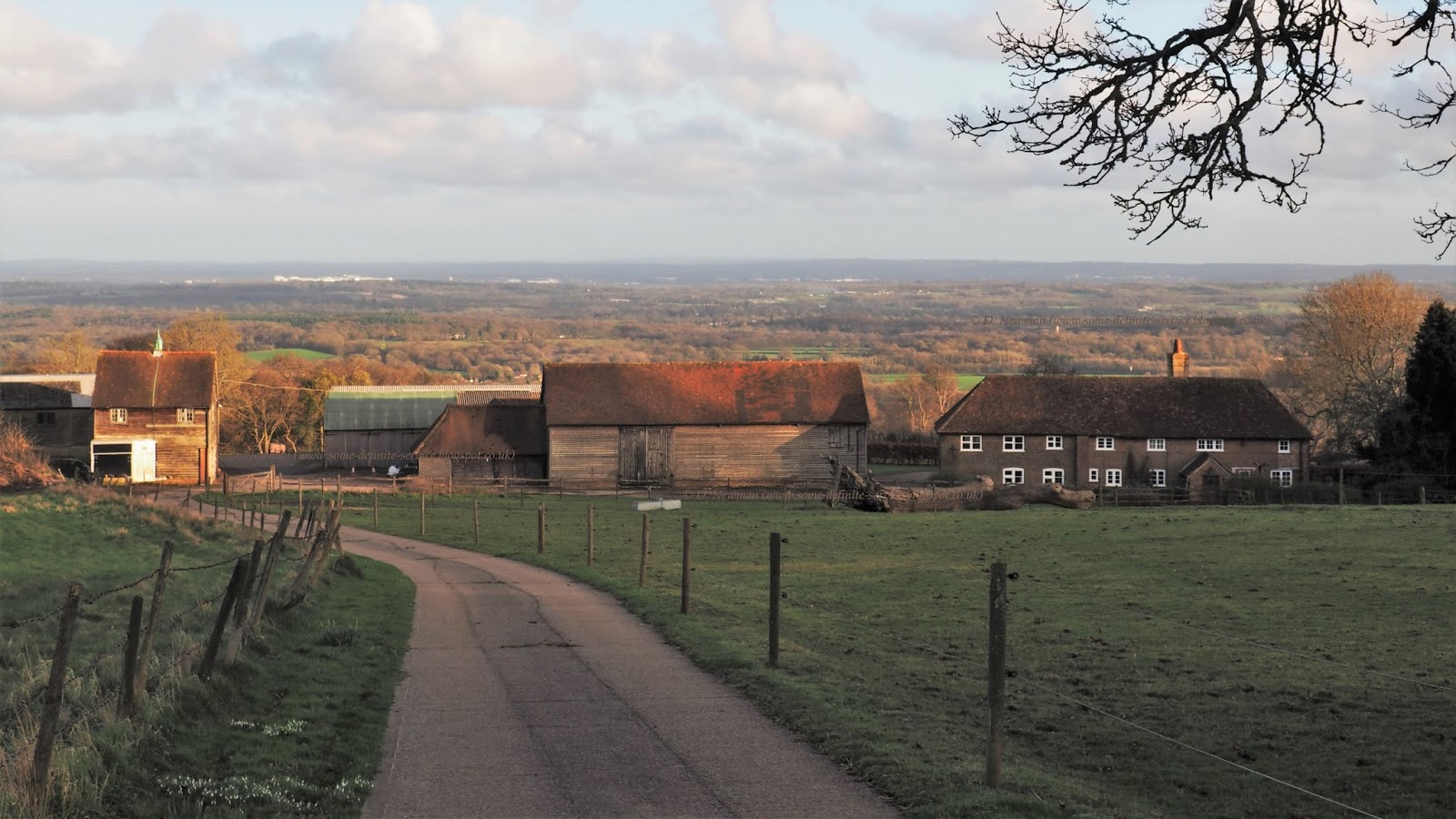
Looking slightly south-eastwards from the slopes of Leith Hill near Coldharbour.  Gatwick Airport in the distance.

Love of home is for me as old as thought.  It is mostly a gentle thing, but it is also deep and dogged and immovable.  These days it is the fashion to scorn such sentiments, perhaps because of the extremes to which versions of it have been taken in the past.  But fashion, for all its force, holds little sway at the top of Leith Hill.  Up here, I can say boldly that I am blessed by the home we have been given to live in.  I can say that it is a good and natural thing to be grateful for that home, and that it is right and just to regard it as an inheritance, which, however indirectly, we must preserve for those who come after us.  Love of home need not, should not be jealous or selfish.  There is no reason why it should ever be either, not least since when it is authentic it is often actually accompanied by an urge to share it with others.  Nor is it necessarily a false idol: love of England may go very deep without overbalancing into outright worship — though I can sense the fierce flame to which some threat or peril could fan this instinct.


For look: it is indeed in peril.  Not this time by outright war or foreign conquest, but by something less tangible and more insidious, though similarly potent with worldly might.  The homely England I have praised may seem from up here to stretch out timelessly and unendingly, but it is always being threatened and encroached on by another England: that bland, bloated, blemishing England of which Betjeman warned, and Orwell, and Priestley, and Vaughan Williams himself in his later music.  I mean the England of the M23 corridor, just visible in the south-east, all motels and warehouses and commuters’ flats and dual carriageways and business parks.  I mean the pale angular mass of Gatwick Airport (even as I acknowledge the poetry in that airliner drifting dreamily up away from it — bound for Orlando, as my friend informs me).  I mean the scarring noise of traffic from which I have had to travel so far to escape, and the permeating threat of mass development (‘No to 480 homes here,’ a banner near the station had pleaded).  And look, now you can scarcely see, as you could before, the dome of St Paul’s Cathedral, drowned by its boasting and secular skyline.  It is not change in itself that dismays me, but change made blindly, seemingly for its own sake, or for merely economic or pragmatic reasons, on a brutishly massive scale, approved by Larkin’s ‘bespectacled grins’, by immense, distant forces that neither see nor care what they destroy. 


Yet… Leith Hill is a good place for some perspective.   Here it remains, serene above the strife of the world, lifted up from the hurly-burly and the madding crowd.  Now I see how remarkably persistent, how surprisingly tough, is the softness of this south country.  Here all those colours — the green meadows, the blue shadows, that Wealden amethyst, the flood of gold from the low sun — do not merely survive, but triumph, quietly as they may, and, it seems, might well till Doomsday.  For this reason I resolve to remember this part of England when in exile in surroundings quite unlike it — to think of the sun shining down unperturbed, and to give thanks with a grateful heart.
On Moorhurst Lane near Beare Green

Sunday, July 07, 2019

40,000 gather for ‘Jednego Serca Jednego Ducha’ 2019

The writers Joseph Pearce and K. V. Turley have observed that it is often quite ordinary, out-of-the-way places that God chooses for his purposes: Walsingham, Lourdes, even Nazareth and Bethlehem themselves.  I wonder whether something similar is true of Sybiraków Park in the suburbs of the Polish city of Rzeszów.  By all appearances this broad open space, with its municipal playing-fields overlooked by blocks of flats, is exemplary in its plainness, having its commonplace counterparts in every major town and city on earth.  But every year, in early summer, as dusk falls on the feast of Corpus Christi, this place is so transfigured that, in truth, it comes to resemble very little else on earth.  For one evening it becomes the setting of the ‘Jednego Serca Jednego Ducha’ concerts of open-air hymn-singing, whose story I have tried to tell elsewhere in these pages.

This year, on the 20th June, after months of rehearsal, the big stage was set up for the seventeenth time, large enough to accommodate the choir, orchestra, soloists and other musicians.  There, according to Rzeszów News, they were joined by some forty thousand people, who raised their voices in prayerful song as dusk fell.  The claim to the title of ‘Europe’s largest concert of Christian music’ does not seem so unreasonable: the aerial photos speak for themselves.

These concerts have such an uplifting quality to them.  Partly that is because there is no compromise on musicianship: a great deal of time and trouble is taken for the preparations, both the performance and the arrangements, which are mainly the work of the musical director, the film composer and jazz musician Marcin Pospieszalski.  Maybe not all the music is to everyone’s taste, nor even to mine (I tend to prefer the orchestral arrangements, where the majesty and solemnity of the choir and orchestra are allowed to flourish): it is mainly the idea and the atmosphere that I am praising.  But the musical repertoire has been really carefully chosen so that most of the music will lift the spirits of most of the people there, and some of the numbers are irresistible.  The idea of giving favourite hymns uplifting and rich arrangements is, I think, thoroughly inspired — every little detail that Pospieszalski puts in adds to the overall spirit of beauty in truth, and to the dramatic, even ‘epic’, dimension of the faith.  The music comes from every age and corner of the Church: medieval plainsong, traditional hymns, translated versions of more recently-written songs from America, and some new music from Poland itself, all leavened and deepened by the forces of orchestra and choir.  You could take your girl friend or your grandmother to these concerts — in fact the idea is probably that you should take both.

This is because the concert’s foundation is spiritual, as well as musical.  Nobody is suggesting that this is a substitute for going to church and receiving the sacraments, but it is, I think, something semi-sacramental, popular piety for the twenty-first century, drawing people into real and authentic togetherness.  Something brings those forty thousand souls closer together than ordinary audiences or crowds.  The originator of the idea, Jan Budziaszek — who even in Poland could not find the resources to get his idea off the ground for twenty years — has an oft-repeated refrain which runs along these lines: ‘Do you want to hear good music?  Then make it yourself!  Because the heart of man is never truly happy unless he is giving to someone else’.  At a given point in the concert, the voice of St John Paul II is played over the speakers: this year the multitude (as JPII would have called them) heard words of encouragement to men and women to marry, to vow not to leave each other until death, and to keep that vow.  And the organisers add words of their own which would be unthinkable in sullener lands further west: ‘May our entire society be freed from this illusion of freedom, free love… Too much this illusion costs.  Too many children are made to lose trust in their parents, so that the indispensable ground on which they themselves have to build their future, and the future of society, gives way’.  The concert’s organisers are at pains to point out that it is not a performance or a show: it is a gathering, ‘nasza Rodzina JSJD’, ‘our JSJD Family’, in which thousands of people, unified in prayer and song, are made — according to the concert’s name — ‘of one heart and of one spirit’.

A sight like this may seem unbelievable to us in Western Europe, but it is a glorious reality in Poland, which I think has a jewel in this astonishing annual tradition of musicianship with its vital air of togetherness, which has no need to rely on an enemy or a scapegoat for its unity.  This is what, say, Ireland could easily have been — or even Britain, at a stretch.  Has the different path that we have chosen been worth it?  Well, in the choice between the dullness and ennui of self-centred secularism, and the joy of an occasion like this, the answer is clear enough to me.  This is the New Evangelisation in action.  Long may these concerts prosper.

Wykrzykujcie Bogu, wykrzykujcie Królowi’: an adaptation of the forty-seventh (forty-sixth) Psalm (‘Clap your hands, cry to God with shouts of joy’).  Music originally by Marcin Gajda, arranged by Marcin Pospieszalski.