Thursday, March 16, 2017

To Tulse Hill by Third Rail

Is it a different world this side of the Thames?  Many of us in south London like to think so.  After all, everything south of the river, even right up to Southwark and Lambeth, has traditionally lain beyond the immediate authority of the Cities of London or Westminster over the water.  Partly this is because, in the old days, the diocese of Winchester once came all the way up to the river, so that the South Bank, though actually directly overlooked by St Paul’s Cathedral across the river, lay under the jurisdiction of a see sixty miles away.  All through the history of London the Thames has made all the difference: for instance, it was to avoid trouble from the authorities that the theatres of Shakespeare’s time decamped to their transpontine position.

These administrative and ecclesiastical boundaries all seem quite faded now. Today, the mass of ‘Greater London’ sprawls greyly to horizons north and south alike, and elects a single Mayor (who is not to be confused with the Lord Mayor of the City of London). Not without considerable hesitation can Vauxhall or the Borough be described as being in Surrey, a name which now calls to mind rural red-tiled gables,  or downs descending into denes.  Indeed, how laughable is the name ‘Surrey Quays’ for those old docklands of Rotherhithe, left stranded as they are by the ebbing of their historical county?  In recent years even the insatiable developers have crossed the river, hungry to thicken the skyline of south London, too, with their towers.

All the same, there are certain ways in which the Thames still constitutes a barrier between central London and its southern suburbs, and which have no counterparts to the north.  The swathe the river cuts through the city tends towards the south; it still has an isolating effect on Lambeth and Southwark even as it leaves the north contiguous with the centre.  South Londoners wishing to reach the city proper still have the river to cross first, and this means, in contrast to north Londoners, that they know the sensation of crossing the river into the city, into the heart of things.  They shoot out onto one of the bridges aboard a bus or train, or even slide into Blackfriars railway station, with its new platforms spanning the water — and the sky widens without warning, a panorama unfolds along the Embankment, the Houses of Parliament sail clear — and then they come to land in the heart of the city.  Even if few will murmur that ‘Earth has not anything to show more fair’; even if the feeling can be dulled by habit, it never vanishes entirely, and will last as long as the river itself.  Those coming to the West End or the City from the north, however, miss it altogether.

The Tube, of course, provides southerners with several ways to sneak into London without acknowledging or noticing the river.  But, as we are keen to point out, most of us are in any case a long way from the nearest Underground station.  There is always some sort of change needed from the world of south London to the world of central London.  The Underground network is heavily biased towards and largely contiguous with north London, whereas it hardly ventures south of the river (apart from the bold, incongruous and ultimately rather ironic adventure of the Northern line, through Britain’s longest railway tunnel, to Morden, the Underground’s most southerly station).

Yes, as well as crossing the Thames, the majority of south Londoners going ‘up to town’ have a definite threshold to cross: there is for us a clear moment of arrival in London.  North Londoners, however, can generally pile straight onto the Tube, and are already in the system when they set off from their home station.  In their tunnels they see nothing, poor souls, and apart from the entry to these tunnels their journey into the city crosses no perceptible boundary.  Perhaps this is why ‘Metroland’ is a phenomenon of North London rather than South.

Christian Wolmar’s enjoyable history of the Underground, The Subterranean Railway, offers several explanations for this imbalance in provision between north and south. [1]  For instance, the geology of south London is notoriously difficult to tunnel through.  Apart from the obvious obstacle posed by the Thames, Tube tunnelling was defied almost until the new millennium by the the deposits of gravel that overlie the typical London clay in this area, sometimes to a depth of ten metres.

South Bermondsey station
Wolmar also explains that, by the time that the Underground had begun to expand beyond central London at the turn of the twentieth century, the city’s south had already gained its dense network of suburban railways.  It was North London that had greater need of transport connections, having been neglected by the builders of the lines out of Euston and King’s Cross.  These companies had bigger fish to fry than Edgware or Barnet: their sights were set on the big prizes — Manchester, Newcastle, Edinburgh or Glasgow — and they needed to send express trains as far afield as they could, and as quickly as possible.  They did not concern themselves with the more trifling places in between, and constructed their lines accordingly, forging northwards with a smattering of intermediate stations and only paltry connections between east and west.  Speed and directness were everything: ‘There we were aimed’ was Philip Larkin’s impression, racing from Hull towards London straight up the East Coast Main Line.  It was the Underground that was to fill in the gaps.

In Kent, Surrey and Sussex, the situation had been different.  Across these counties no siren song floated from any industrial belt; no ‘fields of apparatus’, no ‘furnaces / Set on the dark plain like gigantic chessmen’ beckoned the top-hatted industrialist.  The only sources of traffic comparable to the likes of Liverpool and Newcastle were Portsmouth, the trans-Atlantic port of Southampton and, further east, Dover or Newhaven, with their Continental connections.  The other main destinations, such as Eastbourne, Brighton and Hastings, generated a different kind of traffic from the northern cities, local and regional rather than heavy goods or long-distance expresses. (Kidner called London and South Western main line ‘from its earliest days a line for farmers, military men, bishops and high class tourists’). [2]  Moreover, because all of these destinations lay within a hundred miles of the capital, there was relatively little to be gained by sustained high speed, and, in turn, less to be lost by stopping in between.

Neither did the geography of south London and England encourage fast railways.  Instead of straightforward natural courses, such as the Thames presented to Brunel as he went westwards, the builders of railways to the south met almost immediately with long dissuading barriers of high ground.  The first is the ridge rising eastwards from southern Battersea towards Norwood and Sydenham, but beyond lie the North Downs, the Weald, and the South Downs, which can be punched through only with difficulty.  For example, the line from Tonbridge to Hastings passes through eight tunnels in the thirty-two miles of its length.

Thus the companies in the south laid speed aside in favour of a different goal: comprehensiveness of coverage, and not only for the passengers’ sake.  The railway barons were competing with each other for territory as much as for traffic, and often proved themselves willing to build new lines simply to pre-empt their rivals.  What was more, the fewer pickings south of London meant that there was less to be squabbled over, and this was how the suburbs, considered an obstacle north of London, came to be seen in the south as a market in their own right.

All this produced in this part of England a distinctive railway map, the unsung tangle of surface railways on which we have relied ever since.  A dense and wayward network it is, particularly those lines in London’s immediate suburbs and leading directly southwards towards Sussex that were known under British Rail as the ‘South Central Division’.

Geographical map of suburban south London railways, created with use of information © OpenStreetMap contributors
Here in the south is the realm of the ‘rolling English rail’, to paraphrase Chesterton: none of the self-containedness or single-mindedness of the north.  The southern suburban lines criss-cross each other like a board game, before sneaking alongside the main lines to run into startlingly grand termini (Waterloo, Victoria, Charing Cross, London Bridge).  They are inclined to diversions, to duplicating each other merrily and to winding circuitously around obstacles.  Who could blame London-bound travellers on the Tattenham Corner branch for being rather more doubtful than Philip Larkin about where precisely they are ‘aimed’?  Another difference with the North is that physical rail connections between lines are more common than on the Underground, so that trains can in theory be sent along a greater variety of routes.  All around the network it is possible to glimpse chords and spurs and sidings leading off round bends, curving away to who knows where?

This game of joining-the-dots has plenty of practical advantages.  One is the relative ease of travel eastwards and westwards, which can usually be done without having to go via central London.   This perspective of North London shows how all the railways (even the Tube) run quite independently of each other along north-south axes, so that the most practical route from (say) Mill Hill Broadway to Winchmore Hill involves either going all the way into London and out again, or resorting to the bus.  Their unrelenting linearity also restricts north Londoners to a single terminus.  Meanwhile, South London railway stations often enjoy direct services to two or sometimes three different London termini.  It is unusual to have to change trains more than once or twice between any two given south London stations.

And there are quirks and curiosities to match any of the Underground’s.  We have unusual and historic stations such as Peckham Rye or Crystal Palace, both of which see the phenomenon of London-bound trains departing in completely opposite directions.  Then there is Vauxhall, from whose name the Russian word for railway station comes, and Clapham Junction, the busiest station in Britain by the number of trains passing through.  And there is no shortage of memorable names: Gipsy Hill, or Penge West, or Elephant and Castle, or Tooting.  After staring for long enough at a map of the network, patterns loom forth and swirl around, such as the symmetry between Battersea in the west and Bermondsey in the east, echoed neatly by the nearby stations of Queens Road Peckham and Queenstown Road Battersea.
Clapham Junction, unusually quiet
Yet amid these uncritical remarks of mine must be heard another voice, as of a great multitude of passengers, wailing and gnashing their teeth, and saying, ‘But these trains are always late!  And slow!  And overcrowded!  And expensive!  And unreliable!  And late!’  And lo, their lament is far from groundless.  The same layouts that open up the variety of destinations and connections also produce conflicts in movements.  A case in point are the flat junctions, which send trains right across each others’ paths, hamper acceleration and constrain the timetable.  At most stations, the price to pay for the choice of routes is a frequency of trains far sparser than on the Underground.  The guiding principle in south London is this: everything is possible, but only once every half-hour.

The system’s complexity also displays its weaknesses by falling to pieces whenever anything goes wrong.  Disruption is rarely contained along one line or in one area, but spreads like wildfire across the congested network.  The failure of a single set of points can cause chaos in an apparently unrelated part of the network; spectacular delays can be accumulated over only a few miles.  And of course there is the South London trundle: first the hopeful acceleration to about 15mph, then the application of the brakes, slowly but surely gnawing away at the speedometer, slowing and slowing the pace nearer and nearer to a crawl, drawing closer and closer the inevitable red signal and yet always in denial: the signal refuses to change until progress has juddered to an emphatic 0.  And so on and so forth, all the way home. 

Since all railways, representing a noble ideal as they do, are difficult to construct, maintain and improve, most of these problems will remain unresolved for many years to come.  In the meantime, one radical way of surviving commuting, I have found, is to become interested in it.  After all, there is often plenty of time to sit and contemplate the network, even if that time is seldom set aside voluntarily.  Who knows, the long meditative silence of a signal failure might lead some fellow-passengers, not yet thoroughly hardened, to acknowledge that South London’s railways have a certain distinctive atmosphere.  Could it even be said that South London is made distinctive by its railways?  If the best way to see any landscape is by rail, in South London the railways themselves form some of the best aspects of the landscape.  For one thing, they maintain corridors of woodland that ought to be unthinkable this far into London, bringing the countryside deep into the city (just as roads, conversely, are take the town out into the country).  Someone unfamiliar with the area might reasonably think that from Streatham to Peckham Rye stretches a kind of wild garden, populated by occasional gables and chimneys.  Who knows: maybe the last boughs and branches of the old Norwood or Forest Hill are hidden away the in railway cuttings.
North Dulwich station
The suggestion of the rural is enhanced by a feature of the infrastructure: the system of electrification, which supplies power not via bristling overhead catenary but through a discreet ‘third rail’ at ground level.  This arrangement is relatively unusual for main line railways and has practical disadvantages of its own, but it does leave branches and sky unencumbered.  As a matter of fact the electrification programme, undertaken by the Southern Railway in the 1920s and 1930s, was really the only marketing campaign successful enough to mark out these railways as a rival to the Underground.  The Art Deco promise of refuge in suburbia,  brought within comfortable reach by the ‘Southern Electric’, did for the south what ‘Metroland’ had done for the north, and the slogan’s euphony even earned it a footnote in (north-Londoner) Betjeman’s poem ‘Love in a Valley’.  (Betjeman even mentions the third rail in that poem: ‘White down the valley curves the living rail’, he declares from his Coulsdon perch.)

I have wondered if this south London atmosphere exists most completely at Tulse Hill station, a place whose position can only be described as the very middle of deep south London.  The area it serves is much like the rest of the city, except for having served as an unlikely poet’s paradise for Jason Strugnell, Wendy Cope’s spoof 1980s alter ego.  The station itself is in many ways the South London station par excellence: it is a complete muddle.  It has the word ‘Hill’ in its name, for one thing; it has direct but distinctly unhurried services to two different London terminals, Blackfriars and London Bridge; it lies at the convergence of several different routes, and its capacity is constrained irredeemably by two overbridges at each end of its platforms.  (One of these, which crosses the South Circular, was the country’s second most collided-with overbridge last year).  Once a day at mid-morning Tulse Hill even has the quirk of a single Parliamentary train to Streatham Hill (no return).  Finally, after standing on the platform, having stared for long enough at the maps during the aeons of bleak winter-evening delays, there is some satisfaction to be gained in observing that from Tulse Hill the points can theoretically be set so that trains might set off in opposite directions, along quite different routes, and yet be able to reach either London Bridge or Victoria stations without having to reverse.  When the station was first opened, which will be 150 years ago next year, I doubt there seemed any particular reason for it to have been placed where it was.  Now the passenger whose train rounds the excruciatingly tight bends and lumbers at last into Tulse Hill has at least the assurance of being completely lost.

Here then in one place — and Tulse Hill, of all places — is a collection of features that are South London’s own.  On life goes, without anybody noticing; on the railway clunks.  Nobody notices that in north London there is nothing quite like it to be found.  Whether that is a shame or a relief is not necessarily the most pressing matter of the day, but it is enough, I think, to justify my claim that there is something special about the world this side of the Thames.
Tulse Hill station: a two-pronged approach from the south
References:
[1] Christian Wolmar, The Subterranean Railway (London: Atlantic, 2004), p. 14
[2]  R. W. Kidner, The Waterloo – Southampton Line (Oakwood, 1983), p.7.

Wednesday, March 01, 2017

St David’s Ash Wednesday

Aberystwyth, St. David’s Day, 2016
Happy St David’s Day, even though it is also Ash Wednesday!  Let the people of Wales, and all who love Wales, turn to their patron in song.  Song is what the Welsh are best at: after all, there is no distinction in Welsh between poetry and music; there is only cerdd.  If Ireland is the land of saints and scholars, Wales is the home of monks and musicians.

May the Welsh people, who know better than most that anything that is not firm rock is deep water, never cease to mark St. David’s Day.

Dewi Sant, gweddia drosom ni!

Parêd Gŵyl Dewi Sant, Aberystwyth, 5 Mawrth 2016

Monday, February 20, 2017

Ruth Gipps Again

Today has brought us to the ninety-sixth anniversary of the birth of the composer Ruth Gipps; Thursday will be the eighteenth of her death.  So it is time for my annual lament about how little-known her music seems to be for a musician of her stature.  The list I have compiled here shows how few readily-available recordings there are.  Of her five symphonies, her proudest achievements, only the second has a decent recording.  Spirited performances of the third, fourth and fifth can only be heard through the fuzz of digitised tape recordings of varying quality, though much gratitude is due to those who have dug them out.

Anniversaries tend to spur things on in music, so I am hoping that her centenary, which is fast approaching, will be marked in some way.  I think she would be an ideal candidate for the Proms, for example.  Imagine how a live performance or even a decent recording of this, the climax of her fifth symphony’s first movement, would sound:

Ruth Gipps: Fifth Symphony. 
(The uploader has chosen a photograph of the Ribblehead Viaduct in the Pennines)

I know I am not alone in enjoying Ruth Gipps’ music. The second movement of her piano concerto was requested and broadcast on the BBC’s excellent Breakfast programme last week, and her neglect has been noted elsewhere on the Internet.  Her personality, which many found rather forthright, and her principles, which included an unashamed rejection of musical or cultural fashion and a readiness to express it, may not have helped her cause during her lifetime — nobody on whose life and works the only scholarly work is sub-titled ‘Anti-modernism, Nationalism and Difference’  can expect thunderous acclaim in the present age — but this is precisely what makes her character interesting, not least because, I think, it is  borne out in the spiky liveliness of her compositions (the third movements of  her fifth symphony or her piano concerto), as is a keen appetite and ear for the lyrical and the beautiful.  Ruth Gipps should be far better known!

Tuesday, February 07, 2017

Press On Wards

This blog does not usually venture into politics, but I think I can say that last June’s referendum on our membership of the European Union transcended politics: it was History (capital H!).  Since I wrote the flurry of posts at the time (on the eve of the vote, the following morning and the day after), it has all given me plenty to think about.

There was an interesting article yesterday from the BBC, which has been going through the details of the votes by electoral ward, every pocket of country, and finding trends and quirks in the result.  I find this fascinating —  it is proof of the variety and character of the country that has always been there.  To think of this result as a revolt by the English and Welsh ‘regions’ against the London ‘metropolitan elite’, with Scotland and Northern Ireland going their own way, was always rather a simplification.  The BBC finds all sorts of patterns — islands of one result isolated by swathes of the other, sharp contrasts between wards in similar regions — and so on.  The article asserts that the factor that correlated most strikingly with the results was the level of formal education.  The lower this was per ward, the more strongly that ward tended to vote to Leave.  Thus 82.5% of the people of Brambles and Thorntree in Middlesbrough, where 5% of people have a degree, voted to Leave; Market ward in Cambridge, which includes most of the colleges, voted 87.8% to Remain.  Rural areas and more deprived parts of England, on the fringes — places people never visit, which are the places I am interested in — were more likely to want to Leave.

Perhaps this goes some way towards explaining why I dithered so much about my vote.  On paper, it seems I ought to be a staunch Remainer.  I am in my twenties, have grown up in London and have a degree — come to that, a degree in French and German.  I am very fond of European cultures.  Yet I fall wholeheartedly, even gratefully, into the category of the ‘Left Behind’.  Perhaps the very interest I have in the particularity of the wards, even the delight I take in their names (Milkstone and Deeplish!  I had never heard of either) betrays this.   Globalisation, or at least globalised culture, makes me dizzy.  I feel much of the time as if I am living in the future, not the present.  I have never taken an international flight in my life; my instinctive idea of a holiday is not to go abroad but to plunge into the narrow hollows or intricate coastline of my own country.  It isn’t at all that I’m not curious and deeply interested in the whole world.  But I can only enjoy it in tiny mouthfuls, because everything I find I must savour.  (But how much does this have to do with the European Union?  I’m not sure).  I think, too, that I shared with Leave voters a feeling that sovereignty was the crux of the whole affair.  The nation is far looser and less important than the family (and the British have lost sight of this in the past) but there is the crucial similarity that we are, to a greater or lesser extent, rooted in both.  These feelings did not make me a Brexiteer any more than the others made me a Remainer, but I have more of an idea now why, almost alone it seems, I felt sympathy in such stubbornly equal parts towards ordinary voters (as opposed to campaigners) in both camps.  

In fact I don’t, incidentally, really think there ought to be a contradiction between these two feelings.  My studies and ventures into Europe made me more fiercely fond of my own country even as I came to know and understand French- and German-speaking cultures better.  It did not, however, stop me from dithering over my vote to the point of its hardly seeming to count…

I would be dithering still, if I allowed myself to.  But I have decided not to.  Now that we have a result, there is no reason why we should not all set to and try and make a success of it.
One way of seeing the result: A view northwards from Leith Hill, the highest point in south-eastern England, down across the Holmwoods ward (57% Leave) in the foreground, over Dorking South (63% Remain) in the dip this side of Box Hill in the middle distance, and then London, world city, practically its own nation and most certainly Remain, in the far distance.  All this variation in the landscape of Meredith and Vaughan Williams and the Lark Ascending.
Of course, I would be a lot happier about it all if I had more faith in the country.  It is often tempting to despair at the scale of the decline of civility, the collapse of marriage and the family, the unthinking public swearing, the callous behaviour on the roads, the ugliness in both popular and high culture, the characterlessness of architecture, the dry tonelessness of language, the dictatorship of relativism, the moral uncertitude, the unhappiness of so many people — especially among young people of my generation, where it might least be expected — the materialism it is such an effort to resist, the crush of fashion, the burdens that people have to shoulder, often alone.  

But then I take myself in hand.  There are many people trying, and indeed succeeding, in doing good, all over the place.  Often they are not seen, which is the proof of the goodness of their actions.  And there are all sorts of movements, ideas, societies, choirs, clubs, even traditions, that carry on unobtrusively without making a spectacle of themselves.  One of the things I was wholeheartedly pleased to see in the referendum was the quiet but firm subversion of celebrity culture, which I would once cynically have supposed held us all in a glitzy grip.  And there are legions of good and just people — I could reel off the names of a hundred people, known to me, many my friends, who number among them — who will not let civilisation crumble on their watch.

Postscript: By the way, I think we should resist the drawing of comparisons between our own referendum and events trans-Atlantic.  It may be that both represent an apparently-unexpected popular uprising, but what has happened in America is the triumph of a brand, whereas the British referendum went the way it did precisely because it was unbranded.  The question was put to us with few bearings, and without the attachments of the main parties, so people voted more freely.  So in my opinion it is unwise to speak of the two events in the same breath, and certainly not allow our feelings about one to affect our opinion of the other.  Right, enough politics!

Friday, January 06, 2017

On a Wise Queen


One among many Christmas Day traditions in our family is ‘the Queen’ — assembling in front of the telly just in time for H.M.’s Christmas broadcast at three in the afternoon.  This annual broadcast of under ten minutes’ length might be easy to take for granted.  The National Anthem is played at the beginning, the Queen delivers her message, and there is another piece of music at the end.  Its simplicity, dignity and reassuring mood are often thrown into relief by the B.B.C.’s tendency to sandwich it between frenetic adverts for the usual televisual fare.  Yet while the Queen speaks, all is calm. 

I know I’ve written plenty already in praise of monarchy in principle and the person of our present monarch.  But it needs repeating: Queen Elizabeth is a tower of strength, strength that she has proved in endurance and constancy.  And I think in the Christmas broadcasts of recent years she has become — to me — noticeably franker about her understanding of the source of this strength.  I thought this year’s (the whole text of which can be read here) was remarkable in several ways.  Here are the last paragraphs:
When people face a challenge they sometimes talk about taking a deep breath to find courage or strength.  In fact, the word ‘inspire’ literally means ‘to breathe in’.  But even with the inspiration of others, it’s understandable that we sometimes think the world’s problems are so big that we can do little to help.  On our own, we cannot end wars or wipe out injustice, but the cumulative impact of thousands of small acts of goodness can be bigger than we imagine.

At Christmas, our attention is drawn to the birth of a baby some two thousand years ago.  It was the humblest of beginnings, and his parents, Joseph and Mary, did not think they were important. 


Jesus Christ lived obscurely for most of his life, and never travelled far.  He was maligned and rejected by many, though he had done no wrong.  And yet, billions of people now follow his teaching and find in him the guiding light for their lives.  I am one of them because Christ’s example helps me see the value of doing small things with great love, whoever does them and whatever they themselves believe.
This is, as any of Elizabeth’s churchgoing subjects will know, strong stuff by the standards of modern Britain — not least since these words follow a quotation from St Teresa of Calcutta and a reference to her canonisation.  It is well-known, I suppose, that the Queen takes her faith very seriously, but here it is expressed with an ear-catching boldness.  The media hunger for the slightest morsel of the Queen’s personal opinions, but here is one that she has chosen carefully to make known.  There can be no mistake about the bell-clear words, "I am one of them."  And she is speaking not only to viewers who share her faith but, as always, to "you all".  It can fairly be called evangelistic.

There must over the years have been no shortage of advisors wringing their hands at this aspect of the Queen’s person, urging her to water it down lest she appear ‘out-of-touch’, that gravest of modern sins.   But the vows she once made, and has unfailingly kept, were to God as much as to her people.  She has known that she could not be just to the latter without being faithful to the former.  Her faith is the foundation of her understanding of the dramatic, fulfilling idea of vocation (largely neglected by our unhappy, rudderless age) which, in turn, underpins her life and reign.  She has received a calling, and having answered it, has not faltered. 

And there is a remarkable humility and saneness in that sentence, “I am one of them.”  With these piercing monosyllables the Queen punches through the distraction of her extraordinary situation: we should all have the same attitude, she is saying, since we all have our vocations to ‘some definite service’, and this makes us equal.  She has answered hers; we each should answer ours.  It is the proof of her level-headedness that she, one of the greatest women on earth, who has always had to be great, has seen and is able to assure us if we only ‘do small things with great love’, we will have done our part.  I submit, of course, that she has also done a great thing with great love.

People on television often praise the Queen for her ‘service’, which irritates me since I sometimes suspect they are trying to avoid using the word ‘reign’.  Of course she has served, but it is more complicated than that.  She has served us by reigning over us, and in doing so also served God.  And the humble acceptance of a great office is a humbler, worthier thing than even the television personalities are hoping for.

Thus on this feast of the Epiphany I record my gratitude for a living monarch who kneels with the three Kings, and who has been rewarded with a wisdom that makes her worthy not only of her subjects’ loyalty to her office, but of their trust in her person.

Sunday, December 25, 2016

‘Pax hominibus bonae voluntatis…’

This atmospheric Christmas poem was written just over a century ago by Robert Bridges, in his first year as Poet Laureate:
Noel: Christmas Eve, 1913 — Robert Bridges.
Pax hominibus bonae voluntatis.

A frosty Christmas Eve
   when the stars were shining
Fared I forth alone
   where westward falls the hill,
And from many a village
   in the water’d valley
Distant music reach’d me
   peals of bells a-ringing:
The constellated sounds
   ran sprinking on earth’s floor
As the dark vault above
   with stars was spangled o’er.

Then sped my thoughts to keep
   that first Christmas of all
When the shepherds watching
   by their folds ere the dawn
Heard music in the fields
   and marvelling could not tell
Whether it were angels
   or the bright stars singing.

Now blessed be the tow’rs
   that crown England so fair
That stand up strong in prayer
   unto God for our souls:
Blessed be their founders
   (said I) an’ our country folk
Who are ringing for Christ
   in the belfries to-night
With arms lifted to clutch
   the rattling ropes that race
Into the dark above
   and the mad romping din.

But to me heard afar
   it was starry music
Angels’ song, comforting
   as the comfort of Christ
When he spake tenderly
   to his sorrowful flock:
The old words came to me
   by the riches of time
Mellow’d and transfigured
   as I stood on the hill
Heark’ning in the aspect
   of th’ eternal silence.
Gerald Finzi used these very English words in his Christmas cantata In Terra Pax, though the third stanza is replaced by words from the second chapter of Luke’s Gospel:
And there were in the same country shepherds abiding in the field, keeping watch over their flock by night.  And, lo, the angel of the Lord came upon them, and the glory of the Lord shone round about them: and they were sore afraid.  And the angel said unto them,

Fear not: for, behold, I bring you good tidings of great joy, which shall be to all people.   For unto you is born this day in the city of David a Saviour, which is Christ the Lord.  And this shall be a sign unto you; Ye shall find the babe wrapped in swaddling clothes, lying in a manger.

And suddenly there was with the angel a multitude of the heavenly host praising God, and saying, Glory to God in the highest, and on earth peace, good will toward men.
Luke 2: 8–14 (KJV)

Finzi’s decision to quote Luke where he does leaves the identity of ‘the same country’ satisfyingly ambiguous.  For Bridges’ words are set unmistakeably in England — perhaps Oxfordshire, known to both Finzi and Bridges — and the words from Scripture seem to follow the poem seamlessly, as if it had been on the same hill that both poet and the shepherds had stood.  Thus the composer leaves undisturbed that unspoken myth, once wished-for and half-believed by everyone in England, and perpetuated by such carols as ‘In the Bleak Midwinter’ or Warlock’s Bethlehem Down, that Christ must have been born somewhere in England, preferably in the Home Counties, perhaps enfolded by a chalky Sussex woodland or a wooded Surrey dene.  After all, where else could He have been born?

Ah, what shall we do with the incorrigible English?  Well, today’s not the day to worry about that.  Glory to God in the highest, peace to people of goodwill, and a merry Christmas to all readers.

Saturday, December 17, 2016

Fame again for Shippea Hill


Last January I wrote (here) at about my proud membership of that select club of 22 people who, in 2014–15, had found (or concocted) a reason to alight at or depart from Shippea Hill station in Cambridgeshire.   So select was this club that, in the annual statistics of passenger usage at British railway stations that year, Shippea Hill had the distinction of coming last.

Now the station is in the news again:  according to this year’s statistics it has retained its position of honour, having attracted a grand total of twelve passengers.  It might seem natural to ask why so few people should use it, but, when it comes to Shippea Hill, as I explained last year, the question is really why the figure should be as high as it is!  For Shippea Hill is notable for having purported to serve, since 1845, a blank, unpopulated fen, the ‘hill’ of its name turning out to be a patch of ground qualifying as a hill only because it is not below sea level, and therefore attains a dizzying altitude compared to all the land around.  As for the trains, there is a single service per week-day, in one direction only, which calls on request only and is totally unsupplemented and uncomplemented by any bus or even a practical service at the next station down the line at Lakenheath.  There is no pub, shop or phone box; there is only the unchecked wind, the uncompromising Fenland horizon and the small bluish vessel of Ely Cathedral, eight miles away.

Happy birthday, Pope Francis!

Happy eightieth birthday to the unstoppable Pope Francis, who continues to teach and us less by words (which I think he sees as a secondary tool) than by gesture and example, in which his real homilies are to be found. 


“How many of you speak Spanish?” Pope Francis prays with refugees in Rome.

He is certainly a Pope who pulls no punches: man has, he says, “slapped nature in the face”; young people are to “renounce the sofa” — and remember the “Curse my mother; expect a punch” line?  People don’t realise how much tougher a nut he is than Benedict ever was!  But he has to be tough.  Time is short.  The world is awash with wrongdoing and riven by evil, and Francis has more to contend with even than the unfolding spiritual decline of the West.  As I have pointed out before, I think he wants to concentrate on the rest of the world before Europe, whose faithful remnant, with its particular mission, can still draw on the (far-from-exhausted) well of teaching of Benedict and St. John Paul, in addition to Francis’s, for years to come.

“Pray for me,” he has asked us, so we should do so.  And the same for his predecessor.

Sunday, December 04, 2016

Advent: a month’s yearning

First the long slow drawing in of the evenings; now the long slow drawing near of God.  Advent is a very precious time of year, less severe than Lent (necessary though that severity is) and tinged with that yearning — known to us all since childhood but dulled and dormant in millions of modern hearts — for a mysterious approaching joy which, though still out of sight, will surely come to those who wait for it.  It is a distilled, wintry version, of course, of the feeling that is with us all year round, even if we choose to ignore it, that for all earth’s delights there is some greater joy somewhere else.  Advent is a model of a lifetime’s waiting that gives us a chance to see our life, and what lies at its end, as if from outside, and to renew our determination to do good.

If the people of Britain are ever again to return to the faith, perhaps it will be this feeling that draws them churchwards at last.  Under the old vaults they will find the joy they have sought, a newborn child in his mother’s arms.  He is only a few Sundays away.  Prepare ye the way of the Lord; make his paths straight.

A stirring arrangement of the old carol by Paul Leddington Wright, sung by the Choir of Derby Cathedral; from ‘Songs of Praise’ broadcast 29 November 2011, (B.B.C.)

Wishing a peaceful Advent to all readers, near and far.

Sunday, November 27, 2016

A Patroness for Archivists

Most occupations — the transport industry, the financial sector, the medical profession, the emergency services — involve trying to overcome the shortness of time.   But others also have to cope with time’s sheer magnitude: for history has shown us that there is rather a lot of it!  The archival profession numbers among these.  If some records are made to be kept, and if they are to outlive our era and last long into many others, then we must ready our records, and their context, to survive decades and centuries.  And information is such a fragile thing.

This has been the week of the annual Explore Your Archive campaign, which promotes archives and their holdings to the public.  Hopefully it is not a mere coincidence that it fell around the feast day (Friday 25th November) of St Catherine of Alexandria, patroness of archivists (among others), and the ranks of whose petitioners I have joined this year.  St Catherine, pleading the cause of all archivists as they wrestle with the past, for the sake of the future, in the narrow window of the present, ora pro nobis!  And deliver us from ninety-year-old sellotape.

St Catherine of Alexandria, Ventura Salimbeni (1567-1613).  From the Wikimedia Commons.

Friday, November 18, 2016

Weather Without

In November 2015 the Royal Commission on the Ancient and Historical Monuments of Wales (Comisiwn Brenhinol Henebion Cymru) held an Open Day at their headquarters in Aberystwyth, just before they moved their offices up the hill to the National Library.  They invited members of the public to find something of interest among the material brought out from their archives, and then to produce ‘something creative’ (art, poetry, even tapestries).  I was struck by an aerial view of Fishguard, taken in 1929 by Aerofilms, that I actually stumbled across on their online catalogue Coflein (the name is a combination of cof, memory and lein, line).  The picture can be seen here.  I sent off my effort at a ‘soldier’s englyn’ (englyn milwr in Welsh) — lines of seven syllables; rhyme-scheme of AAA — and they replied to say that they would put it on the People’s Collection Wales website here, along with other people’s works.  I thought it seemed rather topical this week — though it is topical most of the time in a Welsh November!
Weather Without

Surely little will outlast
West Welsh houses. They hold fast
In the western weather’s blast.
When the wet Welsh wind is big
(Mast or trunk like straw or twig),
West Welsh houses only dig
Hewn heels deeper into hills.
Western weather finds and fills
Every crevice: gusts like drills
Deafen heaven, beaches teem,
Waves maraud and woodlands scream.
In foundation, wall and beam,
West Welsh houses, though, are made
Firm against the rain-storm’s raid;
Stout of hearth and finely laid
Down in stone that shall not fail;
Hale of gable in a gale;
Staunch in every joint and nail.
Rows and rows are sworn to guard
West Welsh hearts against the hard
Rain, however swayed and scarred.
Snugly perched along the steep
Western hillsides, each shall keep
Stories, music, breath and sleep
Safe and sound for years on end:
Side by side they shall defend
West Welsh souls, and will not bend.
Westwards down Buarth Road, Aberystwyth, November 2015.

Tuesday, November 08, 2016

‘Here We Are Again’

DKW_SBFS91_1_SuttonShop_highlight_1908

This is a picture of the High Street in Sutton in Surrey taken at Christmas, 1908 – which is not all that long ago in the grand scheme of things, but long enough, as it turns out, for almost everything visible in this photograph to have disappeared entirely.  Gone are the dignified bunting and proud flags and the banner proclaiming ‘Here we are again’.  Gone are the cumbersome means of transport, the fashion, the manners and mannerisms, the solemn lettering, even Robinson’s High Class Teeth (which might be a good thing).  But I said ‘almost everything’ has disappeared because there has been one remarkable survival from this picture.  It is connected with another of these shops on the right, no. 18: the photography studio of David Knights-Whittome, advertising him as ‘Photographer to His Majesty the King’.  It is his business that we have to thank for some 11,000 photographic negatives taken of Sutton’s townsfolk between 1904 and 1918, and it was his photographic eye that recorded the characters of people who knew and walked this frozen High Street when it was living.  We have to be grateful also to providence that so much of this collection survived the twentieth century against all the odds, so that it is now possible for them be cleaned, conserved, rehoused, catalogued, digitised, researched and put online by Sutton Archives, with the help of local volunteers and a grant from the Heritage Lottery Fund.  The banner that announced ‘Here we are again’ in 1908 turns out to have been a message not only for the ordinary Edwardians of Sutton, but for us in the present day.  Here they are again indeed.
Miss Neate, DKW_30706_30706A_Neate_L
They were ordinary people like Miss Neate who, during her visit to Sutton on the 11th December 1908, might have been able to admire the Christmas decorations if they had been put up, or have thought 1907’s had been better, before she went into Knights-Whittome’s studio to have this photograph taken.  They were ordinary people like Mr. E. A. Blacker who had been a sitter the previous February. 
Mr E.A. Blacker, DKW_30046C_Blacker_L and DKW_30046B_Blacker_L
For single portraits like this, Knights-Whittome tended to use glass plate negatives.  The negative was simply a small rectangle of glass coated in a ‘light-sensitive emulsion of silver salts’.  By the time of these photographs they were being mass-produced.  Knights-Whittome tended to take several exposures per client, sometimes using a single plate for each shot, as he does here, and sometimes squeezing two onto the same plate, as he did for this client, seen here a year later. 
Detective Enticnapp [Enticknap], DKW_30602_Enticnapp_L
A sitter with a name like Detective Enticknap was perhaps not so ordinary, but a  Charles Henry Enticknap was indeed a detective and member of the Metropolitan Police from 1887 to 1913 (his biography is here).  When the print had been taken of the negative and the happy customer had left, the plate was numbered and labelled with the sitter’s surname, put in an envelope and placed on shelves and in boxes in the basement of the shop.

David Knights-Whittome, 1876-1943, self-portrait
This is the man at the heart of the story: David Knights-Whittome, who was born in Greenwich in 1876 and was the seventh child of Joseph Whittome (a warehouseman and Baptist minister) and Eunice Smith.  He probably taught himself the art of photography.  The Borough Archives at Sutton hold a notebook that he compiled at the age of 18, entitled ‘Secrets of Photography’.  There are records of his having worked in Edmonton (North London) and Woking (in Surrey) before he moved to Sutton in 1904.  Here he married, in 1907, Sarah Elizabeth Draper, known as Bessie.  They had two sons, Maurice and Ronald, born in 1908 and 1912 respectively.

He was also indeed a photographer to the King, as he claimed (if not the only one), obtaining a Royal Warrant of Appointment in 1911 and being one of the official photographers at Prince Edward’s investiture as Prince of Wales at Caernarvon Castle in 1911.  His royal subjects included Edward VII, George V and Edward VIII at various ages, and also King Alfonso of Spain, King Manuel of Portugal and Queen Maud of Norway.

To the shop in Sutton, opened in 1904, he added a studio in Epsom in 1911.  All the negatives from both studios were kept together in Sutton without any distinction between the series, which means that any photograph from this date onwards could have been taken in either town.  This has repercussions for the identification of the sitters.

It seems that in 1918 Knights-Whittome gave up photography as a career altogether.  The Sutton and Epsom shops closed, and the family had moved away by 1921 to Wimbledon, then to Bournemouth and finally to retirement in St. Albans, where Knights-Whittome was mayor in 1940. He died in 1943.  As for the one-and-a-half tonnes' worth of glass negatives, they had all been left in the basement of 18, High Street, Sutton in 1918…  There they would remain for sixty years.

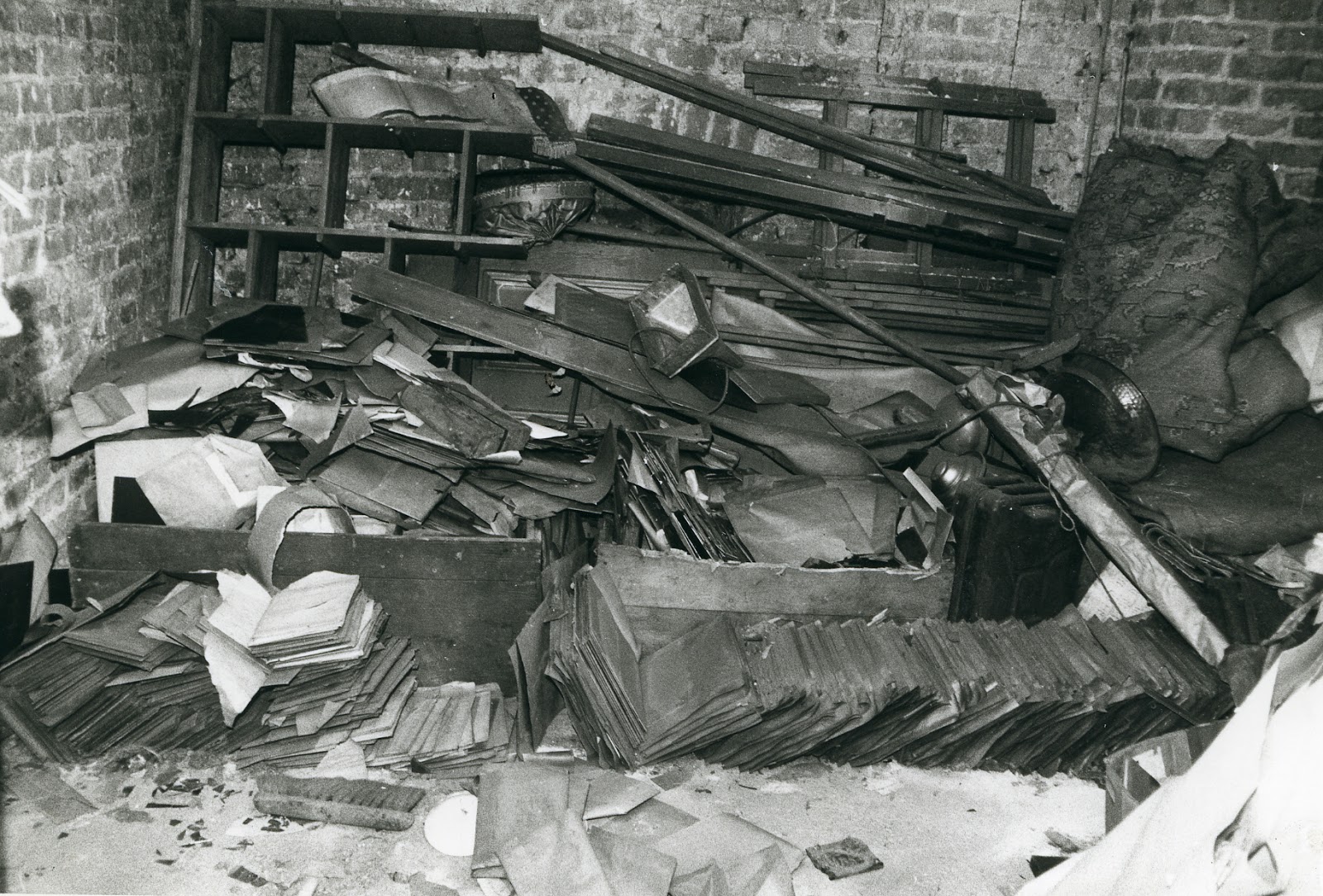
The involvement of the Sutton Borough Archives began in 1978, when June Broughton, the Local Studies Librarian, was contacted by a member of the public about a certain large collection of glass plate negatives in the basement of Linwood Strong optician’s in the High Street… The building was to be demolished to make way for a road-widening scheme (this happened in 1986).  So June Broughton and Frank Burgess, a local historian, went to investigate.  In the words of Abby Matthews, the current Project Officer for the ‘Past on Glass’ project, ‘they were met with a scene of neglect and damage’.
The state of the collection in the basement of 18, High Street, Sutton, Surrey, in 1978.  From the project blog.
Everything remained much as it had been left, on open shelves in original envelopes, except that some of the shelves had collapsed onto others, and some of the plates had been piled up on top of each other anyway, so they were also bearing their own weight.  The inevitable result is shown by the fragments of broken glass visible on the floor.

The plates were moved to Cheam Library as a matter of urgency.  Eventually they were transferred to the main civic offices in Sutton and given to the borough by the Knights-Whittome family.  However, many of the plates had been broken and, worse still, had suffered water damage in the cellar so that they were stuck in their brown envelopes. 
On a large number of plates the emulsion was delaminating, or peeling and flaking off the glass, and with it the image itself.

The collection remained in this position for thirty more years.  Then in 2014, after lengthy audits and consultation with photographic conservators, a successful application was made to the Heritage Lottery Fund for the preservation of the collection.  Nearly £100,000 was awarded so that every plate could be cleaned, rehoused and catalogued, and undergo conservation if necessary.  The funds also provided for their comprehensive digitisation, not least so that they could be made public over the Internet.  The project was called ‘The Past on Glass’.

The Project Officer, Abby Matthews, and Kath Shawcross, the Borough Archivist, oversee a number of local volunteers who clean, catalogue, rehouse and scan as many plates as they can, sending some for conservation.  Some volunteers carry out research on family history websites to try to shed some light on the people in the portraits.  Then they are uploaded to the project’s Flickr page, where there are already about 4,000 images.

The collection might have lain for a hundred years awaiting its moment, but in some respects the timing of this new project is perfect.  Only in recent years has the technology become readily available for a proper digitisation programme.  The same goes for the way in which the Internet can make the collection far more accessible virtually than it ever could have been physically.

As they have done so they have had to contend with all sorts of difficulties.  For example, the writing on these envelopes, all scrawled in ink and bled into the poor paper, are still the only source of information for most of the plates: all the ledgers and account books have disappeared.  And the information that survives is often incomplete: many surnames are illegible or undated.
From an article on the project blog. These envelopes are for photos of quarter-plate size (about A6), the most common for single portraits.
The photograph inside might be stuck, or the emulsion flaking, so it has to be done  gingerly!  Then they have had to catalogue the plates in a way that tries to straighten out Knights-Whittome’s idiosyncratic system of numbering.  But all of this is outweighed by the experience of liberating a photograph that has not seen the light of day for a century, and coming face to face with the people and the characters of that vanished age:
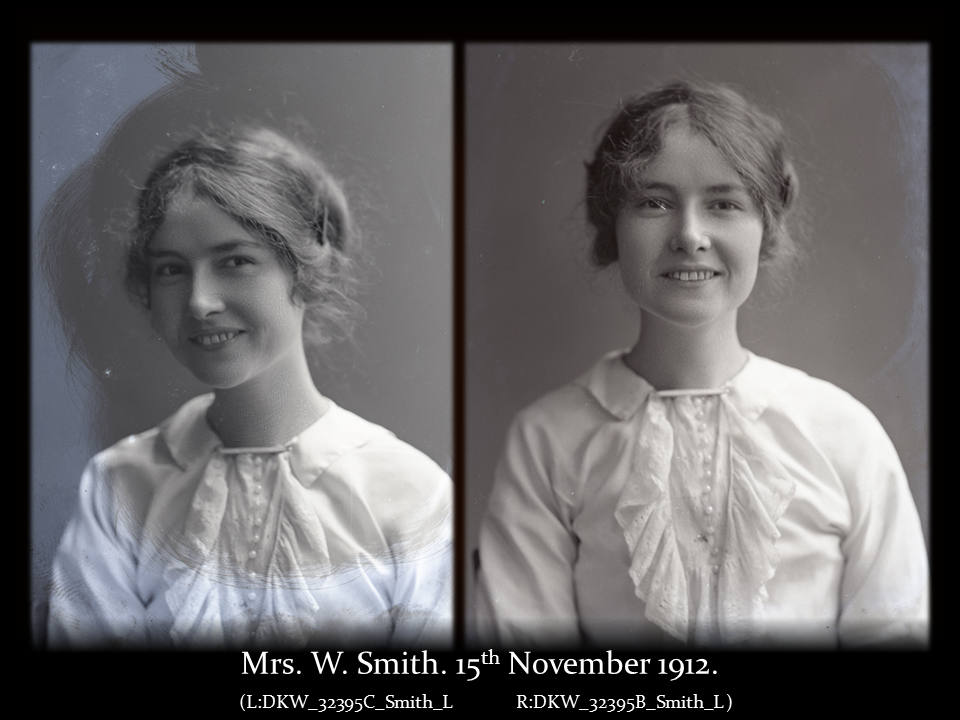
For example, Mrs. W. Smith, photographed on the 15th November, 1912.  Abby Matthews (the Project Officer) has noted that the largest category of photographs are single portraits of women, like this.  One of the reasons she suggests for this is the First World War, which looms large over this collection in many ways.  It would make sense for soldiers who went off to fight to take photographs of their sweethearts with them. 
Correspondingly there are many pictures of officers in uniform. This is J. A. Boyd:
J.A. Boyd, DKW_35442_Boyd_L1
The archives assistant at Sutton found that he had enlisted in the 3rd East Lancashire Field Ambulance Corps two years earlier at the age of sixteen, when he was three years underage.  He survived the war.

Below is Private Harold Dickson Mims, born in North London in 1896; son of Ernest and Sarah Jane Mims; enlisted as a private in the 5th (City of London) Battalion (London Rifle Brigade); embarked for France in January 1915; promoted to Lieutenant in early 1917; killed in action aged 22 on the 27th September, 1918.
There are group portraits as well.  Here is a couple called Bevington, frustratingly with no year given.  I had a go at researching this couple but could not find out anything concrete about them.  But the advantage of their being on the Internet is that the families themselves are more likely to find them and supply the necessary information.
There are also many photographs of babies and children.  This is Baby Bamber on the 10th December 1915:

Mrs Jenkins and baby, DKW_34030C_Jenkins_L
There are some wonderful characters among the plates.  For example, here is Miss Mabuine on the 18th of January, 1907:
Miss Mabuine, DKW_23642A_Mabuine_L
…and a few months later the jovial Mr. Fiddyment sat for his portrait.  Abby Matthews has pointed out that he must be a working man because of the grime in his hands and his worn jacket: unusual, because working men would not normally have been able to afford to have a photograph taken like this.
Mr. Fiddyment, DKW_23745_Fiddyment_L
Miss Biddulph in an impressive hat on the 2nd September 1912:
Miss Biddulph, DKW_32313_Biddulph_L
And there were pets:  Here is Mrs. Henderson and her dog, 5th December 1916:
Mrs. Henderson and dog, DKW_34301A_Henderson_L
Knights-Whittome did occasionally venture outside the studio, for instance to take these pictures of classes at the convent school at Carshalton.

And this is Mr. Andrews who, astonishingly enough, was not satisfied with his portrait, and wrote to Knights-Whittome to tell him so.  It is not yet clear whether this is the offending or the corrected version:
Great Fell
E. Molesey
Aug 7th 1907


Dear Sir,
I am not at all pleased with the photos. Everyone who has seen them says they are very poor & I must ask you to see what you can do towards bettering them.  The one X is all on one side as though the face was badly swollen & twisted. The other is the better of the two & I think can be made to look more natural by turning the nose down & not up as it now is. I am not aware that my nose turns up nor is anyone else who knows me – the head & figure stoops rather too much forward & this can easily be altered when cutting the photo for mount & I think they would look infinitely better if darker about the top of the head – Please adjust these items! Let me have the ½ dozen as soon as you can.


Yours truly,

R.M. Andrews

This goes to show that photographers were in the habit of retouching their work even in those times, mainly by pencil on the reverse of the glass plate.  There is a post here on the project blog about Mr Andrews and his exacting standards!


I count myself very fortunate to have been able to volunteer for this project — only for a short time (and I miss going) but enough to cement my decision to pursue a career as an archivist.  There are plenty of others who have also found it tremendously rewarding.  Recent good news has been that the project has received a second much-needed grant from Lottery Fund.  This means hopefully that the work can be brought to completion.

Of course, this post is a feeble attempt to do justice to this astonishing collection, which throws open not a different era but a vanished civilisation.  There are weddings, grown men in fancy dress, clergymen, schoolchildren and students, and no end of babies and dogs.  There are enigmatic people, too, whose gaze meets ours unsettlingly across the gulf of the twentieth century.  There they are again, full of quirky nooks and eccentric crannies, spirited, upright and full of life, just as we are now.


----------------------------------------------
The Past on Glass Online:

The pictures in this article have all been obtained from the project’s page on Flickr.com, where more are always being added:
www.flickr.com/photos/pastonglass


The project blog:
www.pastonglass.wordpress.com


On Twitter via Sutton Archives:
www.twitter.com/SuttonArchives
#pastonglass


Abby Matthews, project officer:
abby.matthews [at] sutton.gov.uk


Sutton Archives:
https://arena.yourlondonlibrary.net/web/sutton/local-studies-archives


I believe that these images have been reproduced in accordance with to the terms of the Creative Commons Licence but if not will make any necessary changes.  Except for the placing of images in pairs, indications of reference numbers and sitters’ names, and in one case an enhancement of contrast and colour, no alterations have made to the images.  The references and links to the original uploads are given for all pictures..