Monday, April 24, 2023

Happy St. George’s Day!

Happy St. George’s Day, which (at least in the Catholic Church — I think!) has been transferred to today, Monday 24th, as yesterday was a Sunday.  Whether yesterday or today, wishing a very happy feast to all who cherish England.

The view south-west from Risby in the Lincolnshire Wolds, 10th August 2021.  Lincoln Cathedral is visible on the horizon, seventeen miles away.

Sunday, April 09, 2023

Christus Vincit

Every Holy Week I find myself noticing a new detail in the readings — one year it was Pilate’s ‘astonishment’ at Jesus’ answers in the Temple; another it was Christ’s line, ‘All who are on the side of truth listen to my voice’.  This year, amid the irresistible drama of the Easter Vigil, two things struck me about St. Matthew’s account of the Resurrection: firstly, the curious detail that, having rolled the stone away from the tomb and frightened the guardsmen almost to death (is it irony, even an outright joke, to say that they ‘looked like dead men’?), the angel is specifically described as ‘sitting’ on the stone — in my mind’s eye I see quite a casual pose.  Then, having delivered his Universe-inverting message to the dumbfounded women — ‘He has risen, as he said he would’ — he directs them to Galilee: ‘It is there you will see him.’  But in fact Jesus comes to meet them almost straightaway, before they have even had a chance to tell the other disciples.

Crossed wires on the angel’s part, the first of millions of church muddles over the centuries?  Or is Jesus so eager to reveal himself that He makes a last-minute change of plan for the sake of the women, even if the others must wait?  Either way, on this third day, in this third garden, all has come miraculously right.  The Devil is defeated, and comfortably, emphatically enough that the mighty stone, yesterday a sound and silent seal on death, is now demoted to a convenient park bench for his former, unfallen, fellow.

Happy Easter to one and all!

A setting of the Easter plainchant ‘Christus vincit’ by Martin Baker (until 2019 Master of Music of Westminster Cathedral) sung here by the choristers of King’s College Cambridge and the King’s Singers under Daniel Hyde.  An enticing blend of sound-worlds, in that Westminster Cathedral choir has a harder, purer, more Latinate sound, whereas King’s is typically softer and warmer and more Anglican.   The chant itself is a rather subversive repurposing of an acclamation originally sung for Roman generals or emperors, but now sung by Christians for the true general, the true emperor, Christ.

Friday, April 07, 2023

Good Friday

It is three o’clock, and the world comes to a stop.  All Holy Week we have been watching the final disaster draw near; on Palm Sunday, having sung our King into Jerusalem with palms and hosannas, we filled our mouths with barbs and jeers and the unctuous solicitations of the Pharisees (‘Your Excellency, we recall that this imposter said…’)  Now the sentence is passed, on the sentencers as much as the sentenced, and we have come to the place of execution.  Bone-dry silence falls.  Surely there is some mistake… surely God will not permit…?  But the Devil is allowed to see the victory he has so long desired; all, to his own astonishment, has gone entirely to plan; his triumph is within his grasp.  Has he done it?  Has he not only destroyed God’s son but, better, caused humanity to destroy God’s son?  Surely he has; he has driven his opponent out of the world, and humanity is his; if has also pleased God to accept the sacrifice, so much the better.  What now stands in his way?  Only a few things unsettle him: those sharp observant glances among the scattered remnants, their mutterings of recognition and realisation.  And the mother; always the mother; this second Eve whom he cannot bring to ruin.

Ah, holy Jesus, how hast thou offended,
That we to judge thee have in hate pretended?
By foes derided, by thine own rejected,
        O most afflicted!

Who was the guilty?  Who brought this upon thee?
Alas, my treason, Jesus, hath undone thee!
’Twas I, Lord Jesus, I it was denied thee;
        I crucified thee.

Lo, the Good Shepherd for the sheep is offered;
The slave hath sinned, and the Son hath suffered.
For our atonement, while we nothing heeded,
        God interceded.

For me, kind Jesus, was thy incarnation,
Thy mortal sorrow, and thy life’s oblation;
Thy death of anguish and thy bitter passion,
        For my salvation.

Therefore, kind Jesus, since I cannot pay thee,
I do adore thee, and will ever pray thee,
Think on thy pity and thy love unswerving,
        Not my deserving.

‘Herzliebster Jesu’ (‘Ah, Holy Jesus’), melody by Johann Crüger (1598–1662), harmonised by J. S. Bach.  Words by Johann Heermann (1585 –1647); translation by Robert Bridges (1844–1930).

Thursday, April 06, 2023

The Day Before He Was to Suffer

On the day before he was to suffer
for our salvation and the salvation of all —
that is, today
He took bread in his holy and venerable hands,
and with eyes raised to heaven
to you, O God, his almighty Father,
giving you thanks, he said the blessing,
broke the bread
and gave it to his disciples, saying:

TAKE THIS, ALL OF YOU, AND EAT OF IT,
FOR THIS IS MY BODY,
WHICH WILL BE GIVEN UP FOR YOU.

— from Eucharistic Prayer I on Maundy Thursday.

Fresco of the Last Supper by Slavko Pengov (1908–1966) in the church of St. Martin, Bled, Upper Carniola, Slovenia.  The striking resemblance of Judas to one Vladimir Lenin is not coincidental.  My thanks to M. S. for showing me this place.

Wednesday, March 01, 2023

Dydd Gŵyl Dewi Hapus!

 Dydd Gŵyl Dewi Hapus!  Happy St. David’s Day to one and all.

… The same sea breaks
on the same shore and is not
broken. The stone in Llŷn
is still there, honey-
coloured for a girl’s hair
to resemble … 

— R.S. Thomas, from Pen Llŷn (Mass for Hard Times, 1992)

An eastward view from cliffs near Porth Meudwy on the Llŷn peninsula, Gwynedd, 29th March 2022; Ynysoedd Gwylan-fawr and -fach (Big and Little Seagull Islands) are to the right.

Wednesday, February 22, 2023

Rondel for Ash Wednesday

Posted once again, according to tradition… 

All friends of Christ, hold fast, hold fast;
Fear not these desert days of Lent. 
All grunged-up souls, all people pent 
In pleasure’s prison, bravely cast 
Your senseless sin aside at last: 
Believe the Gospel and repent. 
All friends of Christ, hold fast, hold fast;
Fear not these desert days of Lent.
The thirst and hunger will not last, 
For by God’s Son, who underwent 
The Cross, we know that we are meant 
For Heaven’s home when pain is past — 
All friends of Christ, hold fast, hold fast.

Monday, February 20, 2023

Theme and Variations for Ruth Gipps’ Birthday

Today is the anniversary of Ruth Gipps, who was born in Bexhill-on-Sea on the 20th February 1921, and whose legacy of melodic, characterful music is now at last enjoying the recognition it deserves.

Here is the second movement, a Theme and Variations, of her Third Symphony (1965), played by the BBC Philharmonic under Rumon Gamba in their superb recent CD release.  The piano reduction of the same movement is also worth a listen.

The next exciting development on the Gipps front will be the United States première of the fine Fifth Symphony (1982), which will be given on April 15th by the Seattle Philharmonic Orchestra.  I am hopeful that some way might be found to stream the concert over the Internet for listeners in Gipps’ native country, but in any case, the ‘Seattle Phil’ has excelled itself again.  More information here: https://seattlephil.org/concerts-and-tickets/concert/gipps-fifth/ .

Tuesday, January 31, 2023

Farewell to Benedict the Great

And so we must begin the new year without those two great figures, those beacons in our time, Elizabeth II and Benedict XVI.  We were not unprepared for the losses; we cannot complain that long life was not theirs, but we always knew that the world would be a colder and lonelier place without them.  The torches they carried, we realise with a pang, are handed down to us.  I try not to allow myself too many living heroes, but that is what both have been for me.  They stood for truth and faith in a cynical and darkening age.  They used word and gesture to encourage and hearten people of good will.  They made it clear that they understood their offices as vocations, their authority as a form of service, and their main power to be that of the quiet example — which they each set unfailingly, in a strikingly similar style, and with comparable courage. 

The praise of the intelligence, erudition and churchmanship of Joseph Ratzinger I will leave to others better qualified to judge — ‘an essential European thinker’, ‘the greatest mind to reach the papacy in a millennium’, ‘a man with the intelligence of twelve theology professors but the innocence of a child at his First Communion’.  Mine must be a more personal tribute: the thanksgiving of an ordinary rank-and-file pew-filler whose privilege it was to live through, and be formed by, his papacy.  The reign of Benedict XVI corresponded almost exactly with my adolescence: I was confirmed less than a month after his election in 2005, and was most of my way through university when he resigned.  In between, of course, in September 2010, came his visit to Britain, an event which smote my spirit right when the iron was hottest.

Much has been said about the clarity of Joseph Ratzinger’s prose, but this was not a quality confined to his writings or even his speech.  Clarity was a characteristic of all his actions and gestures; it surrounded him like an aura.  Simply by his presence, by occupying his square, he shed light by which others around him could see and think more clearly.  This was certainly true for me: his visit to Britain clarified my life and clarified my faith; it set a seal on me, exactly when I needed it, and deeply and lastingly.

I don’t mean that there was a dramatic conversion.  To grow up with and into the faith in mid-suburban south London in the 2000s was to be more than familiar with the ennui and malaise of our times.  It was, then as now, to live against the grain of the surrounding culture.  There was always an awareness of being held to different, I dare say higher standards; always a discernible change in atmosphere between the Church and the mainstream, secular-materialist world whose raucous tide came right up to the front porch.  I knew that this world thought Christian believers mawkish and irrelevant and obsolete.  I knew about Dawkins and Hitchens and the fashionable New Atheists  though the prevailing mood, at school for example, was less outright hostility than a flippant indifference to serious conversation of any kind.   Yet I was certain that all churches were inhabited; that they were Someone’s house, and that this indwelling presence was a benevolent influence on life.  So the awareness that to practise my faith was to risk the bemusement or ridicule of others was not something I minded — in fact, I probably enjoyed it rather too much.  I felt myself lacking in intellectual formation — and since it was on intellectual grounds that the New Atheists were attacking religious faith, I wanted to know how to mount a defence — but socially, I did not mind being a bit of an outsider.

What I did not altogether realise, though, was what became clear almost at the moment Pope Benedict’s visit was announced in February 2010: the sheer proliferation of quarters in which the Church is actually hated.  Hated not just by celebrity atheists with a book to sell, not merely by self-promoting comedians, but by considerable numbers of influential, intelligent people in actual positions of responsibility. Journalists in reputable papers, politicians, personalities, even employees of government offices — all felt quite free, even in self-proclaimed tolerant Britain, to articulate that hatred to their spleen’s content.

Now, I knew I could not expect unbounded enthusiasm from the media, but this went beyond, say, reasonable concern about public expenditure, or just excoriation of corruption in the Church (corruption which Catholics hate as fiercely as anyone else, if not more).  It was plain that what they hated was the Church itself, and the faith itself, and Pope Benedict himself.  It was personal and it was nasty.  In modern Britain it would have been tolerated towards no other religious leader.  It was different, too, from the residual Protestant anti-Catholic prejudice which had led some to protest against Pope John Paul II’s visit in 1982.  This had a different source: secular progressivism, the new faith of Europe, whose chummy mask had slipped to reveal a face twisted with rage.  It was an outbreak of what we now call ‘cancel culture’, and they certainly wanted Benedict cancelled.

I had not known all that much about Joseph Ratzinger, but all this impelled me to find out pretty quickly.  For us Catholics, an attack on the Pope is like hearing an insult directed at your grandfather — the immediate instinct is to rush to his defence — but even a dispassionate observer should have been able to see the extraordinary discrepancy between Benedict’s media image and the man himself.  This discrepancy was its own wordless vindication of Pope Benedict, of course, but, being a fire-blooded adolescent, I wanted to see some hefty ripostes from our own side.  Many of the most spirited defences I initially found online were mounted by bloggers sympathetic to traditionalist worship, and ever since, though always an English Mass-goer myself, I have been disposed to sympathy for those who prefer the traditional Mass (though it has since been dismayingly instructive to see some other traditionalist blogs turn as nasty about Pope Francis as the secularists were about Benedict).  Benedict had other defenders, too, not least Catholic Voices, which was established precisely in order to offer intelligent, robust, charitable defences of Catholic positions  — an approach which, I now realise, was entirely consistent with the style of the Pope himself.

What I discovered in Benedict was a man alert to the times but not subservient to them, quietly but firmly addressing himself to the modern world, diagnosing its ailments acutely, warning with gentle urgency against its errors, pointing some possible ways ahead.  He explained with startling lucidity what I had long hoped and suspected: that intelligence and faith, far from being opposed, illuminate each other; that there is no contradiction between truth and love; that the small flame of the sanctuary lamp remains the vital spark of life, in this age as in any other.  More immediately, I found a gentle and grandfatherly man, perhaps the most misrepresented man of the past half-century.  

The protesting secularists probably bothered me far more than they did Benedict himself.  Still, there was considerable and justifiable concern that the visit was going to be marred or hijacked in some way, and the eight-month media circus offered little reassurance on this score.  But this was where his clarity came in.  His character, simply by its sheer contrast to the mud-slingers, presented me with a clear choice.  One side was sneering at faith, hating beauty, scoffing at marriage, dismissing hope; on the other sat Pope Benedict and the Church, quietly but firmly standing for the ‘splendour of truth’, defending the absolute and irreducible human dignity of every human being, even when it is inconvenient — perhaps especially when it is inconvenient — and holding up defiantly the model of the person of Christ.  The whole experience confirmed my suspicions about the the secular-progressivist modern West, and my sorrow at the ebbing away of Old Britain.  I saw that I might one day have to choose between my own culture and the Church; that when it came to it, the Faith might actually cost me something.  Before he even landed, then, Pope Benedict made it clear to me where my loyalties lay.

But then he did land — and the mood changed utterly.  There he was on the television, chatting with the Queen at Holyrood; suddenly the BBC was wearing the seriousness and respectability of the national broadcaster, and the grown-ups were back in charge.  And it was not that Benedict routed or shamed the protestors. It was that they just seemed to melt away, and their menace evaporated.  A demonstration against the visit did go ahead in London somewhere, but it had simply ceased to matter.  I almost forgot about them — and if I did give them a moment’s thought, they seemed rather sad and silly and lonely.  Meanwhile, the crowds who came out to see Benedict, Catholics and non-Catholics alike, were unequivocally benevolent, if not jubilant.  That change of mood alone taught me several lessons I have since found useful — how far a media narrative can diverge from public opinion, and how quickly simple spiritual sunlight can evaporate hostility.  It also confirmed everything I had ever been taught about withstanding bullies and their largely illusory power.

But even while all this was sinking in, Pope Benedict himself, twinkling away, was healing the hurt of centuries.  Here he was, at the the Queen’s invitation, not merely on a pastoral visit (as Pope John Paul II had been), but also a state visit.  The following day, the seventeenth of September, he was down in London, meeting the Archbishop of Canterbury at Lambeth Palace, and, later that evening, during a profoundly moving Evensong in Westminster Abbey which included some of my very favourite hymns, kneeling with him at the shrine of St. Edward the Confessor.  This was, however fleeting, a startlingly coherent and plausible expression of Christian unity, an image of how things could be if the divisions between Canterbury and Rome could finally be healed.  It was an act of worship held together not merely by politeness or decorum, I believe, but by an aesthetic and spiritual harmony.  And so, in sudden contrast to the outsiderhood I had been experiencing as a Catholic Englishman only a few days before, I suddenly found deep congruence between my faith and the very roots of Englishness, and a way opened up and out — as if illuminated by a lightning flash in the middle of the night — towards reconciliation between the Churches.  This had a great deal to do with the organisers on both the Anglican and Catholic sides, of course, but it was also because Pope Benedict himself understood the power of symbolic gesture.

That Benedict knew this personally is, I think, proven by my favourite story about him, an incident which occurred during the Lambeth Palace visit.  It was told by the late, great Fr. Mark Langham, himself an ardent ecumenicist, who was present at the time:

At the conclusion of the speeches we prayed together the Lord’s Prayer, and we came to that awkward bit — the bit where the Roman Catholics stop and Anglicans carry on.  The Anglican bishops, sensitive to the Roman Catholic tradition, graciously concluded, “But deliver us from evil,” and there was a pause.  And then one voice continued, “For thine is the kingdom, the power and the glory.”  It was the voice of Pope Benedict.

I think this simple gesture speaks volumes about the man.  He was salving and resolving the past, blessing the present, and giving us hope for the future.  Between the Lambeth Palace visit and the Evensong in the Abbey, he delivered one of the great speeches of his pontificate in the great hammer-beamed Hall of the Palace of Westminster, arguing that faith and reason are not only compatible but essential to each other.  With his impeccable manners he was proposing a vision for Britain — a vision in keeping with our best traditions, and one which would lead us to a happy and harmonious future.  “May all Britons continue to live by the values of honesty, respect and fair-mindedness that have won them the esteem and admiration of many,” was his prayer.  It has occurred to me that the visit meant a great deal to him, as well as to us; I think these words of his were entirely heartfelt.

It remains a special memory for me that I saw him when he was in the midst of all these monumental errands.  Having travelled up with some Sixth Form friends (incidentally none Catholic) to greet him on Lambeth Bridge, we saw him in the Pope-mobile, twenty feet away, as he travelled to Westminster from his meeting with the Anglican bishops.   

Now, so far, everything may seem to have been on the political or national sphere, rather than the personal.  The main spiritual experience took place the following day, Friday 18th, at the great vigil in Hyde Park on the eve of the beatification of John Henry Newman.  It is worth remembering, when watching back film of the crowds on the Mall past which the Pope travelled, that Hyde Park was already full of 80,000 of us waiting for him; the two gatherings have to be taken together!  It was a tremendous joy, to be gathered all together, to see how many of us there were — and, for me, not least, to see so many other Catholics of my own age.  The music — with its full chorus and orchestra — was both dignified and uplifting.  Then came his unforgettable speech.  What other figure, addressing young people, would refuse to talk down to them, would steer clear of slogans or cheap platitudes?  “Dear young friends,” he called us, and one sensed, by the fondness with which he spoke about John Henry Newman that this speech was clearly his own work, and sincerely felt.  There was a sense of his speaking personally to us — indeed, to me.  The three lessons he drew from the life of John Henry Newman were, just as he said, ‘very relevant to our lives as believers and to the life of the Church today’: firstly, that we are capable of knowing — and were created to know — the truth, which, in a word, is Christ; secondly, that this truth requires our commitment, our ‘intellectual honesty’, which may come at a cost; and thirdly, our beliefs and our lives must be consistent with each other: our faith must be no mere intellectual pose or stance, but permeate our hearts and influence our every word and action, so that, by this courageous integrity, health might flow back not only into the human person but into families, into nations, into the whole world:

One of the Cardinal’s best-loved meditations includes the words, “God has created me to do him some definite service.  He has committed some work to me which he has not committed to another.”  Here we see Newman’s fine Christian realism, the point at which faith and life inevitably intersect.  Faith is meant to bear fruit in the transformation of our world through the power of the Holy Spirit at work in the lives and activity of believers.  No one who looks realistically at our world today could think that Christians can afford to go on with business as usual, ignoring the profound crisis of faith which has overtaken our society, or simply trusting that the patrimony of values handed down by the Christian centuries will continue to inspire and shape the future of our society.  We know that in times of crisis and upheaval God has raised up great saints and prophets for the renewal of the Church and Christian society; we trust in his providence and we pray for his continued guidance.  But each of us, in accordance with his or her state of life, is called to work for the advancement of God’s Kingdom by imbuing temporal life with the values of the Gospel.  Each of us has a mission, each of us is called to change the world, to work for a culture of life, a culture forged by love and respect for the dignity of each human person.  As our Lord tells us in the Gospel we have just heard, our light must shine in the sight of all, so that, seeing our good works, they may give praise to our heavenly Father.

And then in the cool September night we fell silent for Adoration, all together in prayer in the middle of London with Pope Benedict, on the eve of the beatification of a great Englishman.  It was an unutterable privilege.

There is much else that I owe to Pope Benedict — I have not even mentioned a greater reverence in the liturgy, and the new English translation of the Mass, which I associated closely with him —  but this visit was the centre-piece of his legacy for me.  Barely a fortnight after hearing this speech I began university; it was a natural step to join the student chaplaincy, and there I found the same irresistible combination of vigour and conviviality which I have been able to find in various different places to this day, and which is so characteristic of the Church. 

Did he have weaknesses?  It is true that neither his visit nor his papacy appear in the short term to have arrested Britain’s, and Europe’s, slide into despondency and self-loathing; true that few of the British parliamentarians who heard his speech have since made any sign of having paid the slightest attention to him.  Some of my friends outside the Church have only an impression of a man overwhelmed by scandals and crises, and even some of his admirers have criticised him for his decision to resign his office.  It is arguable, I suppose, that even a good pastor and perceptive intellectual may lack the strength of will to govern effectively.  But I think some of the things he had to deal with would have been a fairly hellish proposition even for a younger man — and in any case, even before he became Pope, he had already spent twenty years meticulously, if unspectacularly, driving out rot as head of the Congregation for the Doctrine of the Faith.  Likewise, though I was as shocked as anyone else by his resignation, I don’t find myself worrying too much about it now.  I agree with many others that it was a sign of his humility, and his awareness of his own limits, for, much as I would have loved him to be able to carry on for ever, he seemed clearly weakened and bowed down.  It was also a sign to us not to pin all our hopes on him.  He had, in any case, arguably already established his legacy.  His emphasis as Pope was on Europe, and on issuing the last warning to her not to tear up her roots, and on encouraging the faithful as the shadows fall.  At the same time, he knew as well as anyone that the greatest vitality in the Church today is in Africa and Asia, and I could well believe that, having given all he had for the faith in Europe, he felt the need to stand aside to let this new growth flourish.

Pope Benedict XVI was one of those rare people who were both great and good in both mind and heart — too great and too good, perhaps, to be summed up at this short remove; I agree with those who expect his clarifying influence to be making itself felt centuries hence.  He was, as our own Cardinal Nichols has said (himself, I sense, strongly influenced by the visit), ‘through and through a gentleman, through and through a scholar, through and through a pastor, through and through a man of God’ — and, he added in a BBC interview on the day of the funeral, simply ‘a lovely man’.  I am proud to belong to the Benedict Generation.  May the God whom he served so faithfully and so courageously welcome him into the courts of Paradise.

Papal visit: Welcome by HM The Queen

Sunday, December 25, 2022

Merry Christmas!

The lullaby ‘Sweet was the song the Virgin sang’ (words by G. R. Woodward) from Ralph Vaughan Williams’ cantata Hodie (1954)

Wishing all readers a very merry Christmas and a happy New Year!

Monday, December 19, 2022

‘Blessed be the time that apple taken was!’

A contribution to a virtual Advent Calendar of art, music and poetry compiled by members of Deo Gratias, a circle of Catholics in their twenties & thirties meeting fortnightly in London to discuss artistic and cultural expressions of the Christian faith.

Adam lay ybounden,
Bounden in a bond;
Four thousand winter
Thought he not too long.

And all was for an apple,
An apple that he took.
As clerkës finden 
Written in their book.

Ne had the apple taken been,
The apple taken been,
Ne had never our ladie
Abeen heav’ne queen.

Blessed be the time
That apple taken was:
Therefore we moun singen
Deo gratias.

This carol is one of several medieval lyrics, sacred and secular, that are preserved in a remarkable and unique fifteenth-century manuscript, possibly originating from Bury St. Edmunds, and now held at the British Library (Sloane MS 2593).  Like many medieval verses it is macaronic, combining Latin and the vernacular, and, as well as offering an aching glimpse into medieval Catholic England, it expresses in a nutshell one of Christianity’s great theological paradoxes, the ‘felix culpa’ or ‘happy fault’ — the realisation that, in so far as Adam’s sin led to our redemption by Christ, we may actually rejoice that the sin occurred, so wonderful is that redemption.  We hear it in the Exsultet at the Easter Vigil: ‘O happy fault; O necessary sin of Adam, which won for us so great a Redeemer!’

Wearing its learning lightly, and with (I think) a particularly English humour, this carol expresses the same idea, but this time with respect to Mary.  The carol begins with Adam ‘bounden in a bond’, an allusion to the medieval idea that he lay in limbo until Christ’s Harrowing of Hell on Holy Saturday.  I love the wry humour of the lines ‘Four thousand winter / Thought he not too long,’ which strike me almost as brotherly teasing; the same with ‘And all was for an apple, / An apple that he took’.  It is an acknowledgement of a kind of solidarity with Adam; an admission that he and we are all in the same pickle.

And yet — the poet says — if the apple had never been taken, if Adam had not sinned, Mary would never have been Queen of Heaven (since, implicitly, we would have had no need for Christ to save us).  Hence, strange to say,  ‘Blessed be the time / That apple taken was!’  This is the ‘felix culpa’, and a (surely deliberate) echo of the Exsultet.  And so, one senses to his own amazement, the catechist declares, ‘Therefore we moun singen [may sing] / Deo gratias.’  It is one of the most marvellous paradoxes of Christianity, and here is expressed concisely and with winsome humour, and also with the Marian devotion for which medieval England was renowned.

Several composers have set the carol to music. The best-known setting is probably Boris Ord’s, which has regular outings at the Festival of Nine Lessons and Carols at King’s College, Cambridge.  Benjamin Britten also included a version in his Ceremony of Carols.  But I think my favourite is the setting by Philip Ledger, with the words ‘Deo Gratias’ as a haunting refrain.

Sunday, November 27, 2022

‘Go forth, O Christian soul…’

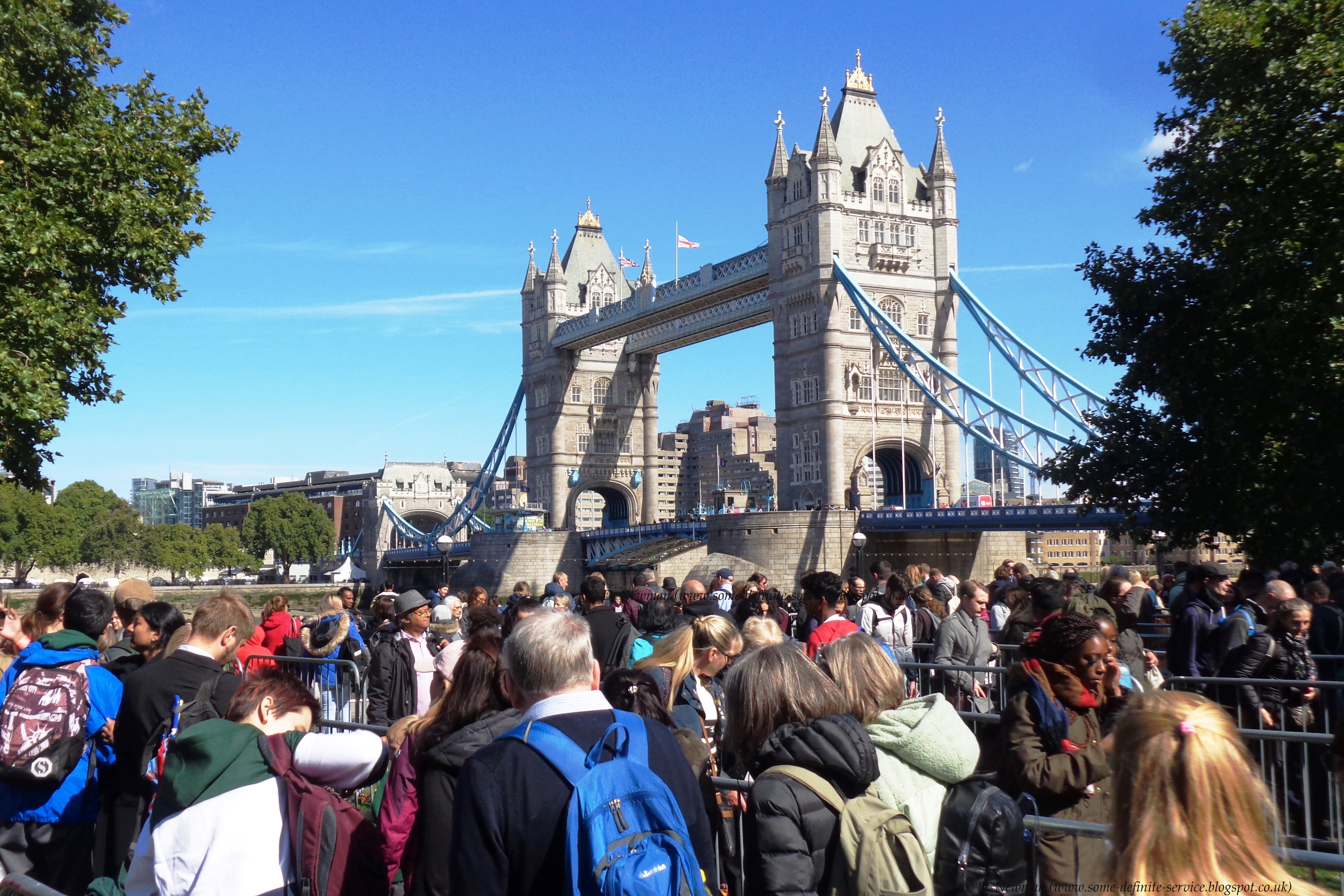
The queue for the Queen’s lying-in-state at the King’s Stairs Gardens, Bermondsey, roughly five miles from Westminster.  10.30 a.m., 17th September 2022. 

My final contribution to the Second Elizabethan Age was, as it turned out, to take half a dozen newly-catalogued manuscripts down to the store, slide them into fresh envelopes, fasten them with archival tape, label them, and put them ready for shelving.  I had seen the lunchtime announcement about the Queen’s health, and worried and prayed as I worked, actually rather glad there was no computer downstairs.  By the time I surfaced again, the news had broken: it was a colleague in Security, an ex-serviceman, who told me.  “If it hadn’t been for her, this country would have gone to the dogs years ago,” he said flatly.

The day afterwards, a friend of mine happened to be cataloguing a file of condolence letters received by an actor’s widow, and came across a nice phrase: ‘You can prepare your mind, but you cannot prepare your heart.’  We had known the day would come and dreaded it, but even I was slightly taken aback by the grief that took hold of me when it did.  As others have said, the Queen’s death was not a surprise — but it was a shock.

Yet the way it happened was in several respects fitting, and therefore already consoling.  Not until after the pandemic, and the great Platinum Jubilee, and even this summer of ferocious heat and the shocking beige of drought were over; only once welcome showers were sending some of the life and colour flowing back into Britain’s veins, so that our landscapes were beginning to look themselves again, did the moment arrive.  The Queen saw us through, and then she went home.

And from the ten days of mourning that followed, too — with a first autumnal bittersweetness in the air, with the tearful glory of rainbows in the skies, with torn ragged clouds trailing overhead at dusk like smoke, with the hard underframe of the national story to which we all belong suddenly only just below the surface — I shall remember not only sorrow, but deep consolation.  I mean not only the constitutional reassurances — the ancient mechanisms of the accession ceremony, swinging into motion like a pair of sombre oaken doors, just, I realise, as they would have done, if needed, on any other day between 1952 and 2022 — I mean something deeper: spiritual consolation.  The lying-in-state, for instance, was balm for the soul, even when seen on television: the solemnity, the simple formality, the reverence.  And it worked, for in filed, and kept filing, thousands upon thousands of mourners, their faces strangely beautiful with love and grief, passing reverently through Westminster Hall, curtseying or bowing or even crossing themselves.  The live-streamed television pictures of this procession, though at times zooming a little intrusively into people’s faces, must be one of the most moving broadcasts I have ever seen.

The queue down Shad Thames, just E. of Tower Bridge.
And the extraordinary lengths of the queues showed the extent of the grief and the love, even as the pictures showed their depth.  Seeing dire warnings of a twenty-two-hour-long wait on the Saturday morning, my sister and cousin and I initially abandoned our plans to join the queue, deciding instead that we would walk along its length, past the mourners, pay our respects outside Westminster Hall, and then perhaps go to see the flowers in Green Park.  But just as we reached the start of the queue at Southwark Park, it was reopened with an estimated length of a mere sixteen hours, and we changed our minds and queued after all.

It was, as many have noticed, a pilgrimage — starting, for us, under the dingy girders of South Bermondsey station, along past Galleywall Road, through Southwark Park and a first set of interminable zigzags into the queue, past the makeshift tea-stands set up by enterprising residents, snaking among converted warehouses and bridges and embankments and theatres, over Lambeth Bridge, until, after a further two hours shuffling concertina-wise up and down Victoria Gardens, and a jarring bag-search and body-scan, at last we slipped into the thick solemn hush of Westminster Hall, with the rich colours of the catafalque before us, and the priceless brilliance of the Imperial State Crown flashing finely at journey’s end.

Zigs and zags at Tower Bridge

The whole experience (which turned out to be eleven hours long, not sixteen) taught me something about pilgrimage: that it is the natural expression of gratitude.  I had, and have, no way of repaying the Queen for her years of faith, and integrity, and quiet constant example.  All I could offer was a mark of respect before her coffin.  Small recompense indeed — but there was subconscious logic at work; the knowledge that if this little gesture could somehow be made to cost me more — if I had had to stand in a queue six miles long in order to be able to make it — perhaps it would actually come to be worth more.  Rather like the widow’s mite in the Gospel, my little bow would take on a greater meaning, because I had ‘given all I had’.

The Lambeth Embankment, across the river from Parliament, as the afternoon wears on

This, I think, has something to do with why, when I had heard that the queuing time had nearly doubled, my initial reaction was not dismay, but a strange instinctive determination that I was Jolly Well going to queue, come what may.  This is surely the same impulse that drives people to walk barefoot and impose on themselves all sorts of hard, tough exigencies while on pilgrimage.  It is, however heartily we laugh and joke with our fellow pilgrims along the way, a serious, deep, even primal gesture of love.

The Palace of Westminster from Lambeth Bridge, with flag at half-mast

I think the same is true of the great marches and the funeral offices: as well as solemn duties, they were acts of love and gratitude.  How beautiful, then, that they healed us even as we undertook them.  How comforting, too, were the beautiful prayers of the Anglican liturgy, their loving poetic language, commending our Queen to our God, and telling us again and again what we needed to hear: that whereas we rightly grieve our Sovereign who ‘now rests in sleep’, we may nevertheless have confidence both that ‘we shall rise again at the coming of our Saviour Jesus Christ’  —  and, furthermore, that ‘in due time, we may share with our sister that clearer vision when we shall see thy face.’  We are right to grieve, but it is not the end: again and again I drank in the medicine of those words.  One sensed the wisdom of ages in the knowledge that ten full days would be needed for the initial salving and bandaging of the wound, for that ‘gracious promise’ to sink in once again.  

The two-mile-long concertina in Victoria Gardens

“We will miss Queen Elizabeth terribly, said Archbishop of Southwark, John Wilson, at a beautiful Requiem Mass at St. George’s Cathedral the following morning.  I have written at length elsewhere in these pages of my admiration for the Queen, and of how extraordinarily blessed we have been to have at the heart of our national life a person who placed love so clearly above power, and for so long, and with such constancy.  She may not have made her personal opinions known, but she did show her beliefs, and the response to her death, the outpouring of grief and love, shows that this did not go unnoticed.  And so, as that extraordinary and bittersweet month slides away off into the past, and as we who share those beliefs, shouldering our loads, turn to carry on without her, we may take slow-burning courage from this parting gift: the vindication in her death of the manner of her life.

Go forth upon thy journey from this world, O Christian soul;
In the name of God the Father Almighty who created thee;
In the name of Jesus Christ who suffered for thee;
In the name of the Holy Spirit who strengtheneth thee.
In communion with the blessèd saints,
and aided by Angels and Archangels,
and all the armies of the heavenly host,
may thy portion this day be in peace,
and thy dwelling in the heavenly Jerusalem.  Amen.
A still frame from the BBC’s live stream from Westminster Hall.

Tuesday, November 01, 2022

Fanfare for Allhallowstide

All Saints’ Day in the city of Łódź in 2014.  In Poland it is traditional to place candles and flowers on the graves of loved ones, even if it involves a journey of hundreds of miles.
(Picture by‘
Zorro2212’ on Wikimedia Commons, shared under US licence https://creativecommons.org/licenses/by-sa/4.0/deed.en)

Reposted according to tradition…

    
 How shall we pilgrims keep the law of love?
  How shall we follow where our Lord has led?
  The saints know how: they point the way ahead;
  They watch the road to Heaven from above.

  The saints were young and old, were great and small;
  However they were called, one truth they knew:
  Whatever works of woe the world may do,
  The Lord shall never let His faithful fall.

  So we on earth, we should be saints as well;
  We wayward wayfarers whom they invite
  To blaze with love; to set the world alight;
  To join them in the joy in which they dwell.

  As we must one day die, they also died,
  But live now as we hope we too shall live.
  To all our friends in Heaven let us give
  Our joyful greetings at Allhallowstide!

Wednesday, October 12, 2022

Vaughan Williams 150

A revised version of an article from 2018.

‘And I saw a new heaven and a new earth…’. From Sancta Civitas (1928), the composer’s favourite of his own choral works. 

Today, 12th October 2022, is the hundred-and-fiftieth anniversary of the birth of Ralph Vaughan Williams (1872–1958).  Was he England’s greatest composer?  He has plenty of strong competition of course, and perhaps half the fun is never quite to settle the question — but as far as I am concerned, if anyone is to match Vaughan Williams, then they too will have to draw me, irresistibly, again and again, yet in a different way every time, into a distinctive, great-hearted, masterfully-crafted musical world that is all its own.  He is in first place in my book.

Vaughan Williams photographed at home (The White Gates, Dorking, Surrey) in January, 1949.

His was a life that, in many ways, took place in reverse.  He emerged as a composer relatively late — not completing his first symphony until he was thirty-five — but from then on never diminished in his  output, even intensifying as he aged.  Those who might have perceived in his fifth symphony (premièred in 1942, his seventieth year) a mellowing in age, or a mood of valediction, would hardly have suspected that this was actually the half-way mark, and that there were four more symphonies to follow.  Throughout his last decade — well into his eighties — he seemed unstoppable, completing his three final symphonies, the opera The Pilgrim’s Progress (a lifetime’s work), concertos for harmonica and tuba and much more, all the while maintaining an energetic social life, both conducting and attending concerts.  And it was not only musically that he was thriving: after the death of his wife Adeline in 1951 after decades of illness, he was rejuvenated by a second marriage to the poet and playwright Ursula Wood (whose poetry he set to music).  So he seems almost to have been cut off in his prime, though he lived to eighty-five.

Music for the film 49th Parallel.

I admire Vaughan Williams in the first place for the most straightforward reason: because the sound of so much of his music appeals to me so directly.  Time and again he wove melodies, harmonies, textures and cadences masterfully together in the service of beauty, beauty for its own sake.  This beauty often seems so self-evident that I would struggle to explain it.  Yet that first appeal, having drawn me in, makes me all the more willing to listen again more carefully for details I have missed, or to brave the composer’s more challenging works.  In that way he has taught me a great deal about the more intellectual side of ‘serious music’: its forms, its structures, and the depth of expression that they make possible.  So, for example, I have found my life enriched both by the tuneful English Folk-song Suite, which I have loved since I was small, and by the Fourth and Sixth Symphonies, which I discovered in my twenties.  Yet in all his works the same personality is discernible: a companion and a teacher and a seer, who may challenge but never disregards the listener.

The third movement (Scherzo) of the London Symphony, played by the Spanish Radio and Television Orchestra and conducted by Carlos Kalmar.

This capacity for both simplicity and complexity is only part of another remarkable aspect of Vaughan Williams: his sheer versatility, or his ‘tremendous range’, as Vernon Handley put it.  He wrote music of so many flavours, for so many purposes, and all so convincingly, that it is sometimes hard to believe that they flowed from a single pen.  Is the same man really responsible for the tranquil Greensleeves Fantasia and the enthralling anguish of the fourth symphony; for the diabolical chortling of Satan’s Dance of Triumph (from his ballet Job) and the tiny jewel of an anthem, O Taste and See?  He went off searching for ideas in all sorts of directions, but always came back to his own distinctive drawing-board: his work always bears, somewhere or other, the hall-mark of one and the same personality.  There is Vaughan Williams the collector of folk songs, Vaughan Williams the scorer of films, Vaughan Williams the compiler of the English Hymnal.  His music might be sacred or secular, it might last for four minutes or four movements, it might summon full chorus and orchestra or call simply for a solo violin and piano.  For his harmonies he drew on everything from Tudor polyphony to thirties dance-band music; he also experimented with sonority, including a wind machine in his Seventh Symphony, a flügelhorn in his Ninth and ‘all the ’phones and ’spiels known to the composer’ in the Eighth.  And then there are the moods that pass over his music, as many and as various as the English weather’s: serene or furious, reserved or exuberant; proliferating with detail or hanging austerely in clear air. 


 One of the best ways of hearing many of these moods is in that eighth symphony — even in its first movement alone, which is constructed entirely around the very first four notes played.  Sir Mark Elder conducts the Hallé Orchestra.

Another characteristic of his music is — I can think of no subtler word — its manliness.  So much of it seems to express some aspect of, and to be so evidently the work of, the heart and spirit of a man.  In other words, there is a particularly masculine warmth, an outward robustness, a heartiness, a full-bloodedness about it all.  That is not to suggest that he did not mean his music for men and women alike, nor to assume that it was conscious or deliberate — it is simply part of the character and colour of his music.  His work is shot through with the vigour, the spirituality, the moods, the quickness, the temper, the restlessness, the passions, the solitary questing of manhood.

The second movement of the Concerto for Violin and Strings (1925; originally Concerto Accademico).   André Previn conducts the London Symphony Orchestra; James Buswell is the soloist.

Then there is his Englishness, the quality of his music which is perhaps most often commented on.  Vaughan Williams is credited with reviving and developing a particularly English style of music, one that was in contrast with the German idiom of Beethoven and Brahms and Mendelssohn that had prevailed before.  Vaughan Williams was interested in Tudor polyphony and traditional folk-song and the music of ordinary people, not for shallow or jealous reasons, but in a search for authenticity, and in a spirit of revival of old forgotten things and celebration of the particular — and it worked: his music sounds like home.  Hear how well it goes with Shakespeare, or with Chesterton; see how his hymns and carols have passed straight into the canon.  And he was keenly aware of the threats that England faced in his own day — war, the destruction of landscape, the decline in spirit.  Indeed, the sheer spiritual exhaustion of the modern world in general, sated with banality to the point of grief, is prefigured in much of his music.  Hear, for instance, the desolate passages that close the first movement of the Ninth Symphony:


Against despair and nihilism, though, Vaughan Williams was the great champion of the human spirit, and the idea of the lone pilgrim persevering against the odds preoccupied him all his life.  His reverence for folk-culture is precisely an example of this.  There is surely much to be said for founding ‘high art’ on traditional, unaffected idioms: familiar, time-worn songs keep high culture rooted in earth, while transfiguring the familiar elevates and enriches the popular culture.  And even as Vaughan Williams broke new ground with his symphonies and cantatas, he was content, I think, to be a servant of his age.  His heavy involvement in the Leith Hill Musical Festival, and his prolific output of hymns and film-scores and ‘practical music’ (notably the Concerto Grosso for musicians of varying accomplishment, or the Household Music written in wartime for whatever instruments were to hand) reveal a profoundly public-spirited man, unashamed of belonging to a particular time and place, and lending his talents to the service of others.  He himself was quite firm about this: ‘The composer must not shut himself up and think about art,’ he declared; ‘he must live with his fellows and make his art an expression of the whole community.’

For all these reasons and more besides, it is Vaughan Williams whom I hero-worship as Britain’s greatest composer.  Other composers may have shared many of the qualities I have described, but it is  only in him that they are all united.  His music, in all its variety, sounds as fresh as ever, and is still working its magic on lovers of beauty in new generations.  May it continue to lighten lives for centuries to come.

Ballad from the Suite for Viola and Orchestra

Thursday, September 15, 2022

It is Meet and Right

Herbert Howells’ anthem for the late Queen’s Coronation in 1953: music that has been much in mind these past few days.  ‘Behold, O God, our defender, and look upon the face of thine anointed.  For one day in thy courts is better than a thousand.’  (Psalm 84)

It is remarkable: Britain has rediscovered solemnity.  Amid my grief — and it certainly has been grief, with the immovable knot of dread in the gut, the catch in the heart, the oblique recurring waves of disbelief — there is a deep well of consolation in seeing the dignified, fond farewell that we are giving our beloved Queen.

Of course, plenty of people are carrying on more or less as normal — loud phone conversations on trains, and so on — and conversations with friends and colleagues have revealed that not everyone is feeling particularly bereaved — several have admitted as much.  Some try to find something humorous to say, while others, perhaps wary of the ambush of sorrow, say breezily, ‘Well, it’s all part of history.’  Maybe at moments like these it has always been so: not everyone sees things in the same way and, after all, feelings cannot be forced.  But to me there is a real change in the air.

For instance, there was the sight of the flowers in Green Park on Sunday, the aisles and aisles of them under the September-heavy trees.  At first, as I wandered up and down them, my thoughts snagged on a mild anxiety that this might all be a little too sentimental, a little too much about us and not enough about the Queen, but then I saw the volunteers, going steadily through the flowers to remove the plastic wrapping — the sort of unglamorous but necessary task that the Queen herself would have noticed and admired — and was reassured.  I made my way up the Mall, past St. James’ Palace from whose window-sills the new King had been proclaimed the previous day, caught the conclusion of the Changing of the Guard at Horse Guards Parade, cut through into Whitehall, went on across Parliament Square and down Millbank, over the Thames at Lambeth Bridge, and ultimately to a beautifully said and sung Requiem Mass at St. George’s Cathedral.  I signed the condolence book there which had been carefully laid out.

This change in the air is a reassurance and a consolation.  Whereas normally, and above all in the pandemic ‘lockdowns’, we have had row after row of identical days like the cells of a blank spreadsheet, these days are heavy with meaning.  That weight tells us that we are right to mourn and to grieve, and to miss the Queen; that we are not being silly or over-sensitive in our sorrow.  Dignity and reverence and solemnity have returned, and for the right reasons.  (The sole mistake so far has been the decision to bring the Queen’s coffin to London by air, rather than by rail as was the original plan.)  Even the screens that usually flicker their deranging advertisements at us now display still pictures of the late Queen with a sober message of condolence.

And then there was yesterday’s cortège, the slow drum-beat, the polished sombre brass, the thud of the guns and Big Ben tolling once every minute.  We of the smartphone generation, the children of the Internet Age, saw the coffin borne in sorrowful dutiful stateliness to the Palace of Westminster.  And  in Westminster Hall, where for now she lies in state, how fitting it all is, how right.  How rich all the colours are, so deep that they can be felt imbuing themselves into the memory.  They are as rich and deep as our grief: the thick warm yellow translucence of the candle-wax, the scarlet and gold of the furled standard, the clean stone, the purple-shrouded catafalque.

The BBC’s live stream of the vigil in Westminster Hall is, though a little intrusively zoomed-in on occasions, very moving to watch.  How strangely beautiful is the grief in the faces of the mourner-pilgrims who have waited many hours to pause, or to bow, or to make the sign of the Cross, or to salute, or even to blow a kiss.

The Queen has ‘surprised a hunger in ourselves to be more serious’ — and this, I think, is the first, immediate example of the way in which her life continues, and will continue, to bear fruit for us.  This is how it works, the life of faith: light catches light, heart speaks unto heart.  Those of us who shared or sympathised with her hopes and beliefs now feel the burden of responsibility falling on us, the duty to be little bolder in standing up for those beliefs, and living by them.

Part of our duty to the late Queen is, of course, giving the new King the acclamation he deserves.  And so we have, with such wonderful sonorous language — ‘Whereas it has pleased God to call to Himself our late Sovereign Lady Elizabeth of happy memory…’

I feel strangely at home in these otherworldly days of sorrow.  This is a deeply sad parting, a real wrench, and it is hard not to worry about the future — I am trying not to think about the loneliness which may well sweep in again after the funeral, that sense of an autumn of many things — but, as Joanna Bogle has pointed out, this is fundamentally not a horrible grief, as one feels after an outrage or a tragedy — it is a gentle farewell, mingled with deep gratitude and with confidence that the Lord whom our Queen served so well will say, ‘Well done, good and faithful servant,’ and receive her at last into Heaven.  And since, after all, as Her late Majesty herself told us, ‘grief is the price we pay for love’, it is only fair that I should settle my account.  So, strange to say, thanks be to God for this moment of togetherness in grief and love, and for all His bittersweet blessings.

Thursday, September 08, 2022

Our Sovereign Lady Elizabeth

Her Late Majesty outside Hitchin station, 14th June 2012

Queen Elizabeth, for seventy years our unfailingly good and just sovereign, died earlier today.  

Eternal rest grant unto her, O Lord, and let perpetual light shine upon her.  Welcome her into the kingdom of Heaven.  Amen.

For the moment I have no other words than these, written for her Platinum Jubilee:

Beacons

After the fanfare the beacons flare 
Out in the dusk and the still June air; 
Thousands of parishes blaze brave light 
Loyally into the nearing night, 
And on the hillside a quiet prayer 

Lifts, though the words are hard to find, 
Up from the heart; because, behind 
These great festivities, we know 
There are some deeper thanks we owe —
Thanks for deep faith, the quiet kind; 

Faith shown in small things that fulfil 
Great vows of youth; that sows good-will; 
Faith that has long encouraged us; 
Faith without faltering or fuss, 
Plain as a beacon on a hill. 

This long example that you have set 
Shows us, Your Majesty, how we yet 
May find eternal jubilee: 
We see, we understand and we 
Will not forget, will not forget.

Tuesday, August 09, 2022

Jubilee Thoughts

I had been worried that I would not enjoy the Queen’s Platinum Jubilee — not because I lacked enthusiasm for the occasion, but because I feared that the national celebration would not do it justice.  There is an impression often given by the purveyors of mainstream or at least mass culture, that they think the Crown exists merely on licence, so to speak, and that they are entitled to permit it to survive solely in the measure that it conforms to the tone, the language and the beliefs of secular modernity.  I worried too that the general inability of our culture to take anything seriously would drain the whole Jubilee of the solemnity, of the mystery, that underlies the celebration.  

Many of these fears did materialise, at least in part, but one way and another I found myself not minding too much.  At least, it certainly did not spoil a thoroughly enjoyable weekend which left me with plenty of happy memories.  There were some wonderful occasions which seemed to capture the spirit of the celebration marvellously — the lighting of the Jubilee beacons on a local summit of suburban south London, and a trip to Windsor to see a flotilla of barges and a display of classic cars — and in general it was heartening to see proper cheerful Union Jacks hung from houses and to know that people were making merry and having a good time together.  The flypast and Trooping the Colour (seen via television) were magnificent; the service at Westminster Abbey was dignified and beautiful.  There was also, on BBC Four, the very moving and warmly recommended programme ‘The Unseen Queen’: a compilation, presented by the Queen herself, of personal cine-films from her early life.  My strong impression was that Her Majesty intended this film less as an autobiography than as a tribute to her father George VI.

This Jubilee was the first chance for a national celebration we have had for some time — indeed for far too long.  The pandemic is the obvious cause of this drought, but we have had other troubles too.  Immediately before that we had had a great deal of understandable disagreement over the result of the European Union referendum, wrangling which, in retrospect, feels like something whose development and duration ought to have been expected but which, until the General Election in 2019, felt as if it would never end.  As it was, we went into the pandemic without those divisions properly healed.  The pandemic itself might have brought about a degree of unity, but of course not for celebration — and even that unity began, probably inevitably, to break down.  Then, during that strange and disturbing summer of 2020, partly, I think, in revenge for the referendum result, advantage was taken of our mutual isolation to push radical and alarming political agendas to the very top of non-political institutions.  So, all in all, for quite some time we have not been ourselves, and have been in need of a cause for proper and convivial unity, a chance for some national sentiment — and our Queen’s unwavering reign gave us one.

How long the good sentiments will last I do not know.  The Queen by her own example makes it clear to us what sort of a country, what sort of a people, she believes we ought to be.  Too many of us pretend not to hear her.  She must know — and, deep down, so must we — that she has been a better Queen to us than we have been subjects to her.  Rather like a grandmother who never ceases to love the grandchildren who have turned their backs on her and all her wisdom, she says no word of reproach, but neither does she concede one shred of principle.  Those of us who still believe in the old values, the eternal verities, hear and understand her, and we will keep her words in mind long after the bunting has been taken down.

For what we are celebrating — the mystery beneath the merriment — is the fulfilment of a great vow.  The Jubilee reminds us, among other things, that such achievements, such greatnesses, remain possible.  It is a wondrous and a fearsome truth, and reason for heartfelt thanksgiving.

Sunday, July 31, 2022

On Praying for Ukraine

In recent days two notices, each outside different Anglican churches, have happened to catch my eye.  One read, ‘We Pray for Ukraine’; the other, ‘Ukrainians Welcome Here’.  

And so we should, and so they should be.  But ought we not also, albeit in a different way, to be praying for Russia; should Russians of good will not also be made welcome?  The obvious plight of Ukraine makes our prayers as straightforward as they are ardent, but it seems to me to be no less important to pray for Russia, even if the words are necessarily more complex and rather harder to say.  The sparing of the young army conscripts and their families, the consolation of the unjustly bereaved, the success of those working underground or behind the scenes to bring a just end to the whole situation, in general the liberation of Russia’s people from their thousand-year nightmare, and — perhaps most difficult of all — the conversion and ultimately the forgiveness of her leaders and soldiers who have willingly spilled blood and brought disgrace on their nation — all these we can surely pray for without excusing or overlooking in any way the evil that has been done in Russia’s name.

Since a nation is a larger, looser version of a family, the bonds that bind it implicate all its members in its collective reputation, its collective fate.  But although the fate is collective, responsibility for that fate is not.  Thus, while the name of Russia is soiled by this new outrage, only a minority of Russians are actually to blame for it.  It is a horrible situation for them — certainly, more abstract and less raw in its horror than having one’s homeland blasted to ashes, but horrible nonetheless.  To pray for them is an act both of mercy and of justice.

The intentions behind the churches’ signs were good and sincere, I do not doubt, and I am confident that any Russians appearing in the pews would be welcomed there in practice, but we should do our best not to leave these things in any doubt, nor to let it be thought that our prayers are too hasty, or too reflexive, or unduly partial.  So, hard as it may be in this one-sided situation, we should try to pray for consolation wherever there is suffering, for justice wherever there is injustice, for mercy wherever there is contrition.

Tuesday, July 26, 2022

Six years since World Youth Day in Kraków

Six years ago today I was sitting at my laptop in my student flat, watching the opening Mass of World Youth Day in Kraków, and wishing more with every minute that I were there.  I was struck particularly by the music, which was supplied by a full choir and orchestra and consisted of fine, uplifting hymns and a beautiful Mass setting — full of a kind of joyful stateliness for the occasion, and all with rich, even cinematic orchestration.  

My endeavours to try and find out more, or indeed anything, about it all — what the hymns were called and how to spell them, let alone who had composed them! — sparked an effort to learn Polish pronunciation (which turned out not to be as hard as it looks) and a tentative but continuing attempt to learn the language itself.  And it drew me into the discovery and deepening love of Polish church music and the life that surrounds it — everything from their travelling liturgical music workshops, which draw hundreds of people to make music together, to the enormous outdoor hymn-concerts held every year in the city of Rzeszów.  The discovery of the Dominican Liturgical Centre in Kraków has been a revelation, and last October it was a joy and a privilege to take part in a workshop given by the composer Paweł Bębenek at St. Dominic’s Priory in London, and then to sing music composed by him and his fellow composers in an unforgettable candle-lit vigil.

Today is also, of course, the sixth anniversary of the martyrdom of père Jacques Hamel of Saint-Etienne-du-Rouvray, near Rouen.  The mingling of the two events as they reached me from afar — of the joy of World Youth Day and the sharp sorrow of that news — is something else which has fixed that day in my memory.

The Agnus Dei of Henryk Jan Botor’s Missa Ioannis Paoli Secundi, written specially for World Youth Day and sung at its opening Mass at Błonia Park, Kraków, on the 26th July 2016.  This setting has proved popular with our parish Youth Choir in South London.

Friday, June 24, 2022

Finding Adlestrop

Yes.  I remember Adlestrop —
The name, because one afternoon
Of heat the express-train drew up there
Unwontedly.  It was late June.

In fact it was the twenty-fourth of June: today is the anniversary of the ‘afternoon of heat’ that inspired this much-loved poem.  On this day in 1914 Edward Thomas was aboard the London to Hereford express, climbing up over the north Cotswolds, on his way to the poets’ colony at Dymock in Gloucestershire.  It was, as he recorded in his journal —

[…] a glorious day from 4:20 am and at 10 tiers above tiers of white cloud with dirtied grey bars above the sea of slate and dull brick by Battersea Park — then at Oxford tiers of pure white with loose large masses above and gaps of dark clear blue above haymaking and elms.

Then we stopped at Adlestrop, through the willows could be heard a chain of blackbirds songs at 12:45 and one thrush and no man seen, only a hiss of engine letting off steam.

Stopping outside Campden by banks of long grass willowherb and meadowsweet, extraordinary silence between the two periods of travel — looking out on grey dry stones between metals and the shining metals and over it all the elms willows and long grass — one man clears his throat — greater than rustic silence.  No house in view.  Stop only for a minute till signal is up. 

Another stop like this outside Colwell [Colwall, just west of the Malverns?] on 27th with thrush singing on hillside above on road.

I hope I do Edward Thomas no disservice in observing that it is as much because of circumstance as the poem’s beauty in itself that this poem is so fondly and firmly remembered.  Within three months of that afternoon Britain was at war; three years later Thomas was dead, killed by a shell at Arras.  In March 1963 they came for the station as well: if you turn in your copy of Richard Beeching’s ‘The Reshaping of British Railways’ part 1, section 3, to page 109, the list for England of ‘Passenger Stations and Halts to be Closed’ — a list which reads, Ian Hislop has observed, ‘like the names on a war memorial’ — there it is, the fifth item from the top, ‘Adlestrop’, in cold dispassionate print between Addingham and Ainsdale: so callously tin-eared, so ruthlessly bureaucratic and ignorant, so bone-headedly inevitable, that there is something actually poetic and tragic about its presence on this list.

The steam hissed. Someone cleared his throat.
No one left and no one came
On the bare platform. What I saw
Was Adlestrop — only the name

And willows, willow-herb, and grass,
And meadowsweet, and haycocks dry,
No whit less still and lonely fair
Than the high cloudlets in the sky.

And for that minute a blackbird sang
Close by, and round him, mistier,
Farther and farther, all the birds
Of Oxfordshire and Gloucestershire.

Thomas recorded the event because he knew it was fleeting, one of those in-between moments that we so seldom remember to remember — but did he realise how fleeting how much of it was?  For it is not only the moment that is now lost, but the country, the world in which it was possible.  Not only ‘that minute’ but most of what was in it and around it: the locomotive, the station, the silence aboard stationary carriages; no doubt most of the birdsong too.  The Dymock colony, the whole reason for the journey — the whole set of circumstances upon which it was contingent.  The railway survives — Brunel’s ‘Cotswold line’ from Oxford to Worcester is still one of Britain’s loveliest —  but of the station, other than the stationmaster’s house, nothing is left but the sign, mounted on a bus stop in the village  — only the name.  

The poem itself seems in retrospect as fragile and precious as the moment it is describing: written just in time, in the last years when such a poem could be made, by Thomas or anyone else.  This one vignette of a single signal-check has been pressed and hardened by the tremendous historical forces around it into a tiny treasured gem, standing not only for itself, but for all those other unwonted moments of ‘extraordinary silence’ that were possible, and about which poems could have been written, in that old world before the war.  Almost by accident, then, we have this snapshot from a time, perhaps the last time, when Deep England could still make a riposte to the modern world, could conspire to bring a modern express train to a grinding halt and ambush its passengers with her shocking stillness.  Thomas’s sketch — which even in finished form retains the jotted-down freshness of his original journal entry — is now as strangely dizzying as one of those old autochrome photographs, so real we can scarcely believe it.

The site of Adlestrop station is between Kingham and Moreton-in-Marsh stations on the climb to Chipping Campden summit; the precise coordinates are 51.9360°N 1.6591°W, immediately north-west of the overbridge carrying the road from Adlestrop to Oddington.  On this cab-ride video of the journey from London Paddington to Hereford, the site can be seen just after the bridge at 1h 16m seconds.  (The former stationmaster’s house can just be glimpsed on the left).

Thomas was absolutely correct, by the way, to speak of ‘Oxfordshire and Gloucestershire’ — the county boundary crosses the railway less than a mile from the station in the up direction. (Its rough position is indicated by a caption on the cab-ride video at 1h 14m 40s; the line it takes is rather convoluted but it makes its final crossing of the railway at the end of the wall of tall trees on the right).  Thomas’s last line was as accurate as it was evocative.

What does it mean, I wonder, that at the poem’s centenary in 2014, a special train was organised to recreate the ‘unwonted stop’, slowing down at the old station so that the lines could be read over the loudspeaker?  Here is a video taken from aboard the train —

— and here is another from the overbridge itself, where the poem was also read as the train rounded the curve.

I cannot help feeling that something deep and beautiful is happening here.  These people have come to a particular place at a particular time — in other words, come on pilgrimage — for the sake of a much-loved, long-remembered poem.  Poetry often seems to be at its strongest when it works through the memory, and this poem, in touching not only our minds and hearts but the English landscape and time itself, has become a kind of memorial — one not of marble or granite, but made up of all four of those elements: minds, hearts, landscape, time.  Thus, just as the poem has come to stand for a whole vanished world, so this remembrance of the poem was a remembrance of that world.  To remember Adlestrop is to remember England.  And, even though it has been blotted out of the landscape and is no more than a memory, Adlestrop station still persists; it still somehow belongs to the English landscape, and the poem keeps it there. 

So for that minute a lost world lived again, proven still to abide in many minds and hearts; and poetry sustained it, poetry summoned it into sight.  Poetry is deeper than we know; it is as deep as England, as history, as life itself.