Saturday, September 18, 2021

Eleven years ago today…

Eleven years ago, Pope Benedict delivered these words to a multitude of 80,000 in Hyde Park in London…

This is an evening of joy, of immense spiritual joy, for all of us. We are gathered here in prayerful vigil to prepare for tomorrow’s Mass, during which a great son of this nation, Cardinal John Henry Newman, will be declared Blessed.  How many people, in England and throughout the world, have longed for this moment!  It is also a great joy for me, personally, to share this experience with you.  As you know, Newman has long been an important influence in my own life and thought, as he has been for so many people beyond these isles.  The drama of Newman’s life invites us to examine our lives, to see them against the vast horizon of God’s plan, and to grow in communion with the Church of every time and place: the Church of the apostles, the Church of the martyrs, the Church of the saints, the Church which Newman loved and to whose mission he devoted his entire life. 

I thank Archbishop Peter Smith for his kind words of welcome in your name, and I am especially pleased to see the many young people who are present for this vigil.  This evening, in the context of our common prayer, I would like to reflect with you about a few aspects of Newman’s life which I consider very relevant to our lives as believers and to the life of the Church today.  Let me begin by recalling that Newman, by his own account, traced the course of his whole life back to a powerful experience of conversion which he had as a young man.  It was an immediate experience of the truth of God’s word, of the objective reality of Christian revelation as handed down in the Church.  This experience, at once religious and intellectual, would inspire his vocation to be a minister of the Gospel, his discernment of the source of authoritative teaching in the Church of God, and his zeal for the renewal of ecclesial life in fidelity to the apostolic tradition.  At the end of his life, Newman would describe his life’s work as a struggle against the growing tendency to view religion as a purely private and subjective matter, a question of personal opinion.  Here is the first lesson we can learn from his life: in our day, when an intellectual and moral relativism threatens to sap the very foundations of our society, Newman reminds us that, as men and women made in the image and likeness of God, we were created to know the truth, to find in that truth our ultimate freedom and the fulfilment of our deepest human aspirations.  In a word, we are meant to know Christ, who is himself “the way, and the truth, and the life”.

Newman’s life also teaches us that passion for the truth, intellectual honesty and genuine conversion are costly.  The truth that sets us free cannot be kept to ourselves; it calls for testimony, it begs to be heard, and in the end its convincing power comes from itself and not from the human eloquence or arguments in which it may be couched.  Not far from here, at Tyburn, great numbers of our brothers and sisters died for the faith; the witness of their fidelity to the end was ever more powerful than the inspired words that so many of them spoke before surrendering everything to the Lord.  In our own time, the price to be paid for fidelity to the Gospel is no longer being hanged, drawn and quartered, but it often involves being dismissed out of hand, ridiculed or parodied.  And yet, the Church cannot withdraw from the task of proclaiming Christ and his Gospel as saving truth, the source of our ultimate happiness as individuals and as the foundation of a just and humane society.

Finally, Newman teaches us that if we have accepted the truth of Christ and committed our lives to him, there can be no separation between what we believe and the way we live our lives.  Our every thought, word and action must be directed to the glory of God and the spread of his Kingdom.  Newman understood this, and was the great champion of the prophetic office of the Christian laity.  He saw clearly that we do not so much accept the truth in a purely intellectual act as embrace it in a spiritual dynamic that penetrates to the core of our being.  Truth is passed on not merely by formal teaching, important as that is, but also by the witness of lives lived in integrity, fidelity and holiness; those who live in and by the truth instinctively recognize what is false and, precisely as false, inimical to the beauty and goodness which accompany the splendour of truth, veritatis splendor.

Tonight’s first reading is the magnificent prayer in which Saint Paul asks that we be granted to know “the love of Christ which surpasses all understanding”. The Apostle prays that Christ may dwell in our hearts through faith, and that we may come to “grasp, with all the saints, the breadth and the length, the height and the depth” of that love.  Through faith we come to see God’s word as a lamp for our steps and light for our path.  Newman, like the countless saints who preceded him along the path of Christian discipleship, taught that the “kindly light” of faith leads us to realize the truth about ourselves, our dignity as God’s children, and the sublime destiny which awaits us in heaven.  By letting the light of faith shine in our hearts, and by abiding in that light through our daily union with the Lord in prayer and participation in the life-giving sacraments of the Church, we ourselves become light to those around us; we exercise our “prophetic office”; often, without even knowing it, we draw people one step closer to the Lord and his truth. Without the life of prayer, without the interior transformation which takes place through the grace of the sacraments, we cannot, in Newman’s words, “radiate Christ”; we become just another “clashing cymbal” (1 Cor 13:1) in a world filled with growing noise and confusion, filled with false paths leading only to heartbreak and illusion.

One of the Cardinal’s best-loved meditations includes the words, “God has created me to do him some definite service. He has committed some work to me which he has not committed to another”.  Here we see Newman’s fine Christian realism, the point at which faith and life inevitably intersect.  Faith is meant to bear fruit in the transformation of our world through the power of the Holy Spirit at work in the lives and activity of believers. No one who looks realistically at our world today could think that Christians can afford to go on with business as usual, ignoring the profound crisis of faith which has overtaken our society, or simply trusting that the patrimony of values handed down by the Christian centuries will continue to inspire and shape the future of our society.  We know that in times of crisis and upheaval God has raised up great saints and prophets for the renewal of the Church and Christian society; we trust in his providence and we pray for his continued guidance.  But each of us, in accordance with his or her state of life, is called to work for the advancement of God’s Kingdom by imbuing temporal life with the values of the Gospel.  Each of us has a mission, each of us is called to change the world, to work for a culture of life, a culture forged by love and respect for the dignity of each human person.  As our Lord tells us in the Gospel we have just heard, our light must shine in the sight of all, so that, seeing our good works, they may give praise to our heavenly Father.

From the homily of Pope Benedict XVI at the Prayer Vigil in Hyde Park, Saturday, 18th September 2010, retrieved 18 September 2021 from https://thepapalvisit.org.uk/home/replay-the-visit/day-three/the-holy-fathers-hyde-park-vigil-address/

Wednesday, September 08, 2021

Thanksgiving for a Fair Summer

The Malvern Hills seen from fields east of Whittington, Worcestershire, in late August 2021.

Does it come about now, the cusp between summer and autumn?  Or has it already passed?  Or is it still to arrive?  The change hides deep in the veins and roots of things, like the turning of a tide, or the recognition of a truth.  Elizabeth Jennings smelled it before she could see it:

Now watch this autumn that arrives
In smells.  All looks like summer still;
Colours are quite unchanged, the air
On green and white serenely thrives.
Heavy the trees with growth and full
The fields.  Flowers flourish everywhere.    [1]

Those lines are a perfect description of days such as Monday was in south-eastern England, though in suburban London there was no hint of smoke of the kind that awoke autumn for Elizabeth Jennings.  Summer still, then — but then Tuesday, with a lessening of the haze or a change in its quality, throwing down a more golden light from a bluer sky, maturing the palette into that of an illuminated manuscript, brought about an anagnorisis of sorts.  On the Common the crickets still sizzle in the parchment-yellow grasses, and there are startling splashes of colour from the thistles and gorse, though the cow-parsley is going over.  The trees are, yes, ‘heavy with growth’, and dark with it, too, as dark as they are green; some already bear rashes and outbreaks of rust, but, less brazenly, even where all seems green at first glance, there is a dustiness, a mauveness, a wine-darkness in the shadows.  It is the purple of finished splendour, of growth itself grown old: the summer is an empire whose conquests are complete.

But the seasons always turn to linger a few times before they are quite gone, and I rather suppose that even these incongruous days of the high twenties are not quite the end.  ‘Ambiguity’ is Jennings’ word for it — 

Summer still raging while a thin 
Column of smoke stirs from the land 
Proving that autumn gropes for us.

I have been trying to work out which should come first: the poem from which these lines are taken, Song at the Beginning of Autumn, or Ruth Pitter’s free-verse Thanksgiving for a Fair Summer.  Perhaps Pitter follows Jennings, even though she is describing weather like today’s.  ‘We had thought summer dead,’ she says —

But now hot camomile in headlands grows,
Strong-smelling as from toil of reaping: bees
Their delicate harvest in the rusty rows
Of scarlet bean, and woodbine that still blows,
Though flower with berry, gather and do not cease;
No mushroom yet, for dryness of the leas;
No leaf too early sere, for droughty root,
Drops from the trees,
But grave broad green guards the thick purple fruit.

The pandemic has taught me much that I have needed to learn about the passage of the seasons, and not only of the seasons, but of the details of the seasons.  Still more has it taught me that they cannot be pinned down by the observer or the poet.  ‘When I said autumn, autumn broke,’ says Jennings, but she is speaking of the memories and associations that autumn, or its herald, releases into her mind.  All the same, there is undoubtedly a counterpoint between the turns of the seasons and the moods of the mind.  For days like these, days of mingled moods, signposting the seasons — and even for those lacklustre, overcast days against which they stand out — I follow Ruth Pitter, and give thanks.

So for the sun
That all men love and understand,
Lo here is one
In gratitude lifts either hand:
O dearest land!
Heaven give harvests without end,
Heaven mend our quarrels, cure our ills,
And the whole peace of heaven descend
On all the English plains and hills!

------------------------------------------------------------

[1]    Emma Mason (ed.), Elizabeth Jennings: The Collected Poems (Manchester: Carcanet, 2012), p. 

[2]    Along with two other poems, Thanksgiving for a Fair Summer can be found on p. 279 of The New English Weekly, 7 July, 1932 (vol. I, no. 12), or p. 11 of the PDF document at this link: www.modernistmagazines.com/media/pdf/294.pdf

The Common yesterday

Tuesday, August 31, 2021

Stronger than Anyone Suspects

The secular-progressive opponents of the Church think of her only as a worldly force; a powerful one, yes, and stubborn, but one whose final defeat now seems within reach.  And if it could be defeated, what a prize that would be for Progress!   All those treasures in the Vatican citadel broken up and sold off… all those schools and universities and halls of propagation scattered to the four winds… all that power torn away — this supreme manifestation of Organised Religion, this most oppressive of ‘oppressive structures’, finally toppled and brought to ruin!  Think how many other, mightier empires and kingdoms Progress has already vanquished, that now are but the dust of the Wrong Side of History… the Church too, they think, with one big effort, could be overthrown.  ‘How many divisions has the Pope?’ they would not be the first to scoff.

Meanwhile we, the poor peasantry in the pews, grin wryly to ourselves.  If only they knew, the secular-progressivists, the sheer ricketiness of the whole outfit!  Organised religion?  More like disorganised religion!  Dripping ceilings, peeling paint, prehistoric plumbing…  and parish incomes, these days, scarcely greater than those of a meagre crowd-funding campaign for any secular cause.  Artistic treasures, in the main, do not pay the bills.  And this is before we come to our other weaknesses: self-interest, grudges, fear, indifference; the confusion and the cynicism and woeful inadequacies amongst our own members — in our own hearts — even as the Faith ebbs steadily out of our cities and civilisation.

But still, to everyone’s surprise, the Church abides, and will not go away.  Here it is, this ramshackle body of believers which, owing to what he memorably called its ‘knavish imbecility’, Hilaire Belloc was certain would not have lasted two weeks without divine assistance; here it is, after all these centuries, ever being made new.  The Church’s long defeat by the forces of this world may go on and on and on, but it is never accomplished; it is never finished.  But it should not be a surprise: after all, the Faith on Good Friday was finished as completely as anything has ever been finished, but on Easter Sunday found itself suddenly and entirely back in business.  After that, she can survive anything.  What Chesterton once said of the virtue of faith applies to the Church as well: it is ‘a perpetually defeated thing which survives all conquerors’, one which resolutely contradicts, if only by quiet non-assent, the world’s madnesses and iron ideologies, and which awaits in patient hope the turning of the tables, the unassailable vindication, the unanswerable victory — and the gates of Hell shall not prevail against it.

Side-chapel in the church of Saint Maurice, Lille, France, December 2019.

Thursday, July 29, 2021

Ruth Gipps at the Proms

Wonderful news: this year the music of Ruth Gipps will be heard at the Proms for the first time since 1942 — and not once but twice!

First is a performance of the Second Symphony, in which Mirga Gražinytė-Tyla will conduct the City of Birmingham Symphony Orchestra on Thursday 5th August at 7.30 p.m.  The concert will be broadcast live from the Royal Albert Hall on BBC Radio 3, and also televised from 8pm on BBC Four.  More details here.

Then, at 1 p.m. on the 30th August, the Sea-Shore Suite will be heard as part of a concert of ‘French Fancies’ with François Leleux (oboe) and Eric Le Sage (piano).  This will take place at the Cadogan Hall: details here.

What a triumph this is in Gipps’ centenary year!  Many thanks to all involved.

Extract from the Second Symphony (Andante — Maestoso).

Thursday, June 17, 2021

Lincolnshire Towers: St. Botolph’s, Boston

Part of a series, ‘Lincolnshire Towers’.

Today, the seventeenth of June, being the feast-day of St. Botolph, I am reminded of a memorable trip I made a few years ago, one unseasonably warm February day, to one of England’s greatest parish churches: a church dedicated to him, and whose town is named after him: Botolph’s town, or Boston, in Lincolnshire.

The tower of St. Botolph’s, Boston, seen from Church Street (February, 2019).
In truth, it all began with St. Wulfram, and his church at Grantham.  A few months previously I had finally done as I had long intended, and got off the train for a proper look at it — at least, one longer than the fifteen-seconds’ vision with which it beguiles the passengers of London- or Scotland-bound expresses, soaring heart-stoppingly into view above the blurred tiles and whizzing chimneys of its parish.  After all the occasions on which this astonishing spire — briefly England’s highest, and still the fifth-tallest of all our medieval steeples — had flashed before my eyes, a visit seemed long overdue, and it did not disappoint.  But then I realised that the spire of St. Wulfram’s was not alone, and that Grantham is the gateway of a county whose sky-line is studded with great and graceful towers: as well as Boston there was Louth, and of course the great cathedral at Lincoln itself, which had been for two centuries, before the collapse of its spires in 1548, the tallest building on earth.

So northwards from London it was once again, out of King’s Cross through an unpromising, almost greenish-grey morning.  Harringay… Hatfield… Hitchin… Huntingdon… and not forgetting, after Peterborough, to ‘hail humble Helpstone’, the home parish, resting-place, and in many ways the whole world of the poet John Clare.  (Incidentally, the parish church here is also St. Botolph’s.)
‘Hail, humble Helpstone’: a glimpse of John Clare country near Peterborough.
Boston from London means changing at Grantham, so before the Skegness train came in I had a chance to admire the tower of St. Wulfram’s once again, and to wonder how St Botolph’s would compare with it.  These two Lincolnshire towers both stand on the same river, the Witham, Grantham quite near its source and Boston at its mouth, but as well as sixty miles of river, two centuries and great differences of style lie between them. [1]  Grantham’s steeple, finished in 1320, is in all the handsomeness of the Decorated style, while Boston’s — mostly in the more ornate and intricate Perpendicular — was begun much later, in around 1430, and took until at least 1500 to complete.  St. Wulfram’s had been a launch into the unknown, literally to new heights, and its masons were learning as they went, but at Boston the Gothic style was being finessed and perfected — though this is not to imply any lack of audacity or inspiration in its construction.  On the contrary, these qualities were, as we shall see, abundant.

Onto the Poacher Line, then, and the train, soon happening clatteringly onto jointed railway track, wound on into Lincolnshire, past the Roman town of Ancaster (source of much limestone for the county’s churches, as well as for the colleges of Cambridge), through Sleaford with its despondent and derelict Bass Maltings, and then out into the open Fens.  ‘Six years of a flat land,’ wrote the poet Elizabeth Jennings, who was born in Boston, where her father was Chief Medical Officer: she meant the first six years of her life, before the family moved to Oxford.  A rather laconic verdict (and, remarkably, she never returned), but it must be admitted that there is something uncompromising about the sheer flatness of these parts, something that leaves nothing much to be said.  They are as flat as that, and that is flat.

How extraordinary to glimpse on the horizon, then, amid the relentless horizontality of everything, a vertical shape: a tower aimed straight at Heaven, built in an architectural style which took as its fundamental principle precisely the emphasis, the exaltation of verticality at every opportunity.  The closer it draws, the clearer the sheer contradiction it offers to its surroundings, and the sheer scale at which it does so.  ‘It dominates the town, it dominates the landscape,’ said Betjeman. [2]  Naturally, then, it has with been known for centuries with wry affection as ‘the Stump’.
The ‘Stump’ from just south of Boston’s Grand Sluice. The scaffolding is a frustration, but does provide a measure of the tower’s height — that of a forty-floor tower-block.
The sky was still sullen as we rounded the curve into Boston, and this, combined with the warehouses and supermarkets around the station, lent weight to a first impression of the town as a place with its sleeves rolled up, unprettified and unpretentious.  Although it is a market town amid swathes of arable land, it was originally (and indeed remains) a port —  after all, it was from the sea, and the wool trade, that the wealth came to the church — and the town retains, I think, a port’s brisk unkemptness, a refusal to give itself airs, even though, with its handsome Georgian buildings, it could afford to do so.  Yet even as I approached the church from the station, a strengthening sun dispelled the cloud, and the day transfigured itself into bright cloudless warmth, quite untypical of February.  And there it was, the mighty tower, the great upthrust of Gothic glory, with an incredible audacity, even a youthfulness about it, seeming all the more extraordinary after the greyness and the garages a moment before.

Only one thing marred the view: the scaffolding cladding the entire western face of the tower — quite a contract for someone!  The programme of works on the tower also meant that, unusually, it was closed to the public.  On the other hand, the filigree of poles and planks did provide a useful measure of the tower’s scale — and, already, an excuse to return for a second visit.

St Botolph’s from the Market Square
‘One of the glories of England,’ Peter Hitchens has said of it, ‘and in my view one of the sights of the world (and I’ve seen a few).’  Julian Flannery, in his magisterial survey of English medieval steeples, calls the tower —
…one of the greatest triumphs of medieval engineering.  It is quite as daring as the hammer-beam roof of Westminster Hall, the octagonal lantern of Ely Cathedral or the pendant fan vault of the Henry VII Chapel at Westminster Abbey, and yet is on a greater scale than any of these masterpieces.  For sheer spectacle, the 266 feet of masonry soaring straight from the pavement to the sky is unsurpassed by any church or cathedral in England. [3]
‘Dizzyingly open’, even with
scaffolding 
Two-hundred-and-sixty-six feet makes this the seventh tallest of any extant English medieval tower.  Older churches had risen higher — Grantham to 274ft — and the weathercock of St. James’ church at Louth, at 287 feet the highest parish church in England, was placed into position not long after Boston was completed — but, since all the other towers incorporate a spire, this is the tallest medieval parish church tower measured ‘to its roof’.  It was not a question simply of height, though; there were other things in the masons’ minds.  Flannery observes out how slenderly and economically the tower was built, with the walls between the load-bearing buttresses so lean (scarcely three feet thick) as to be almost skins of stone.  The result, as Flannery goes on to point out, is an interior spacious enough that it could fit most ordinary church towers inside.  The space beneath the tower is also flooded with light, fulfilling another principal aspiration of medieval masons — it is ‘dizzyingly open from inside’, says Betjeman.  Again, on my visit in 2019, scaffolding impeded the view, but even this seemed to leave open an incredible amount of space and height.

Excavations in the north aisle.
Even without the great tower, the older body of the church itself would be worth coming a long way to see.  Not least because nave and chancel are contiguous with the enormous space under the tower, this is the largest parish church in England by volume.  It is also a ‘calendar church’, having twelve internal pillars for the months of the year, fifty-two windows for the weeks of the year, seven doors, and three hundred and sixty-five steps to the top of the tower. [4]  The chancel, built to a scale which in most churches would make for an impressive nave, contains fourteenth-century stalls and misericords, and a remarkable altar-piece.  There was plenty of life in the church, in spite of the works: a little gift-shop, where I bought a post-card for my desk at work, a growing scale Lego model to raise funds for the church, and other pilgrims moving quietly round the church — families, a group of Scouts, a young couple holding hands.

The chancel with fourteenth-century stalls and misericords.
It was time to have a look at the town itself, so I ambled around the market-place, and the side-streets, and then a little way upstream to the Boston Lock Café for lunch (the all-day breakfast is warmly recommended).  The ‘Lock’ of the café’s name is the Grand Sluice right in front of it: it is here that the river Witham technically ends, and the tidal waters of the Haven, leading out to the Wash and the open sea, begin.  Various works in the eighteenth century to improve the navigation of the Witham brought about a second heyday for Boston, hence its many Georgian buildings.  Fortunes seem to rise and fall nowhere so dramatically as in ports, or at any rate seem to rise and fall much faster than a great church can be planned and built.  In fact, even as the tower here was being raised, the town itself had fallen on hard times, and the booming trade of the thirteenth century was a thing of the past.  Julian Flannery draws an interesting comparison with the city of Liverpool, where construction of the Anglican cathedral was completed in the 1970s under economic circumstances quite different from those in which is had started in 1904.
Where Red Lion Street meets Wormgate.
The course of my amblings was largely determined by the sheer difficulty of photographing the tower: I had to retreat by some distance simply to fit it into the frame.  As the afternoon wore on, I found myself to the east of the church, and meeting with the sight of the sun shining straight through the open lantern at the top: another demonstration of the slenderness and lightness of the construction.  Yet the tower is still strong enough to hold a full peal of ten bells, and these above the cavernous space already described — there must be few belfries higher than Boston’s.
From Wide Bargate in late afternoon
Yes, they built it not only beautifully but masterfully, for in spite of its position right on the banks of the Haven it has never needed shoring up or major structural work.  There was a practical purpose to it, as well: the tower has served as an unmistakeable aid to navigation for miles around, especially for seafarers on the Wash.  (Scorch-marks on the masonry offer evidence that beacons were hung here for precisely this purpose: it really was a lantern tower.)  On a clear day the Stump is even visible from the west coast of Norfolk, and I have never forgotten a spine-tingling picture of St. Botolph’s on the horizon, silhouetted starkly against the setting sun, which the photographer Gary Pearson captured from Hunstanton, twenty-one miles away.
From the Market Place
Another interesting aspect of the tower observed by Flannery are its four distinct levels, corresponding roughly to the four generations of masons it took to build it.  He adds, though, that in order to avoid too prominent a horizontal division between them, and so to maintain the priority of verticality, the breaks in the masonry of the buttresses at the corners are made at different levels to those of the tower faces.  By thus interrupting the horizontal lines, while keeping the vertical lines continuous, there is nothing to distract or mislead the eye as it is drawn heavenwards.  The similarity of the tower’s lower half to that of St James’s at Louth has led some to suppose that a spire was the original intention here too, but owing to various aspects of the construction Flannery thinks this unlikely.  As for the unmistakeable octagonal lantern tower, he points out precedents and possible influences as various and far-flung as Beverley Minster, the belfry at Bruges and Brussels’ Town Hall as evidence that this was the intention all along.  The Flemish connection is interesting: ‘People called it Holland,’ remembered Elizabeth Jennings, and not only because of the flatness: in the other Low Counties, too, great belfries like this were raised.
The ‘Stump’ and the Haven in evening light.  
Spring-like as the weather might have been, the law of the sun was still winter’s, and all too soon the time came for the train home.  From London a day-trip to Boston is easily possible by train, but it perhaps does not allow for a very long day.  I could hardly complain about mine, though, as the train set off back westwards, through the the dark levels and glassy drains, to Grantham and the main line — but I knew there would have to be a return, once the scaffolding was gone, to admire the tower in its full glory.
The South Forty Foot Drain, west of Boston, seen from the Nottingham train

References / footnotes:
1.   The river Witham has a curious course: from Grantham it flows northwards all the way to Lincoln (at one point being separated from the Trent by only a narrow watershed) and then, once through the Lincoln Gap, back south-eastwards again.  Though it is eighty-two miles in length, its mouth and its source are fewer than thirty miles apart as the crow flies.
2.  Richard Surman (ed.), Betjeman’s Best British Churches (London: Collins, 2001))
3.  Julian Flannery, Fifty English Steeples (New York: Thames & Hudson, 2016),
4.  Soul architects, ‘Conservation Architect for St Botolph’s Church ‘Boston Stump’, Lincolnshire’, web article retrieved 17 June 2021 from <https://soularchitects.co.uk/conservation-architect-for-st-botolphs-church-boston-stump-lincolnshire/>.

A down express flies past St. Wulfram’s Church, Grantham, in the dusk.

Friday, May 14, 2021

The Unbelief, yet Half-Religion, of Herbert Howells (III)

Continued from part 1 here and part 2 here.

Having gone some way, in a fair manner I hope, to work out what Herbert Howells and Vaughan Williams really believed about life and the ultimate things, and how their glorious music fitted into it, there is another question waiting to be answered: where does the unbelief of these church composers — however nuanced, however thoughtful — leave us, their listeners?  

John Skeltons whimsical ode ‘To Mistress Margaret Hussey, the middle movement from Howells’ suite ‘In Green Ways’, 1919.  This mood of whimsy disappeared for ever from Howells music after the death of his son Michael.

One way to approach this question, of course, is from the national perspective: to ask how, and why, these great Englishmen seem to have anticipated the enormous lapsation in faith that has befallen this country over the course of the past century or so.  There is no question that they were highly attuned to the spirit, character and landscape of England (indeed, both men received commissions for the Queens Coronation ceremony in 1953, setting to music prayers for the entire country.)  What change did these men, sensitive as they were, and so well-acquainted with Christian tradition, detect in the air; why did they not find in the old religion the assurances their forefathers found, as so many of our countrymen do not find it now?  An answer to this might take us some way towards working out why the Christian and the English imaginations have, for the moment, so catastrophically lost each other.  But, of course, their own personal reticence about these things — in its very Englishness! — deprives us of a clear answer.  

Howells anthem for the Coronation of Elizabeth II: ‘Behold, O God our defender, and look upon the face of thine anointed’.  The opening motif in the strings is echoed, more duskily, more lingeringly, in the final bars.  The most extraordinarily beautiful music.

And what of us as individual listeners?  The writer Boyd Tonkin has recently argued — and I do not disagree — that agnostic listeners should not hesitate to draw spiritual comfort from church music, not least given that this is precisely what its composers, believers and unbelievers alike, were often seeking. [1]  But what about the other way around?  Can believing listeners find valid affirmation of a confessional faith in the sacred music of an unbelieving composer?  Or can an agnostic composer ultimately only ever compose ‘agnostic music’?  If we are uplifted by a Vaughan Williams hymn or a Howells anthem; if, as well as beauty, we find it expressive of truth to which we know they did not assent, are we misleading ourselves in our faith, and doing an injustice to their legacy?  

From the score of the anthem ‘Like as the Hart desireth the waterbrooks’ (Oxford University Press).
The question bites because we are afraid of deceiving ourselves.  Are we dupes?  Doubt, and the fear of mistaken belief, can be at least as contagious as faith, and there is something chilling about those words of Howells, You know theres nothing.  Michael White is blunt: Countless churchgoers who find Christian affirmation in the Howells oeuvre are hearing things he did not put there. [2]  When I asked a comparable question about the Soviet-Armenian composer Aram Khachaturian, whether his vivid and lyrical music is spoiled by his apparently unswerving loyalty to the Soviet Union, my hope was to be able to distance the music from the composers professed ideological fervour, to hold it at arms length, so that I could enjoy his music in greater comfort.  But with Howells it is the other way around: his position introduces an unwanted distance that we have neither anticipated nor desired.  By turning aside from the very Christian religion that his music ornamented and beautified, it is he, however unknowingly, however blamelessly, who seems to hold himself away from us.

It is not simply a question of comfort, though.  The fear behind the question is not simplistic; it is not that we are afraid of ambiguity or adventure.  After all, even confirmed and practising composers do not always offer an easy ride: that is not what faith is for; faith is full of mystery.  The difference is that, in the case of a believing composer, we are surer of our ground in approaching the music in the first place; more confident that we will know where to look for its meaning; more assured that we are all entering the world of the music through the same door, side-by-side with the composer.  The difficulty with Howells, then, is not that his music is mysterious — far from it; this is largely what is so appealing about it! — but that we are not quite sure how we are supposed to approach its mysteries.  We are necessarily less sure in our grasp of the inner sense of his work.

The orchestrated version of Howells’ setting of the Te Deum for Kings College, Cambridge (Collegium Regale), sung by the choir and in the chapel for which it was written.

Here are some personal thoughts as to a sensible approach.  Firstly, although faith, truth and authorial intention do matter, and although it would be unjust to brush over the doubts of such thoughtful composers, the simple truth is that both Howells and Vaughan Williams definitely intended their music to enrich Christian worship and belief.  They were not being cynical: they were willing for their work to sustain in others something they did not possess themselves.  Secondly, since the music they wrote was undoubtedly good and beautiful, and since the Church always upholds whatever is truly good and beautiful whatever its source, the right response is very clear: we are to rejoice in it.  Thirdly, we should not fear that in worshipping God in their music we are press-ganging their names onto our team, so to speak, as if we were a political party or a football team.  God exists beyond us and outside us, as well as within us; He is as He is, whatever we might say or do; He does not allow himself to be co-opted into factions or camps.  (In that sense, our religion is not our own possession).  

Vouchsafe, O Lord, to keep us this day without sin  Hear how differently Howells treats the same words, the final verses of the Te Deum, at the end of his Collegium Regale setting above, and here, in the last bars of the setting for St Georges Chapel, Windsor.

Fourthly, I think this matter has something to teach us about the transcendence of great art, for, without ever coming loose from them, without ever drifting away as mere floatings of authorless ‘discourse’, artistic greatness is nevertheless capable of surpassing its creators, and their troubles or weaknesses, just as it can escape the limits of their circumstances and times.  It may indeed be the case, to repeat Michael White’s phrase, that ‘countless churchgoers who find Christian affirmation in the Howells oeuvre are hearing things he did not put there’ — but this does not mean that they are not there all the same, without him having had to put them there.  Howells may not himself have put the spirit of faith into his music, but I think it may fairly be said that he left room for it, a space where its animating force might nevertheless come to dwell.

Fifthly, I think that such composers’ doubts teach us to be grateful for our own faith, to remember that it is indeed a gift, as is even the desire for faith; and also that the gift of faith is distinct from the gift of spiritual insight through artistic sensitivity, however great a gift this too may be.  True faith, though it can rightly be approached rationally, ultimately belongs to a realm above and beyond reason, one that is mysterious even to believing folk, and one to which the point of assent or unbelief can seldom, if ever, be pinned down.  The doubts of great artists teach us the importance of generosity and humility towards those who, though without the gift of formal faith themselves, might yet have something to tell us about the eternal verities.

There is one particular work of Howells, one of his last, made in the very evening of his life, which I think it is fair to regard as his last testament.  Both the music and the words seem to encompass his whole spirit and artistic endeavour.  Here in one anthem is all that is characteristic of Howells: the radiance of creative ecstasy, the melancholic sensitivity to the fleetingness of earthly things, the ambiguity about God even as the harmonies set His name ablaze, and the adoration of beauty — except that this time the adoration is explicitly and confidently proclaimed, with all the solemnity of a Credo.  The words, by Robert Bridges, run —
I love all beauteous things,
I seek and adore them;
God hath no better praise,
And man in his hasty days
Is honoured for them.

I too will something make
And joy in the making;
Altho’ to-morrow it seem
Like the empty words of a dream
Remembered on waking.

Both Howells and Vaughan Williams were thoughtful and serious men; they were unafraid to contend with the truth about life; they were generous with their talents and our lives are the richer for them.  The Church is bigger and deeper than we know; let us who love their music give grateful thanks for their lives and for the art that they have left to us.

Howells’ setting of Robert Bridges’ poem ‘I love all beauteous things,’ sung by the choir of St. Alban’s Cathedral under Peter Hurford, broadcast on BBC radio on the 25th May 1977.

References
1.  Boyd Tonkin, O come, all ye faithless’, published in UnHerd online magazine, retrieved 13 May 2021 from <https://unherd.com/2020/12/o-come-all-ye-faithless/>

Wednesday, May 12, 2021

The Unbelief, yet Half-Religion, of Herbert Howells (II)

Continued from part 1 here.

The Howells family in 1930. 
Royal College of Music, ref. LDRCM.HH.1.138, retrieved from
http://museumcollections.rcm.ac.uk/collection/Details/collect/5037,
reproduced under CC BY 4.0 licence, cropped and enhanced slightly.
If Herbert Howells’ half-religion was indeed a personalised theology of his own creation, one of art and ardour without tenets or sacraments, it was not, however, a shallow or trivial one.  For one thing, his view of the world was forged in great suffering: he was a man who knew pain in plenty.  The experience at the age of eleven of his father’s bankruptcy scarred him considerably; the subsequent ostracisation of his family by the local townspeople left him with a life-long anxiety about money.  Then, a decade later, there was the brutality with which the Great War cut short his youth, and with it the company of the poet Frederick William Harvey and of Ivor Gurney, whose life was to end so unhappily, and so far away from his beloved Gloucestershire, in a Dartford mental asylum.  Francis Purcell Warren, a friend from the Royal College of Music, to whom Howells had dedicated a movement of his orchestral suite ‘The B’s’, was killed in the Battle of the Somme, and his body never found; ‘and one of humanity’s tenderest possessions was ruthlessly destroyed,’ as Hubert Parry’ said. [1]  Howells himself avoided military action only because he was facing death on a different front: having been diagnosed with Graves’ disease, he was told at one point that he had only months to live, and at this time was among the first people in Britain to undergo radium treatment.  Years later, even the Second World War was not to spare him: his house in Barnes was bombed in an air-raid, with great loss to his library and manuscripts.  Surpassing all these, however, one supreme pall of grief lay over his life: that cast by the death, aged nine, on the 6th September 1935, from a form of meningitis or polio, and within a matter of days after the first signs of illness, of his son Michael.

A Sequence for St. Michael (1961), sung by the choir of St. John’s College, Cambridge.

The effects of this catastrophe were as deep and irreversible as might be imagined.  For some time afterwards, frozen, Howells could not compose a single note of music.  Eventually, though, his daughter Ursula encouraged him actually to work out his grief in music, and this he did.  There had been dedications before — ‘Michael’ was already the name of the tune to which we commonly sing the hymn ‘All my hope on God is founded’ — but now it was with grief, as well as with love, that he was to inscribe his son’s name above the manuscripts.  Given this context, it is actually rather difficult to hear, in the opening bars of his Sequence for St Michael of 1961, the name ‘Michael’ cried in bright anguish to heaven, and not, we realise, to the Archangel alone.  But the greatest memorial that Howells made to his son grew from one of the first pieces he took up when he began composing again: an earlier Requiem that he had already written for a cappella choir.  This he expanded, orchestrated, and indeed transfigured into Hymnus Paradisi, the first of his three great master-works for chorus, orchestra and soloists.  In spite of its enormous scale, he made known its existence to almost nobody for years, until various friends — notably Ralph Vaughan Williams and Herbert Sumsion — persuaded him to allow its performance during the Three Choirs Festival of 1950. [2]

Howells at Gloucester Cathedral on the 7th September,
1950, just before conducting the first performance of
Hymnus Paradisi.  The previous day had been the fifteenth
anniversary of his son Michael’s death.
Royal College of Music, ref. LDRCM.Ph.22.77, retrieved from
http://museumcollections.rcm.ac.uk/collection/Details/collect/5038,
reproduced under CC BY 4.0 licence, cropped and enhanced slightly
Like the later Missa SabrinensisHymnus Paradisi was non-liturgical in character.  Howells made much freer with his texts in this first work, intertwining the Sanctus with the 121st Psalm, and choosing for his final movement words from the Salisbury Diurnal: ‘Holy is the true light, and passing wonderful, / Lending radiance to them that endured in the heat of the conflict.’  It was, then, a personal and personalised Requiem, but one with a deadly serious purpose, far more so than in the case of the Mass.  Its creation was a religious act in which Howells’ artistic half-Christianity was put to the test, and required to perform a real and serious spiritual duty: a direct reckoning with the worst of griefs.  The remarkable and sobering thing is that in great measure it worked: it solemnised Howells’ grief; it made his anguish expressible, and in doing so made it to some extent measurable and compassable.   Beauty being only one face of the mountain of God, it was by no means a resolution — twenty years later, the well of grief remained deep enough for him to draw forth a third choral-orchestral work, his 1965 setting of the Stabat Mater, with its unflinching depiction of Mary’s grief at the foot of the Cross —  but, in circumstances under which any straightforward healing seems inconceivable, it is notable that Howells did find a degree of consolation.  And it should be said that Hymnus Paradisi is, like all memorials, meant for the rest of us, too: the music itself, its ascent into supernovic light, its supplication for perpetual light for the departed and consolation for the bereaved, can never be forgotten once heard.  Surely even those untouched by the music itself will be moved by the circumstances of its creation, and by the consecration of such a complex, magnificent work of art, one of the greatest English musical works of the twentieth century, to the memory of a child of nine.  

Requiem aeternam  The second movement of Hymnus Paradisi, given in a memorable Proms performance on the 29th August, 2012, by the combined forces of the BBC Symphony Chorus, the London Philharmonic Choir, the BBC Symphony Orchestra and soloists, conducted by Martyn Brabbins.  The music runs on without a break into the 23rd Psalm.

Amid Howells’ output, Hymnus Paradisi stands in a class of its own.  But there is another sense, too, in which it may be rather an exception.  For whereas in this particular work Howells the composer and Howells the grieving father are evidently one and the same figure — and although it must be said that Michael’s death had a profound effect on his father’s musical output, bringing to an end to the largely orchestral and chamber music of his early career, along with all trace of their moments of whimsy, and being followed almost exclusively by his bittersweet, chromatic, luminously shadowy music for the Church — there is in much of his life a discernible distinction, one drawn by Howells himself, between his identities as a composer and as a man — and the man was rather more private than his music might suggest.  We have already seen how, even in the case of Hymnus Paradisi, others had to persuade him both to write it and to allow its performance.  It also seems unexpected, though consistent with his teaching duties, that he lived most of his adult life not in Gloucestershire but in the London suburb of Barnes (even if he did return every year to Michael’s grave and the Three Choirs Festival in Hereford, Worcester or Gloucester).

Moreover, it has to be said that there was a certain poise or archness, even an artifice, in his public manner.  Even allowing for the greater formality of his age compared to ours, his speech and writing can come across as oddly contrived.  When writing about his own work, he had a tendency to refer to himself in the third person, as if he were a critic of his music, not its composer: consider the earlier-quoted remark about the Missa Sabrinensis’ being ‘essentially a composer’s personal and creative reaction to a text of immense, immemorial significance,’ and, again, in a letter to a friend about the same work: ‘In each movement the composer seems to have sought a dominant mood and to [have] allowed such mood to stamp itself intensively upon thought and expression.’ [3]  Maybe he was aiming for a sober, objective, academic tone, but the effect is inevitably to cordon off or bracket his art; effectively to secularise it.  The very man who might have provided us with insight into the music seems as intrigued by it as anyone else, even abashed, as if anyone’s guess is as good as his when it comes to its meaning.  A similar stiffness is discernible in the only moving film of him available online as I write, in which he recalls attending the first performance of Vaughan Williams’ Fantasia on a Theme of Thomas Tallis.  There is the poise of a man wishing to appear well before the camera, seeming almost to be acting the part of a great composer (which may seem exaggerated, but, on the other hand, his daughter Ursula was a professional actress.)  And yet Howells is describing an occasion which he repeatedly acknowledged to have changed his life, another moment at which, as he admits explicitly, the composer and the man were one — ‘It was after then that I really felt I knew myself, as an artist and as a man.’ [4]

Herbert Howells, interviewed in 1970, describes one of the most significant moments in twentieth-century English music, at which he was remarkably fortunate to be present: the premiere performance of Vaughan Williams’ Fantasia on a Theme of Thomas Tallis in Gloucester Cathedral on the 6th September, 1910.

It seems almost as if his two identities became whole and integral only at the moments of greatest joy or rawest grief, the revelation of the Tallis Fantasia or the blinding trauma of his bereavement (which events, incidentally, both share the anniversary of the 6th September.)  Most of the time, strange as it may seem, Howells half-holds himself from us, with a reserve that is perhaps almost as old as the first Elizabethan age.  A dual identity is indeed an extraordinary paradox to find in the composer of such apparently intimate music as his, but it is another answer to the central question of this essay, another way in which Howells was able to maintain simultaneously his personal unbelief and his composition of explicitly spiritual music.  

From left to right: Isobel Baillie (?), Herbert Howells, Ralph Vaughan
Williams and Rutland Boughton.  (Gloucestershire, mid-1930s). 
Royal College of Music, ref. LDRCM.HH.1.138, retrieved from
http://museumcollections.rcm.ac.uk/collection/Details/collect/6566,
reproduced under CC BY 4.0 licence, cropped and enhanced slightly
Was it the times in which he lived?  It hardly needs saying that the twentieth century was no age of faith.  First there came the iron ideologies, of course, and then, after the various cataclysms they detonated, the widespread attempt to reject, in the West at least, any strong, dogmatic belief concerning anything abstract or supernatural.  Even in the Victorian era, the age of Darwin, of Matthew Arnold’s withdrawing ‘sea of faith’, there had been circles in which the secular attitudes familiar in our own day had already set in.  Howells’ great friend and inspiration Ralph Vaughan Williams is a useful comparison at this point, for here was a man almost a generation older (1872–1958), a composer whose arrangements of hymns are sung throughout the land in church on Sunday, who set the Te Deum twice, the Benedicite, the Song of Songs in ‘Flos Campi’, the Book of Revelation in Sancta Civitas, the poetry of George Herbert in his Five Mystical Songs, and the words of Pilgrim’s Progress — and yet who was no more a churchgoer than Howells, who indeed, as an undergraduate at Trinity College Cambridge, even as he was setting the Mass to music, was apparently a ‘frightful atheist’, though he later mellowed into a ‘cheerful agnostic’.  When questioned about his dark, terrifying, yet strangely addictive Sixth Symphony (1948), he responded simply by quoting a line from Shakespeare’s Tempest: ‘We are such stuff as dreams are made on, and our little lives are rounded with a sleep.’  To the critics’ (not unreasonable!) verdict that the work was a War Symphony, or a cry of protest against atomic war, Vaughan Williams offered characteristically robust resistance — but he was, however, apparently pleased with a friend’s suggestion that the astonishing last movement — ten minutes of icy and unrelieved pianissimo, fading into merciless uncertainty, refusing consolation to the last — might be thought of as an ‘agnostic’s Paradiso’. [5]  Stephen Johnson has pointed out that certain figures in the last movement are actually an inversion of the ‘Amen cadence’ (as here, first in the brass, then in the strings). [6]  It is hard not to hear in this backwards Amen an anti-resolution, a sign of things falling apart, of the undoing of hope; a confirmation of doubt.

Yet with Vaughan Williams, as with Howells, doubt is mingled with a definite kind of faith.  Here was another profoundly spiritual man whose spirituality he had largely fashioned himself from tradition and from culture, and which was devoted ultimately to the transcendent quality of beauty.  This is borne out in the words of his second wife Ursula (née Wood; not to be confused with Howells’ daughter; this essay owes a great deal to the testimonies of Ursulas!), who said said that her husband ‘was far too deeply absorbed in music to feel any need for religious observance’.  Near the end of his life he famously remarked that after death, ‘I shan’t be doing music; I shall be being it.’  Put bluntly, music was Vaughan Williams’ religion, too.

Music from the last movement of Vaughan Williams’ Sixth Symphony, with its chilling ‘backwards Amen’, serves very effectively as an accompaniment to a bleak segment of John Betjeman’s 1977 documentary ‘A Passion for Churches’.

Through his mother Vaughan Williams was actually related to Charles Darwin, and would presumably have been no stranger to the debate over the theory of natural selection, neither its initial challenge to Christian cosmology, nor the subsequent contention with Christianity altogether.  He, like Howells, also lost friends in the Great War; indeed, as an ambulance-driver on the Western Front, he saw its horror first-hand.  Then there was the mood of the artistic world, in which, as elsewhere, the twentieth century came swiftly to be seen as an age of doubt, in contrast to the Victorians’ robust faith (a faith that was placed in science and progress as much as in Christianity).  Doubt, to these artists, may have seemed the only tenable artistic position to hold with integrity, not least given that its open expression in music was new, and that in any case there is something compelling and tragic about it, and therefore appealing to artists.

Yet it seems somehow insufficient to say that Howells and Vaughan Williams were simply men of their age, still less that they were just casting themselves as heroes in their own spiritual epic.  Both were complicated, thoughtful, spirited men.  Consider Vaughan Williams’ perennial fascination with the idea of the human soul questing into the unknown, a theme present from his settings of the Walt Whitman’s humanist verse (the Sea Symphony, ‘Toward the Unknown Region’) all the way to the Sinfonia Antartica and Pilgrim’s Progress — this last was ‘the preoccupation of a lifetime’, according to Lewis Foreman. [7]  These were questions of the highest order: neither he nor Howells were simplistically reductionist or fashionable in their lack of faith.  Michael Kennedy’s words about Vaughan Williams (in the light of his having composed a Mass while still a ‘frightful atheist’) could just as well apply to Howells: 
In Vaughan Williams we have above all else a creative artist of deep humanity — that is the supreme quality of his work […] No doubt he pondered on the great mystery of existence after death; perhaps the Finale of the Sixth Symphony is an attempt to peer into that particular void […]  But Vaughan Williams was essentially a positive, affirmatory artist: he is concerned with life, not death, in all its facets — and these include the contradictions and conflicts epitomised in the spiritual uncertainty of the Sixth.  As for the taunt that an atheist has no business to be writing a Mass, that is altogether too naive an argument.  A composer is a man of imaginative vision and insight, and the inspiration of the words of the Mass alone would enable Vaughan Williams to respond to their humanity and drama, just as a great actor assumes a role entirely different from his own character, just as he of all people would be bound to respond to the implications of a Christian tradition, as opposed to dogma or theology — the tradition which bound generations of men and women together, into which folklore and folksong are interwoven, all part of man’s eternal quest. [8]
True artists are always attuned to reality; they are prophets and seers of a certain kind, but even so we cannot always expect the whole answer from them, neatly packaged and explained.  We pay attention to what they say because we know that they themselves are at the limits, reporting what they find, in dialogue with forces that are greater than man, and beyond his understanding.  They walk into the mystery.  True composers, I now realise, do not write music that they want to write, but music that they have to write.  They do not set out to write, but to discern what they are commanded to write, by something quite beyond themselves.  Vaughan Williams in his Sixth Symphony was not exactly trying to write an ‘agnostic’s Paradiso’, or proving it could be done for the sake of it — it was simply what he was given to write at the time.

Howells, too, though he felt only too keenly what was wrong with the world, knew that the beauty it contained commanded a serious and reverent response; he knew that something to be longed for lay beyond this world, and he knew that his work had a spiritual dimension.  He, likewise, can be said to have written only the music he had to write, in spite of his own unbelief.  That he found a spiritual home for his half-religion in a temple whose tenets he did not share may even have been as puzzling to him as it is to us, but it was in that position that he sought to transcend his faults and his griefs, and, by the beauty of his music if nothing else, to mark the glory and anguish of mankind.

Continued in part 3 here

-----------------------------------------------------------------------
References
1.  Entry for Francis Purcell Warren (1895–1916) from ‘War Composers’, web resource.  Retrieved April 2021 from <https://www.warcomposers.co.uk/warren>.
2.  Andrew Burn, sleeve-notes for ‘Hymnus Paradisi & An English Mass’ (1991), record on Hyperion, catalogue no. CDA66488, retrieved 11th May 2021 from <https://www.hyperion-records.co.uk/notes/66488-B.pdf>
3.  Herbert Howells, quoted in Jonathan Clinch, sleeve-notes for Hyperion’s disc  ‘Howells Missa Sabrinensis’ (catalogue number CDA68294), retrieved 11 May 2021 from <https://jclinch.com/2020/07/16/hyperion-programme-note-for-herbert-howells-missa-sabrinensis/>
4.  Lionel Pike, ‘Tallis—Vaughan Williams—Howells: Reflections on Mode Three,’ in Tempo, 1984, p. 2.  Retrieved 11th May 2021 from <http://dx.doi.org/10.1017/S0040298200058496>.
5.  Michael Kennedy, ‘The Unknown Vaughan Williams’. Proceedings of the Royal Musical Association, no. 99 (1972), p. 32. Retrieved 11th May 2021, from <http://www.jstor.org/stable/766153>.
6.  Stephen Johnson, ‘Discovering Music: Vaughan Williams: Symphony No. 6’, radio programme, first broadcast on BBC Radio 3, 11 May 2014.  Retrieved 11 May 2021 from <https://www.bbc.co.uk/programmes/p01yxd4b?.
7.  Lewis Foreman, ‘Ralph Vaughan Williams’, biographical note for the website of Hyperion Records.  Retrieved 6th May 2021  from <https://www.hyperion-records.co.uk/c.asp?c=C611>.
8.  Kennedy, p. 35.

Monday, May 10, 2021

The Unbelief, yet Half-Religion, of Herbert Howells (I)

The Anthem is a setting of the forty-second Psalm.  ‘Like as the hart desireth the waterbrooks, so longeth my soul after Thee, O God.’  The organ shimmers darkly under the high vaults; the harmonies ring rich and dry from the walls of weightless stone.  ‘My soul is athirst for God: yea, even for the living God.  When shall I come to appear before the presence of God?’  A heightening of tension, a sudden edge of bitterness: ‘My tears have been my meat day and night, while they daily say unto me: Where is now thy God?’  No answer but a return to the aching, sinuous refrain — ‘Like as the hart desireth the waterbrooks…’ — and the voices thread between and tug against each other, clashing, half-resolving and clashing again until, faintly and distantly but unfailingly and luminously, they come to rest at last again on the word God.  Now here, we think in the Evensong stalls, here is a composer who knew the psalmist’s anguish; who knew that, when we miss our Creator, we miss Him very much indeed. 

Herbert Howells, circa 1938. 
Royal College of Music, ref. LDRCM.HH.1.6, retrieved from
http://museumcollections.rcm.ac.uk/collection/Details/collect/6304,
reproduced under licence CC BY 4.0, cropped and enhanced slightly.
So often it is like this with the sacred music of Herbert Howells.  In all his many settings of texts from Scripture or the liturgy, including some twenty of the Evening Canticles, his unmistakeable style — with its influences as varied and flavoursome as Tudor polyphony, Gregorian plainsong, French impressionism, even Stravinsky and the blues, and combined with a highly distinctive voice of his own — gives vivid and poignant expression to the faith of the Christian Church.  According to their meaning he could make the ancient prayers blaze, or gleam, or glower with a flavour all his own.

And yet, by all accounts, Howells himself did not profess the Creed of the Church whose worship his music so enriched.  He did not go to church, nor even, it seems, believe in God.  He neither drew attention to this fact in public nor appears particularly to have wrestled with it in private, the only really solid evidence of his position being an outburst remembered by his daughter Ursula — “I don’t believe there’s anything,” she recalled him telling her flatly one day near the end of his long life (1892–1983).  Otherwise, there seems simply to have been a settled absence of formal belief, one arising more from an emotional disposition than a firm conviction, but which was settled, even so: Howells had, according to one former student, ‘not a glimmer’ of serious religious faith. [1]  ‘He loved the tradition of the church, and the Bible as literature,’ was his daughter’s verdict, ‘but he was never more than an agnostic who veered toward belief.’

Howells’ anthem Like as the hart desireth the waterbrooks, sung by the choir of St. John’s College, Cambridge, under Andrew Nethsinga.  Howells wrote this piece in a single sitting on the 8th January, 1941, in the middle of a snow-storm in Cheltenham, after he and his family had been bombed out of their house in Barnes, south-west London. [2]  The piece was among those he selected to be played on Composers Portrait , a profile of his work on BBC radio.

So I find myself asking much the same question as the conductor David Hill, who, listening back over his recent recording with the Bach Choir of Howells’ monumental Missa Sabrinensis, posted last year on Twitter: ‘Wonder how Howells — a known atheist, poss[ibly] agnostic — could write such impassioned music that makes it all so much more believable?’  The puzzle is not that an unbelieving composer should write music of profound beauty for the Church, but that such a composer should in this case have written music so deeply, explicitly and unfakeably conversant with the Christian faith, so consistently and vividly expressive of its language, its beauty, and its spirit — should have spent fully half his career doing so — and yet still, in the end, demurred as to its truth.

Something perhaps makes us hesitate even in asking the question.  Is it not enough for us to know the composer’s intentions, to know that he meant his music for sacred settings?  Is it not mere prying to enquire further, to make windows into his soul; should we not rather rejoice in the art, and leave the man alone?  Yet I ask not from a sense of inquisitorial superiority or from petty inquisitiveness, but from the friendship into which any sincere creative artist invites a sympathetic audience.  Howells’ friend Gerald Finzi once said, ‘It is good to shake hands with a good friend across the centuries’ — and Paul Spicer, in his biography of Howells, applies these words, aptly I think, to the regard in which Howells himself is held by his admirers. [3]  All good friends want to grow to understand each other better, and the deepening of a friendship often means asking serious questions.  So it is natural that, in seeking to understand who Howells was and what moved him, we should want to know what he really believed.

The setting of the Magnificat from the Collegium Regale service (written for the chapel choir of King’s College, Cambridge), sung by the choir of Winchester Cathedral under David Hill.

Moreover, there is something about the musical handshake with this particular composer that fans this burning question to a blaze.  For Howells’ style is not only distinctive but peculiarly and intensely personal: ‘highly reflective and emotive’, ‘sensitive’ and ‘contemplative’, in Sophie Cleobury’s words.  To those of us who love his music, something intimate corresponds.  He is one of the great composers of what I can only call ‘mist-and-distance’ music — music of melismatic, sinuous melodies woven together into impressionistic harmonies, into tapestries of contrapuntal sound.  Paul Spicer has elsewhere written of Howells’ remarkable ability to create whole worlds of moods, sometimes ablaze with ecstasy or anguish, though more often steeped in sad November light, in melancholic radiance, in ‘the sorrow that sounds like Heaven’, as Michael White has called it.  Though Howells was, in spite of his surname, a forceful denier of any Welsh or Celtic inheritance or musical influence, there must be few composers whose works bear a stronger accent of hiraeth, the untranslatable Welsh word for that bittersweet homesickness in our souls, that longing for a home beyond this world.  Howells saw the lost country, and how far off it lies, and he wrote the distance down in sound

His careful craftsmanship, too, invites us into long and close acquaintance.  There are intricacies in his work that lie in wait to be discovered on a tenth, a twentieth, a hundredth hearing.  The conductor David Willcocks compared him to —
[…] the medieval craftsman, who takes enormous pains to fashion in stone some angel right up in the triforium of a cathedral — where it will never be seen, but he did it just for the love of it.  Sometimes I feel that Herbert Howells lavishes his love in his music by having some felicitous little counterpoint in some inner part which may never be heard — but he knows it’s there. [4]
David Willcocks (right) with Herbert Howells
in Gloucester in 1950.
Royal College of Music, ref. LDRCM.Ph.22.74, retrieved from
reproduced under licence CC BY 4.0, cropped and enhanced slightly.
‘I have composed out of sheer love of trying to make nice sounds,’ Howells once declared, but ‘nice sounds’ is an almost laughable understatement of the soul-plumbing, Heaven-haranguing harmonies that he spun into existence.  Always with him there is a sense of yearning, of seeking, of straining to reach something just out of hearing, out beyond the edges of earthly music.  His tendency in his work to give precedence to expressions of raw emotion over, say, tightness of structure or discipline of form, only intensifies the appeal of his music to the heart and spirit, and our curiosity about its source.

We friends of Herbert Howells love his music, then, because we share his fierce sensitivity to beauty, his susceptibility to romance and pathos, his delight in detail, his grief at loss.  But to those of us who do not share his atheism — who indeed might count his music as precisely one reason why we do not — his position presents a clear difficulty.  It is in church that Howells’ music is most often heard; we hear him interceding with God on our behalf and in our language; the music is our prayer as much as it is his art; when all is said and done, he looks and sounds like a man whose soul ‘longeth for the living God’; he made setting after setting of the same canticles and prayers with a dedication that seems to approach devotion; he ought to have believed, we want to say.  Where, then, does his unbelief leave his believing listeners?  What does it mean for any great artist, however privately or quietly, to disavow the Credo to which his life’s work is such an ardent witness?

The composer John Rutter, himself a self-described agnostic who is renowned for his sacred music, has interesting thoughts on this score.  ‘I don’t think faith is a necessary precondition for writing religious music,’ he says, ‘but I do think the composer needs a sense of faith, by which I mean an ability to understand what faith feels like.’ [5]  Perhaps Howells might have agreed with this, for, in spite of avowing no formal religious faith, he surely did have a religious sense.  He was certainly no secular rationalist.  In the first place this was true in quite a primitive way, for he was a superstitious man, apparently willing, for example, to move only in one direction around London’s circular Albert Hall.  But, more profoundly, he was a romantic; he was deeply susceptible to beauty and its every incarnation; he was spiritually in love with it; if he worshipped anything, it was surely this.  And in so far as the natural abode of beauty is found in the Church, Howells, too, found his home there.  ‘He adored the music and the buildings — he adored cathedrals,’ his daughter said: that verb ‘adored’, uniting as it does both love and worship, is telling.

The Pastoral Rhapsody (1923), played by the BBC Philharmonic Orchestra under Martyn Brabbins.

The beauty of the created world was a life-long inspiration for Howells.  ‘I’ve never been able to compose a note of music without either a place or a building in my mind,’ he once went so far as to say.  Most of the canticle settings of the latter half of his career were composed specifically for particular churches and cathedrals and named explicitly after them, having been written to match not only their acoustics but their atmosphere and architecture.  (Thus the Collegium Regale service for King’s College, Cambridge is delicately fluted and luminous, whereas the canticles for St. Paul’s have a harder, bolder, marblier quality to them).  There was also the English landscape that the churches adorned: as a young composer, Howells had been influenced tremendously by his native Gloucestershire.  In a BBC interview of 1963 he was to recall a conversation with the composer, poet and fellow Gloucestershireman Ivor Gurney, the great friend of his youth:
I used to sit with Ivor Gurney on [Chosen Hill] half-way between Gloucester and Cheltenham, and from there — on a clear April day, shall we say, when the visibility was second to none — you could see the whole outline of the Malvern Hills thirty miles north of that hill.  And Gurney said to me one day, “Look at that outline […]  Unless that influences you for the whole of your life in tune-making, it [the tune-making] is failing in one of its chief essentials.”  And of course, outlines of hills and things are tremendously important, especially if you were born in Gloucestershire, God bless it. [6]

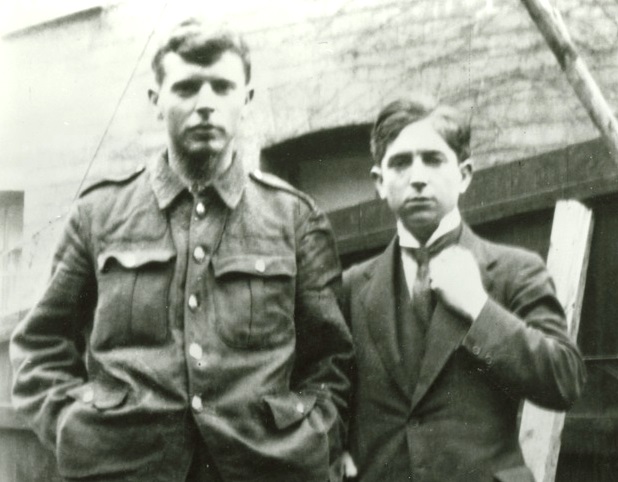
Ivor Gurney (left) and Herbert Howells, circa 1916–1918. 
Royal College of Music, ref. LDRCM.HH.1.124, retrieved from
http://museumcollections.rcm.ac.uk/collection/Details/collect/6558,
reproduced under licence CC BY 4.0, cropped and enhanced slightly.
And that ‘God bless it’ was not ironic, for indeed Howells did not fail.  Those Severn meadows and the Cotswold and Malvern Hills above them were to become the explicit inspiration for such works as the string quartet ‘In Gloucestershire’, or tone-poems such as the Paradise Rondel (named after the Gloucestershire village of Paradise) or the Pastoral Rhapsody.  The very sky-line that had so moved Gurney was to provide strikingly literal inspiration when it came to the Chosen Tune, Howells’ wedding-present for his bride Dorothy: the shape of its melody-line, when written on the stave, mirrors the sky-line of the Cotswolds as seen from the top of Chosen Hill.  

In 1954, decades after these works were written, there followed one final tribute to this landscape, probably the greatest; certainly the largest: the Missa Sabrinensis, the ‘Mass of the Severn’.  It is a massive, shimmering, glittering estuary of sound for full orchestra, chorus and soloists, calling for anything and everything to recreate in music the might of the ‘noble river’ on whose banks Howells had been born, formed his imagination and learned his music.  Now, the Mass is a particular case in point when it comes to the question of Howells’ faith because, even as it seems to complicate the mystery, it is suggestive of an answer.  At first, the idea of a ‘Mass of the Severn’ sounds like something that only Howells could write; indeed, like something that he had to write, seeming as it does rather gloriously to combine Catholic spirituality with the special mood that Howells is not alone in sensing very strongly in that border-land world of the Welsh Marches and England-west-of-the-Severn.  But even to sympathetic listeners, something might seem amiss.  What is this Mass really for?  Although its normal six parts are all set quite faithfully and in their entirety, and although the work received its première in the sacred setting of Worcester Cathedral, it was intended not as a liturgical work but as a concert piece.  Howells himself made this quite plain: ‘Missa Sabrinensis is not designed for ritualistic use,’ he wrote, ‘It is essentially a composer’s personal and creative reaction to a text of immense, immemorial significance.’  [7]  Dr. Jonathan Clinch, in his sleeve-notes for the David Hill recording, considers it more a ‘choral symphony’ than anything.  He also observes that ‘Howells was most inspired when dealing with the substantial musical architecture in setting what he called “immemorial prose”, words that, although they had little personal meaning for the atheistic composer, had nevertheless represented a source of human comfort for centuries.’  This suggests that the resonance or the antiquity of the words mattered more to Howells, far more, than their context, or even their essential meaning.

Mist and distance: the closing bars of the ‘Sanctus’ of the Missa Sabrinensis.  The full performance was part of a special performance given by David Willcocks and the Bach Choir for the composer’s ninetieth birthday.

Howells was by no means the first composer to set a non-liturgical Mass, but what is curious is that such a work emerged from a man whose music was in fact by then almost exclusively liturgical in character, explicitly and specifically ‘designed for ritualistic use’.  Since the Severn Mass, then, sprang from Howells’ love of poetry and of landscape, and not from a concern for the true sense of the words he was setting; since it therefore constituted not so much a Mass with a Severn theme for flavour as a Severn-themed symphony lent its form by the Mass; since, as ever with Howells, theme and mood had priority over all else, a crucial question is made obvious: is the same true of all his liturgical music, as well?  Was it Christianity’s style, and not its substance, that drew him to sacred texts and church buildings?  Was the Church to him simply a plentiful source of aesthetic edification, and the cathedrals simply grand medieval concert-halls which, in their unbelievable magnificence and antiquity, gratified his artistic appetite better than their modern counterparts?  In the end, did it matter little to him whether his music formed part of divine worship or not, so long as its performance was splendid?  Was he, to put it bluntly, a kind of free-loader, a poacher of the sacred for the lustre it would lend his music?  And was this Severn Mass, then, simply a pantheistic show-piece, spiced up with the allure of some exotic Catholic spirituality? 

Well, for one thing, Howells was no jester or thieving magpie.  The Catholic flavour of Howells’ work, with its debt to the polyphony of Tallis and Byrd, was drawn from from long study and deep understanding.  (Several commentators have noted the irony that it was mainly for the Anglican Church, which worships God with such English restraint, that Howells’ lyrical and starkly emotional music was written).  In his early career, Howells had worked with Richard R. Terry at Westminster Cathedral, and composed an a cappella Mass in the Dorian Mode; he set ‘Catholic words’ throughout his career, whether by Catholic poets such as John Skelton or his friend F. W. Harvey, or medieval verse in translation by Helen Waddell, or Latin liturgical prayers.  The choice of the Mass was no mere affectation, then, but the continuation of a serious musical interest.  And in any case, his concern for ‘immemorial prose’, and the seriousness with which he set all these words, within the liturgy and without, shows surely that he did not regard them as mere cultural artefacts to be rummaged through at will.  He took his texts seriously enough to revere them, and to rejoice quite sincerely in their beauty, even if consideration of their truth did not follow.  

Would it not be truer, then, and kinder, to say that Howells had developed a kind of personal, customised theology of his own, one seeking beauty rather than truth, atmosphere rather than dogma?  Was he not among those who, as Philip Larkin observed at about the same time as Howells was writing the Missa Sabrinensis, find in the Church a ‘serious house on serious earth’ — serious and gravely beautiful?  As J. B. Pauley says, ‘Howells’s perspective seems to have been that of the non-theist mystic [… who] so completely identified with so many aspects of Anglican Christianity that he naturally expressed his non-theist mystical penchant in the language of Christian spirituality.’ [8]  And he did so in a literate and nuanced, if unorthodox manner.  It is possible to go even further than Rutter’s ‘sense of faith,’ then, and say that Howells did actually hold to and observe a faith of his own: a kind of self-made half-religion.

Continued in part 2 here
-----------------------------------------------------
References:
1.  Alan Ridout, quoted in Sophie Cleobury, ‘The style and development of Herbert Howells’ Evening Canticle settings’. University of Birmingham, MPhil Dissertation, 2007, retrieved 9th May 2021 from <etheses.bham.ac.uk/5735>, p. 219.
2. Philip Lancaster, sleeve notes for Signum Records’ disc ‘A Walk with Ivor Gurney’ (catalogue number SIGCD557).  Retrieved 25th April 2021 from <https://www.tenebrae-choir.com/wp-content/uploads/2018/07/SIGCD557-A-Walk-with-Ivor-Gurney-Signum-2018.pdf>
3.  Paul Spicer quotes Finzi’s remark in his introduction to his biography of Howells.  (Bridgend: Seren, 1998).
4. Sir David Willcocks interviewed for BBC Radio 3 programme, ‘Echoes of a Lifetime’, BBC radio documentary presented by Robert Prizeman, broadcast 17 October 1982.  
5.  John Rutter, quoted in Cleobury above (Ibid., p. 219).
6.  ‘Echoes of a Lifetime’, BBC radio documentary presented by Robert Prizeman, 1982.  
7.  Herbert Howells quoted in Jonathan Clinch, ‘Beauty Springeth Out of Naught’: Interpreting the Church Music of Herbert Howells’, retrieved 24 April 2021 from <http://britishpostgraduatemusicology.org/bpm11/clinch_beauty_springeth_out_of_naught.pdf>
8.  Pauley, John-Bede, Benjamin Britten, Herbert Howells, and Silence as the Ineffable in English Cathedral Music.  Durham University, Durham Theses, 2013.  Retrieved 9th May 2021 from <http://etheses.dur.ac.uk/9499/>.

All images have been reproduced according to the terms of use published on the website of the Royal College of Music at <http://museumcollections.rcm.ac.uk/terms-of-use/>.