The Anthem is a setting of the forty-second Psalm. ‘Like as the hart desireth the waterbrooks, so longeth my soul after Thee, O God.’ The organ shimmers darkly under the high vaults; the harmonies ring rich and dry from the walls of weightless stone. ‘My soul is athirst for God: yea, even for the living God. When shall I come to appear before the presence of God?’ A heightening of tension, a sudden edge of bitterness: ‘My tears have been my meat day and night, while they daily say unto me: Where is now thy God?’ No answer but a return to the aching, sinuous refrain — ‘Like as the hart desireth the waterbrooks…’ — and the voices thread between and tug against each other, clashing, half-resolving and clashing again until, faintly and distantly but unfailingly and luminously, they come to rest at last again on the word God. Now here, we think in the Evensong stalls, here is a composer who knew the psalmist’s anguish; who knew that, when we miss our Creator, we miss Him very much indeed.
So often it is like this with the sacred music of Herbert Howells. In all his many settings of texts from Scripture or the liturgy, including some twenty of the Evening Canticles, his unmistakeable style — with its influences as varied and flavoursome as Tudor polyphony, Gregorian plainsong, French impressionism, even Stravinsky and the blues, and combined with a highly distinctive voice of his own — gives vivid and poignant expression to the faith of the Christian Church. According to their meaning he could make the ancient prayers blaze, or gleam, or glower with a flavour all his own.
And yet, by all accounts, Howells himself did not profess the Creed of the Church whose worship his music so enriched. He did not go to church, nor even, it seems, believe in God. He neither drew attention to this fact in public nor appears particularly to have wrestled with it in private, the only really solid evidence of his position being an outburst remembered by his daughter Ursula — “I don’t believe there’s anything,” she recalled him telling her flatly one day near the end of his long life (1892–1983). Otherwise, there seems simply to have been a settled absence of formal belief, one arising more from an emotional disposition than a firm conviction, but which was settled, even so: Howells had, according to one former student, ‘not a glimmer’ of serious religious faith. [1] ‘He loved the tradition of the church, and the Bible as literature,’ was his daughter’s verdict, ‘but he was never more than an agnostic who veered toward belief.’
Howells’ anthem Like as the hart desireth the waterbrooks, sung by the choir of St. John’s College, Cambridge, under Andrew Nethsinga. Howells wrote this piece in a single sitting on the 8th January, 1941, in the middle of a snow-storm in Cheltenham, after he and his family had been bombed out of their house in Barnes, south-west London. [2] The piece was among those he selected to be played on ‘Composer’s Portrait’ , a profile of his work on BBC radio.
So I find myself asking much the same question as the conductor David Hill, who, listening back over his recent recording with the Bach Choir of Howells’ monumental Missa Sabrinensis, posted last year on Twitter: ‘Wonder how Howells — a known atheist, poss[ibly] agnostic — could write such impassioned music that makes it all so much more believable?’ The puzzle is not that an unbelieving composer should write music of profound beauty for the Church, but that such a composer should in this case have written music so deeply, explicitly and unfakeably conversant with the Christian faith, so consistently and vividly expressive of its language, its beauty, and its spirit — should have spent fully half his career doing so — and yet still, in the end, demurred as to its truth.
Something perhaps makes us hesitate even in asking the question. Is it not enough for us to know the composer’s intentions, to know that he meant his music for sacred settings? Is it not mere prying to enquire further, to make windows into his soul; should we not rather rejoice in the art, and leave the man alone? Yet I ask not from a sense of inquisitorial superiority or from petty inquisitiveness, but from the friendship into which any sincere creative artist invites a sympathetic audience. Howells’ friend Gerald Finzi once said, ‘It is good to shake hands with a good friend across the centuries’ — and Paul Spicer, in his biography of Howells, applies these words, aptly I think, to the regard in which Howells himself is held by his admirers. [3] All good friends want to grow to understand each other better, and the deepening of a friendship often means asking serious questions. So it is natural that, in seeking to understand who Howells was and what moved him, we should want to know what he really believed.
The setting of the Magnificat from the Collegium Regale service (written for the chapel choir of King’s College, Cambridge), sung by the choir of Winchester Cathedral under David Hill.
Moreover, there is something about the musical handshake with this particular composer that fans this burning question to a blaze. For Howells’ style is not only distinctive but peculiarly and intensely personal: ‘highly reflective and emotive’, ‘sensitive’ and ‘contemplative’, in Sophie Cleobury’s words. To those of us who love his music, something intimate corresponds. He is one of the great composers of what I can only call ‘mist-and-distance’ music — music of melismatic, sinuous melodies woven together into impressionistic harmonies, into tapestries of contrapuntal sound. Paul Spicer has elsewhere written of Howells’ remarkable ability to create whole worlds of moods, sometimes ablaze with ecstasy or anguish, though more often steeped in sad November light, in melancholic radiance, in ‘the sorrow that sounds like Heaven’, as Michael White has called it. Though Howells was, in spite of his surname, a forceful denier of any Welsh or Celtic inheritance or musical influence, there must be few composers whose works bear a stronger accent of hiraeth, the untranslatable Welsh word for that bittersweet homesickness in our souls, that longing for a home beyond this world. Howells saw the lost country, and how far off it lies, and he wrote the distance down in sound.
His careful craftsmanship, too, invites us into long and close acquaintance. There are intricacies in his work that lie in wait to be discovered on a tenth, a twentieth, a hundredth hearing. The conductor David Willcocks compared him to —
[…] the medieval craftsman, who takes enormous pains to fashion in stone some angel right up in the triforium of a cathedral — where it will never be seen, but he did it just for the love of it. Sometimes I feel that Herbert Howells lavishes his love in his music by having some felicitous little counterpoint in some inner part which may never be heard — but he knows it’s there. [4]
David Willcocks (right) with Herbert Howells
in Gloucester in 1950.
Royal College of Music, ref. LDRCM.Ph.22.74, retrieved from
reproduced under licence CC BY 4.0, cropped and enhanced slightly.
‘I have composed out of sheer love of trying to make nice sounds,’ Howells once declared, but ‘nice sounds’ is an almost laughable understatement of the soul-plumbing, Heaven-haranguing harmonies that he spun into existence. Always with him there is a sense of yearning, of seeking, of straining to reach something just out of hearing, out beyond the edges of earthly music. His tendency in his work to give precedence to expressions of raw emotion over, say, tightness of structure or discipline of form, only intensifies the appeal of his music to the heart and spirit, and our curiosity about its source.
We friends of Herbert Howells love his music, then, because we share his fierce sensitivity to beauty, his susceptibility to romance and pathos, his delight in detail, his grief at loss. But to those of us who do not share his atheism — who indeed might count his music as precisely one reason why we do not — his position presents a clear difficulty. It is in church that Howells’ music is most often heard; we hear him interceding with God on our behalf and in our language; the music is our prayer as much as it is his art; when all is said and done, he looks and sounds like a man whose soul ‘longeth for the living God’; he made setting after setting of the same canticles and prayers with a dedication that seems to approach devotion; he ought to have believed, we want to say. Where, then, does his unbelief leave his believing listeners? What does it mean for any great artist, however privately or quietly, to disavow the Credo to which his life’s work is such an ardent witness?
The composer John Rutter, himself a self-described agnostic who is renowned for his sacred music, has interesting thoughts on this score. ‘I don’t think faith is a necessary precondition for writing religious music,’ he says, ‘but I do think the composer needs a sense of faith, by which I mean an ability to understand what faith feels like.’ [5] Perhaps Howells might have agreed with this, for, in spite of avowing no formal religious faith, he surely did have a religious sense. He was certainly no secular rationalist. In the first place this was true in quite a primitive way, for he was a superstitious man, apparently willing, for example, to move only in one direction around London’s circular Albert Hall. But, more profoundly, he was a romantic; he was deeply susceptible to beauty and its every incarnation; he was spiritually in love with it; if he worshipped anything, it was surely this. And in so far as the natural abode of beauty is found in the Church, Howells, too, found his home there. ‘He adored the music and the buildings — he adored cathedrals,’ his daughter said: that verb ‘adored’, uniting as it does both love and worship, is telling.
The Pastoral Rhapsody (1923), played by the BBC Philharmonic Orchestra under Martyn Brabbins.
The beauty of the created world was a life-long inspiration for Howells. ‘I’ve never been able to compose a note of music without either a place or a building in my mind,’ he once went so far as to say. Most of the canticle settings of the latter half of his career were composed specifically for particular churches and cathedrals and named explicitly after them, having been written to match not only their acoustics but their atmosphere and architecture. (Thus the Collegium Regale service for King’s College, Cambridge is delicately fluted and luminous, whereas the canticles for St. Paul’s have a harder, bolder, marblier quality to them). There was also the English landscape that the churches adorned: as a young composer, Howells had been influenced tremendously by his native Gloucestershire. In a BBC interview of 1963 he was to recall a conversation with the composer, poet and fellow Gloucestershireman Ivor Gurney, the great friend of his youth:
I used to sit with Ivor Gurney on [Chosen Hill] half-way between Gloucester and Cheltenham, and from there — on a clear April day, shall we say, when the visibility was second to none — you could see the whole outline of the Malvern Hills thirty miles north of that hill. And Gurney said to me one day, “Look at that outline […] Unless that influences you for the whole of your life in tune-making, it [the tune-making] is failing in one of its chief essentials.” And of course, outlines of hills and things are tremendously important, especially if you were born in Gloucestershire, God bless it. [6]
And that ‘God bless it’ was not ironic, for indeed Howells did not fail. Those Severn meadows and the Cotswold and Malvern Hills above them were to become the explicit inspiration for such works as the string quartet ‘In Gloucestershire’, or tone-poems such as the Paradise Rondel(named after the Gloucestershire village of Paradise) or the Pastoral Rhapsody. The very sky-line that had so moved Gurney was to provide strikingly literal inspiration when it came to the Chosen Tune, Howells’ wedding-present for his bride Dorothy: the shape of its melody-line, when written on the stave, mirrors the sky-line of the Cotswolds as seen from the top of Chosen Hill.
In 1954, decades after these works were written, there followed one final tribute to this landscape, probably the greatest; certainly the largest: the Missa Sabrinensis, the ‘Mass of the Severn’. It is a massive, shimmering, glittering estuary of sound for full orchestra, chorus and soloists, calling for anything and everything to recreate in music the might of the ‘noble river’ on whose banks Howells had been born, formed his imagination and learned his music. Now, the Massis a particular case in point when it comes to the question of Howells’ faith because, even as it seems to complicate the mystery, it is suggestive of an answer. At first, the idea of a ‘Mass of the Severn’ sounds like something that only Howells could write; indeed, like something that he had to write, seeming as it does rather gloriously to combine Catholic spirituality with the special mood that Howells is not alone in sensing very strongly in that border-land world of the Welsh Marches and England-west-of-the-Severn. But even to sympathetic listeners, something might seem amiss. What is this Mass really for? Although its normal six parts are all set quite faithfully and in their entirety, and although the work received its première in the sacred setting of Worcester Cathedral, it was intended not as a liturgical work but as a concert piece. Howells himself made this quite plain: ‘Missa Sabrinensis is not designed for ritualistic use,’ he wrote, ‘It is essentially a composer’s personal and creative reaction to a text of immense, immemorial significance.’ [7] Dr. Jonathan Clinch, in his sleeve-notes for the David Hill recording, considers it more a ‘choral symphony’ than anything. He also observes that ‘Howells was most inspired when dealing with the substantial musical architecture in setting what he called “immemorial prose”, words that, although they had little personal meaning for the atheistic composer, had nevertheless represented a source of human comfort for centuries.’ This suggests that the resonance or the antiquity of the words mattered more to Howells, far more, than their context, or even their essential meaning.
Mist and distance: the closing bars of the ‘Sanctus’ of the Missa Sabrinensis. The full performance was part of a special performance given by David Willcocks and the Bach Choir for the composer’s ninetieth birthday.
Howells was by no means the first composer to set a non-liturgical Mass, but what is curious is that such a work emerged from a man whose music was in fact by then almost exclusively liturgical in character, explicitly and specifically ‘designed for ritualistic use’. Since the Severn Mass, then, sprang from Howells’ love of poetry and of landscape, and not from a concern for the true sense of the words he was setting; since it therefore constituted not so much a Mass with a Severn theme for flavour as a Severn-themed symphony lent its form by the Mass; since, as ever with Howells, theme and mood had priority over all else, a crucial question is made obvious: is the same true of all his liturgical music, as well? Was it Christianity’s style, and not its substance, that drew him to sacred texts and church buildings? Was the Church to him simply a plentiful source of aesthetic edification, and the cathedrals simply grand medieval concert-halls which, in their unbelievable magnificence and antiquity, gratified his artistic appetite better than their modern counterparts? In the end, did it matter little to him whether his music formed part of divine worship or not, so long as its performance was splendid? Was he, to put it bluntly, a kind of free-loader, a poacher of the sacred for the lustre it would lend his music? And was this Severn Mass, then, simply a pantheistic show-piece, spiced up with the allure of some exotic Catholic spirituality?
Well, for one thing, Howells was no jester or thieving magpie. The Catholic flavour of Howells’ work, with its debt to the polyphony of Tallis and Byrd, was drawn from from long study and deep understanding. (Several commentators have noted the irony that it was mainly for the Anglican Church, which worships God with such English restraint, that Howells’ lyrical and starkly emotional music was written). In his early career, Howells had worked with Richard R. Terry at Westminster Cathedral, and composed an a cappella Mass in the Dorian Mode; he set ‘Catholic words’ throughout his career, whether by Catholic poets such as John Skelton or his friend F. W. Harvey, or medieval verse in translation by Helen Waddell, or Latin liturgical prayers. The choice of the Mass was no mere affectation, then, but the continuation of a serious musical interest. And in any case, his concern for ‘immemorial prose’, and the seriousness with which he set all these words, within the liturgy and without, shows surely that he did not regard them as mere cultural artefacts to be rummaged through at will. He took his texts seriously enough to revere them, and to rejoice quite sincerely in their beauty, even if consideration of their truth did not follow.
Would it not be truer, then, and kinder, to say that Howells had developed a kind of personal, customised theology of his own, one seeking beauty rather than truth, atmosphere rather than dogma? Was he not among those who, as Philip Larkin observed at about the same time as Howells was writing the Missa Sabrinensis, find in the Church a ‘serious house on serious earth’ — serious and gravely beautiful? As J. B. Pauley says, ‘Howells’s perspective seems to have been that of the non-theist mystic [… who] so completely identified with so many aspects of Anglican Christianity that he naturally expressed his non-theist mystical penchant in the language of Christian spirituality.’ [8] And he did so in a literate and nuanced, if unorthodox manner. It is possible to go even further than Rutter’s ‘sense of faith,’ then, and say that Howells did actually hold to and observe a faith of his own: a kind of self-made half-religion.
1. Alan Ridout, quoted in Sophie Cleobury, ‘The style and development of Herbert Howells’ Evening Canticle settings’. University of Birmingham, MPhil Dissertation, 2007, retrieved 9th May 2021 from <etheses.bham.ac.uk/5735>, p. 219.
3. Paul Spicer quotes Finzi’s remark in his introduction to his biography of Howells. (Bridgend: Seren, 1998).
4. Sir David Willcocks interviewed for BBC Radio 3 programme, ‘Echoes of a Lifetime’, BBC radio documentary presented by Robert Prizeman, broadcast 17 October 1982.
5. John Rutter, quoted in Cleobury above (Ibid., p. 219).
6. ‘Echoes of a Lifetime’, BBC radio documentary presented by Robert Prizeman, 1982.
8.Pauley, John-Bede, ‘Benjamin Britten, Herbert Howells, and Silence as the Ineffable in English Cathedral Music’. Durham University, Durham Theses, 2013. Retrieved 9th May 2021 from <http://etheses.dur.ac.uk/9499/>.
Coming down England by a different line the other week, aiming south-west for Wales, I had an excuse for a journey over a stretch of railway I have long wanted to travel. The train, bereft of most passengers at Cheltenham and after Gloucester nearly empty altogether, turned to wind on towards Newport along the far, western bank of the river Severn (the far bank from my point of view), with the Forest of Dean unseen to our right, and the widening water always somewhere, sometimes immediately, on the left.
A glimpse of Broadoak, with the A48 road and the river Severn meeting in the distance.
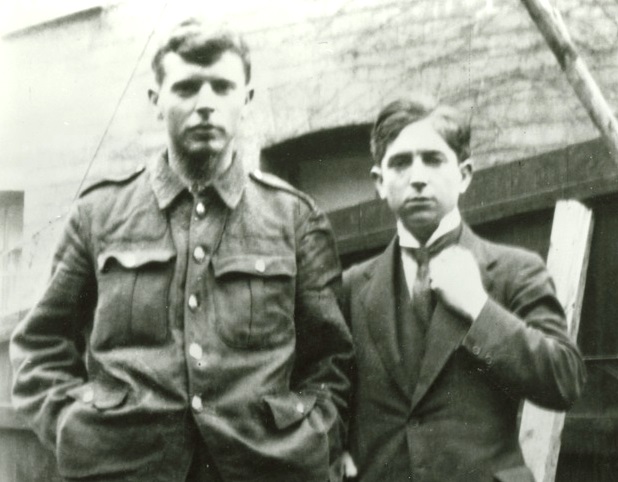
This stretch of Gloucestershire, between the county city and the Welsh border at Chepstow, belongs to the corner of England that produced, in the early twentieth century, a great flourishing of art and music, and some of our greatest poets and writers. The railway runs straight through the land of Herbert Howells, Ivor Gurney and Frederick William Harvey, three friends who came of age in that brief sunlit window of the early twentieth century that was shattered by the First World War. Gurney, the poet and composer whose life had such a long and sad ending, was born in the city of Gloucester itself. Howells was a son of Lydney, through which we rushed non-stop; it was this line that took him, by way of Gloucester, to the heights of his musical career. And perhaps some of the depths, as well — it was also along here, a century before my own journey, that he had managed to leave the first score of his Piano Quartet on the train by mistake. F. W. Harvey, too, was of this earth — not long after Gloucester, the train had skimmed past his birthplace at Minsterworth, and, a few miles downstream, cut straight through the hamlet of Broadoak, where he recorded winter’s ending in his psalm-like, rhapsodic poem ‘Spring 1924’:
Spring
came by water to Broadoak this year,
I
saw her clear. Though
on the earth a sprinkling Of
snowdrops shone, the unwrinkling Bright
curve of the Severn River Was
of her gospel first giver […] In the unthinking safety of those years on the eve of the Great War, this landscape was not simply the setting but in some ways the foundation of the trio’s friendship. It was their native Gloucestershire that led them into artistic and temperamental sympathy with each other, and Gloucestershire that moved each to their arts: Howells to music, Harvey to poetry and Gurney, remarkably, to both, with equal passion. Hence Gurney’s Gloucestershire Rhapsody; hence the melody of Howells’ Chosen Tune, whose line on the staves mirrors the shape of the same hills of which Harvey exclaimed, ‘Cotswold or Malvern, sun or rain! / My hills again!’. (Harvey was incidentally a Catholic convert, though Anthony Boden’s generally excellent biography does not shed much light on this aspect of his life). So in tune were these men with each other that when Gurney and Howells heard the first performance, in Gloucester Cathedral, of Vaughan Williams’ Tallis Fantasia, the piece had the same effect on them: it so overwhelmed them that had to spend the whole night pacing round the city’s streets in deep conversation to work it out of them. I struggle to imagine this depth of companionship and artistic togetherness of spirit between any two people, let alone men: it seems foreign and almost incomprehensible only a century later. Though their friendship — which is also described in a superb documentary on Gurney, The Poet who Loved the War — never failed, it was to be transformed by forces that had lain unsuspected beyond the Gloucestershire horizon, but called them out of their home county and into new lives. Who knows how else their lives and careers would have gone on, had Gurney’s mind held out, had Howells not lost his son to an ambush of meningitis in 1935, emerging from the trauma a changed man and a composer of changed music, and had the war not cost Harvey some of his prime years in a German prison camp.
The ‘Sanctus’ of Herbert Howells’ monumental Missa Sabrinensis (Mass of the Severn)
When I came past on my incidental pilgrimage the weather was murky and damp, with the tinge of nearing dusk. My sight was not nearly as clear as Harvey’s was when he beheld spring heralded in the Severn. But certainly visible, as we persevered towards Chepstow, was the grey expanse of river, with the tide in, cutting off this part of England from the rest and, I like to think, leaving it benignly open to Welsh influence, both in landscape and mood. Then the train, parting company slightly with the main estuary, slowed to a pace stately enough for a fitting, dignified passage across the Wye flowing in from the north, and over the border into Wales. (Chepstow station, not far beyond the bridge, was a riot of Welsh signage amid the drizzle). After Chepstow the line shadows the Wye all the way to its confluence with the Severn. Gloucestershire, on the opposite bank, has tapered away to the curious Beachley peninsula, a last stubborn sliver of England between the two rivers. Here the white parabola of the first Severn Bridge hurtles serenely in to land from across the main estuary, which is two miles wide at this point. The BBC’s excellent Timeshift series includes a thoroughly enjoyable documentary about the construction of this bridge (Bridging the Gap: How the Severn Bridge was Built), chronicling the colossal undertaking year by year from the start of work in 1961 to the opening in 1966. It combines superbly-chosen archive film with recent interviews of some of those actually involved: I was struck by their literate, measured speech — engineers, workmen and locals alike — and by their boyish octogenarian grins — and by the clarity with which they explained the fairly complicated principles and mechanisms by which the bridge was made to stand. Due time was also given to those who died in its construction: six men, which I think may still fairly be called a relatively small number for a project of this scale, not least given that it was generally the water, rather than the structure itself, that claimed their lives. It must have taken a good deal of research and editing to put the programme together, though somebody has clearly enjoyed compiling an early Sixties sound-track to set the mood. I have known this bridge all my life, and watching this programme I was fascinated to learn in so much detail how it was built, and by whom.
Gathering pace again, we converged with the Great Western main line as it emerges at Caldicot from the Severn Tunnel (an earlier triumph of engineering, opened in 1886) and thence ran along the flat towards Newport. But there is something about estuaries: once in mind they will drain away only sluggishly. The previous Sunday having been Pentecost, my thoughts drifted to someone else’s memorable journey by rail, involving another river’s ‘level drifting breadth’, which had been made on the other side of the country. Philip Larkin’s intricate and atmospheric poem ‘The Whitsun Weddings’ — one of my ‘Desert Island’ lyrics — begins, like the journey it describes, in Hull (‘all windows down, all cushions hot, all sense / Of being in a hurry gone’) and gathers pace alongside the Humber estuary ‘where sky and Lincolnshire and water meet’. Its description of a ‘sunlit Saturday’ in 1955 — when Whitsun was a known, universal holiday — when it was customary to marry on Whitsun — when it was the custom to aspire to marriage at all — stirs up in me the same momentary ache or dizziness as I feel when looking at the 1947 series of one-inch Ordnance Survey maps, at the sight of those lost expanses of untrashed, unmotorwayed England. Yet perhaps it was all already slipping away, as slowly, massively and unstoppably as the ebb of an estuary tide. Perhaps what moved Larkin to his symphonic utterance of sights and sounds was the urge to record and capture not only the ‘frail travelling coincidence’, but the whole civilisation in which it took place. I who come later am glad he did.
Like many modern buildings in Wales, Newport’s recently rebuilt station was not wearing well. While sensible terraces of older, hardier houses climbed sturdily uphill in the distance, the station’s futuristic ceilings and space-age gutters were dripping with rain and the Thunderbirdsesque roof was smudged with moss. Hadn’t they known there is no present in Wales, and no future; there is only the past? But that’s another poet, and another country, for another time…