Today, the seventeenth of June, being the feast-day of St. Botolph, I am reminded of a memorable trip I made a few years ago, one unseasonably warm February day, to one of England’s greatest parish churches: a church dedicated to him, and whose town is named after him: Botolph’s town, or Boston, in Lincolnshire.
 |
The tower of St. Botolph’s, Boston, seen from Church Street (February, 2019).
|
In truth, it all began with St. Wulfram, and
his church at Grantham. A few months previously I had finally done as I had long intended, and got off the train for a proper look at it — at least, one longer than the fifteen-seconds’ vision with which it beguiles the passengers of London- or Scotland-bound expresses, soaring heart-stoppingly into view above the blurred tiles and whizzing chimneys of its parish. After all the occasions on which this astonishing spire — briefly England’s highest, and still the fifth-tallest of all our medieval steeples — had flashed before my eyes,
a visit seemed long overdue, and it did not disappoint. But then I realised that the spire of St. Wulfram’s was not alone, and that Grantham is the gateway of a county whose sky-line is studded with great and graceful towers: as well as Boston there was Louth, and of course the great cathedral at Lincoln itself, which had been for two centuries, before the collapse of its spires in 1548, the tallest building on earth.
So northwards from London it was once again, out of King’s Cross through an unpromising, almost greenish-grey morning. Harringay… Hatfield… Hitchin… Huntingdon… and not forgetting, after Peterborough, to ‘hail humble Helpstone’, the home parish, resting-place, and in many ways the whole world of the poet John Clare. (Incidentally, the parish church here is also St. Botolph’s.)
 |
| ‘Hail, humble Helpstone’: a glimpse of John Clare country near Peterborough. |
Boston from London means changing at Grantham, so before the Skegness train came in I had a chance to admire the tower of St. Wulfram’s once again, and to wonder how St Botolph’s would compare with it. These two Lincolnshire towers both stand on the same river, the Witham, Grantham quite near its source and Boston at its mouth, but as well as sixty miles of river, two centuries and great differences of style lie between them. [1] Grantham’s steeple, finished in 1320, is in all the handsomeness of the Decorated style, while Boston’s — mostly in the more ornate and intricate Perpendicular — was begun much later, in around 1430, and took until at least 1500 to complete. St. Wulfram’s had been a launch into the unknown, literally to new heights, and its masons were learning as they went, but at Boston the Gothic style was being finessed and perfected — though this is not to imply any lack of audacity or inspiration in its construction. On the contrary, these qualities were, as we shall see, abundant.
Onto the Poacher Line, then, and the train, soon happening clatteringly onto jointed railway track, wound on into Lincolnshire, past the Roman town of Ancaster (source of much limestone for the county’s churches, as well as for the colleges of Cambridge), through Sleaford with its despondent and derelict Bass Maltings, and then out into the open Fens. ‘Six years of a flat land,’ wrote the poet Elizabeth Jennings, who was born in Boston, where her father was Chief Medical Officer: she meant the first six years of her life, before the family moved to Oxford. A rather laconic verdict (and, remarkably, she never returned), but it must be admitted that there is something uncompromising about the sheer flatness of these parts, something that leaves nothing much to be said. They are as flat as that, and that is flat.
How extraordinary to glimpse on the horizon, then, amid the relentless horizontality of everything, a vertical shape: a tower aimed straight at Heaven, built in an architectural style which took as its fundamental principle precisely the emphasis, the exaltation of verticality at every opportunity. The closer it draws, the clearer the sheer contradiction it offers to its surroundings, and the sheer scale at which it does so. ‘It dominates the town, it dominates the landscape,’ said Betjeman. [2] Naturally, then, it has with been known for centuries with wry affection as ‘the Stump’.
 |
| The ‘Stump’ from just south of Boston’s Grand Sluice. The scaffolding is a frustration, but does provide a measure of the tower’s height — that of a forty-floor tower-block. |
The sky was still sullen as we rounded the curve into Boston, and this, combined with the warehouses and supermarkets around the station, lent weight to a first impression of the town as a place with its sleeves rolled up, unprettified and unpretentious. Although it is a market town amid swathes of arable land, it was originally (and indeed remains) a port — after all, it was from the sea, and the wool trade, that the wealth came to the church — and the town retains, I think, a port’s brisk unkemptness, a refusal to give itself airs, even though, with its handsome Georgian buildings, it could afford to do so. Yet even as I approached the church from the station, a strengthening sun dispelled the cloud, and the day transfigured itself into bright cloudless warmth, quite untypical of February. And there it was, the mighty tower, the great upthrust of Gothic glory, with an incredible audacity, even a youthfulness about it, seeming all the more extraordinary after the greyness and the garages a moment before.
Only one thing marred the view: the scaffolding cladding the entire western face of the tower — quite a contract for someone! The programme of works on the tower also meant that, unusually, it was closed to the public. On the other hand, the filigree of poles and planks did provide a useful measure of the tower’s scale — and, already, an excuse to return for a second visit.
 |
| St Botolph’s from the Market Square |
‘One of the glories of England,’ Peter Hitchens
has said of it, ‘and in my view one of the sights of the world (and I’ve seen a few).’ Julian Flannery, in his magisterial survey of English medieval steeples, calls the tower —
…one of the greatest triumphs of medieval engineering. It is quite as daring as the hammer-beam roof of Westminster Hall, the octagonal lantern of Ely Cathedral or the pendant fan vault of the Henry VII Chapel at Westminster Abbey, and yet is on a greater scale than any of these masterpieces. For sheer spectacle, the 266 feet of masonry soaring straight from the pavement to the sky is unsurpassed by any church or cathedral in England. [3]
 |
‘Dizzyingly open’, even with
scaffolding |
Two-hundred-and-sixty-six feet makes this the seventh tallest of any extant English medieval tower. Older churches had risen higher — Grantham to 274ft — and the weathercock of St. James’ church at Louth, at 287 feet the highest parish church in England, was placed into position not long after Boston was completed — but, since all the other towers incorporate a spire, this is the tallest medieval parish church tower measured ‘to its roof’. It was not a question simply of height, though; there were other things in the masons’ minds. Flannery observes out how slenderly and economically the tower was built, with the walls between the load-bearing buttresses so lean (scarcely three feet thick) as to be almost skins of stone. The result, as Flannery goes on to point out, is an interior spacious enough that it could fit most ordinary church towers inside. The space beneath the tower is also flooded with light, fulfilling another principal aspiration of medieval masons — it is ‘dizzyingly open from inside’, says Betjeman. Again, on my visit in 2019, scaffolding impeded the view, but even this seemed to leave open an incredible amount of space and height.
 |
Excavations in the north aisle.
|
Even without the great tower, the older body of the church itself would be worth coming a long way to see. Not least because nave and chancel are contiguous with the enormous space under the tower, this is the largest parish church in England by volume. It is also a ‘calendar church’, having twelve internal pillars for the months of the year, fifty-two windows for the weeks of the year, seven doors, and three hundred and sixty-five steps to the top of the tower. [4] The chancel, built to a scale which in most churches would make for an impressive nave, contains fourteenth-century stalls and misericords, and a remarkable altar-piece. There was plenty of life in the church, in spite of the works: a little gift-shop, where I bought a post-card for my desk at work, a growing scale Lego model to raise funds for the church, and other pilgrims moving quietly round the church — families, a group of Scouts, a young couple holding hands.
 |
| The chancel with fourteenth-century stalls and misericords. |
It was time to have a look at the town itself, so I ambled around the market-place, and the side-streets, and then a little way upstream to the Boston Lock Café for lunch (the all-day breakfast is warmly recommended). The ‘Lock’ of the café’s name is the Grand Sluice right in front of it: it is here that the river Witham technically ends, and the tidal waters of the Haven, leading out to the Wash and the open sea, begin. Various works in the eighteenth century to improve the navigation of the Witham brought about a second heyday for Boston, hence its many Georgian buildings. Fortunes seem to rise and fall nowhere so dramatically as in ports, or at any rate seem to rise and fall much faster than a great church can be planned and built. In fact, even as the tower here was being raised, the town itself had fallen on hard times, and the booming trade of the thirteenth century was a thing of the past. Julian Flannery draws an interesting comparison with the city of Liverpool, where construction of the Anglican cathedral was completed in the 1970s under economic circumstances quite different from those in which is had started in 1904.
 |
| Where Red Lion Street meets Wormgate. |
The course of my amblings was largely determined by the sheer difficulty of photographing the tower: I had to retreat by some distance simply to fit it into the frame. As the afternoon wore on, I found myself to the east of the church, and meeting with the sight of the sun shining straight through the open lantern at the top: another demonstration of the slenderness and lightness of the construction. Yet the tower is still strong enough to hold a full peal of ten bells, and these above the cavernous space already described — there must be few belfries higher than Boston’s.
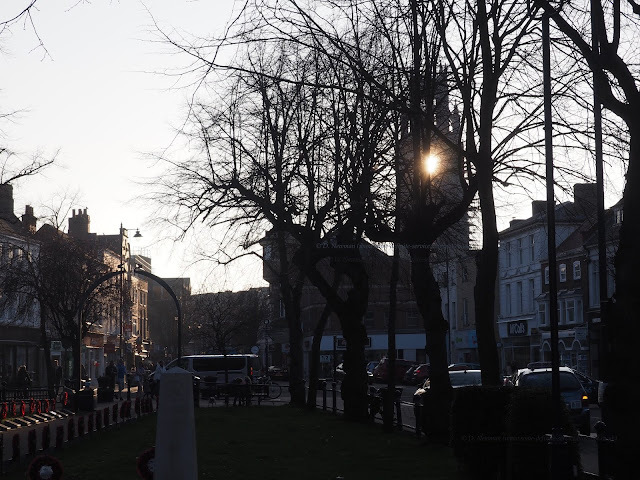 |
| From Wide Bargate in late afternoon |
Yes, they built it not only beautifully but masterfully, for in spite of its position right on the banks of the Haven it has never needed shoring up or major structural work. There was a practical purpose to it, as well: the tower has served as an unmistakeable aid to navigation for miles around, especially for seafarers on the Wash. (Scorch-marks on the masonry offer evidence that beacons were hung here for precisely this purpose: it really was a lantern tower.) On a clear day the Stump is even visible from the west coast of Norfolk, and I have never forgotten a spine-tingling picture of St. Botolph’s on the horizon, silhouetted starkly against the setting sun, which the photographer Gary Pearson captured from Hunstanton, twenty-one miles away.  |
From the Market Place
|
Another interesting aspect of the tower observed by Flannery are its four distinct levels, corresponding roughly to the four generations of masons it took to build it. He adds, though, that in order to avoid too prominent a horizontal division between them, and so to maintain the priority of verticality, the breaks in the masonry of the buttresses at the corners are made at different levels to those of the tower faces. By thus interrupting the horizontal lines, while keeping the vertical lines continuous, there is nothing to distract or mislead the eye as it is drawn heavenwards. The similarity of the tower’s lower half to that of St James’s at Louth has led some to suppose that a spire was the original intention here too, but owing to various aspects of the construction Flannery thinks this unlikely. As for the unmistakeable octagonal lantern tower, he points out precedents and possible influences as various and far-flung as Beverley Minster, the belfry at Bruges and Brussels’ Town Hall as evidence that this was the intention all along. The Flemish connection is interesting: ‘People called it Holland,’ remembered Elizabeth Jennings, and not only because of the flatness: in the other Low Counties, too, great belfries like this were raised.
 |
| The ‘Stump’ and the Haven in evening light. |
Spring-like as the weather might have been, the law of the sun was still winter’s, and all too soon the time came for the train home. From London a day-trip to Boston is easily possible by train, but it perhaps does not allow for a very long day. I could hardly complain about mine, though, as the train set off back westwards, through the the dark levels and glassy drains, to Grantham and the main line — but I knew there would have to be a return, once the scaffolding was gone, to admire the tower in its full glory.
 |
| The South Forty Foot Drain, west of Boston, seen from the Nottingham train |
References / footnotes:
1. The river Witham has a curious course: from Grantham it flows northwards all the way to Lincoln (at one point being separated from the Trent by only a narrow watershed) and then, once through the Lincoln Gap, back south-eastwards again. Though it is eighty-two miles in length, its mouth and its source are fewer than thirty miles apart as the crow flies.
2. Richard Surman (ed.), Betjeman’s Best British Churches (London: Collins, 2001))
3. Julian Flannery, Fifty English Steeples (New York: Thames & Hudson, 2016),
 |
| A down express flies past St. Wulfram’s Church, Grantham, in the dusk. |