Thursday, April 21, 2016

‘Where a Crown shines, the courage cannot fail…’

H.M. the Queen visiting Hitchin on the occasion of her Diamond Jubilee in June, 2012.
Strange though it seems to write for the second time in a week in honour of a great person’s birthday  (after Pope Emeritus Benedict’s on Saturday), nevertheless I feel that the occasion calls for it: Elizabeth II, our Queen for sixty-three years, has reached her ninetieth birthday. 

I hope soon to try to write a defence of the monarchy in principle, but for today it is Elizabeth herself who matters.  I feel all the more keenly a duty to mark her birthday because she has been such a just monarch and good example, made all the more radiant in an age with infrequent regard for justice and goodness.  This is the ninetieth year of a life that she herself vowed at the age of twenty-five to give, and ever since has given, to her kingdom.  It might not have been so.  She has reigned unfalteringly, making a deliberate decision to understand the verb ‘to reign’ to be very close in meaning as the verb ‘to serve’.  Neither did this have to be the case.  She chose goodness, similarly to Benedict XVI, and has prevailed.

Three women, I think, deserve most of the credit for the British crown’s continuity since the early nineteenth century.  Queen Victoria is the first, Queen Mary of Teck the second and our present Queen the third.  Queen Mary, wife of George V and Elizabeth II’s grandmother, taught her grand-daughter the importance of duty, something that Elizabeth has taught us in turn, mainly by example.  She has shown us that the greatest strength is often proved not in impressive activity or energetic deeds, but in endurance and steadfastness (and I might add that she is echoed by her husband).  She is also unembarrassed to be a woman of faith, and an ordinary, simple faith at that, and it is clear that her sense of duty is bound up with an awareness of vocation.  Her duty is not only to her subjects.

Elizabeth is strong, and knows where her strength comes from, in a weak age unaware of the source of its weakness.  Long may she reign, and may her subjects strive in loyalty to her and to follow her example!


This post’s title is taken from a poem written by John Masefield (1878–1967) for Elizabeth’s marriage when Princess in 1947; the music is by Ralph Vaughan Williams (1872–1958).

Saturday, April 16, 2016

Geburtstagsglückwünsche…

…für den emeritierten Papst Benedikt XVI, der heute sein neunundachtzigtes Lebensjahr feiert!

Yes, today is the great Pope Emeritus Benedict’s eighty-ninth birthday.  I say ‘great’ and mean it because, as I explained in one of my first posts on this blog, I think he is one of the most important public figures to have appeared on the world stage since the millennium (and he had been doing mighty work long before then).  Not only did he hold the Church’s tiller steady against wave after wave in this age of tumult, but he went out to do battle with the forces of secularism and relativism: not with sound and fury, as they expected, but with lucidness of intellect and steadfastness of goodness.  He dedicated his intellectual gifts to the cause of goodness and truth.  He reminded a world unwilling  (especially in the West) to acknowledge its burden of disillusionment, cynicism and selfishness that it is, in fact, possible to speak of such things as absolute truth, intellectual faith and authentic love: “I have come,” he once said, visiting Berlin, “to speak about God".  He was undaunted when the apostles of secularism scoffed, “Truth?  What is that?”. He continued to use old words like ‘beauty’, ‘love’ and ‘faith’ with a straight face, and yet without raising his voice.  Having witnessed evil for himself, especially in the 1930s and 1940s, he taught my generation that goodness and gentleness are not the same as blandness, or even as kindness, but often have to be proved with moral courage and honesty before God.  Above all, he gave us a tremendous example, itself founded on the example of Christ.  He (along with St. Peter) has a magnificent successor in Pope Francis, but his writing and example remain a rich treasure-trove for the Church and for the New Evangelisation.  It is as much a gift as a challenge to number among the ‘Benedict generation’, and so I here express my gratitude for his long life, pray for his good health, and propose a Bavarian ‘Prost!’.

photo April 16 15 Birthday OR 15a_zpsphsz5t9l.jpg
Pope Benedict toasting last year’s 88th birthday (It is right and just)
(Photo: The Ratzinger Forum, possibly ultimately L’Osservatore Romano)

Sunday, March 27, 2016

‘Rise heart; thy Lord is risen’

After Lent’s long flatness and sinking into bitter hollowness in Holy Week, especially on Good Friday (which this year, for the first time I can remember, was not shrouded in pallid cloud at three o’clock), Easter has dawned upon us.  Happy Feast!

Here is a setting by Ralph Vaughan Williams (again, sorry) of fitting words by George Herbert:
  
Easter.

Rise heart; thy Lord is risen.  Sing his praise
                                                  Without delayes,
Who takes thee by the hand, that thou likewise
                                                  With him mayst rise:
That, as his death calcined thee to dust,
His life may make thee gold, and much more, just.

Awake, my lute, and struggle for thy part
                                                  With all thy art.
The crosse taught all wood to resound his name,
                                                  Who bore the same.
His stretched sinews taught all strings, what key
Is best to celebrate this most high day.

Consort both heart and lute, and twist a song
                                                  Pleasant and long:
Or, since all musick is but three parts vied
                                                  And multiplied,
O let thy blessed Spirit bear a part,
And make up our defects with his sweet art.
George Herbert (1593–1633)
I cannot resist including another monunental rendition of the same music at the Royal Albert Hall in London on the Last Night of the Proms in 2004:

Tuesday, March 01, 2016

Dydd Gŵyl Dewi Hapus!

To live in Wales is to be conscious
At dusk of the spilled blood
That went into the making of the wild sky,
Dyeing the immaculate rivers
In all their courses…

Wednesday, February 17, 2016

‘O the mind, mind has mountains’: Pixar, the Poets and the Teenager

This post has somehow ballooned into a 2,000-word tract.  Nevertheless, I don’t think I have said anything that will spoil the film for those who have not seen it, nor given away the plot beyond about the film’s half-way mark, though I let slip clues to the mood of its resolution.  Put simply, two hours spent watching the film is recommended over two hours trying to read my review of it. 

Film fare at the university Cathsoc on Shrove Tuesday was Pixar studios’ Inside Out.  I suppose I had been expecting something fairly light after all those pancakes.  Yet here I am a week afterwards still puzzling out this unusual film.

Inside Out has been selling itself on the point of its being set mainly inside the main character’s own head.  Riley is an ordinary American girl, with a strong and steady mother and father, who has been steered through her eleven years (and counting) by five characters who are her emotions personified: Joy, Sadness, Anger, Fear and Disgust.  They oversee her mind, react to all she meets, influence her actions, send off a daily consignment of memories to the archives and engage themselves perpetually in a well-intentioned squabble for the upper hand.  The apparently whimsical premise is rather like the Numbskulls series in the Beano comic, except that, for all its bright colours, for all its lashings of humour and for all its characteristically American warm-heartedness, this is a not a trivial film.  It has something serious to say to adults and children alike.  In other words, it does not reach over the heads of the young audience but has two rare qualities: firstly, it is a children’s film which takes itself seriously because it takes its young audience seriously, and secondly it remembers most of the time, as it also speaks seriously to an older audience, that both old and young are in the same room.

Inside Out’s first triumph, in my view, is its astonishing animation.  It is slick without quite being too rushed and lavishes detail on the viewer.  No stone is left unturned in recreating wan sunlight on concrete or the cold yellow sweep of street lamps through a moving car.  Most impressive of all is that, out of nothing but pixels under a computer’s bonnet, it is now possible to breathe the very subtleties and shadows of emotions into a character’s face: the face falling, the collapse into laughter, the dawning of disappointment, the hesitant brightening of hope, the dance of dozens of movements or half-smiles or twitches or blinks in conversation, and (crucially, as it turns out) the zero of numb expressionlessness.  Even in this age of commonplace technological wonder it is amazing to watch.  The personified emotions may be very clever on their own, but they are, after all, (deliberately) undisguised stock characters.  The really remarkable achievement is their way of mingling and moderating each other in the heroine’s expressions.  The whole film has surely been designed to show off this animation; at any rate, it certainly depends upon its success.  I think the ambitious gamble has paid off.  

I am hoping that it is all right to link to this short extract from the beginning of the film,  which gives a better impression of its cleverness than the trailer does.

Then there is the film’s setting, the landscape of the mind.  They have the most important thing right: its scale is enormous.  The five emotions sit dizzyingly high up in a sort of control tower, from which they and the viewer can see miles of shelves of long-term memory in the distance.  There is also an archipelago of ‘islands of personality’, great floating citadels to Riley’s particular strengths and talents, which are (if I remember properly) ‘Family’, ‘Friendship’, ‘Hockey’, ‘Honesty’ and something like high spirits.  Between these and the control-tower yawns a dark void, a hopeless pit of forgotten memories.  They have depicted Gerard Manley Hopkins’ lines exactly:
O the mind, mind has mountains; cliffs of fall
Frightful, sheer, no-man-fathomed. Hold them cheap
May who ne’er hung there.
The mind is not a mere safe or chamber.  It is its own country.  Yes, this scale is completely right: yes, this setting is entirely fitting, as the film’s audience will have known, in fact.

Having built up this mountainous mythology of the mind, the directors have kept the narrative simple.  All that is made to happen to Riley is that her family moves from the Mid-West of the U.S. to San Francisco in California.  Yet the setting’s palette means that this realistic uprooting and her understandable struggle to settle in her new home can be depicted in scrupulous, meditative detail.  In Riley’s mind its effect is literally upheaving, even seismic.  Setbacks and threats, real or imagined but all of an unfamiliar potency, suddenly come thick and fast at home and at school.  The five emotion characters struggle to maintain control over the mind.  There is a panicked tussle over the memory-mechanism, and then there is catastrophe: the Joy character — the sole optimist — and the Sadness character — a combination of Eeyore and King Midas, who cannot help tainting anything she touches with a contagious blue gloom — manage to catapult themselves out of the control tower, across the mind’s chasm and into the archives of memory, hopelessly far away from any influence over their charge and leaving to hold sway over the mind only Fear, Disgust and Anger who, as might be expected in spite of their efforts, cannot sustain Riley’s character by themselves.  One by one, her ‘islands of personality’ begin to founder and topple; a tectonic catastrophe threatens and weakens her whole person.  (How puny and trivial San Francisco’s immense Golden Gate bridge, seen in opening shots, is made to seem now).  That is the plot seen from the inside.  From the outside, and from the perspective of her parents, she withdraws into herself, turns her back on her surroundings and slumps into disillusion.  Come to that, the narrative can be stated more simply still.  The move to California jolts Riley’s mind into a new age: her growing up enters a painful phase.

This linearity and simplicity of narrative leaves plenty of room for a remarkable richness and dignity in the portrayal of her character which, it is also worth noticing, also provides the film’s setting.  This richness of character is its fourth and crowning triumph in my book, and the reason why I think so many people have found it so powerful.  Just as the animation shows the emotions mingling in Riley’s face, so their overall effect is to mingle in her character.  Inside Out’s heroine is at intervals joyful, sorrowful, disgusted, angry, fearful, or somewhere in between, but remains always plainly the same person.  She is exalted and deepened where, in many modern children’s books and films, characterisation often suffers from being crowded out by over-complicated narratives.  Even though I had trouble keeping up with the frenetic dialogue (once a line is missed it is gone), I can see that such slickness is justified here.  It makes sense for these emotions, being the voices in Riley’s head, to chatter away at the speed of thought: their speech, perhaps along with the musical score, is the very sound of her thinking.  (The film’s dialogue outside the mind is very well paced and particularly cleverly delivered).  The distinction between first person and third person is gloriously vague. The result, then, is a meticulous and self-unconscious chronicle not only of a character’s actions and words but also of her every thought.  It might even be possible to treat this film as a moving portrait instead of as a story, and to be content with studying and contemplating a single character, painted as richly as any in literature, for its two hours’ length.  

I have longed for a work of literature for children (for I think this is literature) that is brave and serious enough to do something like this.  I have often thought that the most moving stories work on this sort of scale, painting the apparently prosaic or normal in monumental colours without taking leave of a realistic world, and by making characters deep enough to let their young audiences almost befriend them.  Such literature triumphs because it upholds human dignity — as I persist in believing all literature ought to, one way or another — by portraying its majesty.   For majesty is the cornerstone of Inside Out, in spite of its psychedelic appearance.  Riley’s loss of heart, manifested on the outside only in despondency and flouncing (which I thought her parents indulged too much!), is actually the interior landscape’s very ruin. The doomed realm of childhood imagination is depicted as a sprawling rubble-strewn demolition site, leered over by lofty cranes; the collapse of an ‘island of personality’ is always slow, grave and noble, more terrible than the foundering of a battleship, or the schism of an iceberg or indeed a San Franciscan earthquake.  ‘O the mind, mind has mountains; cliffs of fall frightful, sheer, no-man-fathomed’, and, come to that, O it carries enough quests and perils for a trillion trilogies, even at eleven. 

For all that I praise the film, I must also admit to being unsettled by it.  This is not really the directors’ fault but the fault of the culture that engulfs Pixar Studios and audience alike.  I have two criticisms to make of the film’s powerful depiction of growing up, which I think is what most moves its older audience.  Firstly, curmudgeon that I am, I find myself deprived of the film’s cathartic relief because I do not see much hope in the culture into which Riley is about to graduate.   The end of the film shows that the screen-writers are uncritical of the principles, and the implications, of modern Western teenager- and adulthood.  When Riley is more than once given the line ‘I’ve got to go’  just before some setback, always ‘I’ve got to go’, words delivered casually but which become profoundly haunting once they are recognised as a refrain — it really feels like a permanent farewell.  This is why I find myself hoping that they do not attempt a sequel and instead leave Inside Out alone atop a plinth of its own.  My second regret is that this growing up produces in her mind nothing short of revolution, rather than a less traumatic formation — or, in other, broader words, I lament that she must be delivered up to teenagerhood without comment or criticism.

I am compelled to wonder why the growth from child to adult must now, since the invention of the teenager, necessarily involve more ruin and revolution than mellowing and deepening.   Why a campaign of levelling and rebuilding, rather than a programme of refurbishment and extension?  Why must the teenage attitude be one of self-repudiation, a developer’s instead of a gardener’s?  We have all surely seen it happen: young people, feeling compelled to rebel against themselves, vandalise any part of their character they perceive as childlike and re-engineer themselves aggressively into almost a different person.  In fact, one of Inside Out’s finest strokes is to look briefly into the mind of a worldly, eye-shadowed-up ‘in-crowd’ girl from school during the credits.  Underneath the façade her emotional characters are wailing, ‘We’re a complete fraud; do you think they can see through us?’, ‘It’s so tiring being cool’, and so on.  Teenagers will go to such lengths because they are now even more afraid of being thought childish than of being thought stuffy.  Of course we must all in the end put aside childish things; of course we squirm at some of the things we have said and done in childhood; of course the teenager plumbs depths unknown by the child; of course we must arm ourselves for the adult world.  But why is that adult world so unforgiving of childhood at present?  What is the attitude, I wonder, of the ordinary modern man to his boyhood, or the ordinary modern woman’s to her girlhood?   What does the adult do with the child’s spirit and ambitions?  Do we remain loyal to the principles, if not the practice, of youth?  (Shouldn’t we?).  What do old and young versions of the same person have in common?  Were such a thing possible, could they any longer have a sincere conversation with each other?  What would the child think of the teenager’s later policy of disinterest, scoffery and sullenness adopted precisely in order to spite the old earnestness, enthusiasm and high spirits?  

In response to Wordsworth, who was able to sing
My heart leaps up when I behold 
  A rainbow in the sky: 
So was it when my life began, 
  So is it now I am a man, 
So be it when I shall grow old
    Or let me die! 
The child is father of the man: 
And I could wish my days to be 
Bound each to each by natural piety,
Gerard Manley Hopkins, who might have been joking, went to the trouble of cementing into a triolet his view that ‘the words are wild’, scoffing ‘Suck any sense from that who can’.  Supposing Wordsworth was certainly not joking, though?  If the child is indeed father of the man, then the parental authority against which the teenager actually rebels is not, in the first instance, that wielded by the real mother and father.  The struggle is more against the authority of the childhood self.  This is why, in Inside Out, Riley’s personality must be torn down and demolished rather than refurbished from within; why there must take place not merely a broadening and deepening of the mind but its wholesale razing and rebuilding.  Watching the film, I thought this dramatic, even violent depiction of the end of her interior childhood was unwarranted except, of course, by cinematic purposes.  Surely we ought to grow up more steadily, more slowly, more gently, than that?


There is, of course, a sorrow about the necessary fading of childhood that is sewn into us irrevocably.  I do not take these lines, also by Wordsworth (from his Intimations of Immortality, set vividly to music by Gerald Finzi) altogether as the whole truth, but they are very moving, and perhaps we all know what he means:
Our birth is but a sleep and a forgetting:
The Soul that rises with us, our life’s Star,
        Hath had elsewhere its setting,
          And cometh from afar:
        Not in entire forgetfulness,
        And not in utter nakedness,
But trailing clouds of glory do we come
        From God, who is our home:
Heaven lies about us in our infancy!
Shades of the prison-house begin to close
        Upon the growing Boy,
But he beholds the light, and whence it flows,
        He sees it in his joy;
The Youth, who daily farther from the east
    Must travel, still is Nature’s priest,
      And by the vision splendid
      Is on his way attended;
At length the Man perceives it die away,
And fade into the light of common day.
And how about the note struck here (by Cecil Day-Lewis, in his poem Walking Away), also sounded in  Inside Out’s ‘I’ve got to go’ refrain:
                                                              … I can see

You walking away from me towards the school
With the pathos of a half-fledged thing set free
Into a wilderness, the gait of one
Who finds no path where the path should be.
For all its pain, felt by the self and by others, the farewell to childhood is necessary.  Why, though, must our culture insist on so high a price, paid in full and not in instalments, as ransom for the passage into modern adulthood?  Why must it harden children so swiftly into so hollow a cynicism; why must its economics compel parents to leave their children for days on end in nurseries and child-care; why must even its entertainment exclude the young for the sake of adults’ freedom to snigger?  Why should we not revere childhood to the point of costing ourselves and society something?  We might even keep in mind Herbert Howells’ titanic Hymnus Paradisi, which, as I have written about here, he saw fit to consecrate to his small son, lost suddenly to polio at the age of nine?  Why should we not say of the child, with Eliot, 
Let him continue in the spirit of wonder…

… So that the reverence and the gaiety
May not be forgotten in later experience,
In the bored habituation, the fatigue, the tedium,
The awareness of death, the consciousness of failure…  ?
I ask all these questions, but see no good answers.

Comparison of Inside Out to the age that has produced it also makes me restless because it throws light on all the good things that Western culture  not simply American culture, though this is an American film through and through  is capable of if only it tried.  Why do we not make more films like this instead of the catastrophic waste of money and time and talent there is, I am tempted to fume, on idiotic, violent or lurid films that trample human dignity in a stampede for fame and wealth?  Pixar has produced a justly popular film (and incidentally made a great deal of money) without graphic violence, almost entirely wholesome humour and, apart from three rather surreal scenes that might alarm very young children, no gratuitously upsetting scenes.  (I should say that there are upsetting scenes, but they are not gratuitous!).  Why can we not have more films with fine actors and symphonic musical scores, dispensing with the low and the sordid but confronting the great questions of the spirit and soul, elevating the detail of ordinary life, depicting the fortress of a traditional family deepening and strengthening in love even in crisis, and underlain by an uplifting vision of human life and dignity?  Whole swathes of this film resound in a majestic minor key that, astonishingly for a children’s film, never quite resolves wholly to major.  If I had seen it at the age of its intended audience — as the reviewers interviewed here on BBC Radio 5 have done  I suspect that I would impulsively have declared it film of the century.  It is tempting to do so even now.

----------------------------------------------------

Further viewing / listening:
Readers who have seen the film might appreciate this.

Sunday, February 07, 2016

Poem for National Libraries Day

Here — a little too late! — is a short poem to mark National Libraries Day, celebrated in the United Kingdom on the 6th February, 2016.
Library

It is a wayside house for passers-by;
It offers shoppers wares they need not buy:
It is already theirs.  Outside they pause
And glance between a wrist-watch and the doors,
And peer inside, and then surprise themselves
Ten minutes later deep among the shelves.

It is a sitting-room; it is a street;
It has been set aside for minds to meet
Across an arm-chair, or beyond a page.
It squashes miles and bends the gulfs of age.
It holds the civic treasure; how much gold
Would buy the joy it sows cannot be told.

It is a match for any shade of mood:
For here is company or solitude;
A laden heart of aches and sorrow will
Discover that it wakes and wonders still.
And anyone can nestle in a nook
And bury all their cares beneath a book.

It is the shelter of the thoughtful child
From boredom or the tediously wild
And raucous playground.  It is a reward
That parents more than earn and can afford.
The wisest, who should know, call it the crown
That quietly lends the life to any town.

The Central Library, Sutton, Surrey.

Thursday, January 07, 2016

Destination Shippea Hill

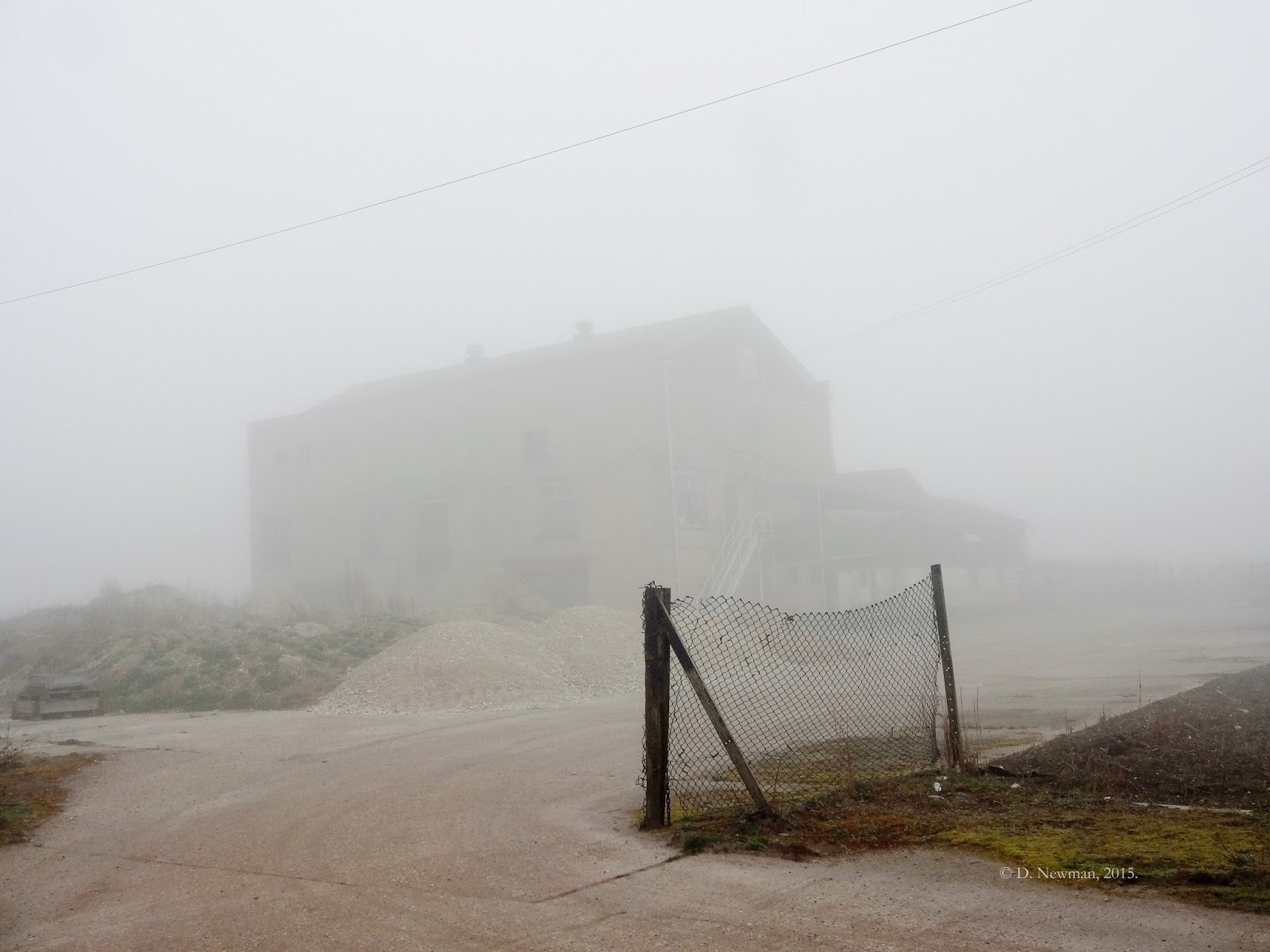
This was the view I had, not far from the summit of Shippea Hill in Cambridgeshire, early on the 13th March, 2014:
Shippea Hill station, 13th March, 2014, with convenient red arm-chair outside the signal-box
The perceptive reader, contemplating this tableau, might make several observations and deductions.  For instance, the engineer’s mind might wonder how the builders of the railway negotiated the hill of the station’s name.  A sceptical, troublesome reader (we all know the sort), developing a strong suspicion that the author arrived by train, might keep eyes peeled for any hint of a claim to have made the ascent under his own steam.  A more sympathetic reader, noting the heavy fog, might regret that the view has been so comprehensively obscured, and imagine that the 13th March 2014 must have been the occasion of a wasted trip.

I wonder now what these same readers will make of the picture below, taken from the same point a few months later on the 20th June, 2014:
Shippea Hill station, 20th June, 2014
Several observations might again be made — for instance, that the weather has cleared up admirably, or that, at some point since March, the signal-box appears to have been relieved both of its sign and of the red arm-chair perched outside.  Or perhaps something else is more immediately amiss?  For in this place, Shippea Hill, there seems to be no visible sign of any actual hillas the sceptical reader would doubtless point out without hesitation.  Indeed, we would appear to be in the Fens, a part of the world not renowned for its craggy splendour.  Warming quickly to his tune, the indignant reader might add indignantly that there is not a ship or a pea in sight either (though one cannot quite rule the latter out in this agricultural region of England).

I suppose it is no use denying that the elevation of the summit of Shippea Hill above sea level is, well, negligible.  Yet it qualifies as a hill because all of the peat fenland around it (Burnt Fen) lies at an altitude at or below 0.  The clue is in the Anglo-Saxon suffix ‘ea’, which in the old days referred to an island of firm, raised ground above the prevailing wateriness of the undrained fens.

This means that I can now attest without shame to having arrived by train, since I can hardly be accused of gaining any altitudinous advantage by doing so.  In fact, my riposte to the sceptical reader is that my achievement in making the journey by train is possibly greater than if I had arrived on foot.  Shippea Hill station is served by a single train a day — not a single train in each direction, but one train, a Norwich-bound service at 7.28 a.m., and that is it.  There is no return train (except on Saturdays), and no Sunday service at all.  All other traffic along this stretch of railway, the well-used Breckland line between Ely and Norwich, hammers straight through.

One might expect the good people of Shippea Hill to be up in arms about this state of affairs.  But it is far from certain how many ‘people of Shippea Hill’, good or bad, it is possible to speak of.  There is no village, no pub, no church for miles.  The only signs of habitation in the empty breadths of peatland are the austere, solitary farms with their strange, unhomely names (Lark Engine Farm, Bulldog Bridge Farm, Letter F Farm).  As any map makes plain, the only apparent reason for the existence of this station, which has stood here on its lonely fen since 1845, is the road that meets the railway at this point.  In fact, the station was originally called ‘Mildenhall Road’ — small matter that Mildenhall itself lies eight miles away.  It is hard to say which is the more tenuous: the claim to serve Mildenhall or the toponym ‘Hill’.
Thus the reader will understand why, on the two occasions that I have managed to drag my friends out into the middle of the Fens to this apparently unremarkable but resolutely contrary place, almost an almost military standard of precision and planning has been required.  Coming from the direction of Cambridge, we would make ourselves known to the guard, ask for the train to stop, find ourselves duly deposited on the platform, congratulate ourselves on our initiative and daring, and then, at half seven in the morning, apprehend the reality of our predicament:  there was now nothing for it but to spend most of the rest of the day making for civilisation on foot.  For a bus service is something else that there is not at Shippea Hill.

Considerable alertness was required, too, not to be taken in by the tantalising presence, five miles further down the line, of another station, Lakenheath.  It would not be unreasonable to assume that this might be a good place to a catch a return train.  Alas, it is no help at all.  Perhaps the reader will not now be surprised to learn that the service provided here is almost the direct inverse of Shippea Hill’s.  It has no trains at all on weekdays, there is one train in each direction on Saturdays, and on Sundays it enjoys a service that might almost be called lavish.  For all that these are two adjacent stations on the same line, it is generally impossible, and always totally impractical, to travel between Shippea Hill and Lakenheath by train.  No single train serves both consecutively in either direction.  The only itinerary that does not actually involve breaking the journey overnight is on Saturdays, when it is possible to go from Shippea Hill to Lakenheath by catching the 0728 Norwich train, hurtling straight through Lakenheath, getting off at Brandon and catching a train back west.  This journey takes three hours, and the same in reverse takes four.  It is just as well that nobody much lives near Lakenheath station either.

It was to Brandon, in fact, that my long-suffering friends and I made our way on foot on the first (foggy) occasion, along the Hereward Way.  And very spooky the journey was too:


Lakenheath station
East of Lakenheath, things cleared up slightly:
View over the Little Ouse east of Lakenheath
Near Brandon
My friends forbore this escapade with superhuman patience.  All the same, since these foggy photographs would hardly have satisfied the Shippea Hill Tourist Board, and I still had scarcely any idea what the view from the summit actually looked like, I decided to make a second excursion, with another unsuspecting friend, this time setting off back towards Ely from the train.  The weather was much clearer, and this time there was no obstruction to those strange fenland views, which go on and on and on for miles across the level, and are in their own way almost as disconcerting as the fog had been.
At Shippea Hill again, looking eastwards towards Brandon
Westwards towards Ely
This was not a public bus — it was taking farm labourers to work.
The typically enormous Fenland skies and foreground 
Level crossing at Mile End, Prickwillow
Towards Ely Cathedral
One might have thought it impossible that anything else should remain to be said about this station that is scarcely a station and its hill that is hardly a hill.  Imagine my surprise in early December 2015, then, to read this article about the latest estimated passenger numbers at stations in Great Britain.  Lo and behold, there is Shippea Hill station in pride of place as the quietest in Britain.  Your humble scribe hereby boasts of finding himself among a rather select club of people who actually used the station in 2014/15: a grand total of twenty-two.

It is true of course, as the O.R.R. admits, that there are some limitations to this data.  For instance, since on the first trip my friends and I had bought returns to Brandon, I doubt that our perfectly valid visit to Shippea Hill will have been registered in the statistics.  We are presumably not alone in having done this, so the actual number of passengers is probably higher than the figures show.  But that only raises another question: for what conceivable reason could Shippea Hill station have been visited by even as many as 22 people?

And might any of them have anything to say about a missing station sign and a red arm-chair?
The author is also a member of a somewhat less exclusive club of 99, 201, 604 people who  last year used London Waterloo, the most alighted-/boarded-at station in Britain, and through which the equivalent of Shippea Hill’s entire annual footfall passes every seven seconds…!

Tuesday, January 05, 2016

Three Carols from Old England

Along with their ten favourite pieces of music and a luxury, castaways on the B.B.C.’s programme Desert Island Discs are given three books: the Bible, the Complete Works of Shakespeare and a volume of their choice.  Unlikely though it is that I will suffer that fate (either to be cast away on a desert island or to be interviewed on Radio 4), I have been thinking that my choice might be Sloane manuscript 2593, a collection of fifteenth-century English carols and poems held in the British Library.  A (smallish) digitised image can be seen here.

These manuscripts have preserved something quite precious of medieval England’s character.  Sacred lyrics are mixed with profane in the manuscript, which alone tells us something about faith and life in those days, but it is the carols that I find the most spine-tingling.  I think the best-known are Lullay, myn lyking, Adam lay ybounden and I sing of a maiden, which have each been set to music by various composers.  Not only the meaning of these three texts have survived, and their noteworthy Marian spirituality, but also (as I hear it) their mood, something altogether more fragile.  The lyricist sets off with a catechetical aim but succeeds in amazing himself with his own catechesis.  This amazement is expressed in a restrained, a mild — and dare I say even an English — way.  For instance, I find very moving this depiction of the Adam’s ‘happy fault’ in Adam lay ybounden:
Ne had the apple taken been,
The apple taken been,
Ne had never our ladie
Abeen heav’ne queen.
Or, in I sing of a mayden, there is the quiet awe of the line 
Well may such a lady
Goddes mother be.
which leaves nothing else to be said.  With closing lines like this, the middle three verses can afford to be duplicates (but beautiful duplicates!) of each other.

Or there is the detail of the line ‘as clerkes finden written in their book’, an image which for the original listeners linked the everyday and familiar seamlessly to the song’s spiritual subject-matter, and which for us transmits a flicker of the flavour of their life and worship. (We marvel that clerics had to read Sacred Scripture on behalf of laypeople; these words were written by someone for whom this was normal).  As an Englishman, certainly as an English speaker, I cannot read them as a neutral observer or objective student: I feel I have inherited these carols in a certain way.  This only magnifies the flash of elation that comes with reading any good poem.  Centuries separate the England I know from the England that produced these words, but the feeling that that I know what they meant, or that I think exactly what they thought — which is also an assurance of the unchanging nature of the Christian faith — is, in my view, very precious indeed.

Here are some musical settings which to my mind have captured the words’ mood: Lullay, myn lyking  Richard Runciman Terry:


Adam lay ybounden — Philip Ledger:


or https://play.spotify.com/track/1hDflwTiGeSXvD2hHqLRii

I sing of a maiden Patrick Hadley: